When the COVID vaccines were approved as experimental for emergency use one week after the U.S. 2020 election the claim was that they were 05% effective in preventing COVID, a result that seemed too good to be true, since flu vaccines, fully approved were only about 50% effective, even if they had guessed right on the strain of the year. So, vaccines started to be administered at a breathtaking rate. The initial response seemed to be very good. But their evvectiveness vaned ofer time, so a booster seemed necessary, still experimental.
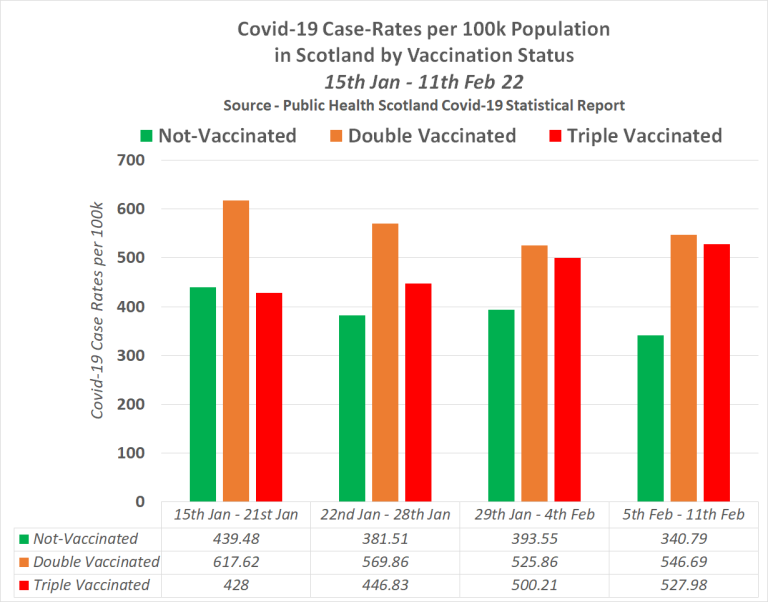
The original claim: If you are vaccinated you will not get COVID. Recent statistics from Scotland seems to indicate otherwise:
Truth: The vaccinated get COVID at a higher rate than the unvaccinated
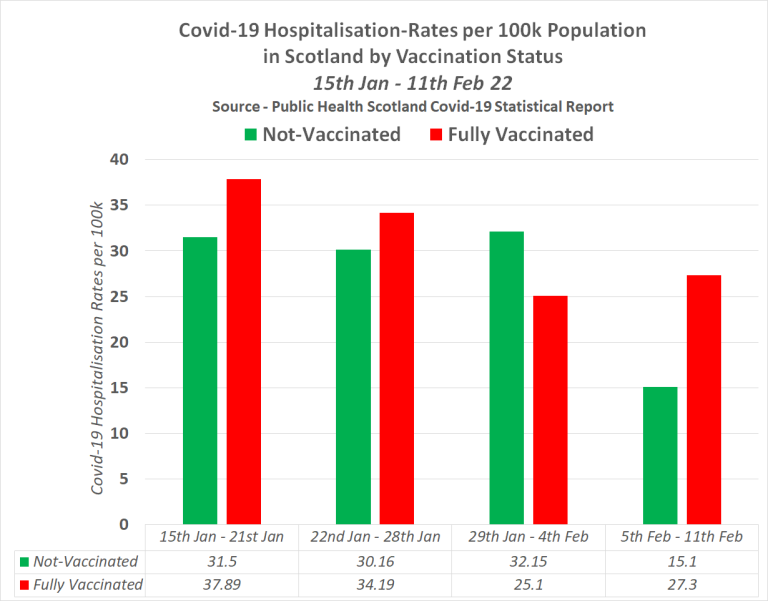
Claim number two: If people still get COVID after vaccination they will rarely get hospitalized. Recent results from Scotland:
The truth: Hospitalizations are on the increase for immunized people getting COVID. Which leads to
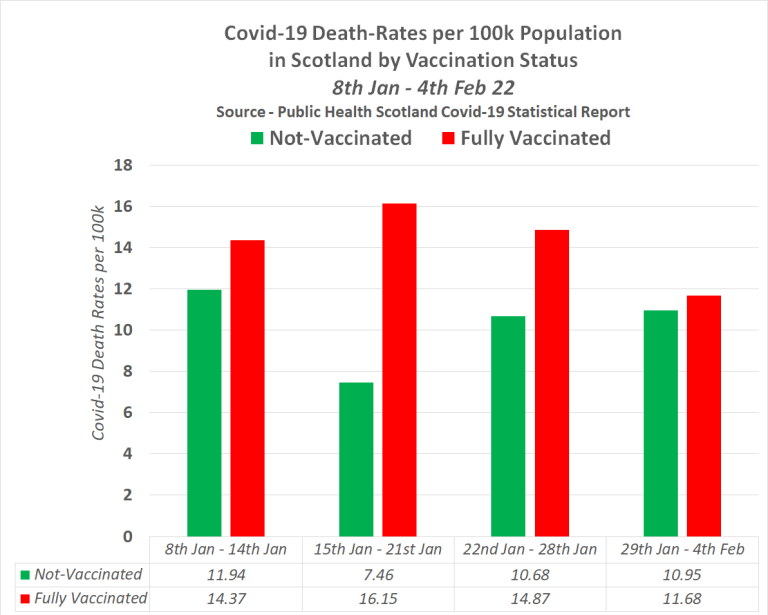
Claim number three: If you are fully vaccinated and still get COVID and still get hospitalized your risk of dying is greatly reduced,Even that is not true according to latest statistics from Scotland.
The truth: With the new Omicron variant people seem to die at the same or higher rate if vaccinated.
In addition there has been over 20,000 deaths occurring after vaccine injections. It is time to halt all COVID vaccinations until a thorough analysis of all vaccine related deaths has been performed. Since the death rate is still less than one in ten thousand the vulnerable should still be allowed to be vaccinated until we have developed a true prophylactic/therapeutic. There are many candidates: Ivermectin, HCQ, Regeneron. Pfizer and Moderna work on what I cal Pfizermectin and Modernactin. They work the same way as Ivermectin but use different acting molecules, more specific for the current strain of COVID, so they may work even better and cost a lot more, so they will be approved quickly.
President Biden had the U.S. join the Paris accord and we are once again in accord with the IPCC and UN. Unfortunately, if we comply with all the requirements of the Paris accord we will lower the temperature increase by only 0.05C by 2030, and by only 0.17C by 2100. See the reasons why this is so here. How can that be? It is because the real climate change is not mainly caused by increasing CO2 and Methane. No, these are only minor players compared to land use changes such as deforestation, aquifer depletion, urbanization, erosion and so on.
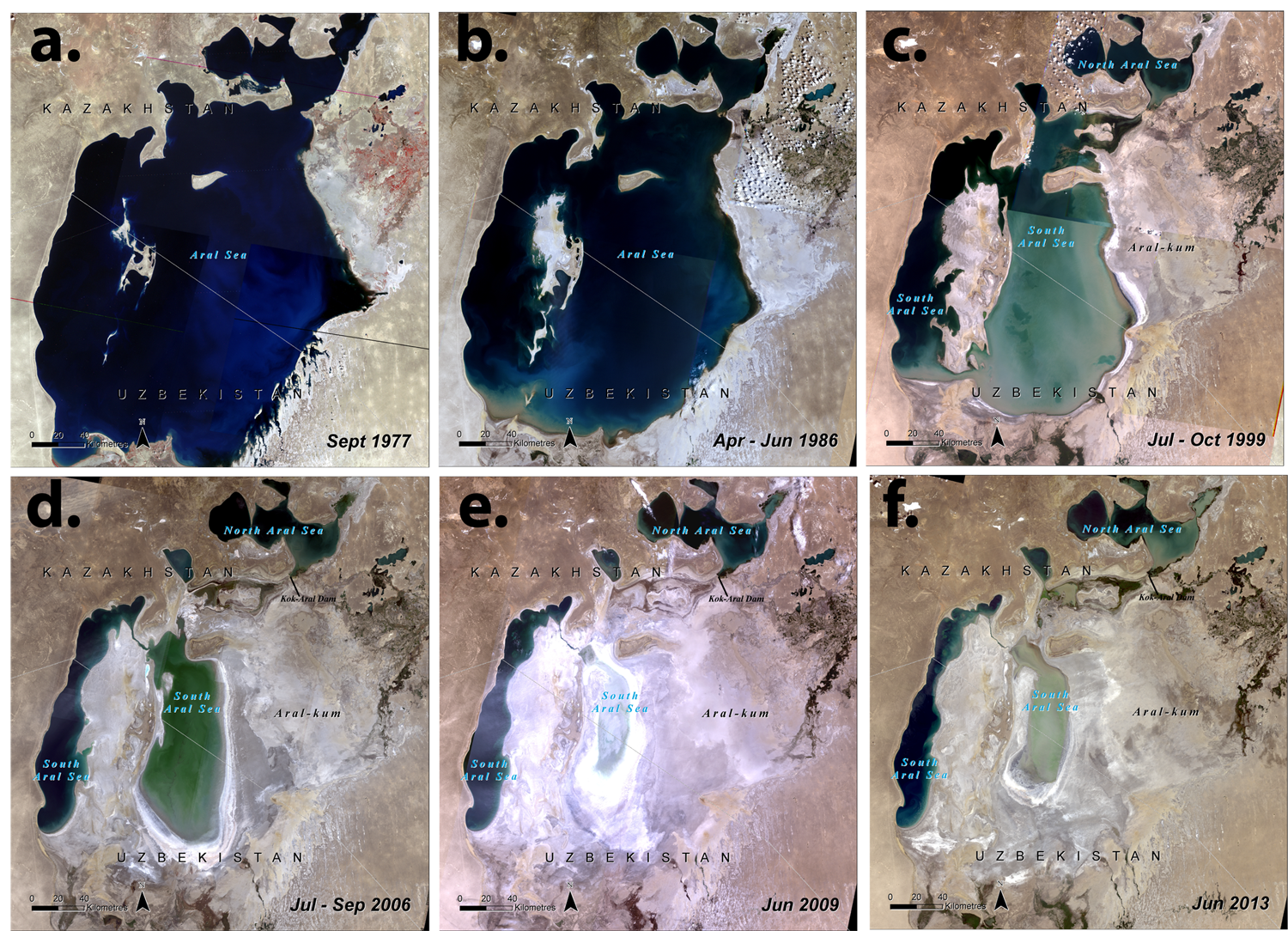
One of the worst consequences of government controlled land use changes is the disappearance of Lake Aral in Asia, the fourth largest lake in the world. It provided a sensitive, but functioning Eco-system for a large portion of South East Soviet Union and western Afghanistan. Then the central planners wanted to improve the productivity of the area through irrigation and changing land management. In the 1960s and 1970s the Soviets started using the Amu Darya and the Syr Darya rivers to irrigate extensive cotton fields in the Central Asian plain. The results can be seen in these 6 Satellite photos
Disaster is a mild word. The lake was the source of the rains that fell up-stream. With the lake gone, the rivers dried up completely, and the whole upland became desert-like. There has been efforts to restore the upper part of the lake with a dam, but that will do nothing to reverse the desertification.
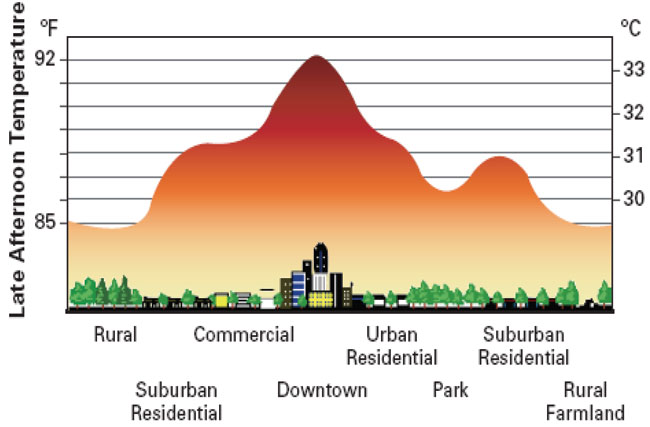
Another land use change is urbanization. This produces an urban heat island that can increase the temperature in the city by as much as 4C compared to forested surroundings.
Yes, there is significant climate change for the people living in the downtown areas. It is called urbanization. The globe as a whole does not experience it, but the people living in the asphalt jungles surely do. One could turn off the air conditioners, but their contribution is less than one degree on average. Far bigger is the fact that the albedo changes, the ground dries up, and when it rains it all gets flushed out in the streams or simply evaporates on the burning hot asphalt or concrete. One hour after the rain it is as hot as before.
Another climate change occurs when forested land is cleared but not replanted, or when land is overgrazed down to the roots. In these cases the streams dry out hillsides and floodplains, and flash floods occur instead of steady streams, and erosion causes major damages. And so it is with much of the American Southwest. The average temperature increase from deforestation and overgrazing is usually around 1C. This video explains it much better than may words. There is still hope, but it will take work
Why can’t this be done here in the dry American southwest? It involves water rights. Unless the property owner owns the water rights to the land the owns he has no right to harvest any of the rain that falls on it. If he improves the land with a road or a structure with a roof, all the rain that falls on it must be going to the river, and eventually to Lake Mead to prevent it from going dry. In the Eastern United states water rights are automatic, they are in fact water responsibilities. If you improve the land and build a road, parking lot or a structure with a roof, you must build a catch basin big enough to capture all the extra runoff generated by the rain falling on the improved land. Farmers are encouraged to build swales to minimize erosion and runoff of fertilizer and pesticide. This should also be done in the dry parts of the country, there their erosion problems are even worse. The way to do it is determined by local factors and should be decided at the local or regional level. When the federal government gets involved they tend to mandate one solution for all, and the needs for Arizona is quite different from the needs for Louisiana when it comes to water.
Here is the suggestion: Give this challenge to all local Universities and High School biology departments. Make a competition to come up with the best local solutions to restore the American Southwest if the water rights belonged to the land. The only limits are; you can not dam established creeks and you cannot draw water from the aquifers. The indigenous people once knew how to do it. Unfortunately, the American Southwest can suffer multiyear droughts, and, unlike in India, the monsoons can fail. The greening that occurred in the five projects mentioned in the video above should act as an inspiration. The greening that will occur will lower the temperature, drastically reduce erosion, provide a more permanent water flow in the rivers, and reduce flooding.
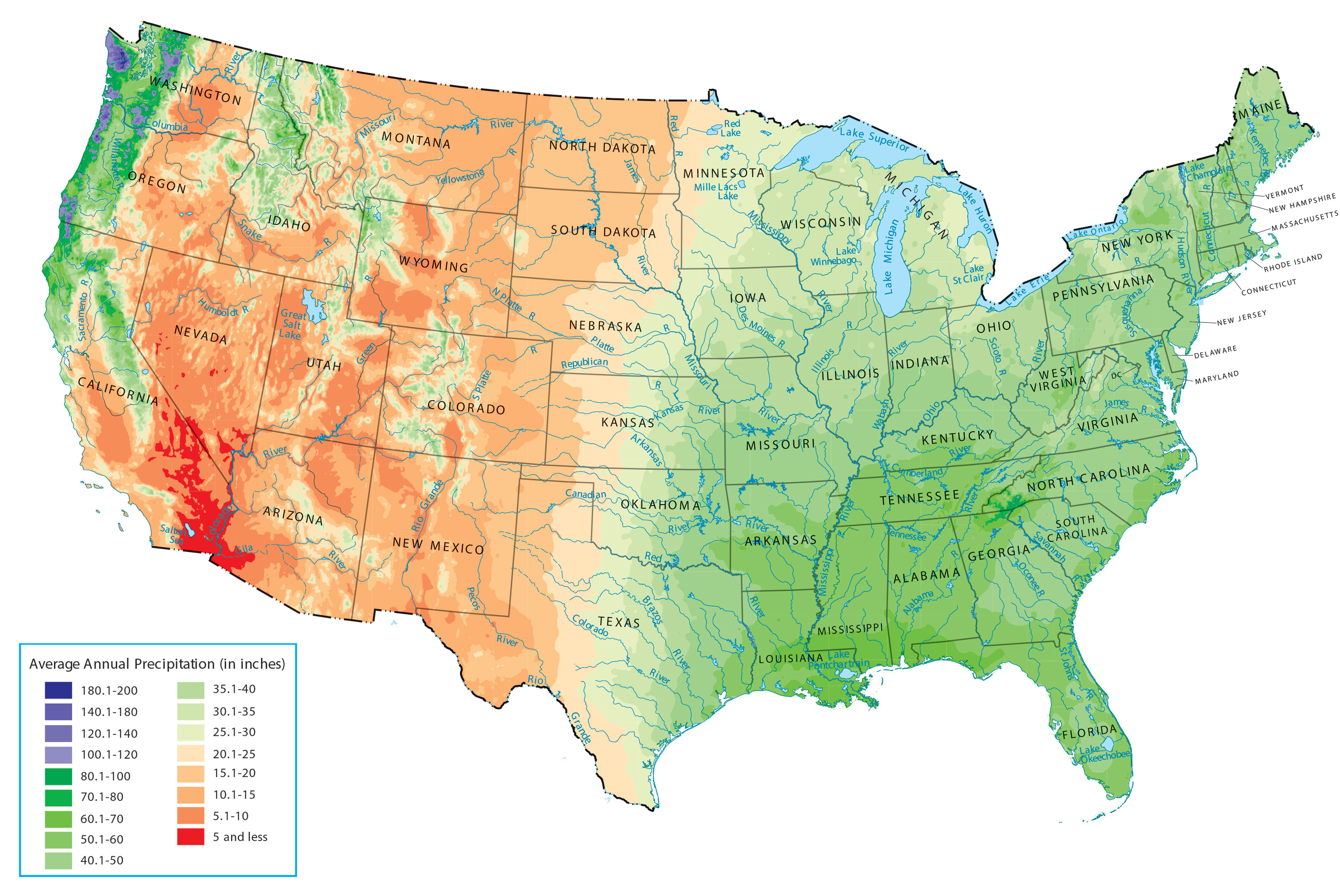
When the Hoover dam was built the population in the American south west was around seven million. Now the population dependent on the water from the Colorado river is over 40 million, and growing. Not only is the Colorado River water supply insufficient, but the aquifers are being depleted, and the desertification is starting to set in. Looking at a precipitation map of the U.S. there is one obvious solution.
Green areas have enough water, orange, brown or red areas are water sparse.
Bring water from the east to the west! There is only one big problem: The Rocky Mountains are in the way. The water must be lifted around 8,000 feet before it will start to flow downhill again. To lift one acre-ft of water one foot requires about 1.08 kWh. Some energy is regained on the way down, but the net energy needed is around 5,000 kWh per acre-ft of water delivered to the thirsty American South-west.
This proposal is to deliver up to 23.75 million acre-feet of water annually to the thirsty American South-west. It will consist of three aqueducts:
The first one is called the South Platte Aqueduct and will serve Eastern Colorado and help save the High Plains Aquifer, also called the Ogallala Aquifer. It is sketched out here. It is quite modest, only up to 750,000 acre-ft pumped annually, and while the aqueduct will be built to this capacity only 375,000 acre-feet will be initially needed. For now, it will serve about 5 million people.
The second is the Trans-Rocky-Mountain Aqueduct. It will serve the upper Colorado River Basin and the upper Rio Grande Basin. When fully used it will pump 8 million acre-ft yearly from the Mississippi/Arkansas River. It is more fully described here .
The third is the Transcontinental Aqueduct. It will serve the Lower Colorado River Basin, Southern New Mexico and Western Texas. It will pump up to 15 million acre-ft of water annually from the Atchafalaya river (Mississippi river bypass) all the way to southern Colorado River. It is described more fully here.
The total electricity need to accomplish this giant endeavor is about 120 billion kWh annually. or about three percent of the current US electricity demand. In 2020 the US produced 1,586 billion kWh from natural gas, 956 from coal, 337.5 from wind and 90.9 from solar.
For this giant project to have any chance of success there has to be something in it to be gained from every state that will be participating. Here are some of the benefits:
Arizona: Arizona needs more water. The water from Mississippi is less saline and better suited for agriculture and the people growth makes it necessary to provide more water sources. Right now the aquifers are being depleted. Then what? One example: The San Carlos lake is nearly dry half the time and almost never filled to capacity. With the aqueduct supplying water it can be filled to 80 +- 20% of full capacity all the time. In the event of a very large snow melt the lake level can be reduced in advance to accommodate the extra flow. Likewise during Monsoon season the aqueduct flow can be reduced in anticipation of large rain events. Arizona together with New Mexico has the best locations for solar power, but is lacking the water necessary for hydro-power storage. This proposal will add 13.6 GW of hydro-power storage capable of adding 68 GWh of electric peak power daily.
Arkansas: The main benefit for Arkansas is better flood control and river control of the Arkansas River and allowing it to deepen the draft for canal barges from 9,5 feet to 12 feet, which is standard on the Mississippi river.
California: The water aqueduct serving Los Angeles will be allowed to use maximum capacity at all times. Additional water resources will be given the greater San Diego area. The Imperial valley will be given sweet Mississippi water, which will improve agriculture yield. The polluted New River will be cut off at the Mexico border. There will be water allocated to the Salton Sea. There is a proposal to mine the world’s largest Lithium ore, mining the deep brine, rich in Lithium. (about a third of the world supply according to one estimate). This requires water, and as a minimum requirement to allow mining in the Salton Sea the water needs to be cleaned. This requires further investigation, but the area around the Salton Sea is maybe the most unhealthy in the United States. It used to be a great vacation spot.
Colorado: The future water needs from Fort Collins to Colorado Springs metropolitan area will be met. In addition the Pueblo area will be allowed to use more of the Arkansas River water, since the John Martin Reservoir will be filled by the Trans-Rocky Mountain aqueduct.
Kansas: It will get a reliable water supply to serve Wichita and all towns along the Arkansas River in times of drought and to serve additional water needs at all times. It will also improve flood control along the river.
Louisiana: The main benefit for Louisiana is: By siphoning off up to 23.75 million acre-ft/year from the Mississippi river it will lower the flow through the lower Mississippi, especially New Orleans, reducing flood risk. By making these aqueducts the whole Mississippi/Missouri watershed will be incentivized to make sure the river waters are clean enough to be able to use as water supply. This will positively affect 40% of the continental United States landmass.
Mexico: During the negotiations about who was going to get the water in Lake Mead Mexico did not get enough water, so they have been using all remaining water for irrigation, and no water is reaching the ocean anymore. In addition the water is too salty for ideal irrigation. This proposal will provide sweet Mississippi water to Mexico, ensure that some water reaches the Colorado river delta. This will restore the important ecology and restore aquatic life in the delta and the gulf. The town of Mexicali will get some water in exchange for shutting off New River completely.
Nebraska: One of the benefits for Nebraska is that it will help save the Ogallala aquifer. The farmers close to the aqueduct will use pumped water from Missouri rather than draw from the aquifers.
Nevada: Las Vegas is a catastrophe waiting to happen unless Lake Mead is saved. With this proposal there will be ample opportunity to make the desert bloom.
New Mexico: The state is ideally suited for solar panels. In addition to give much needed water to communities along the length of the aqueduct, it will provide 10.5 GW of hydro-power storage to be made available at peak power usage for up to 5 hours a day.
Oklahoma: The main advantage for Oklahoma is a much improved flood control, especially through the City of Tulsa. It will provide the same advantage for river barge traffic as benefits Arkansas.
Texas: The state has a big problem. It has already built up too much wind power and can not give up their coal burning power plants until the electricity is better balanced. They have no hydro-electric power storage at all, and we saw the result of that in last year’s cold snap. This proposal will give the Texas electric grid 18.5 GW of hydro-electric power for up to 5 hours a day.
Utah: The state will no longer be bound to provide water to Lake Mead, but can use all of its water rights for Utah, especially the Salt Lake City region.
Wyoming: The state will be free to use the water in the Green River and all the yearly allocated 1.05 million acre-feet of water can be used by the state of Wyoming.
The cost to do all these aqueducts will be substantial, but it can be done for less than 400 billion dollars in 2021 money, and that includes the cost of providing power generation. Considering it involves 40 million people dependent on the Colorado River now and another 10 million east of the Rocky Mountains, it is well worth doing, much more importand to do than other “green” projects, since it will save the American Southwest from becoming an uninhabitable desert.
This proposed solution cannot be made possible without changing our approach to power generation. The mantra now is to solve all our power needs through renewables. Texas has shown us that too much wind power without any hydroelectric power storage can lead to disaster. In addition, windmills kill birds, even threatening some species, such as the Golden Eagle and other large raptors that like to build their aeries on top of the generators. Solar panels work best in arid, sunny climate, such as Arizona and New Mexico, but the panels need cooling and cleaning to work best, and that takes water. They are even more dependent on hydro-power storage than wind. The transcontinental aqueduct will triple the hydro-electric power storage for the nation, and the Trans-Rocky-Mountain will add to it. Without hydro-electric power storage we still need all the conventional power generation capacity for when the sun doesn’t shine and the wind doesn’t blow.
Conventional Nuclear power plants doesn’t work in most places since they depend on water for their cooling, and most of these aqueducts pump water in near deserts, and there would be too much evaporation losses to use water from the aqueducts for cooling.
The only realistic approach would be to use LFTR power plants. (Liquid Fluoride Thorium Reactors). There are many advantages for using LFTR. Here are 30 reasons why LFTRs is by far the best choice.
For this project to succeed there must be developed a better way to build SMRs (Small Modular Reactors, less than 250 MW) more effectively. The price to build a LFTR plant should be less than $2.50 per watt. While the LFTR science is well understood, the LFTR engineering is not fully developed yet, but will be ready in less than 5 years if we get to it. In the mean time there should be built one or more assembly plants that can mass produce LFTR reactor vessels small enough so they can be shipped on a normal flatbed trailer through the normal highway system. My contention is that a 100 MW reactor vessel can be built this way and the total cost per plant will be less than 250 Million dollars. To save the American Southwest we will need about 350 of them, or 87,5 billion dollars total. This cost is included in the total calculation. There will be many more of these plants produced to produce all the electric power to power all the electric vehicles that are going to be built. This is the way to reduce fossil fuel consumption. Just switching to electric vehicles will not do the trick. The electric energy must come from somewhere. To convert all cars and trucks and with unchanging driving habits will require another 600 GW of generating capacity by 2050, our present “net zero emissions” goal.
To do this project we need cooperation from all states in providing dominant domain access. The Federal government will need to approve LFTR as the preferred Nuclear process and streamline approval from many years to less than one year.
Ivermectin is a Nobel Prize winning drug. It has been called a wonder drug. It is used by over 2.2 Billion people in the world to combat occasional parasites, and is used constantly by about 700 million people to prevent river blindness. The people that use Ivermectin constantly have about 1/10 as many covid case and death rates as people who don’t use Ivermectin. You can see the evidence here.
No it is not that NIH doesn’t know. Their scientists know, but their hands are tied by politics. The decisions are based by politics. But they are trying to get the story out. Check their official library of appoived articles. The firstlist is on Ivermectin and cancer (source https://search.nih.gov/search?affiliate=nih&query=ivermectin+cancer)
Colorectal cancer (CRC) is the third most common cancer worldwide and still lacks effective therapy. Ivermectin, an antiparasitic drug, has been shown …
Colorectal cancer (CRC) is the third most common cancer worldwide and still lacks effective therapy. Ivermectin, an antiparasitic drug, has been shown …
Purpose: Ivermectin is an antiparasitic drug that exhibits antitumor effects in preclinical studies, and as such is currently being repositioned for c …
Taken together, these data suggest that ivermectin inhibits the growth of esophageal cancer both in vitro and in vivo. It had been reported that iverm …
Ivermectin is a mysterious multifaceted ‘wonder’ drug that keeps shocking and exceeding expectations . It was repositioned as cancer drug , and showed …
Interestingly, several years ago it was reported by a Russian group that Ivermectin can suppress almost completely the growth of human melanoma and a …
We show that treatment with the FDA-approved anti-parasitic drug ivermectin induces immunogenic cancer cell death (ICD) and robust T cell infiltration …
The docking result showed that paritaprevir and ivermectin have highest binding affinity to the ACE2 receptor with interaction energies of −11.8 kcal …
Epithelial ovarian cancer (EOC) is a most lethal cancer in gynecology, of which cure rate is 30%. To seek its new therapeutic targets, we performed in …
Ivermectin has been suggested as a potential COVID-19 treatment.6 It is a US Food and Drug Administration (FDA)-approved broad-spectrum antiparasitic …
Ivermectin hastens recovery and prevents deterioration in patients with mild to moderate disease treated early after symptoms. 45,49–52,61,62. Ivermec …
Ivermectin (IVM), an approved anthelminthic drug, has been reported to have antiviral, antibacterial, and anticancer activities. Antiviral activity is …
The most recommended dose of ivermectin for the treatment of COVID-19 is 150-200 µg/kg twice daily. As ivermectin adoption for COVID-19 increased, the …
In 2015, the Nobel Committee for Physiology or Medicine, in its only award for treatments of infectious diseases since six decades prior, honoured the …
The use of compassionate ivermectin in the management of symptomatic outpatients and hospitalized patients with clinical diagnosis of COVID-19 at the …
Background: Ivermectin was shown to inhibit severe acute respiratory syndrome coronavirus 2 replication in vitro, which has led to off-label use, but …
Over the two months, treatment protocols changed with gathering evidence. Patients received hydroxychloroquine (50%), azithromycin (63%), oseltamivir …
The established method of justifying the need for ivermectin delivery to a community is the use of Rapid Assessment Method (RAM). This method involves …
Introduction. The 2015 Nobel prize for the discovery of ivermectin (IVM) and an antimalarial treatment was the Nobel committee’s first award for …
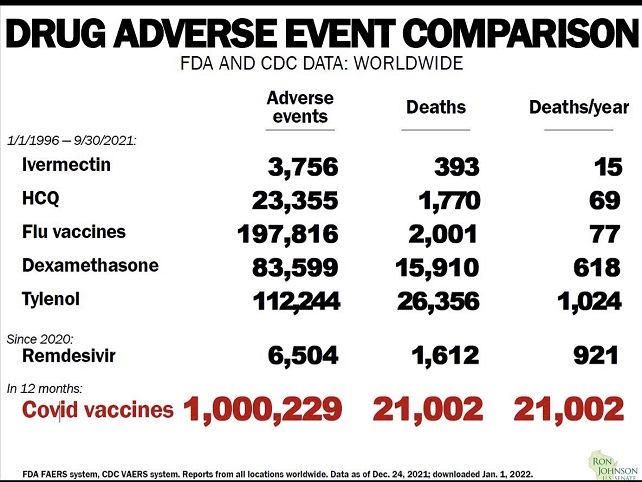
But they say how dangerous and deadly Ivermectin and HCQ are. The truth is quite different. Here are somd statistics
The headlines say it all. These are the results so far of adverse reactions to various medications and vaccines according to the official VAERS reporting, which give low estimates. The truth is worse. This is from Sen John Johnson:
It should be noted that for the first five medications the time frame is nearly 16 years, the result for COVID vaccine is one year.
Time to approve Ivermectin against COVID-19. It is my opinion that about 80% of all Covid deaths could have been avoided had we followed the real scientists rather than the political views of NIH.
Ever since beginning of time the battle has been about water. The garden of Eden was watered by four rivers, but ever since Adam and Eve were exiled from it, water has been the major concern. In the Middle East the first treaty between Abraham and Abimelech was about water and who was to control it. In Exodus 7:19 (NIV) The LORD said to Moses, “Tell Aaron, ‘Take your staff and stretch out your hand over the waters of Egypt—over the streams and canals, over the ponds and all the reservoirs—and they will turn to blood.’ In Ezra 8:15 concerning the return to Jerusalem Ezra wrote: I assembled them at the canal that flows toward Ahava, and we camped there three days. In Daniel 8:2 Daniel wrote “In my vision I saw myself in the citadel of Susa in the province of Elam; in the vision I was beside the Ulai Canal.” And in Isaiah 19:6 Isaiah Prophesied “The canals will stink; the streams of Egypt will dwindle and dry up.” This means the Nile River would still flow, but the intricate canal system would fail.
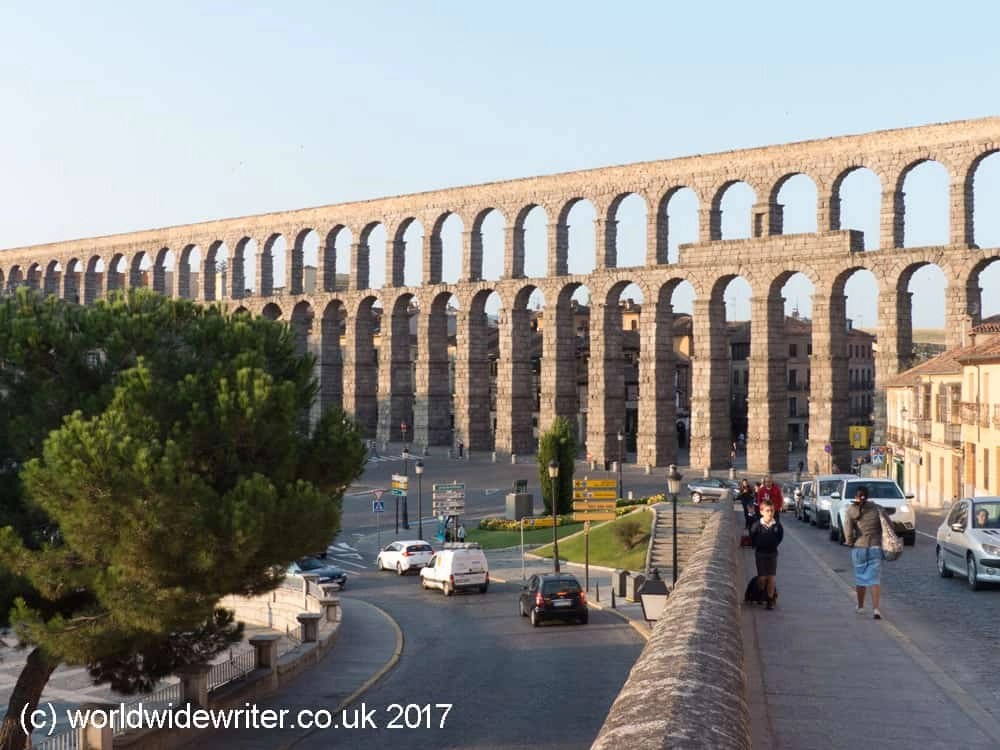
The Romans built many aqueducts. Rome had 11 aqueducts to supply it with water. One of the most impressive aqueducts is the Segovia Aqueduct in Spain.
This aqueduct has been maintained through the centuries and supplied Segovia with water as late as the 19th century.
Even in the dry American south-west canals have been built for irrigation in the past, check out this video from the Arizona State University:
When the Hoover dam was built the population in the American south west was around seven million. Now the population dependent on the water from the Colorado river is over 40 million, and growing. Not only is the Colorado River water supply insufficient, but the aquifers are being depleted, and the desertification is starting to set in. Looking at a precipitation map of the u.s there is one obvious solution.
Green areas have enough water, orange, brown or red areas are water sparse.
Bring water from the east to the west! There is only one big problem: The Rocky Mountains are in the way. The water must be lifted around 8,000 feet before it will start to flow downhill again. To lift one acre-ft of water one foot requires about 1.08 kWh. Some energy is regained on the way down, but the net energy needed is around 5,000 kWh per acre-ft of water delivered to the thirsty American South-west.
This proposal is to deliver up to 23.75 million acre-feet of water annually to the thirsty American South-west. It will consist of three aqueducts:
The first one is called the South Platte Aqueduct and will serve the Eastern Colorado and help save the High Plains Aquifer, also called the Ogallala Aquifer. It is sketched out here. It is quite modest, only up to 750,000 acre-ft pumped annually, and while the aqueduct will be built to this capacity only 375,000 acrefeet will be initially needed. For now, it will serve about 5 million people.
The second is the Trans-Rocky-Mountain Aqueduct. It will serve the upper Colorado River Basin and the upper Rio Grande Basin. When fully used it will pump 8 million acre-ft yearly from the Mississippi/Arkansas River. It is more fully described here .
The third is the Transcontinental Aqueduct. It will serve the Lower Colorado River Basin, Southern New Mexico and Western Texas. It will pump up to 15 million acre-ft of water annually from the Atchafalaya river (Mississippi river bypass) all the way to the southern Colorado River. It is described more fully here.
The total electricity need to accomplish this giant endeavor is about 120 billion kWh annually. or about three percent of the total US electricity demand. In 2020 the US produced 1,586 billion kWh from natural gas, 956 from coal, 337.5 from wind and 90.9 from solar.
For this giant project to have any chance of success there has to be something in it to be gained from every state that will be participating. Here are the benefits
Arizona: Arizona needs more water. The water from Mississippi is less saline and better suited for agriculture and the people growth makes it necessary to provide more water sources. Right now the aquifers are being depleted. Then what? One example: The San Carlos lake is nearly dry half the time and almost never filled to capacity. With the aqueduct supplying water it can be filled to 80 +- 20% of full capacity all the time. In the event of a very large snow melt the lake level can be reduced in advance to accommodate the extra flow. Likewise during Monsoon season the aqueduct flow can be reduced in anticipation of large rain events. Arizona together with New Mexico has the best locations for solar power, but is lacking the water necessary for hydro-power storage. This proposal will add 13.6 GW of hydro-power storage capable of adding 68 GWh of electric peak power daily.
Arkansas: The main benefit for Arkansas is better flood control and river control and allowing to deepen the draft for the canal barges from 9,5 feet to 12 feet, which is standard on the Mississippi river.
California: The water aqueduct serving Los Angeles will be allowed to use maximum capacity at all times. Additional water resources will be given the greater San Diego area. The Imperial valley will be given sweet Mississippi water, which will improve agriculture yield. The polluted New River will be cut off. There will be water allocated to the Salton Sea. Proposed will be the to mine world’s largest Lithium ore, mining the deep brine, rich in Lithium. (about a third of the world supply according to one estimate). This requires water, and as a minimum requirement to allow mining in the Salton Sea the water needs to be cleaned. This requires further investigation, but the area around the Salton Sea is maybe the most unhealthy in the United States. It used to be a great vacation spot.
Colorado: The future water needs from Fort Collins to Colorado Springs metropolitan area will be met. In addition the Pueblo area will be allowed to use more of the Arkansas River water, since the John Martin Reservoir will be filled by the Trans-Rocky Mountain reservoir.
Kansas: It will get a reliable water supply to serve Wichita and all towns along the Arkansas River in times of drought and to serve additional water needs at all times. It will also improve flood control along the river.
Louisiana: The main benefit for Louisiana is: By siphoning off up to 23.75 million acre-ft/year from the Mississippi river it will lower the flow through the lower Mississippi, especially New Orleans, reducing flood risk. By making these aqueducts the whole Mississippi/Missouri watershed will be incentivized to make sure the river waters are clean enough to be able to use as water supply. This will positively affect 40% of the continental United States landmass.
Mexico: During the negotiations who was going to get the water in Lake Mead Mexico did not get enough water, so they have been using all remaining water for irrigation, and no water is reaching the ocean anymore. In addition the water is too salty for ideal irrigation. This proposal will provide sweet Mississippi water to Mexico, ensure that some water reaches the Colorado river delta. This will restore the important ecology and restore aquatic life in the delta and the gulf. The town of Mexicali will get some water in exchange for shutting off New River completely.
Nebraska: One of the benefits for Nebraska is that it will help save the Ogallala aquifer. The farmers close to the aqueduct will use pumped water from Missouri rather than draw from the aquifers.
Nevada: Las Vegas is a catastrophe waiting to happen unless Lake Mead is saved. With this proposal there will be ample opportunity to make the desert bloom.
New Mexico: The state is ideally suited for solar panels. In addition to give much needed water to communities along the length of the aqueduct, it will provide 10.5 GW of hydro-power storage to be made available at peak power usage for up to 5 hours a day.
Oklahoma: The main advantage for Oklahoma is a much improved flood control, especially through the City of Tulsa. It will provide the same advantage for river barge traffic as benefits Arkansas.
Texas: The state has a big problem. It has already built up too much wind power and can not give up their coal burning power plants until the electricity is better balanced. They have no hydro-electric power storage at all, and we saw the result of that in last year’s cold snap This proposal will give them 18.5 GW of hydro-electric power for up to 5 hours a day.
Utah: The state will no longer be bound to provide water to Lake Mead, but can use all of its water rights for Utah, especially the Salt Lake City region.
Wyoming: The state will be free to use the water in the Green River and all the yearly allocated 1.05 million acre-feet of water can be used by the state of Wyoming.
The cost to do all these aqueducts will be substantial, but it can be done for less than 400 billion dollars in 2021 money, and that includes the cost of providing power generation. Considering it involves 40 million people dependent on the Colorado River now and another 10 million east of the Rocky Mountains, it is well worth doing, much more than other “green” projects, since it will save the American Southwest from becoming an uninhabitable desert.
This proposed solution cannot be made possible without changing our approach to power generation. The mantra now is to solve all our power needs through renewables. Texas has shown us that too much wind power without any hydroelectric power storage can lead to disaster. In addition, windmills kill birds, even threatening some species, such as the Golden Eagle and other large raptors that like to build their aeries on top of the generators. Solar panels work best in arid, sunny climate, such as Arizona and New Mexico, but the panels need cooling and cleaning to work best, and that takes water. They are even more dependent on hydro-power storage than wind. The transcontinental aqueduct will triple the hydro-electric power storage for the nation, and the Trans-Rocky-Mountain will add to it. Without hydro-electric power storage we still need all the conventional power generation capacity for when the sun doesn’t shine and the wind doesn’t blow.
Conventional Nuclear power plants doesn’t work either since they depend on water for their cooling, and most of these aqueducts pump water in near deserts, and there would be too much evaporation losses to use the aqueduct’s water for cooling.
The only realistic approach would be to use LFTR power plants. (Liquid Fluoride Thorium Reactors). There are many advantages for using LFTR. Here are 30 0f them.
For this project to succeed there must be developed a better way to build small nuclear plants more effectively. The price to build a LFTR plant must be less than $2.50 per watt. The LFTR technology is not fully developed yet, but will be ready in less than 5 years. In the mean time there should be built one or more assembly plants that can mass produce LFTR reactor vessels small enough so they can be shipped on a normal flatbed trailer through the normal highway system. My contention is that a 100 MW reactor vessel can be built this way and the total cost per plant will be less than 250 Million dollars. To save the American Southwest we will need about 350 of them, or 87,5 billion dollars total. This cost is included in the total calculation. There will be many more of these plants produced to produce all the electric power to power all the electric vehicles that are going to be built. This is the way to reduce fossil fuels. Just switching to electric vehicles will not do the trick. The energy must come from somewhere.
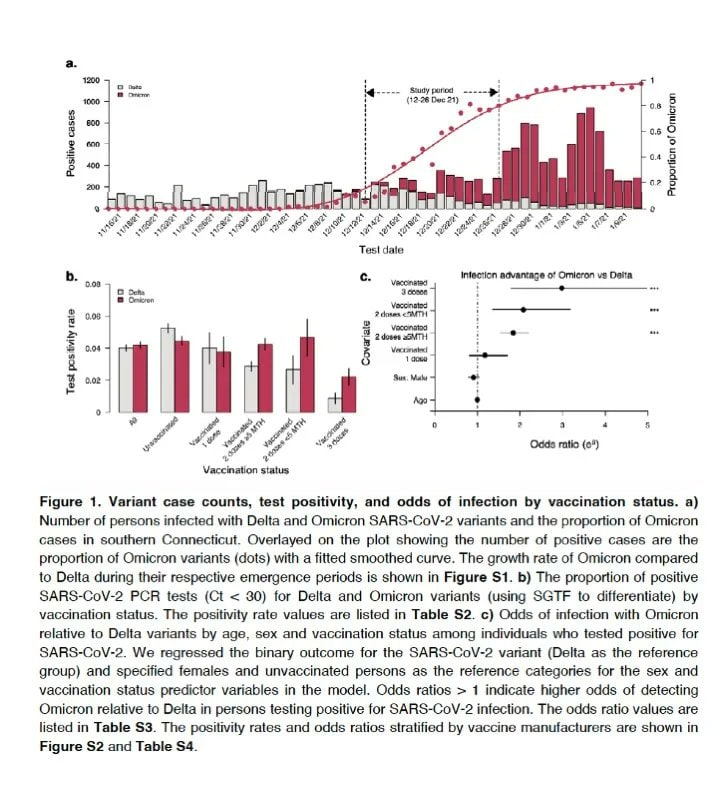
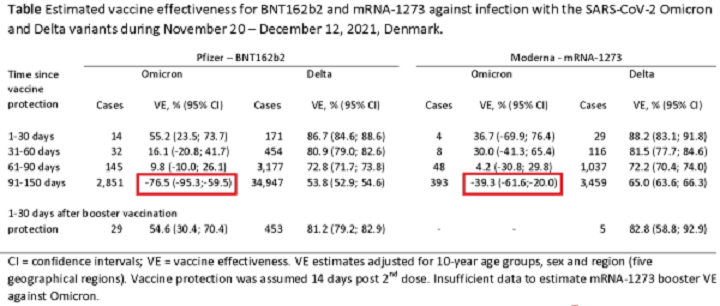
The take home from this pre-publication study is that there seems to be no difference in the probability of getting the Omicron variety of COVID or the Delta variety if you are unvaccinated, but the risk for being infected doubles if you are double vaccinated, and triple if you are also boosted. This means that the vaccines are less effective if you have had a booster shot for the Omicron variant. The Covid pandemic has moved from a pandemic of the unvaccinated to a pandemic of the vaccinated. My hopethesis is that the vaccines are too specific to work for a heavily mutated COVID such as the Omicron variety. We need a more broadband vaccine. Lucky for us they have changed the definition of what a vaccine is to include substances that lessen the impact of a disease, as prophylactic and therapeutic. With that definition there is already such a vaccine. It is called Ivermectin.
Let us test this hypothesis comparing the experience of U.S. and Nigeria. Since the start of the pandemic the U.S. has had 221,892 cases per million and 2,689 deaths per million people. By contrast, Nigeria has had 1,180 cases per million and 15 deaths per million, or about 0.53 percent of the cases and 1.27% of the deaths per million people.
How can that be? United states has the best medical system in the world, spending about 20% of GNP on medical care, Nigeria spends about 4% of their GNP on medical care. The median age for people in u.s is about 38.4 years, for Nigeria the median age is 18.4 years. The expected death risk for U.S.is about 5 times larger thanks to the age factor, so this makes up part of the difference. But the difference is far greater, so there must be something else. I am willing to accept that Nigeria has under-reported the number of cases, but the difference is much larger than can be explained this way. In addition Nigeria has one of the lowest vaccination rates in the world, less than 3%.
There is one better hypothesis, Nigeria has a great problem with River Blindness, a parasite on the skin that causes blindness if not treated. There is medication, given to all without cost, and it does the job. This medication is Ivermectin, and thanks to that the COVID cases are lower by a factor of 20, age-adjusted. Recently there has been a small study in Nigeria that seem to suggest that if you combine Ivermectin with HCQ and Zinc and Azithromycin, the results are even better. The results are presented here.
Want to save over a thousand deaths a day in U.S. alone? Switch immediately from vaccine only therapy to immediately allow Ivermectin and HydroxyChloroquine to be sold over the counter. The deaths from Ivermectin are only 15/ year worldwide and for Hydroxy Chloroquine 65/year worldwide, far less than say Tylenol, while the deaths from the vaccines are over 20,000 in the first year. The vaccines are great for people over 45, but for the younger generation the death risk outweighs the benefits.
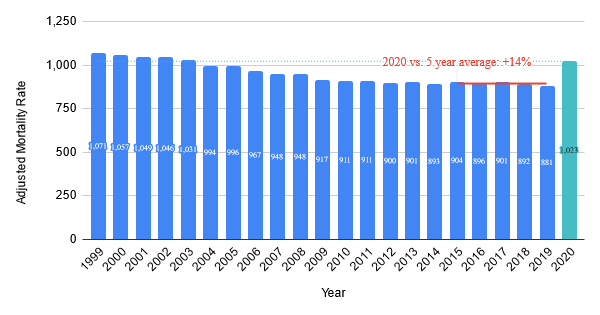
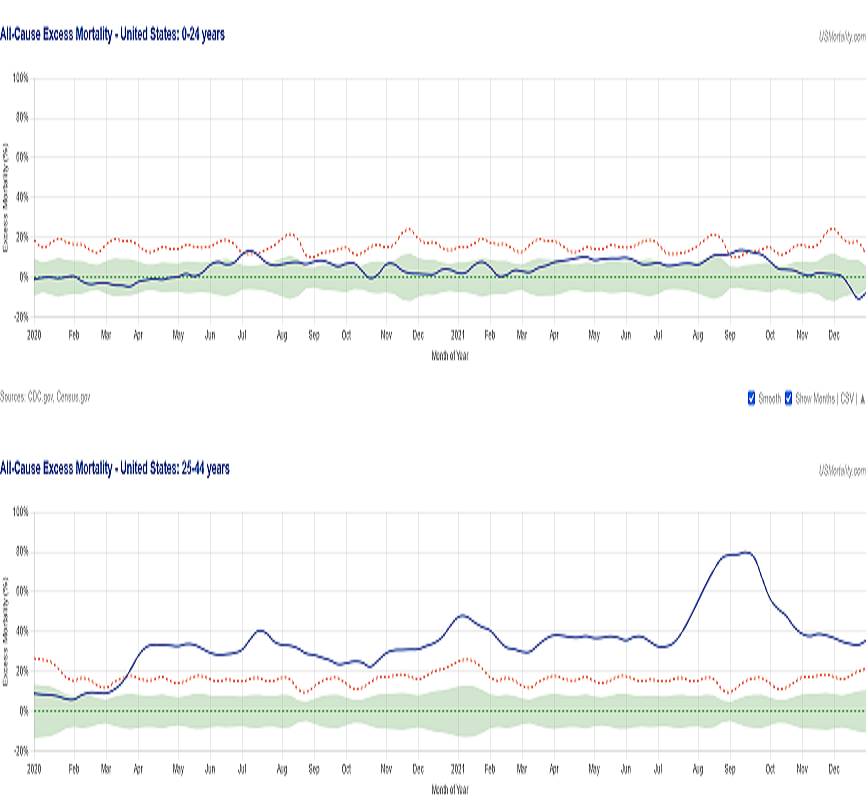
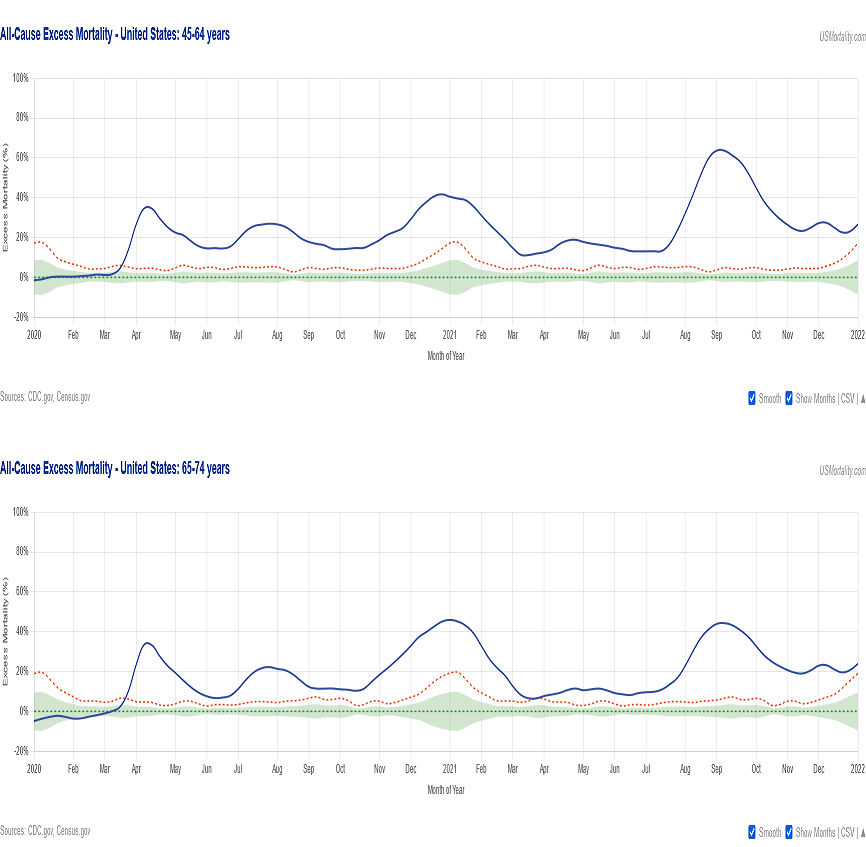
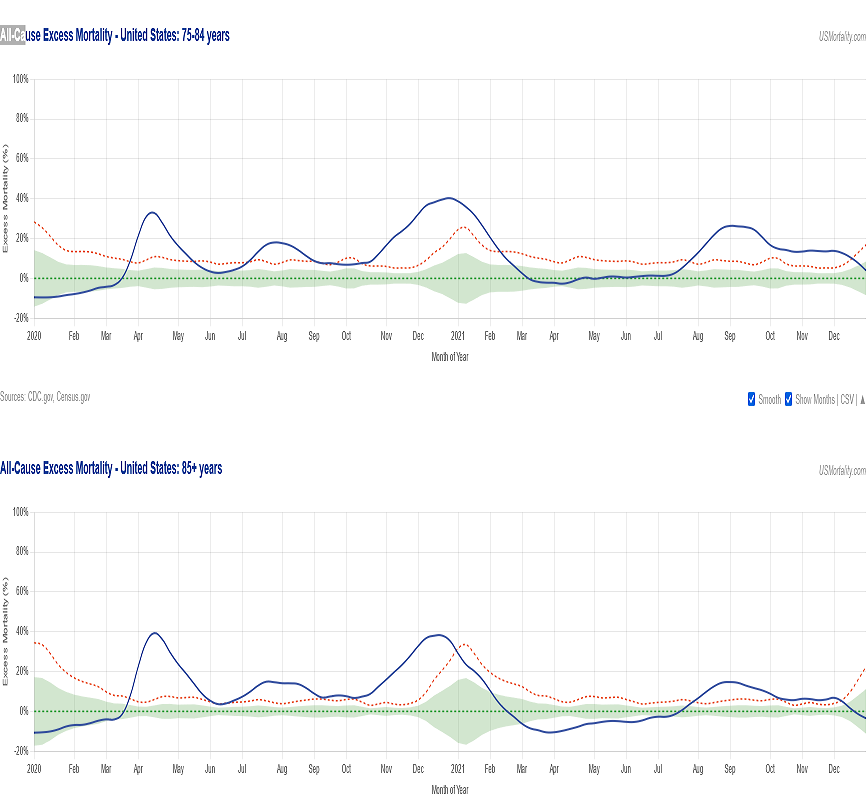
The U.s census is doing a remarkable job of statistics. This is from US Mortality
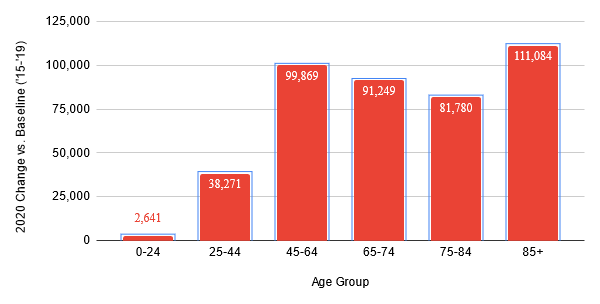
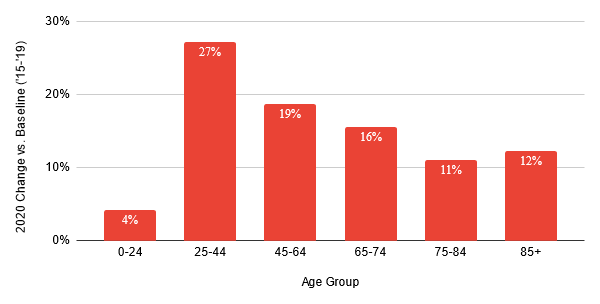
We can see the 2020 excess mortality was 14%Total 425,794 deaths broken down i 6 age categoriesPercentage wise it looks quite different!
COVID deaths in 2020 was about 377,878 not much different than the total excess deaths. For the 6 categories they are as follow: 0-24 721 or 27% of excessive deaths; 25-44 9,144 or 24% of excessive deaths; 45-64 62,536 or 63% of excessive deaths; 65-74 80,617 or 88% of excessive deaths; 75-84 104,212 or 127% of excessive deaths; 85+ 120,648 or 109% of excessive deaths;
We can see that for people under 45 years of age only a quarter of the excess deaths came from COVID-19. Most of the deaths came from excess stress, delayed medical treatments, depression, drugs, drinking and misbehavior, but for people over 65 there was a positive effect of the protective provisions that followed. But 2020 was the year without vaccines and a learning year for how to best treat the pandemic.
So how are we doing in 2021? We now have three vaccines and have learnt a lot about how to best treat COVID. Well for openers COVID deaths in 2021 were 452 thousand, far more than in 2020! And we have learned a lot of best treatment for hospitalized patients. The official results are not in yet, but there are charts that can give us a clue.
The all cause excess mortality for the age group 0-24 years in 2021 is not much different than for 2020, the chart below indicate it is about 3% more, or about 4,000 excess deaths.
For the age group 25-44 years: From the time COVId started to the end of the year 2020 the excess mortality rate was about 30%. In 2021 the excess mortality ate was around 44%, or about 41,500 excess deaths.
For the age group 45-64 years: From the time COVID started to the end of the year 2020 the excess mortality rate was about 23%. In 2021 the excess mortality ate was around 29%, or about 126,000 excess deaths.
For the age group 65-74 years: From the time COVID started to the end of the year 2020 the excess mortality rate was about 24%. In 2021 the excess mortality ate was around 22%, or about 84,000 excess deaths.
For the age group 75-84 years: From the time COVID started to the end of the year 2020 the excess mortality rate was about 18%. In 2021 the excess mortality ate was around 11%, or about 50,000 excess deaths.
And finally, for the age group 85+ years: From the time COVID started to the end of the year 2020 the excess mortality rate was about 18%. In 2021 the excess mortality ate was around 3%, or about 30,000 excess deaths.
First the good news. In 2020 the COVID-19 deaths were 89% of the total excessive deaths excessive deaths, in 2021 they were 131% of all excessive deaths. This means the vaccines are effective in reducing total deaths.
But do they reduce total deaths in all age categories?
For age group 0-24years: Excessive deaths 2020, 2,641 2021, 4,500, a 75% increase. 25-44years: Excessive deaths 2020, 38,271; 2021, 41,500, an 8.5% increase. 45-64years: Excessive deaths 2020, 99,869; 2021, 126,000, a 26% increase. 65-74years: Excessive deaths 2020, 91,249; 2021, 84.000, an 8% decrease. 75-84years: Excessive deaths 2020, 81,700; 2021, 50.000, a 39% decrease. 85+ years: Excessive deaths 2020, 111,284; 2021, 30.000, a 73% decrease.
Now, vaccines are not the only determining factor in the excessive deaths, overdoses of Fentanyl, opioids, alcohol and other drugs played a role. Especially in the 25-64 age group the additional stress to care for elderly parents while the children are still in high school or college plus being locked in at home and having to wear masks can be devastating to the mental health of anyone.
The conclusion from this study is: Dont vaccinate children and young adults. For people 25-44 vaccinate people with compelling medical needs to be protected. For people 45-64 make an informed decision, and since there are very often co-mprbidity factors, consider get vaccinated. For people over 65: By all means get vaccinated and boosted. Your immune system is already weakened anyway.
The vaccines that exist do not provide immunity. That was the old definition of vaccine. The new definition is that vaccines are prophylactic therapeutics for a time period, to be followed by boosters. There are two excellent prophylactic therapeutic medicines tha so fr has been overlooked by CDC, but are used at great advantage in much of the rest of the world: HydroxyChloroquine and Ivermectin. Check out Why is U.S.A. doing so poorly in fighting the pandemic? Is it beecause they refuse HCQ and Ivermectin?
It shows that the world has recorded 325,125,927 cases of the coronavirus and 5,550,676 deaths as of January 14 2022. U.S.A has recorded 66,250,206 cases and 872,332 deaths, or 20.4% of the world total cases but only 15.1% of the world’s deaths from the same virus. Great, we have more cases because we are doing more testing.
Not so, we have done 856 million tests, but the world has done over 4.8 billion tests, so our share of the testing is 17.8% or nearly the same as our part of the cases and deaths. But we are only 4.2% of the world population! This means we are doing three and a half times worse than the world as a total!
How can that be? We have the world’s best health care system with fantastic hospitals, full of state of the art equipment to monitor and do things that was unthinkable a decade ago. We are spending in excess of 10,000 dollars yearly per person on healthcare, while the global arithmetic average is less than 1200 dollars yearly per person, This means that most countries spend less than 1000 dollars yearly per person. In fact they are so poor that they cannot even think of spending for expensive patented medicines, so they are limited to the simplest generic prophylactic and therapeutic medicines. And you guessed it, they are mostly HydroxyChloroQuine and Ivermectin.
Why are we not approving Ivermectin and HCQ? They are ultra safe and they work. There are two reasons CDC is a vaccine approving agency and want dependent customers to purchase expensive medicines, and to approve Ivermectin and HCQ at this stage would mean that they would confess they have caused hundreds of thousand deaths by their refusal to approve them even they were far safer than say Remdesivir which was approved immediately after just one study (Hint it is expensive). We need to reorganize NIH, FDA and CDC to be patient oriented, no longer beholden to the medico-industrial behemoth.This is my opinion.
The headlines say it all. These are the results so far of adverse reactions to various medications and vaccines according to the official VAERS reporting, which give low estimates. The truth is worse. This is from Sen John Johnson:
It should be noted that for the first five medications the time frame is nearly 16 years, the result for COVID vaccine is one year.
Of all medications that actually works against COVID with a more than 75% efficiency, Ivermectin has been approved for human use against river blindness and other parasites, such as head lice since late 1980’s. The countries in Africa that routinely use it for parasite control have a COVID case and death rate of less than 1/10th of the countries in Africa that don’t. There are almost no adverse reactions.
HCQ is almost as good COVID fighter as Ivermectin when taken early in conjunction with Zinc. It’s effectiveness is at least 65% and has been used for over 50 years as an anti malaria drug, against lupus and some rheumatoid diseases. It is given to pregnant women and nursing mothers without restrictions.
Flue vaccines have very few adverse effects, but they happen.
Remdisivir was approved very fast, after all, it was expensive and showed early promising results, but it turned out that nearly 30% of the test clientele had used HCQ before entering the protocol. It turned out, that without HCQ it was not so good after all.
Alone in the history of vaccines has COVID vaccines been approved with such a staggering rate of adverse reactions and over 20,000 deaths from the vaccine in a year. Yet it helps people at risk, people over 60, obese, diabetic, anemic, vitamin C and D deficiency, immune compromised, high blood pressure and a variety of diseases, so they were important in the beginning of the disease, and will be for a while until the therapeutics are approved.
In the mean time , children and young adults without additional risk factors are at higher risk of dying if they take the vaccine than if they get COVID, older people should still go the vaccine route. With admittedly limited statistics available I have calculated the crossover point to be 45 years for people without additional risk factors.
First let me assure you I am not an anti-vaxxer. Both me and my wife got the booster shot of Pfizer vaccine last week, so that is not my beef. The problem is to get accurate information from CDC. All they say is Get the vaccine, and now they want to expand the age down to 5 year olds, even without conducting any meaningful tests.
I am of Swedish origin and my wife is from Denmark, so I follow what is going on in the world to get real, up to date information; CDC, FDA and NIH seem to be indebted to promote vaccines only, so they keep real time information to themselves, or so it seems.
According to a report from the Danish Ministry of Health’s Statens Serum Institut(SSI), nearly 90% of individuals infected with the Omicron coronavirus variant are “fully vaccinated,” or have also had a “booster” injection.
Out of a total reported 41,342 Omicron infections, 29,781 infected individuals had completed the primary vaccination injection schedule.
7,330 infected individuals had been injected with a “booster,” and 731 infected individuals had received one dose.
Compared to the 3,500 unvaccinated people who became infected with Omicron variant, 37,842 infected individuals had been injected with coronavirus vaccines. Denmark’s reported vaccination rate is purported to be nearly 78%. It is clear that the Omicron variant favors vaccinated people. Not only that , but the longer you have been vaccinated the worse it gets. Another statistics from Denmark confirms:
The booster shot does not even bring you back to the original efficiency of the vaccine.
The data appears to suggest a trend, as previous data from Germany showed that 96% of new Omicron coronavirus patients were “fully vaccinated,” while unvaccinated people accounted for only 4% of the infections.
A small sample of data released by the German government found that the Omicron coronavirus variant has been overwhelmingly infecting “fully vaccinated people,” including triple vaccinated people, while unvaccinated people remain largely unscathed by the newly discovered strain.
Out of 4,206 patients in the study, 4,020 had been injected with the COVID-19 vaccines, National File reported Thursday.
In the United States, data from the U.S. Centers for Disease Control and Prevention (CDC) found that the Omicron variant had been overwhelmingly infecting people who had received vaccine injections for COVID-19 to the tune of 80%. The Dec 28 U.S. vaccination rate is 69.31%
An explanation as to why vaccinated individuals appear to be getting infected with the new strain at such a staggering rate, when compared to those who have not been injected, could perhaps be found in a report by the New York Times, which claimed that experts in Israel had warned the Israeli government that “too many shots might cause a sort of immune system fatigue, compromising the body’s ability to fight the coronavirus.”
This is a big red flag. Let us stop vaccinate people under the age of 45 unless there are at risk people.
Let us take a look at the nations that have country wide use of Ivermectin and see how they fare compared to the nations that don’t.
Bangladesh have been using Ivermectin since June 2020. Population 167 million. Total deaths per million 168. COVID-19 cases are down 99% from peak, deaths down 98%
Belize has been using Ivermectin since 2020, but only for serious cases. Population 0.4 million. Total deaths per million 1,450. COVID-19 cases are down 89% from peak, deaths down 67%
Bolivia has country-wide usage. Population 12 million. Total deaths per million 1,641. COVID-19 cases are down 70% from peak, deaths down 59%. Less than half of the population are vaccinated.
Bulgaria has country-wide usage. Population 6.8 million. Total deaths per million 4,450. COVID-19 cases are down 36% from peak, deaths down 80%. Bulgaria had a late start with vaccines and has still the lowest vaccination rate in Europe of 32.4%.
Cambodia has country-wide usage. Population 17 million. Total deaths per million 176. COVID-19 cases are down 99.5% from peak, deaths down 75%
Dominican Republic – country-wide adoption – Sep 30, 2020. Population 11 million. Total deaths per million 385. COVID-19 cases are down 76% from peak, deaths down 90%
Egypt – country-wide adoption – Nov 30, 2020. Population 105 million. Total deaths per million 205. COVID-19 cases are down 38% from peak, deaths down 44%
El Salvador – country-wide adoption. Population 12 million. Total deaths per million 1,641. COVID-19 cases are down 36% from peak, deaths down 80%
Guatemala – country-wide adoption – Jan 23, 2021. Population 12 million. Total deaths per million 1,641. COVID-19 cases are down 95% from peak, deaths down 80%
Honduras – country-wide adoption – Apr 23, 2020. Population 8.5 million. Total deaths per million 875. COVID-19 cases are down 36% from peak, deaths down 92%
Lebanon – country-wide adoption – Jan 27, 2021. Population 6.8 million. Total deaths per million 1,334. COVID-19 cases are down 48% from peak, deaths down 62%
Nicaragua – country-wide adoption – Jan 25, 2021.Population 6.7 million. Total deaths per million 31. COVID-19 cases are down 92% from peak, deaths down 50%. This number is highly suspicious.
Panama – country-wide adoption. Population 4.4 million. Total deaths per million 1,680. COVID-19 cases are down 40% from peak, deaths down 80%
Venezuela – country-wide adoption.Population 28 million. Total deaths per million 188. COVID-19 cases are down 83% from peak, deaths down 80%
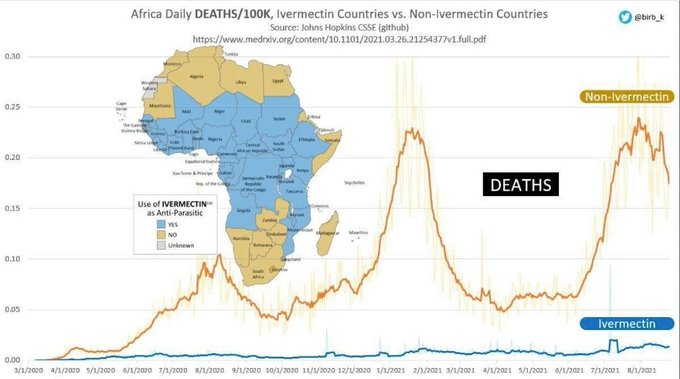
But the most interesting aspect of the first picture is what happens to the countries that use Ivermectin to fight parasites such as river blindness or head lice just to name a few. Look at this chart!
This chart lists Egypt as non Ivermectin because it is not used to fight parasites, but the point is clear. Ivermectin is working well as a prophylactic for COVID-19 even though its intent is to fight parasites. The death rates being around 90% lower for countries that fight parasites should be enough evidence for any thinking individual.
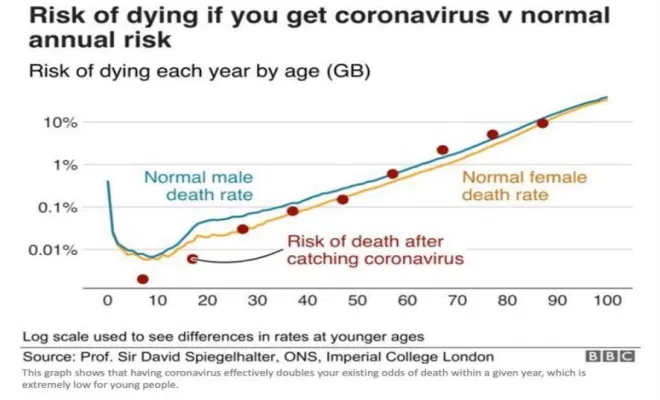
So here is my suggestion: Vaccines help for older people and people with special risk factors. The death rate for COVID-19 rises by about 7% par year of age after 2 years. See chart:
The statistics from the U.K. Office for National Statistics shows a 2.2x higher death rate for fully vaccinated people under 60 years of age than for unvaccinated people.
Charting these statistice I find that the crossover age is 45 years. People under this age are better off taking Ivermectin than get vaccinated unless there are special risk factors. Since between 2 and 3 billion people are already taking it for parasite protection it cannot be that dangerous. And by the way Ivermectin was offered to all Afghan refugees, as per immigration protocol, not for COVID, but for parasite control.
Summary: For people over 45 years of age and anybody with special risk factors. Take the vaccine, and continue with boosters. At the earliest sign of COVID take Ivermectin, Zinc and an antibiotic.
For the rest, most people under the age of 45, take Ivermectin and Zinc and an antibiotic during the first 5 days of symptoms, If diagnosed later there is most hopefully Regeneron available.
This would reduce the death rate by 80 t0 85%, reduce hospitalizations by a lot and make COVID-19 a mere nuisance so we can return to a normal life.



 Len Bilén's blog, a blog about faith, politics and the environment.