January 17, read the Bible in a year in PowerPoint; commented.

Mankind has a strong survival instinct. This leads to trying to manipulate people to gain an advantage or at least survive, and because Jesus had raised Lazarus from the dead in John 11:45-57 the ruling Jews were worried that Jesus would become ruler and then the Romans would destroy their nation. This lead to Caiaphas’ inadvertent prophecy “You know nothing at all! You do not realize that it is better for you that one man die for the people than that the whole nation perish.

The sons of Laban were displeased with Jacob getting rich at their expense, so in Genesis 31 Jacob fled from Laban. However, as Jacob, wives and children all were set to depart, Rachel stole Laban’s idols. Laban found out the idols were missing, pursued Jacob and caught up with him. Laban looked for the idols, at no avail, Rachel had hid them under the saddle of her camel and sat on it claiming she had her period. Finally Laban gave in, said farewell to all and he and Joseph established the Mizpah.

In Genesis 32 Jacob, schemer as he was, prepared to meet Esau. He figured Esau wanted to kill him, so he split up his company in two, and gave instructions to his messengers on what to say to make Esau less vindictive. Then the Jacob family crossed the Ford of Jabbok. On the other side they camped for the night, and Jacob wrestled with an angel of God and prevailed, but got a limp in his hip. God then gave Jacob a new, spiritual name, Israel.

And in Genesis 33 Jacob finally met up with Esau, but it turned out that Esau rejoiced to see Jacob and all his children.

January 16, read the Bible in a year in PowerPoint; commented.

John 11:1-44 describes how Jesus raised Lazarus from the dead (on the fourth day no less).

In Genesis 29, Jacob arrived in Paddan Aram, fell in love with Rachel, worked seven years to be allowed to marry her, but her father Laban tricked Jacob, so he got Leah instead. Then he worked another “seven years for Rachel”. But it was Leah that gave him his first four children, Reuben, Simeon, Levi and Judah.

Genesis 30 records the remaining children born to Jacob (except Benjamin, who would be born later). It also tells a story about Rachel, desperate to get a child of her own was bargaining with Leah for Reuben’s mandrakes. After Joseph was born, Jacob wanted to leave and go back to the promised land, but Laban bargained with him to stay and make them even more prosperous. Through selective breeding Jacob acquired the majority of the flocks and became morwealthy.

Psalm 6 is a prayer, this time from a humble David asking for mercy, but also asking God to humiliate his enemies.

The greatest sign was that Jesus raised Lazarus on the fourth day, the day the Talmud had decided the soul had forever left the body. The contrast in the Old Testament could not be stronger. It is full of strife and manipulation and tell it like it was, which makes it more believable that this was really how it happened.

January 15, read the Bible in a year in PowerPoint; commented.

In John 10:22-42 Jesus claimed to be one with his Father. This is of course blasphemy unless it is true, so for that the Jews wanted to stone him.

In Genesis 27 Jacob deceived Isaac to get the blessing of the firstborn instead of Esau. Esau got one too, but just the regular blessing, and to avoid more trouble Jacob fled to Laban.

In Genesis 28, Jacob went to Paddan Aram to get a wife. On the way he had a dream, commonly known as “Jacob’s Ladder”. Meanwhile, Esau took yet another wife, the daughter of Ishmael. The promise of Jacob’s dream was that God was to give the land to Jacob’s descendants. Jacob made a vow to God and named the place Bethel.

Psalm 5 is a prayer extolling the joy of praising God and praying towards Jerusalem, but is also an urgent prayer to do away with and destroy all wickedness and wicked people.

Jesus claimed to be one with God. True Jews took up stones to stone him, but the fullness of time was not yet, and furthermore only the Romans had the authority to execute people, so there the Pharisees were left powerless.

Rebekah was the original inventor of the plot for Isaac to give Jacob the blessing rather than Esau after Jacob had extorted Esau’s birthright. By deceit they fulfilled God’s will. The Bible shows how sinful man can still fulfill God’s purpose. Jacob fled from the wrath of God for what he had done, but God was still reaching out to Jacob and the dream Jacob had at Bethel.

January 14, read the Bible in a year in PowerPoint; commented.

In John 10:1-21 Jesus told that he is the good shepherd, the gate for the sheep, there will be one flock and one shepherd, and the sheep hear and know his voice.

After Sarah’s death, in Genesis 25 Abraham married his concubine Ketorah, who had already borne him six children. Before his death he sent them all away with ample gifts and provisions but his inheritance he gave to Isaac. Isaac and Ishmael buried Abraham, and then Ishmael’s genealogy was written down. Finally is told the story of Jacob and Esau, and how Esau sold his birthright for a bowl of lentil stew and some bread.

Genesis 26 tells of Isaac and Rebekah, how Isaac too said Rebekah was his sister, like father, like son. In spite of that lie God protected them, and the rest of the chapter deals with the eternal Mideast dispute: Water right

Today’s selection of chapters illustrates well the difference between Jesus, the good shepherd and the intrigues in the Old Testament. Jesus gives his sheep protection, pasture and he knows where the good water is. The still waters are often polluted. Abraham married his concubine, but he never let them be part of his inheritance. Isaac and Ishmael buried Abraham, but Abraham never married Hagar even though she gave birth to his firstborn child. Jacob was always a schemer, blackmailed Esau out of his birthright, and told Abimelech Rebekah was his sister, a blatant lie. In spite of that they came to an agreement of water rights.

January 13, read the Bible in a year in PowerPoint; commented.

The three chapters chosen for today are also very interesting.

In John 9 Jesus opened the eyes of a man blind from birth, Since this was done on a Sabbath more trouble arose from the Pharisees. In the arguments that followed the Pharisees tried their best to cancel him and his parents, but the people believed the truth revealed, and Jesus again affirmed his divinity.

In Genesis 23 Abraham’s wife Sarah died and Abraham purchased a grave in Mamre, where he buried her.

Life goes on, and Genesis 24 records the beautiful story of Isaac and Rebekah.

The connection with the Old and New testament is again water. The blind man was told to wash in the pool of Siloam. The man obeyed and the sign was completed. In Genesis the sign to look for was if the damsel would draw water for the camels too. (they are thirsty when they haven’t had any water to drink for days).

January 12, read the Bible in a year in PowerPoint; commented.

 John 8 begins with a sinful woman who was about to be stoned for adultery. Jesus last words to her was “Go and sin no more”. Jesus did not condemn her for the past but forgave and pointed to the future. Then he got into an argument with the religious powers about his and their ancestry. They claimed to be descendants of Abraham, and they questioned the legitimacy of Jesus. Jesus answered “Before Abraham, I am”. Jesus claimed to be God. This was of course blasphemy, unless it is true.

Genesis 21 tells about the birth of Isaac and when Ishmael made fun of it, Sarah got angry and Hagar and Ismael were sent away to die in the desert, but God protected them. The chapter also features the treaty between Abraham and Abimelech at Beersheba. This was the first treaty between men in the Bible and it was about water rights.

In  Genesis 22 Abraham was told by God to offer up his son Isaac to be sacrificed on Mount Moriah, the same mountain where Jesus was to be crucified. Obeying God he did what he was told, but at the last moment God provided a substitute sacrifice in the form of a ram.

These three chapters are significant. Read them through twice and ponder their importance: Jesus claiming deity, The birth of the Ishmaelite nation, later becoming the Islamic nations, the importance of water (The Bible begins and ends with water and a healing river in the middle) and Abraham’s faith being severely tested.

January 11, read the Bible in a year in PowerPoint; commented.

Today’s reading is very interesting. In John7:25-53 the people started asking Jesus if he was the Christ. Rather than answering directly Jesus promised “Streams of living water”and more, but they were not ready to understand it yet, and to be honest neither would I if I had been part of the crowd at that time. But the pharisees understood that he was a threat to their world order.

And in Genesis 19 Sodom and Gomorrah were destroyed. There is ample evidence this is a historical true event, the Bible is verified true even here. God provided for Lot, his wife and two daughters to escape.They did, but Lot’s wife looked back towards the city and was no more. After that the strange story about Lot and his two daughters is recorded , and all I can say about that is that it is not good to take matters in your own hands rather than listen to God and let Him guide.

In Genesis 20 Abraham claimed Sarah was his sister. Why? Sarah was his half-sister, so Abraham stretched the truth, also called a lie, or sin. This chapter shows God’s protection even when we do wrong.

Psalm 4 is David’s appeal to righteousness, and the blessings that follow is David’s appeal to righteousness, and the blessings that follow.

When the connection with God is broken all things happen; from the unbelief of the Pharisees to the sin of Sodom, to the lie of Abraham. They all show we always go wrong when we do our own thing apart from God.

Daisy World, The Gaia Hypothesis and the real story of Creation. Part 9: Nature or nurture?

We were created by God in his image with an expanded brain, capable of lifelong learning. This included a spiritual connection directly with God through His Spirit. This is the connection that died when Adam sinned and people decided they could function quite well without constant communication with God. Yet there remained a god-shaped void in their brains, a longing that wanted to be satisfied.

The question for us now is: Are we the way we are as a result of nature or nurture? Up to now we have dealt with the physical universe, the creation of all forms of life, and finally the creation of mankind, where mankind is unique in that it is created to have a special functioning connection with God. This is the only physical difference between us and the animals. A dog has better sense of smell, a cat hears better, an eagle sees better a bat uses echolocation to see at night, a dolphin has a better sonar than what scientists has been able to duplicate, many animals can sense changes in magnetic disturbances and so on.

We can separate the nature-nurture question two ways: Spiritually and environmentally. We start to develop much sooner after conception than people think, and the brain as it develops starts to record sounds and begins feeling way before birth.These impressions become hardwired into the brain and some insists that listening to classical music is the best environment for the developing baby, but the voice of the mother, both language and accent start to get imprinted before birth. The baby can also sense mood changes, arguments, stress and unrest. Some of this is already imprinted in their brain before the baby is born! If the mother gets sick, takes drugs, eats or drinks improper things, this too affects the baby’s development. Then comes birth, and so many things have to come to pass in right time and order for the birth to succeed, and yet it normally does. This is a miracle. Granted, when you see a cow give birth, she licks the calf off, and one hour later the calf rises up and starts to follow the mare, while a baby is helpless for a long time. When a child grows up, all it senses, hears, sees smells, tastes and feels gets uploaded into the brain, but only a small part is forever stored into memory, and what is stored permanently is often in connection with a traumatic event, good or bad. The events as memorized can be seen as nurture, but how they are handled are more part of nature. Some learn and change for the better, others change for the worse.

For all of us that are over 45 we will never forget January 28 1986. The space shuttle was ready and loaded to send up “teacher in space”, every classroom that had access to a television had it loaded and President Regan was ready to give the State of the Union speech the same night. The sky was perfect, but there had been a short dip below freezing and the dew had condensed thick on the main tank and even formed icicles from the cold from the liquid oxygen and liquid hydrogen. The boosters were not certified to work safely below 50 F, but they had done successful cold liftoffs before. A friend Ph.D chemist was working in the next cubical and together we were terrified that they would not scrub the mission. They could not find one engineer to sign off on the mission, but they went ahead anyway. The State of the Union speech was more important than safety. We all know what happened.With nearly all school-age children watching online the shuttle blew up and all seven astronauts were instantly killed. Some took it very hard, especially most teachers that had looked forward to this special moment in history. Some children had nightmares for a long time, but for others it was just another video-game. I can still remember some children coming home from school laughing: We now know what NASA stands for: “Need Another Seven Astronauts”. – The only one punished for this disaster was the one refusing to approve the mission and not accepting the white-washing of management responsibility; another sign of the fallen human nature.

It is of great importance where you spent your childhood. If you are born and raised on a subsistence farm, your experience is quite different from being raised on a modern specialized farm. If you are raised in the asphalt jungle of a modern city where crime and rape is commonplace, drugs are everywhere and corruption is the dominant method of doing business, that will shape how you see the world. Every memory impression will shape the way you behave and react.

If you are born in the country you will observe nature, and see how weather and climate affect all aspects of life, and you will see how beautifully God controls the weather. You learn to read the clouds and be a part of nature. Not so in the big cities! All is covered up, the sky tells you nothing. There are of course cultural events, sports, shows and spectacles, and many are drawn to that.

All this will be important in how you deal with the big question: Why are we here in the first place?

Next installment: The spiritual search for truth.
January 10, read the Bible in a year in PowerPoint; commented.

Today we read about circumcision and its importance; in John 7 and one of the four chapters in Genesis selected for today. But that is just one part of the story.

John 7:1-24. Jesus pointed out that according to Jewish law, circumcision is more important than keeping Sabbath, so, if the eighth day is on a Sabbath, it must be performed on that day, but healing on a Sabbath is not permitted.

In Genesis15 God promised Abram a son. Abram believed God and it was counted to him as righteousness.

But in Genesis 16 Abram badly wanted an heir, so Sarai, being too old, gave her handmaiden Hagar to be the mother of Abram’s son, Ishmael. Sarai regretted what she had done, and Hagar was sent away with Ishmael into the wilderness.

Thirteen years later, in Genesis 17, Ishmael was back with Abram,  God  promised Abram his seed of promise, changed Abram’s name to Abraham and Sarai’s name became Sarah, established with an eternal covenant, the covenant of Circumcision, and it was performed on Abraham, Ishmael and all Abraham’s male servants.

Which brings us to Genesis 18 with Abraham still waiting for his promised offspring. He was visited by three angels that promised him he will have a son within a year. Sarah heard it and found it laughable, but God confirmed this promise, and was also proclaiming the destruction of Sodom and Gomorrah. Abraham tried to bargain with God at no avail.

The question to ponder: Why is circumcision important for Jews and Muslims, but not for Christians? Hint: read the Acts of the Apostles, chapter 15.

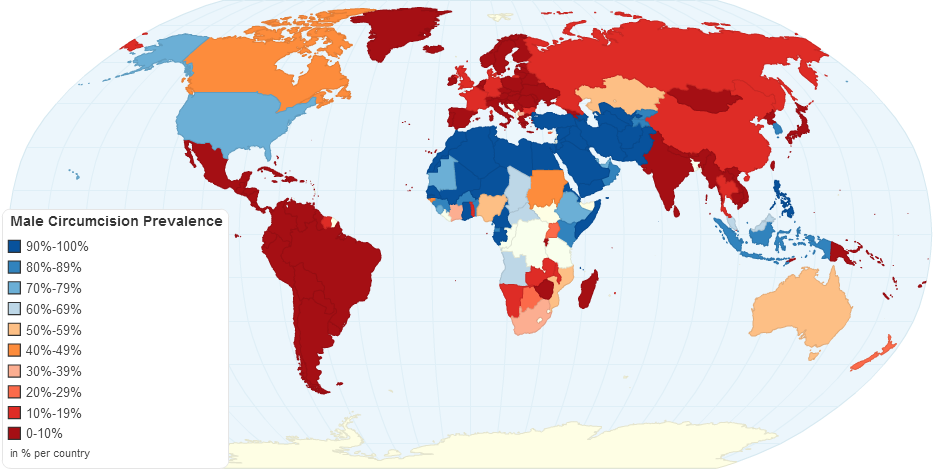
here is a map of the prevalence of male circumcision:

As we can see, circumcision is almost universal in Muslim countries, but very low in Europe and South America. In the U.S the circumcision rate is around 70%. Why is that? U.S. is a mostly Christian nation and we are told in Acts 15 that we should not be circumcised. There is an interesting aspect to circumcision and prostate cancer. The Mayo Clinic conducted a study a long time ago about the correlation between prostate cancer and circumcision, and they found a strong link, circumcised males had much lower risk of prostate cancer. There was one fatal fault with the study; it was done in Minnesota with a lot of people of Swedish descent, and the Swedes do not circumcise, and they have a much higher genetic propensity for developing prostate cancer than other population groups.

When our first son was born in 1969 the nurse nonchalantly handed me a clipboard and said: Sign here, it is standard procedure but it requires your signature. When I read through it I found out it was about circumcision, so I refused. She snarled and left and I overheard her saying to another nurse: Those Scandinavians; they are so backwards – she even wants to breast feed – how primitive!

January 9, read the Bible in a year in PowerPoint; commented.

The four chapters chosen for today are thought provoking and begins with

John 6:25-71. Jesus had fed the five thousand and been seen walking on water. In spite of these miracles the Jews demanded a sign. Jesus responded in kind by saying he is the bread of life, and if people want to have eternal life they must come to him and eat of his flesh and drink of his blood. When hearing this, many abandoned Jesus, but Peter said: To whom shall we go? You have the words of eternal life.

Then in Genesis 12 Abram was called to leave his home in Ur. He obeyed and traveled to a land he did not know, promised by God, but when a famine came he went to Egypt and acted deceitfully rather than trusting God completely.

In Genesis 13 Abram and his sidekick Lot went back from Egypt and their paths separated . Lot chose the fertile plain of Jordan, and Abram went to the hills of Mamre.

Finally in Genesis 14 Lot got in trouble and was taken captive by a local Mafia. Abram rescued Lot, and on the way back gave a tithe to Melchizedek, king of Salem – (later to become Jerusalem), after God had given him success in battle.

Question: Who was Melchizedek, and why is that important? He is mentioned again in Psalm 110 and in Hebrews 5-7.