Old Testament proof of the resurrection of the Messiah.

For a long time the oldest manuscripts of the Old Testament was the Masoretic text from the 7th to the 10th century AD.Then in 1947 and 1948 a an Arab bedo:uin discovered the Qumran caves that were full of old scrolls. The most famous was a near complete scroll if the Prophet Isaiah, dated to about 150 before Christ. While there were numerous minor textual differences between the copies, none of them mattered much. Or so I was told. The Tübingen School (Tübinger Schule) was a highly influential 19th-century German theological movement at the University of Tübingen that pioneered the historical-critical method of biblical research. They proved that Isaiah 53 was a later addition to the book of Isiah. one of their argument came from the 17th-century Jewish historian, Raphael Levi. He admitted that long ago the rabbis used to read Isaiah 53 in synagogues, but after the chapter caused “arguments and great confusion” the rabbis decided that the simplest thing would be to just take that prophecy out of the Haftarah readings in synagogues. That’s why today when they read Isaiah 52, they stop in the middle of the chapter, and the week after, they jump straight to Isaiah 54.

But it is even more remarkable than that. There is one word missing from the Masoretic text that is found both is the Dead Sea scroll and the Greek Septuagint translation. Here is the difference in Isaiah 53:11
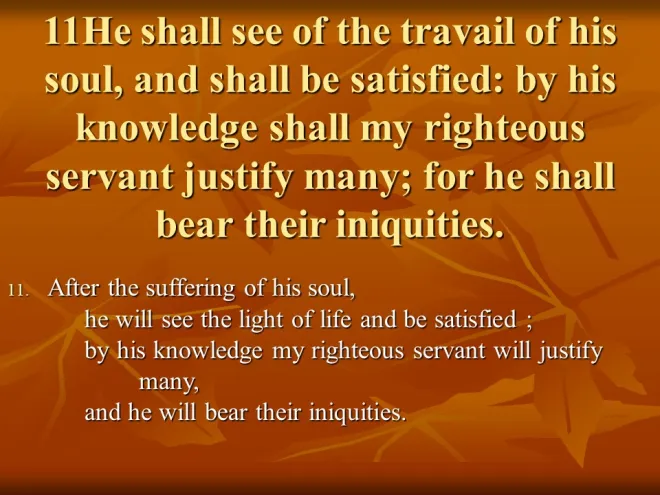
The first translation is the King James translation. It follows the Masoretic text and says see and be satisfied.

The second translation incorporates the Dead Sea scroll (also in the Septuagint) missing word: see the light of life and be satisfied. The light of life is one word in Hebrew and means come to life or resurrection.

When the early Christians had an opportunity to read the Bible, most of them could not read Hebrew at all, but some could read Greek and read the Septuagint Isaiah 53 with light of life included. Could it be that the light of life was taken out of the Masoretic text because the Jews wanted badly to have Isaiah 53 refer to the rebirth of the state of Israel after many years of suffering?

The second question is: When did it or will this happen? The answer is found in Daniel 9:26
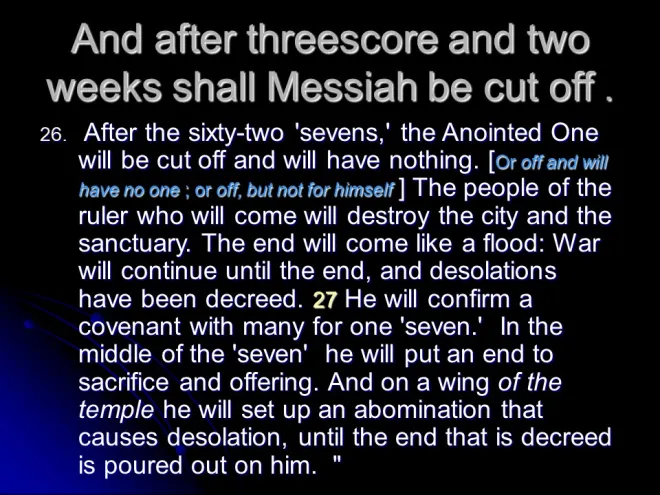
The answer is: Before the destruction of both Jerusalem and the Temple in AD 70. This means the Messiah was resurrected somewhere before AD 70.

The third question is: To whom did the Messiah give His message? As is shown here in Jeremiah 31:31-34 it was initially given to the people of Israel
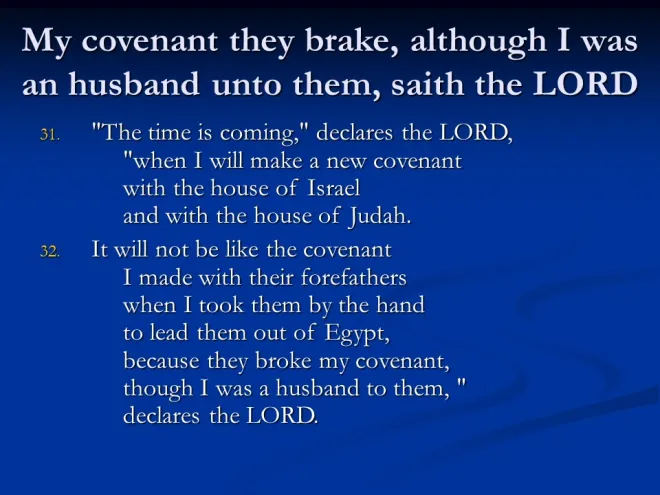
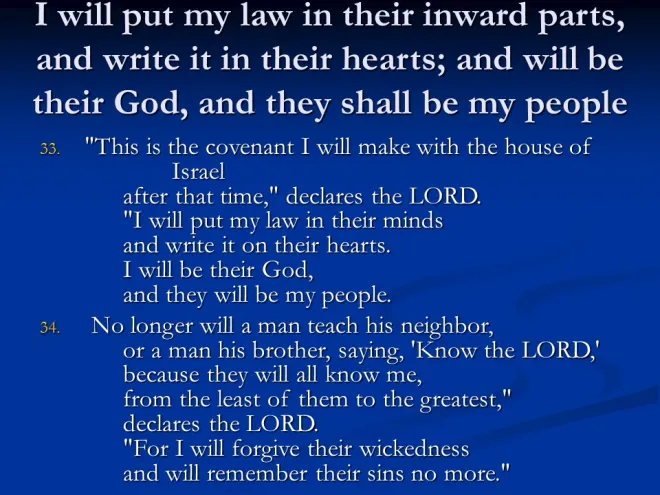
The Israel people lived under the Mosaic and Davidic covenants, which involved animal and other sacrifices to obtain forgiveness for a time. Once a year during the day of Atonement the High Priest the High Priest went in to the Holy of Holiest to clear the people from their unwittingly committed sins during the previous year. The next year it had to be performed again. The wilful sins had to be atoned for separately. To be a good Jew you must not only eat kosher food, but prepare it ahead before sabbath. A different process was to be followed if there was a double sabbath, the maximum length of a sabbath day’s journey, how to give tithing of cumin and other small spices so as not to give too much or too little, the proper way to fast and so on. This was later documented in the Talmud.

The prophet Jeremiah lived just before the people of Judah was taken into 70 years of captivity in Babylon, so when this prophesy was given it was taken to mean that the Messiah would come and restore the grandeur of Israel and save it from all oppressors. So at the time of Jesus the 69 “weeks” given in Daniel 9 had passed, so people were looking for the Messiah. At precisely the 10th day of Nisan Jesus rode in to Jerusalem on an unbroken colt of a donkey. This was the sign given in Zechariah 9:9 so the people gathered and shouted “Hosanna” which means “save us, we pray”. They meant “save us from the evil Roman rule.” But instead Jesus went into the temple and overturned the merchants tables and caused a commotion. This was the final straw for the Jews. Not only did he claim he was God, he forgave sins, he was doing miracles on sabbath, he also rejected the Talmud as being only the traditions of men. Through a sham trial he was tortured, flogged, crucified, killed and buried. That should have been the end of the story, but to be sure the disciples would not come and steal the body and say he was resurrected the Jews put up a guard to protect the tomb with their lives.

The end of the story is that Jesus did resurrect, proving the resurrection prophecy true, and that changed the world. Under the old covenant the holy spirit came upon the prophet as God spoke through him. Under the new covenant the Holy Spirit takes residence as they repent and believe. Initially it is only the new covenant with Israel.

But then it will speak about “his neighbor.” This is all mankind. The new covenant is for Jews, Christians, Muslims and even Hindus, Buddhists, Chinese and all people. There is now a great revival and awakening occurring i the world. Young people are coming to Christ in ever increasing numbers. In Iran there were maybe a handful domestic believers 60 years ago. Now there are over a million. Muslims all over the world have dreams about Jesus and have come to believe. In China there are probably more than 70 million believers. It is a worldwide awakening.

October 10, read the Bible in a year in PowerPoint; with comments

2 Timothy 1 starts out with the customary greeting. The Apostle Paul was encouraged by Timothy’s faith, which he got from his mother Eunice and grandmother Lois. Paul was not ashamed of the Gospel “for I know whom I have believed, and am persuaded that he is able to keep that which I have committed unto him against that day.” Then Paul urged Timothy to be loyal to the faith.

Jeremiah 51 tells of the time of the Lord’s vengeance, the Destruction of Babylon. The words of Jeremiah end with his command to Seraiah.

Jeremiah 52 is a historical epilogue to the book of Jeremiah. It tells of the fall of Jerusalem, the temple plundered and burned, the important people taken into captivity in Babylon, and finally Jehoiachin was released from prison but remained in Babylon.

October 9, read the Bible in a year in PowerPoint; with comments

1 Timothy 6:11-21. The Apostle Paul gave final instructions to Timothy: Guard the Faith.

Jeremiah 49. More judgments: on Ammon, Edom, Damascus, Kedar and Hazor and finally, judgment on Elam.

Jeremiah 50. The judgments continued, this time against Babylon and Babylonia.

October 8, read the Bible in a year in PowerPoint; with comments

1 Timothy 6:1-10.  Even if you are under the yoke of slavery, honor your masters. Don’t listen to those that teach error, and especially to those that think that with godliness comes financial gain. Remember: The Love of Money is the Root of all kinds of evil.

Jeremiah 45. In 5 verses God gave assurance to Baruch to save his life, but disaster on the people.

Jeremiah 46. God proclaimed judgment on Egypt. Babylonia will strike Egypt but God will preserve Israel.

Jeremiah 47. And finally, there will be judgment on Philistia.

Psalm 88, of the Sons of Korah, a Maskil of Heman the Ezrahite. This may be the saddest Psalm of them all, seemingly without hope, and yet?

October 7, read the Bible in a year in PowerPoint; with comments

1 Timothy 5 outlines the proper treatment of church members, honor the widows and honor the elders. Then the Apostle Paul urged Timothy to drink a little wine for his stomach’s sake.

Jeremiah 44. Some Israelis escaped to Egypt. Nothing good would come out of that. Read the horrible future that awaited them.

Psalm 87, of the Sons of Korah. A song of praise to Zion, the City of God and its citizens, even to those gentiles so honored.

October 6, read the Bible in a year in PowerPoint; with comments

1 Timothy 4. The Apostle Paul gave advice to Timothy and prophesied the coming great apostasy, but as a good servant of Jesus Christ he should not give in to it but be devoted to the ministry and let no man despise him for his youth.

Jeremiah 42. God told the remnant of Judah to stay in the land and not flee to Egypt.

Jeremiah 43. But they did, so Jeremiah was taken to Egypt.

October 5, read the Bible in a year in PowerPoint; with comments

1 Timothy 3. The Apostle Paul defined the qualifications of overseers and deacons, then he “waxed eloquent” about the great mystery of godliness. It is still a great mystery, but I like it and accept it by faith.

Jeremiah 39. The fall of Jerusalem finally happened and Jeremiah was to be set free.

Jeremiah 40. Jeremiah was finally freed, most of the people were still in the old land and had a bountiful harvest, most of which was then taken away from them.

Jeremiah 41 is a historical chapter recording the insurrection against Gedaliah and the beginning of a flight to Egypt.

October 4, read the Bible in a year in PowerPoint; with comments

1 Timothy 2. The Apostle Paul reminded the believers to pray for all, including the people of authority. Then he explained the roles for men and women in the Church.

Jeremiah 36. Jehoiakim burned Jeremiah’s Scroll. Did this action result in the end of David’s line?

Jeremiah 37. Zedekiah held on to the vain hope that the Chaldeans would be defeated. Jeremiah prophesied otherwise, so he was put in prison.

Jeremiah 38. Jeremiah was in the dungeon and near death so they pulled him up to question him some more. Zedekiah feared for his life, and Jeremiah’s advice was: Give in to Babylon and you will live.

October 3, read the Bible in a year in PowerPoint; with comments

1 Timothy 1 is a personal letter from the Apostle Paul to Timothy and it starts out with a personal greeting of encouragement and a warning about false teachers, for there is no other doctrine. He encourages Timothy to remember to give glory to God for His grace and to fight the good fight. An interesting fact in this letter: No slave trader will inherit the Kingdom of God.

Jeremiah 34. Zedekiah was warned by God to give liberty to the slaves, as commanded by Him, but the slaves were not freed, so bad things were going to happen.

Jeremiah 35 tells of the obedient Recabites.

Psalm 86, a Prayer of David. A plea for help, David poured out his needs and confessed his total dependence on God to teach him His ways.

October 1, read the Bible in a year in PowerPoint; with comments

2 Thessalonians 2 tells of the great apostasy, when the man of lawlessness is revealed and usher in the tribulation. People will believe “The Lie” and be destroyed. Stand fast, Jesus will destroy him at his return.

Jeremiah 30. Jeremiah sent a letter to the exiles, a letter of hope, and a promise of return “And ye shall seek me, and find me, when ye shall search for me with all your heart.And I will be found of you, saith the Lord: and I will turn away your captivity, and I will gather you from all the nations, and from all the places whither I have driven you, saith the Lord“. Then follows a message to Shemaiah, a not so promising message.

Jeremiah 31 is a most remarkable chapter. Jeremiah, in a dream heard God say “Yea, I have loved thee with an everlasting love” and God continued by promising that the remnant of Israel will be saved. Then, in verse 15 God provided an abrupt change “A voice was heard in Ramah, lamentation, and bitter weeping; Rachel weeping for her children refused to be comforted for her children, because they were not.” Returning to the dream God gave an even more remarkable statement “O thou backsliding daughter? for the Lord hath created a new thing in the earth, A woman shall compass a man.” After this Jeremiah woke up from his pleasant dream. God continued speaking, promising mercy on Ephraim, future prosperity to Israel, and promised the New Covenant: “But this shall be the covenant that I will make with the house of Israel; After those days, saith the Lord, I will put my law in their inward parts, and write it in their hearts; and will be their God, and they shall be my people. And they shall teach no more every man his neighbour, and every man his brother, saying, Know the Lord: for they shall all know me, from the least of them unto the greatest of them, saith the Lord: for I will forgive their iniquity, and I will remember their sin no more.