Acts 17:16-34. Paul was escorted to Athens. Waiting for Timothy and Silas to arrive Paul reasoned with the Greeks about Jesus and the resurrection. Being Greeks they thought the resurrection was the female counterpart to Jesus, so they took him to Areopagus (or Mars Hill), where Paul gave his famous “Athens discourse”. Read it and reflect.
2 Chronicles 9. The Queen of Sheba praised Solomon,” the one half of the greatness of thy wisdom was not told me: for thou exceedest the fame that I heard.” The chapter continues listing Solomon’s wealth and splendor, ending with a record of his death.
2 Chronicles 10. Israel rebelled against Rehoboam, and nothing good came out of that.
For a long time the oldest manuscripts of the Old Testament was the Masoretic text from the 7th to the 10th century AD.Then in 1947 and 1948 a an Arab bedo:uin discovered the Qumran caves that were full of old scrolls. The most famous was a near complete scroll if the Prophet Isaiah, dated to about 150 before Christ. While there were numerous minor textual differences between the copies, none of them mattered much. Or so I was told. The Tübingen School (Tübinger Schule) was a highly influential 19th-century German theological movement at the University of Tübingen that pioneered the historical-critical method of biblical research. They proved that Isaiah 53 was a later addition to the book of Isiah. one of their argument came from the 17th-century Jewish historian, Raphael Levi. He admitted that long ago the rabbis used to read Isaiah 53 in synagogues, but after the chapter caused “arguments and great confusion” the rabbis decided that the simplest thing would be to just take that prophecy out of the Haftarah readings in synagogues. That’s why today when they read Isaiah 52, they stop in the middle of the chapter, and the week after, they jump straight to Isaiah 54.
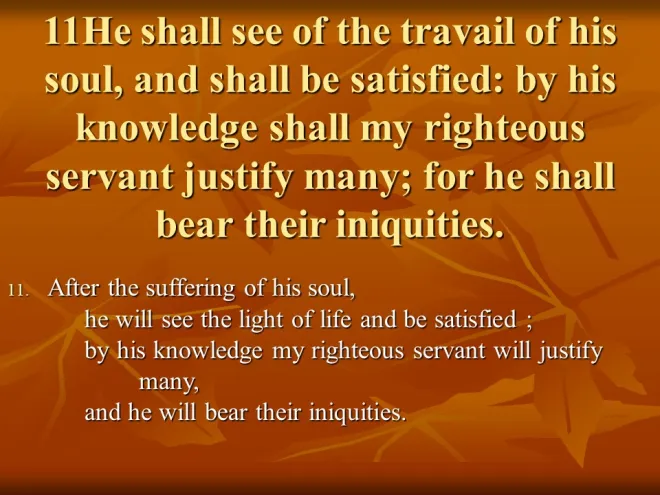
But it is even more remarkable than that. There is one word missing from the Masoretic text that is found both is the Dead Sea scroll and the Greek Septuagint translation. Here is the difference in Isaiah 53:11
The first translation is the King James translation. It follows the Masoretic text and says see and be satisfied.
The second translation incorporates the Dead Sea scroll (also in the Septuagint) missing word: see the light of life and be satisfied. The light of life is one word in Hebrew and means come to life or resurrection.
When the early Christians had an opportunity to read the Bible, most of them could not read Hebrew at all, but some could read Greek and read the Septuagint Isaiah 53 with light of life included. Could it be that the light of life was taken out of the Masoretic text because the Jews wanted badly to have Isaiah 53 refer to the rebirth of the state of Israel after many years of suffering?
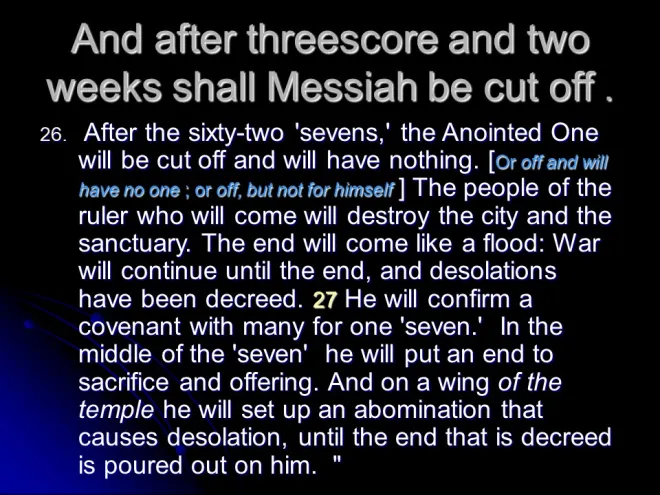
The second question is: When did it or will this happen? The answer is found in Daniel 9:26
The answer is: Before the destruction of both Jerusalem and the Temple in AD 70. This means the Messiah was resurrected somewhere before AD 70.
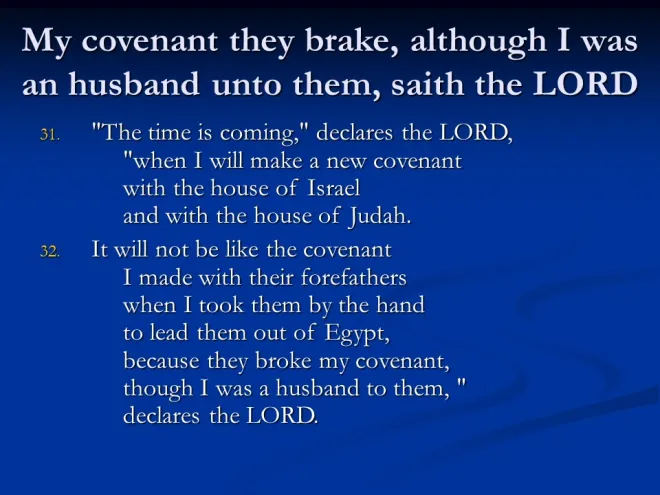
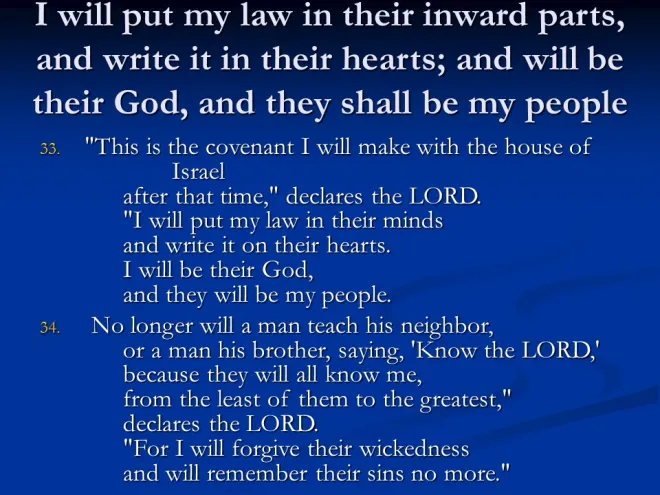
The third question is: To whom did the Messiah give His message? As is shown here in Jeremiah 31:31-34 it was initially given to the people of Israel
The Israel people lived under the Mosaic and Davidic covenants, which involved animal and other sacrifices to obtain forgiveness for a time. Once a year during the day of Atonement the High Priest the High Priest went in to the Holy of Holiest to clear the people from their unwittingly committed sins during the previous year. The next year it had to be performed again. The wilful sins had to be atoned for separately. To be a good Jew you must not only eat kosher food, but prepare it ahead before sabbath. A different process was to be followed if there was a double sabbath, the maximum length of a sabbath day’s journey, how to give tithing of cumin and other small spices so as not to give too much or too little, the proper way to fast and so on. This was later documented in the Talmud.
The prophet Jeremiah lived just before the people of Judah was taken into 70 years of captivity in Babylon, so when this prophesy was given it was taken to mean that the Messiah would come and restore the grandeur of Israel and save it from all oppressors. So at the time of Jesus the 69 “weeks” given in Daniel 9 had passed, so people were looking for the Messiah. At precisely the 10th day of Nisan Jesus rode in to Jerusalem on an unbroken colt of a donkey. This was the sign given in Zechariah 9:9 so the people gathered and shouted “Hosanna” which means “save us, we pray”. They meant “save us from the evil Roman rule.” But instead Jesus went into the temple and overturned the merchants tables and caused a commotion. This was the final straw for the Jews. Not only did he claim he was God, he forgave sins, he was doing miracles on sabbath, he also rejected the Talmud as being only the traditions of men. Through a sham trial he was tortured, flogged, crucified, killed and buried. That should have been the end of the story, but to be sure the disciples would not come and steal the body and say he was resurrected the Jews put up a guard to protect the tomb with their lives.
The end of the story is that Jesus did resurrect, proving the resurrection prophecy true, and that changed the world. Under the old covenant the holy spirit came upon the prophet as God spoke through him. Under the new covenant the Holy Spirit takes residence as they repent and believe. Initially it is only the new covenant with Israel.
But then it will speak about “his neighbor.” This is all mankind. The new covenant is for Jews, Christians, Muslims and even Hindus, Buddhists, Chinese and all people. There is now a great revival and awakening occurring i the world. Young people are coming to Christ in ever increasing numbers. In Iran there were maybe a handful domestic believers 60 years ago. Now there are over a million. Muslims all over the world have dreams about Jesus and have come to believe. In China there are probably more than 70 million believers. It is a worldwide awakening.
Acts 17:1-15. Paul and Silas arrived in Thessalonica, preached in the Synagogue, many people were converted, the Jews didn’t like it and a crowd attacked Jason’s home. But in Berea they were welcomed: “These were more noble than those in Thessalonica, in that they received the word with all readiness of mind, and searched the scriptures daily, whether those things were so.” The net result though was similar to what happened in Thessalonica, so Paul was escorted to Athens.
2 Chronicles 6 records Solomon’s speech when the work was completed and Solomon’s prayer of dedication.
2 Chronicles 7. Solomon dedicated the Temple, and God appeared to Solomon a second time, promising “If my people, which are called by my name, shall humble themselves, and pray, and seek my face, and turn from their wicked ways; then will I hear from heaven, and will forgive their sin, and will heal their land.”
Acts 16:16-40. In Philippi Paul and Silas were put in prison, but while singing praises to God their chains fell off, the Philippian Jailer, rather than killing himself asked “Sirs, what must I do to be saved?” And they answered, “Believe on the Lord Jesus Christ, and thou shalt be saved, and thy house.” Since Paul and Silas were Roman citizens they were asked to leave secretly, but they went to Lydia’s house instead. After that they departed.
2 Chronicles 3. Solomon did build the temple to man’s standard, six hands to a cubit. He even used gold nails instead of iron nails in the ceiling, far more gold than was called for in the tabernacle.
2 Chronicles 4 contains a listing of the temple furnishings.
2 Chronicles 5. The ark was brought into the Temple, and the glory of the LORD filled the Temple.
Acts 16:1-15. Timothy joined Paul and Silas in Lystra and in Troas Paul received “the Macedonian Call”. Lydia, a new convert was baptized at Philippi.
2 Chronicles 1. Solomon asked for wisdom, he received it and more, God also gave him economic and military power.
2 Chronicles 2. Solomon Prepared to build the temple, took inventory of all things collected and tallied the number of constricted aliens to do the work.
Psalm 45, of the Sons of Korah, a Wedding Song. C.S. Lewis saw this psalm pointing to Christmas: “The birth of Christ is the arrival of the great warrior and the great king. Also of the Lover, the Bridegroom, whose beauty surpasses that of man. But not only the Bridegroom as the lover, the desired; the Bridegroom also who makes fruitful, the Father of children still to be begotten and born.” (C.S. Lewis, as cited in Willem VanGemeren)
Acts 15. There was much ado about circumcision, and the believers decided to settle the issue at the Council at Jerusalem, which led to the Jerusalem decree, (in short: Abstain from fornication and from blood). Barnabas and Paul argued about Mark, so they split up, and Paul took Silas and embarked on the second missionary journey.
Proverbs 7. Keep the Law, Seek wisdom and above all, stay away from harlots! They will use every trick to get you!
Psalm 44. Of the sons of Korah. It is a Psalm recounting the great victories God gave the Israelites when they followed God, and the humiliating defeats they suffered when they did not. Yet the psalmists were trusting God and claimed they had not forgotten the Lord and ended with an urgent plea for help.
Acts 14. The Apostle Paul went to Iconium, preached the Gospel and the Jews and some Gentiles threatened to stone him, so he fled to Lystra and they did. He and Barnabas then escaped to Derbe. From there they returned to Lystra, Iconium and Pisidian Antioch where Paul strengthened the converts, after which they went back to Attalia and sailed back to Antioch where they gave a report on their first missionary journey.
1 Chronicles 28. David instructed Solomon how to build the Temple, complete with promises and warnings for the future.
1 Chronicles 29 begins with a long list of offerings for building the temple, then is recorded David’s praise to God, after which Solomon was anointed King and finally recorded is the close of David’s reign.
Acts 13:13-52. From Cyprus, Barnabus and Paul went to the Pisidian Antioch. Paul preached Jesus powerfully, almost the whole city wanted to listen, the Jews got jealous and expelled them from the region. As a consequence Paul and Barnabas continued on their journey to Iconium.
1 Chronicles 26 lists the gatekeepers, the treasurers and other officials.
1 Chronicles 27 lists the military divisions, the leaders of the Israeli tribes and other officials.
Acts 13:1-12. Barnabas and Saul began their first missionary journey with preaching on the island of Cyprus where Saul’s name was changed to Paul. Paul rebuked Elymas the sorcerer and God struck him with blindness.
1 Chronicles 24 shows the divisions of the priests, when they served tabernacle duties, and the other Levites serving as alternates.
1 Chronicles 25 lists the musicians set apart for temple service in 24 divisions for the different times of service.
Acts 12. King Herod persecuted the Church and putting many in prison, even Peter; but Peter miraculously escaped. Herod suffered a violent death after giving a speech without giving glory to God.
1 Chronicles 22. David made preparations to build the Temple.
1 Chronicles 23 contains a listing of the Levites and their duties.
Psalm 43. This Psalm may very well be a continuation of Psalm 42. Nevertheless, it is a Psalm of deep depression and yet full of praise and hope.