A Climate Realist’s (not so) short Answers to Hard Questions About Climate Change. Question 10 (of 16) Why do people question climate change?

NOV. 28, 2015 gave his answers to 16 questions in the N.Y. Times regarding Climate Change. This Climate realist added his answer.

 Answers to Question 1: How much is the planet heating up?

Answers to Question 2. How much trouble are we in?

Answers to Question 3. Is there anything I can do?

Answers to Question 4. What’s the optimistic scenario?

Answers to Question 5. Will reducing meat in my diet help the climate?

Answers to Question 6. What’s the worst-case scenario?

Answers to Question 7. Will a tech breakthrough help us?

Answers to Question 8. How much will the seas rise?

Answers to Question 9. Are the predictions reliable?

Justin Gillis answer to Question 10. Why do people question climate change?

“Hint: ideology.

Most of the attacks on climate science are coming from libertarians and other political conservatives who do not like the policies that have been proposed to fight global warming. Instead of negotiating over those policies and trying to make them more subject to free-market principles, they have taken the approach of blocking them by trying to undermine the science.

This ideological position has been propped up by money from fossil-fuel interests, which have paid to create organizations, fund conferences and the like. The scientific arguments made by these groups usually involve cherry-picking data, such as focusing on short-term blips in the temperature record or in sea ice, while ignoring the long-term trends.

The most extreme version of climate denialism is to claim that scientists are engaged in a worldwide hoax to fool the public so that the government can gain greater control over people’s lives. As the arguments have become more strained, many oil and coal companies have begun to distance themselves publicly from climate denialism, but some are still helping to finance the campaigns of politicians who espouse such views.”

My answer to Question 10. Why do people question climate change?

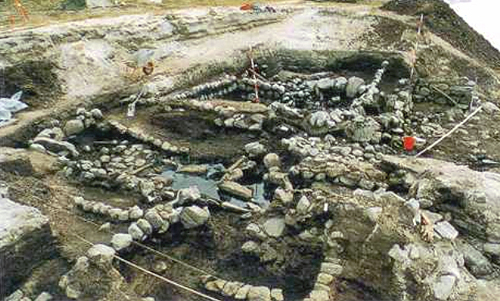
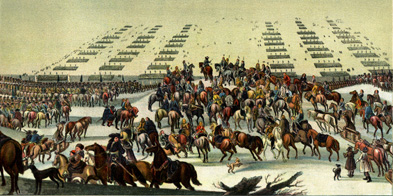
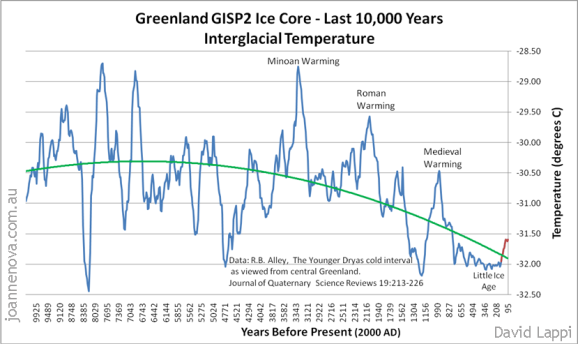
Nobody except total ignoramuses deny climate change. We can learn from history that the Swedish army crossed the Great belt on ice during the little ice age, Greenland had a cheese farm “Gaarden under sanden” during the Medieval warming period,  tree stumps emerging from the melting Mendenhall Glacier, shows there was a forest there 1000 to 3000 years ago, the wine making in England during the Roman warm period, the cooldown during the Dark ages causing massive deaths, the emerging of a man preserved in ice for 5000 years, even before the Minoan warming period. We can see marks from multiple ice ages, such as the finger lakes, “giant kettles” in Sweden from the river that emptied the Baltic Ice lake, and so on. All this happened during stable CO2 levels.

The recent sharp rise of CO2 levels is unprecedented and it should be studied if that is good or bad for the climate since it is a greenhouse gas. We had a little ice age and are still coming out of it, but worldwide temperatures are still lower than during the Medieval warming period. So the question is: how much of the recent warming trend can be attributed to the rise of CO2 and will we ever get back to the Minoan optimum at any level of CO2? On the other hand, what can we do to stave off, or at least delay the onset of the next ice age? These are questions that should be made, but unless you take the “politically correct” position it is very hard to get funding. On the other hand, the “ideological position”  taken by the IPCC,  has convinced numerous countries, which have spent in the hundreds of billions of dollars, to prop up the “research” on the evils of increasing CO2.

The main cherrypicker of data and climate denialism can be can be represented by Michael Mann and his famous “hockey stick” denying both the little ice age and the Medieval Warming period. Another example is how homogenization of temperature data to make the data fit when the environment around the temperature stations change. The temperature adjustments form a near perfect straight line, the less CO2, the more old temperatures are adjusted downward to conceal previous warm periods. This is not science. It may be political science where perception is reality, but science demands the models are checked versus reality.  To adjust temperatures as a function of CO2 levels to prove rising temperatures as a function of CO2 levels is scientific fraud.
 

A Climate Realist’s (not so) short Answers to Hard Questions About Climate Change. Question 9 (of 16) Are the predictions reliable?

NOV. 28, 2015 gave his answers to 16 questions in the N.Y. Times regarding Climate Change. This Climate realist added his answer.

 Answers to Question 1: How much is the planet heating up?

Answers to Question 2. How much trouble are we in?

Answers to Question 3. Is there anything I can do?

Answers to Question 4. What’s the optimistic scenario?

Answers to Question 5. Will reducing meat in my diet help the climate?

Answers to Question 6. What’s the worst-case scenario?

Answers to Question 7. Will a tech breakthrough help us?

Answers to Question 8. How much will the seas rise?

Justin Gillis answer to Question 9. Are the predictions reliable?

“They’re not perfect, but they’re grounded in solid science.

The idea that Earth is sensitive to greenhouse gases is confirmed by many lines of scientific evidence. For instance, the basic physics suggesting that an increase of carbon dioxide traps more heat was discovered in the 19th century, and has been verified in thousands of laboratory experiments.

Climate science does contain uncertainties, of course. The biggest is the degree to which global warming sets off feedback loops, such as a melting of sea ice that will darken the surface and cause more heat to be absorbed, melting more ice, and so forth. It is not clear exactly how much the feedbacks will intensify the warming; some of them could even partially offset it. This uncertainty means that computer forecasts can give only a range of future climate possibilities, not absolute predictions.

But even if those computer forecasts did not exist, a huge amount of evidence suggests that scientists have the basic story right. The most important evidence comes from the study of past climate conditions, a field known as paleoclimate research. The amount of carbon dioxide in the air has fluctuated naturally in the past, and every time it rises, the Earth warms up, ice melts, and the ocean rises. A hundred miles inland from today’s East Coast, seashells can be dug from ancient beaches that are three million years old, a blink of an eye in geologic time. These past conditions are not a perfect guide to the future, either, because humans are pumping carbon dioxide into the air far faster than nature has ever done.

My answer to Question 9. Are the predictions reliable?

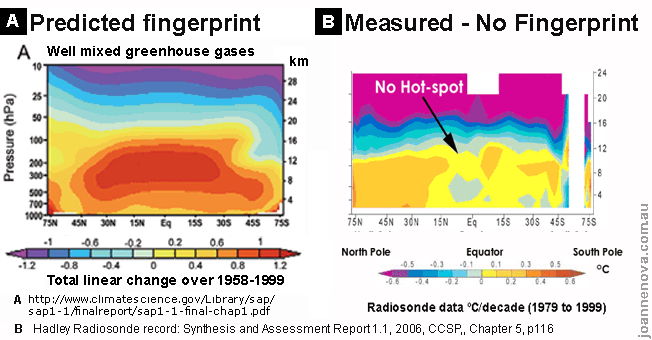
They are not perfect, for sure, but are they even grounded in solid science? For a model to have credibility it must be tested with measurements, and pass the test. There is important evidence suggesting the basic story is wrong. All greenhouse gases work by affecting the lapse rate in the tropics. They thus create a “hot spot” in the tropical troposphere. The theorized “hot spot” is shown in the early IPCC publications. (Fig A)

Fig. B shows observations. The hotspot is not there. If the hotspot is not there, the models must be wrong. So what is wrong with the models?

The models all assume greenhouse gases are additive. This is true for low concentrations and over short distances, such as is done in laboratory environments. Yet there is one truth bout heat absorption.  Once all the energy in one frequency band is absorbed, that is it. If the water vapor has already absorbed the energy, no matter of added CO2 will change that. This is largely true in the tropics, where water vapor is dominant. As CO2 levels increased, no hotspot formed in the tropics. Near the poles the situation is different,  more CO2 will lead to higher temperatures, but always less than what would have been predicted by separately adding the effects of water vapor and CO2.

[The amount of carbon dioxide in the air has fluctuated naturally in the past, and every time it rises, the Earth warms up, ice melts, and the ocean rises.]

This statement should read: Every time temperature rose in the past,  the ice melted, and the oceans warmed up, causing carbon dioxide to be released from  ice and oceans and rise with a 300 to 800 years delay,  the amount of water vapor rose, increasing the earth’s cloud cover,  stopping the temperature rise, and after a time delay CO2 also stopped rising, and ocean levels stabilized.

So CO2 is an effect of, not a cause for the observed temperature rise.

Al Gore’s movie An Inconvenient Truth used this very argument to show CO2 causes temperature rise. A British court found that this was one of the 9 errors of fact that appear in the movie. The court ruled that any theater showing the movie would need to inform the audience of these 9 errors. http://www.telegraph.co.uk/news/earth/earthnews/3310137/Al-Gores-nine-Inconvenient-Untruths.html

Answers to Question 10. Why do people question climate change?

Answers to Question 11. Is crazy weather tied to climate change?

Answers to Question 12. Will anyone benefit from global warming?

Answers to Question 13. Is there any reason for hope?

Answers to Question 14. How does agriculture affect climate change?

Answers to Question 15. Will the seas rise evenly across the planet?

Answers to Question 16. Is it really all about carbon?

A Climate Realist’s (not so) short Answers to Hard Questions About Climate Change. Question 8 (of 16) How much will the seas rise?

NOV. 28, 2015 gave his answers to 16 questions in the N.Y. Times regarding Climate Change. This Climate realist added his answer.

 Answers to Question 1: How much is the planet heating up?

Answers to Question 2. How much trouble are we in?

Answers to Question 3. Is there anything I can do?

Answers to Question 4. What’s the optimistic scenario?

Answers to Question 5. Will reducing meat in my diet help the climate?

Answers to Question 6. What’s the worst-case scenario?

Answers to Question 7. Will a tech breakthrough help us?

Justin Gillis answer to Question 8. How much will the seas rise?

“The real question is not how high, but how fast.

The ocean is rising at a rate of about a foot per century. That causes severe effects on coastlines, forcing governments and property owners to spend tens of billions of dollars fighting erosion. But if that rate continued, it would probably be manageable, experts say.

The risk is that the rate will accelerate markedly. If emissions continue unchecked, then the temperature at the Earth’s surface could soon resemble a past epoch called the Pliocene, when a great deal of ice melted and the ocean rose by something like 80 feet compared to today. A recent study found that burning all the fossil fuels in the ground would fully melt the polar ice sheets, raising the sea level by more than 160 feet over an unknown period.

With all of that said, the crucial issue is probably not how much the oceans are going to rise, but how fast. And on that point, scientists are pretty much flying blind. Their best information comes from studying Earth’s history, and it suggests that the rate can on occasion hit a foot per decade, which can probably be thought of as the worst-case scenario. A rate even half that would force rapid retreat from the coasts and, some experts think, throw human society into crisis. Even if the rise is much slower, many of the world’s great cities will flood eventually. Studies suggest that big cuts in emissions could slow the rise, buying crucial time for society to adapt to an altered coastline.”

My answer to Question 8. How much will the seas rise?

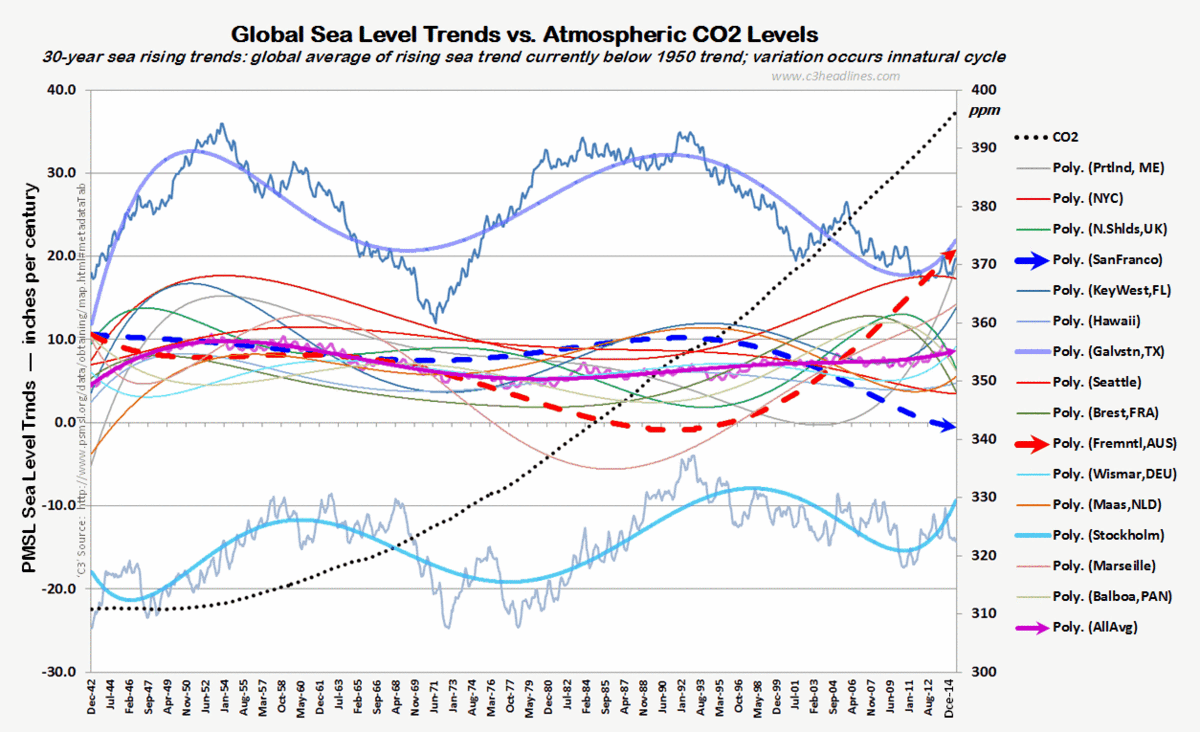
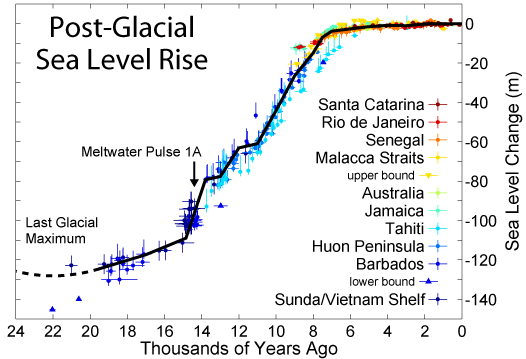
During the Pliocene epoch the water levels were about 80 feet higher than today, temperatures were 1 to 3 degree C warmer, but the CO2 level was less than 280 ppm, so there must have been another cause for the high temperatures than Carbon dioxide. My guess is that the activity of the Sun and the Milankovitch cycles triggered the meltdown of most of the Greenland and part of the Antarctic ice sheet. This is not the case now.  We are well into the bog generating phase of this interglacial period, the Minoan optimum temperature ( at 260 ppm CO2) did not trigger the ice-melt, and ever since we have been in a downward temperature trend. What is remarkable about this period is how stable sea levels have been. The ocean levels have been rising at an average rate of about one inch per century, quite different from emptying out the Baltic Ice Lake, an event that rose  Ocean levels by feet per year until it emptied out, the rest formed what is now the Baltic Sea. Coming out of the ice age rose Ocean levels about 400 feet, and then it stopped. There are places in northern Sweden where the land still rises out of the sea at about 3 feet per century. The Mid-Atlantic ridge is rising, has plenty of undersea volcanoes, about one third of all undersea volcanoes are between Jan Mayen and Svalbard. All this displaced water has to go somewhere, and so most of the rest of the world’s coastlines are experiencing rising sea levels. This is especially true for the U.S. East coast, sinking of its own. The warming of the oceans are vastly over-estimated, being confined to the surface and the upper 1000 feet, the sunlight is absorbed in the first few feet of water and there is limited and very slow mixing of deep water with surface water. But there is a temperature dependence of sea levels, the sea levels were fluctuating with temperature, as the chart to the right indicates.

Right now average ocean levels are increasing by about a foot per century, but the trend is not increasing. See Fig:

The take-home from this chart: Sea level rise has nothing to do with CO2 level rise, it is more about tectonic plates movements and what happens on the sea floor.


A Climate Realist’s (not so) short Answers to Hard Questions About Climate Change. Question 7 (of 16) Will a tech breakthrough help us?

NOV. 28, 2015 gave his answers to 16 questions in the N.Y. Times regarding Climate Change. This Climate realist added his answer.

 Answers to Question 1: How much is the planet heating up?

Answers to Question 2. How much trouble are we in?

Answers to Question 3. Is there anything I can do?

Answers to Question 4. What’s the optimistic scenario?

Answers to Question 5. Will reducing meat in my diet help the climate?

Answers to Question 6. What’s the worst-case scenario?

Justin Gillis answer to Question7. Will a tech breakthrough help us?

Even Bill Gates says don’t count on it, unless we commit the cash.

As more companies, governments and researchers devote themselves to the problem, the chances of big technological advances are improving. But even many experts who are optimistic about technological solutions warn that current efforts are not enough. For instance, spending on basic energy research is only a quarter to a third of the level that several in-depth reports have recommended. And public spending on agricultural research has stagnated even though climate change poses growing risks to the food supply. People like Bill Gates have argued that crossing our fingers and hoping for technological miracles is not a strategy — we have to spend the money that would make these things more likely to happen.

My answer to Question7. Will a tech breakthrough help us?

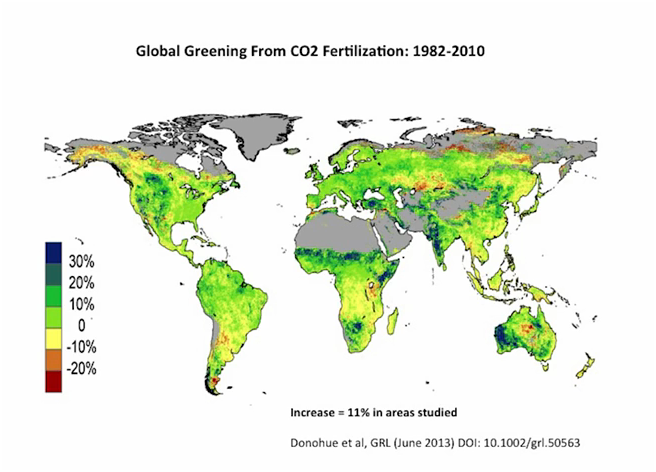
The CO2 increase is already showing its benefits by increasing harvests, forest growth and especially greening grasslands by more than 11%. The greening of the earth is real. See fig:In addition plants use less water to perform photosynthesis as CO2 levels increase.

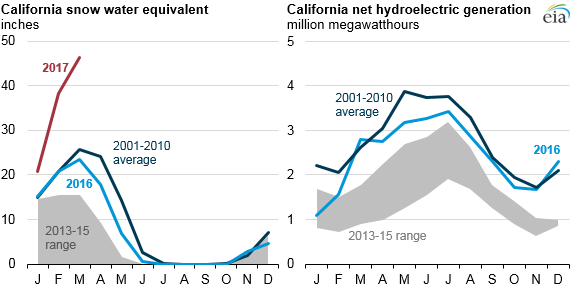
But we need technological breakthrough to clean up our environment and  provide enough water for a thirsty planet, especially in the 10/40 window. Nearly all large cities in that area suffer a shortage of water. In Teheran the water table is sinking by 6 feet a year, and in Mexico City things ate just as bad. Southern California and Las Vegas depend to a large extent on water from Lake Mead, and unless checked Lake Mead is being drained at an alarming rate, (this winter being an exception).

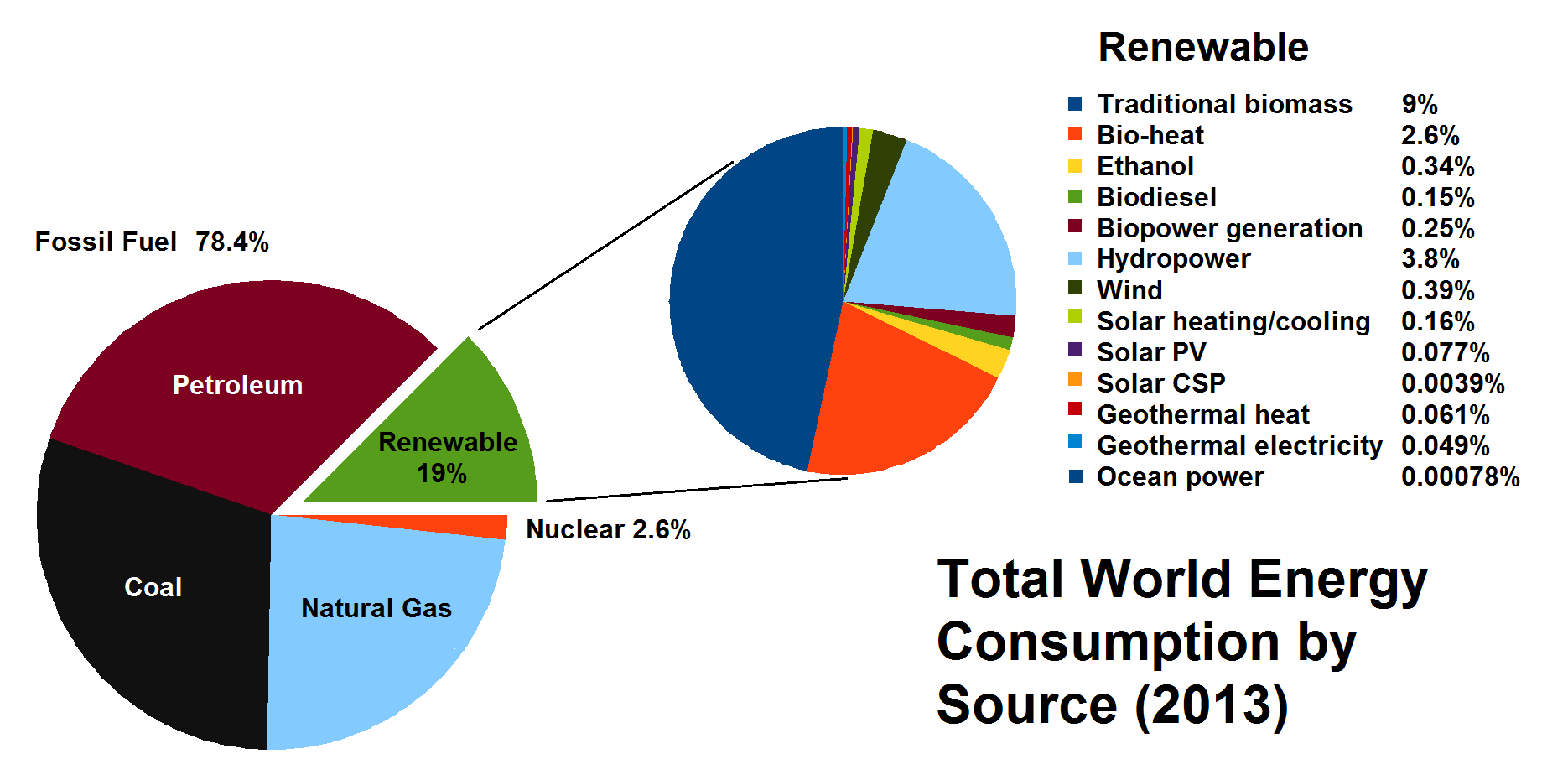
Making clean water and cleaning up the environment takes a lot of energy, so it would be good to check from where the world gets its energy.

More than three quarter of all energy comes from fossil fuel, less than 0.1% comes from solar panels. To tenfold solar panels will not help much, hydropower is limited, ethanol competes with the food supply, only drastic action will change the situation. May I suggest to switch all electricity production now generated by coal and oil to nuclear power, but not any nuclear power, switch to Thorium based nuclear power generation. Until that is done it makes no sense to use electric automobiles and trucks except in special circumstances. There is a million year supply of Thorium, and Thorium based nuclear energy has only 0.01% of the long term nuclear waste of Uranium based nuclear energy.

Don’t believe me? Check out https://lenbilen.com/2012/02/15/eleven-reasons-to-switch-to-thorium-based-nuclear-power-generation/  and https://lenbilen.com/2012/02/15/eleven-more-reasons-to-switch-to-thorium-as-nuclear-fuel/

Then we can tackle the real problems, such as real (not “carbon”) pollution, water, energy distribution, electrification of the developing world, all worthwhile endeavors.

Answers to Question 8. How much will the seas rise?

Answers to Question 9. Are the predictions reliable?

Answers to Question 10. Why do people question climate change?

Answers to Question 11. Is crazy weather tied to climate change?

Answers to Question 12. Will anyone benefit from global warming?

Answers to Question 13. Is there any reason for hope?

Answers to Question 14. How does agriculture affect climate change?

Answers to Question 15. Will the seas rise evenly across the planet?

Answers to Question 16. Is it really all about carbon?


A Climate Realist’s (not so) short Answers to Hard Questions About Climate Change. Question 6 (of 16) What’s the worst-case scenario?

NOV. 28, 2015 gave his answers to 16 questions in the N.Y. Times regarding Climate Change. This Climate realist added his answer.

 Answers to Question 1: How much is the planet heating up?

Answers to Question 2. How much trouble are we in?

Answers to Question 3. Is there anything I can do?

Answers to Question 4. What’s the optimistic scenario?

Answers to Question 5. Will reducing meat in my diet help the climate?

Justin Gillis answer to Question 6. What’s the worst-case scenario?

There are many.

That is actually hard to say, which is one reason scientists are urging that emissions be cut; they want to limit the possibility of any worst-case scenario coming to pass. Perhaps the greatest fear is a collapse of food production, accompanied by escalating prices and mass starvation. Even with runaway emissions growth, it is unclear how likely this would be, as farmers are able to adjust their crops and farming techniques, to a degree, to adapt to climatic changes. Another possibility would be a disintegration of the polar ice sheets, leading to fast-rising seas that would force people to abandon many of the world’s great cities and would lead to the loss of trillions of dollars worth of property and other assets. Scientists also worry about other wild-card scenarios like the predictable cycles of Asian monsoons’ becoming less reliable. Billions of people depend on monsoons to provide water for crops, so any disruptions could be catastrophic.

My answer to Question 6. What’s the worst-case scenario?

CO2 concentration is rising at an unprecedented rate, more than half a percent per year, an order of magnitude faster than the CO2 rise coming out of the ice age. The Arctic ice cap just showed a record low maximum, and the Antarctic ice cap was recently at a new low  since measurements began. So why am I not worried?

Well, I am, but not for the reason you think. What we are seeing is the rain-out after the last el-nino. But not only that, we are in a general cooling trend which the rain-out is masking. Let me explain.

This winter the Arctic was about 12 degrees F warmer than normal on average with a spike of 30 degrees F warmer than normal, well documented.                  What happened?  There came one storm after another all the way from the Philippines or China and caused record rain and snowfall in California.

So much for California’s “unending drought”.

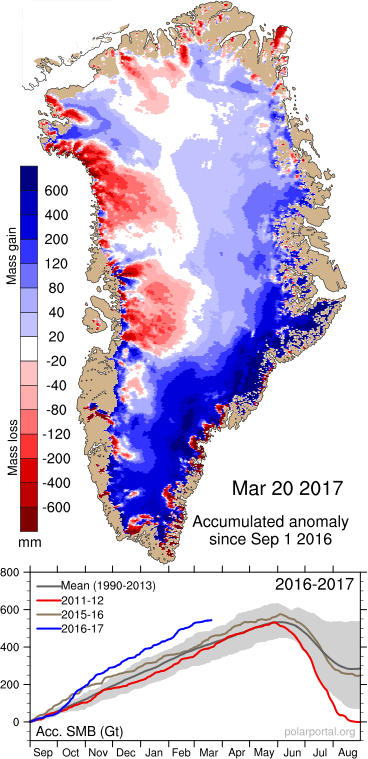
Then the storms went over the West, picked up more moisture from the Mexican Gulf and went up the East Coast, rained in the North Atlantic and snowed out in the Arctic and Greenland. The picture on the right shows just much it has snowed this winter over Greenland, a record snow accumulation so far. And it is concentrated to  East Greenland while North and West Greenland had normal snowfalls. The storms went up through Iceland and it rained as far north as Svalbard, preventing the Barents Sea from freezing, but delivering so much snow to the rest of the Arctic that the ice accumulation was near normal in spite of the unusually warm winter.

Come spring Arctic temperatures will be lower than normal, as they have been the last two years snow melt will go slower than normal, and there will be more multi-year ice than the year before. Worldwide temperatures will no longer get the boost they got from the unusually warm winter, so the “18 year pause” will be back, now as a 19 year pause.

What worries me are a number of factors, all leading to a new ice age much faster than what can be expected even with our best efforts to increase the CO2 level.

The next solar cycle, cycle 25 will be weaker than predicted, surpassing even the Maunder minimum. The Maunder minimum coincided with the little ice age.

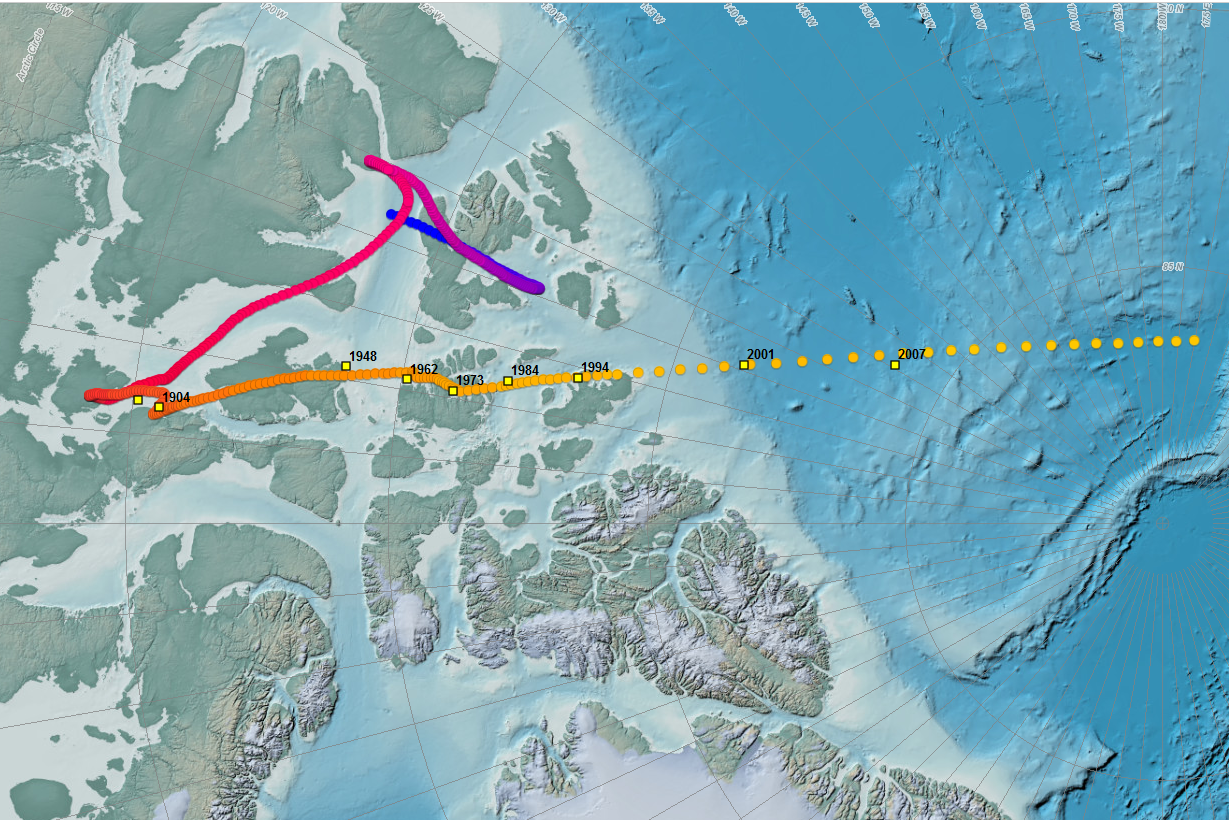
The earth’s magnetic field is starting to act erratically. The magnetic north pole is speeding up and is now way up in the Arctic, near the North pole. The chart on the right shows the observed north dip poles during 1831 – 2007 as yellow squares. Modeled pole locations from 1590 to 2020 are circles progressing from blue to yellow. In addition the magnetic field is getting substantially weaker, maybe a breakup is possible having two North Poles and two South Poles. If this occurs, the protection from the cosmic radiation from the Sun will be weakened, causing more clouds and maybe trigger the next ice age.

Then there is the double star KIC 9832227. They are only 1,800 light-years away, are an eclipsing binary pair, which means as they revolve around one another, each one briefly blots out the other from the perspective of a viewer on Earth. In 2021 or 2022 we will see them merge into one causing a red supernova. When this happens, because they are so near, we may even observe gravity waves. But from a climate standpoint there will be a burst of cosmic radiation, first the gamma rays clming at the speed of light, then with a slight delay the other cosmic radiation, coming at a time of the solar minimum and an unusually weak earth magnetic field.

This is new territory, and the best we can do is to increase CO2. It will not help much, but CO2 will help rather than hurt.

Then there is always the possibility of a supervolcanic explosion spewing ash way up into the stratosphere.

And for people who want to worry, don’t forget supersized meteorites!

All these worst case fears lead to a cooling earth.

On the other hand, the Sun is heating up at a rate of about 1% per 100 million years, not enough to worry about.

A Climate Realist’s (not so) short Answers to Hard Questions About Climate Change. Question 5 (of 16) Will reducing meat in my diet help the climate?

NOV. 28, 2015 gave his answers to 16 questions in the N.Y. Times regarding Climate Change. This Climate realist added his answer.

 Answers to Question 1: How much is the planet heating up?

Answers to Question 2. How much trouble are we in?

Answers to Question 3. Is there anything I can do?

Answers to Question 4. What’s the optimistic scenario?

Justin Gillis answer to  Question 5. Will reducing meat in my diet help the climate?

Yes, beef especially.

Agriculture of all types produces greenhouse gases that warm the planet, but meat production is especially harmful – and beef is the most environmentally damaging form of meat. Some methods of cattle production demand a lot of land, contributing to destruction of forests; the trees are typically burned, releasing carbon dioxide into the atmosphere. Other methods require huge amounts of water and fertilizer to grow food for the cows.

The cows themselves produce emissions of methane, a potent greenhouse gas that causes short-term warming. Meat consumption is rising worldwide as the population grows, and as economic development makes people richer and better able to afford meat.

This is worrisome: Studies have found that if the whole world were to start eating beef at the rate Americans eat it, produced by the methods typically used in the United States, that alone might erase any chance of staying below an internationally agreed-upon limit on global warming. Pork production creates somewhat lower emissions than beef production, and chicken is lower still. So reducing your meat consumption, or switching from beef and pork to chicken in your diet, are both moves in the right direction. Of course, as with any kind of behavioral change meant to benefit the climate, this will only make a difference if lots of other people do it, too, reducing the overall demand for meat products.

My answer to  Question 5. Will reducing meat in my diet help the climate?

It will do very little for the climate, but it might help your personal economy to switch your eating habits. Beef used to be cheap, but no more. Bacon, baby pork ribs, beef tenderloin, veal cutlets, chicken wings are at premium prices, and switching from beef to chicken and turkey is already under way thanks to the wonderful regulator called the free market. However, there is one thing that will help the environment and indirectly the climate:

Switch from feed-lot beef to grass fed beef. Release more grasslands for responsible grazing to preserve the environment. Here is an interesting video:

What do you think?

Answers to Question 6. What’s the worst-case scenario?

Answers to Question 7. Will a tech breakthrough help us?

Answers to Question 8. How much will the seas rise?

Answers to Question 9. Are the predictions reliable?

Answers to Question 10. Why do people question climate change?

Answers to Question 11. Is crazy weather tied to climate change?

Answers to Question 12. Will anyone benefit from global warming?

Answers to Question 13. Is there any reason for hope?

Answers to Question 14. How does agriculture affect climate change?

Answers to Question 15. Will the seas rise evenly across the planet?

Answers to Question 16. Is it really all about carbon?

A Climate Realist’s (not so) short Answers to Hard Questions About Climate Change. Question 4 (of 16) What’s the optimistic scenario?

NOV. 28, 2015 gave his answers to 16 questions in the N.Y. Times regarding Climate Change. This Climate realist added his answer.

 Answers to Question 1: How much is the planet heating up?

Answers to Question 2. How much trouble are we in?

Answers to Question 3. Is there anything I can do?

Justin Gillis answer to Question 4. What’s the optimistic scenario?

“Several things have to break our way.

In the best case that scientists can imagine, several things happen: Earth turns out to be less sensitive to greenhouse gases than currently believed; plants and animals manage to adapt to the changes that have already become inevitable; human society develops much greater political will to bring emissions under control; and major technological breakthroughs occur that help society both to limit emissions and to adjust to climate change.

The two human-influenced variables are not entirely independent, of course: Technological breakthroughs that make clean energy cheaper than fossil fuels would also make it easier to develop the political will for rapid action.

Scientists say the odds of all these things breaking our way are not very high, unfortunately. The Earth could just as easily turn out to be more sensitive to greenhouse gases than less. Global warming seems to be causing chaos in parts of the natural world already, and that seems likely to get worse, not better. So in the view of the experts, simply banking on a rosy scenario without any real plan would be dangerous. They believe the only way to limit the risks is to limit emissions.”

My answer to Question 4. What’s the optimistic scenario?

We are now in a sweet spot as to climate, not too warm and no ice age yet. Were it not for increasing CO2 levels the little ice age might have triggered the onset of a real ice age, but a lot of factors, such as coming out of the Maunder solar minimum, starting industrialization in England and Germany sooting up the growing glaciers so they started melting again, the diminishing effect from the Tycho Brahe and Kepler supernovas cosmic radiation, all contributed to get us out of the start of the new ice age. Yet, we are into the latter stages of the bog generating phase of the interglacial period, and the onset of a new ice age is overdue.

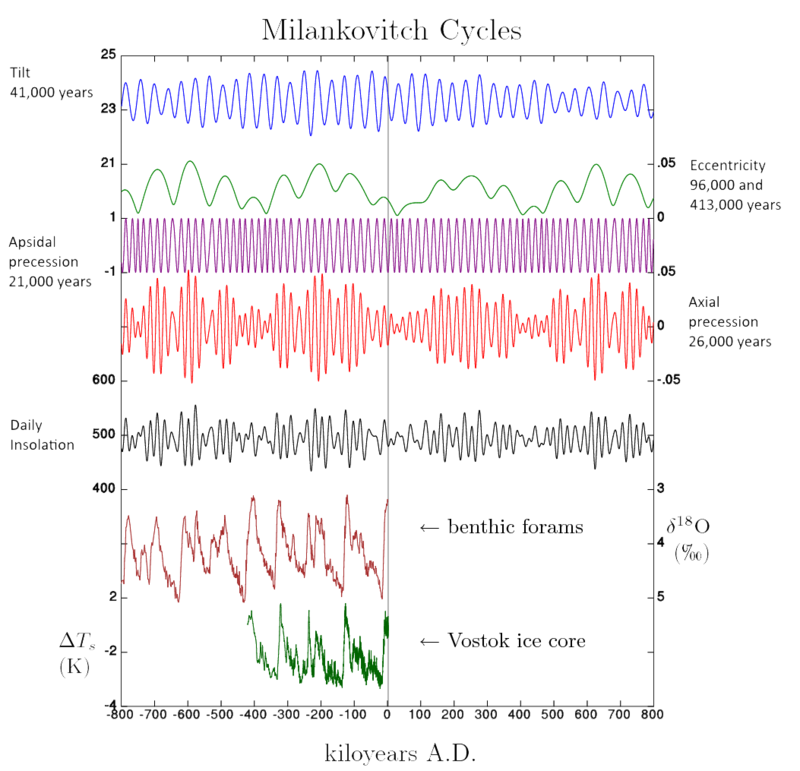
We need more CO2, not less to keep us in the climate sweet spot. Increasing CO2 levels to between 850 and 1000 ppm should delay the onset by about 2000 to 5000 years (my guess), but after that the next ice age is coming. Historically, according to the Milankovitch cycles we should have already entered the next ice age.

This picture is simplified, but together with the other cycles the picture is quite complicated.

The take home from this picture is that daily insolation (at the 60th latitude) can vary by as much as 100 w/m2 or about 50 times the effect of a doubling of the CO2 level. It is also worth noting that the normal state of the earth is ice age, and thermal runaways have never occurred, even when in past geological ages, CO2 levels were over 10000 ppm.

Answers to Question 5. Will reducing meat in my diet help the climate?Answers to Question 6. What’s the worst-case scenario?

Answers to Question 7. Will a tech breakthrough help us?

Answers to Question 8. How much will the seas rise?

Answers to Question 9. Are the predictions reliable?

Answers to Question 10. Why do people question climate change?

Answers to Question 11. Is crazy weather tied to climate change?

Answers to Question 12. Will anyone benefit from global warming?

Answers to Question 13. Is there any reason for hope?

Answers to Question 14. How does agriculture affect climate change?

Answers to Question 15. Will the seas rise evenly across the planet?

Answers to Question 16. Is it really all about carbon?


A Climate Realist’s (not so) short Answers to Hard Questions About Climate Change. Question 3 (of 16) Is there anything I can do?

NOV. 28, 2015 gave his answers to 16 questions in the N.Y. Times regarding Climate Change. This Climate realist added his answer.

 Answers to Question 1: How much is the planet heating up?

Answers to Question 2. How much trouble are we in?

Justin Gillis answer to Question 3. Is there anything I can do?

Fly less, drive less, waste less.

You can reduce your own carbon footprint in lots of simple ways, and most of them will save you money. You can plug leaks in your home insulation to save power, install a smart thermostat, switch to more efficient light bulbs, turn off the lights in any room where you are not using them, drive fewer miles by consolidating trips or taking public transit, waste less food, and eat less meat.

Perhaps the biggest single thing individuals can do on their own is to take fewer airplane trips; just one or two fewer plane rides per year can save as much in emissions as all the other actions combined. If you want to be at the cutting edge, you can look at buying an electric or hybrid car, putting solar panels on your roof, or both.

If you want to offset your emissions, you can buy certificates, with the money going to projects that protect forests, capture greenhouse gases and so forth. Some airlines sell these to offset emissions from their flights, and after some scandals in the early days, they started to scrutinize the projects closely, so the offsets can now be bought in good conscience. You can also buy offset certificates in a private marketplace, from companies such as TerraPass in San Francisco that follow strict rules set up by the state of California; some people even give these as holiday gifts. Yet another way: In states that allow you to choose your own electricity supplier, you can often elect to buy green electricity; you pay slightly more, with the money going into a fund that helps finance projects like wind farms.

In the end, though, experts do not believe the needed transformation in the energy system can happen without strong state and national policies. So speaking up and exercising your rights as a citizen matters as much as anything else you can do.

My answer to Question 3. Is there anything I can do?

First let us look at the so called carbon footprint. These feet are from 2010.

I would like to acknowledge Stanford Kay Studio; a version of this graphic first appeared in Miller-McCune. Thank you, Stanford! Copyright Stanford Kay 2010. China has the largest carbon footprint in the world, followed by the United States, but when it comes to carbon footprint per capita Gibraltar is number one, followed by the U.S Virgin Island.  How can that be? Everything in Gibraltar must be imported, and nearly everything is imported to the U.S. Virgin Islands.

The solution to lower the carbon footprint is to produce and buy local, and eat things produced in season.

Pipelines has less than half the carbon footprint of the same substance transported by rail.

Transport by rail has much smaller carbon footprint than transport by truck.

Electric cars make no sense as long as electricity is produced by fossil fuels. The extra energy consumed in manufacturing the batteries will never be repaid if transmission and conversion losses are taken into account.

Make food from scratch rather than eating processed food.

If possible plant a garden and eat fresh vegetables. Even a window pot with chives makes the sour cream tasty. A rosemary pot is wonderful. I could wax eloquent, but you get the point.

Don’t ever buy CFL light bulbs again, and don’t throw the old bulbs in the trash. Sometimes in the future we will have to mine the landfills.

A lot of stuff is flown in from abroad, very energy inefficient. Work to make it locally.

Answers to Question 4. What’s the optimistic scenario?

Answers to Question 5. Will reducing meat in my diet help the climate?

Answers to Question 6. What’s the worst-case scenario?

Answers to Question 7. Will a tech breakthrough help us?

Answers to Question 8. How much will the seas rise?

Answers to Question 9. Are the predictions reliable?

Answers to Question 10. Why do people question climate change?

Answers to Question 11. Is crazy weather tied to climate change?

Answers to Question 12. Will anyone benefit from global warming?

Answers to Question 13. Is there any reason for hope?

Answers to Question 14. How does agriculture affect climate change?

Answers to Question 15. Will the seas rise evenly across the planet?

Answers to Question 16. Is it really all about carbon?


A Climate Realist’s not so short Answers to Hard Questions About Climate Change. Question 2 (of 16) How much trouble are we in?

NOV. 28, 2015 gave his answers to 16 questions in the N.Y. Times regarding Climate Change. This Climate realist added his answer.

 Answers to Question 1: How much is the planet heating up?

Justin Gillis answer to Question 2. How much trouble are we in?

“For future generations, big trouble.

The risks are much greater over the long run than over the next few decades, but the emissions that create those risks are happening now. Over the coming 25 or 30 years, scientists say, the climate is likely to resemble that of today, although gradually getting warmer. Rainfall will be heavier in many parts of the world, but the periods between rains will most likely grow hotter and therefore drier. The number of hurricanes and typhoons may actually fall, but the ones that do occur will draw energy from a hotter ocean surface, and therefore may be more intense, on average, than those of the past. Coastal flooding will grow more frequent and damaging.

Longer term, if emissions continue to rise unchecked, the risks are profound. Scientists fear climate effects so severe that they might destabilize governments, produce waves of refugees, precipitate the sixth mass extinction of plants and animals in Earth’s history, and melt the polar ice caps, causing the seas to rise high enough to flood most of the world’s coastal cities.

All of this could take hundreds or even thousands of years to play out, conceivably providing a cushion of time for civilization to adjust, but experts cannot rule out abrupt changes, such as a collapse of agriculture, that would throw society into chaos much sooner. Bolder efforts to limit emissions would reduce these risks, or at least slow the effects, but it is already too late to eliminate the risks entirely.”

My answer to  question: 2. How much trouble are we in?

For climate alarmists: big trouble, for climate realists, not anything out of the ordinary as to temperature rise.
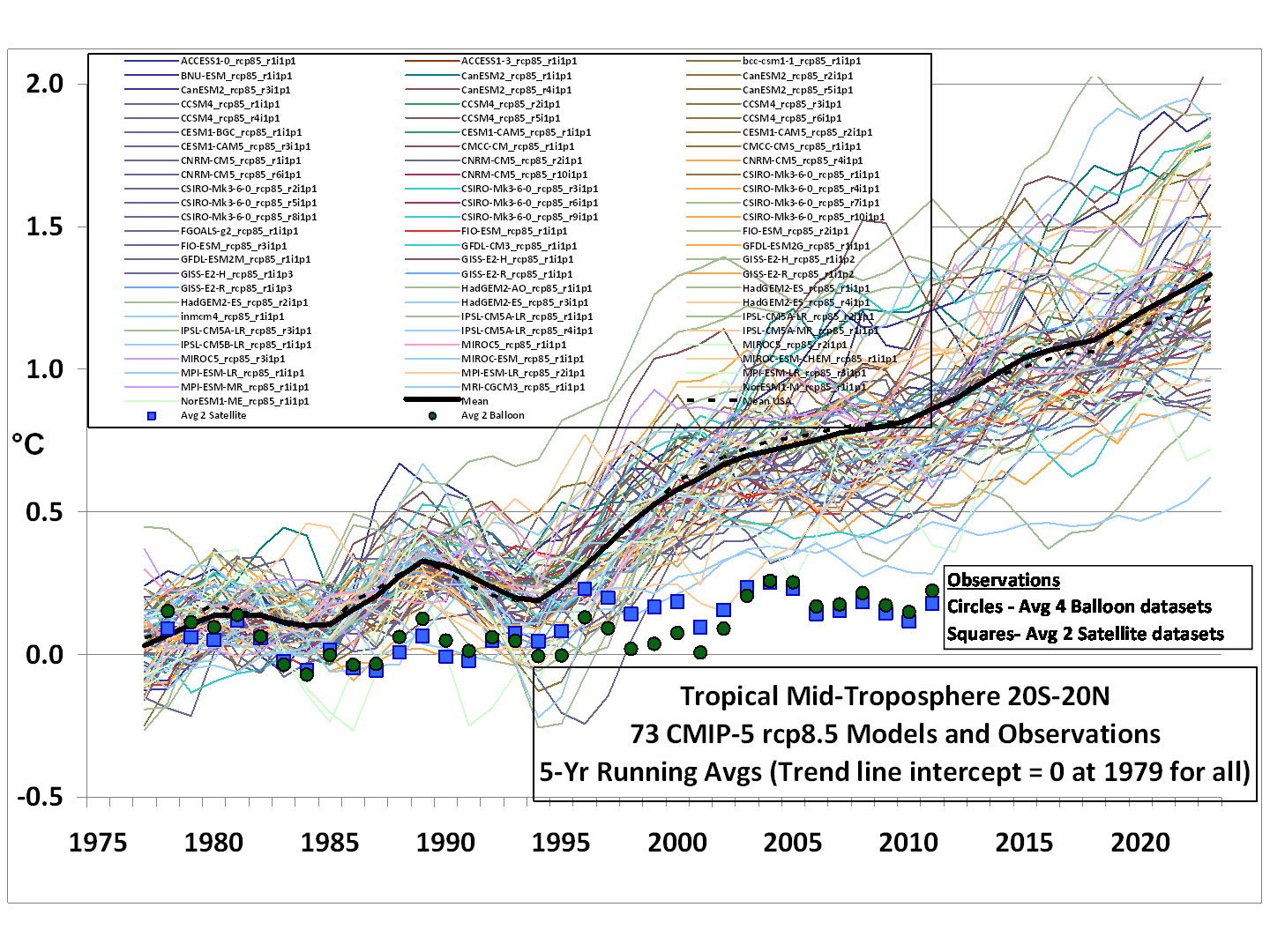
The temperature rise is predicted using models that assume the major effect on the climate is from rising CO2 and ignore other factors such as a changing cloud cover. The imbalance due to rising CO2 levels is less than 2W/m2, and every percent change in cloud cover makes a larger difference. Here is the performance of 73 climate models versus observations.
There is almost no correlation between models and observations. What is the problem? Looking at how the models model clouds gives a hint:The models are way off on the amount of clouds. Antarctica is almost cloud free and the Arctic has plenty of clouds. This means the models totally underestimate the effects of water vapor (the source of clouds) and overestimate the effects of rising CO2.  It turns out that clouds are the major stabilizer of the climate on the high end, thanks to their high negative feedback – more clouds, cooler climate. This means that even with a doubling of the CO2 levels we will not even get back to even the Medieval warm period. We are in a long cooling trend.
No such feedback occurs when it cools, rather more snow means higher albedo which leads to a new ice age. More CO2 will delay the onset of the next ice age, but will not prevent it. Fear not, the next ice age is probably more than 5000 years away.

A Climate Realist’s not so short Answers to Hard Questions About Climate Change. Question 1 (of 16) How much is the planet heating up?

1. How much is the planet heating up?

As of February 2016, the Earth has warmed about 1.8 degrees Fahrenheit since 1880, when records began at a global scale. That figure includes the surface of the ocean. The warming is greater over land, and greater still in the Arctic and parts of Antarctica, but there is very little warming in the tropics.

Since pre-industrial times the CO2 level has increased from 280 ppm to 405 ppm, an increase of about 45%, and we know that for every doubling of CO2 temperatures will rise about 1.6 degrees F unless other factors dominate, such as positive or negative temperature feedbacks.

During ice-ages global temperatures hover around 10 degrees F colder with CO2 levels around 185 ppm. Global temperature was about 6 degree F colder than today and in about 4000 year time temperature rose rapidly and we came out of the ice age. During that time, and with a 300 to 800 year delay CO2 rose from 185 ppm to 265 ppm, a 43% rise.  Coming out of the ice age, if CO2 was the only factor,  the effect of doubling CO2 would increase global temperatures by 11.5 degrees F.

Al Gore saw the charts, and got so alarmed that he wrote “Earth in the balance.” What he didn’t take into account was that the major rise in temperature was not due to the increasing CO2, but the loss of albedo when the ice melted. CO2 played a supporting role, a lagging one. Then, around 9000 years ago temperatures stopped rising, CO2 levels stabilized and we entered a period of relative stability. What happened?

The albedo came back, this time in the form of increasing clouds. Once the oceans got warmer and stabilized, there was enough water vapor in the air to make more clouds, and so stabilize temperature. Since then temperatures have been on a slow decline, and the trend was accelerating until the ” little ice age”. There were 3 notable warming periods, the Minoan, the Roman, and the Medieval warming period.

During the Roman warm period wine grapes were grown almost up to the Hadrian Wall. It is well documented, and in Northhamptonshire, England there were at least 9 flourishing wineries..

The Roman Northamptonshire wine
was good, not excessively fine.
So it just goes to show
that Al Gore does not know
of Climate Change past, that’s my line.

The the dark ages came and grapes no longer ripened in England. During the Medieval Warm Period there was at least one cheese farm on Greenland “Gården under sanden”, abandoned as the glaciers regrew, starting the “Little Ice Age”. During the little ice age it got so cold, that in Jan 1658 the Swedish army crossed the Great Belt of Denmark over ice, canons and all,  and sacked Copenhagen. We are still recovering from the “little ice age.” 2016 may have been a warm year, but most years since the ice age were warmer. See Chart.Greenlandgisp-last-10000-newWe are still in the sweet spot of a remarkable stable Climate, only more CO2 will save us from a new Ice Age. We are not yet back to the Medieval warming period, much less the Roman and even less the Minoan. A doubling of CO2 will not get us back to the Roman warming period since the negative feedback from clouds will dominate and limit the temperature rise.

As to the fear mongering claim that “The heat accumulating in the Earth because of human emissions is roughly equal to the heat that would be released by 400,000 Hiroshima atomic bombs exploding across the planet every day,” I can only say that the energy from the sun is equivalent to over 25oo Hiroshima bombs per second, or about 540 times as much as comes from human energy production, about 0.2%, hardly anything to worry about.

Answers to Question 2. How much trouble are we in?

Answers to Question 3. Is there anything I can do?

Answers to Question 4. What’s the optimistic scenario?

Answers to Question 5. Will reducing meat in my diet help the climate?

Answers to Question 6. What’s the worst-case scenario?

Answers to Question 7. Will a tech breakthrough help us?

Answers to Question 8. How much will the seas rise?

Answers to Question 9. Are the predictions reliable?

Answers to Question 10. Why do people question climate change?

Answers to Question 11. Is crazy weather tied to climate change?

Answers to Question 12. Will anyone benefit from global warming?

Answers to Question 13. Is there any reason for hope?

Answers to Question 14. How does agriculture affect climate change?

Answers to Question 15. Will the seas rise evenly across the planet?

Answers to Question 16. Is it really all about carbon?