In addition he signed one Executive Order restoring Science to the Golden Standard: Free from politics!
In the presentation of the Executive Orders the CEO of Oklo, James DeWitte mentioned that we are restarting a technology that has been inactive for over 40 years. This can only mean he meant without saying so the Oak ridge Molten Salt Thorium reactor. It was going great, but President Nixon wanted to go with the fast breeder reactor and move nuclear development to California, so they started to badmouth the MSR. One false accusation was that it was unreliable and needed to be shutdown frequently. The real reason was it was routinely shut down on weekends to save money and personnel. The Molten Salt Reactor does not have a poison time after shutdown as does conventional power station but can be scaled up and down including small power stoppages. I see this as an advantage. Anyhow, this is what Mr. DeWitte said:
One of many new options
There are only a few fissionable options, Uranium 233, Uranium 235 and Plutonium 239. Uranium 233 is produced by bombarding Thorium 232 with neutrons. Plutonium 239 is produced by bombarding Uranium 238 with neutrons.
Right now only 0.5% of the mined uranium is used. The rest goes to nuclear waste. Molten Salt reactors can use the nuclear waste as raw material and use the other 99.5% of the available energy. Another exciting use of Plutonium is when we finally dismantle the nuclear arsenal and burn it for peaceful use. And there is four times as much Thorium as there is mine-able Uranium, enough for thousands of years!
This is the beginning!
Here are 30 reasons why Thorium is a superior source for nuclear power:
Section 1. Purpose. Nuclear energy is critical to United States national security. That is why I have taken a series of actions to promote its development and facilitate its use. On June 29, 2017, I announced an initiative to revive and expand the nuclear energy sector and directed a complete review of United States nuclear energy policy to help find new ways to revitalize this crucial energy resource. On July 12, 2019, I signed a Presidential Memorandum entitled “The Effect of Uranium Imports on the National Security and Establishment of the United States Nuclear Fuel Working Group,” with the goal of examining the current state of domestic nuclear fuel production and reinvigorating the nuclear fuel supply chain, consistent with United States national security and nonproliferation goals. On August 20, 2019, I signed National Security Presidential Memorandum-20, entitled “Launch of Spacecraft Containing Space Nuclear Systems,” calling for development and use of space nuclear systems to enable or enhance space exploration and operational capabilities.
The purpose of this order is to take an important additional step to revitalize the United States nuclear energy sector, reinvigorate America’s space exploration program, and develop diverse energy options for national defense needs. Under this action, the United States Government will coordinate its nuclear activities to apply the benefits of nuclear energy most effectively toward American technology supremacy, including the use of small modular reactors for national defense and space exploration. This work is critical to advancing my Administration’s priorities for the United States to lead in research, technology, invention, innovation, and advanced technology development; its mission to promote and protect the United States national security innovation base; its drive to secure energy dominance; and its commitment to achieving all of these goals in a manner consistent with the highest nuclear nonproliferation standards.
The United States was the first nation to invent and develop the technology to harness nuclear energy. Since the 1950s, the United States Navy has been operating and advancing transportable nuclear reactors, resulting in powerfully enhanced marine propulsion for its aircraft carriers and allowing nuclear-powered submarines to remain submerged for extended periods of time.
The United States must sustain its ability to meet the energy requirements for its national defense and space exploration initiatives. The ability to use small modular reactors will help maintain and advance United States dominance and strategic leadership across the space and terrestrial domains.
Sec. 2. Policy. It is the policy of the United States to promote advanced reactor technologies, including small modular reactors, to support defense installation energy flexibility and energy security, and for use in space exploration, guided by the following principles:
(a) A healthy and robust nuclear energy industry is critical to the national security, energy security, and economic prosperity of the United States;
(b) The United States should maintain technology supremacy for nuclear research and development, manufacturing proficiency, and security and safety;
(c) The United States Government should bolster national defense and space exploration capabilities and enable private-sector innovation of advanced reactor technologies.
Sec. 3. Demonstration of Commercial Reactors to Enhance Energy Flexibility at a Defense Installation. (a) Micro-reactors have the potential to enhance energy flexibility and energy security at domestic military installations in remote locations. Accordingly, the Secretary of Defense shall, within 180 days of the date of this order, establish and implement a plan to demonstrate the energy flexibility capability and cost effectiveness of a Nuclear Regulatory Commission-licensed micro‑reactor at a domestic military installation.
(b) If the demonstration is successful, the Secretary of Defense shall identify opportunities at domestic military installations where this capability could enhance or supplement the fulfillment of installation energy requirements. In identifying these opportunities, the Secretary of Defense shall take into account considerations that are unique to national defense needs and requirements that may not be relevant in the private sector, such as:
(i) the ability to provide resilient, independent energy delivery to installations in the event that connections to an electrical grid are compromised;
(ii) the ability to operate for an extended period of time without refueling;
(iii) system resistance to disruption from an electro‑magnetic pulse event; and
(iv) system cybersecurity requirements.
Sec. 4. Defense Capabilities. (a) The Department of Defense is one of the largest consumers of energy in the world, using more than 10 million gallons of fuel per day and 30,000 gigawatt-hours of electricity per year, nearly all of which is provided through civilian electrical grids. Fuel demands for a modern United States military have dramatically grown since World War II and are anticipated to continue to increase in order to support high-energy-usage military systems. In this context, nuclear power could significantly enhance national defense power capabilities.
(b) The Secretary of Defense shall, in consultation with the Secretary of State, the Secretary of Commerce, the Secretary of Energy, and the Administrator of the National Aeronautics and Space Administration (NASA Administrator):
(i) determine whether advanced nuclear reactors can be made to benefit Department of Defense future space power needs;
(ii) pilot a transportable micro-reactor prototype;
(iii) direct an analysis of alternatives for personnel, regulatory, and technical requirements to inform future decisions with respect to nuclear power usage; and
(iv) direct an analysis of United States military uses for space nuclear power and propulsion technologies and an analysis of foreign adversaries’ space power and propulsion programs.
Sec. 5. Space Exploration. (a) Nuclear power sources that use uranium fuel or plutonium heat sources are essential to deep space exploration and in areas where solar power is not practical. NASA uses radioisotope power systems, such as radioisotope thermoelectric generators and radioisotope heater units, to provide power and heat for deep space robotic missions. Nuclear power sources in the kilowatt range may be needed for demonstrating In-situ Resource Utilization (ISRU) and robotic exploration of permanently shadowed craters on the Moon that contain frozen water. Nuclear reactors up to 100 kilowatts may be needed to support human habitats, ISRU, other facilities, and rovers on both the Moon and Mars. Power sources in the megawatt range would be necessary for efficient, long‑duration deep space propulsion. Affordable, lightweight nuclear power sources in space would enable new opportunities for scientific discovery. The sustainable exploration of the Moon, Mars, and other locations will be enhanced if small modular reactors can be deployed and operated remotely from Earth.
(b) Within 180 days of the date of this order, the NASA Administrator, in consultation with heads of other executive departments and agencies (agencies), as appropriate, shall define requirements for NASA utilization of nuclear energy systems for human and robotic exploration missions through 2040 and analyze the costs and benefits of such requirements. In defining these requirements, the NASA Administrator shall take into account considerations unique to the utilization of nuclear energy systems in space, such as:
(i) transportability of a reactor prior to and after deployment;
(ii) thermal management in a reduced- or zero-gravity environment in a vacuum or near-vacuum;
(iii) fluid transfer within reactor systems in a reduced or zero-gravity environment;
(iv) reactor size and mass that can be launched from Earth and assembled in space;
(v) cooling of nuclear reactors in space;
(vi) electric power requirements
(vii) space safety rating to enable operations as part of human space exploration missions;
(viii) period of time for which a reactor can operate without refueling; and
(ix) conditioning of reactor components for use in the space environment.
Sec. 6. Domestic Fuel Supply. (a) A thriving and secure domestic nuclear fuel supply chain is critical to the national interests of the United States. A viable domestic nuclear fuel supply chain not only supports defense and national security activities, but also enables the success of the commercial nuclear industry. Many advanced reactor concepts, however, will require high-assay, low-enriched uranium (HALEU), for which no domestic commercial enrichment capability currently exists. The United States must take steps to ensure a viable United States-origin HALEU supply.
(b) The Secretary of Energy shall complete the Department of Energy’s ongoing 3-year, $115 million demonstration of a United States-origin enrichment technology capable of producing HALEU for use in defense-related advanced reactor applications. Within funding available for the demonstration project, the Secretary of Energy should develop a plan to promote successful transition of this technology to the private sector for commercial adoption.
(c) The Secretary of Energy shall consult with the Secretary of Defense, the Director of the Office of Management and Budget, and the NASA Administrator regarding how advanced fuels and related technologies can best support implementation of sections 3, 4, and 5 of this order.
Sec. 7. Common Technology Roadmap. (a) The Secretary of State, the Secretary of Defense, the Secretary of Commerce, the Secretary of Energy, and the NASA Administrator shall develop a common technology roadmap through 2030 that describes potential development programs and that coordinates, to the extent practicable, terrestrial-based advanced nuclear reactor and space-based nuclear power and propulsion efforts. Agencies shall remain responsible for funding their respective mission-unique requirements. The roadmap shall also include, at a minimum:
(i) assessments of foreign nations’ space nuclear power and propulsion technological capabilities;
(ii) pathways for transitioning technologies developed through Federally supported programs to private-sector activities; and
(iii) other applications supporting the goals provided in section 1 of this order.
(b) The roadmap shall be submitted to the President by the Director of the Office of Management and Budget, the Assistant to the President for Domestic Policy, the Director of the Office of Science and Technology Policy, the Assistant to the President for National Security Affairs, the Assistant to the President for Economic Policy, and the Executive Secretary of the National Space Council before submissions of budget proposals by the Secretary of State, the Secretary of Commerce, the Secretary of Energy, and the NASA Administrator.
Sec. 8. Definitions. For purposes of this order:
(a) The term “small modular reactor” refers to an advanced nuclear reactor of electric generation capacity less than 300 megawatt-electric. Because of the smaller size, small modular reactors can generally be designed for factory fabrication and modular construction to take advantage of economies of serial production and shorter construction times.
(b) The term “micro-reactor” refers to a nuclear reactor of electric generation capacity less than 10 megawatt-electric that can be deployed remotely. Micro-reactors are a subset of small modular reactors and are also known as “very small modular reactors.”
(c) The term “transportable micro-reactor” refers to a micro-reactor that can be moved by truck, ship, or large military transport aircraft and is capable of both rapid deployment and teardown or removal, typically with safe teardown or removal less than 1 week after 1 year of full-power operation.
(d) The term “space exploration” refers to in-space scientific and resource exploration, in-space economic and industrial development, and development of associated in-space logistical infrastructure.
(e) The term “national defense” refers to the protection of the United States and its interests from foreign attack or other natural danger, including phenomena occurring on Earth and in space.
Sec. 9. General Provisions. (a) Nothing in this order shall be construed to impair or otherwise affect:
(i) the authority granted by law to an executive department or agency, or the head thereof; or
(ii) the functions of the Director of the Office of Management and Budget relating to budgetary, administrative, or legislative proposals.
(b) This order shall be implemented consistent with applicable law and subject to the availability of appropriations.
(c) This order is not intended to, and does not, create any right or benefit, substantive or procedural, enforceable at law or in equity by any party against the United States, its departments, agencies, or entities, its officers, employees, or agents, or any other person.
DONALD J. TRUMP THE WHITE HOUSE, January 5, 2021. WhiteHouse.gov
Thorium Nuclear Power generators scale beautifully from small portable generators to full size power plants. One of the first applications was as an airborne nuclear reactor.
Granted this was not a Thorium breeder reactor, but it proves nuclear reactors can be made lightweight. Thorium reactors can be made even lighter as long as they are not of the breeder type.
Lawrence Livermore, Los Alamos, and Argonne national laboratories are designing a self-contained nuclear reactor with tamper-resistant features. Called SSTAR (small, sealed, transportable, autonomous reactor), this next-generation reactor will produce 10 to 100 megawatts electric and can be safely transported on ship or by a heavy-haul transport truck.
This type of reactor can be transported to disaster areas, and provide emergency power, during rescue and rebuilding efforts. This particular reactor still uses solid fuel and steam heat exchanger. A LFTR reactor with a supercritical CO2 gas heat exchanger would be even more compact and efficient.
From these compact designs, Thorium power can be scaled up to any size. The LFTR reactor will be placed on barges and left moored in navigable rivers or in ocean harbors. This will typically be a one or two 250 MW LFTR with reprocessing capabilities. Where there is only road access the LFTR’s will be one or up to six 100 MW LFTR with one reprocessing fuel capability servicing the nuclear units one at a time on a rotary basis. These will come as complete units tested and ready for use on a number of trucks. It is to be noted that no water is necessary for cooling. There can also be 5 and 10 MW power units for freight trains and large towboats. They will not have reprocessing capabilities on board, but will be serviced regularily by refueling and reprocessing stations in key locations. Oceangoing ships will be fitted with LFTR reactors with reprocessing capability. When all of this is done the need for diesel fuel for nearly all shipping by train, barge or ship will be nearly eliminated.
Admittedly there are security risks associated with this arrangement. Locomotives and barges can be stolen, ships can be hijacked, when the whole reactor vessel came on a truck it can be stolen. By having minimum fuel at all time, it increases safety, but it also makes it possible for terrorists and common thieves to steal shipments of fuel and fissile by-products. This means that there must still be strict security measurements for maintaining chain of security for U-233 and Protactinium.
The climate is changing. The American Southwest is getting hotter and drier, the American East is getting wetter and the North is getting snowier. U whererban areas are getting warmer as energy use and paving increase. How much of all this is attributable to increasing greenhouse effect? How much is due to changing cloud patterns? How much is due to water and air pollution? And how much is due to land use changes?
1. The greenhouse effect increase.
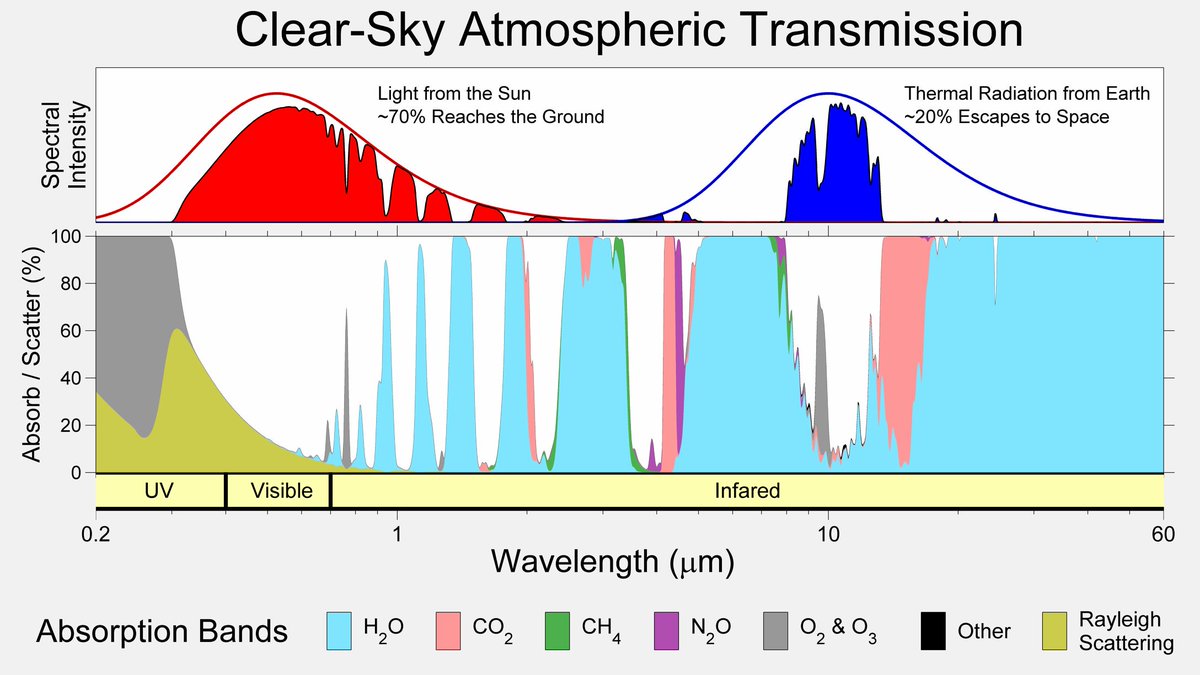
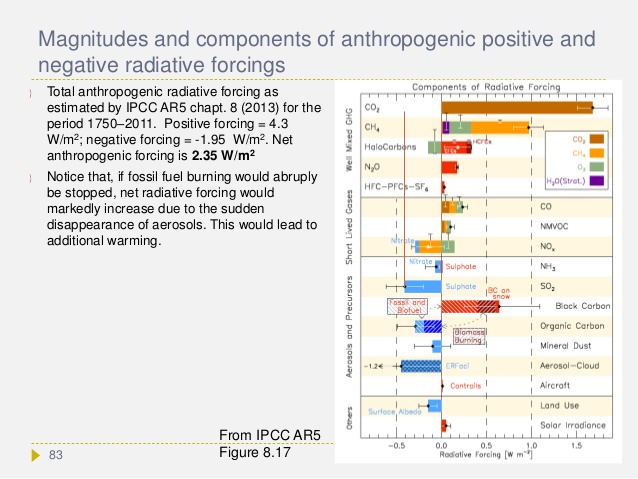
To get a grasp of how the greenhouse effect functions look at this chart:
From this chart we can see that water vapor is by far the most important greenhouse gas, followed by CO2 with Methane and Nitrous oxide far behind. Oxygen is part of the atmosphere, and so is Nitrogen and their concentration is assumed to be constant. Ozone concentration is too small to have any effect. Raleigh scattering is why the sky is blue and it is constant regardless of other factors.
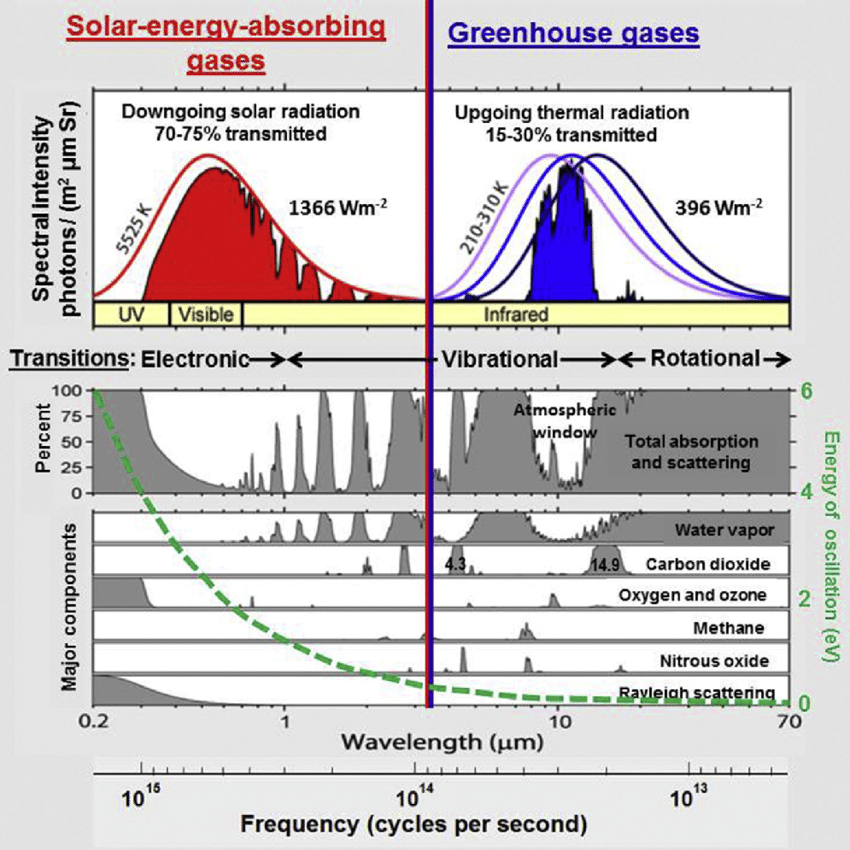
. But this chart is deceiving, for it does not fully explain the net effect on radiation, from the sun or from the earth. The chart below is much better:
The incoming solar radiation includes ultraviolet radiation, visible light and near infrared radiation. This is all the heat incoming to the earth, except the heat that is coming from the earth’s core. All area under the curves of the right halves represent greenhouse gases absorption, except the blue area which represents energy radiated into space under a cloud-free sky. The all dominant geenhouse gas is water vapor but CO2 contributes with 2 absorption bands, at 4.3 microns and 14.9 microns. The 4.3 micron absorption is of almost no importance since it occurs at a wavelength where very little radiation is available, neither from the sun, nor from the earth’s blackbody radiation. The only wavelength that counts for CO2 absorption is at 14.9 microns, because it occurs in the so called atmospheric window and the blackbody radiation is near its maximum.
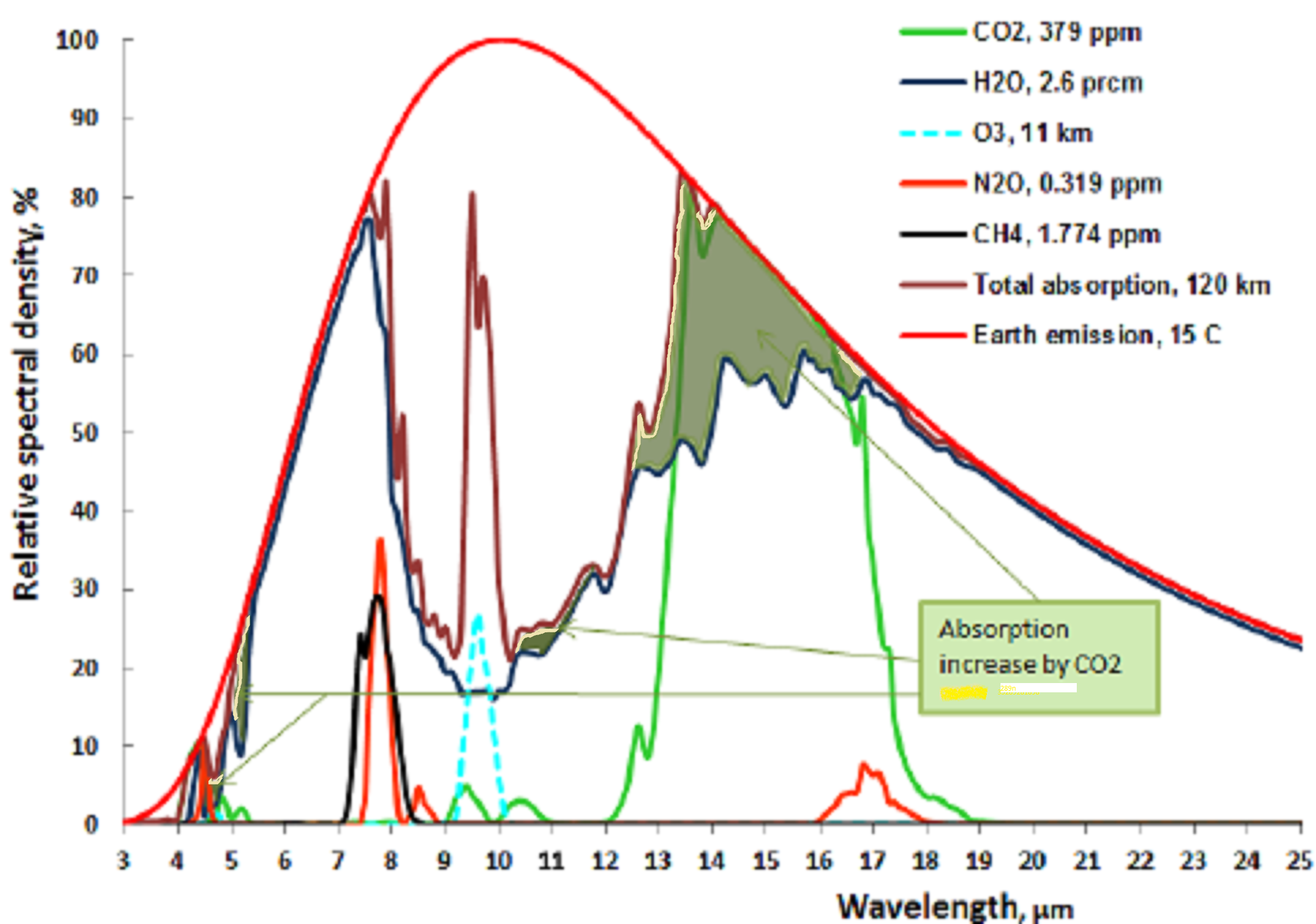
Let us take a closer look at the outgoing blackbody radiation and the atmospheric window:
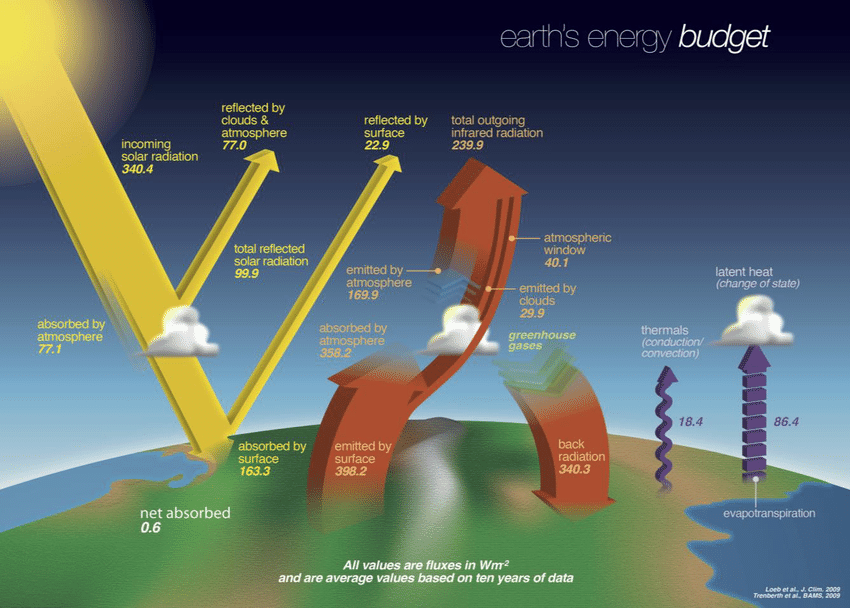
The first thing to notice is that no absorption exceeds 100% , so at 14.9 micron wavelength CO2 absorbed 100%, and water vapor absorbed another 80%, the total sum is still 100%. It is impossible to absorb more than 100% of the total energy available for that wavelength. Therefore between the wavelengths 14 and 16 microns all energy was absorbed regardless of CO2 concentration and water vapor concentration. The olive area represents the extra absorption of CO2 at 280 ppm when the water vapor is taken out (you cannot absorb more than 100%). The small yellow slivers represent the extra CO2 absorption at 415 ppm. The white area between the brown total absorption area and the red earth emission line is the total emitted energy through the atmospheric window.. the Methane and N2O gas greenhouse absorptions occur at wavelengths where water vapor already absorbs nearly 100%, so their contribution to greenhouse gases is negligible. Likewise Ozone absorption occurs where O2 also absorbs. From the picture below (thanks, NASA) we can see that the total amount of energy escaping through the atmospheric window from clouds and from the ground is on average (29.9 + 40.1) = 70 W/m2. In pre-industrial times the value would have been around 70.6 to 71 w/m2.
NASA update 9 August 2019
NASA has made a good estimate of the earth’s energy budget. Total incoming energy is 340.4 W/m2 and escaping through the atmospheric window is 70 W/m2, or 20.56%. Before the industrial age the value was about 70.8 W/m2 or 20.80%, an increase of 0.24%. A black body radiation is proportional to the fourth power of absolute temperature (Kelvin). The current average temp on earth is 287 degree Kelvin, so the temperature rise since pre-industrial times from the sum of increasing Co2, Methane, Nitrous oxide and ozone is 287 * fourth root of (1-0.0024) = 286.83 K, or 0.17 degree Celsius less.
This is but a small portion of the temperature rise experienced, and it so happens that there exists a good measuring point, where the all dominant greenhouse gases are CO2, Methane, NO2 and O3. At the South Pole in the winter the air is clean, there is almost no water vapor and the winter temperature at the Amundsen–Scott South Pole Station between April and September 2021, a frigid minus-78 degrees (minus-61 Celsius), was the coldest on record, dating back to 1957, and the trend is 1 C colder per century.
2. The effect from decreasing cloud cover.
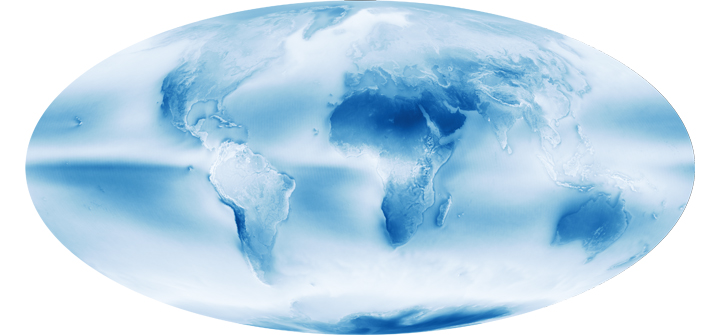
White = 100% cloud cover, Dark blue = o% cloud cover
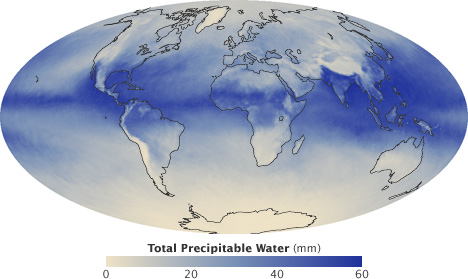
This is a world map showing the average cloud cover in August 2009. It shows the cloud free areas of the earth in blue. Another way to look at it is to see how much total water vapor there is in the atmosphere:
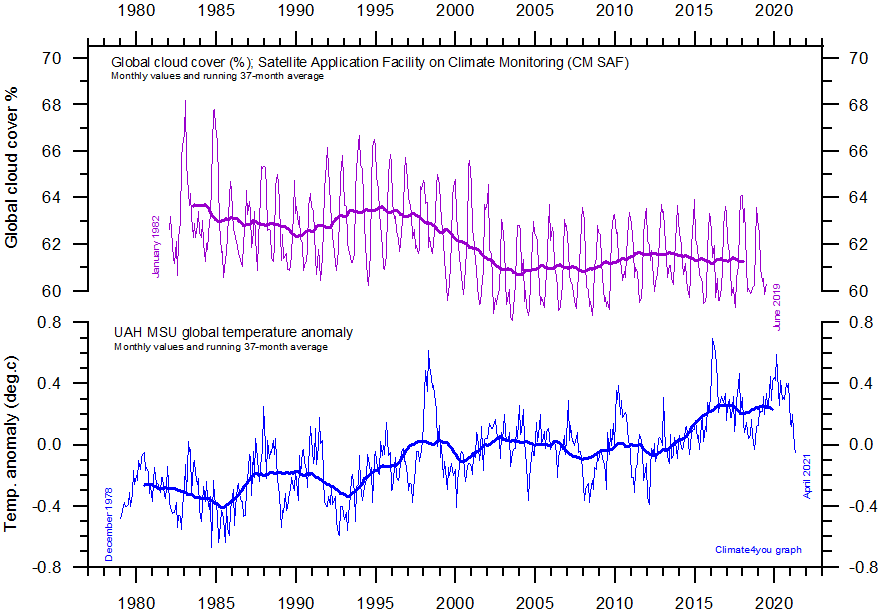
Nowhere on earth can it rain out more than two inches without more humidity being transported in from another place. Over the ocean humidity gets replenished by evaporation, over land only areas that has vegetation or swamps or lakes will replenish humidity by evaporation. keep these charts in mind for later. For now concentrate on the decreasing average cloud cover. It has only been measured for the last 40 years, but here are the results:
There are many different clouds, low, mid-level and high clouds, and they have changed differently over the same time span:
Of these clouds, the low level clouds are reflecting the most, so the 2.4% loss in average cloud cover is an assumption on the low side on the loss of reflection.
In 1984 the average cloud cover was 63.7%, in 2019 it was 61.1%, a loss of 2.6%. The total reflection from clouds and atmospheric scattering is 77 W/m2, of which 60 is from cloud reflection. A 2.6% loss of area of reflection leads to a decreasing of incoming energy of 60 * 0.026 = 1.56 W/m2. This results in a temperature increase to 287 * fourth root of (1- (1.56 / 340)) = 287.33 K, or 0.33 degree Celsius.
3. The effects from air and water pollution. . a. The warming of the Northern Arctic region.
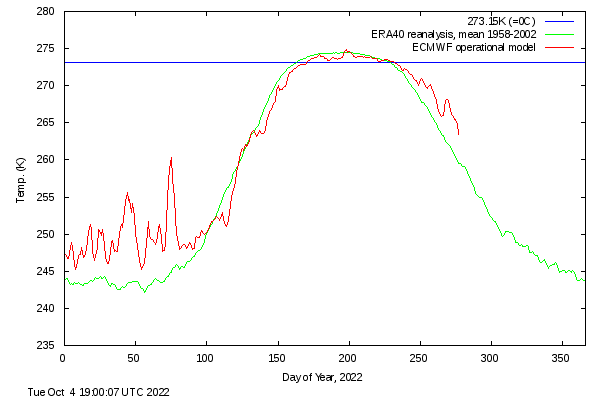
North America has great rivers, none greater than the mighty Mississippi. It used to be a meandering river with frequent floods that resulted in depositing its silt over large areas and thus fertilizing the land. The Indians living by the river moved to its new location after the water receded, and they could use the newly fertilized land. After the Louisiana purchase river traffic grew rapidly, but shifting sandbars and the excessively winding river became a problem, so the Mississippi river was converted to be the main transportation artery of the middle USA, the river banks were reinforced and the course of the river straightened. This meant that more of the silt was transported out into the Mexican Gulf, some of the silt that used to fertilize the soil instead fertilized the Mexican gulf. In addition, the Mississippi river used to be very polluted, but is now clean enough that it can be used for drinking water after treatment all the way down into Louisiana. There remains elevated concentration of nitrogen compounds so the Mexican Gulf suffers from excessive algae blooms and even red tide from time to time. This leads to more cloud formation and more rain in the United States east of the 98th meridian. This also occurs in Northern Europe, especially in the North Sea; the rivers flowing into the North Sea are rich in nutrients. The Baltic Sea was near oxygen death, but after the Baltic countries and Poland joined the EU, their rivers got partially cleaned up. In the far East the Yellow Sea and the South China sea are suffering major pollution. All these regions produce more clouds, and through prevailing winds some end up in the Arctic, where they snow out, except in the Summer when they rain out except on Greenland where it snows 12 months of the year. This leads to increasing winter temperatures of about 5.5 C above the 80th latitude, 2.5 C in spring and fall and a decrease of about 0.5 C in the summer (it takes a long time to melt that extra snow). This affects about 4% of the earth’s surface, so the total temperature increase from over-fertilizing the rivers is 0.04 * 2.5 = 0.1 C. No such effect occurs in the Antarctic. To illustrate the current yearly temperature trend in the Arctic, see this current polar temperature chart:
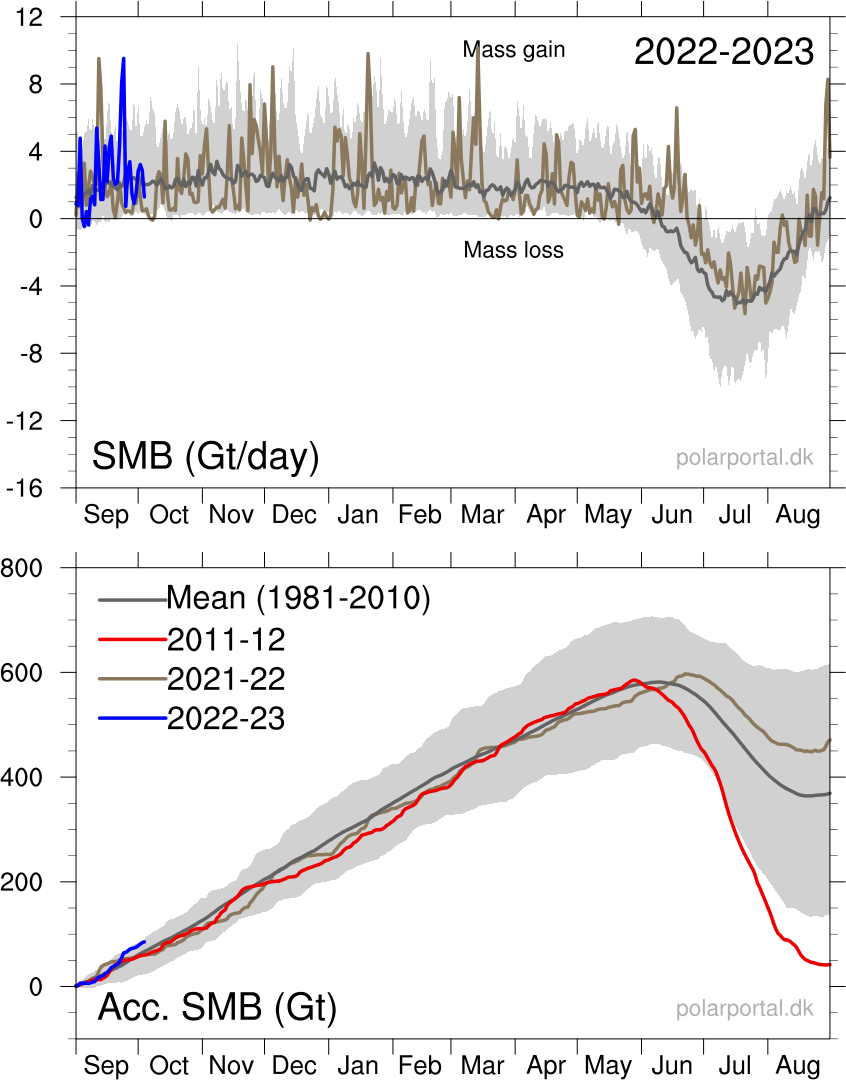
Even more illustrative is the development of ice on Greenland. In 2012 it looked like all of Greenland was going to melt in less than 1000 years, and the polar ice cap would be gone altogether in late summer of 2020. The ice over Greenlnd is now growing ever so slightly again:
b. The effect of various air pollution.
The major effect from air pollution is that it generates aerosols that act as condensation points for cloud formation if the air is oversaturated with moisture. In the last 40 years the air has gotten cleaner in the industrial west, not so much in China, India and Africa. The net result was a 2 % drop in cloud cover and the resulting temperature rise is already accounted for. There are no good worldwide analyses of ancient cloud cover, but air pollution was rising rapidly until the clean air act, enacted in 1963 was beginning to show results in the 70’s. However, ancient method of heating with coal, wood, peat and dried cowdung was far more polluting and harmful to your lungs. If U.S is eliminating all remaining coal plants the CO2 will still be rising since China is planning to build another 1070 coalburning power plants, ane their coal is inferior to ours and their pollution control is far less strict than ours resulting in more aerosols over China and some of the soot to be transmitted all the way to the Arctic, resulting in a black layer of soot on old snow and old ice.
c. The effect of greening of most of the earth.
There is one great benefit of increased CO2, the greening of the earth.
Thanks to this greening, done with only the fertilizer of CO2, the earth can now keep another 2 billion people from starvation, not to mention what good it does for plants and wildlife.
The greening of the earth should cause temperature to increase, but if there is enough moisture in the earth the evapotranspiration from the leaves have a cooling effect and more than offsets the lower albedo from green leaves versus dry earth. In addition, with rising CO2 levels the leaves need less water to perform the photosynthesis, so the net result from lowering the albedo by 0.05 % over 17% of the world leads to a cooling down. The average albedo of the earth is 30%, and 17% of the earth lowers the albedo by 5% this lowers the total albedo of the earth by 0.25%.
The total reflection of sunlight from the earth is 22.9 W/m2, so 0.25% of that is 0.057 W/m2, which translates to a net temperature increase of 287 * fourth root of (1- (0.057/ 340)) = 287.33 K, or 0.012 degree Celsius.
d. The areas that are becoming more like a desert.
Most of the earth displays an increase of leaf area, but there are areas in red that are becoming less green. The areas are: The American Southwest, The Pampas area of South America, a 100 mile band in Southern Sahara, part of East Africa, Madagascar, South East Africa, Western Australia, Part of the Volga region, Kazakhstan east of Lake Aral and various parts of China, and the Mekong river. These areas have this in common, the aquifers ate being depleted, the rivers are diminishing and some of them no longer reach the ocean, lakes are almost disappearing, but people still move to those areas “for the good climate”.
The areas so affected are about 900,000 sq miles of the American Southwest and about 3 million square miles total to suffer from becoming more like a desert. The common theme of all these areas is depletion of the aquifers, rivers diminishing, lakes drying up and soil erosion.
The only part of the world US can control directly is The American Southwest. It can expect more frequent and longer droughts, since there is no amplification of clouds from the relatively cool and clean Pacific ocean, and the long term temperature trend is cooling. The Colorado River no longer feeds the Gulf of California with nourishment. The Colorado river used to all the water allocation for all the participating states, but around 2000 the water use had caught up with supply, and since then it has become much worse with demand far outstripping supply.
In addition the Great Salt Lake is now less than a third of the size it was in the 1970’s. A second level water shortage has been issued and for example Arizona will get a million Acre-feet lass per year from the river. The aquifers will be further depleted leading to less rainfall and the few remaining springs will dry out. If nothing is done, the American southwest will become desertified.
What congress is doing to solve the problem.
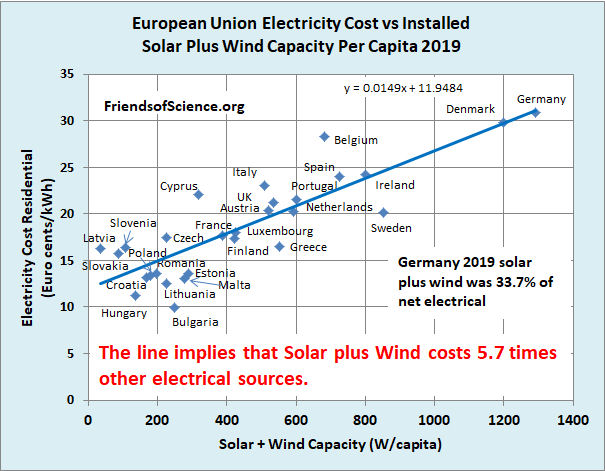
Congress has passed the anti-inflation bill that included over 300 billion to fight climate change, and it included more solar panels and wind turbine motors to be imported from China. The experience from Europe is that electricity from solar panels and windmills is 5.7 times as expensive as conventional power generation.
This analysis was done for 2019, before COVID. The situation is much worse now, with electricity rares up to 80 c/kWh, topping $1 /kWh this winter in some countries.
Even at the current increased European Gas prices, the estimated excess expenditures on Weather-Dependent “Renewables” in Europe is still very large: $~0.5 trillion in capital expenditures and $~1.2 trillion excess expenditures in the long-term.
These simple calculations show that any claim that Wind and Solar power are now cost competitive with conventional fossil fuel (Gas-fired) generation are patently false. The figures give an outline of the financial achievements of Green activists in stopping fracking for gas in Europe, close on to $1.2 trillion of excess costs.
It would be better not to import any solar panels and wind power generators from China and let them pay for the extra cost rather than building more coal burning plants. After all they were planning to build over a thousand new plants between now and 2030, all legal under the Paris accord. This would benefit the world climate much more, since Chinese coal plants are far more polluting, since China has far less stringent environmental regulations than U.S.
U.S. uses 13.5% of the world’s coal, and eliminating U.S. CO2 emissions would in time reduce the world temperature by 0.023C, providing no other country, such as China and India would increase their use of Coal, which they are, to the total of 1300 new coal plants between now and 2030. This would raise global temperature by more than 0.06 C.
What congress should do instead.
a. What congress should do immediately.
Immediately stop downblending U 233 and pass The Thorium Energy security act SB 4242a. See more here.
Remove Thorium from the list of nuclear source material. The half-life of Thorium232 is 14 billion years, so its radioactivity is barely above background noise. More importantly, while Thorium is fertile, it is not fissile and should therefore not be included in the list. This would make it far easier to mine rare earth metals, as long as the ore consists of less than 0.05% Uranium, but any amount of Thorium is allowed without classifying the ore “Source material”.
Separate nuclear power into 3 categories. a. conventional nuclear power. b. Thorium breeder reactors that make more U233 than it consumes, and c. Thorium reactors that reduce nuclear waste.
stop buying solar panels from China. Stop buying wind turbine generators from China. Let them install these in China and pay 5 times as much for that electricity.
Immediately form a commission led by competent people, not politicians to decide how to best expand the electric grid and to best harden it against electro-magnetic pulses, whether solar or nuclear and to safeguard it against sabotage.
Remove all subsidies on electric cars, solar panels and wind generators, but continue to encourage energy conservation.
Encourage research and development of Thorium fueled reactors, especially liquid salt reactors by drastically simplifying and speeding up the approval process. President Trump issued an executive order in the last month of his presidency EO 13972 specifying that the United States must sustain its ability to meet the energy requirements for its national defense and space exploration initiatives. The ability to use small modular reactors will help maintain and advance United States dominance and strategic leadership across the space and terrestrial domains. This EO should be expanded to include civilian small modular reactors, including Liquid salt Thorium reactors less than 200 MW, which are the only valid reactors for space exploration.
b. Longer term developments, but extremely urgent.
Of the long term warming of the globe of 1.1 C since the beginning of industrialization only 0.17 C is attributable to rising CO2, NH4 and NO2 levels, of which United states is currently responsible for 13.5% and decreasing, or 0.023C. The disappearance of clouds is responsible for twice as much globally or 0.33 C of which probably 1/6 is occurring in the American Southwest, causing an increase in temperature of 0.055C. However, the temperature rise in say the Grand Canyon has been in excess of 2 C,, and in the urban areas it has been even more. These are my long term suggestions:
Build a TransContinental Aqueduct. A realistic way to save Lake Mead and reverse the desertification of the American SouthWest.
The problem:
Lake Mead will be emptied in less than 10 years with the current usage pattern. Then what?
The hydroelectric power from Lake Mead (and Lake Powell) is diminishing as the lakes are emptied.
the aquifers in Arizona, especially in the Phoenix and Tucson area, and to some extent New Mexico and the dry part of Texas are being drawn down and are at risk of being exhausted.
The Salton Sea in the Imperial Valley of California is maybe the most polluted lake in all of U.S.A. It is even dangerous to breathe the air around it sometimes. The area contains maybe the largest Lithium deposit in the world.
The Colorado River water is too salty for good irrigation .
The Colorado river no longer reaches the Gulf of California. Fishing and shrimp harvesting around the Colorado River Delta is no more.
40 million people depend on the Colorado River for drinking water. The population is still rising rapidly in the West. Will they have water in the future?
Except for California there is not much pumped Hydro-power storage in the American Southwest.
Texas has plenty of wind power, but no pumped hydro-power storage. This makes it difficult to provide peak power when the sun doesn’t shine and the wind doesn’t blow. Nuclear power is of no help, it provides base power only. Peak power has to come from coal and natural gas plants.
New Mexico has some ideal spots for solar panels, but no water is available for pumped storage.
Arizona has a surging population, wind and solar power locations are abundant, but no pumped hydro-power storage.
Arkansas and Oklahoma have a good barge traffic system. This proposal will increase flood control and improve barge traffic by increasing the maximum barge draft from 9 feet to 12 feet and during dry periods reverse the flow of the Arkansas River. The Arkansas river yearly water flow is nearly double that of the Colorado River.
The solution:
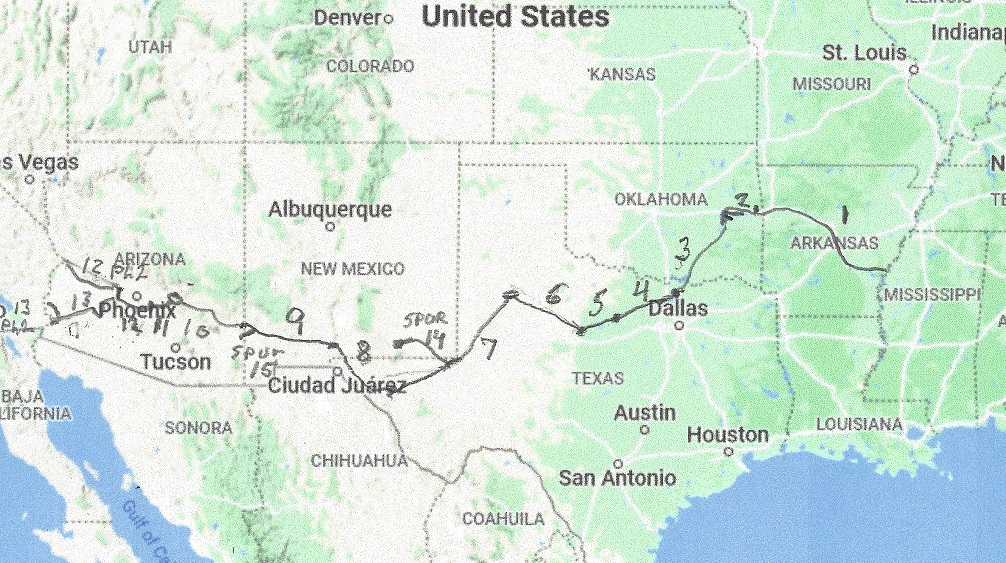
Build a transcontinental aqueduct from the Mississippi River to the Colorado River capable of transporting 12 million acre-ft of water yearly through Arkansas, Oklahoma, Texas, New Mexico and Arizona. It will be built similar to the Central Arizona Project aqueduct, supplying water from the Colorado river to the Phoenix and Tucson area, but this aqueduct will be carrying four times more water over four times the distance and raise the water nearly twice as high before returning to near sea level. The original Central Arizona Project cost $4.7 billion in 1980’s money, the Transcontinental Aqueduct will in Phase 1 cost around $200 Billion in 2022 money applying simple scaling up principles.
The Mississippi River has a bad reputation for having polluted water, but since the clean water act the water quality has improved drastically. Fecal coli-form bacteria is down by a factor of more than 100, the water is now used all the way down to New Orleans for drinking water after treatment. The lead levels are down by a factor of 1000 or more since 1979. Plastic pollution and pharmaceutical pollution is still a problem, as is the case with most rivers. The Ph is back to around 8 and salt content is negligible. Mississippi water is good for irrigation, and usable for drinking water after treatment. The Arkansas River is used as a drinking water source.
But the aqueduct will do more than provide sweet Mississippi water to the thirsty South-west, it will make possible to provide peak power to Texas, New Mexico and Arizona. In fact, it is so big it will nearly triple the pumped Hydro-power storage for the nation, from 23 GW for 5 hours a day to up to 66 GW when fully built out.
The extra pumped hydro-power storage will come from a number of dams built as part of the aqueduct or adjacent to it. The water will be pumped from surplus wind and solar power generators when available. This will provide up to 50 GW of power for 5 hours a day. If not enough extra power has been generated during the 19 pumping hours, sometimes power will be purchased from the regular grid. The other source of pumped hydro-power storage is virtual. There will be up to 23 GW of LFTR (Liquid Fluoride salt Thorium Rector) power stations strategically stationed along the waterway providing pumping of water for 19 hours and providing virtual hydro-power output for the remaining 5, when the aqueduct is fully built.
These 43 GW of hydro-power capacity will be as follows: Oklahoma, 0.2 GW; Texas, 18,5 GW (right now, Texas has no hydro-power storage, but plenty of wind power); New Mexico, 10.5 GW; Arizona 13.6 GW. In Addition, when the Transcontinental Aqueduct is fully built out, the Hoover dam can provide a true 2.2 GW hydro-power storage by pumping water back from Lake Mojave; a 3 billion dollar existing proposal is waiting to be realized once Lake Mead is saved.
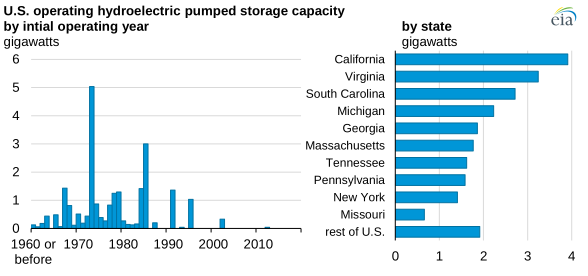
The amount of installed hydroelectric power storage is:
Most hydroelectric pumped storage was installed in the 70’s. Now natural gas plants provide most of the peak power. This aqueduct will more than double, triple the U.S. pumped peak storage if virtual peak storage is included. By being pumped from surplus wind and solar energy as well as nuclear energy it is true “Green power”. Some people like that.
What follows is a description of each leg of the aqueduct. Each leg except legs 9 and 10 ends in a dam, which holds enough water to make each leg free to operate to best use of available electricity and provide peak power on demand.
The Transcontinental Aqueduct will serve the Lower Colorado River Basin, Southern New Mexico and Western Texas. It will pump up to 12 million acre-ft of water annually from the Arkansas river and Mississippi river all the way to southern Colorado River.
The total electricity needed to accomplish this giant endeavor is about 60 billion kWh annually. or about one and a half percent of the current US electricity demand. In 2020 the US produced 1,586 billion kWh from natural gas, 956 from coal, 337.5 from wind and 90.9 from solar.
For this giant project to have any chance of success there has to be something in it to be gained from every state that will be participating. Here are some of the benefits:
Arizona: Arizona needs more water. The water from Mississippi is less saline and better suited for agriculture and the people growth makes it necessary to provide more water sources. Right now the aquifers are being depleted. Then what? One example: The San Carlos lake is nearly dry half the time and almost never filled to capacity. With the aqueduct supplying water it can be filled to 80 +- 20% of full capacity all the time. In the event of a very large snow melt the lake level can be reduced in advance to accommodate the extra flow. Likewise during Monsoon season the aqueduct flow can be reduced in anticipation of large rain events. Arizona together with New Mexico has the best locations for solar power, but is lacking the water necessary for hydro-power storage. This proposal will give 600 cfs of water to Tucson, 3,100 cfs to the Phoenix area and 3,900 cfs to the lower Colorado River in Phase 1. I phase 2 it will add 3,100 cfs to Lake Havasu and an extra 4,700 cfs to the lower Colorado River. It will also also add 28 GW of hydro-power storage capable of adding 140 GWh of electric peak power daily when it is fully built out in Phase 3.
Arkansas: The main benefit for Arkansas is better flood control and river control of the Arkansas River and allowing it to deepen the draft for canal barges from 9,5 feet to 12 feet, which is standard on the Mississippi river.
California: The water aqueduct serving Los Angeles will be allowed to use maximum capacity at all times. Additional water resources will be given the greater San Diego area. The Imperial valley will be given sweet Mississippi and Arkansas River water, which will improve agriculture yield. The polluted New River will be cut off at the Mexico border. There will be water allocated to the Salton Sea. There is a proposal to mine the world’s largest Lithium ore, mining the deep brine, rich in Lithium. (about a third of the world supply according to one estimate). This requires water, and as a minimum requirement to allow mining in the Salton Sea the water needs to be cleaned. This requires further investigation, but the area around the Salton Sea is maybe the most unhealthy in the United States. It used to be a great vacation spot.
Mexico: During the negotiations about who was going to get the water in Lake Mead Mexico did not get enough water, so they have been using all remaining water for irrigation, and no water is reaching the ocean anymore. In addition the water is too salty for ideal irrigation. This proposal will provide sweet Mississippi and Arkansas River water to Mexico, ensure that some water reaches the Colorado river delta. This will restore the important ecology and restore aquatic life in the delta and the gulf. The town of Mexicali will get some water in exchange for shutting off New River completely.
Nevada: Las Vegas is a catastrophe waiting to happen unless Lake Mead is saved. With this proposal there will be ample opportunity to make the desert bloom.
New Mexico: The state is ideally suited for solar panels. In addition to give much needed water to communities along the length of the aqueduct, it will provide 13.5 GW of pumped storage power to be made available at peak power usage for up to 5 hours a day.
Oklahoma: The main advantage for Oklahoma is a much improved flood control. It will provide the same advantage for river barge traffic as benefits Arkansas.
Texas: The state has a big problem. It has already built up too much wind power and can not give up their coal burning power plants until the electricity is better balanced. They have no hydro-electric power storage at all, and we saw the result of that in a previous year’s cold snap. This proposal will give the Texas electric grid 8.8 GW of hydro-electric power for up to 5 hours a day.
Utah: The state will no longer be bound to provide water to Lake Mead, but can use all of its water rights for Utah, especially the Salt Lake City region, and to reverse the decline of the Great Salt Lake that is now shrunk to less than a third of the size it had in the 1970’s.
Wyoming: The state will be free to use the water in the Green River and all the yearly allocated 1.05 million acre-feet of water can be used by the state of Wyoming.
The cost to do all these aqueducts will be substantial, but it can be done for less than 350 billion dollars in 2022 money, and that includes the cost of providing power generation. Considering it involves 40 million people dependent on the Colorado River now and another 10 million east of the Rocky Mountains, it is well worth doing, much more important to do than other “green” projects, since it will save the American Southwest from becoming an uninhabitable desert.
This proposed solution cannot be made possible without changing our approach to power generation. The mantra now is to solve all our power needs through renewables. Texas has shown us that too much wind power without any hydroelectric power storage can lead to disaster. In addition, windmills kill birds, even threatening some species, such as the Golden Eagle and other large raptors that like to build their aeries on top of the generators. Solar panels work best in arid, sunny climate, such as Arizona and New Mexico, but the panels need cooling and cleaning to work best, and that takes water. They are even more dependent on hydro-power storage than wind. The transcontinental aqueduct will triple the hydro-electric power storage for the nation. Without pumped power storage we still need all the conventional power generation capacity for when the sun doesn’t shine and the wind doesn’t blow.
Conventional Nuclear power plants doesn’t work in most places since they depend on water for their cooling, and most of these aqueducts pump water in near deserts, and there would be too much evaporation losses to use water from the aqueducts for cooling.
The only realistic approach would be to use LFTR power plants. (Liquid Fluoride Thorium Reactors). There are many advantages for using LFTR. Here are 30 reasons why LFTRs is by far the best choice.
For this project to succeed there must be developed a better way to build SMRs (Small Modular Reactors, less than 250 MW) more effectively. The price to build a LFTR plant should be less than $2.50 per watt. While the LFTR science is well understood, the LFTR engineering is not fully developed yet, but will be ready in less than 5 years if we get to it. In the mean time there should be built one or more assembly plants that can mass produce LFTR reactor vessels small enough so they can be shipped on a normal flatbed trailer through the normal highway system. My contention is that a 100 MW reactor vessel can be built this way and the total cost per plant will be less than 250 Million dollars. To save the American Southwest we will need about 350 of them, or 87,5 billion dollars total. This cost is included in the total calculation. There will be many more of these plants produced to produce all the electric power to power all the electric vehicles that are going to be built. This is the way to reduce fossil fuel consumption. Just switching to electric vehicles will not do the trick. The electric energy must come from somewhere. To convert all cars and trucks and with unchanging driving habits will require another 600 GW of generating capacity by 2050, our present “net zero emissions” goal.
To do this project we need cooperation from all states in providing eminent domain access. The Federal government will need to approve LFTR as the preferred Nuclear process and streamline approval process from many years to less than one year.
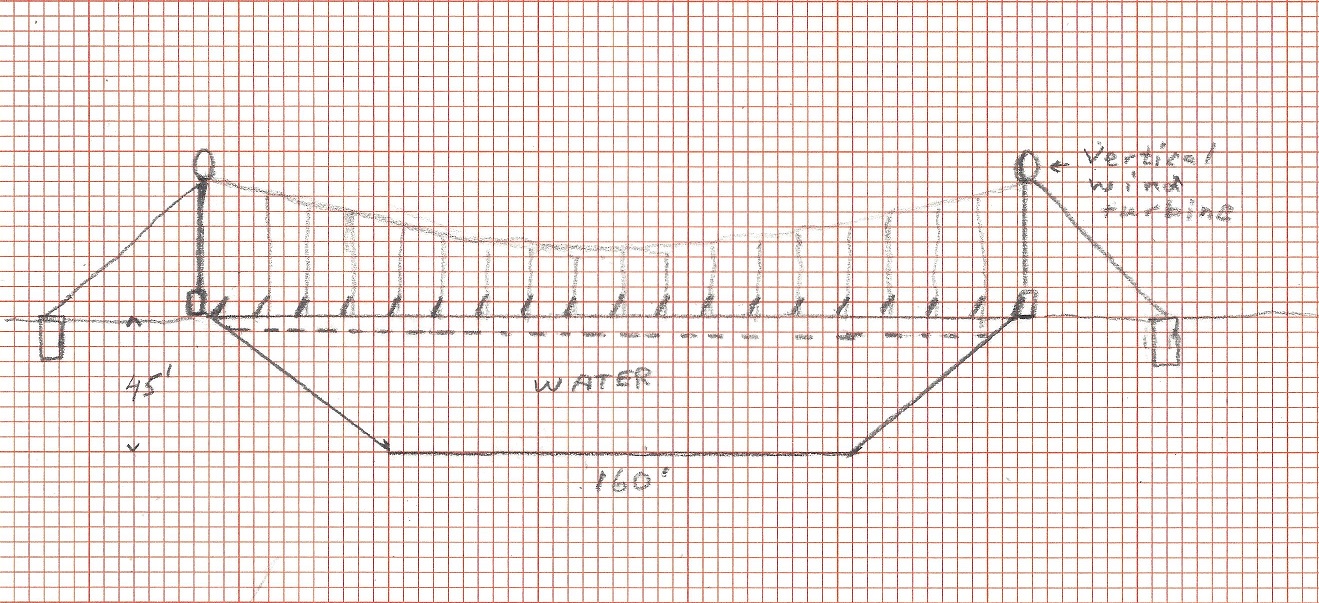
Some of the power will come from solar panels and wind turbines, which will reduce the need for LFTR’s. One tantalizing idea is to cover the aqueduct with solar panels. This will do many things, it will not take up additional acreage, water needed to keep the panels clean is readily available, and can even be used to cool the solar panels if economically beneficial. The area available is 152 feet times 1100 miles = 1.6 billion square feet, and one square foot of solar panel produces around 1 W, which means covering the aqueduct with solar panels would produce 882 MW of power. It would also reduce evaporation. The second source of energy will be 165,000 5kW vertical wind turbines producing 825 MW when the wind is blowing. The rest of the power will cme from LFTRs. This idea requires further analysis. Here is one possible implementation of the idea:
Total volume of water is over 1 million acre-ft.
C. Further developments to save the American Southwest.
When the Transcontinental aqueduct is well under way it is time to start the Trans-Rocky-Mountain Aqueduct. in a few years the population growth will require again to save Lake Powell and Lake Mead, and rejuvenate the American South-west.
The problem:
Lake Powell and Lake Mead will be emptied in less than 10 years with the current usage pattern. Then what?
The hydroelectric power from Lake Mead (and Lake Powell) is diminishing as the lakes are emptied.
the aquifers are drawn down everywhere in the Southwest, but also the Ogallala Aquifer in Colorado and Kansas, and are at risk of being exhausted.
The Colorado River water is too salty for good irrigation .
The Colorado river no longer reaches the Gulf of California. Fishing and shrimp harvesting around the Colorado River Delta is no more.
40 million people depend on the Colorado River for drinking water. The population is still rising rapidly in the West. Will they have water in the future? Think 20 million future population growth in the next 40 years, people want to move there even with the current water problems.
The solution:
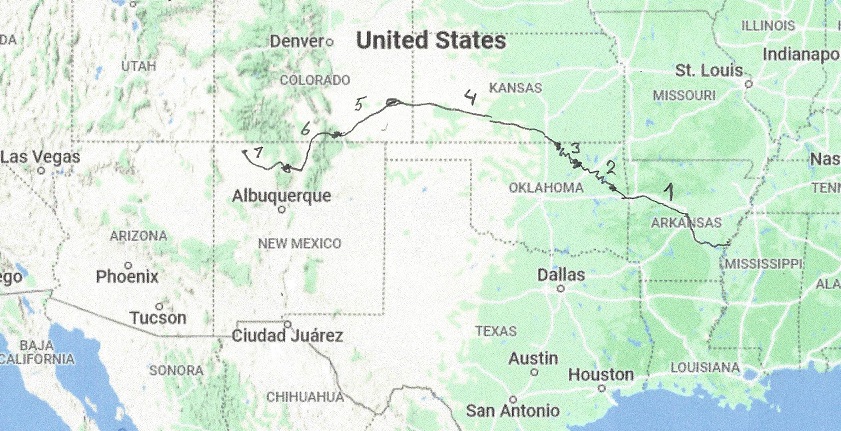
Build a Trans-Rocky-Mountain aqueduct from the Mississippi River to the San Juan River. In the first 391 miles the aqueduct joins the McClellan–Kerr Arkansas River Navigation System by adding the capability of pumping 7,500 cfs of water through 16 dams that service the locks. This will lead to reversing the flow of water during low flow. This also facilitates the navigation channel to be deepened from 9 feet to 12 feet to service fully loaded barges, a step authorized but not funded by Congress. The Arkansas river will then be capable of transporting 8 million acre-ft of water yearly through Arkansas, Oklahoma, Kansas, Colorado and New Mexico, supplying water from the Colorado river to Lake Powell. All that is needed to do in this stage is provide the dams and locks with a number of pumps and pump/generators to accommodate this, at a cost of less than 2 billion dollars. The next phase is pumping up water in the Arkansas river for 185 miles. To accommodate this there will be 17 small control dams built that are closed when normal pumping occurs and open during flood conditions. The cost for this segment, including pumps will be less than 3 billion dollars. The third segment is a 465 mile aqueduct to cross the Rocky Mountains much like the Central Arizona project but this aqueduct will carry three times more water 1.27 times the distance and raise the water four times higher. The original Central Arizona Project cost $4.7 billion in 1980’s money, the aqueduct part of the Trans-Rocky-Mountain aqueduct will cost around $50 Billion in 2021 money applying simple scaling up principles.
Power requirements for the 3 stages are 310 MW for the canal stage, 600MW for the river stage and 6.2 GW for the aqueduct stage. The aqueduct stage can be controlled by the power companies to shut off the pumps and provide 6.4 GW of virtual peak power for up to 5 hours a day on average, and each leg can be controlled individually since they are separated by large dams. There will be 64 one hundred MegaWatt LFTR (Liquid Fluoride salt Thorium Rector) power stations strategically stationed along the waterway providing pumping of water for 19 hours and providing virtual hydro-power output for on average 5 hours. There will also be 910 MW of power needed that is controlled by the river authorities.
The building cost of providing LFTR power should be around $2.50 per Watt of installed energy if a plant is built to manufacture via an assembly line a standardized version of 100 MW LFTR reactor core vessels assemblies capable of being transported on truck to the installation point. The total power cost should then be 16 billion dollars to build, and 5 cents per kWh or about 2.5 billion dollars a year to provide power.
The Mississippi River has a bad reputation for having polluted water, but since the clean water act the water quality has improved drastically. Fecal coli-form bacteria is down by a factor of more than 100, the water is now used all the way down to New Orleans for drinking water after treatment. The lead levels are down by a factor of 1000 or more since 1979. Plastic pollution and pharmaceutical pollution is still a problem, as is the case with most rivers. The Ph is back to around 8 and salt content is negligible. Mississippi water is good for irrigation, and usable for drinking water after treatment. The Arkansas River water quality is pretty good, good enough in Kaw Lake to be used for municipal water supply. Nitrates and phosphates are lower than in most Eastern rivers, Ph is around 8 and coli-bacteria low.
Most hydroelectric pumped storage was installed in the 70’s. Now natural gas plants provide most of the peak power. This aqueduct will add 6.4 GW to the U.S. pumped peak storage if virtual peak storage is included. By being pumped from surplus wind and solar energy as well as nuclear energy it is true “Green power”. Some people like that.
What follows is a description of each leg of the aqueduct. Legs 3, 4, 5 and 6 ends in a dam, which holds enough water to make each leg free to operate to best use of available electricity and provide peak power on demand.
Leg 1 of The Trans-Rocky-Mountain aqueduct. From the Mississippi river to Webbers Falls lock and dam. Total length 15miles of aqueduct and 335 miles of river. Cost of water 333 kWh per acre-ft.
Leg 2 of The Trans-Rocky-Mountain aqueduct. From Webbers Falls to Keystone Dam, a distance of about 75 miles that is river and 25 miles, which is canal. Cost of water 593 kWh per acre-ft.
Leg 3 of the Trans-Rocky-Mountain aqueduct. From Keystone Dam to Kaw Dam.The Keystone Lake is 38 miles long and the river part is about 110 miles. Cost of water 901 kWh per acre-ft.
Leg 4 of the Trans-Rocky-Mountain aqueduct. From Kaw Lake to John Martin Reservoir, a distance of about 200 miles. Cost of water 4,446 kWh per acre-ft.
Leg 5 of the Trans-Rocky-Mountain aqueduct. From John Martin Reservoir to Trinidad Lake, a distance of about 120 miles. Cost of water 7,300 kWh per acre-ft.
Leg 6 of the Trans-Rocky-Mountain aqueduct. From Trinidad Lake to Abiquiu Reservoir, a distance of 90 miles. Cost of water 7,910 kWh per acre-ft.
Leg 7 of the Trans-Rocky-Mountain aqueduct. From the Abiquiu Reservoir to the San Juan River, a distance of 55 miles. Cost of water 7,395 kWh per acre-ft.
Once these two aquifers are completed and running successfully filling the rivers again it is time to refill the aquifers. This requires a change in the water rights laws. The rain water is a property of the land and can be locally retained via small catch basins and ditches. This will restore the aquifers, reduce soil erosion and rejuvenate vegetation as has been successfully done in the dry parts of India. They needed to capture the monsoon rains, and so does Arizona and New Mexico.
The Democrats greatest concern was Climate Change, followed by Election Laws and Inflation. At the bottom of the list was the Supreme Court.
The Republicans greatest concern was Inflation, followed by Immigration and Crime. At the bottom of the list was Climate Change.
The Independents greatest concern was Inflation, followed by Immigration and COVID-19. At the bottom of the list was Unemployment.
For Blacks there was a tie between COVID-19 and Inflation as their greatest concern, followed by Racial Inequality. At the bottom of the list was the Supreme Court.
And for Hispanics the greatest concern was Inflation, followed by Climate change and COVID-19. At the bottom of the list was Supreme Court.
The biggest concern was Inflation for everybody but Democrats. Their biggest concern was Climate Change, but for Republicans that was the least of their worries.
Why is that?
Some Democrats believe with religious fervor that we have only limited time to solve the climate crisis before we reach the point of no return. Alexandra Occasio Cortez said in January 2019 that if we didn’t abolish fossil fuel asap the world will end in 12 years. There is now less than 9 years left. President Trump ended our part in the Paris accord, and President Biden rejoined it in 2021. If we fulfill all the Paris accord demands, the world temperature, according to the UN agency IPCC will rise 0.05 C cooler by 2030, and a whopping 0.17C less by 2100. See analysis here. Meanwhile, China is in negotiations to buy another 100 million metric tons of Coal from Russia. They consume half the world’s coal mining.
For other Democrats it is another method of gaining control of all production and consumption, the Venezuelan model.
Then there is the sustainability crowd, and they point out the obvious fact, that unless something is done, we will run out of Coal, Oil and Gas sometimes in the not too distant future. Their suggested solution is to build Wind Turbines with generators made in China and western Europe. Solar panels are mostly built in China. But that is not the worst part. To build these generators and solar panels we need rare earth metals, 80% of which come from China. Details here. The problem is what to do when the sun doesn’t shine, which is most of the time, and the wind doesn’t blow. Energy must then be produced by other means. For now it is generated by coal and natural gas plus some diesel generators. Battery technology is not there yet, and hydro-power storage is way inadequate for today’s need.
And then there is John Kerry, who’s greatest fear is that the war in Ukraine will distract us from our greatest threat, Climate Change. His latest concern on Migration: “Wait until you see 100 million people for whom the entire food production capacity has collapsed.”
Some Republicans thank God for the increased CO2 levels because thanks to that the world can now keep an additional 2 billion people from starving. It seems hard to believe, but as food yield increases in greenhouses when additional CO2 is added, so does the greenhouse called earth benefit from more CO2. Don’t believe me? Look at this map:
This means more roots for plants, less erosion, and more food for animals. The exception is desert areas.
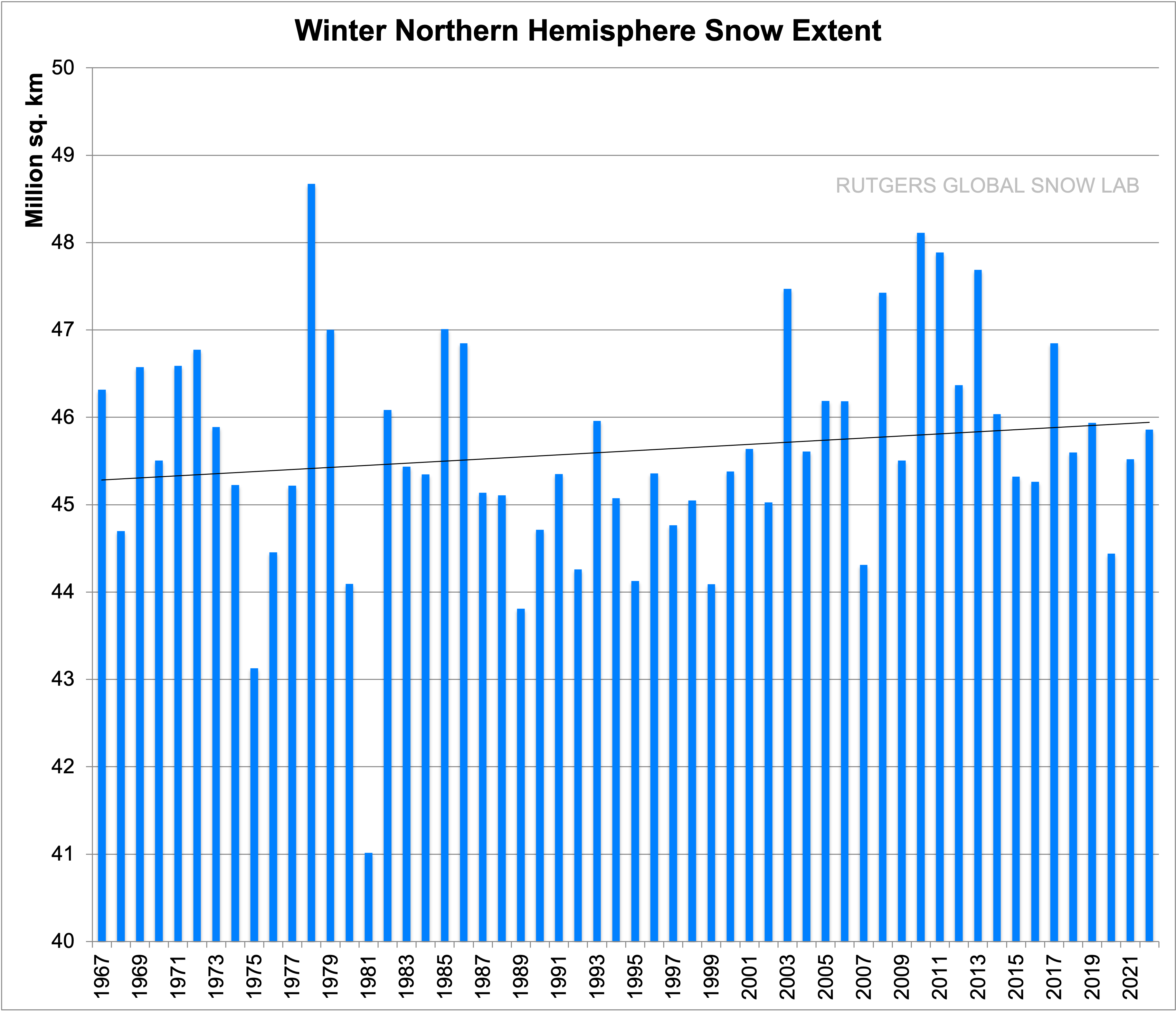
Others have noticed that the dire predictions from IPCC, a UN Climate Change Panel, have always been way off base. The temperature increase, while real has always been way below what is predicted. It is predicted that the largest temperature increases occur at the poles, so this summer the South Pole had its coldest winter on record. A weather station at the Amundsen-Scott South Pole Station registered record cold winter temperatures this season (April – September), averaging at -61.1 °C (-77.9 °F) and breaking the previous record set in 1976 at -60.6 °C (-77 °F). Weather records date back to 1957. The North Pole on the other hand is experiencing a warmer trend, but only in the winter. The summers are marginally cooler, but that is because there is more now to melt. Yes, the Snow over the Arctic is increasing. See the chart from Rutgers Snow Lab:
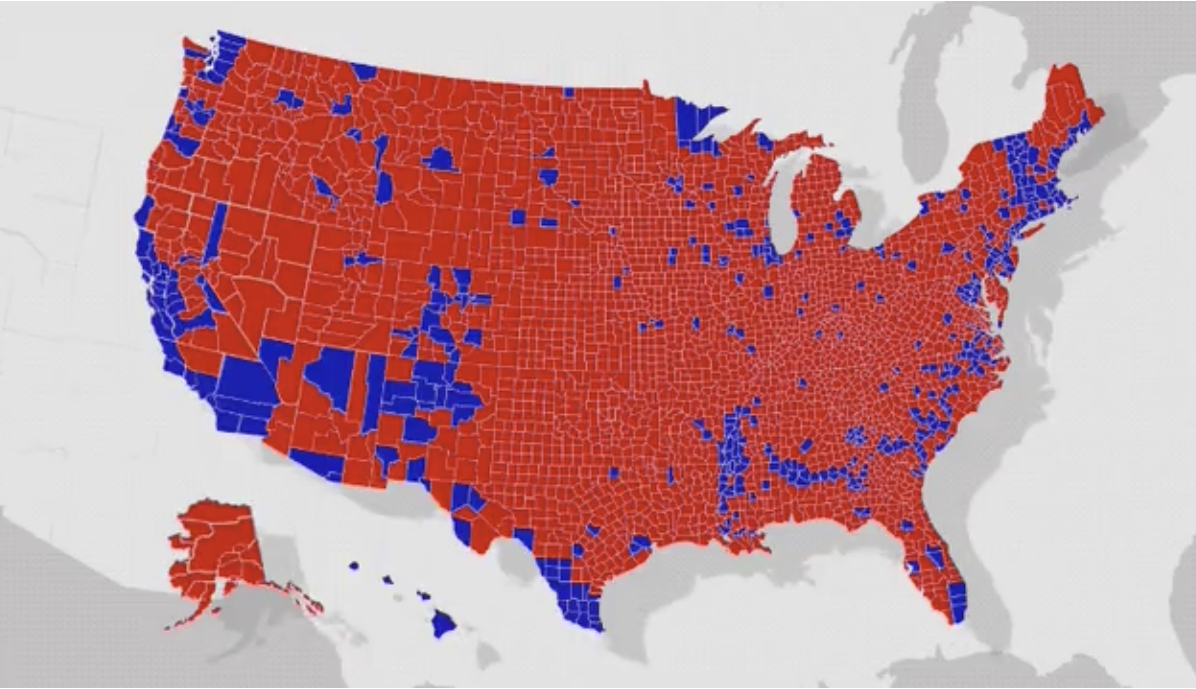
These are but a few of the differences in opinion concerning Climate change. Let’s see where democrats and republicans live. If we look at the 2020 voting results the map looks nearly all Republican: (84% of the counties voted Republican)
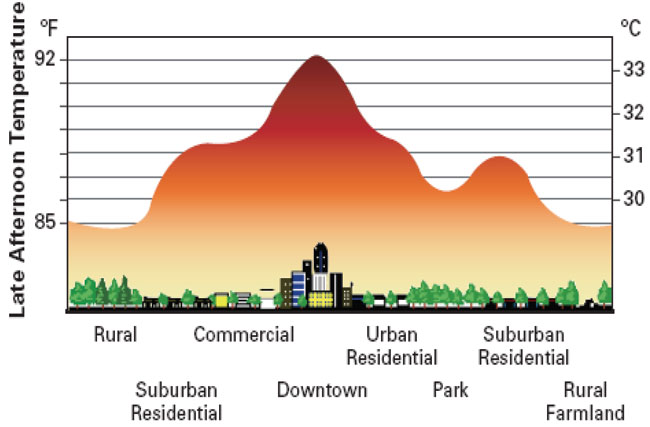
Yet there were more Democrat votes cast than Republican. This is because the largest counties population wise vote Democrat and they experience Climate Change big time thanks to the so called Urban Heat Island effect:
This is late afternoon, somewhere in Urban USA.
People living in the rural America do not experience the Urban Heat Island effect, so they tend to dismiss the constant drumbeat from PBS, everything bad is because of climate change as just idle talk. What do they know; they are stuck in their asphalt jungle complaining about how bad things are. The rural people remember how their grandparents used to say it was much worse in the thirties, heatwave after heatwave and everything dried up. And dust storms and wildfires were much worse. Not to mention the winters, the Mississippi river froze all the way down to New Orleans. We have never has it so good as it is now. Poor Urban Heat Island dwellers.
The Democrats solution to Climate Change is: Eliminate CO2 emissions from fossil fuels and replace with wind and solar but not nuclear power. All cars trucks, trains and busses should be electric. This is impossible.
Republicans want to gradually lessen our dependency of fossil fuel and make electric production come from Nuclear power, preferably small modular Thorium reactors. They have many advantages explained here. There are immense environmental problems, it is not CO2 or even Methane, but water. The American South-west has too little water for its growing population and the east US has sometimes too much. One possible solution is described here.








 Len Bilén's blog, a blog about faith, politics and the environment.
