A Climate Realist’s (not so) short Answers to Hard Questions About Climate Change. Question 5 (of 16) Will reducing meat in my diet help the climate?

NOV. 28, 2015 gave his answers to 16 questions in the N.Y. Times regarding Climate Change. This Climate realist added his answer.

 Answers to Question 1: How much is the planet heating up?

Answers to Question 2. How much trouble are we in?

Answers to Question 3. Is there anything I can do?

Answers to Question 4. What’s the optimistic scenario?

Justin Gillis answer to  Question 5. Will reducing meat in my diet help the climate?

Yes, beef especially.

Agriculture of all types produces greenhouse gases that warm the planet, but meat production is especially harmful – and beef is the most environmentally damaging form of meat. Some methods of cattle production demand a lot of land, contributing to destruction of forests; the trees are typically burned, releasing carbon dioxide into the atmosphere. Other methods require huge amounts of water and fertilizer to grow food for the cows.

The cows themselves produce emissions of methane, a potent greenhouse gas that causes short-term warming. Meat consumption is rising worldwide as the population grows, and as economic development makes people richer and better able to afford meat.

This is worrisome: Studies have found that if the whole world were to start eating beef at the rate Americans eat it, produced by the methods typically used in the United States, that alone might erase any chance of staying below an internationally agreed-upon limit on global warming. Pork production creates somewhat lower emissions than beef production, and chicken is lower still. So reducing your meat consumption, or switching from beef and pork to chicken in your diet, are both moves in the right direction. Of course, as with any kind of behavioral change meant to benefit the climate, this will only make a difference if lots of other people do it, too, reducing the overall demand for meat products.

My answer to  Question 5. Will reducing meat in my diet help the climate?

It will do very little for the climate, but it might help your personal economy to switch your eating habits. Beef used to be cheap, but no more. Bacon, baby pork ribs, beef tenderloin, veal cutlets, chicken wings are at premium prices, and switching from beef to chicken and turkey is already under way thanks to the wonderful regulator called the free market. However, there is one thing that will help the environment and indirectly the climate:

Switch from feed-lot beef to grass fed beef. Release more grasslands for responsible grazing to preserve the environment. Here is an interesting video:

What do you think?

Answers to Question 6. What’s the worst-case scenario?

Answers to Question 7. Will a tech breakthrough help us?

Answers to Question 8. How much will the seas rise?

Answers to Question 9. Are the predictions reliable?

Answers to Question 10. Why do people question climate change?

Answers to Question 11. Is crazy weather tied to climate change?

Answers to Question 12. Will anyone benefit from global warming?

Answers to Question 13. Is there any reason for hope?

Answers to Question 14. How does agriculture affect climate change?

Answers to Question 15. Will the seas rise evenly across the planet?

Answers to Question 16. Is it really all about carbon?

A Climate Realist’s (not so) short Answers to Hard Questions About Climate Change. Question 4 (of 16) What’s the optimistic scenario?

NOV. 28, 2015 gave his answers to 16 questions in the N.Y. Times regarding Climate Change. This Climate realist added his answer.

 Answers to Question 1: How much is the planet heating up?

Answers to Question 2. How much trouble are we in?

Answers to Question 3. Is there anything I can do?

Justin Gillis answer to Question 4. What’s the optimistic scenario?

“Several things have to break our way.

In the best case that scientists can imagine, several things happen: Earth turns out to be less sensitive to greenhouse gases than currently believed; plants and animals manage to adapt to the changes that have already become inevitable; human society develops much greater political will to bring emissions under control; and major technological breakthroughs occur that help society both to limit emissions and to adjust to climate change.

The two human-influenced variables are not entirely independent, of course: Technological breakthroughs that make clean energy cheaper than fossil fuels would also make it easier to develop the political will for rapid action.

Scientists say the odds of all these things breaking our way are not very high, unfortunately. The Earth could just as easily turn out to be more sensitive to greenhouse gases than less. Global warming seems to be causing chaos in parts of the natural world already, and that seems likely to get worse, not better. So in the view of the experts, simply banking on a rosy scenario without any real plan would be dangerous. They believe the only way to limit the risks is to limit emissions.”

My answer to Question 4. What’s the optimistic scenario?

We are now in a sweet spot as to climate, not too warm and no ice age yet. Were it not for increasing CO2 levels the little ice age might have triggered the onset of a real ice age, but a lot of factors, such as coming out of the Maunder solar minimum, starting industrialization in England and Germany sooting up the growing glaciers so they started melting again, the diminishing effect from the Tycho Brahe and Kepler supernovas cosmic radiation, all contributed to get us out of the start of the new ice age. Yet, we are into the latter stages of the bog generating phase of the interglacial period, and the onset of a new ice age is overdue.

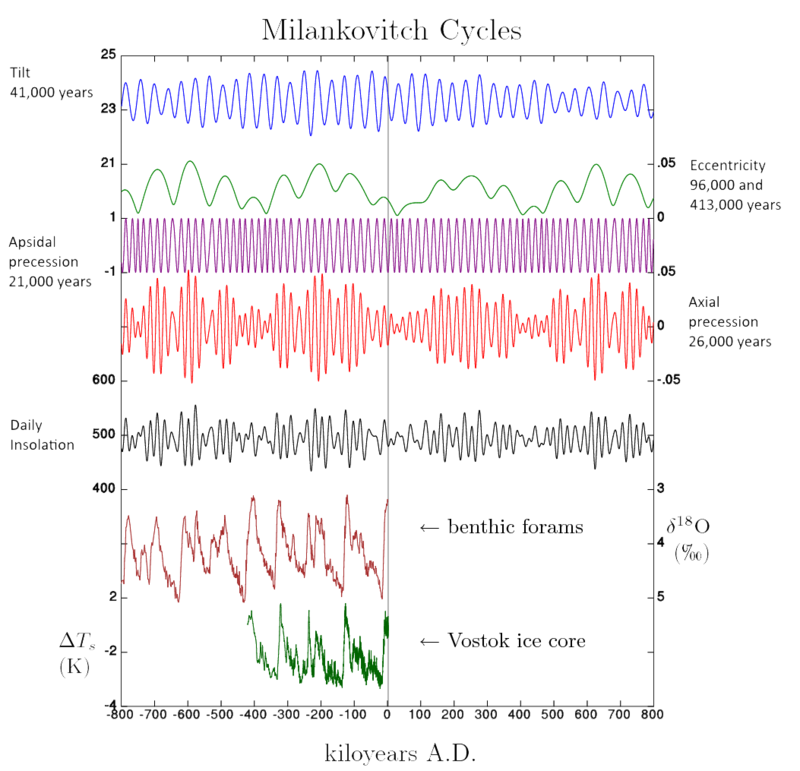
We need more CO2, not less to keep us in the climate sweet spot. Increasing CO2 levels to between 850 and 1000 ppm should delay the onset by about 2000 to 5000 years (my guess), but after that the next ice age is coming. Historically, according to the Milankovitch cycles we should have already entered the next ice age.

This picture is simplified, but together with the other cycles the picture is quite complicated.

The take home from this picture is that daily insolation (at the 60th latitude) can vary by as much as 100 w/m2 or about 50 times the effect of a doubling of the CO2 level. It is also worth noting that the normal state of the earth is ice age, and thermal runaways have never occurred, even when in past geological ages, CO2 levels were over 10000 ppm.

Answers to Question 5. Will reducing meat in my diet help the climate?Answers to Question 6. What’s the worst-case scenario?

Answers to Question 7. Will a tech breakthrough help us?

Answers to Question 8. How much will the seas rise?

Answers to Question 9. Are the predictions reliable?

Answers to Question 10. Why do people question climate change?

Answers to Question 11. Is crazy weather tied to climate change?

Answers to Question 12. Will anyone benefit from global warming?

Answers to Question 13. Is there any reason for hope?

Answers to Question 14. How does agriculture affect climate change?

Answers to Question 15. Will the seas rise evenly across the planet?
Answers to Question 16. Is it really all about carbon?


A Climate Realist’s (not so) short Answers to Hard Questions About Climate Change. Question 3 (of 16) Is there anything I can do?

NOV. 28, 2015 gave his answers to 16 questions in the N.Y. Times regarding Climate Change. This Climate realist added his answer.

 Answers to Question 1: How much is the planet heating up?

Answers to Question 2. How much trouble are we in?

Justin Gillis answer to Question 3. Is there anything I can do?

Fly less, drive less, waste less.

You can reduce your own carbon footprint in lots of simple ways, and most of them will save you money. You can plug leaks in your home insulation to save power, install a smart thermostat, switch to more efficient light bulbs, turn off the lights in any room where you are not using them, drive fewer miles by consolidating trips or taking public transit, waste less food, and eat less meat.

Perhaps the biggest single thing individuals can do on their own is to take fewer airplane trips; just one or two fewer plane rides per year can save as much in emissions as all the other actions combined. If you want to be at the cutting edge, you can look at buying an electric or hybrid car, putting solar panels on your roof, or both.

If you want to offset your emissions, you can buy certificates, with the money going to projects that protect forests, capture greenhouse gases and so forth. Some airlines sell these to offset emissions from their flights, and after some scandals in the early days, they started to scrutinize the projects closely, so the offsets can now be bought in good conscience. You can also buy offset certificates in a private marketplace, from companies such as TerraPass in San Francisco that follow strict rules set up by the state of California; some people even give these as holiday gifts. Yet another way: In states that allow you to choose your own electricity supplier, you can often elect to buy green electricity; you pay slightly more, with the money going into a fund that helps finance projects like wind farms.

In the end, though, experts do not believe the needed transformation in the energy system can happen without strong state and national policies. So speaking up and exercising your rights as a citizen matters as much as anything else you can do.

My answer to Question 3. Is there anything I can do?

First let us look at the so called carbon footprint. These feet are from 2010.

I would like to acknowledge Stanford Kay Studio; a version of this graphic first appeared in Miller-McCune. Thank you, Stanford! Copyright Stanford Kay 2010. China has the largest carbon footprint in the world, followed by the United States, but when it comes to carbon footprint per capita Gibraltar is number one, followed by the U.S Virgin Island.  How can that be? Everything in Gibraltar must be imported, and nearly everything is imported to the U.S. Virgin Islands.

The solution to lower the carbon footprint is to produce and buy local, and eat things produced in season.

Pipelines has less than half the carbon footprint of the same substance transported by rail.

Transport by rail has much smaller carbon footprint than transport by truck.

Electric cars make no sense as long as electricity is produced by fossil fuels. The extra energy consumed in manufacturing the batteries will never be repaid if transmission and conversion losses are taken into account.

Make food from scratch rather than eating processed food.

If possible plant a garden and eat fresh vegetables. Even a window pot with chives makes the sour cream tasty. A rosemary pot is wonderful. I could wax eloquent, but you get the point.

Don’t ever buy CFL light bulbs again, and don’t throw the old bulbs in the trash. Sometimes in the future we will have to mine the landfills.

A lot of stuff is flown in from abroad, very energy inefficient. Work to make it locally.

Answers to Question 4. What’s the optimistic scenario?

Answers to Question 5. Will reducing meat in my diet help the climate?

Answers to Question 6. What’s the worst-case scenario?

Answers to Question 7. Will a tech breakthrough help us?

Answers to Question 8. How much will the seas rise?

Answers to Question 9. Are the predictions reliable?

Answers to Question 10. Why do people question climate change?

Answers to Question 11. Is crazy weather tied to climate change?

Answers to Question 12. Will anyone benefit from global warming?

Answers to Question 13. Is there any reason for hope?

Answers to Question 14. How does agriculture affect climate change?

Answers to Question 15. Will the seas rise evenly across the planet?

Answers to Question 16. Is it really all about carbon?


A Climate Realist’s not so short Answers to Hard Questions About Climate Change. Question 2 (of 16) How much trouble are we in?

NOV. 28, 2015 gave his answers to 16 questions in the N.Y. Times regarding Climate Change. This Climate realist added his answer.

 Answers to Question 1: How much is the planet heating up?

Justin Gillis answer to Question 2. How much trouble are we in?

“For future generations, big trouble.

The risks are much greater over the long run than over the next few decades, but the emissions that create those risks are happening now. Over the coming 25 or 30 years, scientists say, the climate is likely to resemble that of today, although gradually getting warmer. Rainfall will be heavier in many parts of the world, but the periods between rains will most likely grow hotter and therefore drier. The number of hurricanes and typhoons may actually fall, but the ones that do occur will draw energy from a hotter ocean surface, and therefore may be more intense, on average, than those of the past. Coastal flooding will grow more frequent and damaging.

Longer term, if emissions continue to rise unchecked, the risks are profound. Scientists fear climate effects so severe that they might destabilize governments, produce waves of refugees, precipitate the sixth mass extinction of plants and animals in Earth’s history, and melt the polar ice caps, causing the seas to rise high enough to flood most of the world’s coastal cities.

All of this could take hundreds or even thousands of years to play out, conceivably providing a cushion of time for civilization to adjust, but experts cannot rule out abrupt changes, such as a collapse of agriculture, that would throw society into chaos much sooner. Bolder efforts to limit emissions would reduce these risks, or at least slow the effects, but it is already too late to eliminate the risks entirely.”

My answer to  question: 2. How much trouble are we in?

For climate alarmists: big trouble, for climate realists, not anything out of the ordinary as to temperature rise.
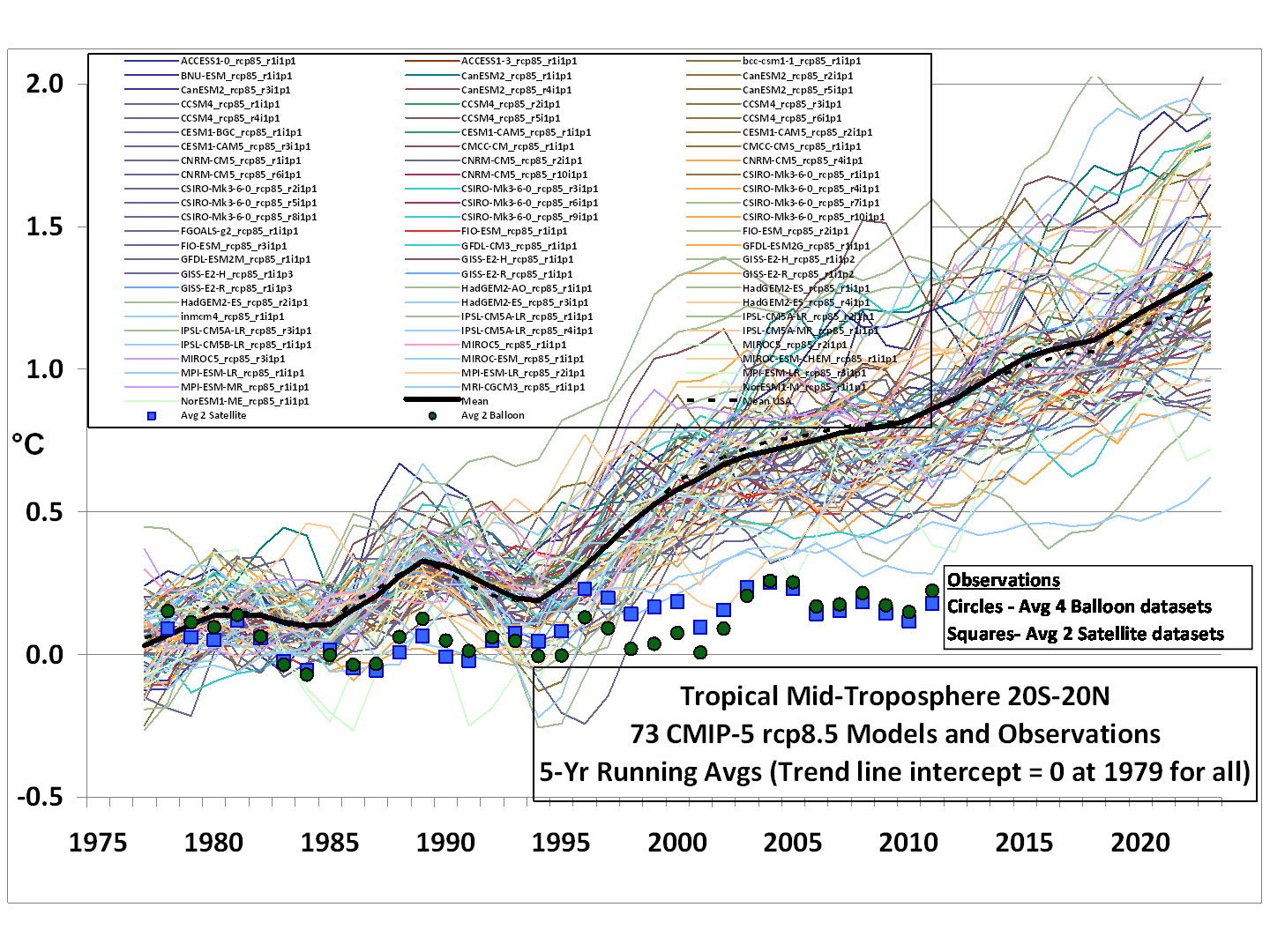
The temperature rise is predicted using models that assume the major effect on the climate is from rising CO2 and ignore other factors such as a changing cloud cover. The imbalance due to rising CO2 levels is less than 2W/m2, and every percent change in cloud cover makes a larger difference. Here is the performance of 73 climate models versus observations.
There is almost no correlation between models and observations. What is the problem? Looking at how the models model clouds gives a hint:The models are way off on the amount of clouds. Antarctica is almost cloud free and the Arctic has plenty of clouds. This means the models totally underestimate the effects of water vapor (the source of clouds) and overestimate the effects of rising CO2.  It turns out that clouds are the major stabilizer of the climate on the high end, thanks to their high negative feedback – more clouds, cooler climate. This means that even with a doubling of the CO2 levels we will not even get back to even the Medieval warm period. We are in a long cooling trend.
No such feedback occurs when it cools, rather more snow means higher albedo which leads to a new ice age. More CO2 will delay the onset of the next ice age, but will not prevent it. Fear not, the next ice age is probably more than 5000 years away.

A Climate Realist’s not so short Answers to Hard Questions About Climate Change. Question 1 (of 16) How much is the planet heating up?

1. How much is the planet heating up?

As of February 2016, the Earth has warmed about 1.8 degrees Fahrenheit since 1880, when records began at a global scale. That figure includes the surface of the ocean. The warming is greater over land, and greater still in the Arctic and parts of Antarctica, but there is very little warming in the tropics.

Since pre-industrial times the CO2 level has increased from 280 ppm to 405 ppm, an increase of about 45%, and we know that for every doubling of CO2 temperatures will rise about 1.6 degrees F unless other factors dominate, such as positive or negative temperature feedbacks.

During ice-ages global temperatures hover around 10 degrees F colder with CO2 levels around 185 ppm. Global temperature was about 6 degree F colder than today and in about 4000 year time temperature rose rapidly and we came out of the ice age. During that time, and with a 300 to 800 year delay CO2 rose from 185 ppm to 265 ppm, a 43% rise.  Coming out of the ice age, if CO2 was the only factor,  the effect of doubling CO2 would increase global temperatures by 11.5 degrees F.

Al Gore saw the charts, and got so alarmed that he wrote “Earth in the balance.” What he didn’t take into account was that the major rise in temperature was not due to the increasing CO2, but the loss of albedo when the ice melted. CO2 played a supporting role, a lagging one. Then, around 9000 years ago temperatures stopped rising, CO2 levels stabilized and we entered a period of relative stability. What happened?

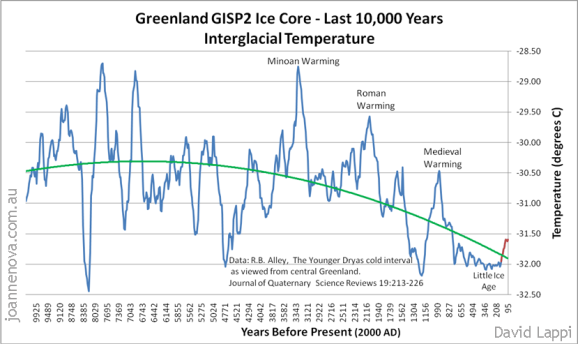
The albedo came back, this time in the form of increasing clouds. Once the oceans got warmer and stabilized, there was enough water vapor in the air to make more clouds, and so stabilize temperature. Since then temperatures have been on a slow decline, and the trend was accelerating until the ” little ice age”. There were 3 notable warming periods, the Minoan, the Roman, and the Medieval warming period.

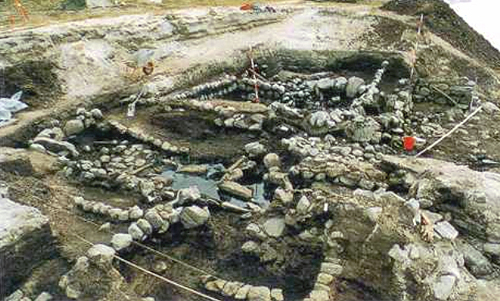
During the Roman warm period wine grapes were grown almost up to the Hadrian Wall. It is well documented, and in Northhamptonshire, England there were at least 9 flourishing wineries..

The Roman Northamptonshire wine
was good, not excessively fine.
So it just goes to show
that Al Gore does not know
of Climate Change past, that’s my line.

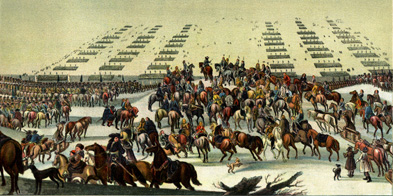
The the dark ages came and grapes no longer ripened in England. During the Medieval Warm Period there was at least one cheese farm on Greenland “Gården under sanden”, abandoned as the glaciers regrew, starting the “Little Ice Age”. During the little ice age it got so cold, that in Jan 1658 the Swedish army crossed the Great Belt of Denmark over ice, canons and all,  and sacked Copenhagen. We are still recovering from the “little ice age.” 2016 may have been a warm year, but most years since the ice age were warmer. See Chart.Greenlandgisp-last-10000-newWe are still in the sweet spot of a remarkable stable Climate, only more CO2 will save us from a new Ice Age. We are not yet back to the Medieval warming period, much less the Roman and even less the Minoan. A doubling of CO2 will not get us back to the Roman warming period since the negative feedback from clouds will dominate and limit the temperature rise.

As to the fear mongering claim that “The heat accumulating in the Earth because of human emissions is roughly equal to the heat that would be released by 400,000 Hiroshima atomic bombs exploding across the planet every day,” I can only say that the energy from the sun is equivalent to over 25oo Hiroshima bombs per second, or about 540 times as much as comes from human energy production, about 0.2%, hardly anything to worry about.

Answers to Question 2. How much trouble are we in?

Answers to Question 3. Is there anything I can do?

Answers to Question 4. What’s the optimistic scenario?

Answers to Question 5. Will reducing meat in my diet help the climate?

Answers to Question 6. What’s the worst-case scenario?

Answers to Question 7. Will a tech breakthrough help us?

Answers to Question 8. How much will the seas rise?

Answers to Question 9. Are the predictions reliable?

Answers to Question 10. Why do people question climate change?

Answers to Question 11. Is crazy weather tied to climate change?

Answers to Question 12. Will anyone benefit from global warming?

Answers to Question 13. Is there any reason for hope?

Answers to Question 14. How does agriculture affect climate change?

Answers to Question 15. Will the seas rise evenly across the planet?
Answers to Question 16. Is it really all about carbon?


Change of tune in next week’s G20 meeting on Climate Change, a Limerick.

G20 to meet in Black Forest

Sweet unity  no longer chorused

The encouraging word

in the Paris accord

Mnuchin to farce metamorphosed.

(Bloomberg) — Finance ministers for the U.S., China, Germany and other members of the Group of 20 economies may scale back a robust pledge for their governments to combat climate change, ceding efforts to the private sector.

Citing “scarce public resources,” the ministers said they would encourage multilateral development banks to raise private funds to accomplish goals set under the 2015 Paris climate accord, according to a preliminary statement drafted for a meeting that will be held in Germany next week.

The statement, obtained by Bloomberg News, is a significant departure from a communique issued in July, when finance ministers urged governments to quickly implement the Paris Agreement, including a call for wealthy nations to make good on commitments to mobilize $100 billion annually to cut greenhouse gases around the globe.

“It basically says governments are irrelevant. It’s complete faith in the magic of the marketplace,” John Kirton, director of the University of Toronto’s G-20 Research Group, said in an interview. “That is very different from the existing commitments they have repeatedly made.”

The shift in tone comes as U.S. President Donald Trump’s Treasury Secretary, Steven Mnuchin, prepares for his first G-20 meeting, scheduled for March 17 to 18 in the spa town of Baden-Baden. While European nations including Germany have been at the forefront of combating global warming, Trump has called climate change a hoax.

The Republican president vowed during his campaign to “cancel” the Paris agreement but has said little about the deal since taking office. His cabinet members, meanwhile, have sent mixed signals. U.S. Secretary of State Rex Tillerson said the U.S. should keep a seat at the table for international climate talks. Scott Pruitt, the head of the Environmental Protection Agency, on Thursday expressed doubt that humans were to blame for global warming and called the Paris agreement a “bad deal” for the U.S.

The most notable element of the draft is what’s missing. The statement issued after the G-20 finance ministers and central bank governors meeting in July dedicated 163 words to the Paris Agreement, pushing nations to bring the deal into force, meet emissions targets and fulfill financial pledges. This current draft dedicates just 47 words to the agreement, focusing exclusively on development banks raising private funds, without mentioning government financial support.

Germany, as the meeting’s host, leads the process of writing the statement, which will eventually be adopted via consensus by all 19 nations plus the European Union. The German finance ministry declined to comment on the draft.

“The most charitable thing to say is they’re waiting to see where Donald Trump actually lands by the time they get in Hamburg and thus, doing nothing to annoy the incoming American Treasury Secretary,” Kirton said.

German Chancellor Angela Merkel, who holds the rotating presidency of the G-20, has signaled that she would use the forum to push Trump on climate issues. The two leaders are scheduled to meet in Washington March 14.

“The takeaway is it clearly puts less emphasis on climate finance as a priority than last year’s did,” Alden Meyer, director of policy at the Union of Concerned Scientists, said in an interview. “It doesn’t talk about government action. That is a significant step back from what countries agreed to in Paris.”

Full statement: https://www.bloombergquint.com/politics/2017/03/09/g-20-document-shows-governments-retreating-from-climate-funding

Bill Nye knows nothing of Climate Change Science. A Limerick.

The Roman Northamptonshire wine

was good, not excessively fine.

So it just goes to show

that Bill Nye does not know

of Climate Change past, that’s my line.

During the Roman warm period wine grapes were grown almost up to the Hadrian Wall, The the dark ages came and grapes no longer ripened in England. During the Medieval Warm Period there was at least one cheese farm on Greenland “Gården under sanden”, abandoned as the glaciers regrew, starting the “Little Ice Age”. We are still recovering from the little ice age. 2016 may have been a warm year, but most years since the ice age were warmer. See Chart.Greenlandgisp-last-10000-newWe are still in the sweet spot of a remarkable stable Climate, only more CO2 will save us from a new Ice Age.

Check this video:

https://youtu.be/LKMxmYcfw8Q

It is true that human activity causes climate change, and as for CO2, it is all to the good. Cutting down rain forests in Borneo to produce bio-fuel is not.

Does this make me a denier?

The origin of the 97% consensus, a Limerick.

Canard: Ninety-seven percent,

on Climate Change give their assent

that it is getting warm,

and they want to conform

and blame CO2, they’re hell-bent.

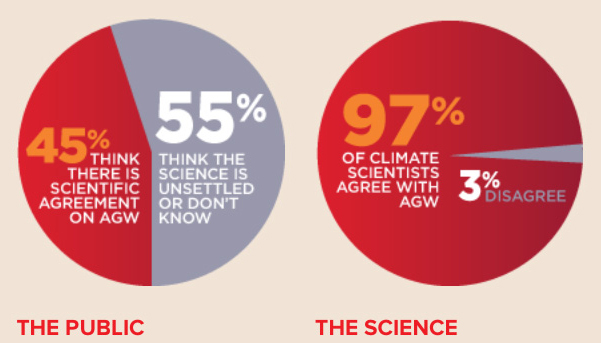
pies-public-scienceHow did the 97% consensus come about, and is this claim valid, or do 55% of the public have a point?  The number 97%  stems from a 2008 master’s thesis by student Maggie Kendall Zimmerman at the University of Illinois, under the guidance of Peter Doran, an associate professor of Earth and environmental sciences. The two researchers obtained their results by conducting a survey of 10,257 Earth scientists, excluding scientists most likely to think that the Sun,  planetary movements or cosmic radiation might have something to do with climate on Earth — such as solar scientists, space scientists, cosmologists, physicists, astronomers and meteorologists.

To encourage a high participation among these remaining disciplines, the two researchers decided on a quickie survey that would take less than two minutes to complete, and would be done online, saving the respondents the hassle of mailing a reply. Nevertheless, most didn’t consider the quickie survey worthy of response — just 3,146, or 30.7%, answered the two key questions on the survey:

1. When compared with pre-1800 levels, do you think that mean global temperatures have generally risen, fallen, or remained relatively constant?
2 Do you think human activity is a significant contributing factor in changing mean global temperatures?

The 10,257 scientists in such disciplines as geology, geography, oceanography, engineering, paleontology and geochemistry were somehow deemed more worthy of being included in the consensus. The two researchers also decided that only scientists employed by an academic or a governmental institution  would qualify. Neither was academic qualification a factor — about 1,000 of those surveyed did not have a PhD, some didn’t even have a master’s diploma.

The questions posed to the Earth scientists were actually non-questions. Nearly all scientists know the planet has warmed since the 1700s, and almost all think humans have contributed in some way to the recent warming — quite apart from carbon dioxide emissions, few would doubt that urbanization,  clearing of forests for agricultural purposes,  or misguided irrigation efforts such as the Aral Sea disaster have affected the climate. When pressed for a figure, global warming skeptics might say humans are responsible for 10% or 15% of the warming; some skeptics place the upper bound of man’s contribution at 35%. The skeptics only deny that humans played a dominant role in Earth’s warming.

Surprisingly, just 90% of the Earth scientists who responded to the first question believed that temperatures had risen — I would have expected a figure closer to 100%, since Earth was in the Little Ice Age in the centuries immediately preceding 1800. But perhaps some of the responders interpreted the question to include the past 2,000 years, when Earth was in the Medieval  or Roman Warm Period, when the climate was warmer than today.

As for the second question, 82% of the Earth scientists replied that human activity had significantly contributed to the warming. For openers, the question is a catch-all, is it CO2, pollution, urban development, cutting down of forests, failed irrigation projects or what? Secondly, how much is significantly?

To get up the percentage of positive responses above the 82% they excluded all the Earth scientists whose recently published peer-reviewed research wasn’t mostly in the field of climate change. This subset reduced the number of remaining scientists from over 3,000 to under 300. But the percentage that now resulted still fell short of the researchers’ ideal, so they chose a subset of 77 scientists that in the last 5 years had published multiple, peer reviewed papers, paid for by their respective academic institutions.

Once all these cuts were made, 75 out of 77 scientists of unknown qualifications were left endorsing the global warming orthodoxy. The two researchers, the master’s student and her prof, were then satisfied.

This claim was picked up by politicians and became truth that could not be disputed or you  were called the scum of the earth, worse than terrorists. Many more surveys, all intended to confirm the original claim

ritchie-2_121416The newer surveys also intended to confirm that it is CO2 that is the cause of Anthropogenic Climate Change. Because the U.N. agency IPCC insists that CO2 is the dominant, if not sole factor affecting Climate Change most scientists, eager to maintain funding tended to comply.

Lately there has been exposed one scandal after another has exposed massive data manipulation, from Climate Gate to changing old temperature tables eliminating the heat waves of the 30’s, just to name a few.

So, is there Anthropogenic Global Warming, and if so, is the cause mainly increasing CO2?

The jury is still out.


The spillway at the Oroville Dam fails. Blame Climate Change, not the politicians. A Limerick.

The spillway at Oroville Dam:

The “permanent drought” was a scam.

“No more need for repairs,

if it fails,  no one cares.”

“It’s Climate Change. Blame Uncle Sam.”

In May of 2016 California Gov. Jerry Brown made some of the state’s temporary water restrictions permanent. The executive order, in response to the state’s drought, permanently bans wasteful practices like hosing sidewalks and washing cars with hoses that don’t have shut-off nozzles.

“Californians stepped up during this drought and saved more water than ever before,” Brown said in a statement. “But now we know that drought is becoming a regular occurrence and water conservation must be a part of our everyday life.”

Meanwhile, the concerns for the existing dams faded. They would never be filled to capacity again, so why worry about emergency spillways? Regular maintenance and repair work, not of an emergency nature was delayed yet another year, and resources were diverted to other priority items, such as a Satellite program to monitor Climate change  if disaster should strike and Donald Trump, perish the thought, would be elected.

This was in the middle of the last El Niño, and temperatures had only one way to go, up, and with that increasing capacity to hold water vapor. Now the El Niño has been replaced by a La Niña, the temperature are getting back to normal, the 19 year pause is back, and now the excessive humidity is raining out over the Pacific West.

k_street_inundation_of_the_state_capitol_city_of_sacramento_1862This should not have come as a surprise. The Great flood of 1862 was worse. The Oroville Dam spillwater empties out in what is Sacramento river, and flood control by building dams has been successful to avert major flooding like that. Politicians have short memories and even less sense of history. The climate changes all the time. We are now raining out from a very temporary temperature rise, and we know that eventually our descendants will have  to face another ice age. More CO2 may delay that inevitability by a few hundred years, but the long term trend is down. 2016 was still on of the 1000 coldest in the last 10000 years.


On Climate Change. What can we learn from the snow?

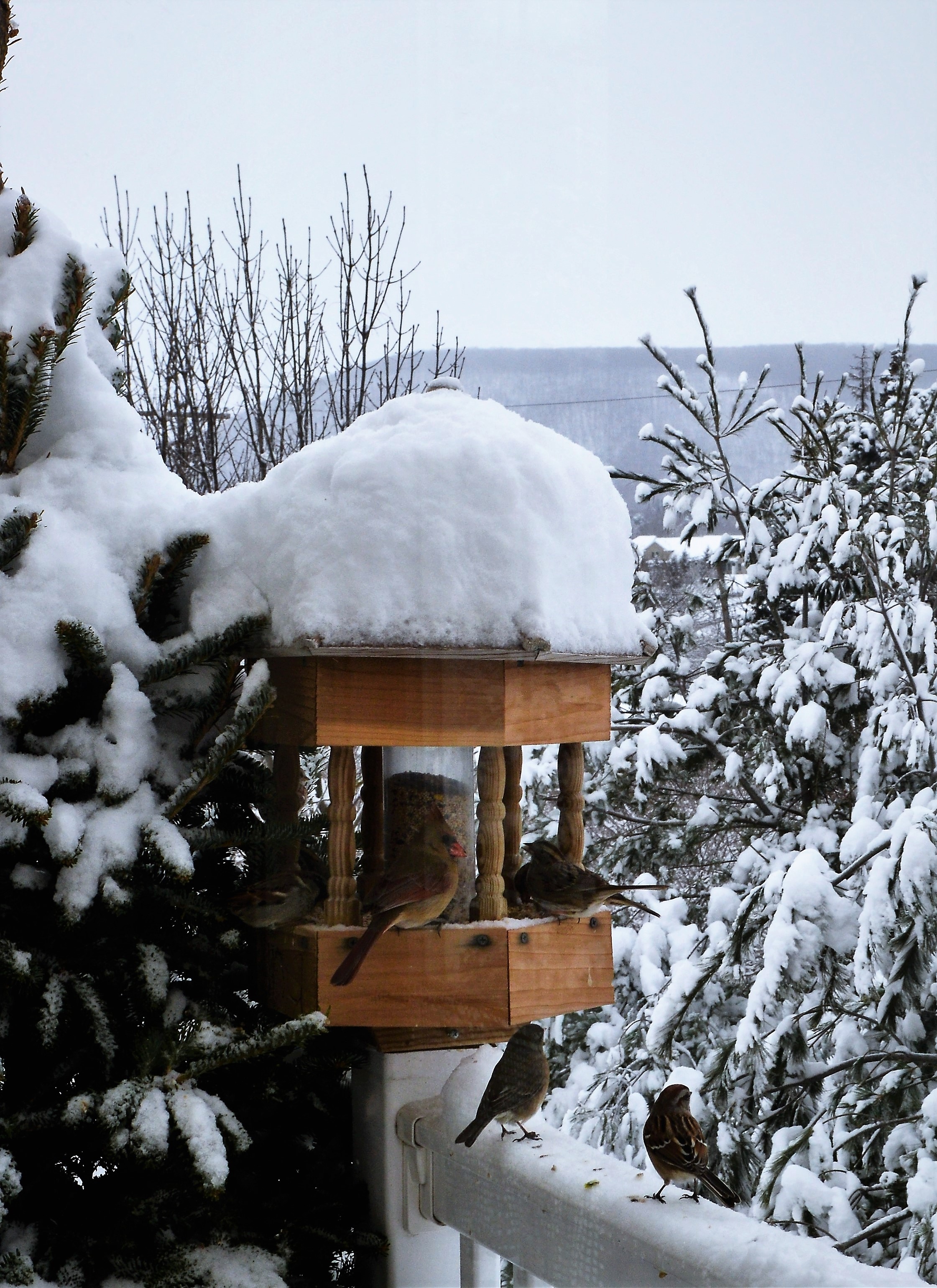
Having a snow day here at State College, and watching the birds feast on theseeds dsc_0355in the feeder, remembering the temperature was in the fifties yesterday my thoughts went back, way back to a time when I was trying to figure out why it was so hard to calibrate a temperature programmed gas chromatograph  when analyzing samples  from -40C to 275C. During the cryogenic phase water vapor froze on the inside of the oven, and when the oven temperature then rose through the melting point of water, temperature rise took a pause until all the ice was evaporated. As a result, calibration could vary widely dependent on the humidity and how long the oven was in the cryogenic state.
The weather has been unusual this year. After a long drought the Pacific coast has been hit with a seemingly unbroken string of storms, carrying moisture all the way from the Philippines, resulting in record rain and snow. Likewise, in the Atlantic there have been a string of strong storms going from the Gulf of Mexico all the way up to Greenland or Norway, and the storms are still roaring. From time to time the temperature has been reported to be up to 30 degrees warmer than normal, and it has been raining as far north as Svalbard.

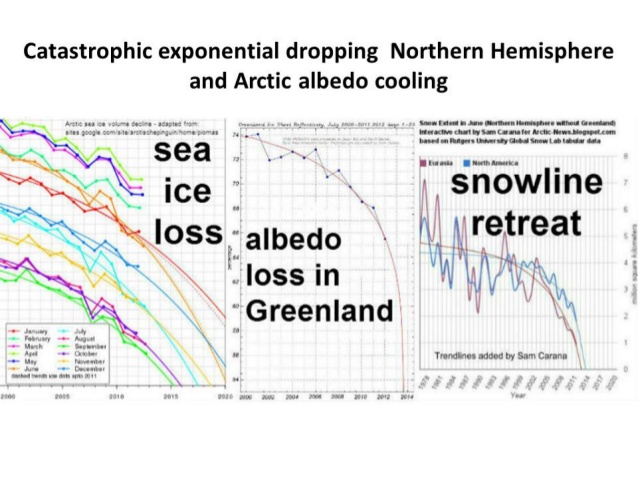
A few years ago there was a prediction (was is Al Gore?) that Arctic Sea ice would be totally gone by the year 2015 and the following charts were produced as proof:

arctic-albedo-loss-and-feedbacks-9-638The charts seem to indicate that by September 2015 Arctic ice would be totally gone and all Arctic snow by summer 2014.

Yogi Berra said: “It is hard to predict, especially about the future.” So how are we doing?

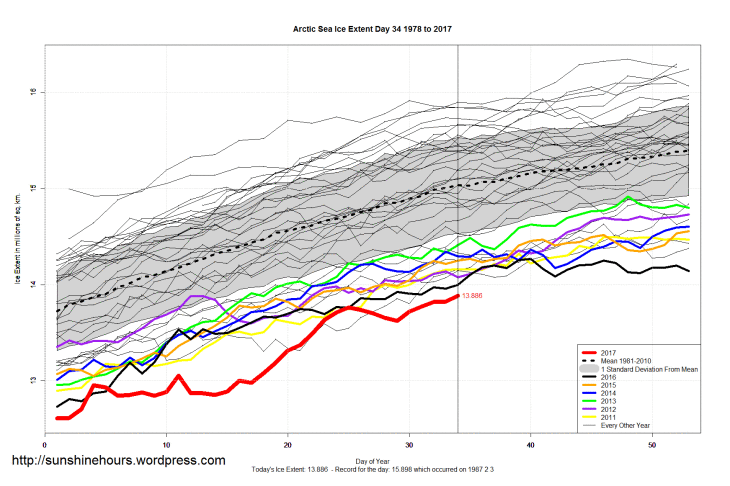
Arctic ice started out with the lowest minimum since 2012 and is still at record low levels for this time of the year.arctic_sea_ice_extent_zoomed_2017_day_34_1981-2010

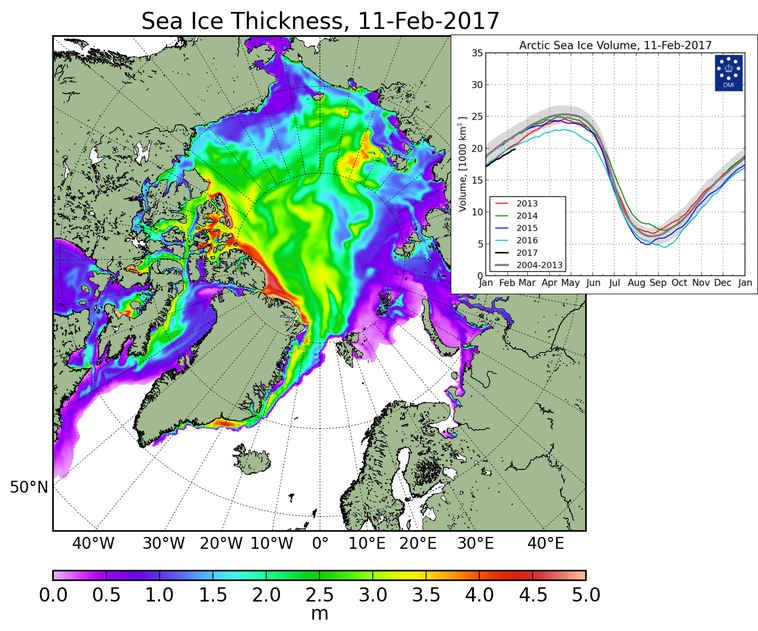
The total sea ice volume is also at a record low for this time of the year: (from DMI, Danish Meteorological Institute)

cice_combine_thick_sm_en_20170211

Couple this with the message that 2016 was reported the warmest year on record, and there seems to be plenty cause for alarm. But then it was reported by whistle blowers that the temperature data is homogenized to better align with climate models, in other words, falsified, so we may have to look for something that does not change over time, like temperature. Snow and ice have the characteristic of freezing and melting at the same temperature, al long as there is no change in what else is in the snow or ice, like soot or salinity.

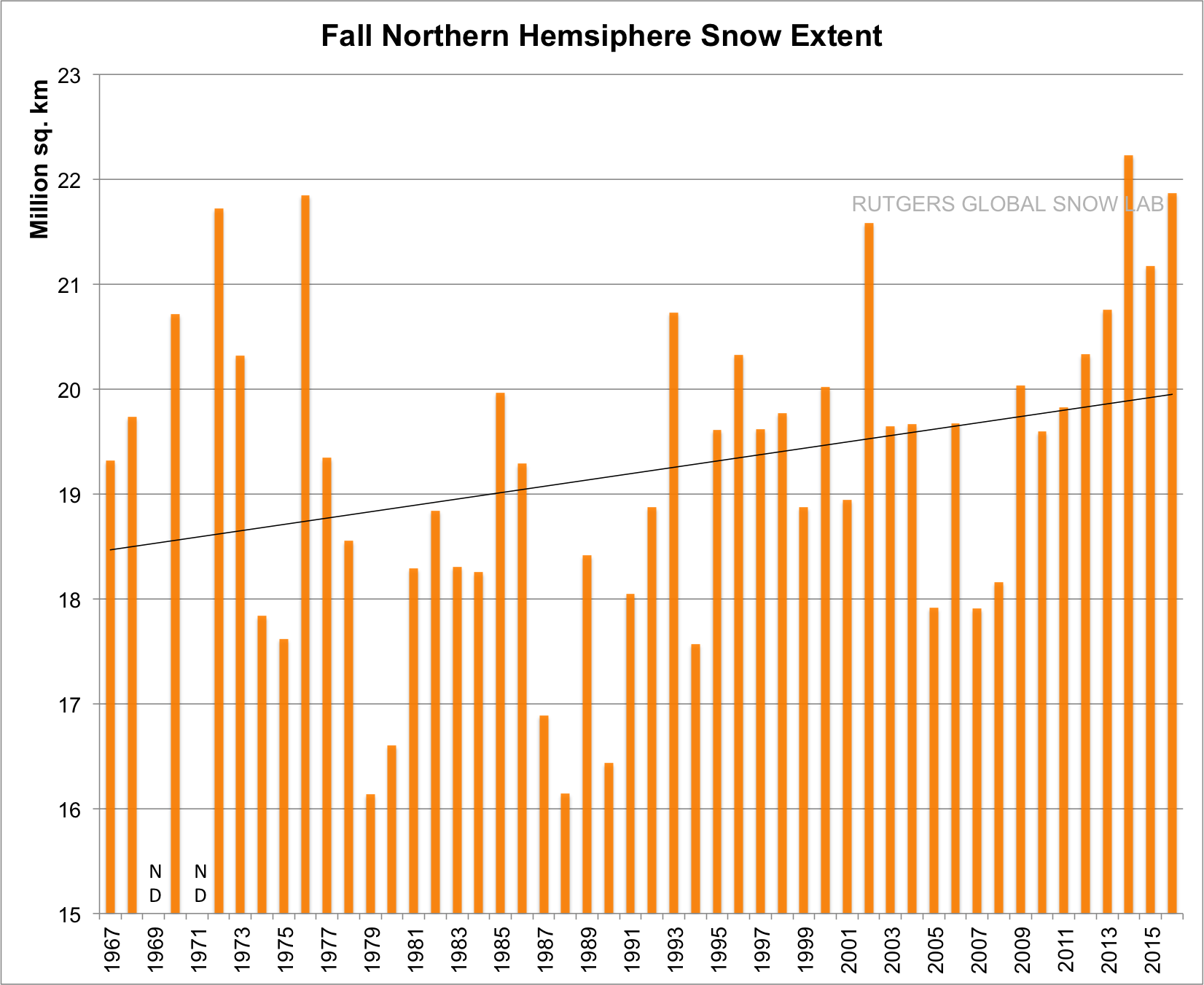
With all this ice melting, what is happening to the snow? Checking Rutgers’ University Global Snow Lab ice charts it is clear that the fall snow cover is increasing, signifying an about 8% increase in the last 50 years, and surprisingly,  a significant rise in the last 8 years.

This seems to hint it is getting colder.

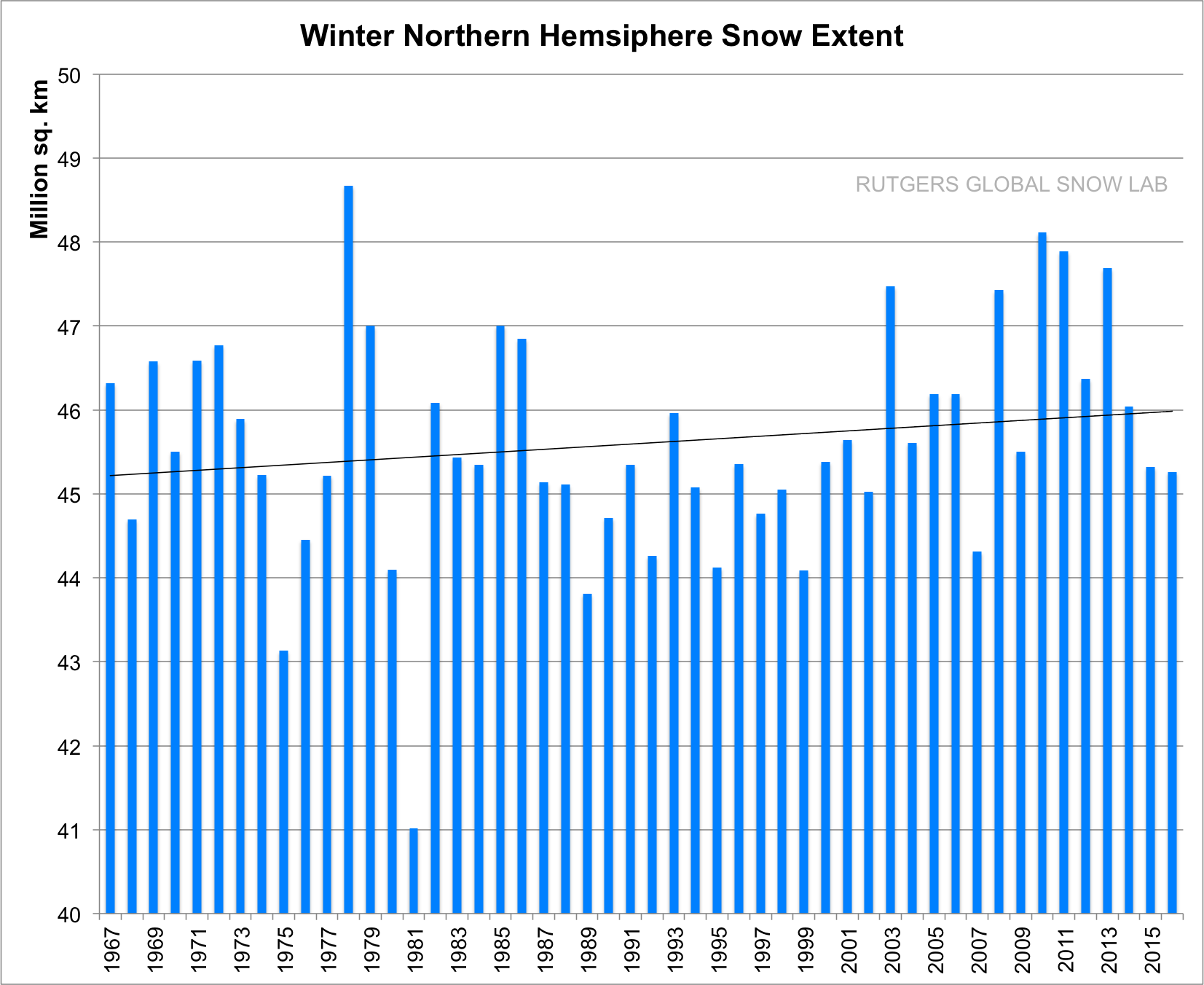
Not so fast: what happens to the winter snow cover?

Again we see a slight upward movement, about 2% in the last 50 years.

The January 2017 result are in, and the snow cover was the 5th highest on record for January, so the upward trend continues, indicating the climate is getting colder.

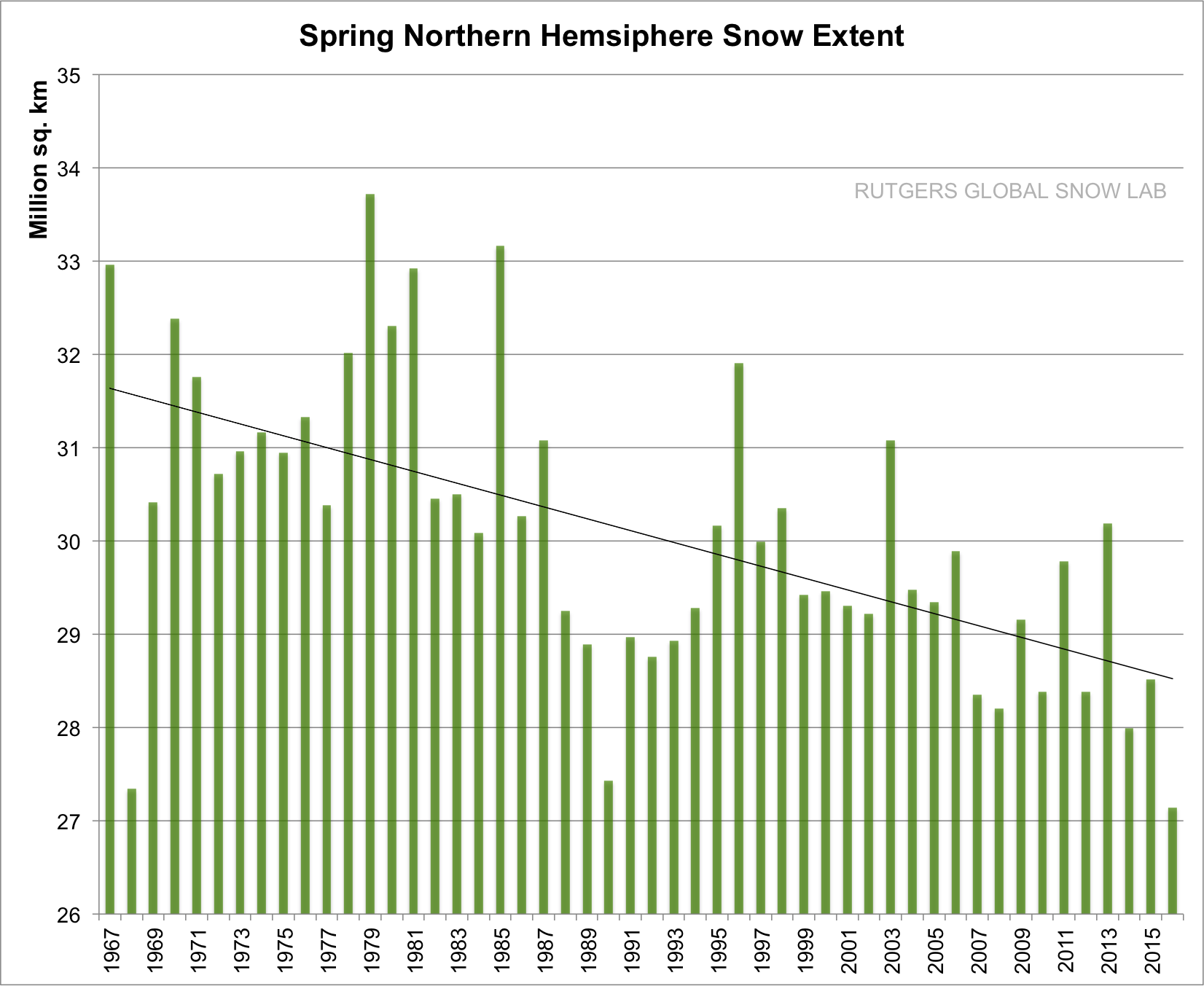
But what happens in spring?

The story is quite different with the snow cover decreasing about 10% in the last 50 years.

That must mean the climate is warming.

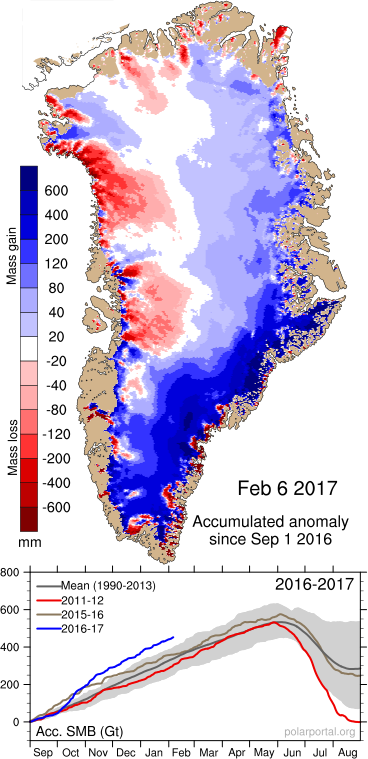
Let us look at one more piece of smb_combine_sm_acc_en_20170206statistics: The Greenland ice cover.

This fall has seen a lot of snow falling over Greenland, about double of normal, much like the rain falling in California, the result of a string of storms starting in the Philippines, raining and snowing i California, snowing out in the Western states, recharging  themselves with moisture from the Gulf of Mexico, and finally snowing out over Greenland or Norway.

When the storms hit Greenland the temperature spikes, sometimes reaching 30F above normal, but it is still snowing!

This year the snow fallen over Greenland is larger than ever recorded. This means that  al this new-fallen snow will not melt during the melting season, which means the snow albedo is higher this year and will cause less snow melt than in years when the albedo is lower

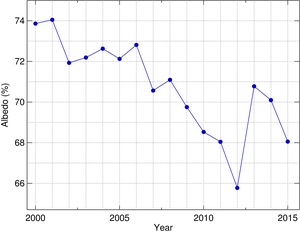
ice-glaciers-2015-fig3-3c-tedesco_smlThe albedo was constantly getting lower until 2012, and then it again snowed more than normal and the albedo recovered in 2013, from then continuing a downward trend. This year it will probably recover some more, leading to a year of ice gain over Greenland.

Why is the albedo decreasing? Blame China. The last few years they have been building one dirty coal plant every week, spewing out soot and sulphur compounds in spite of their claim to have the best scrubbers. This is the reason for the earlier spring snow melt.

The conclusion?

The effects of  increasing CO2 is mush less than the effects from clouds and what the clouds reflect back into the sky and what they carry in the form of water vapor. We are now seeing the result of the end of the el nino, the raining out of the excess humidity, which happens when the earth again is cooling.

The 18 year pause is back, and is now 19 years.