February 17, read the Bible in a year in PowerPoint; commented

Matthew 9:1-17.  Jesus continued his healing ministry, he healed a paralytic, but the real story is; Jesus forgave him his sins, a blasphemy unless Jesus is who he said he is. Then he called Matthew the tax collector and explained to John the Baptist followers why his disciples did not fast while Jesus was with them.

Leviticus 14 continues to deal with leprosy and mildew and what to do with both. Things like that are complicated.

Leviticus 15 deals with bodily discharges. (Hang in there, next chapter deals with the Atonement!)

Verse 16 and 17 of Matthew 9 explains fasting in an unexpected way. There is a right time to fast and a wrong time, and he uses wine and wineskins to illustrate that.

Wine is made from grapes, and the sugar content of grapes is about 16%. The wine making process is to convert the sugar into ethanol via fermentation, and grapes come replenished with their own yeast, so the fermentation starts whether you like it or not. If you leave the grapes out in the air they will ferment and the ethanol will oxidize into vinegar, so they must ferment in a vessel that locks out oxygen. The fermentation has two phases, the first phase is fairly fast, a little more than 10 days, where the sugar converts to ethanol. This process releases CO2; nearly half of the weight of the sugar goes up in the air in the form of CO2, the rest is ethanol. No wineskin can handle that, so fermentation was usually done in a clay vessel with a lid on to prevent air to enter. At the end of 10 to 15 days they had “new wine”.

Bur the fermentation was not over, the aging process began, and that lasted from a few weeks to a few months. During that time there is a slow release of CO2, but the vessel had to be air tight so no oxygen would spoil the wine and turn it into vinegar.

This is where new wineskins come in, they can handle this process by being ever so slightly permeable, if they are made from young goatskin, properly prepared.

Old wineskins on the other hand are hardened and can even be brittle, like an old leather glove that has been lost in the snow for the winter, and when it is found in the spring, it is ruined.

Jesus did not teach wine-making when he used that parable, in the parable the wine is the Holy Spirit and we are the wineskins.

Many people, me and my wife included have been praying for a great new, worldwide revival, and following that, a great worldwide awakening. Revivals usually start small and local, but with great intensity. The intensity will be greatest among young people, and they will celebrate with a new song in their heart. They are the new wineskins, they will be filled with new wine, and their new music will be less refined, raw and unpolished, or so it will seem to us old wineskins. We better prepare for the outpouring of the Holy spirit in our old wineskins by rejuvenate them with the oil of joy to make us ready to receive the old wine, aged to perfection with the full bouquet, like when Jesus turned water into wine. Then we who have been saved for many years can join with the young and appreciate each other, we appreciate their youthful enthusiasm and music, and they will appreciate the good wine that comes from lifelong experience.

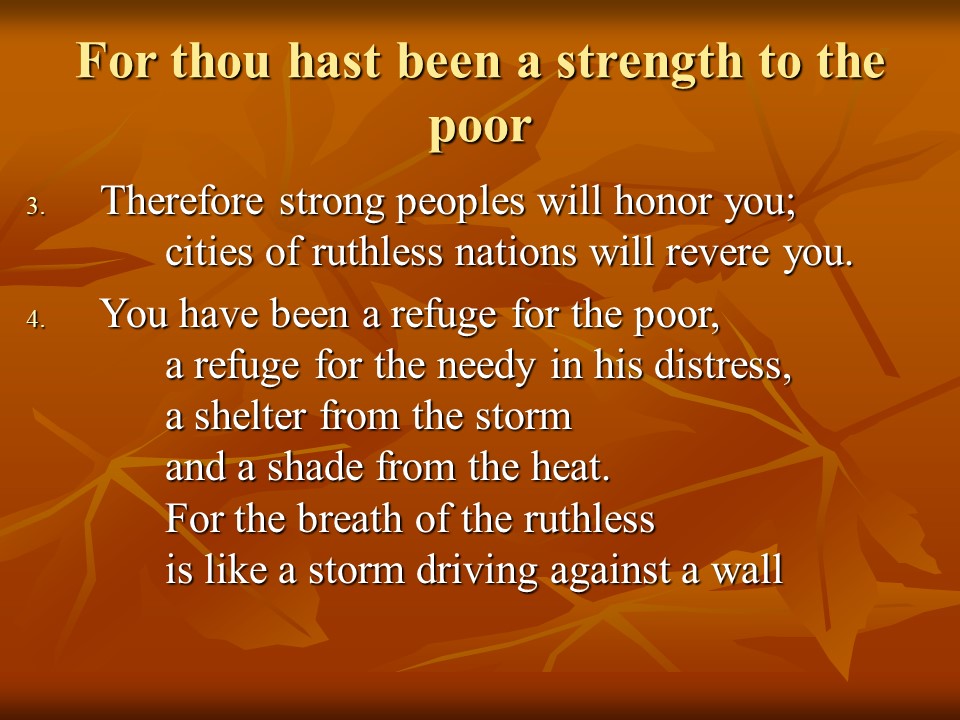
There is a great passage in Isaiah 25, a song of praise coming right after the dreadful chapter 24. It speaks of aged wine being the finest of wines.

Slide11

Revelation 7:17: For the Lamb at the center of the throne will be their shepherd; ‘he will lead them to springs of living water.’ ‘And God will wipe away every tear from their eyes.’”

Yes, there will be a great worldwide revival, and an even greater awakening.

February 3, read the Bible in a year in PowerPoint; commented.

Matthew 2:1-12 . We get to read about the Magi (probably about 15 of them including servants) who came to Jerusalem to ask about the King of the Jews. This worried King Herod and all Jerusalem, and Herod asked the Scribes and the other learned men where he was to be born. They answered “In Bethlehem of Judea”, but were otherwise remarkably uninterested. The wise men went to Jesus (he is by now at least a few months old), but did not report back to Herod, instead they returned another way.

In Exodus 16  God gave them Manna (what is it?) and quail, and Moses gave the instructions on how to gather it. And they ate Manna for 40 years.

In Exodus 17, lack of water is a recurring theme in the desert. In Rephidim there was no water at all, so God told Moses to strike the rock at the foot of Mount Horeb. Water gushed out and they were all filled with good water. Good it was, for the Amalekites attacked them right afterwards. Joshua and his men fought a good fight, and Moses helped by raising his hands, and as long as he held them high Joshua prevailed. But Moses got tired, so Aaron and Hur held up his hands until sunset, and so the Amalekites were defeated.

Exodus 18 tells of Jethro, Moses’ father-in-law when he visited Moses, who now was in a difficult situation trying to lead his people all by himself, and Jethro gave Moses good advice about real leadership, delegation of management, a practice essential for all governing.

The lesson for today is the wise men acted on what they saw,; the teachers of the Law seemed uninterested and were afraid to find out. The people that had miraculously escaped Egypt complained and wanted to go back to slavery. Moses wore himself out trying to govern, but Jethro, his father in law gave good governing advice. So began in earnest the 40 year journey.

February 1, read the Bible in a year in PowerPoint; commented.

John 21 tells of the eighth miracle of Jesus. This miracle, a great catch of fish happened after Jesus resurrection and was a sign of new beginnings. Jesus reinstated Peter and told him: “Feed my sheep.”

Exodus 12 tells of how God instituted the Passover. The name comes from the action of the night the angel of death came to kill every firstborn in Egypt; if he saw the blood of the pascal lamb om the doorposts and the lentil of the house, he would pass over that house. The chapter is fantastic, read it and marvel!

In Exodus 13 the feast of unleavened bread is defined and the consecrating of the firstborn to the LORD. The Hebrews have escaped from Egypt, and a proposed route is suggested.

We are in the middle of the battle of the centuries, and it is spiritual. Bear with me as I try to explain. Jesus asked Peter 3 times : Do you love me?; the first 2 times using agape (Gods love) and the third time using brotherly love, and every time Peter answered positively with brotherly love. Jesus then says “Feed my sheep”, but Peter answered “What about John”? and Jesus answered “What is that to thee, follow thou me”. Peter then understood that all authority was still Christs, and they were to follow the leading of the Holy Spirit. Under heavy persecution Christianity grew rapidly, and in 313 A.D. Emperor Constantine declared Christianity protected. This meant that a lot of people became Christians in name only, and to solidify Christian beliefs the Apostles’ creed was formalized in 325 A.D. establishing our belief i God the Father, God the Son and God, the Holy spirit, and Christ’s return and final judgement. Many kept their old beliefs and added Christianity to advance in society. With people in power and authority with little or no knowledge of Christ there was a period of anarchy and strife in the papacy. The Umayyad caliphate had just arisen ande declared the triune God blasphemy, only Allah, and waged war to conquer. Out of this arose Pope Leo III a byzantine from the Eastern brench of the Catholic church. He was declared Pope in 795 A.D. and in 800 A.D. Crowned emperor Charlemagne on Christmas Day in 800, thereby initiating what would become the Holy Roman Empire, which certainly wasn’t holy, nor was it Roman or even very much of an empire. Which brings us to today when Pope Leo XIV seems to undo many of the traditions that sought to cement the Papacy as a worldly power, such as the infallability of the Pope when he speaks “Ex Cathedra”. There are many old traditions going by the wayside. Time will tell if it is a restoration to original Christianity or just another upheaval in the Roman Catholic Church.

Meanwhile, every Passover Seder ends with “Next year in Jerusalem”

January 31, read the Bible in a year in PowerPoint; commented.

John 20 deals with the resurrection, and Jesus was not there, only his grave clothes, strips of cloth, not the “Turin Shroud.” It was the first day of the week and Jesus showed himself to all the disciples except Thomas. He doubted their testimony, and it is from this we have the expression “Doubting Thomas.” Later, when even he saw Jesus, he bowed down and worshiped him saying “My Lord, and my God”. Jesus also gave the promise they would receive the Holy Spirit.

Exodus 10: Two more plagues, the plague of locusts and the plague of darkness. For these two plagues the LORD hardened Pharaoh’s heart.

In Exodus 11 Moses and Aaron proclaimed the tenth and final plague: The death of the firstborn. Interestingly enough the plagues of Egypt are also in the Quran, four are the same, five are different, and one is missing altogether. Guess which one!

Psalm 11 has the phrase “flee as a bird to the mountain”, which bring back memories of songs we used to sing in choir.

Yes, it was a long time ago, and our pastor wanted us to sing it, but our choir director thought otherwise. However, in obedience we sang it, and it was well received. The disagreement centered around: We are supposed to be in the world, but not of it. To flee to avoid all sin is not in the Gospel commandment.

When Jesus breathed on the disciples, they received the Holy Spirit, but they still had to wait until they received power from above. The Holy Spirit dwells in us, but the power of the Holy Spirit is still given only by God and only to do His will in His opportune time. This is why daily communication with God is so important, in thanksgiving , prayer, and yes ; in spiritual songs.

January 30, read the Bible in a year in PowerPoint; commented.

John 19:16b-42. I took the liberty to incorporate all the “seven words of Christ on the cross.” This requires to take passages from the Gospel of Luke, as well as from the Gospel pf Matthew or Mark. It helped me a lot to get the time-order of events as well as the completeness of Christ substitutionary sacrifice on the Cross. It is finished!

In Exodus 9 there are three more plagues, the plague of livestock, the plague of boils and the plague of hail. In the fifth and seventh plague Pharaoh’s heart remained hard, but for the sixth plague the LORD hardened Pharaoh’s heart.

In most predominately Christian nations Good Friday is a holiday, second only to Easter Sunday, but in U.S.A. only Christmas Day and Easter Sunday are religious holidays. In Sweden Good Friday is called Long Friday because in Church they read the whole Litany, and because of the length of the reading the Congregation is asked to sit down during the reading. All other readings from Scripture is supposed to be listened to standing up in reverence. Then as children we were not allowed to play or have any kind of fun. This was the most solemn day of the year.

The commemoration of the death of Christ on Friday was instituted by the Catholic Church o fit the readings for the Holy week. In the Gospel of John it says it was the day of preparation for the “special Sabbath” when Jesus was buried. In the Gospel of Matthew the resurrection occurred “Opse de Sabbaton” or after the Sabbaths. This means it was a double Sabbath, which happens every seventh year on average. This was the case in A.D.30 so we know when it happened exactly, but we stick to the tradition of having it close to the Jewish Passover.

January 28, read the Bible in a year in PowerPoint; commented.

John 18:28-40 deals with the last 24 hours of Jesus’ life, from the trial before Annas and the Sanhedron Jesus was paraded before Pilate, seeing a way out, Pilate sent him to Herod, who sent him back to Pilate, Pilate offered to release Jesus or Barabbas and the people demanded that Barabbas be released.

In Exodus 4 God gave Moses his call. At first Moses came up with one objection after another, but God persuaded him with signs that he must go back to Egypt, face Pharaoh and lead his people.

In Exodus 5 Moses and Aaron went to Pharaoh and asked for a 3 day reprieve for their people so they could go and worship God. Like all dictators Pharaoh reacted to this petition by making life even more miserable for the Hebrews; he wanted them to gather their own straw and still make as many bricks as before. The Hebrews blamed Moses for stirring up trouble for them.

And in Exodus 6 the LORD (Jehovah) promised deliverance from Pharaoh and He would give them the land He had promised Abraham. The narrative continues with an interlude where the names of the heads of the clans of Israel are listed. Moses protested and did not want to talk to Pharaoh any more, so Aaron would have to do the speaking.

Yesterday I didn’t comment on the momentous events when Jesus was taken into custody, ans Moses finally understood who God is and why it mattered, but the events of the trial reminded me of recent events in Minnesota. This is the Barabbas effect, one part of the government incites a mob to demand something that would be ridiculous for any thinking person to even contemplate. In this case the mob sides with the criminal, like the mob sided with Barabbas.

With Moses, his request was met with punishment of a whole group for a demand given by one person, a typical response for a ruler keeping control.

January 26, read the Bible in a year in PowerPoint; commented.

John 17 is commonly known as Jesus’ high priestly prayer. In some conservative circles it is also called “The Lord’s prayer.” In it Jesus prayed for himself, then he prayed for his disciples followed by prayer for all future believers. In the end of the chapter he prayed that the believers will see his glory, the glory God gave him before the creation of the world.

A few hundred years has passed since the end of Genesis. Exodus 1 tells how the Hebrews multiplied and became a perceived threat to the Egyptians. The Egyptians told the Hebrew midwives that every boy they delivered must be thrown into the Nile, but every girl were to be let to live.

Which seamlessly leads into Exodus 2, how Moses when he was born was placed in a papyrus basket, which then was thrown into the Nile and the child was left crying in the reeds. Pharaoh’s daughter heard it, picked him up and asked her servant to find somebody to nurse him. Of course she found Moses’ own mother to nurse him. After he was weaned Moses grew up in Pharaoh’s household and got educated. He did remember he was a Hebrew, so when he saw an Egyptian mistreat a Hebrew he killed the Egyptian. This became known and Moses fled to Midian, where he spent 40 years tending flocks. This is great reading.

The take home from today’s reading is that Jesus clearly indicated he existed in his full glory before the creation of the world. And according to Genesis 1:2 the Spirit of God took part in creation. The triune God clearly existed before creation.

Now about Moses birth the edict was that every Hebrew boy should die, but every girl should live. This is opposite but similar to the Chinese one child policy. When I became a citizen I was invited to a special ceremony of naturalization where it was only one or a couple from as many countries they could find. We were 135 people from 78 countries. The only exception were 5 adopted Chinese girls, the result of the one child policy. With only one child allowed he better be a boy. Girls were usually aborted, but some parents chose the difficult and expensive process of giving it up for adoption. China is now paying the price for their catastrophic policies.

January 21, read the Bible in a year in PowerPoint; commented.

John 14:1-14 records the events of the hour after the Passover meal before they all depart to Gethsemane. Jesus told his disciples he is going away to prepare a mansion, more precisely a dwelling place for them. Thomas, always questioning him, asked him “How can we know the way?” And Philip added “Show us the Father“. Jesus answer? “Believe in me“.

Genesis 40 deals with dreams. Joseph’s two fellow cellmates in prison each had a dream, Joseph interpreted the dreams that the cup-bearer would be released and restored to his former position, while the baker would be hanged on a tree.

In Genesis 41  Pharaoh himself had a dream, and Joseph was released from prison to interpret the dream. It dealt with seven years of plenty and seven years of famine. Joseph interpreted the dream so well that Pharaoh put Joseph in charge of all affairs of Egypt. The seven years of plenty came and good harvests filled the storehouses. Then came the seven years of famine.

Psalm 8 has been set to music many times. Even I have sung it many times, both as a choir number, and the first verse as an introit. Looking for the music I found a far better, very free rendition of the Psalm, this one by Marty Goetz.

God created the universe; first in a vision or a dream, then He spoke; and it was so. We have the proof by existing and living in the created universe. Jesus explains the eternal future for believers, but we can only see it as the dream yet, but then we shall see fully as we are fully known. Thomas had trouble with that, he required visual proof.

The Old Testament connection is Joseph, able to both have and interpret dreams. This lead him both in trouble and victory.

These dreams are recorded to help us better understand God’s ways, and the miracles of Jesus that are recorded occurred often on a Sabbath, but Jesus saved and healed people all the time.

January 20, read the Bible in a year in PowerPoint; commented.

John 13 begins the telling of the last 24 hours before the crucifixion of Jesus. Jesus washed the disciples’ feet before the Passover meal, a task normally performed by the lowest servant. During the meal he announced his betrayal, and then he gave the disciples a new commandment “love one another”. He also predicted Simon Peter’s denial.

Genesis 38 tells  the story of Judah and Tamar. One of the rules of the Old Testament is that if a man dies without producing an heir, it was the duty of his brother to try to produce an offspring to his widow. Onan shirked this responsibility, and that was the sin of Onan. Tamar was thus still barren, so she tricked Judah into committing adultery. You can read it for yourself. Judah finally confessed: “She is more righteous than I.”

Genesis 39 then picks up the story of Joseph and Potiphar’s wife. The story is a classic, and for doing the right thing Joseph was falsely accused and thrown in jail.

Psalm 7 is a shiggaion, a dithyrambic ode of David. I would love hearing how the music to this Psalm sounded.

The common thread in today’s selection is betrayal and renewal. Jesus washed all the disciples’ feet, making the betrayal complete. Onan refused to do the brother’s responsibility to produce an offspring for his dead brother, so he was too killed. Tamar took matters in her own hands and tricked Judah into doing his responsibility through adultery.

The story of the scarlet thread is also remarkable. When Tamar gave birth to twins only one hand came out, so she tied a scarlet thread around his wrist. Then the other baby came wholly out first, but the one with the scarlet thread was still considered the firstborn. This proves that if any part of the baby is outside the body the baby is born, and it means that partial birth abortion is murder.

Daisy World, The Gaia Hypothesis and the real story of Creation. Part 9: Nature or nurture?

We were created by God in his image with an expanded brain, capable of lifelong learning. This included a spiritual connection directly with God through His Spirit. This is the connection that died when Adam sinned and people decided they could function quite well without constant communication with God. Yet there remained a god-shaped void in their brains, a longing that wanted to be satisfied.

The question for us now is: Are we the way we are as a result of nature or nurture? Up to now we have dealt with the physical universe, the creation of all forms of life, and finally the creation of mankind, where mankind is unique in that it is created to have a special functioning connection with God. This is the only physical difference between us and the animals. A dog has better sense of smell, a cat hears better, an eagle sees better a bat uses echolocation to see at night, a dolphin has a better sonar than what scientists has been able to duplicate, many animals can sense changes in magnetic disturbances and so on.

We can separate the nature-nurture question two ways: Spiritually and environmentally. We start to develop much sooner after conception than people think, and the brain as it develops starts to record sounds and begins feeling way before birth.These impressions become hardwired into the brain and some insists that listening to classical music is the best environment for the developing baby, but the voice of the mother, both language and accent start to get imprinted before birth. The baby can also sense mood changes, arguments, stress and unrest. Some of this is already imprinted in their brain before the baby is born! If the mother gets sick, takes drugs, eats or drinks improper things, this too affects the baby’s development. Then comes birth, and so many things have to come to pass in right time and order for the birth to succeed, and yet it normally does. This is a miracle. Granted, when you see a cow give birth, she licks the calf off, and one hour later the calf rises up and starts to follow the mare, while a baby is helpless for a long time. When a child grows up, all it senses, hears, sees smells, tastes and feels gets uploaded into the brain, but only a small part is forever stored into memory, and what is stored permanently is often in connection with a traumatic event, good or bad. The events as memorized can be seen as nurture, but how they are handled are more part of nature. Some learn and change for the better, others change for the worse.

For all of us that are over 45 we will never forget January 28 1986. The space shuttle was ready and loaded to send up “teacher in space”, every classroom that had access to a television had it loaded and President Regan was ready to give the State of the Union speech the same night. The sky was perfect, but there had been a short dip below freezing and the dew had condensed thick on the main tank and even formed icicles from the cold from the liquid oxygen and liquid hydrogen. The boosters were not certified to work safely below 50 F, but they had done successful cold liftoffs before. A friend Ph.D chemist was working in the next cubical and together we were terrified that they would not scrub the mission. They could not find one engineer to sign off on the mission, but they went ahead anyway. The State of the Union speech was more important than safety. We all know what happened.With nearly all school-age children watching online the shuttle blew up and all seven astronauts were instantly killed. Some took it very hard, especially most teachers that had looked forward to this special moment in history. Some children had nightmares for a long time, but for others it was just another video-game. I can still remember some children coming home from school laughing: We now know what NASA stands for: “Need Another Seven Astronauts”. – The only one punished for this disaster was the one refusing to approve the mission and not accepting the white-washing of management responsibility; another sign of the fallen human nature.

It is of great importance where you spent your childhood. If you are born and raised on a subsistence farm, your experience is quite different from being raised on a modern specialized farm. If you are raised in the asphalt jungle of a modern city where crime and rape is commonplace, drugs are everywhere and corruption is the dominant method of doing business, that will shape how you see the world. Every memory impression will shape the way you behave and react.

If you are born in the country you will observe nature, and see how weather and climate affect all aspects of life, and you will see how beautifully God controls the weather. You learn to read the clouds and be a part of nature. Not so in the big cities! All is covered up, the sky tells you nothing. There are of course cultural events, sports, shows and spectacles, and many are drawn to that.

All this will be important in how you deal with the big question: Why are we here in the first place?

Next installment: The spiritual search for truth.