At the end of the latest ice age, rising CO2 level was only a secondary effect, but rising CO2 levels will delay the onset of the next ice age. The real measurable causes of climate change are examined.

The normal state of the Earth is being in an ice age. If there were no greenhouse gasses at all, the temperature average for the earth would be about -20 C. But there are greenhouse gasses that increases the present world average temperature to about 15 C.

The earth every now and then warms up and enters an interglaciary period, and then slowly cools down again. People have noticed that for the last few ice ages the CO2 levels have closely tracked temperature, at least for Antarctica.
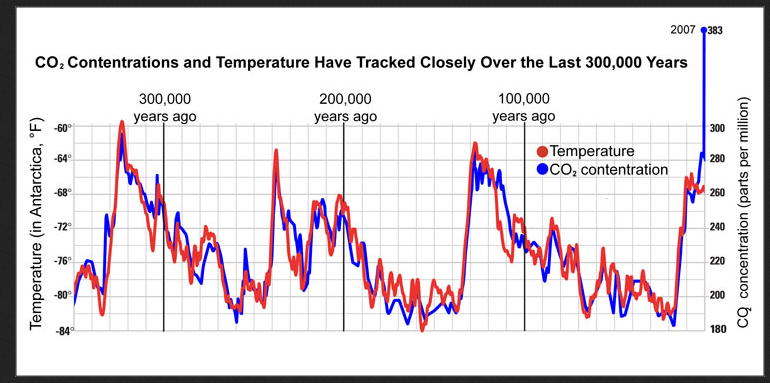
From this chart we can see that for an 18F (10 C) rise in temperature the CO2 level rose 85 PPM. Today;s CO2 level is 425 ppm, a rise of about 165 ppm from pre-industrial levels of about 260 ppm. If the relationship between CO2 levels and temperature still holds we should experience a temperature rise of about 9C for an average temperature on earth to rise to about 23 C (73F) in the near future.

This must be some of the information fed to United Nations Secretary-General Antonio Guterres when he pleaded for immediate radical action on climate change, saying that record-shattering July temperatures show Earth has passed from a warming phase into an “era of global boiling”.

In the book “An inconvenient truth” Al Gore used a very similar chart from the Vostok research site in Antartica, and he used the temperature scale in deviation from normal, hiding the fact that it showed temperatures in Antartica which are not very representative for average temperatures on earth. While the CO2 concentration is about the same everywhere on earth, 20,000 years ago it was about 180ppm. In Vostok, Antarctica the corresponding water vapor concentration was about 50 ppm in the Antarctic winter.

Al Gore chose the Antarctic to show the correlation between temperature and CO2 levels, but does that hold for the rest of the earth?

It was in Antarctica the last Ice age began to end; 19,000 years ago. Why did it end?

To answer that we must look at the
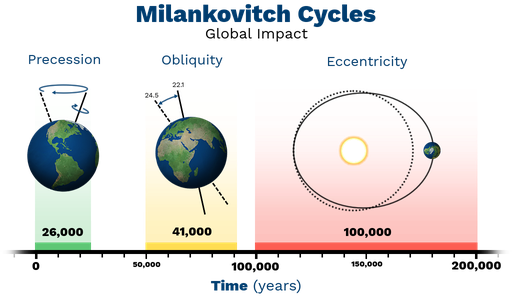
Right now the Earth is near its most circular path, nearing optimum,which is a very good place to be, minimizing yearly temperature cycles globally

Likewise the obliquity angle is about half way between minimum and maximum and is slowly decreasing.This is also good.

The most important of the cycles is the precession cycle. 19,000 years ago it gave most annular heat to the southern hemisphere. This does not normally trigger an end to the ice age, only every 16th cycle or so, when all cycles work together plus the influence of Jupiter and Saturn.One way to describe it is like the rotation in a tilt-a-whirl, popular in many county fairs. You sit peacefully in your car and go around and up and down and nothing happens, and suddenly the centrifugal forces pins you to the back of the car, the more the merrier. But for it to happen, all forces must come together. There could have been a large ice berg break-off, a volcanic eruption spewing ash over the southern hemisphere, an earthquake or a meteoric impact causing a tsunami that caused the start of the beginning of the end of the ice age. One thing is sure, there was no anthropogenic origin (rising CO2 didn’t start it), The question is:

Which came first, rising temperature or rising CO2 level?

The only way to answer that question is to measure what actually happened.
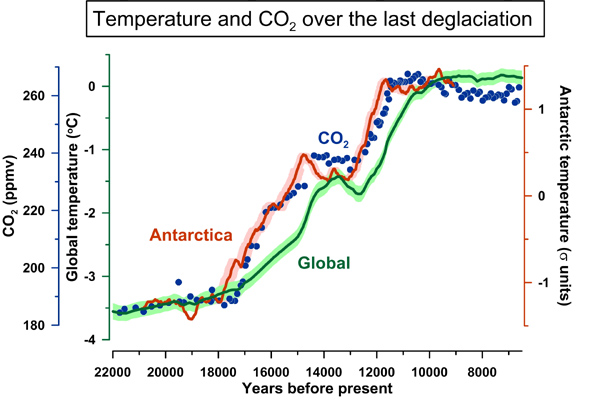
(from LiveScience By Wynne Parry published April 04, 2012.

This chart is very interesting. It shows the Antarctic temperature, starting to rise 19,000 years ago, global temperature and global CO2. The chart clearly shows that Antarctic temperature rose first, followed by rising CO2 levels for the first 4000 years. The CO2 level in the Northern Hemisphere follows the level in the Southern Hemisphere with only a 2 year time lag.
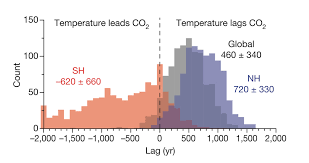
At about 14,000 years ago the Precession changed so solar radiation began to favor the Northern Hemisphere. At this time the CO2 levels had already increased to about 240 PPM but the ocean temperature was still lagging. In the Northern Hemisphere the CO2 rise came before the temperature rise. As we can see from the above picture temperature did lead CO2 levels by about 620 years +- 600 years in the Southern Hemisphere, whereas in the Northern Hemisphere CO2 leads Temperature by about 720+- 300 years for a global lead of CO2 rise over Temperature rise of 400 +- 340 years. But it is important to note that it was temperature that rose first, and as the oceans began to slowly warm up CO2 was released from the warming water hundreds of years later.

Then about 11,500 years ago CO2 levels leveled off at 265 PPM and began a slow decline to 260 PPM while global temperatures rose one degree C during the next 3,500 years. 8,000 years ago began a slow decrease in temperature. Then with no major change in CO2 levels temperatures declined by about 2,5 C until the end of the ‘little ice age’.
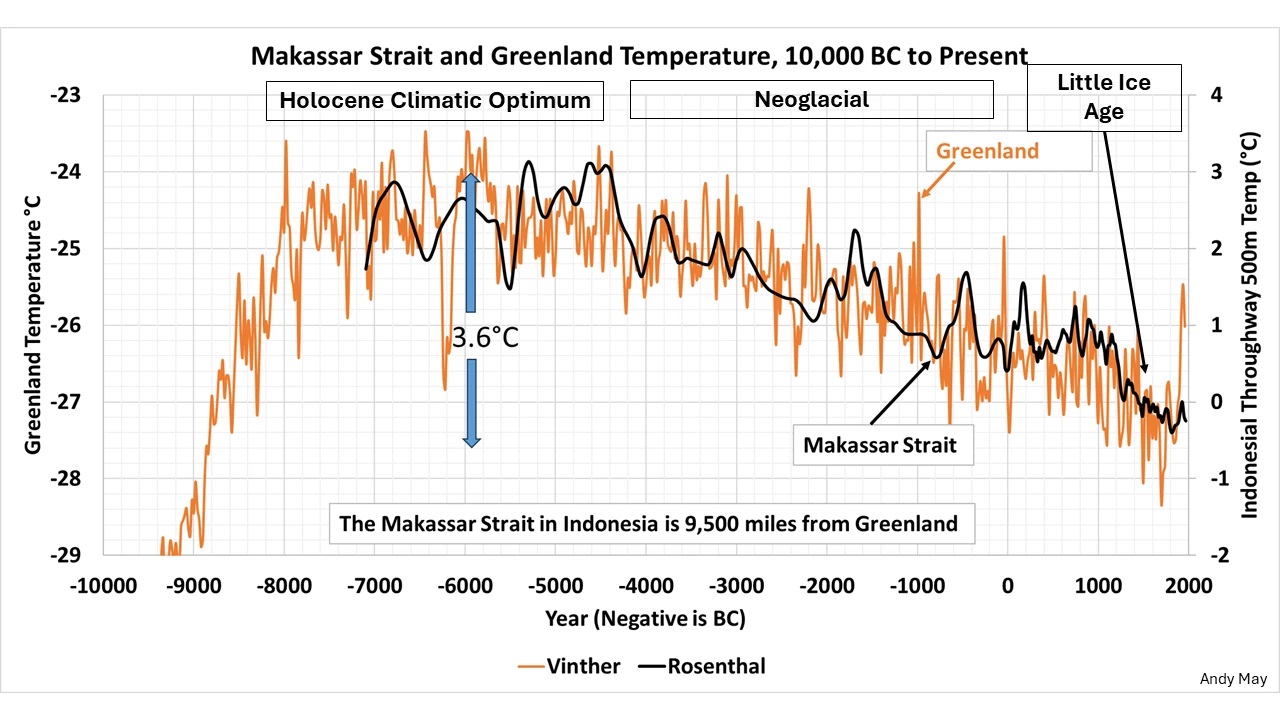
The chart above compares two temperature proxy reconstructions. The orange reconstruction is the Vinther (2009) elevation corrected Greenland temperature reconstruction from ice cores. The black reconstruction is from Rosenthal (2013) and is his 500-meter depth temperature reconstruction in the Makassar Strait, Indonesia. It is thought to represent sea surface temperatures in the North Pacific Ocean. The Greenland temperatures are taken from ice cores from Southeastern Greenland. These are all indirect measures derived from O2 isotopes in Greenland and from sea shells and other sources in the sea bottom of Makassar Strait
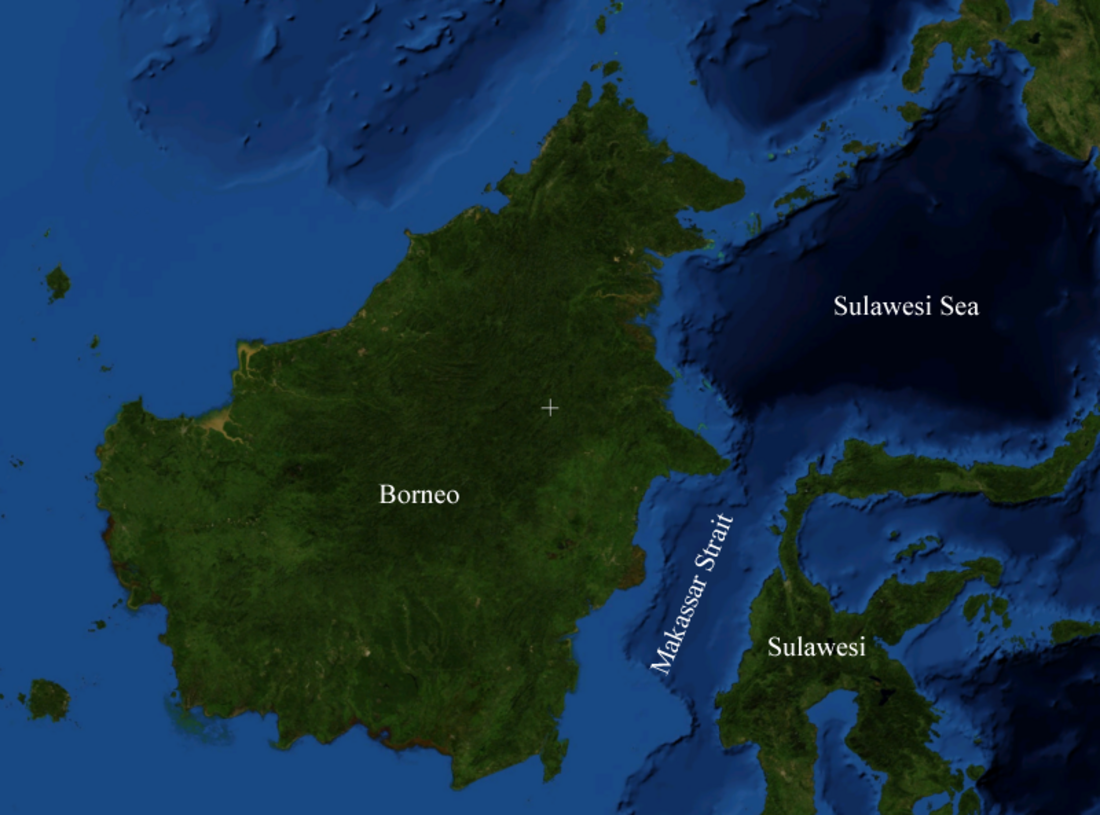
As the graph shows, temperatures follow each other very closely until the industrial revolution, when for the first time in 10,000 years the Greenland temperature start to increase, but the Makassar Strait temp doesn’t. One could argue that ocean temperature change lags atmospheric change by about 300 years.

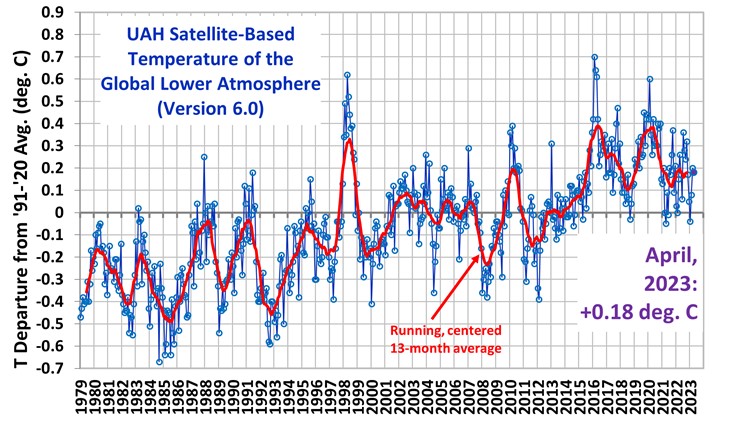
Let us take a closer look at the temperature changes in the last 46.5 years, the only time we have good satellite records of global temperatures, and they are indeed rising.
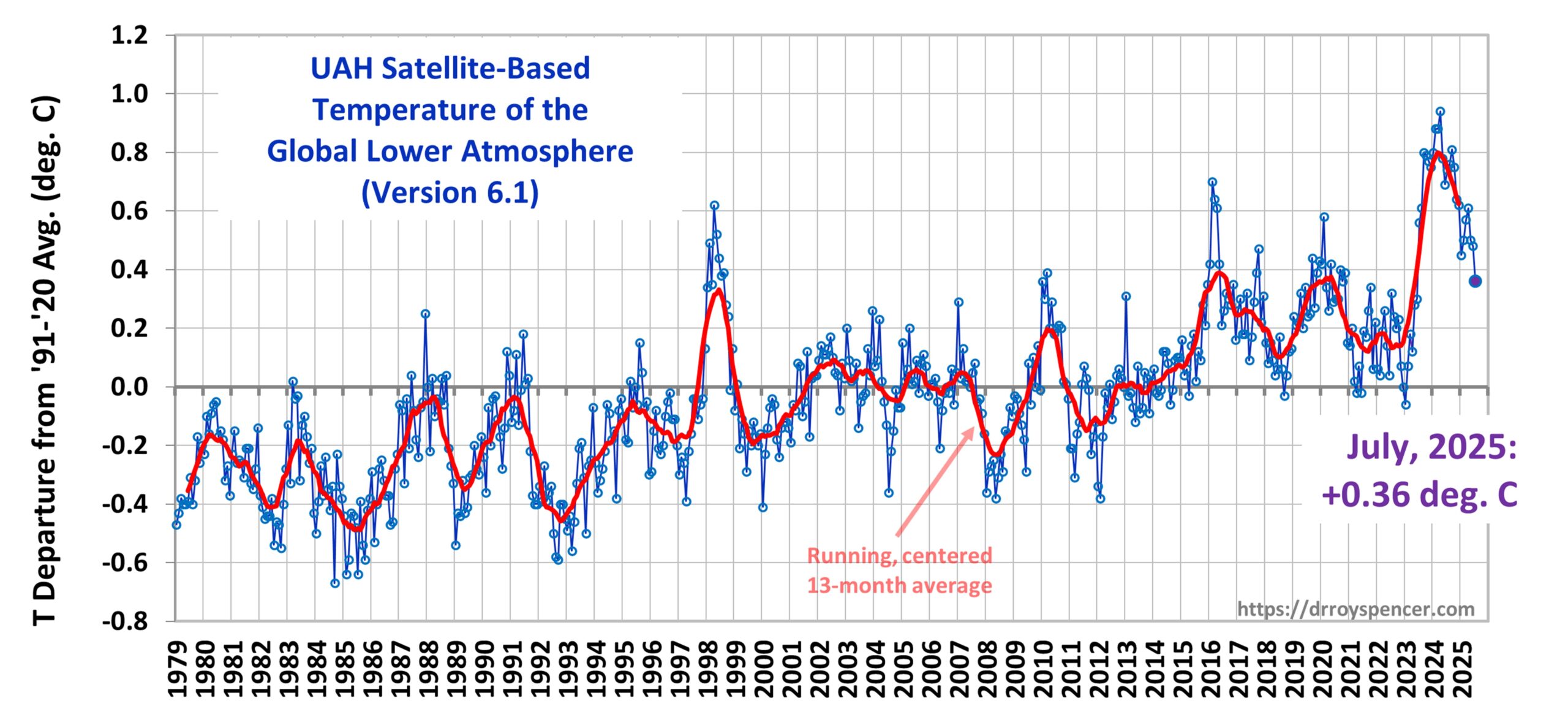
Yes. in the last 46.5 years the global lower atmosphere average temperature has risen about 0.8C. The question is: How much of this is due to rising CO2, how mush to H2O in all its forms: vapor, clouds, liquid, ice; and how much is due to other factors, such as Methane, Nitrous oxide, and the greening of the earth?

When global temperature increases 0.8 degrees Celsius and relative humidity stays the same there will be 5.5% more water vapor in the air. How much of the temperature rise is attributable to a 5.5% increase in water vapor?

To answer that we must take a look at the greenhouse effect. Without it the earth would be an ice ball with an average temperature about 34C cooler than today. The earth can be considered a black body that obeys laws for black body radiation, the Stefan–Boltzmann law that states that the total energy radiation is proportional to the fourth power of the absolute temperature (Kelvin), so an increase in global temp from 14C to 14.8C results in an increase of 1.01% in the total greenhouse effect (a smaller increase in the atmospheric window).
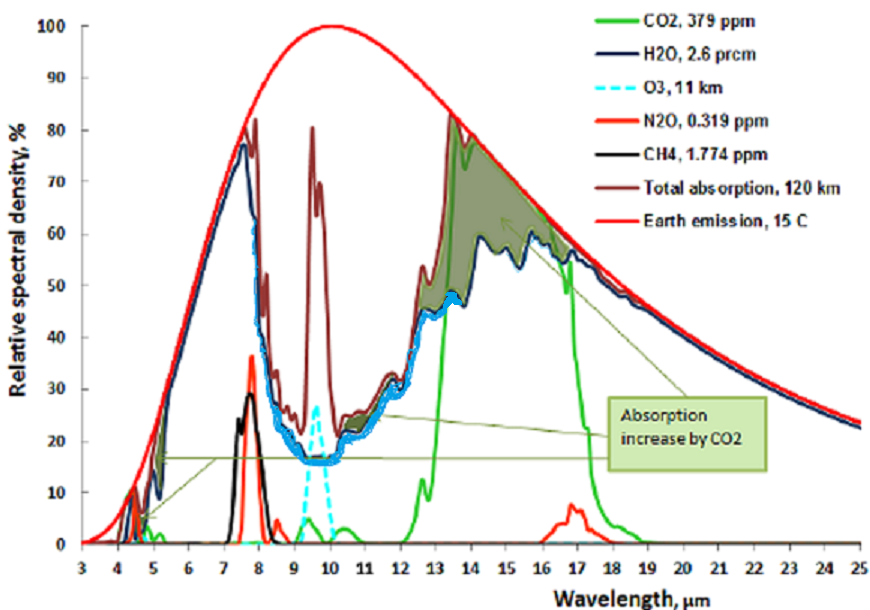
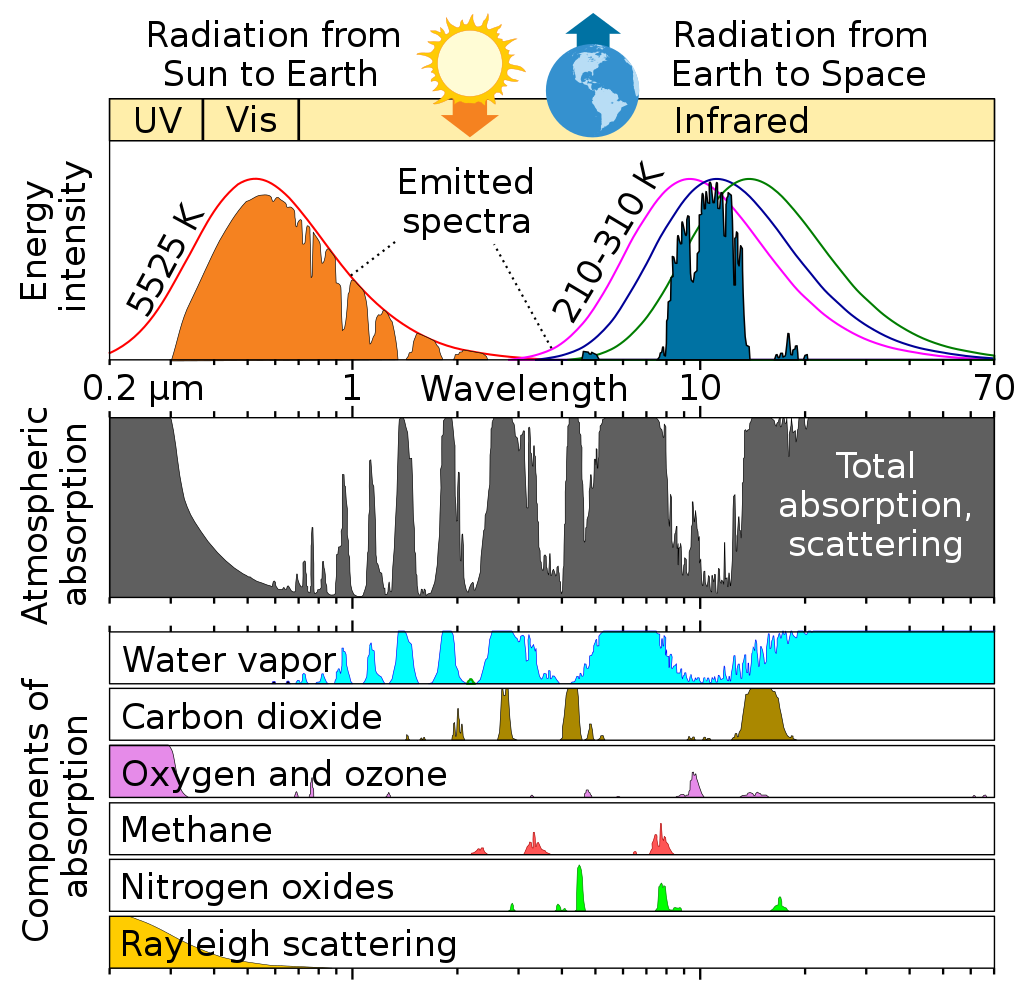
To sum it up: Since water vapor is fundamental I will count it first, and the effect of all the other greenhouse gases will be additional, remembering that the total absorption in any frequency band can never exceed 100% of available energy. Water vapor absorbs all available black body energy in all wavelengths except in the atmospheric window (7 to 17 μm) The increase of absorption occurs in the atmospheric window, and in some bands of the incoming sunlight in the near infrared region. The bands are 0.7, 0.8, 0.9, 1.1, 1.4 and 1.9 μm. Together, they make up 90% of the greenhouse gas temperature rise, or 29.9 degree C. When global temperatures increase by 0.8 C there will be 5.5% more water water vapor assuming relative humidity will stay constant, there will be an additional 0.17 C temperature rise.

Total greenhouse effect 33 C, Greenhouse effect from water vapor is 29.9C

Increased greenhouse effect from 5.5 % water vapor increase 0.17C. This is true only if relative humidity stayed constant. How much has the relative humidity changed?
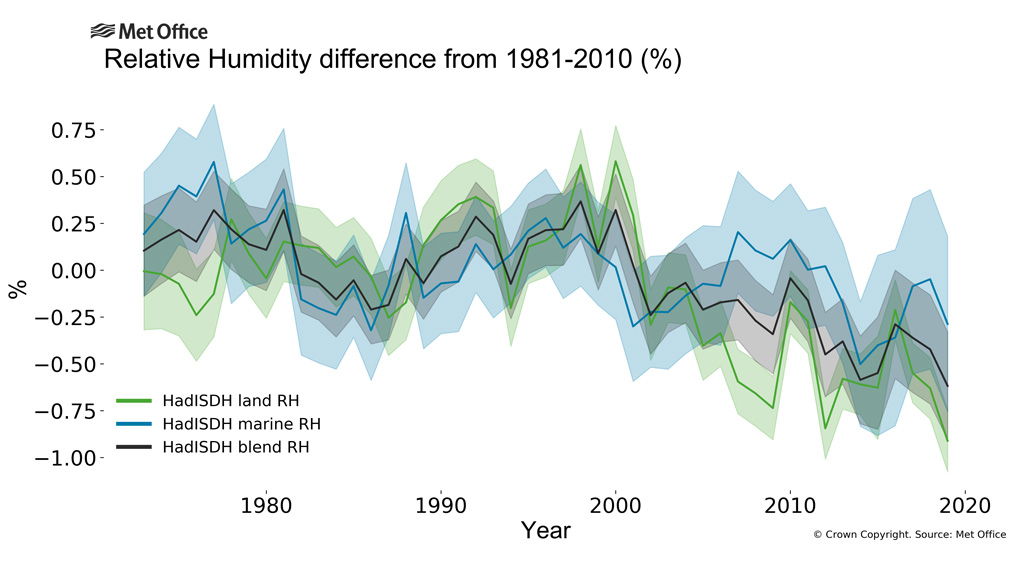
From a temperature increase standpoint the change is too small to change the results. However relative humidity has a great influence in the formation of clouds. We now has the 46.5 years of satellite data of clouds, but I only have the cloud averages. We all know that clouds cool by day and warm by night. During night, what is under clouds will absorb all the black body radiation, but re-emit as a new black body above the clouds, but at a much lower absolute temperature, depending on the cloud height. This is the smaller night effect.

Much more important is the daytime reflection of incoming sunlight. The most important clouds are the low level cumulus clouds that forms from humid air rising in daytime sunshine and disappear in the evening, but all clouds reflect back the incoming sun. All I have is statistics of cloud averages, but not where and when they appear and dissolve, but I will make the assumption that averages prevail. This is recent statistics of world average cloud cover:
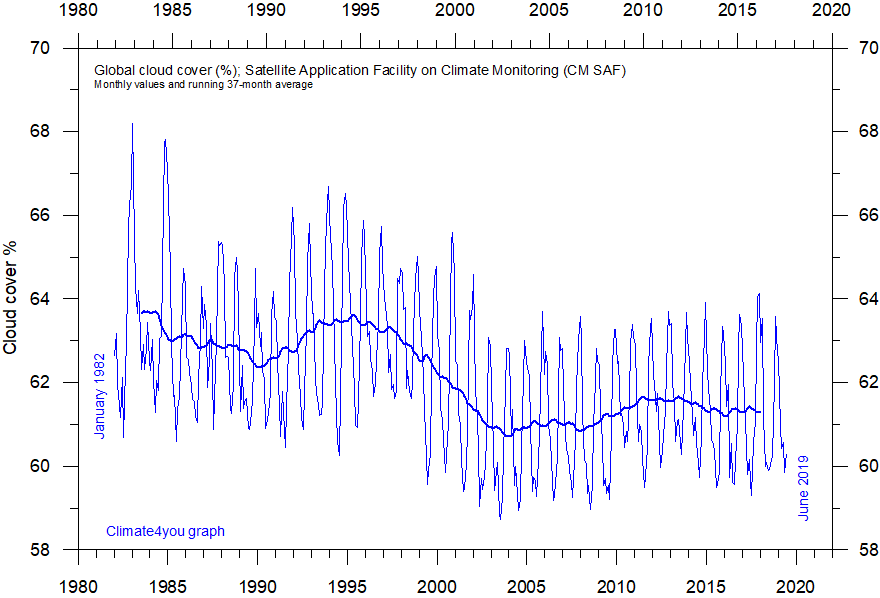
The cloud cover average (extrapolated) has decreased 3.45% in 46.5 years How much has temperature increased in the same time?
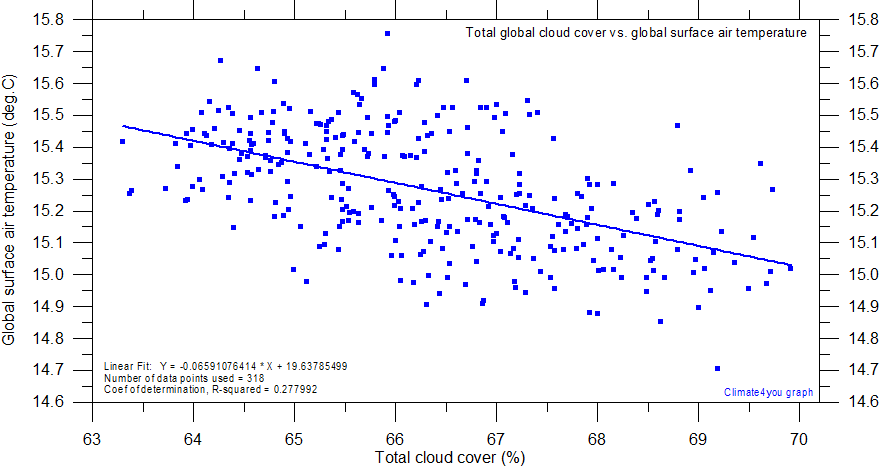
The total temperature rise due to less cloud cover over 46.5 years is 0.23C

Now it is time to see the effect of CO2 increase. In 1979 it was about 327 ppm, now it is about 427 ppm, a 27% rise in 46.5 years. If there was no water vapor in the atmosphere the greenhouse effect of CO2 would be 5.09C at 327 ppm and 5.28 C at 427 ppm. The reason it does not rise more as CO2 rises is that from 13 to 17 μm the temperature rise is limited because all available energy in that band is already fully absorbed. But it gets worse; the water vapor is already the dominant absorber, so the net addition from increased CO2 is only 30% of what would be if there was no water vapor, that is 1.527 C at 327 ppm and 1.584C at 427 ppm for a total CO2 rise of 0.057C.
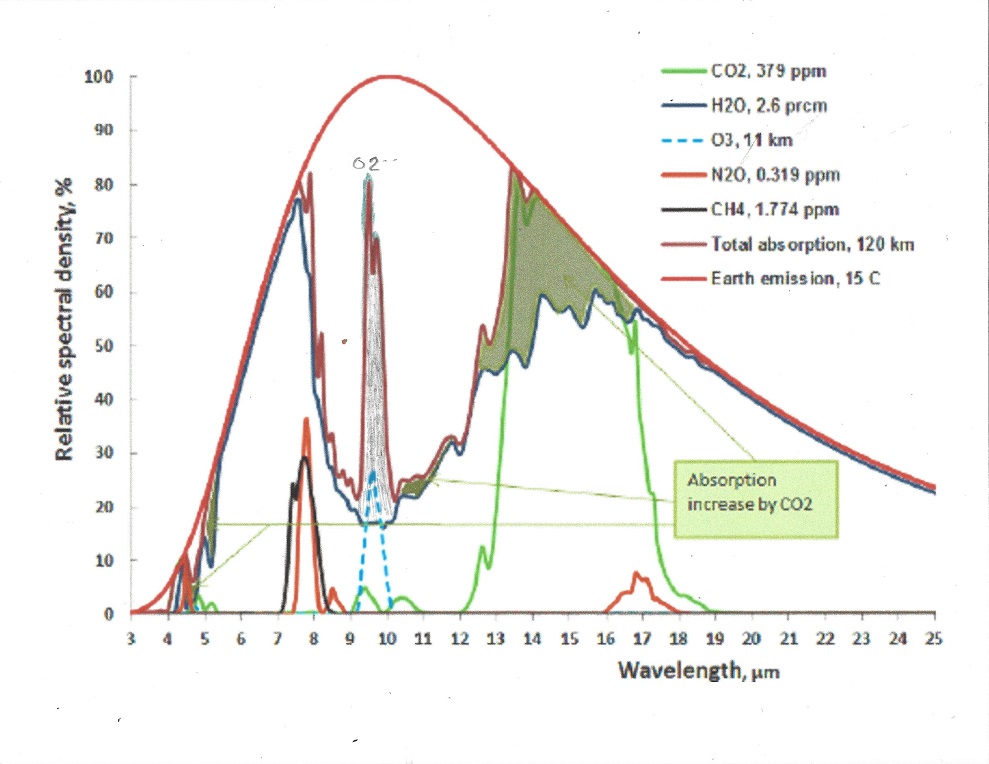
Likewise Methane and N2O absorption both occur around the 8 μm wavelength, where water vapor already absorb about 80% of all available energy, so that means both Methane and N20 are attenuated by about a factor of five from what they would have been had there been no water vapor.

Methane concentration has increased from 1.6 ppm to 1.9 ppm, leading to a temperature increase of 0.03C in 46.5 years.

N2O concentration has increased from 300 ppb to 340 ppb, leading to a temperature increase of 0.006C in 46.5 years.

The Arctic has experienced a temperature rise due to increased cloud cover and snowfall. It is due to increased heat transfer from the American Gulf in the form of water vapor, clouds, rain, and snow. When water vapor condensates into clouds, over 500 calories per gram of energy is released, and when it condensates into snow, another 80 calories per gram gets released. As water vapor increases with temperature, the Arctic gets less cold but snowier. The snow acts as an insulator on the sea ice, allowing the ice to freeze slower in the winter, and melt faster from the underside. This lead to a global warming of 0.06C in the last 46.5 years.

No such heating has occurred as of yet in the Antarctic. It is still the largest desert in the world; a hostile ice desert. (I wonder why Al Gore chose this climate to represent the relation between CO2 and temperature).

Add up all temperature changes so far in the 46.5 years of satellite data

Increased greenhouse effect from 5 % water vapor increase: 0.17C.

Total temperature rise due to less cloud cover over 46.5 years is 0.23C

Total temperature rise due to increased CO2 levels in 46.5 years is 0.057C.

Total temperature rise due to increased Methane levels in 46.5 years is 0.03C.

Total temperature rise due to increased N2O levels in 46.5 years is 0.006C.

Warming in the Arctic (globalized) over 46.5 years: 0.06 C.

Warming due to increased Ozone over 46.5 years: 0.004 C.

Warming due to increased HFC gasses over 46.5 years: 0.0015 C.

The total temperature increase noticed so far: 0.5585C. CO2 is responsible for 10% of the found rise, and Methane for 6% of the experienced rise.

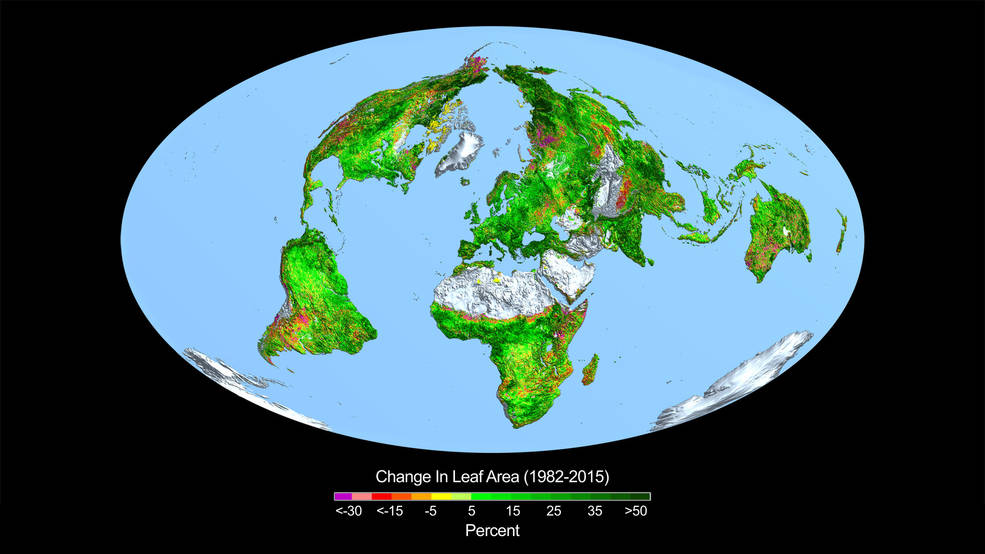
There is one very interesting side effect of rising CO2, and to a much less extent; rising Methane levels. It leads to a substantial greening of the earth. The leaf area has been steadily increasing in areas where the leaf area is not fully saturated:
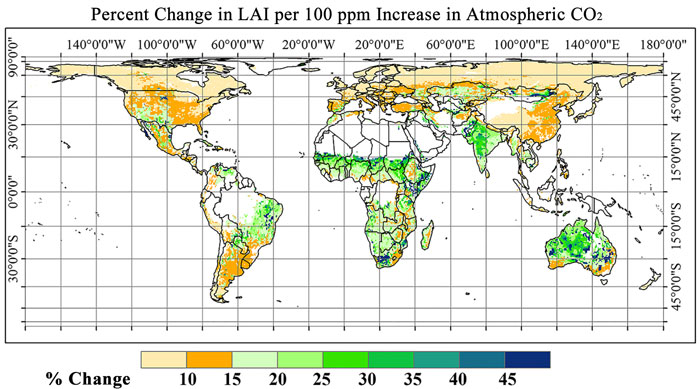
This picture shows the Leaf Area Index increase over the last 46.5 years.As we can see there is no increase in the deserts and in the dense rain forests, but overall there has been between 15 and 20% increase in the LAI. More leafs, more area to absorb CO2.

The rise in CO2 concentration from 327 ppm to 427 ppm makes the effective growth rate of vegetation increase about 25% on average. There is a wide variation between plant sensitivity to increased CO2, but they all react favorably up to more than 1000 ppm concentration.
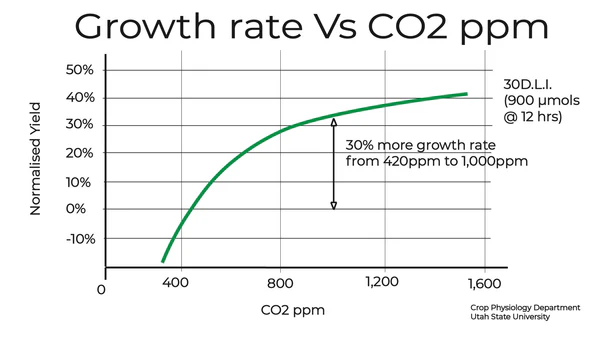
Using this information there should have been an increase in vegetation of 25 + 15% of CO2 uptake by vegetation worldwide without any other use of fertilizer. (Notice that the leaf area index did not increase much in the tropical rain forests since the leaf area is already fully optimized.

If one looks at the total greening of the earth the total leaf area did increase even in the rain forests, in some other areas by as much as 50%.
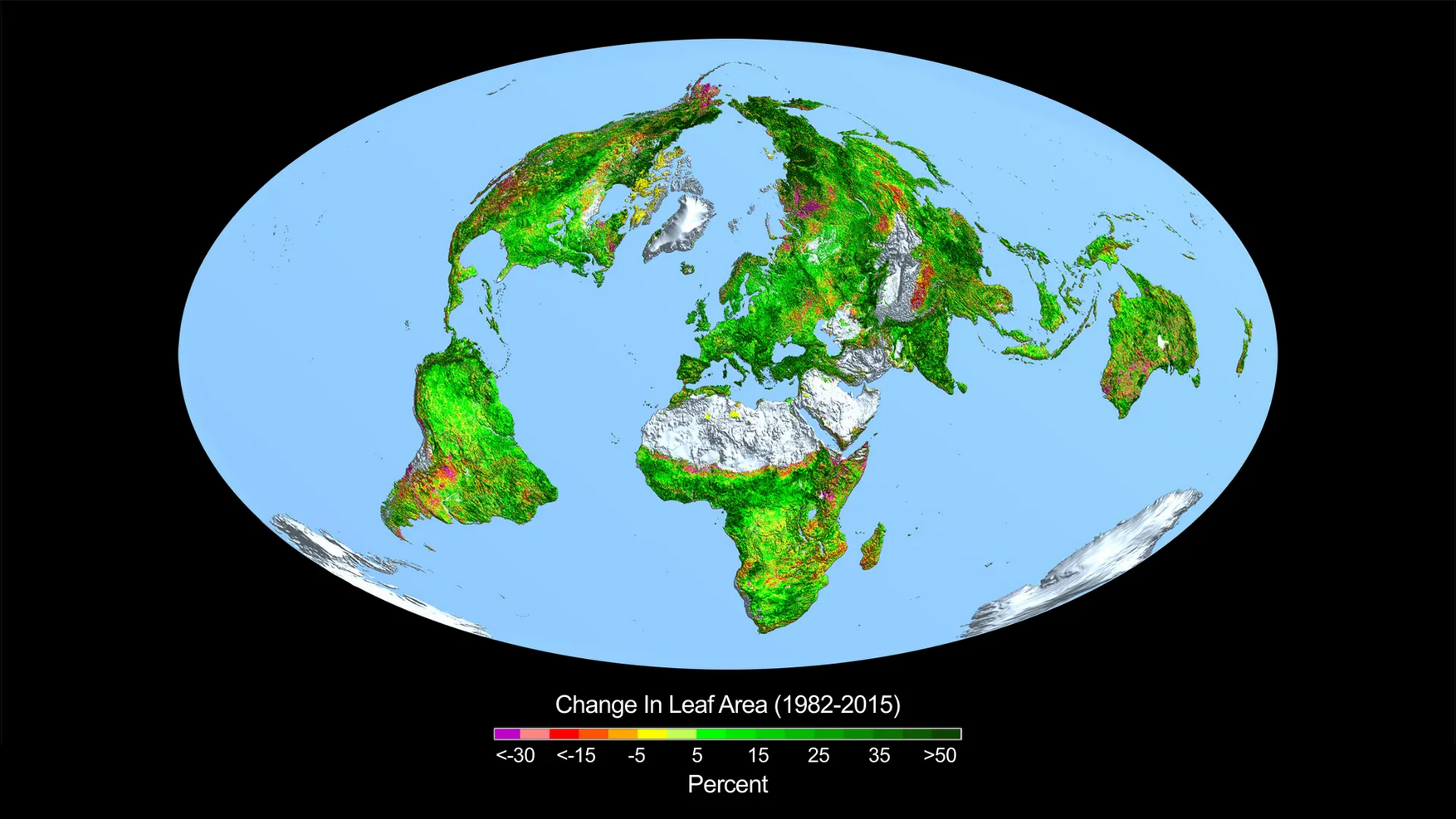
However, there are a few areas where the leaf areas decreased. these areas are where there is a deficit of water for optimal leaf growth. This is worrying, since the areas of water deficiency are areas where people want to live. An extreme example is today’s Iran, where the water reservoirs are running dry, and all water used in the hot summer is taken from aquifers that are also running dry. And it is getting worse:

The following picture shows the drying up of the earth between 2003 and 2013 in sea level equivalence from 0 to 2 mm
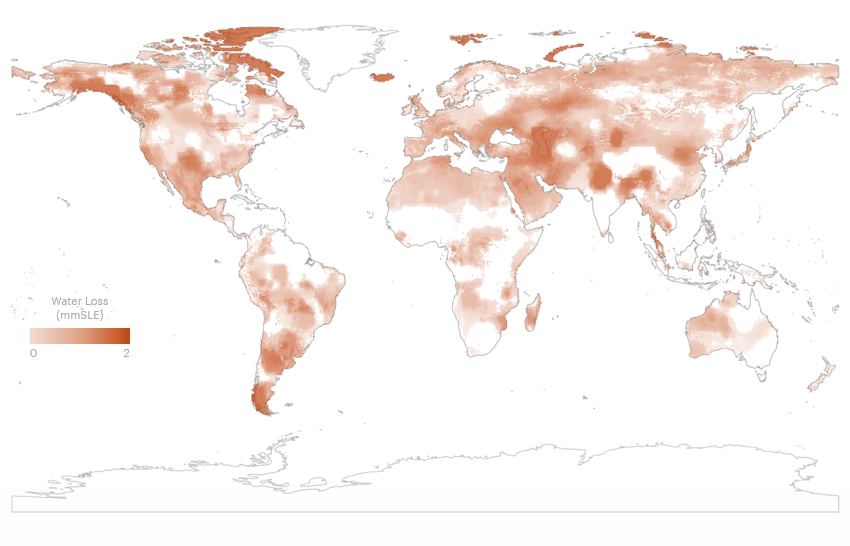
The areas most affected are the U.S. and Mexico Southwest, the South American Pampas, Southern Europe. Northern Africa, The Arabian Peninsula, The Middle East from Syria to Iraq, Iran Kazakhstan, Pakistan and North Western India, This is from 2014 to 2024 and it shows it is getting worse. The aquifers are getting consumed
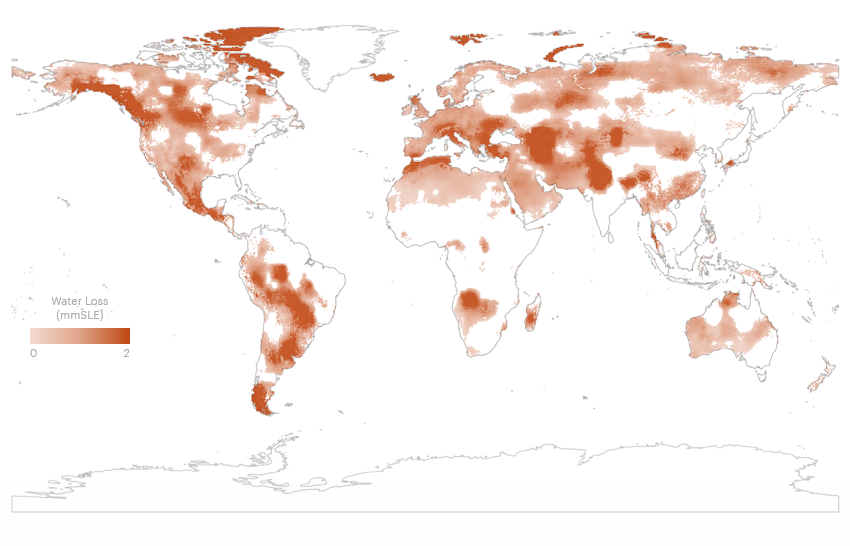
To take water out of aquifers without replacing it leads to an inevitable desertification of the areas where people want to live. Desertification leads to disaster, the rivers dry up and the areas become uninhabitable.

Urban heat islands: The worlds urban areas are growing rapidly and are now housing more than half the world’s population. It is now occupying more than 1% of the land area and has grown 0.15 % of the total area of the world. People living in urban areas, especially in areas with air conditioning are experiencing ‘local global warming’ of about 7F in the U.S. It is still large in all urban areas, maybe 4F on global average. (This is why people living in a megalopolis are convinced in global warming, they are living it.) Total global warming effect in the last 46.5 years: 0.033C

Draining land for infrastructure. We are doing what we can now to preserve wetlands, but wherever a road or other structure such as an airport is being built, proper drainage and land improvement is being performed. In the last 46.5 years about 1% of the worlds land surface has been drained and made dry. This is another heat effect that I estimate to lead to about 2C in the affected areas leading to a world temperature increase of 0.04C

Temperature increase from greening of the earth (without taking into account a changing cloud cover that is accounted for separately 0.002C

Temperature decrease from desertification of the earth: 0.001C

Total estimated temperature rise: 0.6325C

Summary: Temperature change due toWhat to do

Loss of cloud cover: 0.23C or 36%

5% increase in absolute humidity: 0.17C or 27%

Warming in the Arctic: 0.06C 0r 9,5%

Increased CO2: 0.057% or 9%

Infrastructure land use change: 0.04C or 6.3%

Urban heat islands: 0.033C or 5.2%

Increased Methane levels: 4.7%

All 0ther causes: 2.3%

What to do.

To go carbon neutral and do nothing else will solve less than 10% of the perceived problem. Neutralize Methane increase will add less than 5% to the solution

No, the problem is all about water, clouds and desertification.

In the next 100 years or so we will experience a magnetic polar reversal, and this may lead to an unprecedented rash of volcanic activity since the magnetic force reversals will activate magma in ways that we cannot yet foresee. When volcanic ash reaches the stratosphere it stays there for years causing global cooling. The Milankovitch cycles points to a slow cooling down of the earth.

The current rise in CO2 is very good. It has helped us feed another 2 billion people, not to mention all the wild life and plant growth.

The CO2 increase will delay the onset of the next ice age by about 2000 years. Without it we would still be in the little ice age.
Today is the 55th Earth Day. A Limerick.

It’s time for the fifty-fifth Earth Day

To celebrate Lenin’s old birthday

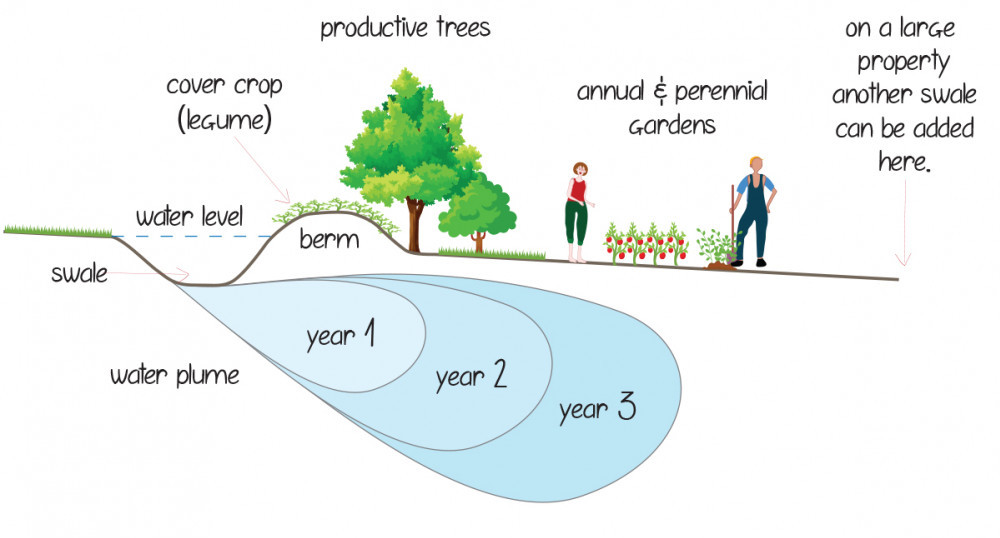
Let’s dig swales, plant more trees

grow more food, attract bees.

Revive God’s dry earth in rebirth day.

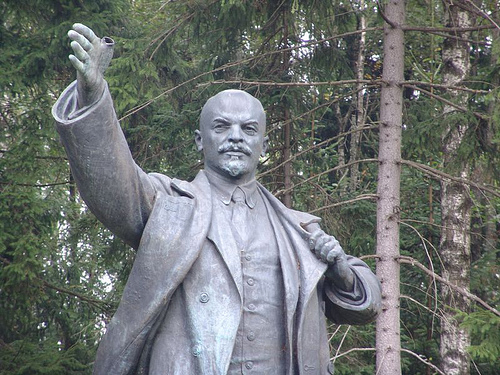
Lenin

The very first Earth Day was celebrated April 22 1970, on the 100 year anniversary of the birth of Vladimir Lenin (Владимир Ильич Ленин). True green environmentalists keep telling me it is just a coincidence. I think not..

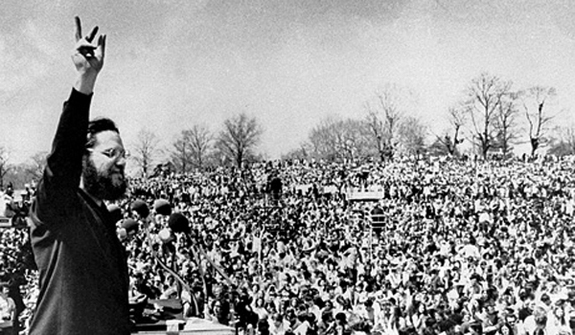
earth-day-Einhorn-02

The first Earth Day in Philadelphia 1970 featured Ira Einhorn (The Unicorn Killer) as master of Ceremonies. For those too young to remember, he murdered his girlfriend , stuffed her in a piece of luggage in his apartment and kept her there for seven years, and no one smelled a dead rat). He was finally convicted many years later. The big environmental scare of that day was the threat of a new Ice Age. The clarion call was: “In the year 2000 temperatures will have fallen 10 degrees”, the culprit was pollution, especially acid rain.

Things have changed, and we have experienced decades of climate change, or so they say, but it depends very much on where you live. Most of the increased temperature since 1970 is due to cleaner air in the industrialized nations, there are now more thunderstorms as opposed to daylong rains. This leads to fewer clouds and less reflection of incoming light back into space. This means warmer days.

What forms clouds is saturated humidity with a sufficient aerosol to form condensing spots. The best solution is to plant trees that provide enough aerosols to form clouds. This is especially important in the American Southwest and the whole 10-40 degrees latitude region where the majority of the world’s population lives.

USA can be seen as two very different regions: In the West the fight is about water rights; in the East it is about water responsibilities.

My proposal is that we reshape the water rights laws so that water rights belong to the land. Where it rains, as much as possible of the rain should remain on that land without building dams. By building swales and planting trees at high elevations the erosion from flash floods will diminish, and more water will remain in the ground, causing rivers to flow year round rather than seasonal. As it is now a house owner in Arizona cannot even water his plants from what falls on his roof or driveway.

In the East the opposite is true. When you build a house with a driveway you must also provide a catch basin capable of absorbing all the rain that falls on the improved property, sufficient to absorb a substantial rainstorm.

As it is now, the aquifers is the west are being drained, and need to be restored. Yes, without restoring the aquifers the American Southwest will experience desertification.

Of the recorded temperature increase between 1980 and 2023, how much is attributable to CO2, and how much to other greenhouse gases? The correct answer is; it is mostly due to the decreased cloud cover.

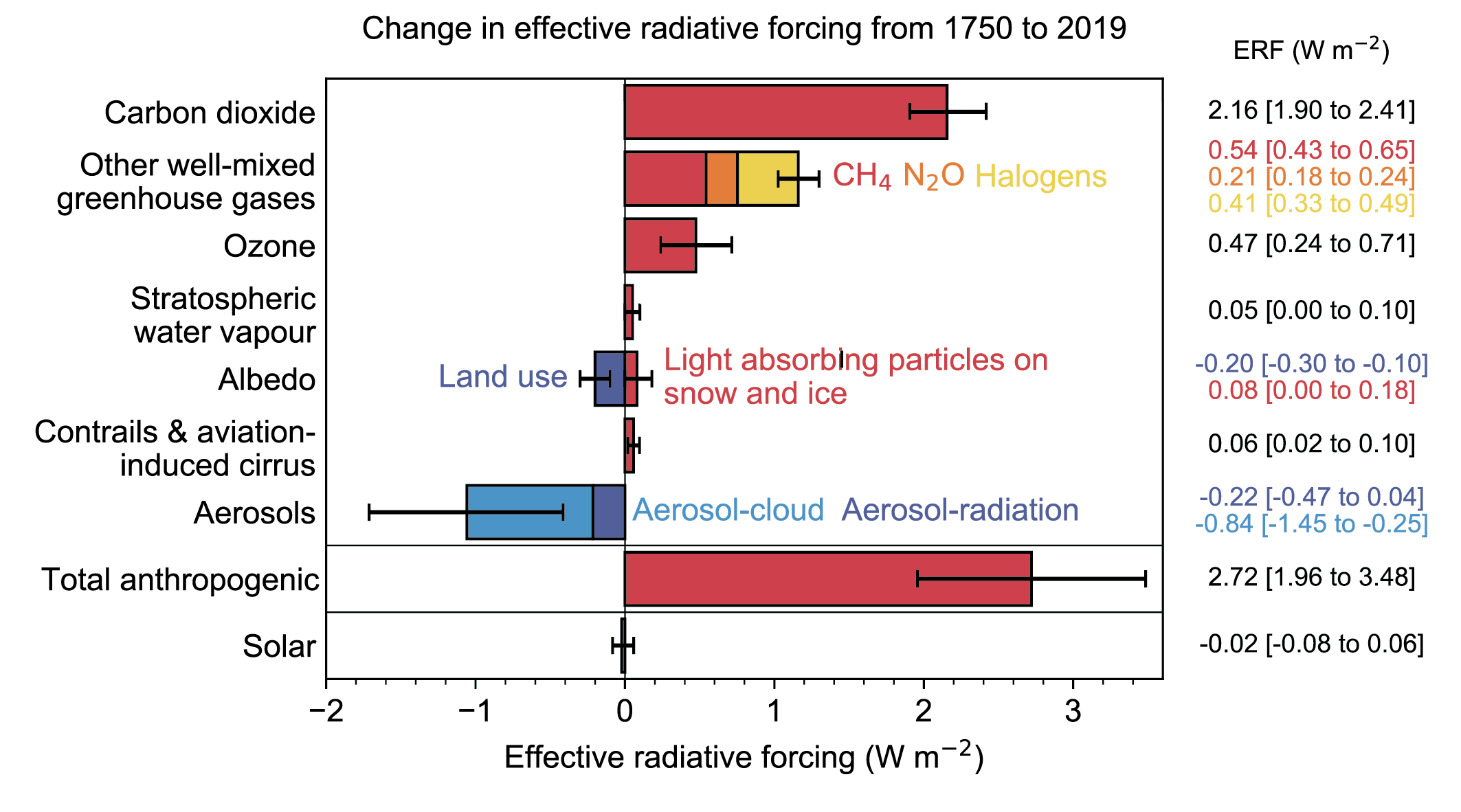
By far, the strongest greenhouse gas is water vapor, not because it is very strong of itself, but it absorbs nearly all outgoing energy in the infrared spectrum except in the so called atmospheric window, where it only partially absorbs. Yet water vapor is missing from the IPCC AR6 chart seen here:

IPCC has consistently treated the effect of greenhouse gasses as additive, but it is impossible to absorb more than 100% of all emitted energy for a given wavelength. This leads to an overestimation of absorption when 2 or more gasses are present. For example, if CO2 absorbs 90% of available energy at 13 μm and water vapor another 50%, the sum is 90% + (1 -0.9} * 0.5 = 95%, not 140%

This will change the relative importance of greenhouse gasses drastically so it must be tested against reality. We now have a good global satellite temperature record from 1980 to 2022 or 43 years:

During this time the temperature rise was 0.5 C, which translates to 2.375 W/m2 ERF

Water vapor.

This is a good chart to see the relative importance of all major greenhouse gasses:

It is to be noted that water vapor also absorbs the incoming solar radiation in certain wavelengths, but solar influx is assumed to be constant.

When average temperature rises 0.5 C, the possible absorption rises by 2.375 W/m2 minus the energy that escapes through the atmospheric window.Water vapor through saturation: is responsible for all of this increase except where other gasses also absorb in the atmospheric window, and in the atmospheric window the absorption must be proportionally shared, subject to the 100% absorption limitation.The atmospheric window is about 26% of all the emitted radiation so net water absorption is 0.74 * 2.375 = 1.6 W.m2 or 0.34 C. However, the relative humidity is also decreasing, see picture:

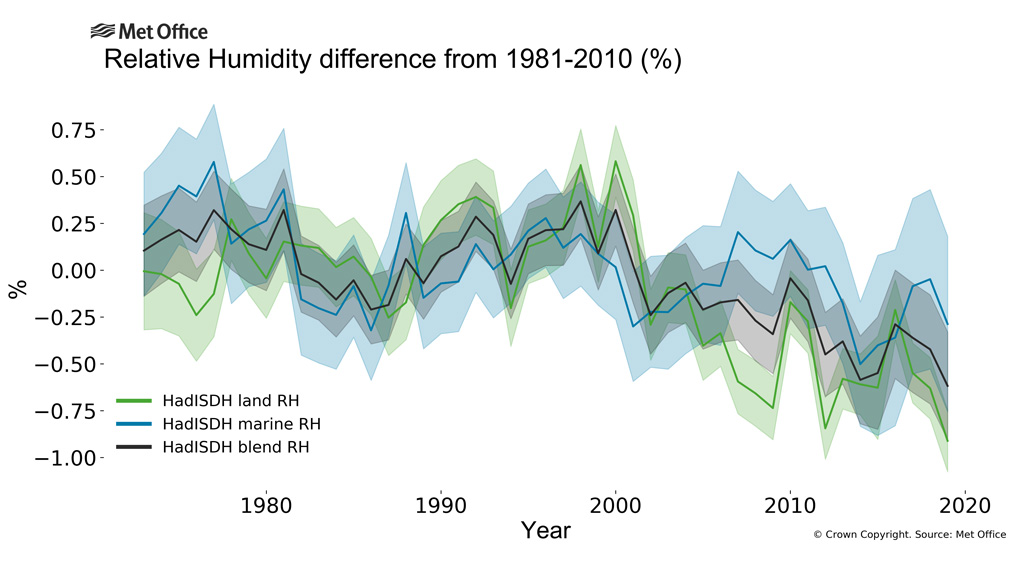
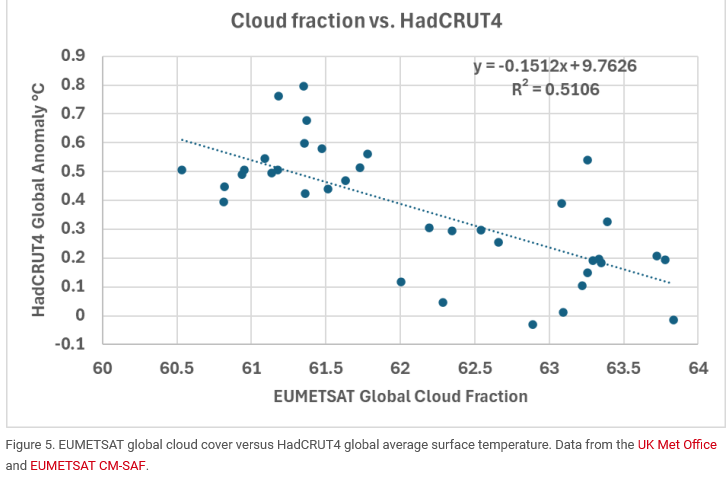
Between 1980 and 2022 the net humidity increase is 3.6% minus 0.75% relative humidity for a net increase of 3.54%. This increase only matters in the atmospheric window which is on average 25% saturated, so the total increase from water vapor increase is 0.26 * 2.375 * 0.25 * 0.9925 = 0.15 W/m2 or 0.03 C., to be added to the total before increase in humidity.This means that for a 0.5C temperature increase between 1980 and 2022 the total sensitivity to water vapor is 1.75 W/m2 or 0.37 C. A confirming picture of the total cloud cover shows the , but temperature sensitivity to the decline in cloud cover between 1980 and 2015

This is of course a very crude method, since it incorporates all temperature rises from all sources, which is 0,5C degrees, from which should be deducted the 0.08C rise from all. This is of course a very cruse assessment of the influence of clouds vary greatly between low clouds, middle clouds and high clouds; as well as when they occur, day or night, and even what time of day they appear. Because of this complexity IPCC has consistently failed to give clouds their full respect. The clouds are the main regulator of temperature on earth!

Carbon dioxide

CO2 is the strongest greenhouse gas after water vapor. The only wavelength band that is meaningful is 13 to 17.4 μm and absorption occurs from both CO2 and water vapor. Since they exist together, the effect of each of them must be proportionally allocated, or the sum of them added would exceed 100%

Between 1980 and 2022 the CO2 levels rose from 335 ppm to 415 ppm or 24% increase. The temperature increase 0.5 C. The net temperature increase or ERF in the 13 to 17.4 μm band is 0.035C or +0.17 W/m2 for the water vapor and 0.04C or +0.19 W/m2 for the CO2. To see how the calculation was made, go to Appendix 1.

Methane.

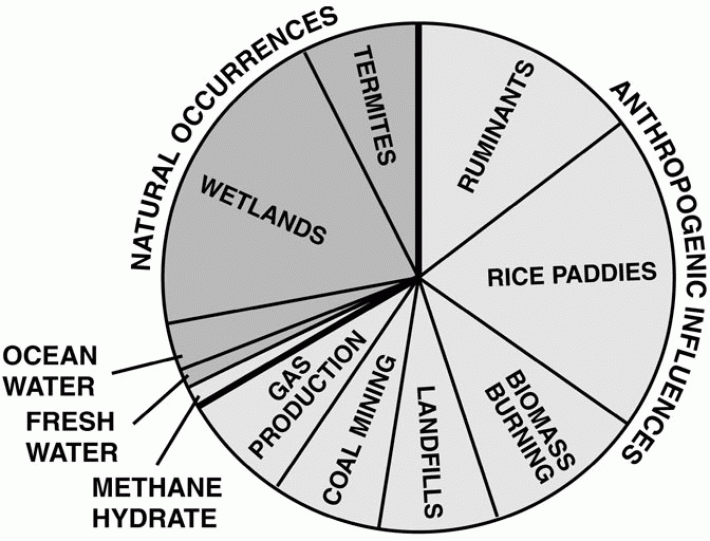
Methane gas is created from a variety of sources, both man made and natural. See pie chart

The good thing about methane is that its lifetime in the atmosphere is only 10 to 15 years, and the real contribution to climate change is only 1/5th of what is commonly advertised, since iits absorption bands occur together with partly saturated absorption from water vapor. See appendix 2.

In 1980 the CH4 concentration was 1.6 ppm and will be 2.0 ppm in 2022 which results in an increase of the greenhouse effect of 0.035 C or 0.17 W/m2 ERF from rising levels of Methane since 1980.

N2O.

Atmospheric N2O levels averaged 336 ppb (parts per billion) during 2022, about and was 301 ppb in 1980. It is a 300 times stronger greenhouse gas than CO2 by itself, because its absorption is not saturated in the atmosphere. When water vapor is dominant it is diminished by over 70% since it is at the edges of the Atmospheric window. For calculations see Appendix 3.

In 1980 the N2O concentration was 0.3 ppm which results in an increase of the greenhouse effect of 0.0065 C or 0.031 W/m2 ERF from rising levels of N2O since 1980 .

Ozone.

Ozone occurs as stratospheric O3 which is good. It protects us from uv radiation. O3 in the troposphere is considered harmful if it is over 0.08% It is normally around 0,01% in the troposphere. For calculations and figures, see appendix 4.

When the earth’s temperature rises by 0.5C, from 1980 to 2022, the amount of tropospheric O3 probably rises by 2% (Lacking good data I am guessing wildly, in urban areas it may be much more, but this is global average). This comes to 0.0034C temperature increase or 0.016 W/m2 ERF from O3, from 1980 to 2022.

CFC gasses.

CFC’s are cheap and efficient gasses to use in refrigerators and air conditioners.Their use rose rapidly until it was discovered they destroyed the protective ozone layer in the stratosphere, so its use, got banned in 1994, later diminished including its use in inhalers. CFCs has since diminished slowly and is maybe already below the levels in 1980. See also Appendix 5.

HFC gasses.

HFCs replaced CFCs and are rapidly growing in use, and the compressor seals still leak. For pictures on why they are a growing concern for the future, see Appendix 6.

The temperature increase from 1980 to 2022 was 0.0015 C or 0.007 W/m2 ERF.

Summary of all greenhouse effect causes for temperature rise from 1980 until 2022:

Effect from water vapor increase: 0.37 C or 1.75 W/m2; 80.9% of total

Effect from rising CO2: 0.04C or 0.19 W/m2; 8.78% of total

Effect from rising Methane: 0.036 C or 0.17 W/m2, 7.86% of total

Effect from rising N2O: 0.0065 C or 0.031 W/m2 1.4% of total

Effect from rising Ozone: 0.0034C or 0.016 W/m2 0.7% of total

Effect from rising HFCs : 0.0015 C or 0.007 W/m2 0.3% of total

TOTAL TEMPERATURE CHANGE 1980 to 2022: 0.4544C or 2.164 W/m2

Conclusion

CO2 amounts to less than 10% if the temperature increase since 1980, and so does Methane. The green new deal is a pipe dream that does not solve the climate problem, but will make it worse.the price of lithium carbonate used in batteries has risen sixteen-fold between 2020 and late 2022. Since then, it has dropped to one third of its peak price. China has corned the market in Lithium for now. There is not enough Lithium to be economically and ecologically justifiable to mine to meet demand in the future. Since solar and wind power are intermittent supplier of electricity they can never be used as base supplier of energy. Other solutions must be offered

Actions to be taken

What congress is doing to solve the problem.

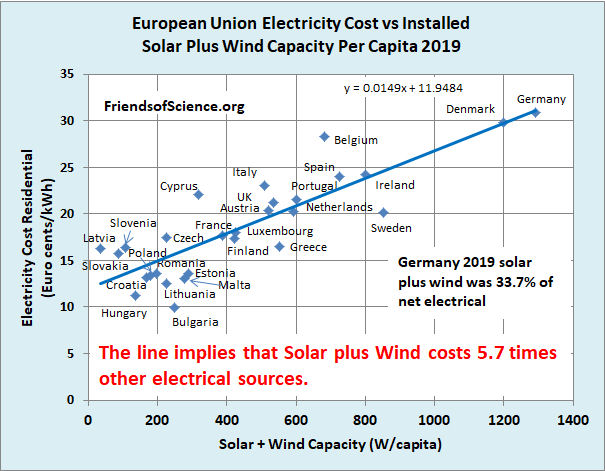
Congress has passed the anti-inflation bill that included over 300 billion to fight climate change, and it included more solar panels and wind turbine motors to be imported from China. The experience from Europe is that electricity from solar panels and windmills is 5.7 times as expensive as conventional power generation.

This analysis was done for 2019, before COVID. The situation is worse now, with electricity rares up to 80 c/kWh, topping $1 /kWh last winter in some countries before subsides.

Even at the current increased European Gas prices, the estimated excess expenditures on Weather-Dependent “Renewables” in Europe is still very large:  $0.5 trillion in capital expenditures and $1.2 trillion excess expenditures in the long-term.

These simple calculations show that any claim that Wind and Solar power are now cost competitive with conventional fossil fuel (Gas-fired) generation are patently false.  The figures give an outline of the financial achievements of Green activists in stopping  fracking for gas in Europe, close on to $1.2 trillion of excess costs.

It would be better not to import any solar panels and wind power generators from China and let them pay for the extra cost rather than building more coal burning plants. After all they were planning to build over a thousand new plants between now and 2030, all legal under the Paris accord. This would benefit the world climate much more, since Chinese coal plants are far more polluting, since China has far less stringent environmental regulations than U.S.

U.S. uses 13.5% of the world’s coal, and eliminating U.S. CO2 emissions would in time reduce the world temperature by 0.023C, providing no other country, such as China and India would increase their use of Coal, which they are, to the total of 1300 new coal plants between now and 2030. This would raise global temperature by more than 0.06 C.

What congress should do instead.

a. What congress should do immediately.

  1. Immediately stop downblending U 233 and pass The Thorium Energy security act SB 4242a. See more here.

2. Remove Thorium from the list of nuclear source material. The half-life of Thorium232 is 14 billion years, so its radioactivity is barely above background noise. More importantly, while Thorium is fertile, it is not fissile and should therefore not be included in the list. This would make it far easier to mine rare earth metals, as long as the ore consists of less than 0.05% Uranium, but any amount of Thorium is allowed without classifying the ore “Source material”.

3. Separate nuclear power into 3 categories. a. conventional nuclear power. b. Thorium breeder reactors that make more U233 than it consumes.c. Thorium reactors that reduce nuclear waste, and d. Plutonium and other trans uranium depletion reactors.

4. Stop buying solar panels from China. Stop buying wind turbine generators from China. Let them install those in China and pay 5 times as much for their electricity.

5. Immediately form a commission led by competent people, not politicians; to decide how to best expand the electric grid and to best harden it against electro-magnetic pulses, whether solar or nuclear and to safeguard it against sabotage.

6. Remove all subsidies on electric cars, solar panels and wind generators, but continue to encourage energy conservation.

7. Encourage research and development of Thorium fueled reactors, especially liquid salt reactors by drastically simplifying and speeding up the approval process. President Trump issued an executive order in the last month of his presidency EO 13972 specifying that the United States must sustain its ability to meet the energy requirements for its national defense and space exploration initiatives. The ability to use small modular reactors will help maintain and advance United States dominance and strategic leadership across the space and terrestrial domains. This EO should be expanded to include civilian small modular reactors, including Liquid salt Thorium reactors less than 200 MW, which are the only valid reactors for space exploration.

Appendix 1, CO2

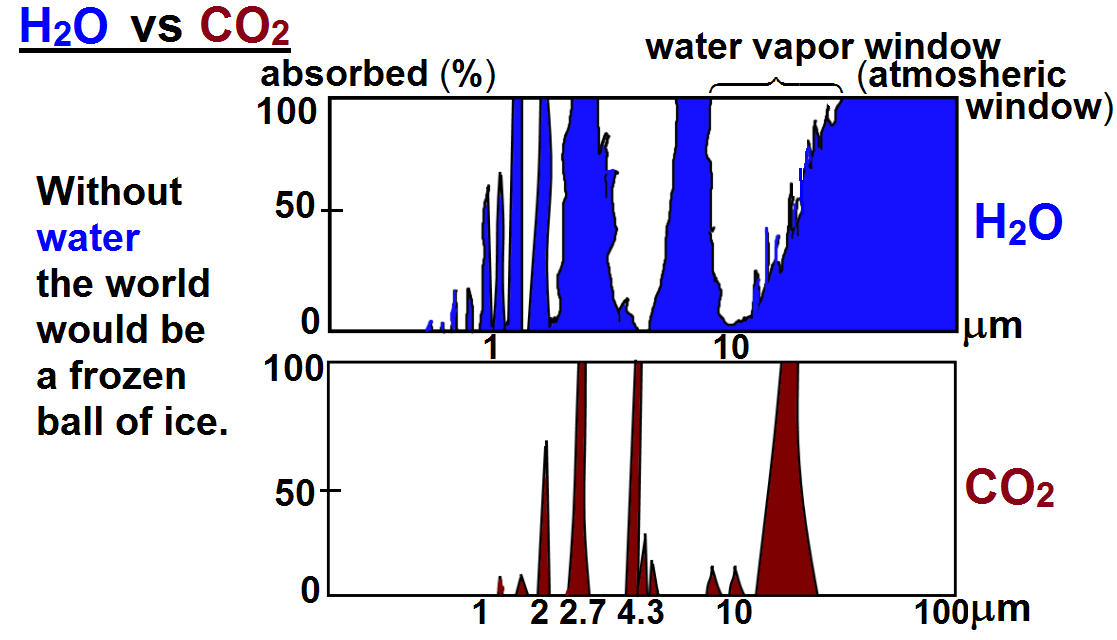
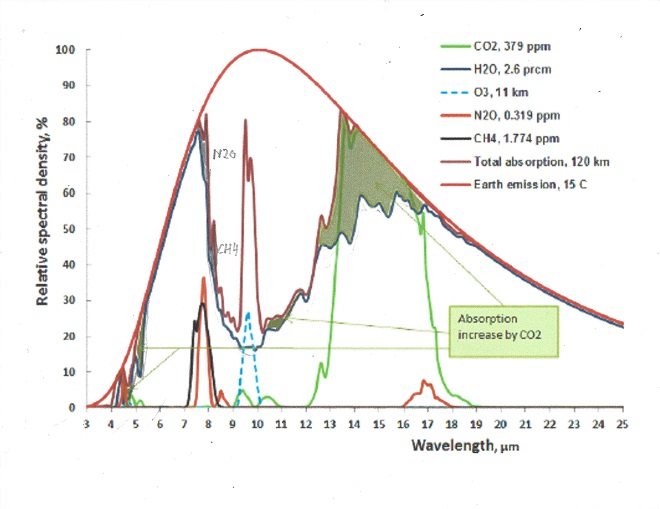
The following chart shows both CO2 and H2O are absorbing greenhouse gases, with H20 being the stronger greenhouse gas, absorbing over a much wider spectrum, and they overlap for the most part. But it also matters in what frequency ranges they absorb.

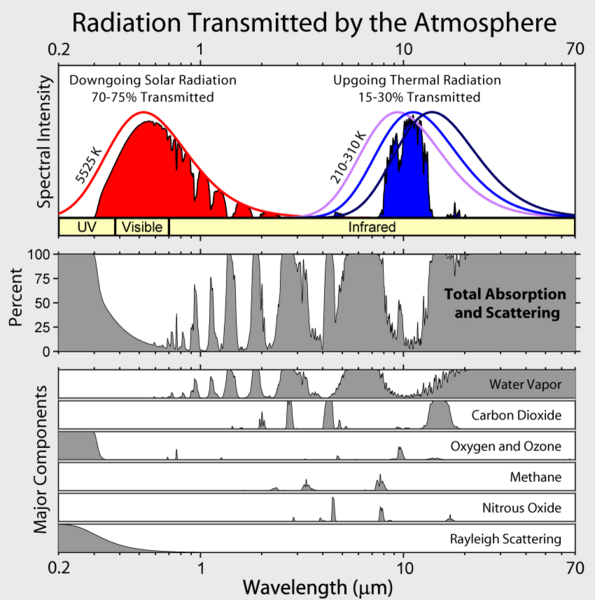
For this we will have to look at the frequency ranges of the incoming solar radiation and the outgoing black body radiation of the earth. It is the latter that causes the greenhouse effect. Take a look at this chart:

The red area represents the observed amount of solar radiation that reaches the earth’s surface. the white area under the red line represents radiation absorbed in the atmosphere. Likewise, the blue area represents the outgoing black body radiation that is not absorbed. The remaining white area under the magenta, blue or black line represents the retained absorbed energy that causes the greenhouse effect.

Let us now take a look at the Carbon Dioxide bands of absorption, at 2.7, 4.3 and 15 μm. Of them the 2.7 and 4.3 μm bands absorb where there is little black body radiation, the only band that counts is at 14.9 μm, and that is in a band where the black body radiation is near its maximum. Let us first consider the CO2 alone in a dry atmosphere, that is one with no water vapor at all. We will investigate the concentration of 335 ppm (in 1980) and 415 ppm (in 2022)

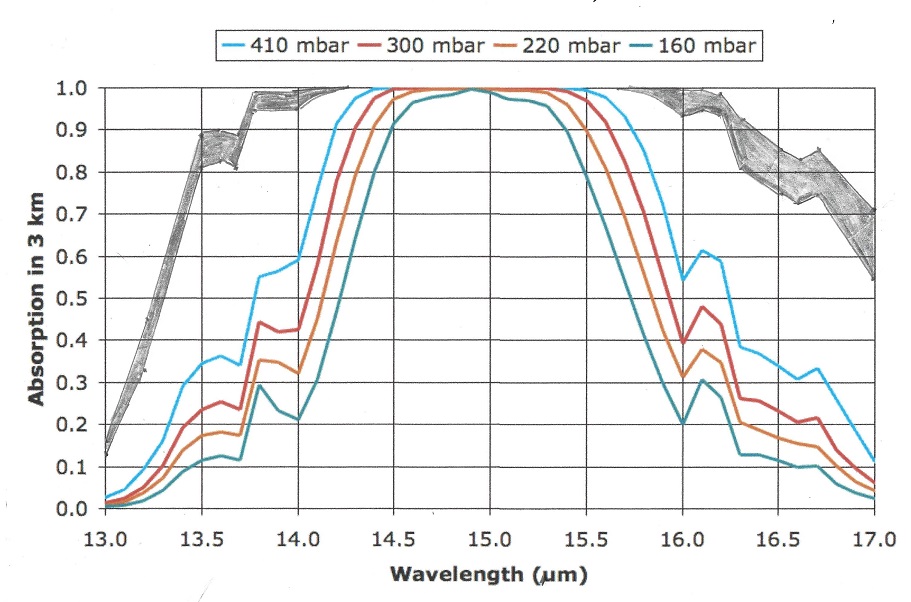
The very top line of the top black band represents total absorption at 415 ppm, the bottom of the black black band represents absorption at 335 ppm. Divide the frequency spectrum in 3 parts, below 14 μm, 14-16 μm, and above 16 μm, In the 13 to 14 μm band 66% of available energy is absorbed at 335 ppm, 70% at 415 ppm. in the 14 to 16 μm band 100% of available energy is absorbed at both 335 and 415 ppm. In the > 16 μm the numbers are also 66 and 70%. In addition, temperature is 0.5 C higher at 415 than at 335 ppm, so available energy is 0.7 % higher at 415 ppm.

The net result is greenhouse gas contribution for CO2 is 5.10 C at 335 ppm and 5.26 C at 415 ppm and 1.5C higher ambient temperature for a dry atmosphere.

The normal way to account for greenhouse gasses contribution is to simply add together the CO2 contribution and the contribution from water vapor. This leads to the wrong result for in doing so, the total result is more than 100% for some energy band, because it is impossible to add more than 100% of all available energy for a given wavelength. Again, the spectrum of interest is 13 to 17.4 μm.

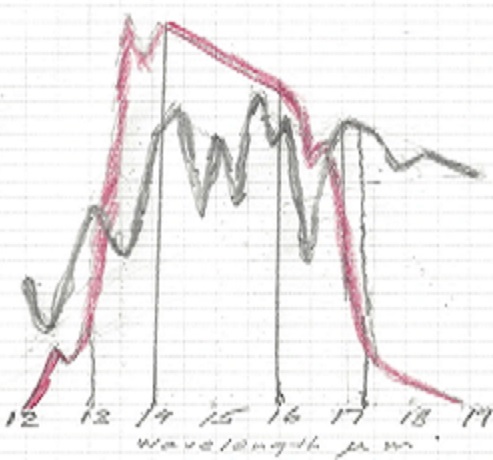
The first thing to notice is that no absorption exceeds 100% , so at 14.9 μm wavelength CO2 absorbed 100%, and water vapor absorbed another 75%, the total sum is still 100%. It is impossible to absorb more than 100% of the total energy available for that wavelength. Therefore between the wavelengths 14 and 16 μm all energy was absorbed regardless of CO2 concentration and water vapor concentration. The only fair way to allocate the absorption is proportionally, 57% to CO2 and 43% to water vapor. Likewise, the 13 to 14 μm band is not fully saturated, so the total absorption is 62% of available energy for CO2 and 33% for water vapor. In the 16 to 17.4 μm range the total absorption is 44% for CO2 and 55 % for water vapor. For CO2 at 335 ppm and average temp 13.5 C the total temperature rise, when proportionally allocated comes to 2.73 C for the CO2 and 2.30 C for the water vapor. For CO2 at 415 ppm and an average temp 0.5 C higher, at 14 C average the net temperature increase or ERF in the 13 to 17.4 μm band is 0.035C or +0.17 W/m2 for the water vapor and 0.04C or +0.19 W/m2 for the CO2.

Appendix 2, Methane

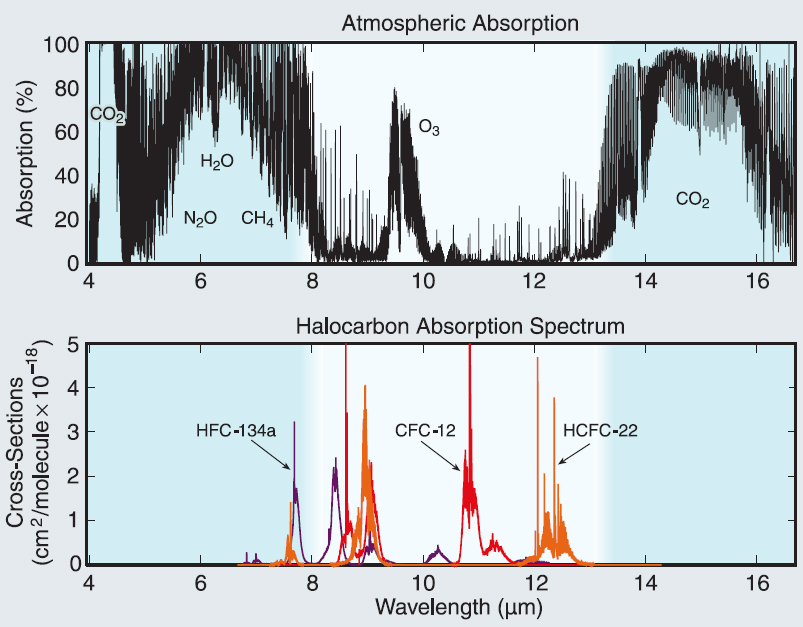
Atmospheric methane levels averaged 2.0 ppm (parts per million) during 2022, or around 25% greater than in 1980. It is a 28 times stronger greenhouse gas by itself unlike CO2, because its absorption is not saturated in the atmosphere. On the other hand the lifetime of Methane in the atmosphere is 10 to 15 years, some of the Methane eating bacteria will do its job. There is only one significant absorption band that absorbs in the atmospheric window at 7.7 μm, at the edge of the atmospheric window.

The picture shows a small peak at 7.7μm. This is because at lower wavelengths absorption from water vapor has nearly eliminated the CH4 contribution. Remember that total absorption can never exceed 100 %, so the maximum absorption from CH4 occurs at 7.7μm. At 1.6 ppm it amounts to a greenhouse effect of 0.68 C for a dry gas.

The only major absorption line at 7.7 μm has two side lobes, at 7.5 and 7.9 μm. In the 7.5 μm sideband water vapor already absorbs nearly all energy, so the NH4 is of little effect. In the 7.9 μm sideband water vapor is 50% saturated at that level and the NH4 net absorption is 20% the net greenhouse effect is one fifth of the effect for a dry gas, or 0.14 C. In 1980 the CH4 concentration was 1.6 ppm and will be 2.0 ppm in 2022 which results in an increase of the greenhouse effect of 0.035 C or 0.17 W/m2 ERF from rising levels of Methane since 1980

Appendix 3, N2O.

Atmospheric N2O levels averaged 336 ppb (parts per billion) during 2022, about and was 301 ppb in 1980. It is a 300 times stronger greenhouse gas than CO2 by itself, because its absorption is not saturated in the atmosphere. When water vapor is dominant it is diminished by over 70% since it is at the edges of the Atmospheric window. On the other hand the lifetime of N20 in the atmosphere is short and is typically greatest at 5 p.m. One of the major reasons for the N2O increase is the increase of fertilization with nitrates, the other is from diesel fumes from trains, boats, ships, trucks and mining equipment

The picture shows a double N2O peak at 7.4 and 7.8 μm. . At 0.336 ppm in 2022it amounts to a greenhouse effect of 0.325 C for a dry gas. In the 7.4 μm band water vapor is saturated, in the 7.8 μm band 80% is saturated by water vapor.In 1980 the N2O concentration was 0.3 ppm which results in an increase of the greenhouse effect of 0.0065 C or 0.031 W/m2 ERF from rising levels of N2O since 1980 .

N2O is commonly called laughing gas, and is hazardous in high concentrations, and should be limited in confined places, but in concentrations of under 1 ppm nobody laughs because of that.

Appendix 4, Ozone.

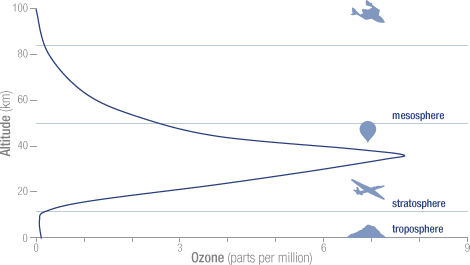
Ozone or 03 is good if it is in the stratosphere. There it helps to absorb the ultraviolet and cosmic rays from the sun and other cosmic radiation. Ozone is bad if it is near the ground. The total proportion of O3 in the troposphere is about 0.01 ppm, yet it is a substantial greenhouse gas because it forms by uv radiation in the stratosphere and mesosphere, and thus protecting us from uv damage. See figure:

The O3 in the troposphere on the other hand is bad. It is normally around 0.01 ppm, but is considered damaging if people are exposed to more than 0.08 ppm in an 8 hour period. This can happen in urban environments in warm and stagnant weather, typically through car traffic. It is a great greenhouse gas because its main absorption band is at 9.5 μm, right in the atmospheric window where the outgoing black body radiation is the greatest. See fig:

The dotted blue line at 9.5 μm represents the tropospheric absorption, the total absorption is between the brown and the solid blue line. The total greenhouse effect from O3 is 0.88C, but the stratosphere does not interact very much with the troposphere, so the stratospheric O3 does not count as a greenhouse gas, only tropospheric O3. The total contribution to the greenhouse effect from tropospheric O3 is about 1/5 of the total, because atmospheric O2 absorbs in the same band limits the temperature rise to 0.17C When the earth’s temperature rises by 0.5C, from 1980 to 2022, the amount of tropospheric O3 probably rises by 2% (Lacking good data I am guessing wildly, in urban areas it may be much more, but this is global average). This comes to 0.0035C temperature increase or 0.016 W/m2 ERF from O3, from 1980 to 2022.

Appendix 5, CFC gasses.

ChloroFluoroCarbon (CFC) gasses started to be manufactured at the beginning of the refrigeration age, replacing ice as the refrigerant. It soon appeared in the atmosphere, mostly due to leaks in the air conditioner compressor seals. It didn’t amount to much as a greenhouse gas even though it was five thousand times more efficient than CO2 as a greenhouse gas. It was discovered that CFCs ate up the Ozone in the stratosphere, and if it continued to increase it could deplete the protective Ozone layer faster than it could be produced. In fact it created an Ozone hole over Antarctica. So it got forbidden Jan 17, 1994, In 2020 even China stopped production. Since 1994 CFC are decreasing by about 1% per year, but cheating persisted, especially among poorer nations and China. By 2022 it will probably have a greenhouse effect of 0.01C or 0,05 W/m2 ERF.

Appendix 6, HFC gases.

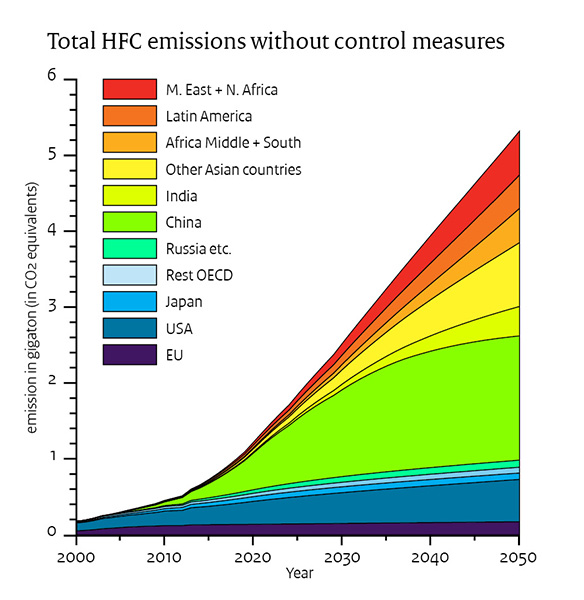
CFC started to be phased out and replaced by HydroFluoroCarbons (HFC), less efficient and more expensive, but at least they do not deplete the Ozone layer that protects us from cancer. Some of the HFCs are even bigger greenhouse effect generators than CFC, but well worth it to protect the Ozone layer. Their biggest absorption bands are in the middle of the atmospheric window.

If nothing is done to control them they will increase from nothing in 1980 until 2022 and beyond. See fig: NOAA Research News

The temperature increase from 1980 to 2022 was 0.0014 C or 0.007 W/m2 ERF..

Earth Day 2024. This year’s feature: Microplastics are bad (and they are). A Limerick.

We celebrate Lenin’s old birth day

in what is renamed the new Earth Day.

This years theme; it is said

microplastics are bad

in water and food in the worst way.

When I came to the U.S. as a resident alien immigrant  from a beautiful, clean Sweden in the spring of 1968 I was horrified at what I found. In Sweden they were worried about the fact that some lakes were fertilized four times more than agricultural fields, acid rain killed the trouts in the already acid lakes and  seeds laced with Mercury as a preservative killed off most of the eagles and owls. None of this seemed to bother the Americans. Coming in to Rochester in N.Y the stench from the fish washing up on the shore of lake Ontario was strong, I read of a river catching on fire in Ohio and the smell of coal burning power plants without scrubbers was bad, almost as bad as in the coal and steel region of Germany. It was also the height of the Vietnam wars, and people were protesting. Many of the protestors were communists at hart, and they also turned to pollution. The aerosol pollution led to a decrease in global temperatures, so the mantra was: The ice age is coming! The worst prediction I read was that the global temperatures would be ten degrees Fahrenheit lower by the year 2000! Most predictions were not that wild, but they all pointed down, ice age, here we come! The urge to clean up the pollution grew stronger and the Earth Day movement was formed, but they had to find just the right day to have the first. Since this was to become a global movement they decided on the birthday of Lenin, his 100th, very fitting for a globalist movement.  That was 1970 in Philadelphia, featured Ira Einhorn (The Unicorn Killer) as master of Ceremonies.

Now fifty four years later the mantra has changed to climate change, specifically carbon pollution and carbon footprint. As the scientists were wrong then, the ice age is coming soon, so they are wrong now. The rise in CO2 causes climate change all right, and it would be really bad unless something else also changes as the CO2 concentration changes. Water vapor is a strong greenhouse gas, much stronger than CO2, and they both add to the greenhouse effect, but only at temperatures below freezing. In the tropics there is 50 times as much water vapor as there is CO2, so the tropics is not affected at all by rising CO2 levels. In the Arctic the situation is quite different. Water vapor is also a condensing gas, and forms clouds in the atmosphere. Clouds cool by day and warm by night, but the effect of cooling by day is much larger than the warming by night, so clouds act as the major temperature regulator on earth. That is why the tropical temperature was about the same in the tropics as now when the CO2 level was over 10000 ppm, 25 times as large as now hundreds of millions of years ago. There is zero risk of overheating, there is no “tipping point” on the warm side, the clouds take care of that. On the other hand we know that because we have too little CO2 in the air we will have a new ice age. When will it come? Not in the next thousand years, in fact, by increasing the CO2 levels we will delay the onset of the next ice age. What will happen at the Poles? They will be less cold in the winters, it will snow more but the summers will be about the same, held largely at the melting point of water.
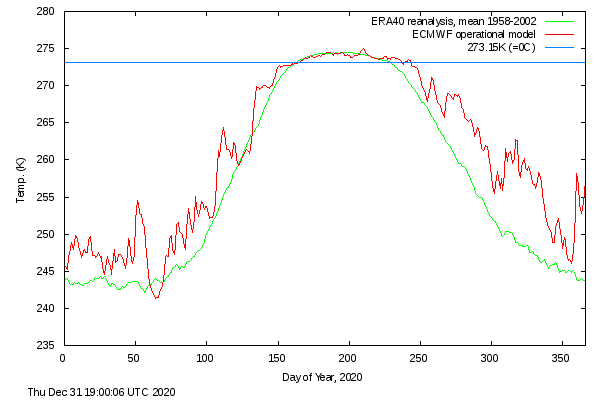
The last 44 years we have good satellite data of the temperature rise, CO2 rise, all pollutants , cloud cover and the like, so we can examine the earth how it has responded to the rising CO2 levels, and the results are very surprising: CO2 rise contributes less than 5% of the increase is due to the CO2 rise, nearly all the changes are due to water effects, either as increased water vapor and decreasing clouds. Here are the results:

Effect from rising CO2: 0.04C or 0.19 W/m2; 4,66% of total

Effect from increasing water vapor: 0.37 C or 1.75 W/m2; 42.9% of total

Effect from rising Methane: 0.036 C or 0.17 W/m2, 4.17% of total

Effect from rising N2O: 0.0065 C or 0.031 W/m2 0.8% of total

Effect from rising Ozone: 0.0034C or 0.016 W/m2 0.4% of total

Effect from rising HFCs : 0.0015 C or 0.007 W/m2 0.2% of total

Effect from decreasing cloud cover: 0.39 C or 1.89 W/m2. 46.4 % of total

Warming of the Northern Arctic: 0.1 C. or 0.475 W/m2;11.6% of total

Cooling from pollution aerosols: 0.1 C or 0.475W/m2; – 11.6% of total

Temperature increase from greening of the earth 0.0063C or 0.030 W/m2; 0.7% of total

Temperature decrease from areas of desertification 0.0015C 0.007 W/m2; 0.2% of total

TOTAL TEMPERATURE CHANGE 1980 to 2022: 0.8522 C or 4.077 W/m2

If this is hard to believe, check it from my blog entry:It’s water and clouds causing climate change, CO2 is only a minor contributor, and so is Methane. Reality check from 42 years of satellite data.
While I realize that increasing CO2 levels contribute to climate change, it is on balance positive, since the earth is increasingly fertilized by increasing CO2 In fact the earth has been more than 15% greener since industrial age by increasing CO2 alone, enabling us to feed 2 billion more people without increasing fossil fuel generated fertilizer. The extra greening means more clouds generating aerosols, which is good except where it already rains too much.

Where we have a problem is with the arid areas, where much water is drawn from the aquifers, the best clean water there is. When the aquifers are deleted desertification sets in. This has already happened in Kazakhstan, where lake Aral disappeared as soon as the Amu- and Syr-darja rivers were siphoned off to produce cotton. This worked fine for about ten years, then the lake dried up, the rains stopped and the rivers dried up. China has built 12 dams in the Mekong river, so now the once reliable yearly floodings stopped and the harvest in the lowlands are disrupted. The once reliable Nile river is a shadow of its former self, all the silt stays above the Aswan Dam rather than fertilizing the lower Nile. The U.S. southwest aquifers are being drawn down and will no longer produce anywhere near as much water as they used to. The whole American Southwest is slowly undergoing desertification. We need to rethink our use of water rather than waste trillions of dollars on CO2 control, which will solve only 5% of the problem.

The other problem with water is waste quality. A most pressing problem is micro plastics. Some of it comes from tire wear. Electric cars are heavier than gasoline cars, leading to more tire wear. Another problem is with water sanitation, Microplastics does not accumulate well in silt,neither does it break down easily. Another problem is antibiotics excreting in the urine of both people and animals, birth control and other medications excreted through urine will act as harmful pollutants,

We have our work cut out for us. There are solutions to all of these problems, but they all require energy, either as heat or electricity. The only possible solution is nuclear power, specifically molten salt nuclear power. Nuclear power can be generated from U233, U 235 and Plutonium 239. These are the available options. We have already used up most of the U 235, which is less than 0.7 percent of the available Uranium. Small modular Reactors can use Thorium, spent Nuclear fuel and depleted Uranium for fuel, all with using special mixtures to sustain a generation. One specially exciting option is to use a molten salt generator as a heat source and incinerate plastics and other trash without supplying Oxygen. That will produce hot gas that will be used for electricity generation, and the resulting Carbon can be made in the form of Graphene.

These are exciting times. We have the solutions ready to clean up the earth by going nuclear with SMRs of many types. They will lessen the mining demands on the earth significantly as they operate under atmospheric pressure. In addition they will make us less dependent on expanding the national grid, the power can be generated where it is used. I could go on, but here are The many cases why Thorium Nuclear Power is the only realistic solution to the world’s energy problems.

Thorium is the long time solution. In the short time we should deplete the nuclear Plutonium waste as fast as possible.

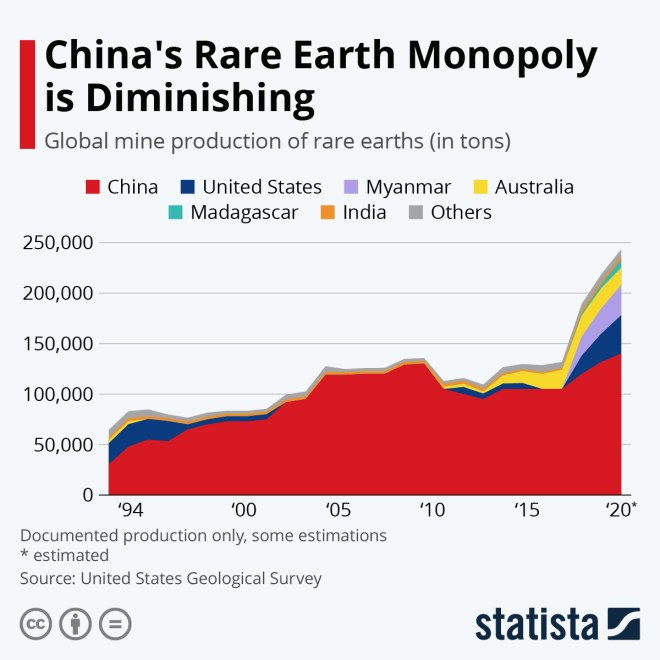
China, Myanmar, U.S.A. and rare earth metals. This may be serious.

In early May, 2019, President Xi and Vice Premier Liu He, China’s top trade negotiator, visited a rare earth metals mine in Jiangxi province. This has led to the rumor that China is seriously considering restricting rare earth exports to the US. China may also take other countermeasures in the future. The trade negotiations between U.S. and China got a lot more serious. It extended far beyond tariffs and intellectual property, it began to involve control of strategic materials.

The first thing we must realize is that rare earth metals are not all that rare. They are a thousand times or more abundant than gold or platinum in the earth crust and easy to mine, but a little more difficult to refine. Thorium and Uranium will  also be mined at the same time as the rare earth metals since they appear together in the ore.

Related image

U.S. used to be the major supplier of rare earth metals, which was fine up to around 1984. Then the U.S. regulators determined that Uranium and Thorium contained in the ore made the ore radioactive, so the regulatory agencies decided to make rare earth metal ore subject to nuclear regulations with all what that meant for record keeping and control. This made mining of rare earth metals in the U.S. unprofitable, so in 2001 the last domestic mine closed down. China had no such scruples, such as human or environmental concerns, so they took over the rare earth metals mining and in 2010 controlled over 95% of the world supply, which was according to their long term plan of controlling the world by 2025.

Rare Earth Element Production

The U.S. used to have a strategic reserve of rare earth metals, but that was sold off in 1998 as being no longer cost effective or necessary. Two years later the one U.S. rare earth metals mine that used to supply nearly the whole world, the Mountain Pass Mine in California closed down, together with its refining capacity. From that day all rare earth metals were imported.

The U.S. used to have a strategic reserve of rare earth metals, but that was sold off in 1998 as being no longer cost effective or necessary. Two years later the one U.S. rare earth metals mine that used to supply nearly the whole world, the Mountain Pass Mine in California closed down, together with its refining capacity. From that day all rare earth metals were imported. In 2010 it started up again together with the refining capacity but went bankrupt in 2015, closed down the refining but continued selling ore to China. They restarted  refining again late 2020.


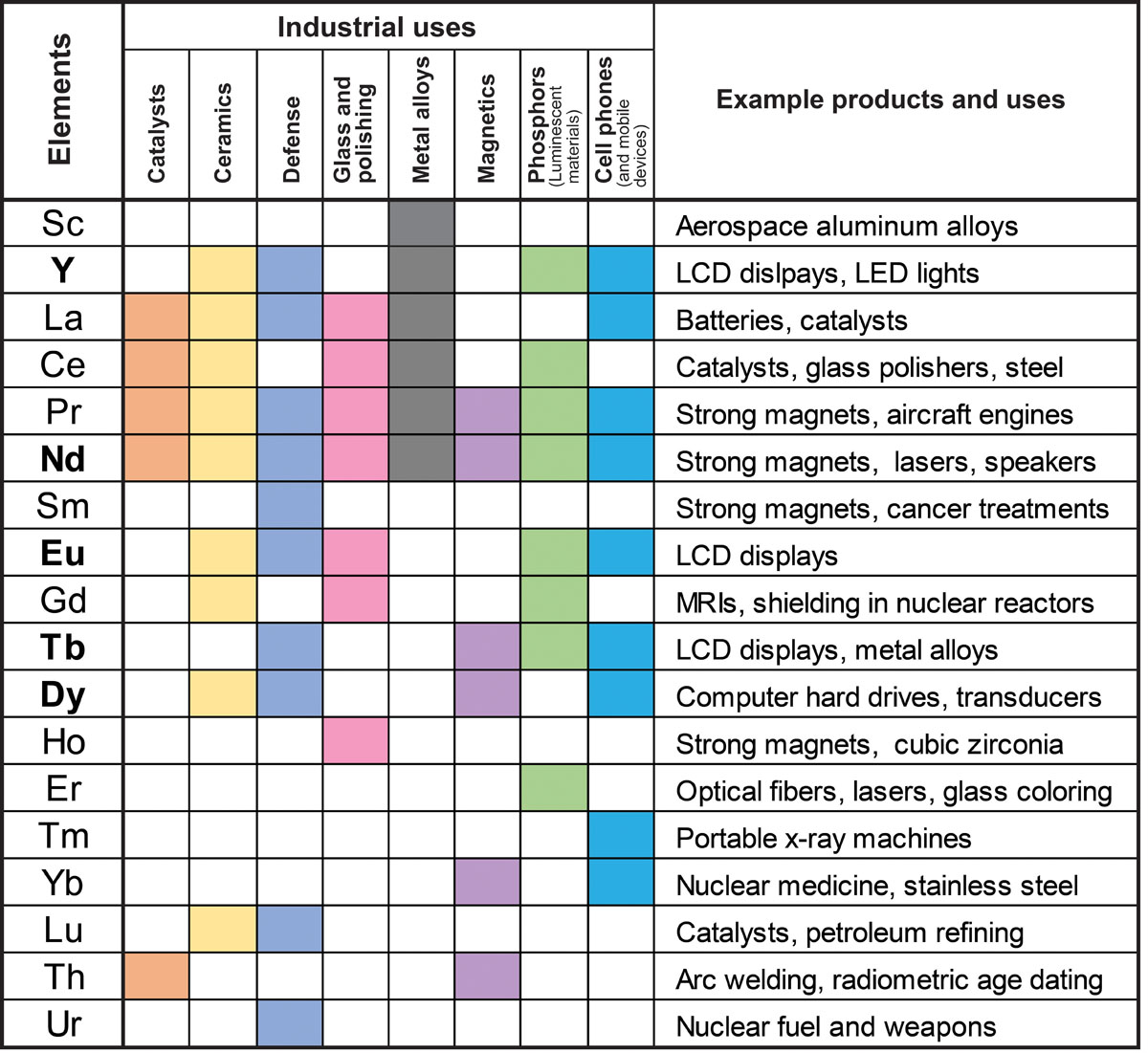
So, why is this important? Just take a look at all the uses for rare earth metals. The most sought after pays all the cost of mining and refining, and the rest are readily available at nominal cost.

The Chinese almost got away with it, and that is but one reason the trade negotiations were so complicated and hard fought, but necessary. Donald Trump fought for reciprocity and fair competition.

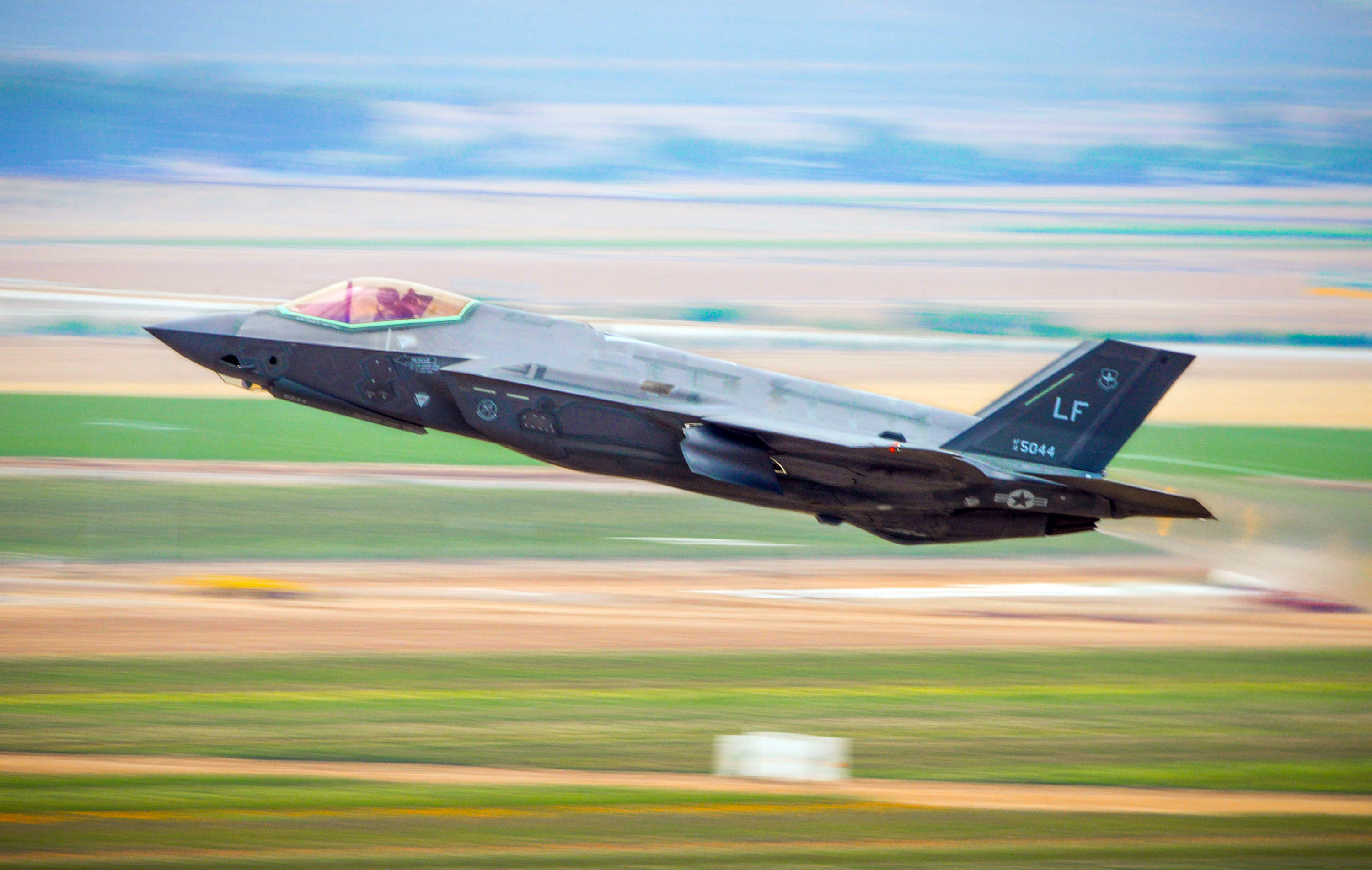
For example, according to a 2013 report from the Congressional Research Service, each F35 Lightning II aircraft requires 920 pounds of rareearth materials. Who is making the most critical parts to this airplane? You guessed it – China, from our drawings and according to our specifications.

Here is  a picture of the F-35

Image result for f-35

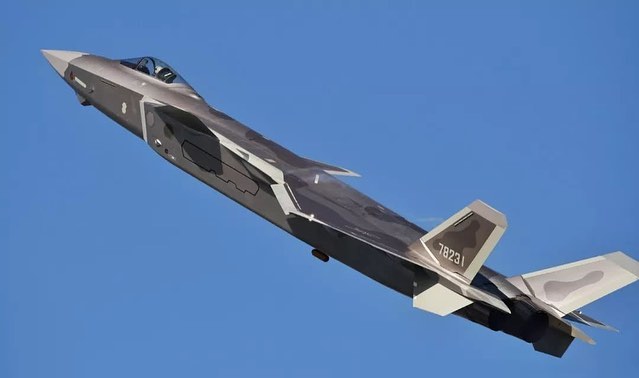
And here is a picture of the Chinese clone, the J-20, stealth capacity and all.

Image result for chinese j-20 vs f-35

It is a lot cheaper to steal technology than to develop your own.

Not all rare earth metals are of equal importance, and this is reflected in their price. The rare earth metals mined in Myanmar are high in the most sought after metals, such as neodymium and dysprosium 

November saw the prices of all major Chinese-sourced rare earths spike, but especially those used in magnets. In particular, the research note mentioned neodymium, which is the most common rare earth used in making magnets, which rose by 27% since early in November, up over 50% year to date. Several other key rare earths also increased in value last month, including dysprosium (+17%), gadolinium (+9%) and terbium (+27%).

Another factor in the price surge is a new law that came into force in China on December 1, Hamilton noted. Known as the Export Control Law, it creates new regulations that give the government more control over such exports as technology and rare earths.

It turns out that Myanmar provides half of China’s need for neodymium and dysprosium, so any disruption in the supply would be most unwelcome for China.

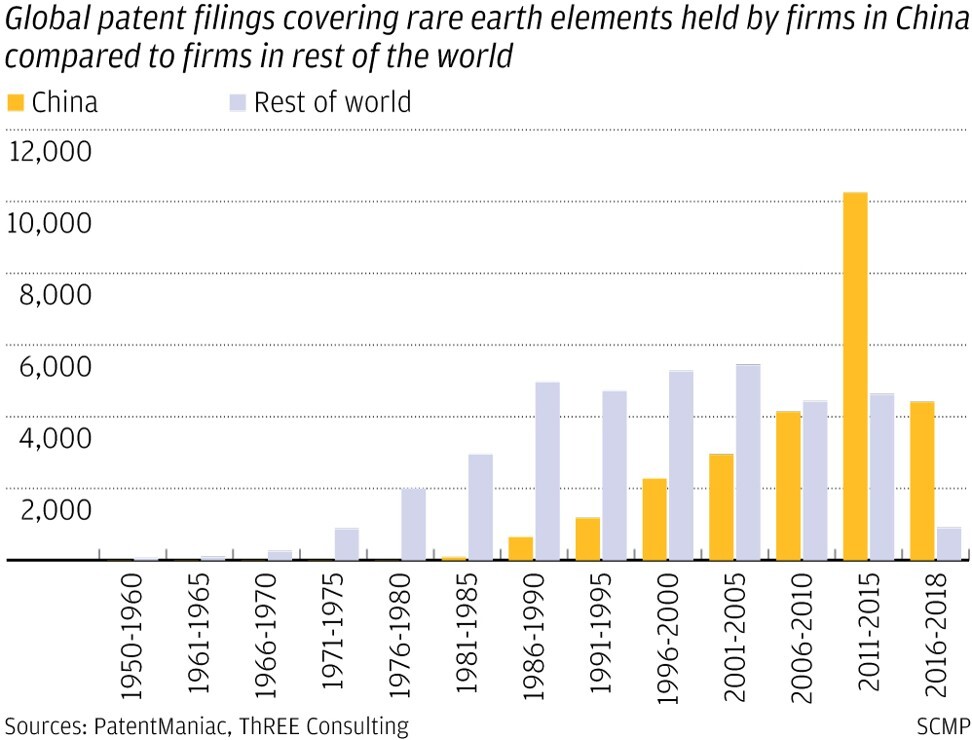
China has been hard at work trying to keep a near monopoly on rare earth metals, by securing patents> Here is a chart of recently issued patents

https://cdn.i-scmp.com/sites/default/files/d8/images/methode/2021/02/03/8e8a1524-65dd-11eb-bc00-908c10a5850a_972x_175322.jpg

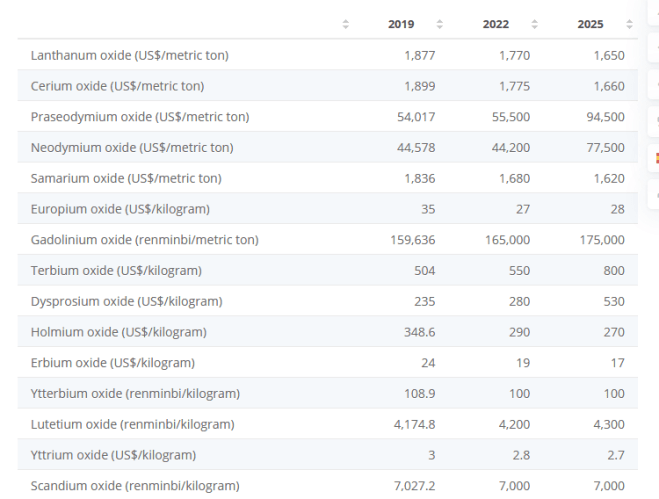
Yogi Berra once said: Predictions are hard, especially about the future Here are the predictions for rare earth metals prices:

On February 1 there was a coup in Myanmar, and the military took over power. Prices of some rare earth metals spiked to more than estimated 2025 levels.

China has been quietly exploring the economic damage it could inflict to US and European companies – including defense contractors – if they were to impose export ‘restrictions’ on 17 rare-earth materials, according to a report in the Financial Times.

FT added that “[t]he Ministry of Industry and Information Technology last month proposed draft controls on the production and export of 17 rare earth minerals in China, which controls about 80% of global supply.”

Before being voted out of office, President Trump and his administration sought to take steps that might help the US limit China’s resource dominance in this area, including signing an executive order declaring a “national emergency” in the US mining and minerals industry (much of which remains focused on digging coal out of the ground). China has been widely acknowledged as dominant in the rare-earth minerals market for decades.

But with Trump out, and a much more China-friendly administration back in power in Washington, it looks like Beijing is already considering playing hardball to get what it wants.

Meanwhile, the Biden administration is considering sanctions against Myanmar, a country that is poorer than Bangladesh.

China is the world’s dominant producer of rare earths, a group of 17 minerals used in consumer electronics and military equipment. But it relied on Myanmar for about half its heavy rare earth concentrates in 2020, says Adamas Intelligence managing director Ryan Castilloux.

Myanmar is therefore an “exceptionally critical supplier of … feedstocks that are essential ingredients in high-strength permanent magnets for electric vehicle traction motors, wind power generators, industrial robots and a wide array of defense-related applications”, he said.

There has been no sign of disruption for now, since Myanmar’s rare earth mines are under the control of autonomous militia groups, but the test will come after the Lunar New Year holiday, which has just ended.


The Great Global climate change Swindle.

This is a very good summary of the origin and development of the Global Warming hypothesis and its origin in the Global Governance movement. After all, the first Earth day was set to be the 100 year anniversary of Lenin.

It is over one hour long, but well worth the time. Listen carefully.


Clouds, water vapor and CO2 – why nearly all climate models fail. – and a Limerick.


Fear spreads up on Capitol Hill

The Climate change will break their will.

AOC: In Ten years

our world disappears!

She acts as a New Green Deal shill.

Quote from Alexandria Occasio-Cortez in January 2019: “Millennials and Gen Z and all these folks that come after us are looking up, and we’re like, ‘The world is going to end in 12 years if we don’t address climate change, and your biggest issue is how are we gonna pay for it?’ ” she said.

I beg to differ.

We live in only one world. As a concerned citizen I realize we have immense environmental challenges before us, with water pollution; from plastics in the ocean, excess fertilizer in the rivers, poison from all kinds of chemicals, including antibiotics, birth control and other medicines flushed down the toilet after going through our bodies, animals fed antibiotics, pest control, weed control and so on. Increasing CO2 is not one of the problems, it will in fact help with erosion control, and allow us to feed more people on less agricultural land with proper management, and require less fertilizer and water to do so. In fact, proper water management is a larger problem, with some rivers no longer even reaching the ocean. All water is already spoken for, especially in the 10 to 40 degrees latitude, where most people live.

Allow me to be somewhat technical and give the background to why I know we will never experience the thermal runaway they are so afraid of.

Many years ago I worked at Hewlett Packard on an Atomic Absorption Detector. It was a huge technical success but a commercial failure, as it was too expensive to use for routine applications. However it found a niche and became the detector of choice when dismantling the huge nerve gas stockpiles remaining from the cold war. I was charged with doing the spectrum analysis and produce the final data from the elements. One day two salesmen came and tried to sell us  a patented device that could identify up to 21 different elements with one analysis. They had a detector that divided the visual band into 21 parts, and bingo, with proper, not yet “fully developed” software you could now analyze up to 21 elements with one gas chromath analysis. What could be better? We could only analyze correctly four or five elements simultaneously. It turns out the elements are absorbing in the same wavelength bands, scientifically speaking they are not orthogonal, so software massaging can only go so far. It turned out that the promised new detector was inferior to what we already had and could only quantify three or 4 elements at the most.

In the atmosphere the two most important greenhouse gases are water vapor and CO2 with methane a distant third. Water vapor is much more of a greenhouse gas everywhere except near the tropopause high above the high clouds and near the poles when the temperature is below 0 F, way below freezing. A chart shows the relationship between CO2 and water vapor:

Image result for h20 and co2 as greenhouse gases

Source: http://notrickszone.com/2017/07/31/new-paper-co2-has-negligible-influence-on-earths-temperature/

Even in Barrow, Alaska water vapor is the dominant greenhouse gas. Only at the South Pole (And North Pole) does CO2 dominate (but only in the winter).

All Climate models take this into account, and that is why they all predict that the major temperature increase will occur in the polar regions with melting icecaps and other dire consequences. But they also predict a uniform temperature rise from the increased forcing from CO2 and the additional water vapor resulting from the increased temperature.

This is wrong on two accounts. First, CO2 and H2O gas are nor orthogonal, that means they both absorb in the same frequency bands. There are three bands where CO2 absorbs more than H2O in the far infrared band, but other than that H2O is the main absorber. If H2O is 80 times as common as CO2 as it is around the equator, water vapor is still the dominant absorber, and the amount of CO2 is irrelevant.

Secondly gases cannot absorb more than 100% of the energy available in any given energy wavelength! So if H2O did absorb 80% of the energy and CO2 absorbed 50%, the sum is not 130%, only 90%. (0.8 + 0.5×0,2 or 0.5 + 0.8×0.5). In this example CO2 only adds one quarter of what the models predict.

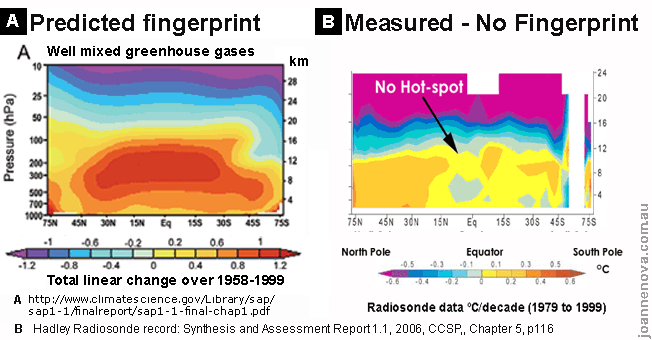
How do I know this is true? Lucky for us we can measure what increasing CO2 in the atmosphere has already accomplished. For a model to have credibility it must be tested with measurements, and pass the test. There is important evidence suggesting the basic story is wrong. All greenhouse gases work by affecting the lapse rate in the tropics. They thus create a “hot spot” in the tropical troposphere. The theorized “hot spot” is shown in the early IPCC publications. (Fig A)

Fig. B shows observations. The hotspot is not there. If the hotspot is not there, the models must be wrong. So what is wrong with the models? This was reported in 2008 and the models still assume the additive nature of greenhouse gases, even to the point when more than 100% of the energy in a given band is absorbed.

How about Methane? Do not worry, it absorbs nearly exclusively in the same bands as water vapor and has no measurable influence on the climate.

But it will get warmer at the poles. That will cause melting of the ice-caps? Not so fast. When temperature rises the atmosphere can hold more water vapor, so it will snow more at higher latitudes. While winter temperatures will be higher with more snowfall, this will lower the summer temperatures until the extra snow has melted. And that is what is happening in the Arctics

As we can see from this picture, the winters were about 5 degrees warmer, but starting from late May through early August temperatures were lower. It takes time to melt all the extra snow that fell because of the less cold air, able to contain more water vapor.

These are my suggestions

  1. Do not worry about increasing CO2 levels. The major temperature stabilizer is clouds, and they will keep the earth from overheating by reflecting back into space a large amount of incoming solar radiation. Always did, and always will, even when the CO2 concentration was more than 10000 ppm millions of years ago. Ice ages will still come, and this is the next major climate change, maybe 10000 years from now, probably less.
  2. Clean up rivers, lakes and oceans from pollution. This is a priority.
  3. Limit Wind turbine electric energy to areas not populated by large birds to save the birds. Already over 1.3 million birds a year are killed by wind turbines, including the bald and Golden Eagles that like to build their aeries on top of wind turbines.
  4. Do not build large solar concentration farms. They too kill birds.
  5. Solar panels are o.k. not in large farms, but distributed on roofs to provide backup power.
  6. Exploit geothermal energy in geologically stable areas.
  7. Where ever possible add peak power generation and storage capacity to existing hydroelectric power plants by pumping back water into the dams during excess capacity.
  8. Add peak power storage dams, even in wildlife preserves. The birds and animals don’t mind.
  9. Develop Thorium based Nuclear Power. Russia, China, Australia and India are ahead of us in this. Streamline permit processes. Prioritize research. This should be our priority, for when the next ice age starts we will need all the CO2 possible.
  10. Put fusion power as important for the future but do not rush it, let the research and development be scientifically determined. However, hybrid Fusion -Thorium power generation should be developed.
  11. When Thorium power is built up and has replaced coal and gas fired power plants, then is the time to switch to electric cars, not before.
  12. Standard Nuclear Power plants should be replaced by Thorium powered nuclear plants, since they have only 0,01% of the really bad long term nuclear waste.
  13. Start thinking about recovering CO2 directly from the air and produce aviation fuel. This should be done as Thorium power has replaced coal and gas fired power plants.
  14. This is but a start, but the future is not as bleak as all fearmongers state.

Re-signing the Paris Accord, a very bad idea, even for the environment! A Limerick.

Don’t fall for the Paris accord!

A bondage we ill can afford

CO2 keeps us free

Food for you, food for me.

The temperature sham sows discord.

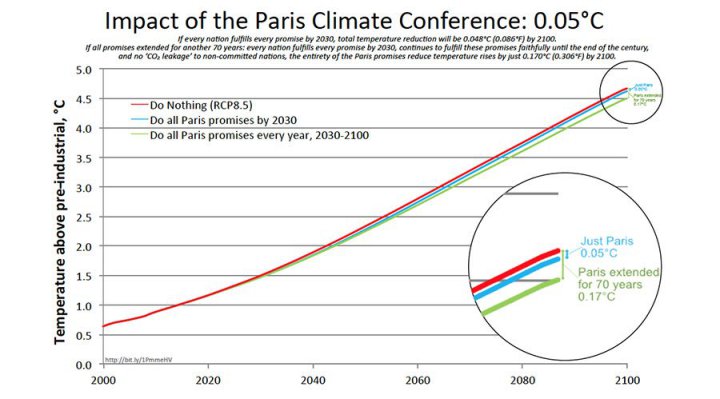
According to alarmists’ climate change models, staying out of the Paris accord will increase global temperatures by 0.05 to 0.17 degrees Celsius by the year 2100, a catastrophe too big to fathom. See the official chart!

These predictions are according to an average of climate change models, all sponsored by various governments in one way or another.

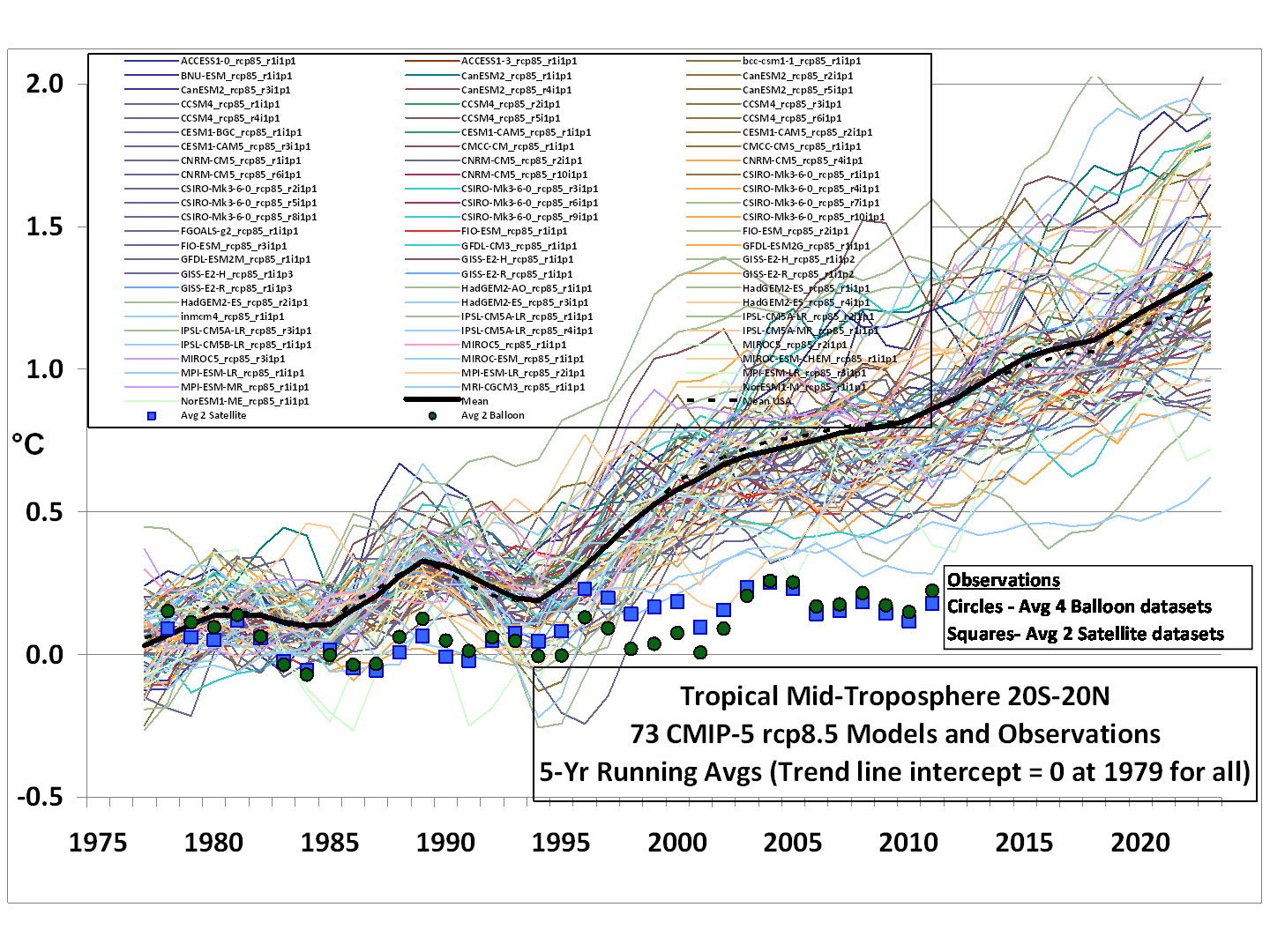
Here is a chart of 73 climate models, and the results of 6 observations.

And how is the current global temperature trend performing right now? There was  A  “pause” for over 19 years even though CO2 was increasing at 3 ppm (nearly one percent) per year! Then came a temperature rise. Here is a chart of the worldwide UAHv6 for the last 24 years.

With the discrepancy of more than half a degree C between the average of the climate models and observations, it pays to be skeptical of even the 0.17 degrees.

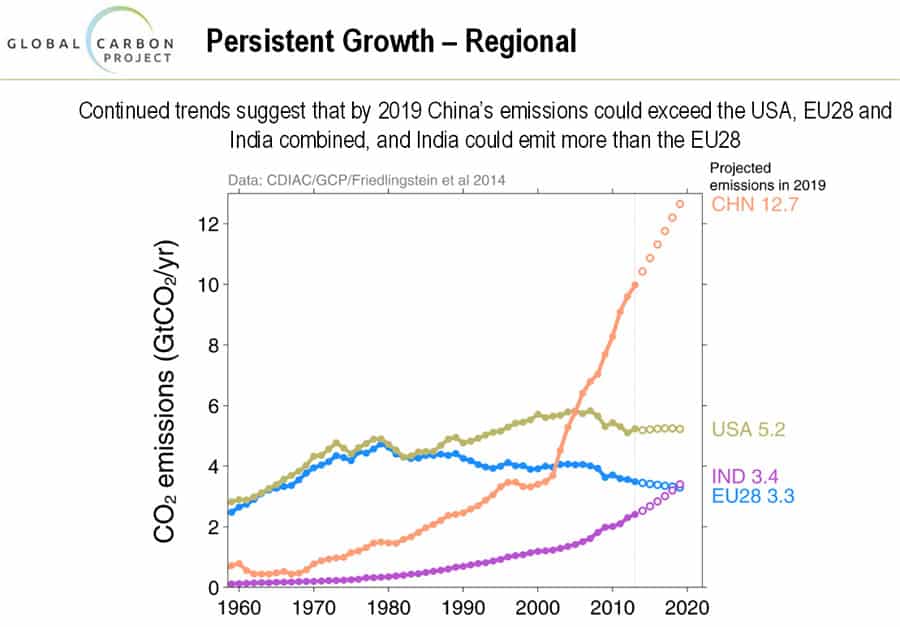
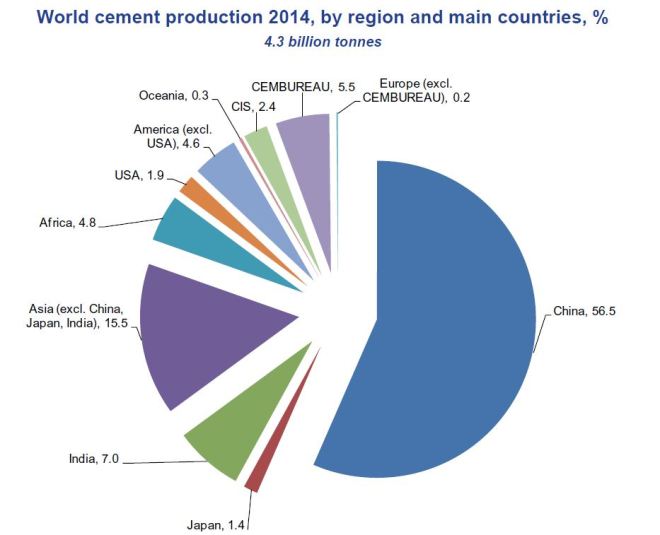
This chart shows the growth of China. Not only are they consuming 47% of the world’s coal production, they are also making 30 times more cement than  U.S. Cement production releases CO2, by replacing carbonate with sulfate.

And with the Paris accord, China was free to grow emissions until 2030, up to 6 times U.S. output, and get paid for it! And we were to pay them!

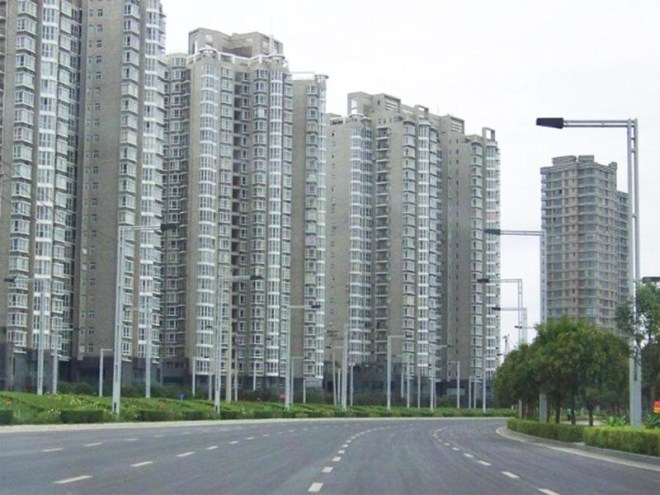
What is China doing with all its cement? Building artificial islands? Bunkers? Ghost cities?

world-cement-production_2

Well, it takes a lot of cement to build artificial islands in the South China Sea!

china3


Vitamin D as COVID-19 fighter, a most important virus fighter!

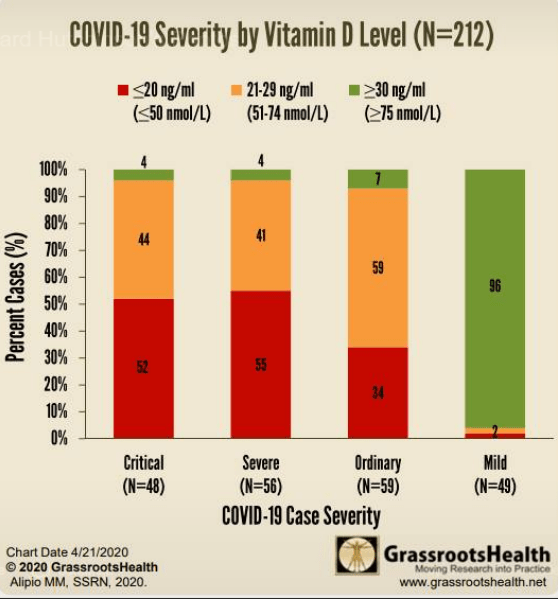
The organization Grassroots health put out the results of 212 people that had the COVID-19 virus, roughly 50 each having a critical or severe or normal or mild outcome. The results were stunning. Nearly all with a high level of vitamin D level in the blood had a mild outcome, as opposed to those with a vitamin D deficiency.

Up to now vitamin D deficiency has mostly been a concern for the people with the following risk factors, but not as a virus fighter.

  • Osteoporosis or other bone disorder
  • Previous gastric bypass surgery
  • Age; vitamin D deficiency is more common in older adults.
  • Obesity
  • Lack of exposure to sunlight
  • Having a darker complexion
  • Difficulty absorbing fat in your diet

It should be fairly simple and fast to expand this analysis to a larger sample of people that also include people with antibodies to COVID-19 but never showed any symptoms.

If this holds true, we did the exact wrong thing by keeping people indoors in hope to slow the spread. Instead we should have encouraged people to be outdoors as much as possible, still practicing hygiene and social distance, give vitamin D to all over 65 (4000 IU), to all obese and people of dark complexion.

This is by no means the only suggestion, but it is one more weapon in the arsenal to combat this virus.

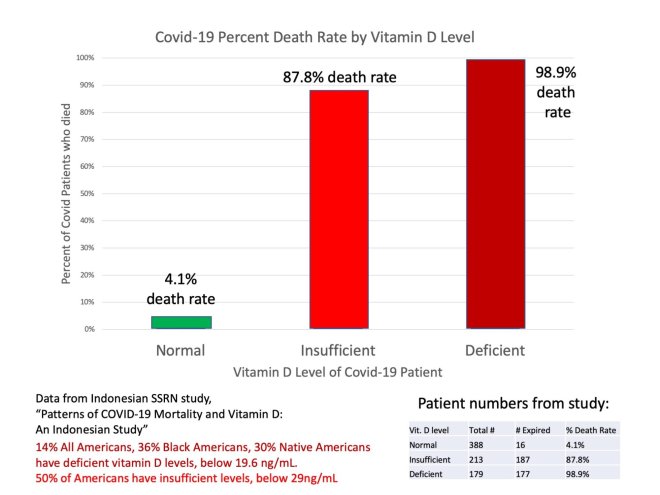
An Indonesian study indicates the link between Vitamin D Deficiency and death is even stronger:


It is correct special attention should be given African Americans and Native Americans, since they have a much higher rate of Vitamin D deficiency.

Conclusion: The AMA should start paying attention to food supplements and issue recommendations for Vitamin D that it is an  important therapeutic and prophylactic against COVID-19.

This also means that forbidding outdoor dining, forcing people to eat indoors in their own homes makes matters worse. This is also confirmed by the statistics of lockdown states, they do worse after lockdown than before. In contrast, states with less confinement are nearly all well past their peak.


Climate change and the Paris climate agreement. A Limerick.

Re-enter the Paris accord?

A folly we ill can afford.

We’ll help China pollute,

they won’t still give a hoot.

Re-sign is a Damocles sword.

I am a climate realist, that means I look at the totality of what is happening to the climate with increasing CO2 levels, and what it means for our future.

Climate alarmists and IPCC believe that the thermal response to increasing CO2 is a feedback gain from increasing water vapor that results from higher temperatures, leading to much higher temperatures. Current climate model averages indicate a temperature rise of 4.7 C by 2100 if nothing is done, 4.65 C if U.S keeps all its Paris commitments and 4.53 C if all countries keep their part of the agreement. In all cases, with or without Paris agreement we are headed for a disaster of biblical proportions.

As the chart indicates, implementing all of the Paris agreement will delay the end of mankind as we know it by at most 4 years.

The cost is staggering. The developing countries want at least 100 billion dollars a year to implement the Paris accord, all paid for by the developed countries. The most infuriating thing about that is that China is considered a developing country, and being a developed country The U.S., while reducing their CO2 footprint will be paying China until the year 2030 to further develop their coal burning electric plants until the China CO2 output is six times our output. They had plans to add 65 GW  (+6.5%) of coal-burning power plants this year alone to their grid. The china-virus delayed that by a few months, but their intent is still to dominate the world by 2025. They already consume 48% of the world’s output of coal, produce over half of the world’s steel and cement (it takes a lot of reinforced concrete to create multiple islands in the South China Sea).

clip_image004


Myself and quite a few scientists, meteorologists, but mostly engineers believe the feedback loop in nature is far more complicated than what the climate models suggest, in fact, there is a large negative feedback in the system, preventing a temperature runaway, and we have the observations to prove it.  The negative feedback manifests itself in 2 ways:

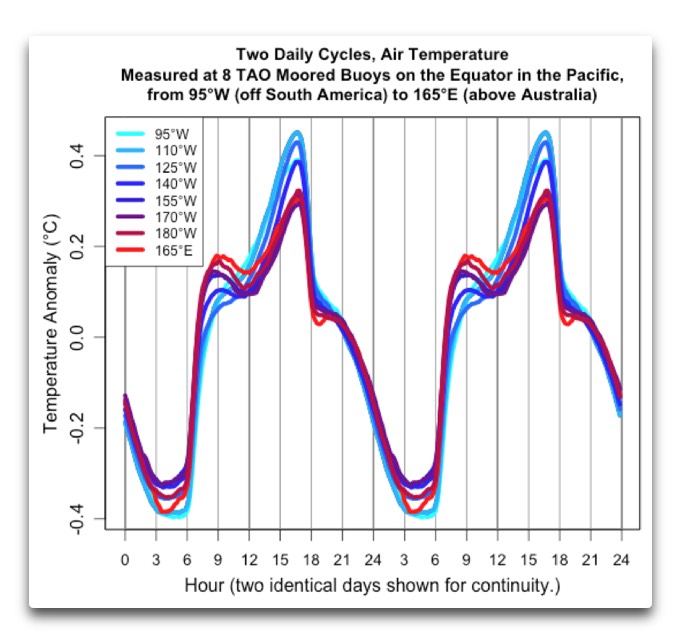
Inorganic feedback, represented by clouds. If there were no clouds, the tropics would average a temperature of  140 F  thanks to the greenhouse effect. The clouds reflect back up to 300 W/m2 into space rather than the same energy being absorbed into water or soil. Clouds are highly temperature dependent, especially cumulus and cumulonimbus clouds. The figure below shows temperature at the equator in the Pacific Ocean.

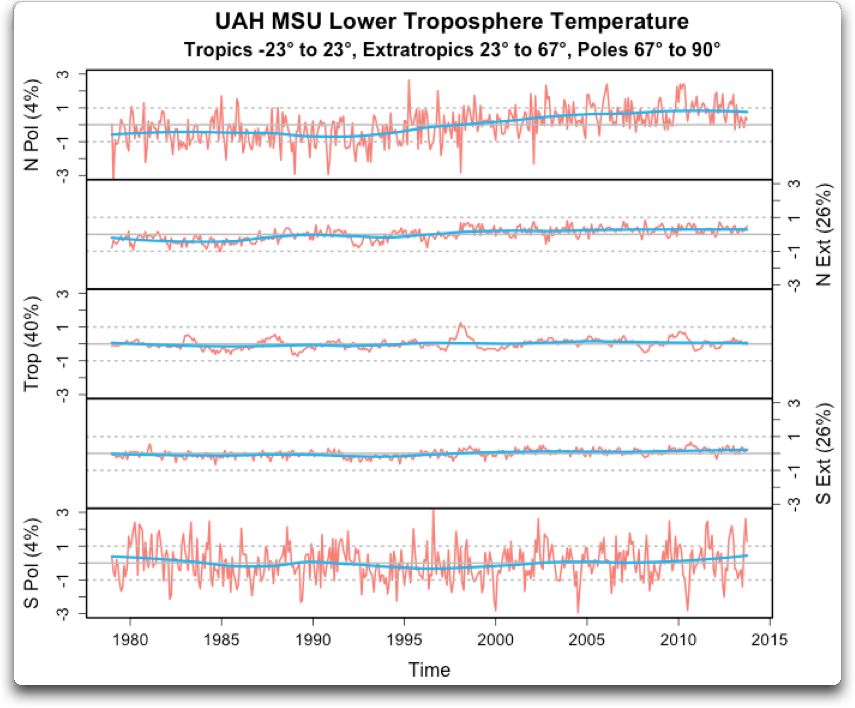
Cumulus clouds are formed in the morning, earlier the warmer it is, and not at all if it is cold, thunderstorms appear when it is warm enough. The figure shows how temperature in the equatorial Pacific rises until about 8:30 a.m, then actually declines between 9 and 12 a.m. even as the sun continues to rise. The feedback, which was positive at low temperatures becomes negative at warmer temperatures, and in the equatorial doldrums, surface temperature has found its equilibrium. No amount of CO2 will change that. Equatorial temperature follows the temperature of the ocean, warmer when there is an el niño, cooler when there is a la niña. Here is a chart of temperature increases since satellite measurements began as a function of latitude.

The tropics follow the ocean temperature closely, no long term rising trend, the extra-tropics are also stable.

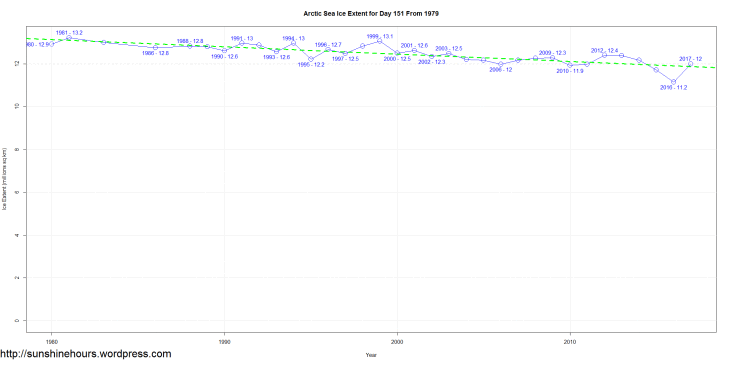
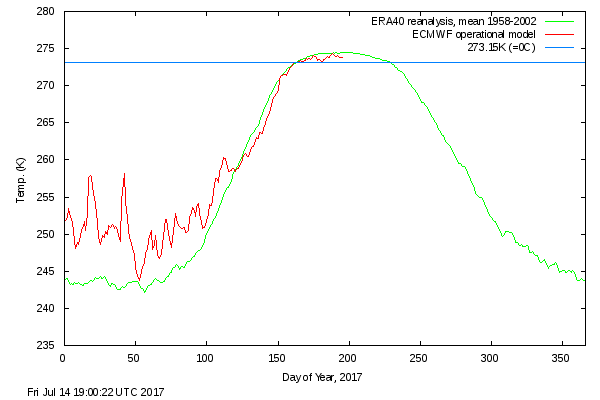
Not so at the poles. the temperature record indicate a noticeable warming with large spikes up and down, up to 3 degree Celsius difference from year to year, especially the Arctic. So, how much has the Arctic melted? Here is a chart of Arctic ice cover for 31 May for the last 39 years.

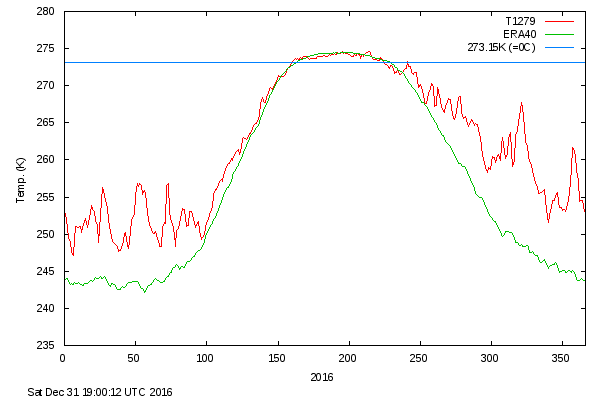
If this trend continues, all ice may melt in 300 to 400 years, faster if there is further warming and nothing else is changing. Let’s take a look at the Arctic above the 80th latitude, an area of about 3,85 million square kilometers, less than 1% of the earth’s surface, but it is there where global warming is most pronounced. Here are two charts from 2016 and 2017.

meanT_2017

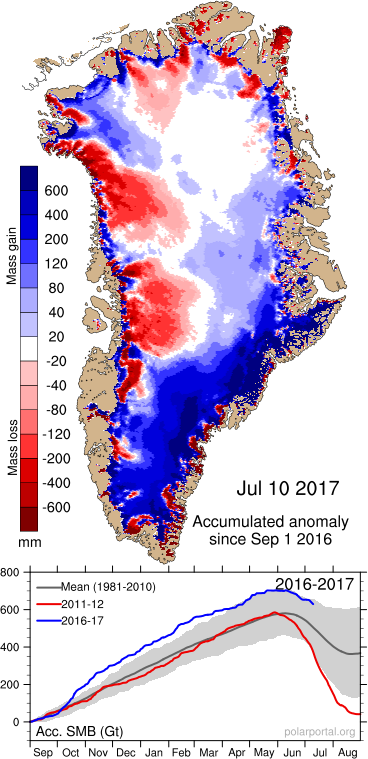
Starting at summer 2016, the Arctic was melting quite normally, but something else happened that is not shown in the chart. Every 5 years or so, the Arctic suffer a large storm with full hurricane strength during the summer. In 2016 there was no one, but two such storms, and as they happened late in the season when the ice is rotten they result in a large ice loss, making the ice minimum the lowest on record, and the ice volume nearly 4,000 Gigatons (Gt) less than the 30 year normal. Then the temperature from October thru April did run 7 degree Celsius warmer than normal with a spike as high as 20 degrees warmer. Yet today the deficit is down to 2,500 Gt. What happened? It snowed more than normal. In the Arctic, it gets warmer under clouds, warmer still when it snows. Take a look at Greenland and what happened during the freezing season. It snowed and snowed and Greenland accumulated 150 Gt more ice than normal. So, at that point in the season we were a total of 1650 Gt ahead of previous year, and this was with Arctic temperatures being seven degrees warmer than normal during the cold season. The counter-intuitive conclusion is that it may very well be that warmer temperatures produces accumulation of snow and ice, colder temperatures with less snow accumulates less. What happens during the short Arctic summer? With more snow accumulated it takes longer to melt prevous year’s snow, so the temperature stays colder longer. In 2017 the Arctic temperature was running colder than normal every day since May 1. If this melting period ended without melting all snow, multi year ice will accumulate, and if it continued unabated, a new ice age would start.


The second feedback loop is organic. More CO2 means more plant growth.  According to NASA there has been a significant greening of the earth, more than 10% since satellite measurements begun. This results in a cooling effect everywhere, except in areas that used to be treeless where they have a warming effect. The net effect is that we can now feed 2 billion more people than before without using more fertilizer. Check this picture from NASA, (now they can publish real science again) showing the increased leaf area extends nearly everywhere.

In addition, more leafs changes the water cycle, increases evapotranspiration, and more trees and vegetation reduces erosion and unwanted runoff. Good news all around.

In short, taking into account the negative feedback occurring the earth will warm up less than 0.5 degrees from now, not at all in the tropics, and less than 3 degrees at the poles. Without the Paris agreement there will be no increase in the death rates in the cities, except from the slight increase of city temperatures due to the urban heat effect. With the Paris agreement we will have to make draconian cuts in our use of electricity, meaning using much less air conditioning and even less heating, and life expectancy will decline.

We need energy. It takes a lot of energy to clean up the planet. Developing nations should be encouraged to use electricity rather than cooking by dried cow-dung. Coal is limited, and we should leave some for our great great grandchildren. Oil and gas should be preserved for aviation, since there is no realistic alternative with a high enough energy density. Therefore I am an advocate for Thorium based nuclear energy, being safer than Uranium based nuclear energy, and, properly implemented will produce about 0.01% of the long term radioactive waste compared to conventional nuclear power plants. And there is a million year supply  of Thorium available. Once the electricity power plants have fully switched away from coal and gas, then and only then is it time to switch to electric cars. The case for Thorium generated electric energy can be found here.