Leg 4 of the Transcontinental aqueduct is 15 miles of lake and 100 miles of aqueduct.
Lake Ray Roberts, elevation 625′, must be kept nearly constant.
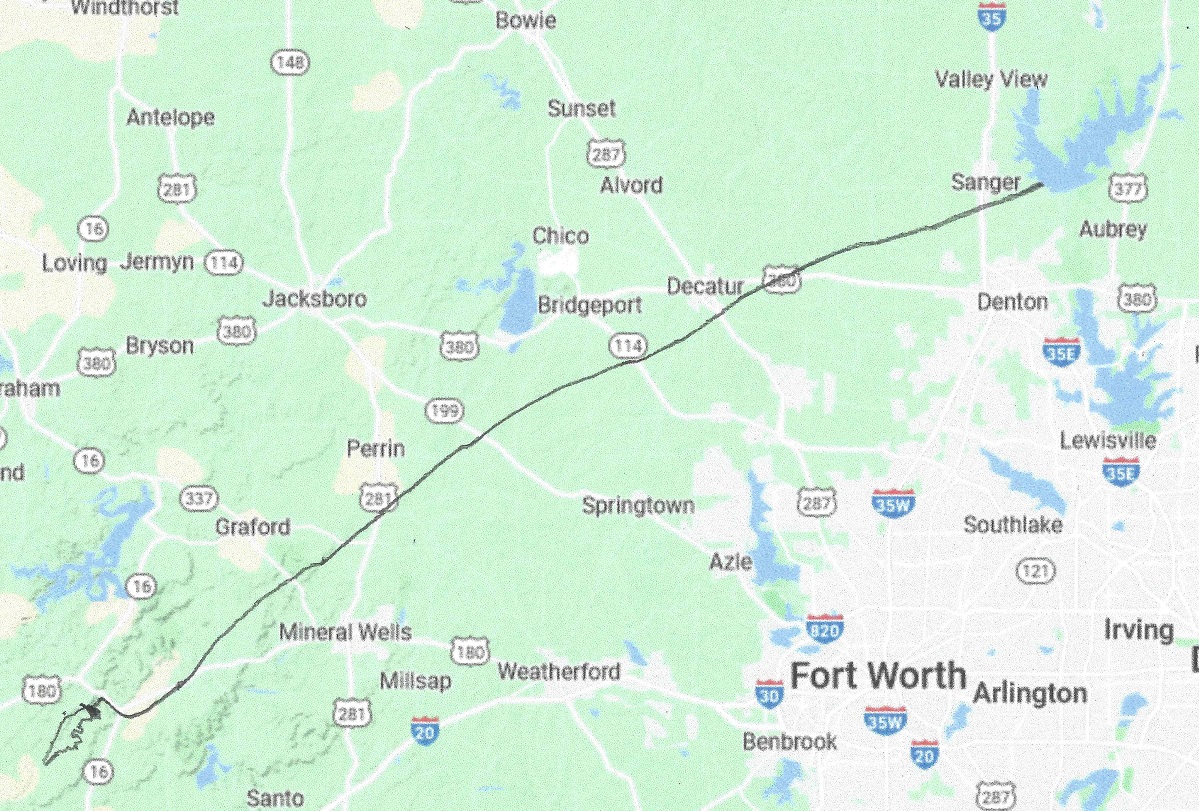
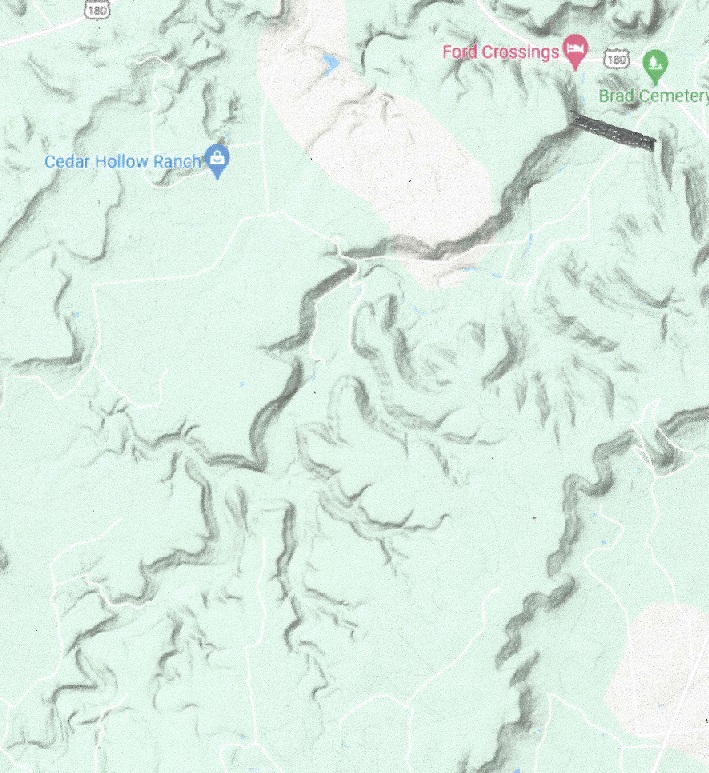
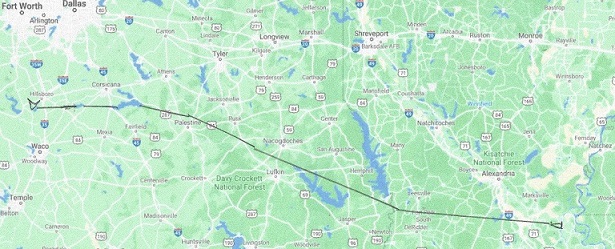
The elevation at Lake Ray Roberts is 625 feet. From here the aqueduct goes WSW to the Brad dam. It crosses the Brazos river, but does not interfere with it. (This can change if desired). The Brad dam is located just south of the Brad Cemetery on U.S. route 180, 25 miles East of Breckenridge. The dam, yet to be built will top out at 1280 feet with maximum water level at 1270 feet. The total lift of the water in stage 2 is (1,260 – 625 + 100×2) feet = 835 ft. To lift 22,000 cubic feet per second 835 feet requires seventeen 100 MW LFTR nuclear reactors. Lake Brad will contain about 60,000 Acre-ft when full, about one and a half day’s worth of storage. For 5 hours per day these 17 reactors can provide 1.7 GW of peak power to the grid. (The power can also partly be provided by wind power, during which time the LFTR’s can make hydrogen for extra peak power storage).
What’s in it for Texas? The 1.7 GW of Nuclear power can provide virtual hydro-power generation by not pumping water for up to 5 hours and thus provide 8.5 GWh of peak power daily. This has to be done in conjunction with Leg 3.
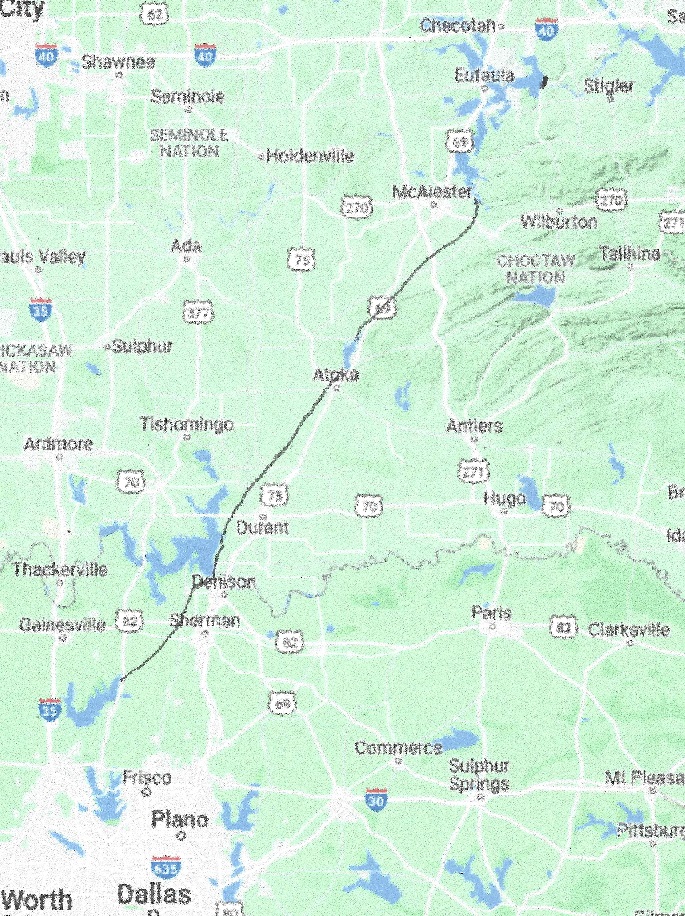
Stage 3 consists of 40 miles on Lake Eufaula, 10 miles on Aquila lake and 125 miles of a 22,000 cfs aqueduct, 95 miles in Oklahoma and 30 miles in Texas. This segment should ideally have used lake Texoma, but the water in it is brackish with between one half to one percent salinity, so it is unusable for drinking water, and even for agricultural purposes.
It starts out at lake Eufaula:
Conservation pool elevation 585′
From there the real aqueduct will start, unencumbered by barge traffic regulation. It will go from the southern tip of Lake Eufaula to lake Atoka, a distance of 40 miles. Lake Atoka is 10 miles long.
Lake Atoka elevation is 590′
Then from Lake Atoka it will pass by lake Texoma on ther downslope of thee Denison dam at an elevation of 640′. From there it will go to Lake Ray Roberts
Leg 3 total length 50miles lake, 125 miles aqueduct, end point Lake Ray Roberts, elevation 625′
The elevation at lake Atoka is about 590′. The aqueduct will have a capacity of 22,000 cfs, and it will climb from Eufaula to about 740′ before going down again to lake Atoka. From lake Atoka it will only pump up water for 85 miles. The aqueduct water level drops by 2′ per mile. Total pumping up will be 365′ and going down water release will be 110′ The total power need for this stage will be up to 665 MW assuming 92% pumping and generation efficiency. three 200 MW LFTR SMR will take care of the power needs this stage, and can be used for peak power generation when pumping is temporarily shut off. It is important to keep the water level steady at Lake Ray Roberts.
What’s in it for Oklahoma? Eufaula lake flood control will be greatly enhanced. Lake Atoka flood control will be enhanced and in case of drought extra water will be supplied to keep lake levels steady. There will be about 200 MW virtual hydro-power energy provided for up to 5 hours/day to stabilize the grid with peak power.
What’s in it for Texas? In case of drought Lake Ray Roberts can supply extra water to the Dallas area. The water levels will be stabilized at Lake Ray Roberts. There will be about 400 MW virtual hydro-power energy provided for up to 5 hours/day to stabilize the Texas grid with peak power.
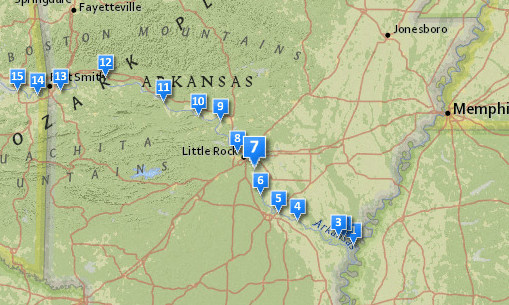
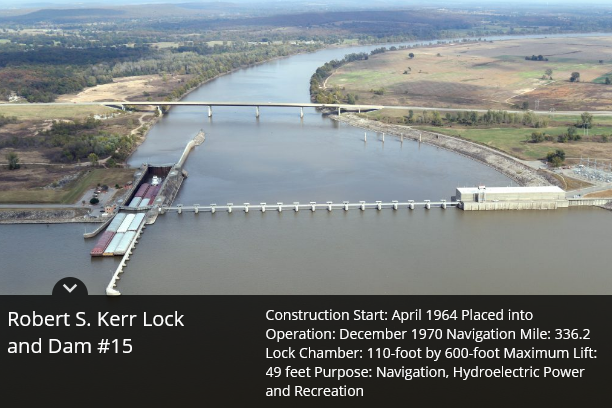
The Trans-Continental aqueduct starts out at the Mississippi river, and for the first leg follows the Arkansas River from Mississippi River to Lock15 of the Arkansas River, a distance of 319 miles.
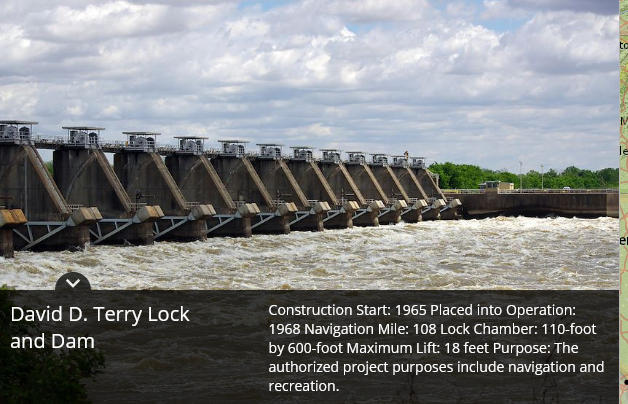
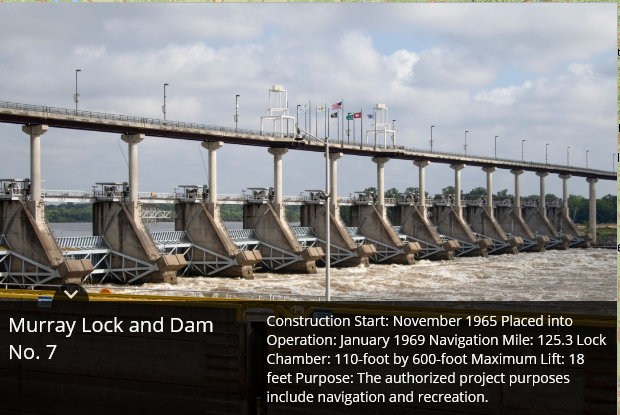
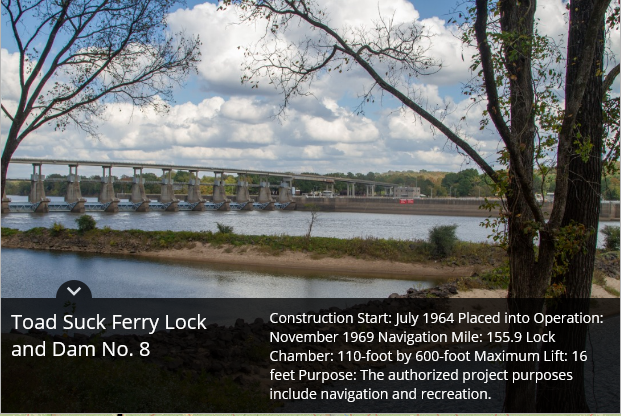
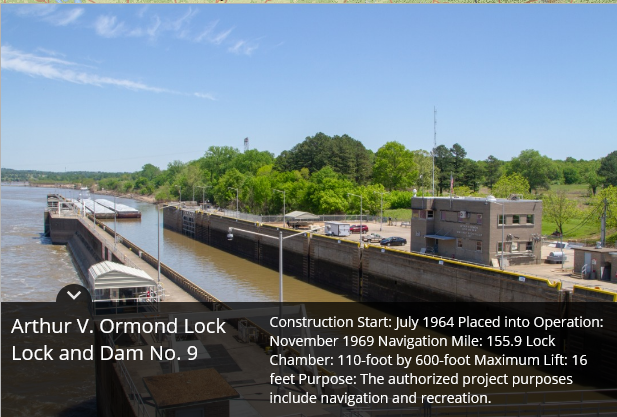
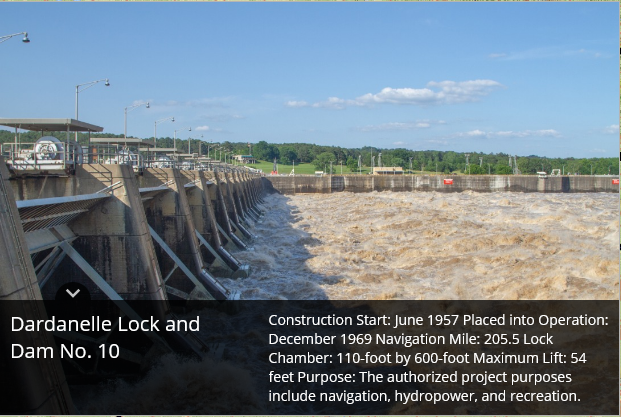
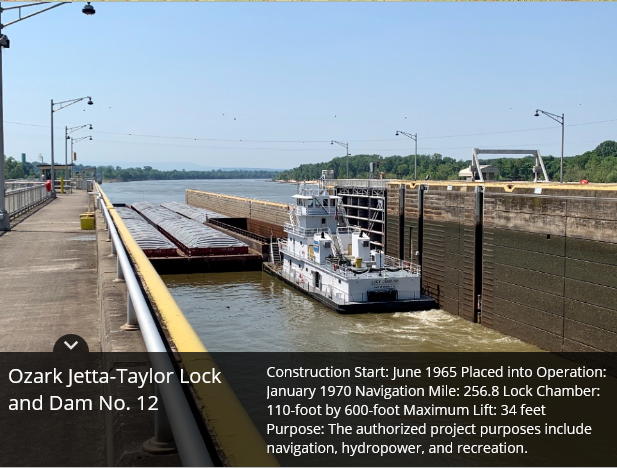
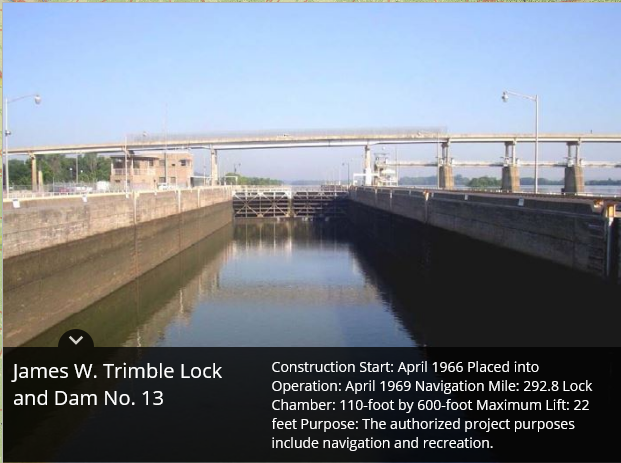
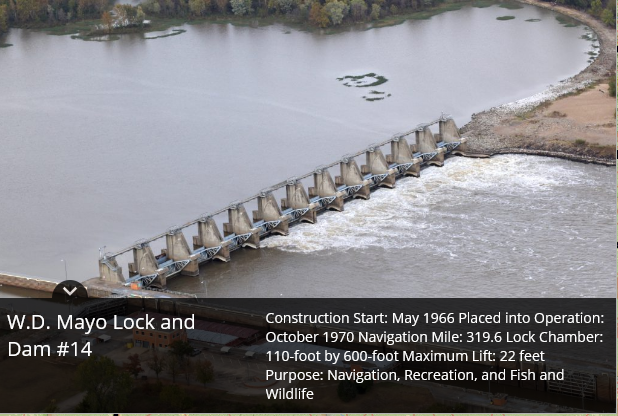
Location of the locks and pumping stations on the Arkansas river.
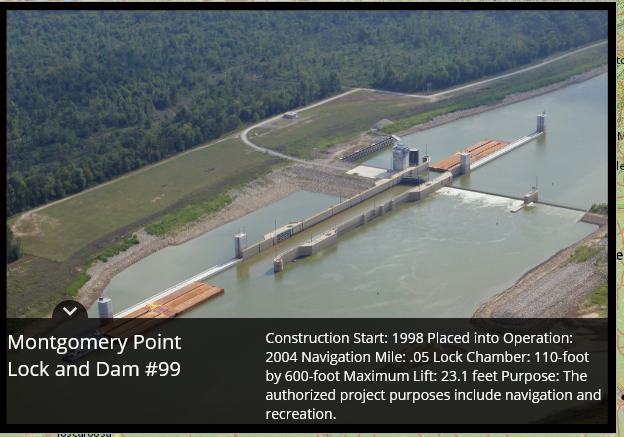
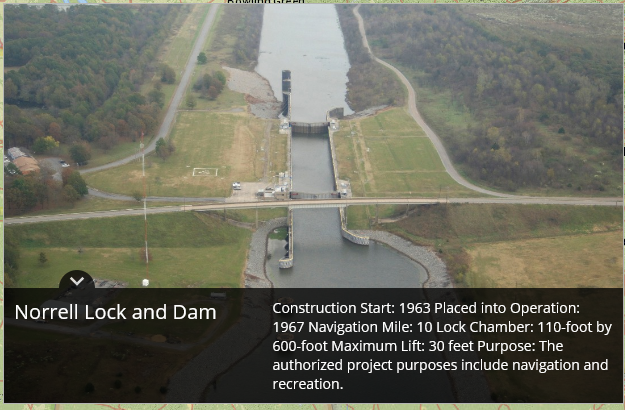
Lock 1, entrance from the Mississippi River to the White river. The water surface at Montgomery Point has fluctuated from elevation 104′ to 172′.
This lock was added later to better accommodate barge traffic when the Mississippi River was running abnormally low. If the Mississippi is normal to high level, this lock is bypassed. Since we are going to move 23,200 cfs of water over the rocky mountain the flow amount in Arkansas river will be reduced by the same amount. In times of drought, the Arkansas River flow is most often less than 23,200 cfs. To alleviate that, a series of 20,000 cfs pumps will be installed, one in every lock of the canal, beginning with Lock 3.
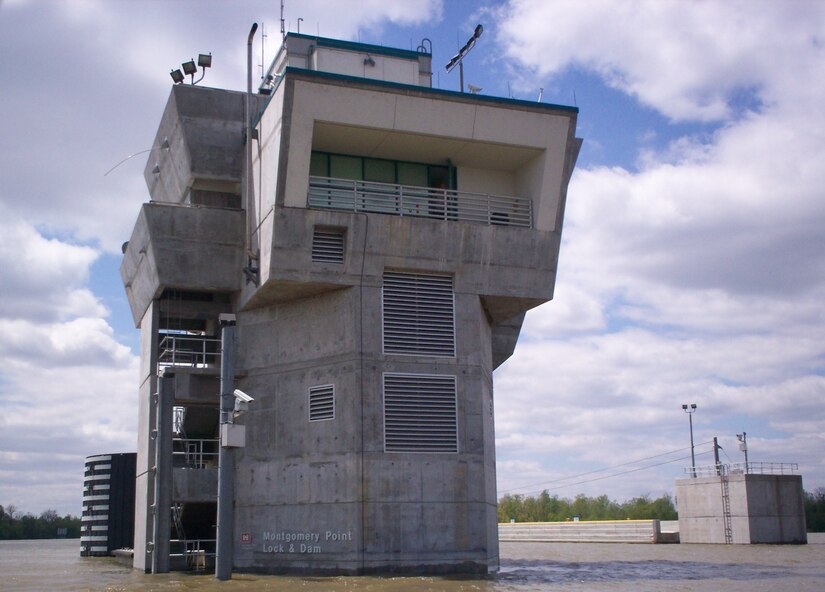
Montgomery Point Lock and Dam features “first of its kind” hydraulically operated gates. When the tail water is at elevation 115′ and rising, the dam gates are flat on the bottom of the river and barge traffic passes over the gates in the navigation pass spillway to minimize lockages saving time and money.This lock is frequently submerged. Only the top of the control tower remains above water
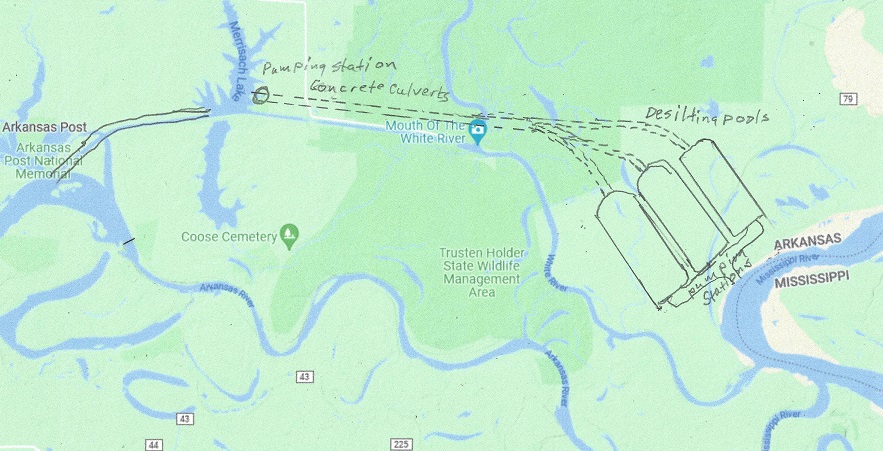
The Mississippi river is muddy. When water is pumped up there needs to be a number of de-silting pools, where the silt is returned to the Mississippi river. Here is suggested 3 pools, each capable of de-silting 10,000 cfs of water, one for the Trans-Rocky Mountain aqueduct, and two for the Trans-Continental aqueduct, being built as the whole aqueduct is nearing completion. The top of the pools is set at 150 ft elevation. Should the Missisippi River flood higher than 142 feet the operation will be shut down until elevation is below 142 feet again, and Lock 2, the Norrell Lock and dam is operational again. For the Trans-Continental aqueduct up to 20,000 cfs needs to be pumped up between 20 and 62 feet, for an energy consumption of between 1MW and 112 MW. The map below show one possible location for the pools:
The de-silting pools.Elevation 142′ No changeElevation 162′ No changeElevation 182′Elevation 1196′Elevation 213′Elevation 231′Elevation 249Elevation 265′Elevation 284′Elevation 336′Elevation 370′Elevation 391′Elevation 412′Elevation 458′
From Lock # 3 to lock # 15 (12 locks # 11 is missing) the Power houses have to either replace two of the operating turbines to a corresponding dual function pump/generator, or add a 20,000 cfs pump.
By removing 20,00 cfs from the flow of water in the Arkansas river, it will be necessary to add these pumps to ensure functioning locks even in times of extreme droughts. The total power generated by the power stations will be reduced by 20,000 cfs times (458 – 127) feet * 0.9 or about 630 megawatts total. This is most of the time all the power that was generated, so the standard hydropower generation in the Arkansas river will be for all practical purposes eliminated.
As a side note, every lock opening uses up water equivalent of between 22 and 66 kWh depending on the size of the lift or lowering of the barges. This is constant and not dependent on the size of the barges or boats. When the spillways are in use, the water is “free”, but otherwise every lock opening costs a few dollars in energy, not much, but in case of a drought the fact that water is pumped back up the river will help increase the capacity.
What is in it for Arkansas? The added pumps will give an additional tool to control the canal system. In addition, in the case of floods it will somewhat alleviate the flood control, and serve the canal system better in times of drought. To add 630 megawatts to the system, may I suggest 3 200 MW LFTR nuclear reactors, they are carbon neutral. In addition they have the ability to shut off the pumping of water and let the power plants provide 600 MW virtual hydro-storage power for up to five hours/day. The barges will benefit from sometimes go with the flow, and sometimes travel over still water, shortening the time of transport substantially.
The power companies in California asked people to avoid charging their electric vehicles to lessen the strain on the power grid.
California has a giant power problem. It depends on solar power to over 10% and wind power to 10%, but depends on hydro power for over 13% of their needs. The two last nuclear power plants in Diablo Canyon, supplying 9% of Californians electricity are being shut down in 2024 and 2025. Hydro-power is declining because of the drought, so the rest has to be made up by fossil fuels and imports from other states. Therefore California has one of the largest transmissions losses of any state, close to 10%. When the wind doesn’t blow and the sun doesn’t shine they import peak power at a price that has a few times been as high as one dollar per kWh. But they are building fast charging stations for their electric vehicles:
This one is in Menlo Park, Ca. Where Else?
The infrastructure bill will add $7.5B in EV charging stations, which could result in around 1,900 highway and rural stations, 100,000 urban stations, and 215,000 Level 2 stations for workplaces, apartments, and airports. There are already 45,000 private charging stations, and s number of exclusive Tesla charging stations. And then there is no saying how many are installing a fast charger in their garage. If electric cars really takes off we will have to greatly expand our electric grid, which is still powered over half with fossil fuels.
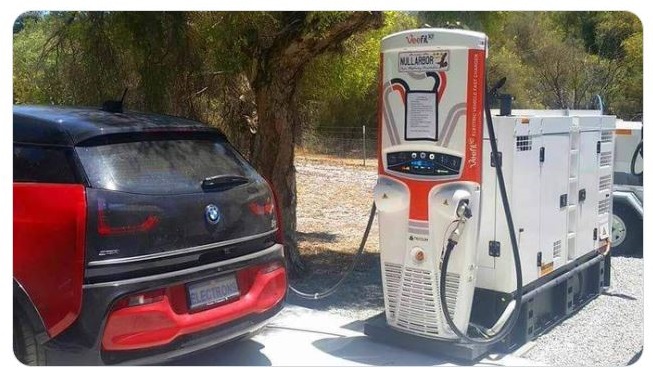
But fear not, when all else fails, here is a diesel powered electric charging station for your electric vehicle:
Should you run out of charge there is always AAA:
I am for electric vehicles as soon as the electric grid is fixed up, the dependency of fossil fuel to stabilize the grid and the grid is built up to accommodate electric vehicles being charged at the same time. As it is now, over half of all electricity is still produced using fossil fuels, and coupled with 10% transmission losses and conversion losses, plus that electric vehicles use electricity to get heated, they are not carbon neutral.
I have a proposal to solve the water problems in the American Southwest and at the same time triple the nation’s hydro-power storage capacity allowing for a greater use of solar panels, and some windmills, they will be a small part of the solution, but the great change will be the use of Small Modular Reactors, preferably Liquid Fluoride Thorium Reactors. The proposal is here-.
The Democrats greatest concern was Climate Change, followed by Election Laws and Inflation. At the bottom of the list was the Supreme Court.
The Republicans greatest concern was Inflation, followed by Immigration and Crime. At the bottom of the list was Climate Change.
The Independents greatest concern was Inflation, followed by Immigration and COVID-19. At the bottom of the list was Unemployment.
For Blacks there was a tie between COVID-19 and Inflation as their greatest concern, followed by Racial Inequality. At the bottom of the list was the Supreme Court.
And for Hispanics the greatest concern was Inflation, followed by Climate change and COVID-19. At the bottom of the list was Supreme Court.
The biggest concern was Inflation for everybody but Democrats. Their biggest concern was Climate Change, but for Republicans that was the least of their worries.
Why is that?
Some Democrats believe with religious fervor that we have only limited time to solve the climate crisis before we reach the point of no return. Alexandra Occasio Cortez said in January 2019 that if we didn’t abolish fossil fuel asap the world will end in 12 years. There is now less than 9 years left. President Trump ended our part in the Paris accord, and President Biden rejoined it in 2021. If we fulfill all the Paris accord demands, the world temperature, according to the UN agency IPCC will rise 0.05 C cooler by 2030, and a whopping 0.17C less by 2100. See analysis here. Meanwhile, China is in negotiations to buy another 100 million metric tons of Coal from Russia. They consume half the world’s coal mining.
For other Democrats it is another method of gaining control of all production and consumption, the Venezuelan model.
Then there is the sustainability crowd, and they point out the obvious fact, that unless something is done, we will run out of Coal, Oil and Gas sometimes in the not too distant future. Their suggested solution is to build Wind Turbines with generators made in China and western Europe. Solar panels are mostly built in China. But that is not the worst part. To build these generators and solar panels we need rare earth metals, 80% of which come from China. Details here. The problem is what to do when the sun doesn’t shine, which is most of the time, and the wind doesn’t blow. Energy must then be produced by other means. For now it is generated by coal and natural gas plus some diesel generators. Battery technology is not there yet, and hydro-power storage is way inadequate for today’s need.
And then there is John Kerry, who’s greatest fear is that the war in Ukraine will distract us from our greatest threat, Climate Change. His latest concern on Migration: “Wait until you see 100 million people for whom the entire food production capacity has collapsed.”
Some Republicans thank God for the increased CO2 levels because thanks to that the world can now keep an additional 2 billion people from starving. It seems hard to believe, but as food yield increases in greenhouses when additional CO2 is added, so does the greenhouse called earth benefit from more CO2. Don’t believe me? Look at this map:
This means more roots for plants, less erosion, and more food for animals. The exception is desert areas.
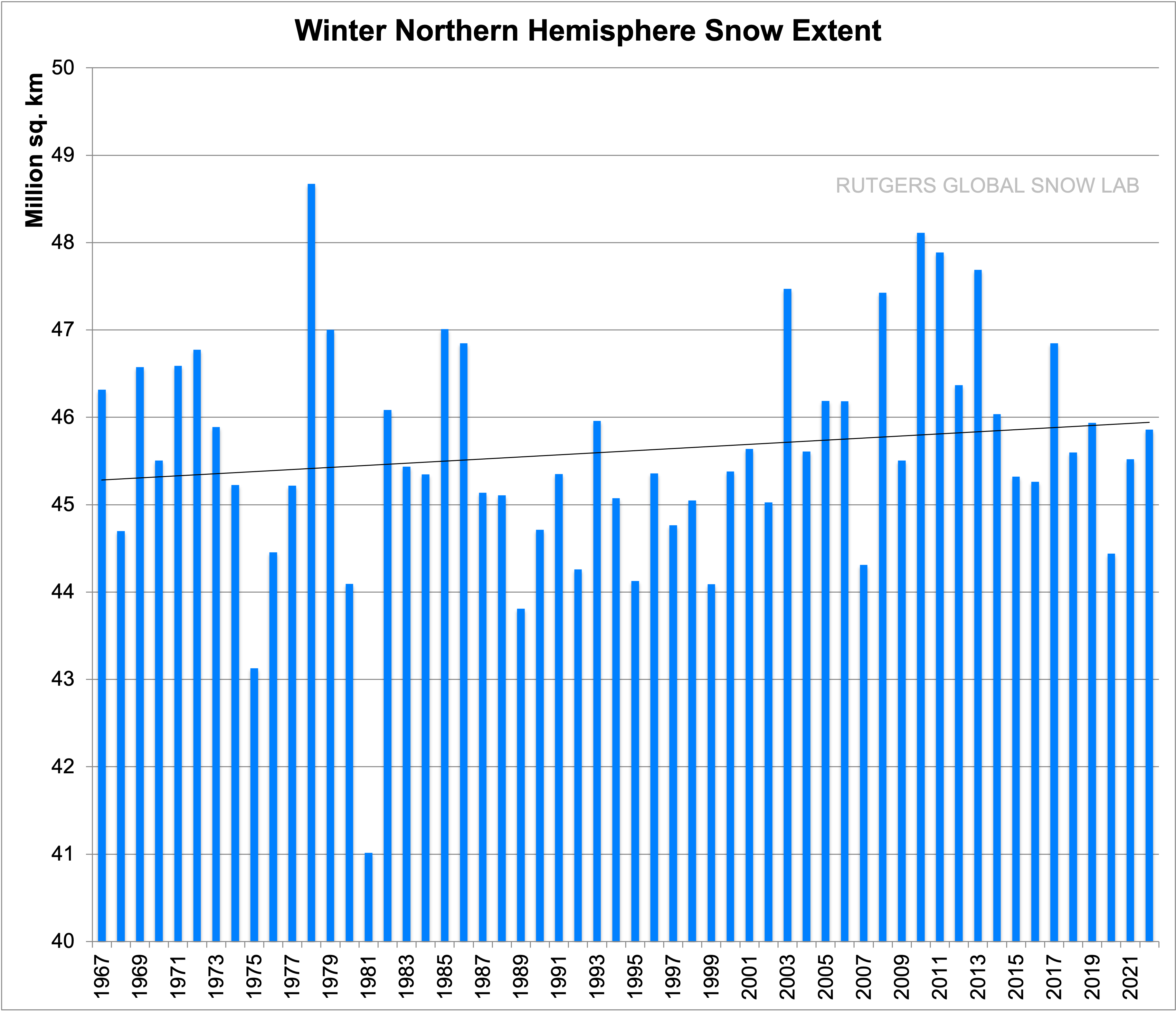
Others have noticed that the dire predictions from IPCC, a UN Climate Change Panel, have always been way off base. The temperature increase, while real has always been way below what is predicted. It is predicted that the largest temperature increases occur at the poles, so this summer the South Pole had its coldest winter on record. A weather station at the Amundsen-Scott South Pole Station registered record cold winter temperatures this season (April – September), averaging at -61.1 °C (-77.9 °F) and breaking the previous record set in 1976 at -60.6 °C (-77 °F). Weather records date back to 1957. The North Pole on the other hand is experiencing a warmer trend, but only in the winter. The summers are marginally cooler, but that is because there is more now to melt. Yes, the Snow over the Arctic is increasing. See the chart from Rutgers Snow Lab:
These are but a few of the differences in opinion concerning Climate change. Let’s see where democrats and republicans live. If we look at the 2020 voting results the map looks nearly all Republican: (84% of the counties voted Republican)
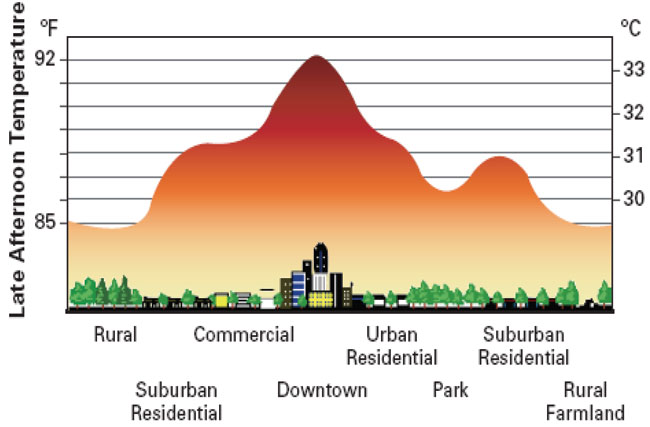
Yet there were more Democrat votes cast than Republican. This is because the largest counties population wise vote Democrat and they experience Climate Change big time thanks to the so called Urban Heat Island effect:
This is late afternoon, somewhere in Urban USA.
People living in the rural America do not experience the Urban Heat Island effect, so they tend to dismiss the constant drumbeat from PBS, everything bad is because of climate change as just idle talk. What do they know; they are stuck in their asphalt jungle complaining about how bad things are. The rural people remember how their grandparents used to say it was much worse in the thirties, heatwave after heatwave and everything dried up. And dust storms and wildfires were much worse. Not to mention the winters, the Mississippi river froze all the way down to New Orleans. We have never has it so good as it is now. Poor Urban Heat Island dwellers.
The Democrats solution to Climate Change is: Eliminate CO2 emissions from fossil fuels and replace with wind and solar but not nuclear power. All cars trucks, trains and busses should be electric. This is impossible.
Republicans want to gradually lessen our dependency of fossil fuel and make electric production come from Nuclear power, preferably small modular Thorium reactors. They have many advantages explained here. There are immense environmental problems, it is not CO2 or even Methane, but water. The American South-west has too little water for its growing population and the east US has sometimes too much. One possible solution is described here.
The Transcontinental aqueduct at the starting point will have a carrying .capacity of 15 million acre-ft per year, or 21,000 cubic feet per second on average. Maximum flow will be 26,500 cfs, allowing the power generators to supply peak power to the grid for up to 5 hours per day instead of pumping water.
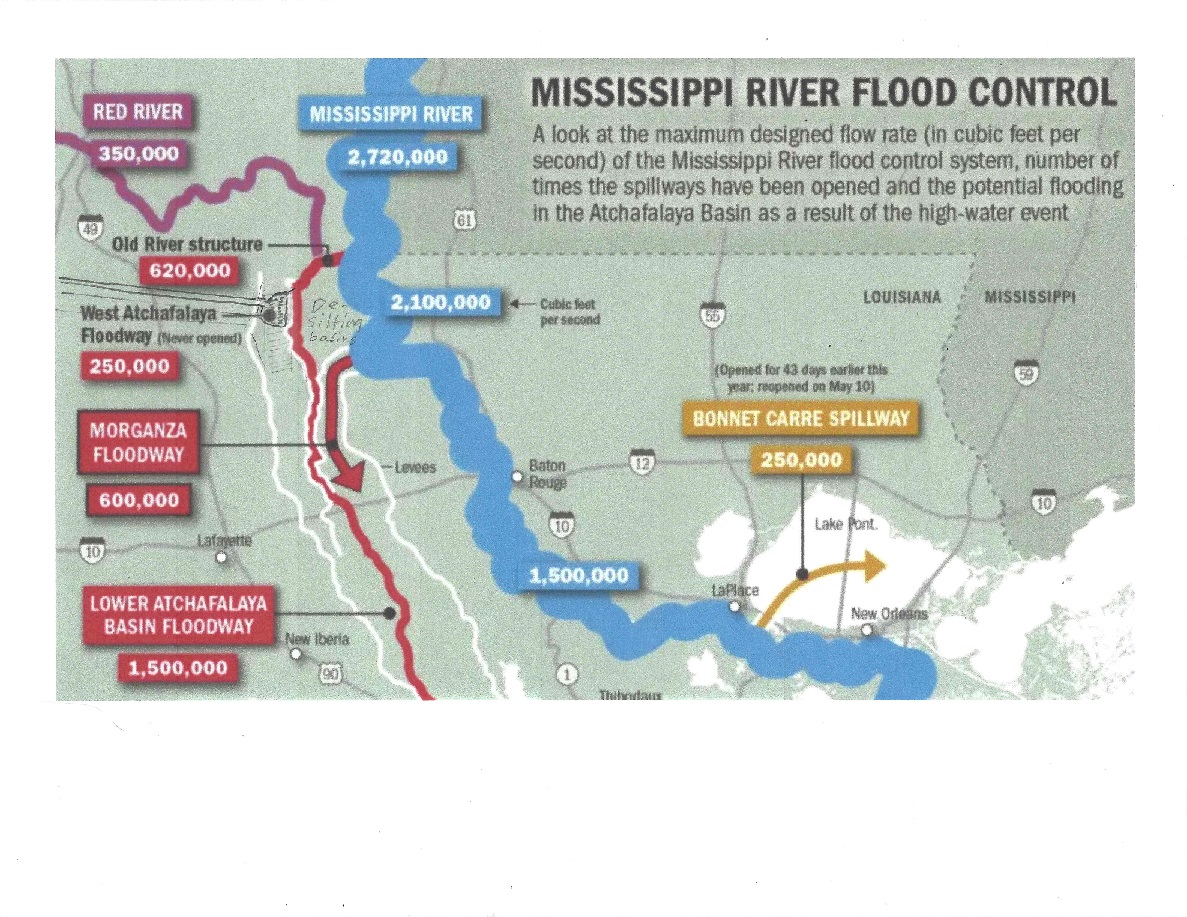
The starting point of the aqueduct is where the Red river empties out in the Atchafalaya river, and has a Mississippi River diversion canal. The elevation at the starting point is 7 feet, and the dam and 32 desilting basins of size 300 x 600 feet with a depth of 20 feet will be located in the upper part of the never used West Atchafalaya Floodway. From there the water will be collected and the aqueduct will start going westward.
The Mississippi River flood control Morganza spillway is south of the Atchafalaya river diversion, and will not interfere. The place chosen is ideal to relieve some of the Mississippi river flow. Even in the lowest Mississippi flow in a drought year this diversion has sufficient flow to divert 26,500 cfs from the river.
The first leg of the aqueduct is 360 miles long and is an open water river with pumping stations whenever the river has to rise at least 30 feet. The river runs by gravity until it has sunk about 15 feet which is about 6.2 miles downstream. Since endpoint is at 548 feet elevation this requires lifting the water about 1300 feet. During the course of the path the aqueduct crosses the Sabine River south of the Toledo Bend Reservoir, going through Richland-Chambers reservoir and Navarro Mills lake; following the best climb it crosses the Neches River and the Trinity River following the geologically best way until it reaches Aquilla Lake. The aqueduct is quite substantial, it will carry about 80% more water than the All American Canal, seen below under construction. This canal has a drop of about 2.2 feet per mile to accommodate maximum flow.
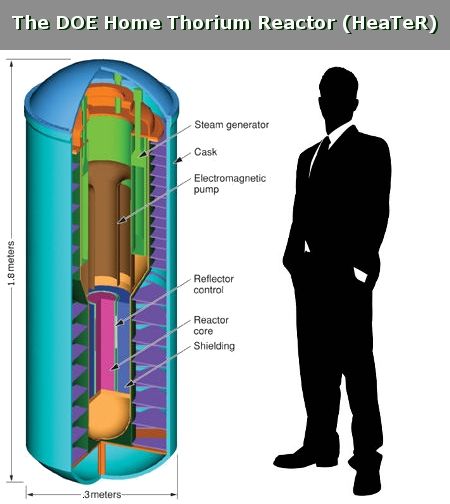
Pumping 26,500 cfs water through the aqueduct requires 3 Gigawatts of power when rounding up for turbine losses. This can be accomplished by thirty 100 MW LFTR reactors, also being able to provide up to 3 GW of peak power for 5 hours/day on demand.
The end point for stage 1 of the channel is Aquilla lake, elevation 548 feet. It has a storage capacity of 100,000 acre-ft, about a day’s worth of storage.
US reveals plan for nuclear power plant on the MOON that could power lunar Space Force base
Harry Pettit, Senior Digital Technology and Science Reporter
Jul 27 2020, 10:56 ET
Updated: Jul 27 2020, 11:02 ET
Edited excerpts here
NASA astronauts could one day live on the Moon inside a base powered by a lunar nuclear plant.
That’s according to plans shared by the US Department of Energy, which hopes to have the sci-fi power station up and running by 2027.
Nasa may one day build a nuclear power plant on the Moon.
The DoE on Friday put out a request online for ideas from the private sector on how to build such a contraption.
Dubbed a fission surface power system, the station could help man survive harsh environments on the Moon, Mars and beyond.
“Small nuclear reactors can provide the power capability necessary for space exploration missions of interest to the Federal government,” the DoE wrote in the notice published Friday.
Nasa has plans to put astronauts on the Moon in 2024 – the first manned mission to the lunar surface in almost five decades.
Nasa plans to establish a permanent base on the Moon in 2028.
The space agency has said it wants to set up a permanent base on Earth’s rocky neighbour in 2028. The base will help launch future missions to Mars.
Questions remain over what will power the base. Nasa would like to use solar panels, but the most power is needed during the 14 day lunar night every month, so nuclear power is the only practical solution.
It seems the space agency, working with the The Idaho National Laboratory and Department of Energy, is at least exploring the nuclear option.
According to the notice published to the DoE’s website, officials are looking for ideas on how to build a mostly autonomous lunar power station.
Only Molten Salt Thorium reactors would fit the bill.
It should work for 10 years at full power and boast a modular design that allows power units to connect together like Lego bricks.
Would-be designers are asked to whip something up that can survive the surface of Mars without modification.
With a Molten Salt Reactor, accidents like Chernobyl are impossible. The Three Mile Island accident was bad. The Chernobyl disaster was ten million times worse. Ah yes, I remember it well.
One morning at work, a fellow co-worker, a Ph.D. Chemist working on an Electron Capture Detector, containing a small amount of Nickel 63, came with a surprising question: You know nuclear science, how come the reactors in Chernobyl don’t have a containment vessel? Well- I answered, it is because they are carbon moderated and their failure mode is that they go prompt critical, and no containment vessel in the world can hold it in, so they skip it. He turned away in disgust. A few weeks later my wife’s father died, and we went to Denmark to attend the funeral. The day of the return back to the U.S. we heard that there had been a nuclear incident in Sweden, too much radiation had caused two nuclear power stations to close down. The Chernobyl disaster had happened 26 April 1986, and this was the first time anyone outside of Chernobyl has heard about it, two days later. This was still the Soviet Union, and nothing ever did go wrong in it worthy of reporting.
(Photo Courtesy of EBRD)
(But the carbon moderated Uranium reactors are the most efficient in producing Pu-239 the preferred nuclear bomb material.)
This has nothing to do with anything, but Chernobyl can be translated wormwood. It is mentioned in the Bible, Revelation 8: 10-11 “ And the third angel sounded, and there fell a great star from heaven, burning as it were a lamp, and it fell upon the third part of the rivers, and upon the fountains of waters; And the name of the star is called Wormwood: and the third part of the waters became wormwood; and many men died of the waters, because they were made bitter. ”
Molten Salt Thorium reactors cannot be used to supply bomb material, and they are far safer than even Light water Uranium reactors.
United States used to be the leader in Thorium usage. What happened?
The 40 MWe Peach Bottom HTR in the USA was a demonstration Thorium-fueled reactor that ran from 1967-74. and produced a total of 33 billion kWh.
The 330 MWe Fort St Vrain HTR in Colorado, USA, ran from 1976-89. Almost 25 tons of Thorium was used in fuel for the reactor.
A unique Thorium-fueled light water breeder reactor operated from 1977 to 1982 at Shippingport in the USA– it used uranium-233 and had a power output of 60 MWe.
However, after 10 years passed and billions invested, the U.S. Atomic Energy Commission abandoned thorium research, with uranium-fueled nuclear power becoming the standard. In the 1980s, commercial Thorium ventures failed, such as the Indian Point Unit 1 water reactor near New York City, because of the vast financial costs of going alone in a hostile regulatory environment, and fuel and equipment failures. By the 1990s, the US nuclear power industry had abandoned Thorium, partly because Thorium’s breeding ratio was thought insufficient to produce enough fuel for commercial industrialization.
After the Three Mile Island accident, Middletown, PA in 1979 there was a 30 plus year hiatus in building another nuclear plant, and Thorium was not on any politicians list of areas in which to invest scarce research funds.
Some research and development was still conducted, but it was more concentrated in protecting the U.S. leading position in monitoring and controlling existing nuclear technology. As a contrast even the Netherlands is developing a molten salt Thorium reactor.
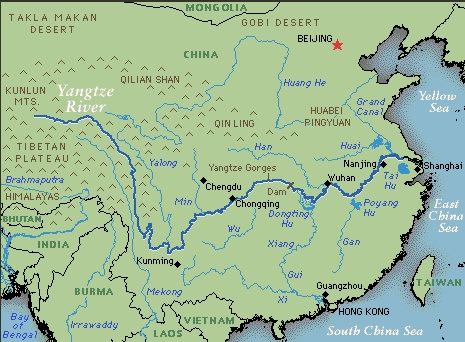
When the Three Gorges River was built it was hailed as an engineering masterpiece and proof of the superiority of the central planning and execution of the Communist regime of the People’s Republic of China. But there were real problems from the start. It was built without an independent quality control function, so they asked a western organization to verify the structural integrity of the construction. It turned out that the rebars in the large concrete blocks were not affixed properly from unit to unit, and had not been affixed to the bedrock below, but could be subject to a slow creep under the pressure of water. The findings were not only ignored, but the inspectors were accused of racial prejudice, and besides, the construction was already done, and could not be changed. So it was given the final go-ahead.
There are troubling pictures emerging of that “slow creep:”
The creep in not inches, some parts of the dam has moved many feet from their original position. This is a disaster in making.
The torrential rains have been falling and now all the floodgates are open. The water behind the dam has risen to more than 50 feet above flood level and is close to top the whole dam.
Downstream there is a 700 year old Buddhist temple. It is still standing, but mostly under water
And this is what it looks like under normal circumstances.
Further downstream the flooding is getting worse than they were before the Three Gorges dam was constructed. After all it was made to alleviate floods.
Downstream are big cities like Wuhan, Nanjing and Shanghai.
Death toll in the north and central China floods have risen to 150 people, with scores still missing and hundreds of thousands forced from homes.. The dam is in a region that experiences frequent earthquakes, and so far there has been a small, shallow earthquake in the region, but everybody is bracing for the “big one.”













 Len Bilén's blog, a blog about faith, politics and the environment.