Climate change is real and is caused by rising CO2 levels, leading to less extreme weather. This is on balance good for the environment!

We have experienced a 50% increase in CO2 levels since the beginning of industrialization. In the last 30 years the level has risen 17%, from about 350 ppm to nearly 410 ppm. Is this good or bad for the climate?

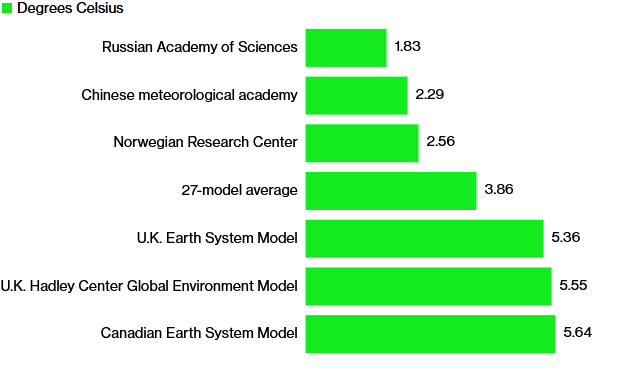
The traditional way to approach the problem of guessing what effect of rising CO2 levels has on the climate is by creating climate models. Thy have recently been adjusted, and they suddenly show a much higher rate of future temperature increase, in this case what is supposed to happen to global temperatures for a doubling of CO2 from pre-industrial times, from 270ppm to 540ppm.

https://lenbilen.com/wp-content/uploads/2020/02/screenshot_2020-02-07-climate-models-are-running-red-hot-and-scientists-done28099t-know-why1.png

The first thing that strikes you is the great discrepancies between the models. The Russian, Chinese and Norwegian models show a much slower temperature rise than  rest of the models. Why is that?

There are two ways to approach this problem. The climate models make certain assumptions about the behavior of the changing atmosphere, and based on these assumptions model future temperature changes. This is the approach from IPCC for the last 32 years. These models are failing miserably when compared to actual temperature changes. This is the traditional way.

The other way i to observe what is actually happening to our temperature over time as the CO2 increases. We have over 50 years of excellent global temperature data, so with these we can see where, when and by how much the earth has warmed.

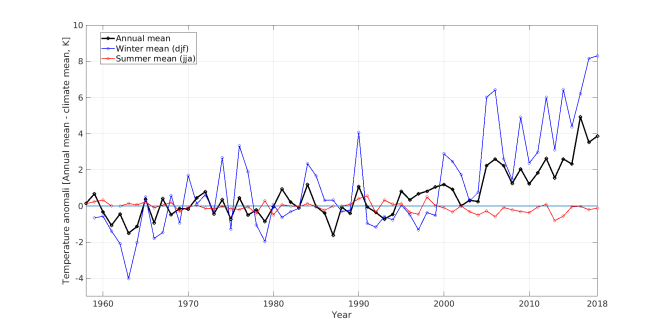
The most drastic temperature rise on earth has been in the Arctic above the 80th latitude. In the winter of 2018 it was 8C above the 50 year average. See charts from the Danish Meteorological Institute:

Note, there is no increase at all in the summer temperatures!

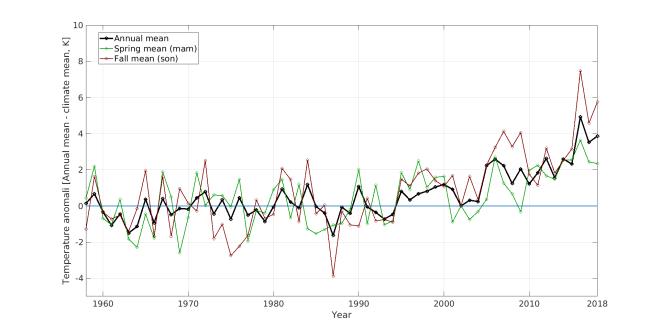
The fall temperature saw an increase of 5C and the spring temperature saw an increase of about 2.5C.

The 2020 winter has so far seen an about 5c increase Source: DMI.

This 8C ( or 5C) rise in winter temperatures is significant, most would even say alarming, but my response is, why is that?

To get the answer we must study molecular absorption spectroscopy and explain a couple of facts for the 97% of all scientists who have not studied molecular spectroscopy. IPCC and most scientists claim that the greenhouse effect is dependent on the gases that are in the atmosphere, and their combined effect is additive according to a logarithmic formula. This is true up to a certain point, but it is not possible to absorb more than 100% of all the energy available in a certain frequency band! For example: If water vapor absorbs 50% of all incoming energy in a certain band, and CO2 absorbs another 90% of the energy in the same band, the result is that 95% is absorbed, (90% + 50% * (100% – 90%)),  not 140%, (90% + 50%).

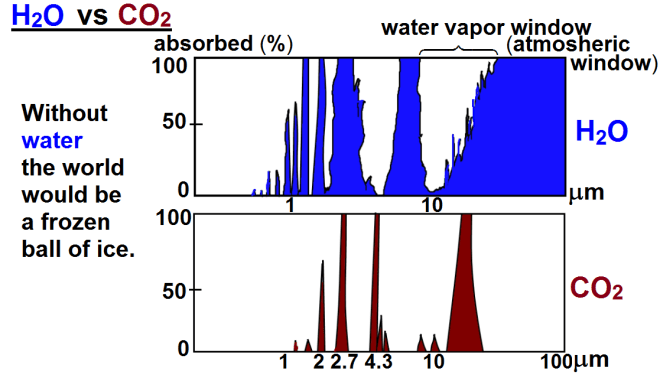
The following chart shows both CO2 and H2O are absorbing greenhouse gases, with H20 being the stronger greenhouse gas, absorbing over a much wider spectrum, and they overlap for the most part. But it also matters in what frequency ranges they absorb.

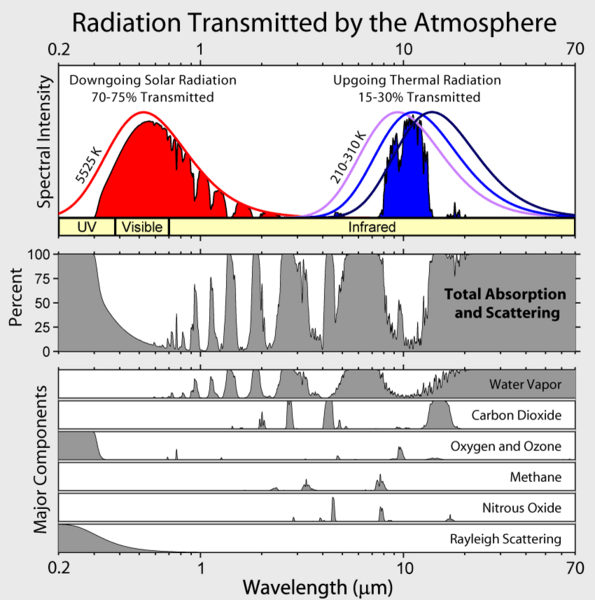
To better understand the importance of frequency spectra this we will look at the frequency ranges of the incoming solar radiation and the outgoing black body radiation of the earth. It is the latter that causes the greenhouse effect. Take a look at this chart:

The red area represents the observed amount of solar radiation that reaches the earth’s surface. the white area under the red line represents radiation absorbed in the atmosphere. Likewise, the blue area represents the outgoing black body radiation that is re-emitted. The remaining white area under the magenta, blue or black line represents the retained absorbed energy that causes the greenhouse effect.

Let us now take a look at the Carbon Dioxide bands of absorption, at 2.7, 4.3 and 15 microns. Of them the 2.7 and 4.3 micron bands absorb where there is little black body radiation, the only band that counts is at 15 microns, and that is in a band where the black body radiation has its maximum. However it is also in a band where water vapor also absorb, not as much as CO2,only about 20% to 70% as much. Water vapor or absolute humidity is highly dependent on the temperature of the air, so at 30C there may be 50 times as much water vapor, at 0C there may be ten times as much water vapor, and at -25C there may be more CO2 than water vapor. At those low temperatures the gases are mostly additive. In the tropics with fifty times more water vapor than CO2, increased CO2 has no influence on the temperature whatsoever. Temperature charts confirm this assertion:

The temperature in the tropics displays no trend whatsoever. It follows the temperature of the oceans, rises in an el niño and falls in a la niña. We are now in the end of an el niño, soon to be followed by a rather strong la niña.The temperature in the southern hemisphere shows no trend. In the northern temperate region there is a slight increase, but the great increase is occurring in the Arctic. There is no increase in the Antarctic yet even though the increase in CO2 is the same in the Antarctic as it is in the Arctic and the winter temperature in the Antarctic is even lower than in the Arctic. So CO2 increase cannot be the sole answer to the winter temperature increase in the Arctic.

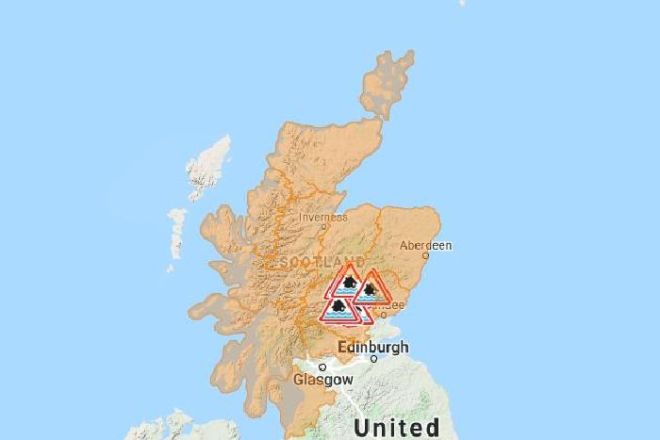
A few days ago there was a storm of historic magnitude, filled with moisture going up from the Mexican Gulf through the Atlantic and really sacked Scotland and Norway. The weather warnings called for severe floods and hurricane-like winds:

What happened to the temperature when the storm arrived?

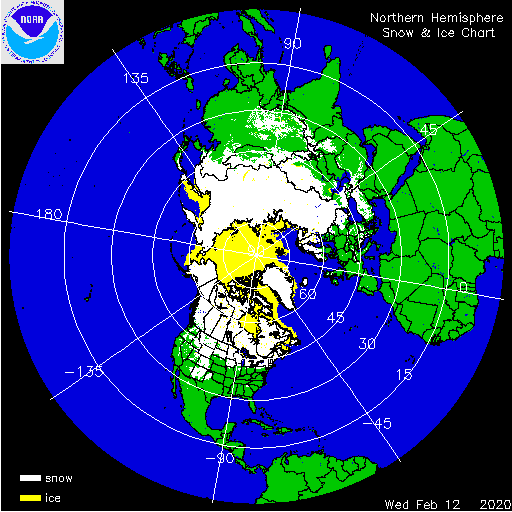
The Arctic temperature above the 80th latitude rose about 12C, from about -30C to about -18C, and most of the moisture snowed out. What happened to the ice cover when the storm arrived? Let’s see the most recent Arctic ice cover.

As the storm arrives, some of the ice breaks up, but at the end of the storm it bounces back, helped with all the snow that just fell. After the snowfall ends the ice formed easily breaks up again.

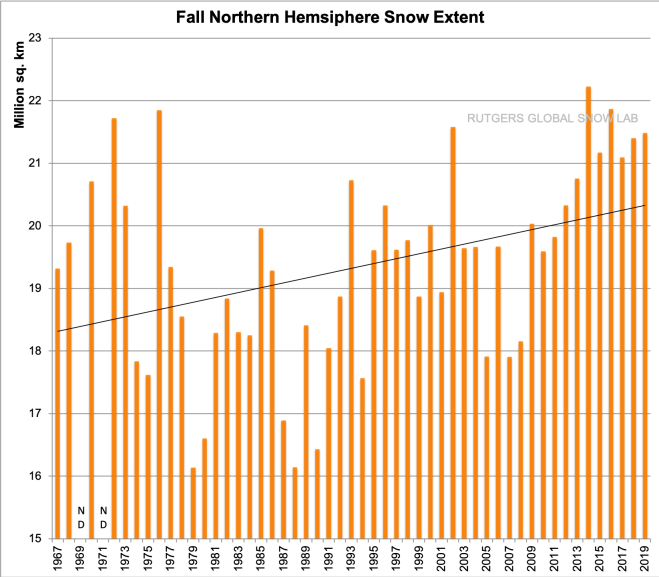
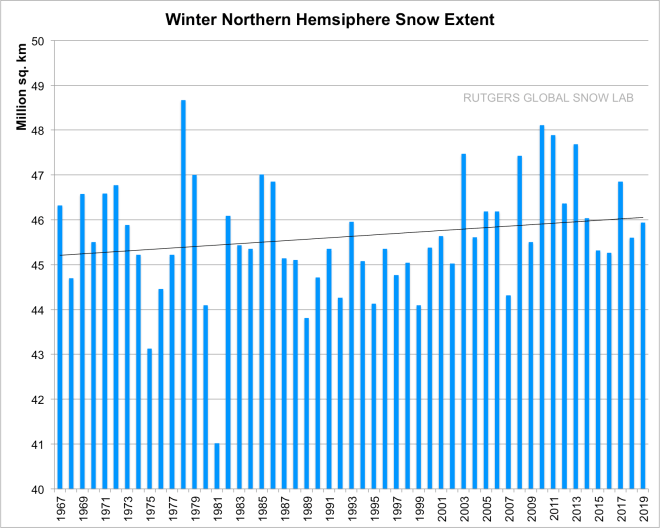
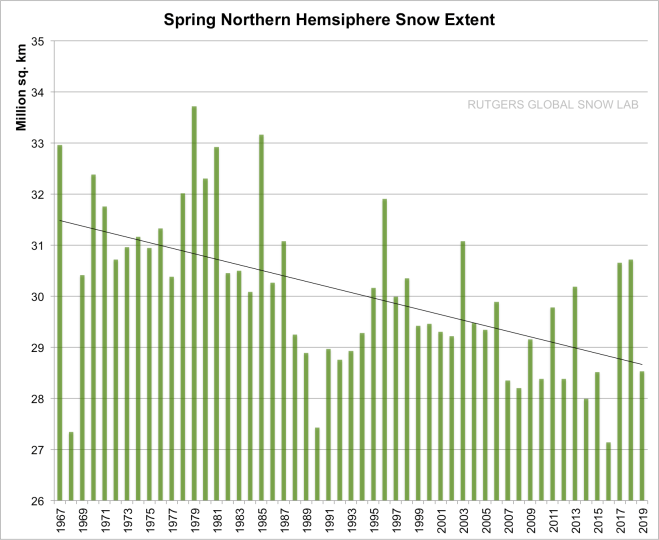
Is the snow cover increasing in the Arctic? Let us see what the snow statistics show. These are from the Rutgers snow lab.

The fall snow extent is increasing by more than 2 percent per year.

The winter snowfall has also increased but only by 0.04 percent per year.

The snow covers all of Russia, Northern China, Mongolia, Tibet, Kashmir and northern Pakistan, Northern Afghanistan, Northern Iran, Turkey, Part of Eastern Europe, Scandinavia, Canada, Alaska, Greenland and parts of Western and Northern United States.

In the spring on the other hand the snow pack is melting faster, about 1.6 percent less snow per year. One of the major reasons for an earlier snow-melt is that the air is getting dirtier, especially over China, and to some extent Russia. The soot from burning coal and mining and manufacturing changes the albedo of the snow. The soot is visible on old snow all the way up to the North Pole. The other reason is that the poles are getting warmer. In the fall and winter it is mostly due to increased snowfall, but in the spring, as soon as the temperature rises over the freezing point, melting occurs.

Moving down to the continental U.S. there are even more good news.

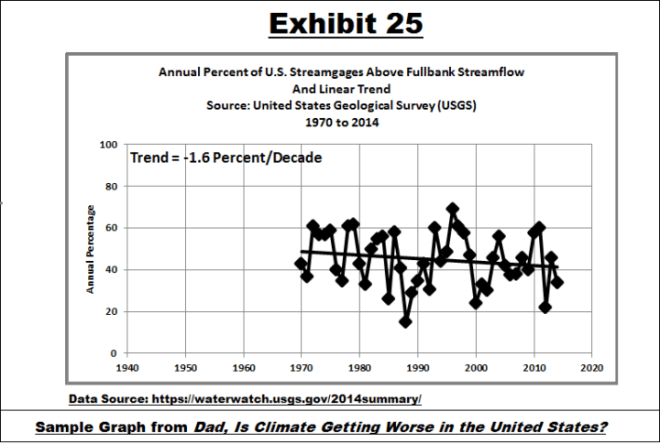
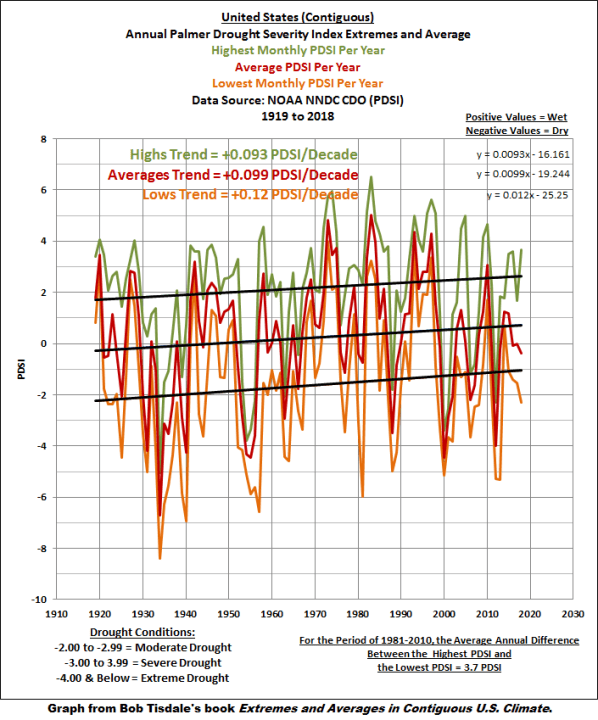
The data presented in the next six graphs were extracted from the data available at the NOAA National Data Center Climate Data Online (NNDC CDO) website.

Yes, rain (and snow) are increasing, but it is also raining slightly more often and regularly, so the net result is a slight decrease in flooding.

Of course, this could change in the future, and we need to watch the rain patterns, as they are constantly changing. Building more levees is not always the answer, since this will increase the risk for flooding in other places. It may be necessary to let certain areas, mostly farmland and woodland be flooded from time to time.

The Palmer Drought Severity Index (PDSI) uses readily available temperature and precipitation data to estimate relative dryness. It is a standardized index that generally spans -10 (dry) to +10 (wet). The chart shows Continental U.S. is getting wetter, about 0.01 PDSI index per year with the lows trend is getting wetter the fastest. This is good news.

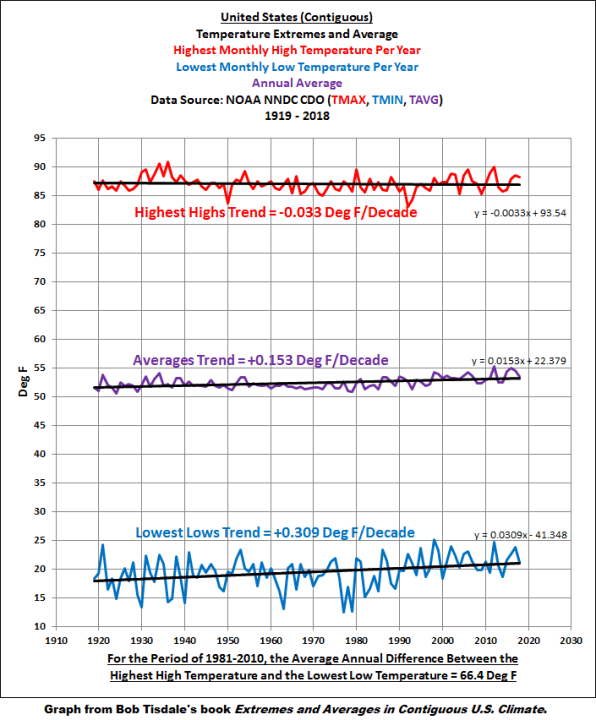
The temperature extremes keep narrowing, the maximum temperatures decrease by 0.033 degree F/decade, but the minimum temperatures increase by 0.309 degree F/decade. This is good, since tornadoes are a result of extreme temperature differences, most often associated with cold fronts.

 The Continental U.S. has not had an EF5 tornado (the most severe) since 2013. Let us hope this trend continues.

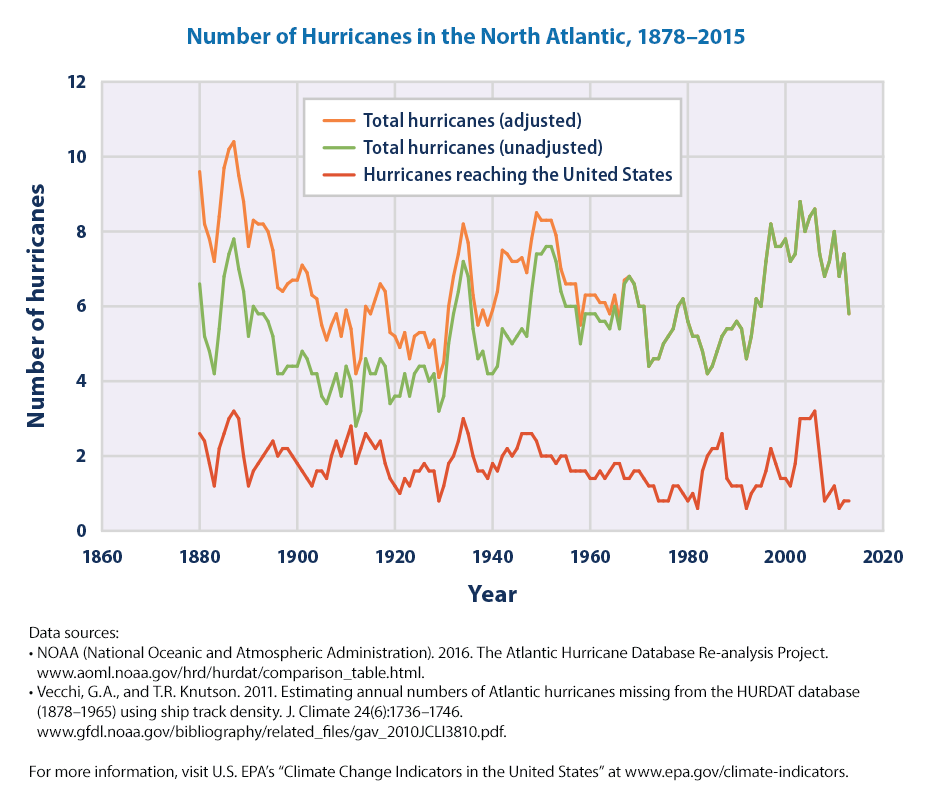
Contrary to popular belief, hurricanes making landfall on the U.S. mainland are decreasing slightly, especially major hurricanes.

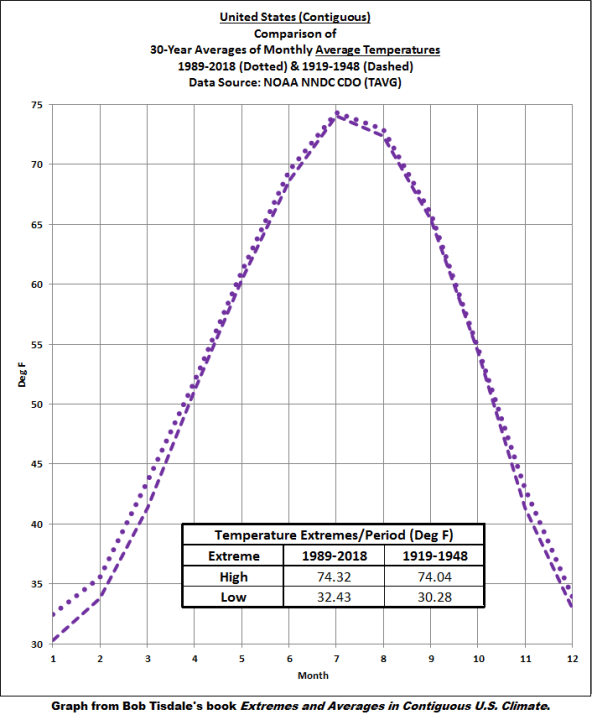
Taking a closer look at the seasonal temperature trends  we can see that the winter aveerage temperatures are rising by about 0.3F per decade but the summer temperatures rise only about one seventh as much, (0.04F/decade)  .

These are the average temperatures. The minimum average temperatures rise in all seasons, but mostly in the winter,

The maximum temperatures barely budge. They rise in the winter and decrease ever so slightly in the summer.

Watching the warming of the poles, and even the continental U.S., far from being an impending end of mankind as we know it, may even be beneficial. Warmer poles in the winter means less temperature gradient between the poles and the tropics, leading to less severe storms. They will still be there, but less severe.

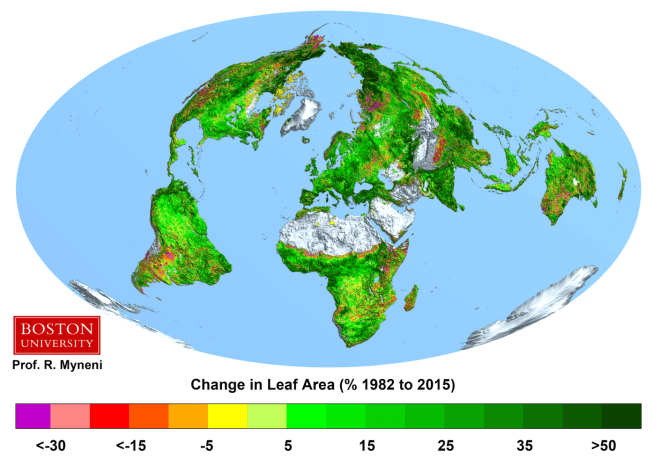
There is one great benefit of increased CO2, the greening of the earth.

Thanks to this greening, which is accomplished with the fertilizer effect of CO2, the earth can now keep another 2 billion people from starvation, not to mention what it does to plants and wildlife.

Having said that, I am still a conservationist. Coal, oil and gas will run out at some time, and I for one would like to save some for our great grandchildren, not yet born. In addition I would like to minimize the need for mining, which can be quite destructive. We have immense environmental problems, like water pollution, deforestation, intoxication of the soil, over-fertilization with nitrogen, real air pollutants, such as Sulfur compounds and soot, just to name a few. They have one thing in common: It takes lots of energy to do the cleanup.

The best solution is to switch most electricity generation to Thorium molten salt nuclear power. There are multiple reasons why this should be done as a priority by streamlining regulation and facilitate competition in development of the best solutions to the energy problems.

The many cases why Thorium Nuclear Power is the only realistic solution to the world’s energy problems.

Obamacare made sharing of data between federal departments, including citizenship question possible. A Limerick.

Since the legal delays made it impossible to put the question of citizenship back on the 2020 census forms, where it had been from the 1800’s to 2000, President Trump issued an executive order directing the Commerce Department to obtain citizenship data through means other than the census. That includes documents from the Department of Homeland Security, which houses citizenship and asylum services, and the Social Security Administration.
The order was signed and released to reporters late Thursday night. The Justice Department notified federal district judges of the administration’s decision.
Sharing of data between federal agencies has always been a sticky point, since federal agencies jealously protect their turf. The introduction of Obamacare changed all that, so the legal hindrances were removed for sharing data.


Obamacare did blaze the trail

of sharing of data, no fail.

Who’s a citizen now

can be found out somehow.

It’s better in every detail.

We all remember the introduction of the Obamacare website. It will stand out as an example for all time how not to design a website. The cost was estimated to be 95 million dollars to design and implement. The final cost was more than 2.2 Billion dollars, maybe an all time record for a website. There were many reasons for this overrun, one of which was it had to import a number of data bases and read the data securely. One of the features of Obamacare was that you were not eligible to enroll if you was not a citizen, so they needed full access to all that data. If the need for sharing had arisen first now, imagine the legal delays!

Since the citizenship question on the census form was voluntary, this is a much better way to obtain somewhat accurate data (the drug runners and child traffickers and sex slaves will never be counted accurately anyway)

One final question: Who took the citizen question off the 2010 long form census and why?

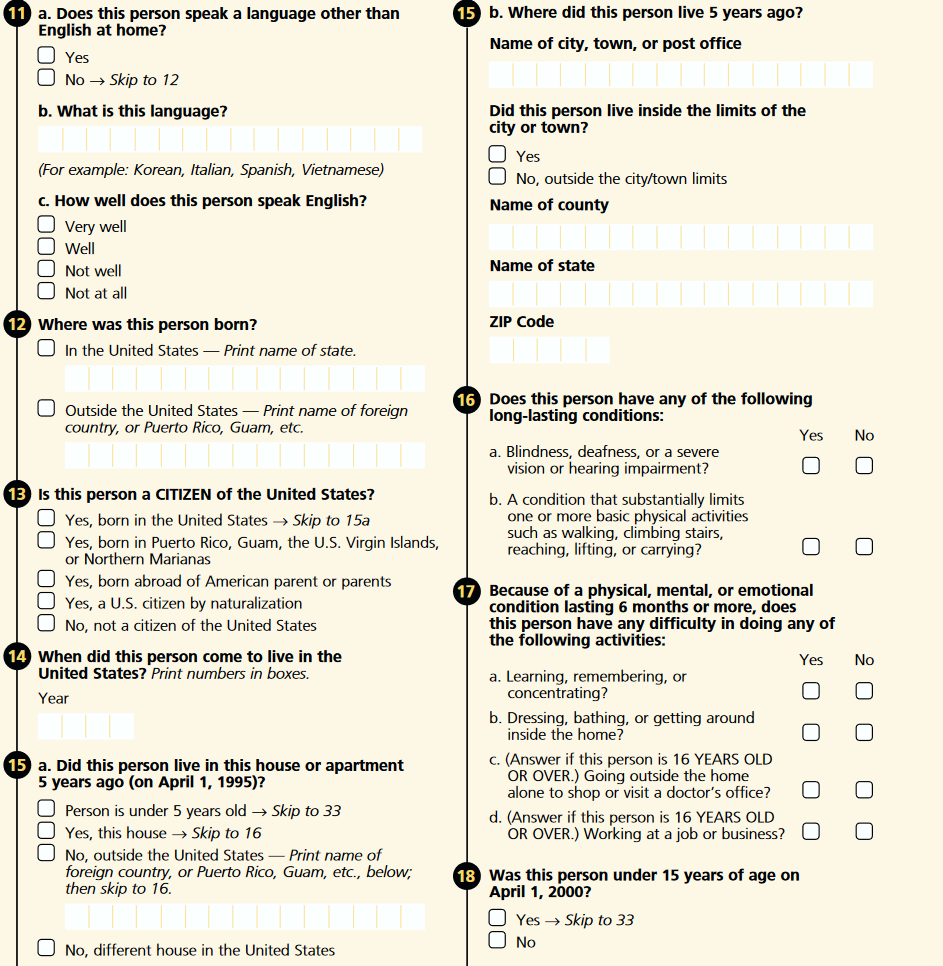
Here is the 2000 long form.

The need to develop Thorium based Nuclear Energy as the major electric energy supply. 14. No need for evacuation zones, can be placed near urban areas.

No need for evacuation zones, can be placed near urban areas. Molten Salt Thorium reactors operate at atmospheric pressure and have a very high negative temperature coefficient, so there is no risk for a boil-over. They are easily made earthquake-safe and no pressure vessel is needed. This will greatly simplify the approval process, no need for elaborate evacuation plans have to be developed. Since the Three Mile Island accident there was a thirty year gap in approvals for new nuclear plants. The “not in my backyard ” mentality reigned supreme, and delay and denial was the rule of the years. But the lawyers still got their share, leading to escalating cost for new nuclear power. In the early days of nuclear power France took the approach of building some of their nuclear plants near the Belgian and German border, so they only had to develop half of an  evacuation plan, leaving the other half to their understanding neighbors. It also leads to placing the nuclear plants where there is the least resistance, not where they are needed the most, adding to the strain on the electric grid.

China is seriously considering restricting rare earth exports to the US. Why is that important?

One week ago, President Xi and Vice Premier Liu He, China’s top trade negotiator, visited a rare earth metals mine in Jiangxi province. This has led to the rumor that China is seriously considering restricting rare earth exports to the US. China may also take other countermeasures in the future. The trade negotiations between U.S. and China got a lot more serious. It extends far beyond tariffs and intellectual property, it now involves strategic materials.

The first thing we must realize is that rare earth metals are not all that rare. They are a thousand times or more abundant than gold or platinum in the earth crust and easy to mine, but a little more difficult to refine. Thorium and Uranium will  also be mined at the same time as the rare earth metals since they appear together in the ore.

Related image

U.S. used to be the major supplier of rare earth metals, which was fine up to around 1984. Then the U.S. regulators determined that Uranium and Thorium contained in the ore made the ore radioactive, so they decided to make rare earth metal ore subject to nuclear regulations with all what that meant for record keeping and control. This made mining in the U.S. unprofitable so in 2001 the last domestic mine closed down. China had no such scruples, such as human and environmental concerns, so they took over the rare earth metals mining and in 2010 controlled over 95% of the world supply, which was according to their long term plan of controlling the world by 2025.

Rare Earth Element Production

The U.S. used to have a strategic reserve of rare earth metals, but that was sold off in 1998 as being no longer cost effective or necessary. Two years later the one U.S. rare earth metals mine that used to supply nearly the whole world, the Mountain Pass Mine in California closed down, together with its refining capacity. From that day all rare earth metals were imported. In 2010 it started up again together with the refining capacity but went bankrupt in 2015, closed down the refining but continued selling ore to China. They just announced they will start up refining again late 2020. Meanwhile China is slapping on a 25% import tariff on imported ore starting July 1. Rare earth metals may be in short supply for a while.

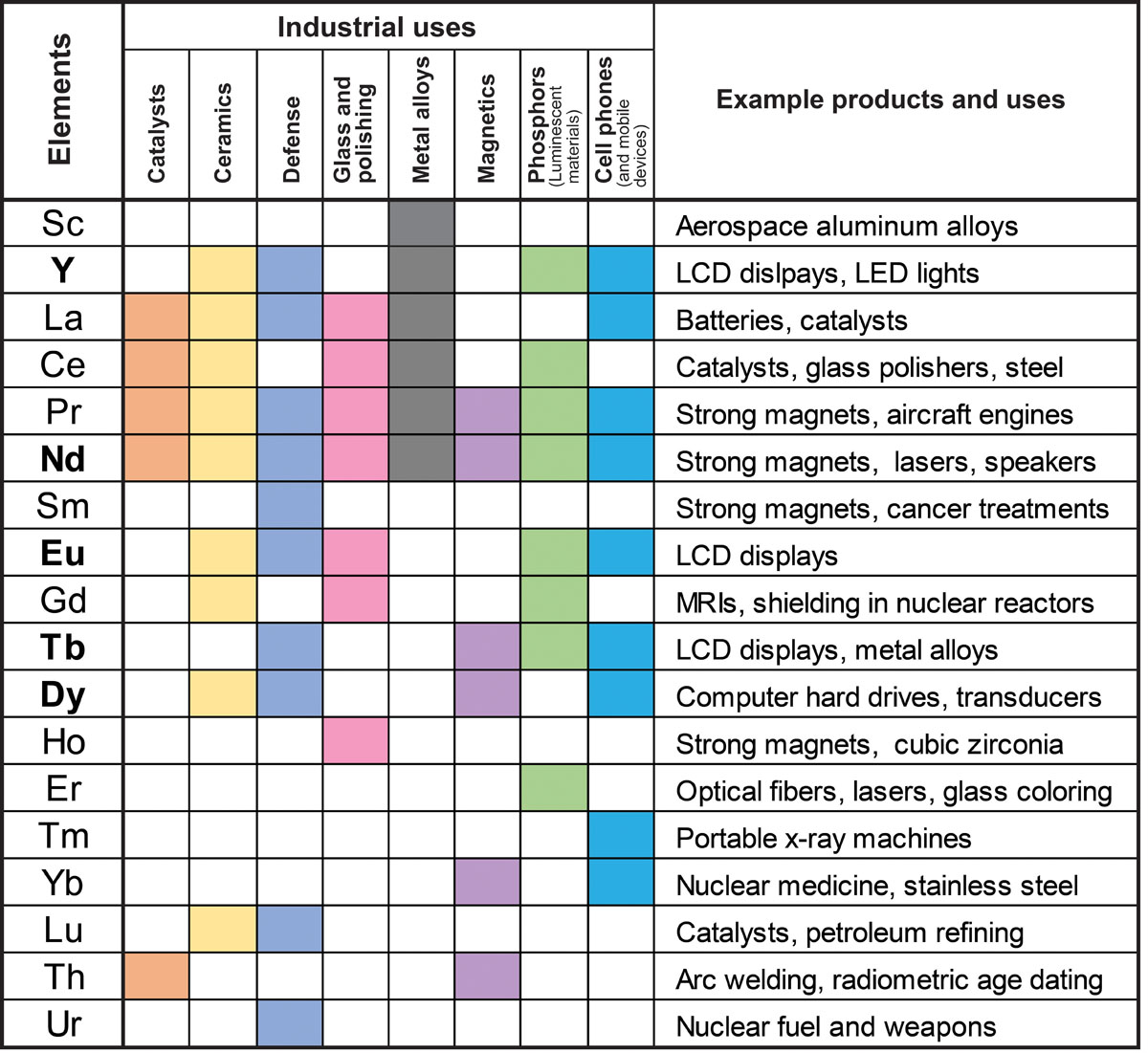
So, why is this important? Just take a look at all the uses for rare earth metals. The most sought after pays all the cost of mining and refining, and the rest are readily available at nominal cost.

The Chinese almost got away with it, and that is but one reason the trade negotiations are so complicated and hard fought, but necessary. Donald Trump fights for reciprocity and fair competition.

What is more precious? Babies, Eagles or fighting climate change?

When I was a little boy is Sweden my father had a dear old friend that was so in love with birds and they with him that he had a great horned owl that came down and sat on his shoulder when he called. I was only three years old at that time, but the sight of this giant bird coming down from the big spruce tree is a sight I will never forget. Since then I have always enjoyed watching birds, normally soaring hawks, but especially eagles, rare as they may be.

Later in life I got gloriously saved and started reading the Bible, and one verse from the prophet Isaiah stands out :Isaiah 40:31 But they that wait upon the Lord shall renew their strength; they shall mount up with wings as eagles; they shall run, and not be weary; and they shall walk, and not faint.

I am now at the stage in my life where walk and not faint seems pretty good, but following what goes on in the world is still exciting, even watching the birds.

The big talk is fighting climate change, and the prevailing political belief is that rising CO2 levels is its major cause, so no expense is spared to find renewable energy in the form of wind power, but at what cost?

The Eagle has landed in aerie

on top of a windmill – that’s scary.

Doesn’t know she will die,

whacked right out of the sky

from rotating blades unawary.

The idea of wind farming is to create sustainable energy.

Will the population of eagles and other large birds be sustainable?

Image result for eagles and wind turbines

They like to build their aeries on top of wind turbines, the highest structure in their territory.

It is estimated that the total bird kill by the year 2030 is going to be 1 million three hundred thousand birds. And that is if the Green New Deal is not implemented.

Is the large bird population sustainable even now?

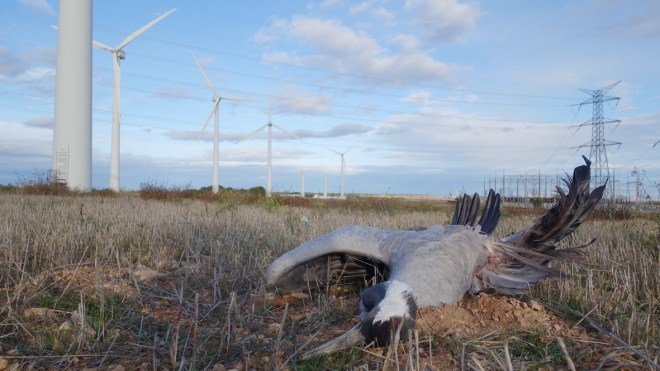
crane-killed-by-turbine

This is a crane killed by a wind turbine blade. In parts of Ohio they have forbidden the turbines to run at night to protect a rare bat.

The allowable yearly limit for killing bald eagles by wind turbines  was upped from 1100 to 4200 on Jan 17 2017, still under the Obama administration. The allowable limit for golden eagles is still 0. If the bird-kill exceeds the allowance, heavy fines are imposed, but that is just the price of producing clean energy. in 2013 Duke energy paid a 1.9 million dollar fine for killing 14 golden eagles and 149 other protected birds.

If you as a person poaches an eagle egg, see this picture

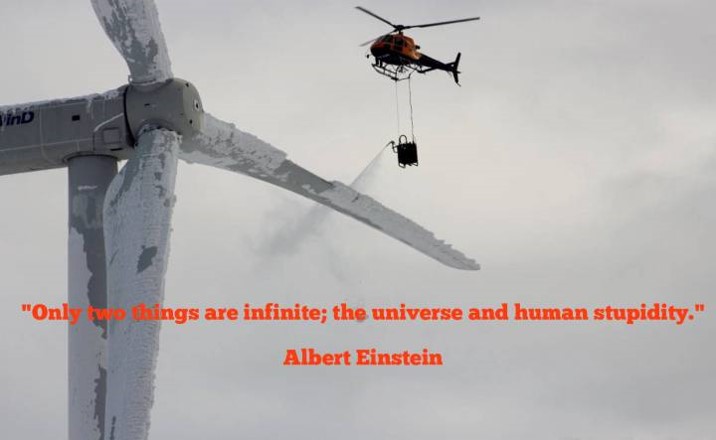
And it takes energy to produce energy. The cost of de-icing the average airplane is $1500. And that is without the helicopter.

And I am not sure about the former.

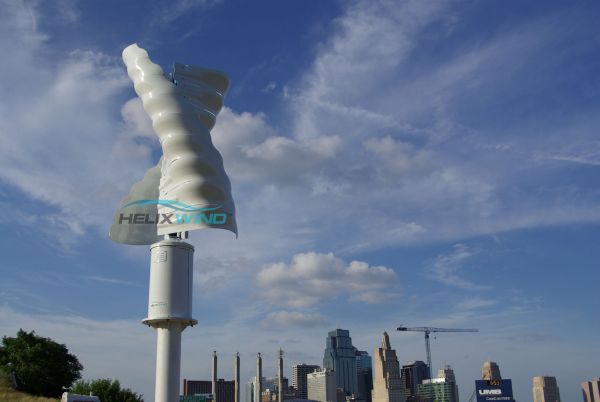
But there are potentially better solutions: The vertical wind turbine:

low_cost_n6ujf

It has a somewhat lower efficiency than conventional wind turbines, but can produce electricity for about 4 c per kWh, so all is not lost. They do not kill birds, and can be made to function with wind speeds of up to 70 mph.

My response to the Green New Deal.

The Green New Deal has been proposed.

Co-sponsors Rep. Alexandra Ocasio Cortez (NY) and Sen. Ed Markley (Mass)

Presidential candidates supporting the bill: Sen. Kamala Harris, Sen Corey Booker, Sen Kirsten Gillibrand, Sen Elizabeth Warren and many more to come.

My comments are in italics. This warrants a thorough evaluation

116TH CONGRESS 1ST SESSION H. RES. ll

Recognizing the duty of the Federal Government to create a Green New Deal.

IN THE HOUSE OF REPRESENTATIVES Ms. OCASIO-CORTEZ submitted the following resolution; which was referred to the Committee on

RESOLUTION

Recognizing the duty of the Federal Government to create a Green New Deal. Whereas the October 2018 report entitled ‘‘Special Report on Global Warming of 1.5oC’’ by the Intergovernmental Panel on Climate Change and the November 2018 Fourth National Climate Assessment report found that—

(1) human activity is the dominant cause of observed climate change over the past century;

The IPCC document is more of a political than a scientific document. It presumes that the dominant factor in climate change is the rise in CO2, while the most important greenhouse gas is water vapor and the many forms it takes. It assumes that with rising CO2 the temperature will rise which will evaporate more water and these greenhouse gases would add up to a larger temperature rise than with CO2 rising alone. That would be true unless something else changes. The assumption that they are additive is only true if they are of the same magnitude which is the case in the polar regions in the winter and in the upper atmosphere near the thermopause. In fact there is a strong temperature stabilizer in the ecosystem. It is called clouds. A one percent difference in the average cloud cover has more influence on temperature than the CO2 rise since the beginning of industrialization. At the equator the average temperature stays constant regardless of the CO2 concentration. Where is the proof? It is in the absence of the so called hot-spot in the troposphere:
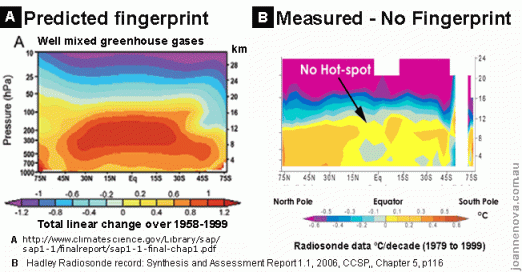


How well do the models do?

That is why the IPCC assessment is a political, not a scientific document. No true scientist would accept a model if contradicted by physical evidence.

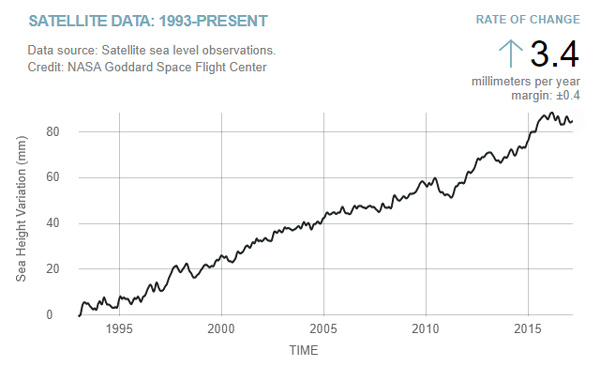
(2) a changing climate is causing sea levels to rise and an increase in wildfires, severe storms, droughts, and other extreme weather events that threaten human life, healthy communities, and critical infrastructure;

The sea level rise has hit a temporary plateau and is not rising at a faster pace than before CO2 started to rise,
https://lenbilen.com/wp-content/uploads/2017/08/sea-level-nasa-1993-present.jpg

as to wildfires, see (3) (C). Droughts are not increasing
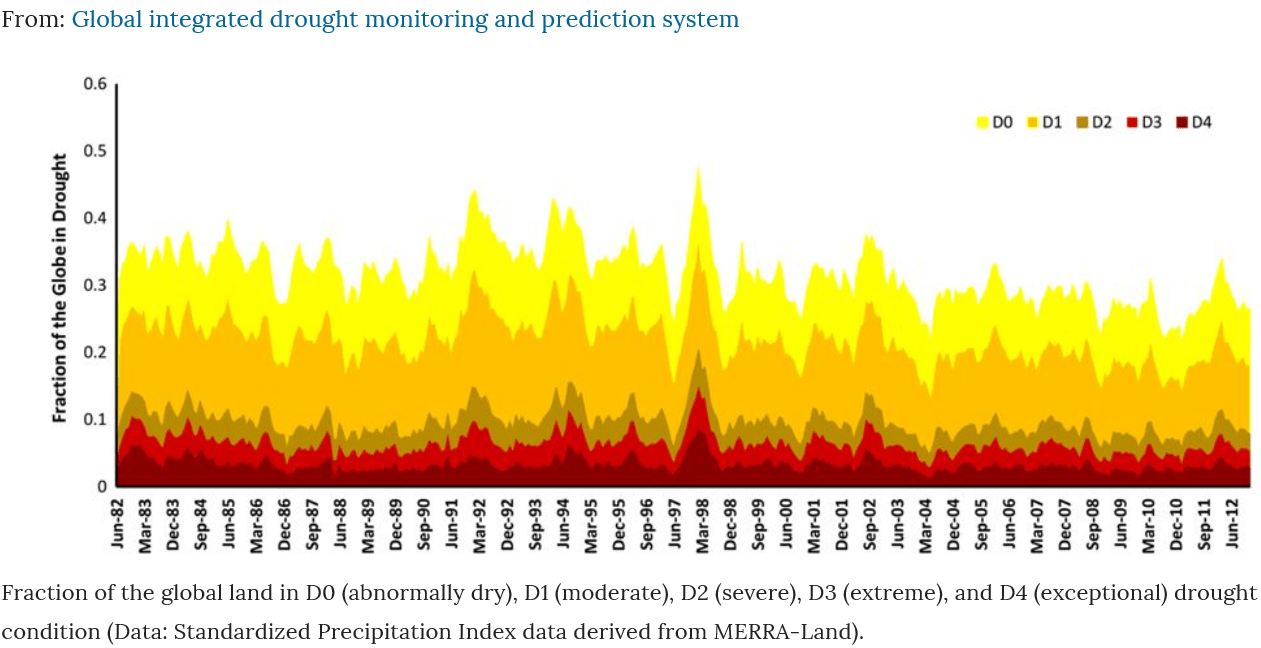
Image result for worldwide droughts

tornadoes are decreasing,

Image result for u.s tornadoes

so are hurricanes.

Image result for hurricane statistics


Page 2

(3) global warming at or above 2 degrees Celsius beyond pre-industrialized levels will cause—

(A) mass migration from the regions most affected by climate change;

This is a problem in the 10-40 latitude where most people live. Some countries like Mexico and Iran are using up their ground water at an alarming rate, and it will only get worse. But climate change is not the cause of it. Overuse of water is.

(B) more than $500,000,000,000 in lost annual economic output in the United States by the year 2100;

That will only happen if we implement the plan and become a socialist country like Venezuela. 500 billion dollars in an economy of what is now around 20 trillion dollars a year is a lot of money.

(C) wildfires that, by 2050, will annually burn at least twice as much forest area in the western United States than was typically burned by wildfires in the years preceding 2019;
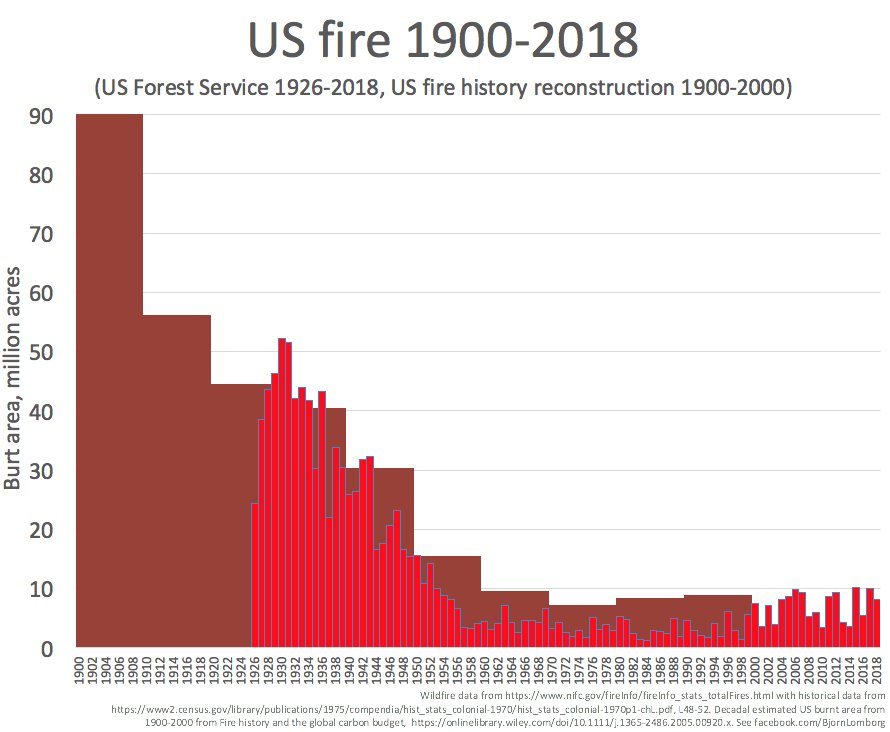
Image result for wildfire statistics

Smokey the bear policies worked well in the 1950’s through 1990 but recent environmental policies hindering cleaning of underbrush are slowly reversing earlier trends.

(D) a loss of more than 99 percent of all coral reefs on Earth;

Temperature is only a minor cause of the coral reef stresses. Overfishing, destructive fishing, water pollution from raw sewage and other dumping is a larger problem.

(E) more than 350,000,000 more people to be exposed globally to deadly heat stress by 2050; and

The tropics has found its temperature and nearly all temperature rise is confined to the polar regions, partly due to increased snowfall. When it snows it is not as cold as when the sky is clear in the (Ant)arctics. But it is still below freezing, so the snow accumulates.

(F) a risk of damage to $1,000,000,000,000 of public infrastructure and coastal real estate in the United States; and
Related image

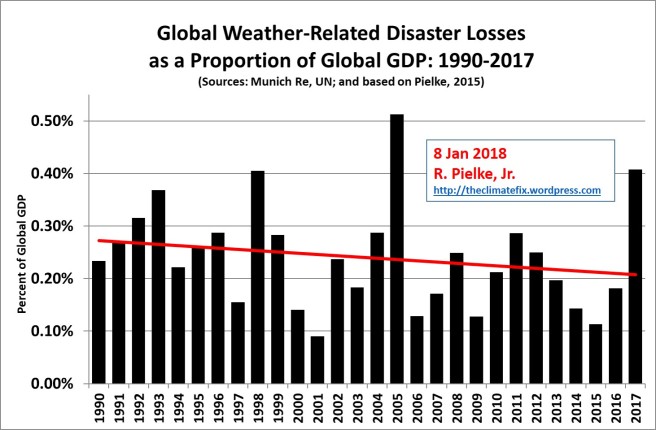
While nominal losses are up, as a percentage of GDP they are going down.

(4) global temperatures must be kept below 1.5 degrees Celsius above preindustrialized levels to avoid the most severe impacts of a changing climate, which will require—

(A) global reductions in greenhouse gas emissions from human sources of 40 to 60 percent from 2010 levels by 2030; and

China is already producing 50% more CO2 than the U.S and is on track to further triple its output by 2030. This was the agreement President Obama hailed as a breakthrough

(B) net-zero emissions by 2050; Whereas, because the United States has historically been responsible for a disproportionate amount of greenhouse gas emissions, having emitted 20 percent of global green-house gas emissions through 2014, and has a high technological capacity, the United States must take a leading role in reducing emissions through economic transformation;

While not accepting the Tokyo protocol, U.S. was the only country in recent years to adhere to its goal of reducing CO2 emissions.

Page 3

Whereas the United States is currently experiencing several related crises, with— (1) life expectancy declining while basic needs, such as clean air, clean water, healthy food, and adequate health care, housing, transportation, and education, are inaccessible to a significant portion of the United States population;

Don’t forget the opioid crisis, the new killing fields.

(2) a 4-decade trend of economic stagnation, de-industrialization, and antilabor policies that has led to—

(A) hourly wages overall stagnating since the 1970s despite increased worker productivity;

True, but the last two years real salaries have stared rising again

(B) the third-worst level of socioeconomic mobility in the developed world before the Great Recession;

Since? Yes it decreased under Clinton, stayed level under Bush and declined drastically under Obama, but is now rising again, especially for women, for Blacks and for Hispanics.

(C) the erosion of the earning and bargaining power of workers in the United States; and

True, Union power is decreasing except for public service unions.

(D) inadequate resources for public sector workers to confront the challenges of climate change at local, State, and Federal levels; and

(3) the greatest income inequality since the 1920s, with—

(A) the top 1 percent of earners accruing 91 percent of gains in the first few years of economic recovery after the Great Recession;

Which recession are we referring to? 1929? 2009?

(B) a large racial wealth divide amounting to a difference of 20 times more wealth between the average White family and the average Black family; and

You are using the wrong average. An example: The average wealth of an Amazon employee is $1800 more if one is to include Jeff Bezos than if not.

(C) a gender earnings gap that results in women earning approximately 80 percent as much as men, at the median;

This time the median is used, and it has to do more with career choices than not. It is worthy of attention though.

Whereas climate change, pollution, and environmental destruction have exacerbated systemic racial, regional,

Page 4

social, environmental, and economic injustices (referred to in this preamble as ‘‘systemic injustices’’) by disproportionately affecting indigenous communities, communities of color, migrant communities, deindustrialized communities, depopulated rural communities, the poor, low-in-come workers, women, the elderly, the unhoused, people with disabilities, and youth (referred to in this preamble as ‘‘frontline and vulnerable communities’’);

Yes, but the goal of Agenda 21 is to depopulate rural areas and to force people to migrate into cities

Whereas, climate change constitutes a direct threat to the national security of the United States—

(1) by impacting the economic, environmental, and social stability of countries and communities around the world; and

Maybe unstable and uncivilized governments have something to do with that

(2) by acting as a threat multiplier;

?

Whereas the Federal Government-led mobilizations during World War II and the New Deal created the greatest middle class that the United States has ever seen, but many members of frontline and vulnerable communities were excluded from many of the economic and societal benefits of those mobilizations; and

Whereas the House of Representatives recognizes that a new national, social, industrial, and economic mobilization on a scale not seen since World War II and the New Deal is a historic opportunity—

(1) to create millions of good, high-wage jobs in the United States;

? Give an example how.

(2) to provide unprecedented levels of prosperity and economic security for all people of the United States; and

? Give an example how.

(3) to counteract systemic injustices: Now, therefore, be it

Page 5

Resolved, That it is the sense of the House of Representatives that—

(1) it is the duty of the Federal Government to create a Green New Deal—

(A) to achieve net-zero greenhouse gas emissions through a fair and just transition for all communities and workers;

What is net-zero? If you emit, you emit.

(B) to create millions of good, high-wage jobs and ensure prosperity and economic security for all people of the United States;

The Federal Government does not create jobs. They may enable or hinder job creation.

(C) to invest in the infrastructure and industry of the United States to sustainably meet the challenges of the 21st century;

This is a good goal.

(D) to secure for all people of the United States for generations to come—

(i) clean air and water;

No argument there. CO2 however is not a pollutant. It is the life-giving gas, without which no plant life would be possible.

(ii) climate and community resiliency;

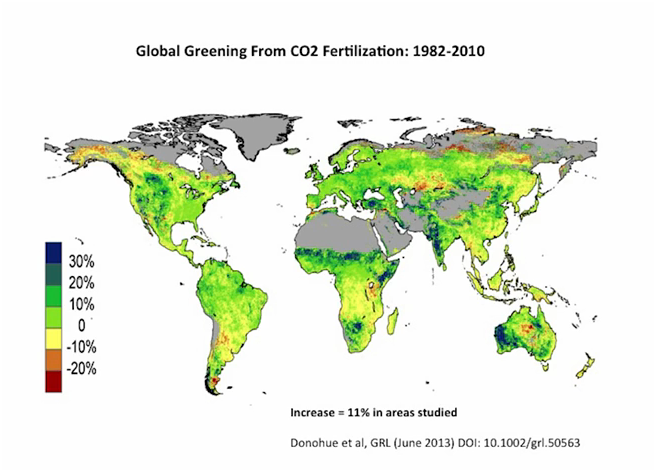
Increasing CO2 helps climate resiliency by greening the earth.
https://lenbilen.com/wp-content/uploads/2016/11/increase.png?w=660

(iii) healthy food;

Increasing CO2 helps increasing food supply. This is good for both people and animals. As a side benefit photosynthesis is more efficient and uses less water as CO2 increases.

(iv) access to nature; and

I love nature. I would never put i earphones as I take a nature walk or run.

(v) a sustainable environment; and

We must work towards a sustainable environment. The best way is to let CO2 rise until we develop a better energy policy until a new nuclear power effort using Thorium or eventually Fusion power.

(E) to promote justice and equity by stopping current, preventing future, and repairing historic oppression of indigenous communities, communities of color, migrant communities, deindustrialized communities, depopulated rural

Page 6

communities, the poor, low-income workers, women, the elderly, the unhoused, people with disabilities, and youth (referred to in this resolution as ‘‘frontline and vulnerable communities’’);

(2) the goals described in subparagraphs (A) through (E) of paragraph (1) (referred to in this resolution as the ‘‘Green New Deal goals’’) should be accomplished through a 10-year national mobilization (referred to in this resolution as the ‘‘Green New Deal mobilization’’) that will require the following goals and projects—

(A) building resiliency against climate change-related disasters, such as extreme weather, including by leveraging funding and providing investments for community-defined projects and strategies;

See above

(B) repairing and upgrading the infrastructure in the United States, including—

(i) by eliminating pollution and greenhouse gas emissions as much as techno-logically feasible;

Pollution, yes; CO2 is not a pollutant.

(ii) by guaranteeing universal access to clean water;

This is the number one problem in many countries, as well as in the U.S. southwest. Lake Mead is slowly being drained.

Page 7

(iii) by reducing the risks posed by flooding and other climate impacts; and

Rain will be increasing, but interestingly enough major floods will decrease. Good news all around.

(iv) by ensuring that any infrastructure bill considered by Congress addresses climate change;

This will slow down development. When I came to America many years ago Congress finally got around to promoting George Washington to a 5 star General.

(C) meeting 100 percent of the power demand in the United States through clean, renewable, and zero-emission energy sources, including—

(i) by dramatically expanding and upgrading existing renewable power sources; and

It is a tall order to replace fossil fuels. 85% of the world’s energy consumption is still based on fossil fuels.

(ii) by deploying new capacity;

Thorium based nuclear power is the best alternative.

(D) building or upgrading to energy-efficient, distributed, and ‘‘smart’’ power grids, and working to ensure affordable access to electricity;

The problem with the grid is that energy produced is not where energy is consumed. Maxwell’s equations are what they are, so transmission losses are a fact of life. In addition solar and wind power are not continuous sources so they still need the same replacement generation capacity to do the job. In addition the present grid is vulnerable to terrorism.

(E) upgrading all existing buildings in the United States and building new buildings to achieve maximal energy efficiency, water efficiency, safety, affordability, comfort, and durability, including through electrification;

All existing buildings? Dream on.

(F) spurring massive growth in clean manufacturing in the United States and removing pollution and greenhouse gas emissions from

Page 8

manufacturing and industry as much as is technologically feasible, including by expanding renewable energy manufacturing and investing in existing manufacturing and industry;

(G) working collaboratively with farmers and ranchers in the United States to eliminate pollution and greenhouse gas emissions from the agricultural sector as much as is technologically feasible, including—

(i) by supporting family farming;
cowbackpacks

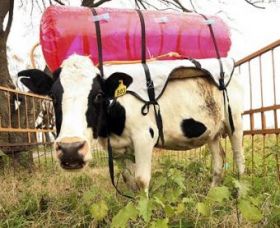
This is a cow recycling methane gas. Methane gas can be used to heat stoves as is done in North Korea since the mid 1800’s. A futurist’s dream.


(ii) by investing in sustainable farming and land use practices that increase soil health; and

The Chesapeake bay Commission and the Susquehanna River Basin Commission are doing a valiant effort to restore the Chesapeake Bay and its tributaries. This is a regional effort, tailor made for the intricate ecology and special challenges facing the bay. Even the Amish have adopted environmentally safe farming practices.

(iii) by building a more sustainable food system that ensures universal access to healthy food;

Again this is best accomplished at a regional and local level by education and individual initiatives. The heavy handed Federal Government tend to think that national polices will solve the problem

(H) overhauling transportation systems in the United States to eliminate pollution and greenhouse gas emissions from the transportation sector as much as is technologically feasible, including through investment in—

(i) zero-emission vehicle infrastructure and manufacturing;

A promising development is hybrid trucks. They charge the batteries instead of using the jake breaks, and provide a much better acceleration out of a stop sign or a traffic light. Then in loading areas they use only the batteries.

(ii) clean, affordable, and accessible public transportation; and

Some cities are better suited for public transportation than others. State College, PA has an excellent public transportation system, but Houston and Los Angeles among others are a nightmare.

Page 9

(iii) high-speed rail;

It is expensive and nowhere near as efficient as people think.

(I) mitigating and managing the long-term adverse health, economic, and other effects of pollution and climate change, including by providing funding for community-defined projects and strategies;

What are community-defined projects and strategies?

(J) removing greenhouse gases from the atmosphere and reducing pollution, including by restoring natural ecosystems through proven low-tech solutions that increase soil carbon storage, such as preservation and afforestation;

Increasing CO2 makes afforestation possible in otherwise too arid areas since more CO2 means less water to do the photosynthesis.

(K) restoring and protecting threatened, endangered, and fragile ecosystems through locally appropriate and science-based projects that enhance biodiversity and support climate resiliency;

This part I love, let’s go for it.

(L) cleaning up existing hazardous waste and abandoned sites to promote economic development and sustainability;

The one has very little to do with the other. Cleaning up hazardous sites is already law.

(M) identifying other emission and pollution sources and creating solutions to eliminate them; and

Yes I remember when Argon was proposed to be regulated. Federal Government at its best.

(N) promoting the international exchange of technology, expertise, products, funding, and services, with the aim of making the United

Page 10

States the international leader on climate action, and to help other countries achieve a Green New Deal;

China, Russia, Australia and even India are far ahead of us in Thorium Nuclear Power Development. Our Patent law is in the Constitution.

(3) a Green New Deal must be developed through transparent and inclusive consultation, collaboration, and partnership with frontline and vulnerable communities, labor unions, worker cooperatives, civil society groups, academia, and businesses; and

Why labor unions? What are frontline communities? Do they mean border states communities overrun by drug smugglers and sex traffickers?

(4) to achieve the Green New Deal goals and mobilization, a Green New Deal will require the following goals and projects—

(A) providing and leveraging, in a way that ensures that the public receives appropriate ownership stakes and returns on investment, adequate capital (including through community grants, public banks, and other public financing), technical expertise, supporting policies, and other forms of assistance to communities, organizations, Federal, State, and local government agencies, and businesses working on the Green New Deal mobilization;

Who is the public? Do they mean politicians and government bureaucrats?

(B) ensuring that the Federal Government takes into account the complete environmental

Page 11

and social costs and impacts of emissions through—

  • existing laws;
  • new policies and programs; and
  • ensuring that frontline and vulnerable communities shall not be adversely affected;

Emissions: Pollution, yes, CO2, the more the better up to 1000 ppm.

(C) providing resources, training, and high-quality education, including higher education, to all people of the United States, with a focus on frontline and vulnerable communities, so those communities may be full and equal participants in the Green New Deal mobilization;

Better still, do a partnership with business for a better and more complete trade school education without union interference.

(D) making public investments in the research and development of new clean and renewable energy technologies and industries;

A Manhattan project to leapfrog the world in Thorium based Nuclear power would be nice.

(E) directing investments to spur economic development, deepen and diversify industry in local and regional economies, and build wealth and community ownership, while prioritizing high-quality job creation and economic, social, and environmental benefits in frontline and vulnerable communities that may otherwise strug-

Page 12

gle with the transition away from greenhouse gas intensive industries;

A very inefficient way.

Private enterprise is better and faster.

(F) ensuring the use of democratic and participatory processes that are inclusive of and led by frontline and vulnerable communities and workers to plan, implement, and administer the Green New Deal mobilization at the local level;

Sounds like an expensive boondoggle for the benefit of lobbyists and politicians.

(G) ensuring that the Green New Deal mobilization creates high-quality union jobs that pay prevailing wages, hires local workers, offers training and advancement opportunities, and guarantees wage and benefit parity for workers affected by the transition;

What does the unions have to do with that?

(H) guaranteeing a job with a family-sustaining wage, adequate family and medical leave, paid vacations, and retirement security to all people of the United States;

What does guaranteeing  a job in a changing world mean? Shall we still guarantee the job of a railroad brakeman or a flight engineer? In a changing world retraining is to prefer such as mandatory retraining for the unemployed.

(I) strengthening and protecting the right of all workers to organize, unionize, and collectively bargain free of coercion, intimidation, and harassment;

Likewise let the employers organize to facilitate lockouts. (This is done in Sweden).

(J) strengthening and enforcing labor, workplace health and safety, antidiscrimination, and wage and hour standards across all employers, industries, and sectors;

Wage and hour standards is a recipe for stagnation.

Page 13

(K) enacting and enforcing trade rules, procurement standards, and border adjustments with strong labor and environmental protections—

What is a border adjustment?

(i) to stop the transfer of jobs and pollution overseas; and

Exactly how are you going to accomplish that?

(ii) to grow domestic manufacturing in the United States;

This is one of Trump’s main goals.

(L) ensuring that public lands, waters, and oceans are protected and that eminent domain is not abused;

Eminent domain is in the constitution and must not be abused.

(M) obtaining the free, prior, and informed consent of indigenous people for all decisions that affect indigenous people and their traditional territories, honoring all treaties and agreements with indigenous people, and protecting and enforcing the sovereignty and land rights of indigenous people;

Isn’t this already law?

(N) ensuring a commercial environment where every businessperson is free from unfair competition and domination by domestic or international monopolies; and

You mean no more trade with China?

(O) providing all people of the United States with—

(i) high-quality health care;

What do you mean with provide? Free? Does people include illegal aliens?

Page 14

(ii) affordable, safe, and adequate housing;

Good luck with that.

(iii}economic security; and

Nothing is as elusive as economic security. Just look at  Zimbabwe and now Nicaragua.

(iv) access to clean water, clean air, healthy and affordable food, and nature.

Free access?
A truly smart electricity meter will revolutionize our electricity use.

Sixty years ago I worked as a plate scrubber and errand boy in a Swedish bakery. In one corner of the bakery stood the oven, a giant cement and stone contraption weighing at least 50 tons. It was run on electricity, turning on every night at 10 P.M. and turning itself off at 5 A.M. First in the morning we baked the Danishes and other good stuff that required the highest heat, and as the day wore on and the oven cooled off, other breads were baked in the order of temperature need. It took some planning, but the price difference between night rates and day rates made it all worthwhile.

This brings me to a truly smart electricity meter.

It would charge the customer at the current cost of generation + transmission cost + utility profit, displaying the current cost at any given time of the day.

The customer would have the right to sell back electricity to the net at the current cost of generation – transmission cost – utility profit.

Knowing the current true price of energy the customer can then delay turning on the clothes dryer until the price goes below an acceptable level. He could take a look at the current price and decide to turn off the air conditioner rather than pay $1.20 per KW, or she could decide: It is worth it.

By making the user rather than the power company decide how and when electricity is used and produced this will bring immense benefits:

Many users will decide to buy a backup generator with battery, charge the battery when the price is low, and discharge the battery when the price is high. If there is excess battery capacity, he can even sell back the excess at the inflated price. And if the price is high enough it is cheaper to use the generator.

This will have immense benefits on the grid, lessening peak demand and increasing the off peak use.

And best of all, should the grid fail, there will be enough generating capacity to run the refrigerators and essential stuff until power is restored.

What prevents this from being realized?

Politicians and the power companies desire to maintain total control over how the net is used. Political regulators hate to give decision making power back to the people.


A Climate Realist’s (not so) short Answers to Hard Questions About Climate Change. Question 13 (of 16) Is there any reason for hope?

NOV. 28, 2015 gave his answers to 16 questions in the N.Y. Times regarding Climate Change. This Climate realist added his answer.

 Answers to Question 1: How much is the planet heating up?

Answers to Question 2. How much trouble are we in?

Answers to Question 3. Is there anything I can do?

Answers to Question 4. What’s the optimistic scenario?

Answers to Question 5. Will reducing meat in my diet help the climate?

Answers to Question 6. What’s the worst-case scenario?

Answers to Question 7. Will a tech breakthrough help us?

Answers to Question 8. How much will the seas rise?

Answers to Question 9. Are the predictions reliable?

Answers to Question 10. Why do people question climate change?

Answers to Question 11. Is crazy weather tied to climate change?

Answers to Question 12. Will anyone benefit from global warming?

Justin Gillis answers to Question 13. Is there any reason for hope?

If you share this with 50 friends, maybe

Scientists have been warning since the 1980s that strong policies were needed to limit emissions. Those warnings were ignored, and greenhouse gases in the atmosphere have since built up to potentially dangerous levels. So the hour is late.

But after 20 years of largely fruitless diplomacy, the governments of the world are finally starting to take the problem seriously. A deal reached in Paris in December commits nearly every country to some kind of action.

Religious leaders like Pope Francis are speaking out. Low-emission technologies, such as electric cars, are improving. Leading corporations are making bold promises to switch to renewable power and stop forest destruction. Around the world, many states and cities are pledging to go far beyond the goals set by their national governments.

What is still largely missing in all this are the voices of ordinary citizens.

Because politicians have a hard time thinking beyond the next election, they tend to tackle hard problems only when the public rises up and demands it.

My answer to Question 13. Is there any reason for hope?

Yes there is. Thanks to the last election the Paris agreement will not be enforced. It is a horrible agreement anyhow, reducing our CO2 emissions immediately and allowing China to keep increasing until 2030, by which time their emissions will be six times as big as ours. Already China is burning 47% of the coal burned in the world, and poor countries still need to get electrified. India is also exempt, and their needs are even bigger than China’s. With the Paris agreement the poorest countries would still use dried cow dung as cooking fuel.

We now have a great opportunity to turn from going after CO2 and address real pollution and environmental degradation. We have immense environmental problems. The water in the American South-West is spoken for, the prairie aquifers are being depleted, water and soil pollution lurks everywhere. We are over-fertilizing our lawns and agricultural fields, not managing wildfires properly, adding red tape to red tape. All environmental action should be regional, such as the Chesapeake Bay Watershed program. Thanks to persuading even the Amish to use proper fertilizing methods, such as not putting out manure just before a thunderstorm, put up manure barriers next to streams and so on, Chesapeake Bay might yet be saved.

It makes no sense to make electric cars as long as the bulk of electricity comes from fossil fuels. Fossil fuels should be reserved for airplane transportation since they have no good alternative.

We need to have a crash program in Thorium based nuclear electricity production, and when enough production capacity is established, then is the time to produce electrical cars.

We need to leave this world a cleaner and better place than when we entered it, and the best way to have a chance to leave more production resources for our grand-children is to switch most of our electricity production to Thorium as a feedstock. There is a million years supply of Thorium in the world, all other material are more limited. Wind and solar will not do it, it takes more power than that to solve our needs.

Answers to Question 14. How does agriculture affect climate change?

Answers to Question 15. Will the seas rise evenly across the planet?

Answers to Question 16. Is it really all about carbon?

President Trump’s executive order on immigration updated, a Limerick.

Executive orders last week:

Just one was in need of a tweak.

Made the green cards exempt,

no more held in contempt;

now humming along, so to speak.

President Trump last week issued an executive order that has created considerable stir. It read: “I hereby proclaim that the immigrant and nonimmigrant entry into the United States of aliens from countries referred to in section 217(a)(12) of the INA, 8 U.S.C. 1187(a)(12), would be detrimental to the interests of the United States, and I hereby suspend entry into the United States, as immigrants and nonimmigrants, of such persons for 90 days from the date of this order.”  And it targets Syrians specifically. “I hereby proclaim that the entry of nationals of Syria as refugees is detrimental to the interests of the United States and thus suspend any such entry until such time as I have determined that sufficient changes have been made to the USRAP to ensure that admission of Syrian refugees is consistent with the national interest.”

Searching through INA 8 the countries of concern are defined  “The order bars all people hailing from Iraq, Syria, Iran, Libya, Somalia, Sudan and Yemen.”

The restrictions used to be for only four of the seven countries, but the Visa Waiver Program Improvement and Terrorist Travel Prevention Act of 2015 added Libya, Somalia, and Yemen as three countries of concern,

Trump didn’t select seven “Muslim-majority” countries. US President Barack Obama’s administration selected these seven Muslim-majority countries. 

The word Muslim is never mentioned in the order, nor is Muslim Majority countries.

The total population in the seven countries mentioned is: Iraq, 31 million, Iran 75, Libya 6, Somalia 9, Sudan 39 , Syria 21 and Yemen  about 24 million, for a total of 205 million out of a total Muslim population of 1.7 billion in the world. That means that 88% of all Muslims are not affected by this 90 day review, only Syrian refugees are mentioned, and only that the review will take more than 90 days and require further executive and legislative action.

The executive order was written in haste, and it became obvious it would have been better if the words “excluding green card holding aliens” had been added to “suspend entry”.

Realizing the mistake, President Trump wasted no time to clarify and amend the executive order exempting green card holders.

People, especially Democrats tend to forget that green card holders, resident aliens are still aliens.

President Trump’s executive order on immigration, a Limerick.

Executive orders this week:

One is in bad need of a tweak.

Let green cards be exempt,

not be held in contempt;

while aliens, will no havoc wreak.

President Trump issued an executive order that has created considerable stir. It reads: “I hereby proclaim that the immigrant and nonimmigrant entry into the United States of aliens from countries referred to in section 217(a)(12) of the INA, 8 U.S.C. 1187(a)(12), would be detrimental to the interests of the United States, and I hereby suspend entry into the United States, as immigrants and nonimmigrants, of such persons for 90 days from the date of this order.”  And it targets Syrians specifically. “I hereby proclaim that the entry of nationals of Syria as refugees is detrimental to the interests of the United States and thus suspend any such entry until such time as I have determined that sufficient changes have been made to the USRAP to ensure that admission of Syrian refugees is consistent with the national interest.”

Searching through INA 8 the countries of concern are defined  “The order bars all people hailing from Iraq, Syria, Iran, Libya, Somalia, Sudan and Yemen.”

The restrictions used to be for only four of the seven countries, but the Visa Waiver Program Improvement and Terrorist Travel Prevention Act of 2015 added Libya, Somalia, and Yemen as three countries of concern,

Trump didn’t select seven “Muslim-majority” countries. US President Barack Obama’s administration selected these seven Muslim-majority countries. 

The word Muslim is never mentioned in the order, nor is Muslim Majority countries.

The total population in the seven countries mentioned is: Iraq 31million, Iran 75, Libya 6, Somalia 9, Sudan 39 , Syria 21 and Yemen  about 24 million, for a total of 205 million out of a total Muslim population of 1.7 billion in the world. That means that 88% of all Muslims are not affected by this 90 day review, only Syrian refugees are mentioned, and only that the review will take more than 90 days and require further executive and legislative action.

The executive order was written in haste, and it would have been better if the wording had been “suspend issuing or renewing entry visas” rather than “suspend entry”. This is what I think is at the core of what the federal judge’s objection, ordering a stay on the executive order, not that all the nations mentioned are Islamic.

People, especially Democrats tend to forget that green card holders, resident aliens are still aliens.