The three chapters chosen for today are also very interesting.
In John 9 Jesus opened the eyes of a man blind from birth, Since this was done on a Sabbath more trouble arose from the Pharisees. In the arguments that followed the Pharisees tried their best to cancel him and his parents, but the people believed the truth revealed, and Jesus again affirmed his divinity.
In Genesis 23 Abraham’s wife Sarah died and Abraham purchased a grave in Mamre, where he buried her.
Life goes on, and Genesis 24 records the beautiful story of Isaac and Rebekah.
The connection with the Old and New testament is again water. The blind man was told to wash in the pool of Siloam. The man obeyed and the sign was completed. In Genesis the sign to look for was if the damsel would draw water for the camels too. (they are thirsty when they haven’t had any water to drink for days).
John 8 begins with a sinful woman who was about to be stoned for adultery. Jesus last words to her was “Go and sin no more”. Jesus did not condemn her for the past but forgave and pointed to the future. Then he got into an argument with the religious powers about his and their ancestry. They claimed to be descendants of Abraham, and they questioned the legitimacy of Jesus. Jesus answered “Before Abraham, I am”. Jesus claimed to be God. This was of course blasphemy, unless it is true.
Genesis 21 tells about the birth of Isaac and when Ishmael made fun of it, Sarah got angry and Hagar and Ismael were sent away to die in the desert, but God protected them. The chapter also features the treaty between Abraham and Abimelech at Beersheba. This was the first treaty between men in the Bible and it was about water rights.
In Genesis 22 Abraham was told by God to offer up his son Isaac to be sacrificed on Mount Moriah, the same mountain where Jesus was to be crucified. Obeying God he did what he was told, but at the last moment God provided a substitute sacrifice in the form of a ram.
These three chapters are significant. Read them through twice and ponder their importance: Jesus claiming deity, The birth of the Ishmaelite nation, later becoming the Islamic nations, the importance of water (The Bible begins and ends with water and a healing river in the middle) and Abraham’s faith being severely tested.
Today’s reading is very interesting. In John7:25-53 the people started asking Jesus if he was the Christ. Rather than answering directly Jesus promised “Streams of living water”and more, but they were not ready to understand it yet, and to be honest neither would I if I had been part of the crowd at that time. But the pharisees understood that he was a threat to their world order.
And in Genesis 19 Sodom and Gomorrah were destroyed. There is ample evidence this is a historical true event, the Bible is verified true even here. God provided for Lot, his wife and two daughters to escape.They did, but Lot’s wife looked back towards the city and was no more. After that the strange story about Lot and his two daughters is recorded , and all I can say about that is that it is not good to take matters in your own hands rather than listen to God and let Him guide.
In Genesis 20 Abraham claimed Sarah was his sister. Why? Sarah was his half-sister, so Abraham stretched the truth, also called a lie, or sin. This chapter shows God’s protection even when we do wrong.
Psalm 4 is David’s appeal to righteousness, and the blessings that follow is David’s appeal to righteousness, and the blessings that follow.
When the connection with God is broken all things happen; from the unbelief of the Pharisees to the sin of Sodom, to the lie of Abraham. They all show we always go wrong when we do our own thing apart from God.
Today we read about circumcision and its importance; in John 7 and one of the four chapters in Genesis selected for today. But that is just one part of the story.
John 7:1-24. Jesus pointed out that according to Jewish law, circumcision is more important than keeping Sabbath, so, if the eighth day is on a Sabbath, it must be performed on that day, but healing on a Sabbath is not permitted.
In Genesis15 God promised Abram a son. Abram believed God and it was counted to him as righteousness.
But in Genesis 16 Abram badly wanted an heir, so Sarai, being too old, gave her handmaiden Hagar to be the mother of Abram’s son, Ishmael. Sarai regretted what she had done, and Hagar was sent away with Ishmael into the wilderness.
Thirteen years later, in Genesis 17, Ishmael was back with Abram, God promised Abram his seed of promise, changed Abram’s name to Abraham and Sarai’s name became Sarah, established with an eternal covenant, the covenant of Circumcision, and it was performed on Abraham, Ishmael and all Abraham’s male servants.
Which brings us to Genesis 18 with Abraham still waiting for his promised offspring. He was visited by three angels that promised him he will have a son within a year. Sarah heard it and found it laughable, but God confirmed this promise, and was also proclaiming the destruction of Sodom and Gomorrah. Abraham tried to bargain with God at no avail.
The question to ponder: Why is circumcision important for Jews and Muslims, but not for Christians? Hint: read the Acts of the Apostles, chapter 15.
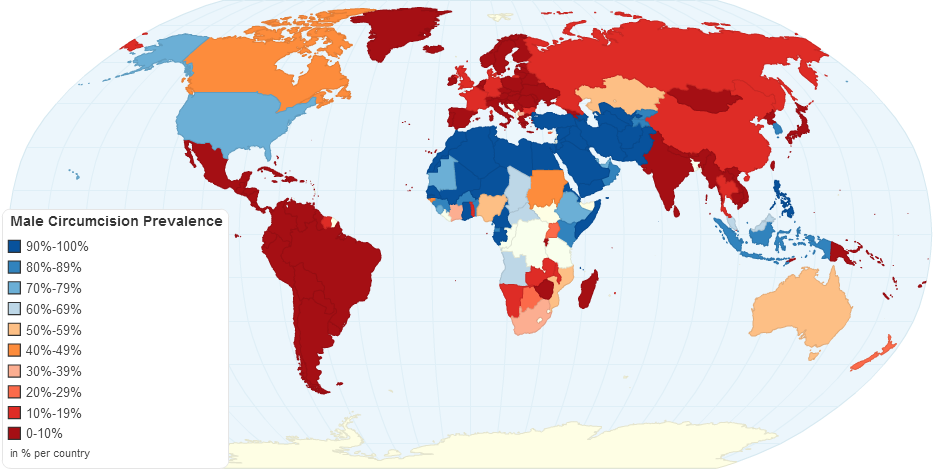
here is a map of the prevalence of male circumcision:
As we can see, circumcision is almost universal in Muslim countries, but very low in Europe and South America. In the U.S the circumcision rate is around 70%. Why is that? U.S. is a mostly Christian nation and we are told in Acts 15 that we should not be circumcised. There is an interesting aspect to circumcision and prostate cancer. The Mayo Clinic conducted a study a long time ago about the correlation between prostate cancer and circumcision, and they found a strong link, circumcised males had much lower risk of prostate cancer. There was one fatal fault with the study; it was done in Minnesota with a lot of people of Swedish descent, and the Swedes do not circumcise, and they have a much higher genetic propensity for developing prostate cancer than other population groups.
When our first son was born in 1969 the nurse nonchalantly handed me a clipboard and said: Sign here, it is standard procedure but it requires your signature. When I read through it I found out it was about circumcision, so I refused. She snarled and left and I overheard her saying to another nurse: Those Scandinavians; they are so backwards – she even wants to breast feed – how primitive!
The four chapters chosen for today are thought provoking and begins with
John 6:25-71. Jesus had fed the five thousand and been seen walking on water. In spite of these miracles the Jews demanded a sign. Jesus responded in kind by saying he is the bread of life, and if people want to have eternal life they must come to him and eat of his flesh and drink of his blood. When hearing this, many abandoned Jesus, but Peter said: To whom shall we go? You have the words of eternal life.
Then in Genesis 12 Abram was called to leave his home in Ur. He obeyed and traveled to a land he did not know, promised by God, but when a famine came he went to Egypt and acted deceitfully rather than trusting God completely.
In Genesis 13 Abram and his sidekick Lot went back from Egypt and their paths separated . Lot chose the fertile plain of Jordan, and Abram went to the hills of Mamre.
Finally in Genesis 14 Lot got in trouble and was taken captive by a local Mafia. Abram rescued Lot, and on the way back gave a tithe to Melchizedek, king of Salem – (later to become Jerusalem), after God had given him success in battle.
Question: Who was Melchizedek, and why is that important? He is mentioned again in Psalm 110 and in Hebrews 5-7.
At first glance there is not much that combines the New and old Testament readings selected for today. In John 6:1-24. Jesus performed miracles 4 and 5 recorded by the Apostle John, feeding five thousand (plus women and children), and then during the night walking on water.
Then in the Old Testament Genesis 11 it tells about the Tower of Babel, and how different languages arose, all by being disobedient to God.
Then again in Psalm 3 David prayed earnestly when he fled from his son Absalom.
The common thread is we always seek to get some favors from God, and thus be able to control the outcome. But God may have other plans for us. In the feeding of the five thousand it is important that they had to start with a ridiculously small amount and end up with much more leftovers than when they started. Sometimes miracles happen and we don’t even notice, but when we participate things sink in.
With the building of the tower of Babel the people started thinking they could do very well without God. They started to have globalist thinking and be able to build the perfect society without God. They started to produce the first money and in so doing they facilitated the “oldest profession” and the goddess Ishtar was worshiped. God decided to confuse their language so they could no longer understand each other globally. We know that happens all the time. Nearly every family has a few words or expressions that are unique to that family. In a city you can hear the different accents in different parts of the city, dialects differ in every valley, and so on.
Today we read in John 5:31-47 how Jesus defended His testimony.
In Genesis 9 God established His covenant with Noah (The Noahic Covenant), and as a sign He established the rainbow in the sky. Noah planted a vineyard, got drunk and exposed his nakedness. This lead to “the curse of Ham,” which gave the excuse that the black race was destined for servanthood and slavery. It was in reality the curse of Canaan, the original inhabitants of the yet to be promised land. Ponder that!
Genesis 10 is a genealogy of the descendants of Noah. It describes how the earth was repopulated. This is quite interesting to see how the different tribes developed.
When Jesus defended his testimony the Scriptures were already written and pointed to the coming Messiah. In most of the prophesies Messiah is described as a conqueror. He will reestablish Israel in all its glory, and the prophesies of the suffering messiah of divine origin were ignored as being inconsistent with the purpose and destiny of Israel. This is why Jesus testimony was vehemently opposed.
In Noah’s time on the other hand none of the Scriptures had been written, so God in His grace gave Noah the covenant He would never again destroy mankind with a flood, and He sealed it with the sign of the rainbow as a remembrance. After the deluge weather patterns changed and thunderstorms became common in season. In spite of this it didn’t take long for Noah to sin and get drunk, and from that story we get “the curse of Ham” which really was the curse of Canaan.
The common thread for today is Jesus redefining the meaning of the Sabbath and Noah being part of the new beginning. Psalm 2 defines Jesus as the Son and God the ruler of all, and mankind still trying to do it all by themselves at no avail.
John 5:1-30, describes how Jesus healed a man at the pool of Bethesda on the Sabbath, which offended the Jews. In addition Jesus claimed to be equal with the Father, for which the Jews sought to kill him, but Jesus defended His testimony.
Genesis 7 tells of Noah, having completed the ark, took with him seven (pairs) of clean animals and one male and one female of each specie of unclean animals, and also birds. The aquatic life did just fine. After the animals had entered, God shut the door and it rained forty days and forty nights.
Genesis 8. The water receded and Noah sent out a raven and later a dove that returned empty. The second time the dove was sent out, it returned with an olive branch in its beak. The dove and the olive branch has since become the universal peace symbol. After exiting the ark Noah built an altar and sacrificed from the clean animals. God made a promise to Noah: “While the earth remaineth, seedtime and harvest, and cold and heat, and summer and winter, and day and night shall not cease.”
Psalm 2 tells of what happens when “the heathen rage” and this psalm speaks of the fight that is going on even today.
John 4, speaks about the first real evangelist spreading the good news of Christ the Messiah. It is the woman at the well, a Samaritan, held in contempt by the Jews, scorned and rejected by her many ex husbands and the town people, yet used by God to tell the good news.
Genesis 6 . Sin and wickedness got worse and worse on earth. God saw it and decided to start over. But Noah, his wife, his three sons and their wives, eight in all found favor with God, so God told him to build an ark. This Noah did, and it was the biggest ship built until the time of Ptolemy (around 215 BC.)
After the fall God revealed himself in His marvelous creation, but the Word of God was not yet given. The spiritual connection was lost, so people did what they deemed most pleasurable. This is much like the situation today: Sigmund Freud declared sexual man the most mature man, rejecting the spiritual aspect and we have gone downhill ever since, rejecting all personal relationship with God as pure imagination.
Ponder that the first evangelist was a scorned woman who happened to meet Jesus, and that Noah, being obedient to God built the ark on dry land, too big to be of any use unless there was going to be a giant flood. This takes faith!
Today we read John 3, the new birth chapter; you must be born again (literally: from above), the new birth is necessary to enter into the Kingdom of God; John 3:16 is the most quoted verse in all the Bible.
Genesis 4 tells of the results of original sin with the story of Cain and Abel and the beginning of animal sacrifice. After the fall people had the spiritual void not being able to fellowship with God, nor even communicate. To satisfy the need to do what they felt God wanted, and God showed that only sacrifice involving the shedding of blood would suffice
The take home for today is there are two births, the physical birth and the spiritual birth (the birth from above), the first sacrifice, the first murder, the first man (Enoch) to be carried directly to God rather than die, (because he walked with God).
 Len Bilén's blog, a blog about faith, politics and the environment.