The ultimate infrastructure project: A Transcontinental aqueduct to save the American Southwest from becoming a desert.

The American Southwest has always been subject to drought cycles, some worse than the one that is now devastating the area. Below is a very interesting presentation from ASU about a previous civilization in the Phoenix area, thriving and then gone.

Arizona State University presentation

Will it happen again?

The problem:

  1. Lake Mead will be emptied in less than 10 years with the current usage pattern. Then what?
  2. The hydroelectric power from Lake Mead (and Lake Powell) is diminishing as the lakes are emptied.
  3. the aquifers in Arizona, especially in the Phoenix and Tucson area, and to some extent New Mexico and the dry part of Texas are being drawn down and are at risk of being exhausted.
  4. The Salton Sea in the Imperial Valley of California is maybe the most polluted lake in all of U.S.A. It is even dangerous to breathe the air around it sometimes. The area contains maybe the largest Lithium deposit in the world.
  5. The Colorado River water is too salty for good irrigation .
  6. The Colorado river no longer reaches the Gulf of California. Fishing and shrimp harvesting around the Colorado River Delta is no more.
  7. 40 million people depend on the Colorado River for drinking water. The population is still rising rapidly in the West. Will they have water in the future?
  8. Except for California there is not much pumped Hydro-power storage in the American Southwest.
  9. Texas has plenty of wind power, but no pumped hydro-power storage. This makes it difficult to provide peak power when the sun doesn’t shine and the wind doesn’t blow. Nuclear power is of no help, it provides base power only. Peak power has to come from coal and natural gas plants.
  10. New Mexico has some ideal spots for solar panels, but no water is available for pumped storage.
  11. Arizona has a surging population, wind and solar power locations are abundant, but no pumped hydro-power storage.

The solution:

Build a transcontinental aqueduct from the Mississippi River to the Colorado River capable of transporting 15 million acre-ft of water yearly through Louisiana, Texas, New Mexico and Arizona. It will be built similar to the Central Arizona Project aqueduct, supplying water from the Colorado river to the Phoenix and Tucson area, but this aqueduct will be carrying seven times more water over five times the distance and raise the water more than twice as high before returning to near sea level. The original Central Arizona Project cost $4.7 billion in 1980’s money, the Transcontinental Aqueduct will cost around $340 Billion in 2021 money applying simple scaling up principles.

The Mississippi River has a bad reputation for having polluted water, but since the clean water act the water quality has improved drastically. Fecal coli-form bacteria is down by a factor of more than 100, the water is now used all the way down to New Orleans for drinking water after treatment. The lead levels are down by a factor of 1000 or more since 1979. Plastic pollution and pharmaceutical pollution is still a problem, as is the case with most rivers. The Ph is back to around 8 and salt content is negligible. Mississippi water is good for irrigation, and usable for drinking water after treatment.

But the aqueduct will do more than provide sweet Mississippi water to the thirsty South-west, it will make possible to provide peak power to Texas, New Mexico and Arizona. In fact, it is so big it will nearly triple the pumped Hydro-power storage for the nation, from 23 GW for 5 hours a day to up to 66 GW.

The extra pumped hydro-power storage will come from a number of dams built as part of the aqueduct or very adjacent to it. The water will be pumped from surplus wind and solar power generators when available. This will provide up to 20 GW of power for 5 hours a day. If not enough extra power has been generated during the 19 pumping hours, sometimes power will be purchased from the regular grid. The other source of pumped hydro-power storage is virtual. There will be more than 230 100 MW LFTR (Liquid Fluoride salt Thorium Rector) power stations strategically stationed along the waterway providing pumping of water for 19 hours and providing virtual hydro-power output.

These 43 GW of hydro-power capacity will be as follows: Louisiana, 0.4 GW; Texas, 18,5 GW (right now, Texas has no hydro-power storage, but plenty of wind power); New Mexico, 10.5 GW; Arizona 13.6 GW. In Addition, when the Transcontinental Aqueduct is fully built out, the Hoover dam can provide a true 2.2 GW hydro-power storage by pumping water back from Lake Mojave; a 3 billion dollar existing proposal is waiting to be realized once Lake Mead is saved.

The amount of installed hydroelectric power storage is:
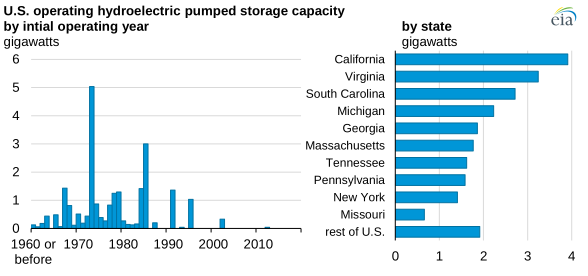
U.S. operating hydroelectric pumped storage capacity

Most hydroelectric pumped storage was installed in the 70’s. Now natural gas plants provide most of the peak power. This aqueduct will double, triple the U.S. pumped peak storage if virtual peak storage is included. By being pumped from surplus wind and solar energy as well as nuclear energy it is true “Green power”. Some people like that.

What follows is a description of each leg of the aqueduct. Each leg except legs 9 and 10 ends in a dam, which holds enough water to make each leg free to operate to best use of available electricity and provide peak power on demand.

Leg 1: Atchafalaya river (Mississippi river bypass) to Aquilla lake, a distance of 360 miles.

Leg 2: Aquilla lake to Brad reservoir (to be built), a distance of 100 miles.

Leg 3: Brad reservoir to North of Baird dams. (to be constructed), a distance of 60 miles

Leg 4: North of Baird dams (to be constructed) to East of Sweetwater dam (to be built), a distance of 60 miles.

Leg 5: East of Sweetwater dam (to be constructed) to Grassland Canyon Lake (to be made), a distance of 50 miles.

Leg 6: Grassland Canyon Lake (to be made) to White Oaks Canyon Lake (to be made), a distance of 110 miles.

Leg 7: White Oaks Canyon Lake (to be made) to the Arch Lewis Canyon Lake via a 20 mile tunnel under the Guadaloupe Mountains in New Mexico.

Leg 8: Arch Lewis Canyon Lake to Martin Tank Lake, a distance of 50 miles.

Leg 9: Martin Tank Lake to Poppy Canyon Reservoir, a distance of 210 miles.

Leg 10: The Poppy Canyon Upper and Lower Reservoir. A Hydro-power storage peak power plant.

Leg 10, alternate solution: Poppy Canyon Reservoir to Cove Tank Reservoir, a distance of 13 miles.

Leg 11: Poppy Canyon Reservoir to San Carlos Lake, a distance of 80 miles.

Leg 12: San Carlos Lake to the Colorado river following the Gila river, a distance of 280 miles.
Yes, there is man-made climate change. It is land use change and results from the battle over water.

All sunshine makes a desert. Arabic proverb.

That ye may be the children of your Father which is in heaven: for he maketh his sun to rise on the evil and on the good, and sendeth rain on the just and on the unjust. Matthew 5:45 (King James version)

The rain that on the righteous falls,

falls also falls also on that other fella.

But mostly on the just, because

the unjust stole the just’s umbrella. (Author unknown)

There is no bad weather, Only bad clothes. (Norwegian saying).

Everybody complains about the weather, but nobody does anything about it. (Common British lament).

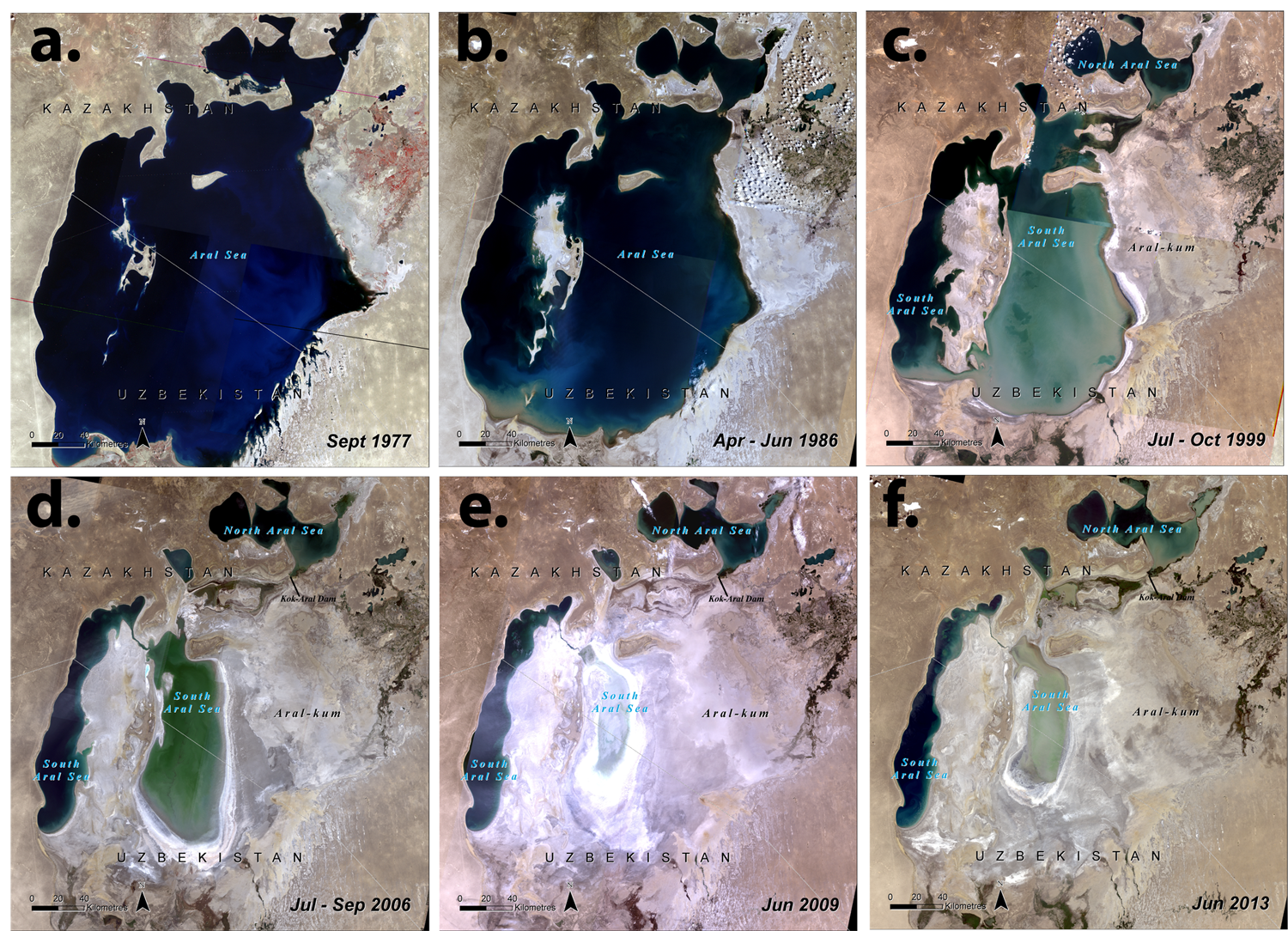
The last comment is not always true. There once was a lake in Central Asia, the fourth largest lake in the world. It provided a sensitive, but functioning Eco-system for a large portion of South East Soviet Union and western Afghanistan. Then the central planners wanted to improve the productivity of the area through central planning on improving land management. In the 1960s and 1970s the Soviets started using the Amu Darya and the Syr Darya rivers to irrigate extensive cotton fields in the Central Asian plain. The results can be seen in these 6 Satellite photos

Disaster is a mild word. The lake was the source of the rains that fell up-stream. With the lake gone, the rivers dried up completely, and the whole upland became desert-like. There has been efforts to restore the upper part of the lake with a dam, but that will do nothing to stop the desertification. My suggestion to solve this is to divert the spring floods from the headwaters of the river Ob and tributaries. There is a gap in the mountains less than 600 feet above sea level, so it is very doable.

A much bigger challenge is facing the south western United States. Lake Mead is at its lowest point since it was first filled, and Lake Powell is faring even worse, with no spring flood adding to the water storage. lake Mead is at less than 40% of full pool

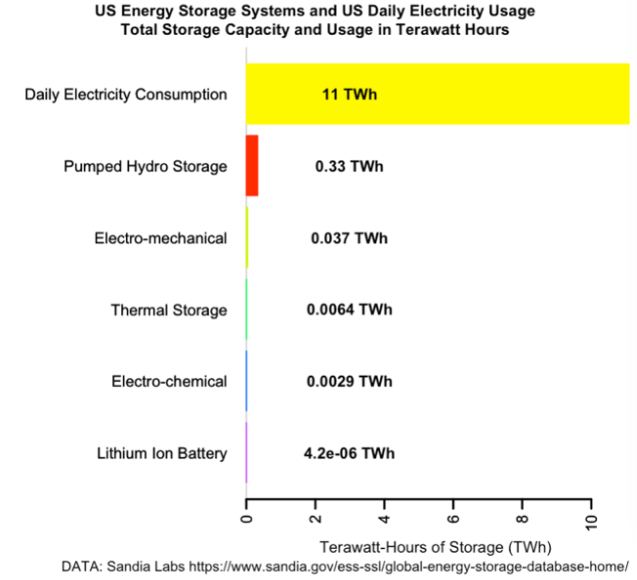
and Lake Powell is at less than 35% of full pool. If nothing is done both lakes will be emptied in less than 20 years, and that is counting on a stable climate. Beside the end of lawns, golf courses, swimming pools and even agricultural irrigation, the dams will no longer provide hydro-electrical storage for peak power, something that is of utmost importance when the wind doesn’t blow and the sun doesn’t shine, which actually happens from time to time. Renewable energy, wind and solar requires a large reserve of stored energy to use as peak power. How much stored energy do we have. This chart is scary:

The lithium batteries we have all over, powering cellphones PCs an all kinds of electric equipment would be able to power the U.s power grid for three hundredths of a second. Large scale electro-chemical storage used by power stations, hospitals and other facilities that need uninterrupted services, also lithium-ion based, can power up the net for almost 23 seconds. And all pumped hydro-electric storage can power the grid for nearly five minutes. This means that nearly all extra peak power up to now has to be provided by Coal and natural gas electric power, since Uranium based nuclear power works as a base load.

There must be a better way to produce electricity. My suggestion will go a long way to provide more water to the Colorado river basin and reduce dependence on fossil fuel.

The Moffat water tunnel takes water from the Colorado river basin, diverts it under the Continental divide and provides some of the water for Denver and Colorado Springs and assorted communities. The yearly water drained from the Colorado river basin is about 74,000 Acre Foot, or about 0.5% of the total rainfall in the Colorado river basin, not much, but every little drop helps. This needs to be stopped. There is one problem, though: The greater Denver- Colorado Springs metropolitan area desperately need more water too, and the Ogalla aquifer is endangered already, so we must do something drastic. The answer is to pump water up-stream South Platte River, all the way from Omaha, Nebraska, lying east of the Ogalla aquifer. To do so we have to pump water 1,300 meter higher, and that requires energy, about 4,500 kWh per acre foot. At a price of 4 cents per kWh that would be about $190 per Acre foot. For an urban dweller or a rancher without water rights it is a bargain, but for a farmer, his water cost would be $250 to $400 per acre, so say the farmer grows corn, this would add $2.60 dollars per bushel in a year without rain at the right time. Any rain during thr growing season would reduce that amount.

The project is very doable and will even allow for increased irrigation, and the draw down of the Ogallala aquifer can stop. We need to pump about 300,000 acre foot per year, requiring 1,35 TWh/year, or about 150 MW of power. But the power stations are only to pump when the electricity demand is low, so it is best to provide 500MW of nuclear power, eliminating maybe 3 TWh/year of coal powered power, reducing CO2 emissions by 3 million metric tons per year. Every little bit helps.

Here is my proposal. Take a maximum of 2000 acre feet of water per day from the Missouri river just south of Omaha, Nebraska, about 3% of the average flow in the river, and pump it up to Colorado Springs, with major tap off stations in Denver and Greely and maybe many other stations. The power will be provided by Liquid Flouoride Nuclear Reactors, maybe five 100 MW reactors. When this project is finished the Moffat tunnel can be shut off, stopping the stealing of water from the Colorado river basin.

Why LFTR? Here is 30 reasons, and the list keeps growing

 1. A million year supply of Thorium available worldwide.

 2. Thorium already mined, ready to be extracted.

 3. Thorium based nuclear power produces 0.012 percent as much TRansUranium waste products as traditional nuclear power.

 4. Thorium based nuclear power will produce Plutonium-238, needed for space exploration.

 5. Thorium nuclear power is only realistic solution to power space colonies.

 6. Radioactive waste from an Liquid Fluoride Thorium Reactor decays down to background radiation in 300 years compared to a million years for U-235 based reactors. A Limerick.

 7. Thorium based nuclear power is not suited for making nuclear bombs.

 8. Produces isotopes that helps treat and maybe cure certain cancers.

 9. Liquid Fluoride Thorium Reactors are earthquake safe, only gravity needed for safe shutdown.

10. Molten Salt Liquid Fluoride Thorium Reactors cannot have a meltdown, the fuel is already molten, and it is a continuous process. No need for refueling shutdowns.

11. Molten Salt Nuclear Reactors have a very high negative temperature coefficient leading to a safe and stable control.

12. Atmospheric pressure operating conditions, no risk for explosions. Much safer and simpler design.

13. Virtually no spent fuel problem, very little on site storage or transport.

14. Liquid Fluoride Thorium Nuclear reactors scale beautifully from small portable generators to full size power plants.

15. No need for evacuation zones, Liquid Fuel Thorium Reactors can be placed near urban areas.

16. Liquid Fluoride Thorium Reactors will work both as Base Load and Load Following power plants.

17. Liquid Fluoride Thorium Reactors will lessen the need for an expanded national grid.

18. Russia has an active Thorium program.

19. India is having an ambitious Thorium program, planning to meet 30% of its electricity demand via Thorium based reactors by 2050.

 20. China is having a massive Thorium program.

21. United States used to be the leader in Thorium usage. What happened?

22. With a Molten Salt Reactor, accidents like the Three Mile Island disaster will not happen.

23. With a Molten Salt Reactor, accidents like Chernobyl are impossible.

24. With Molten Salt Reactors, a catastrophe like Fukushima cannot happen.

25. Will produce electrical energy at about 4 cents per kWh.

26. Can deplete most of the existing radioactive waste and nuclear weapons stockpiles.

27. With electric cars and trucks replacing combustion engine cars, only Thorium Nuclear power is the rational solution to provide the extra electric power needed.

28. The race for space colonies is on. Only Molten Salt Thorium Nuclear reactors can fit the bill.

29. President Donald J. Trump on Jan.12 issued an Executive Order on Promoting Small Modular Reactors for National Defense and Space Exploration. Only Liquid fluoride thorium reactors can meet all the needs

30. We have to switch from Uranium to Thorium as nuclear feed-stock. We are running out of domestic Uranium.