
Matthew 11:1-19, Jesus and John the Baptist.


John 8 begins with a sinful woman who was about to be stoned for adultery. Jesus last words to her was “Go and sin no more”. Jesus did not condemn her for the past but forgave and pointed to the future. The he got into an argument with the religious powers about his and their ancestry. They claimed to be descendants of Abraham, and they questioned the legitimacy of Jesus. Jesus answered “Before Abraham, I am”. Jesus claimed to be God. This was of course blasphemy, unless it is true.
Genesis 21 tells about the birth of Isaac and when Ishmael made fun of it, Sarah got angry and Hagar and Ismael were sent away to die in the desert, but God protected them. The chapter also features the treaty between Abraham and Abimelech at Beersheba.
In Genesis 22 Abraham was told by God to offer up his son Isaac to be sacrificed on Mount Moriah, the same mountain that Jesus was crucified on. Obeying God he did what he was told, but at the last moment God provided a substitute sacrifice in the form of a ram.
Luke and John also record this call.

The final harvest is yet to come.
John7:25-53. The people started asking Jesus if he is the Christ. Rather than answering directly Jesus promised “Streams of living water”and more, but they were not ready to understand it yet.
So in Genesis 19 Sodom and Gomorrah were destroyed. There is ample evidence this is a historical true event, the Bible is verified true even here. God provided for Lot, his wife and two daughters to escape.They did, but Lot’s wife looked back towards the city and was no more. After that is recorded the strange story about Lot and his two daughters, and all I can say about that is that it is not good to take matters in our own hand rather than listen to God and let Him guide.
In Genesis 20 Abraham claimed Sarah was his sister. Why? Sarah was his half-sister, so Abraham stretched the truth, also called a lie, or sin. The chapter shows God’s protection even when we do wrong.
Psalm 4 is David’s appeal to righteousness, and the blessings that follow is David’s appeal to righteousness, and the blessings that follow.

“Everyone knows that only God” can forgive sins.
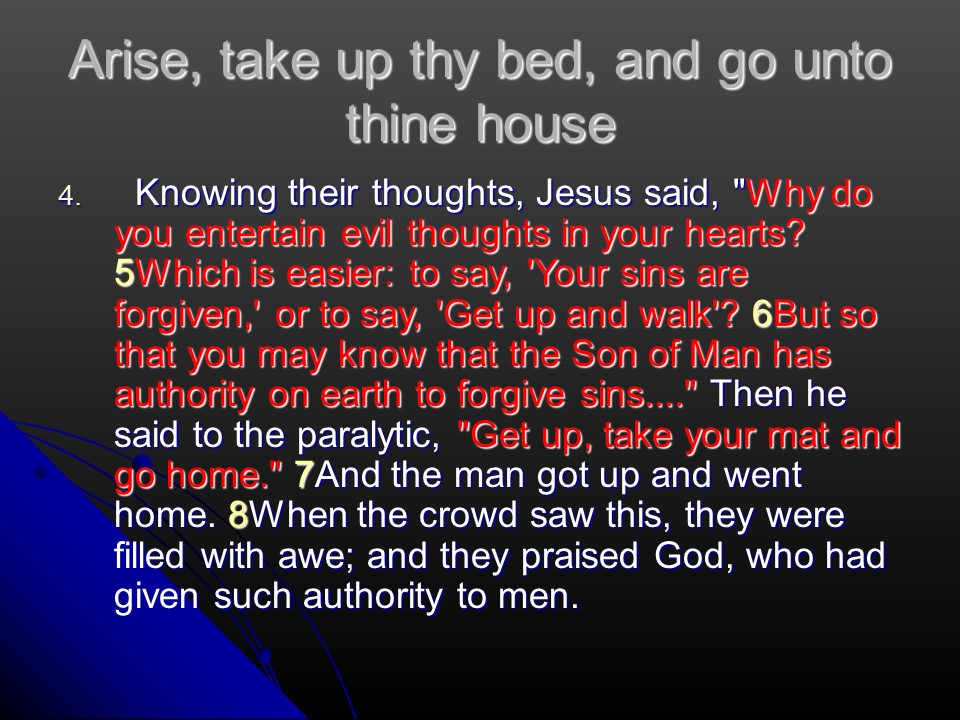
In those days, a bed was only a mat, less than half an inch thick.
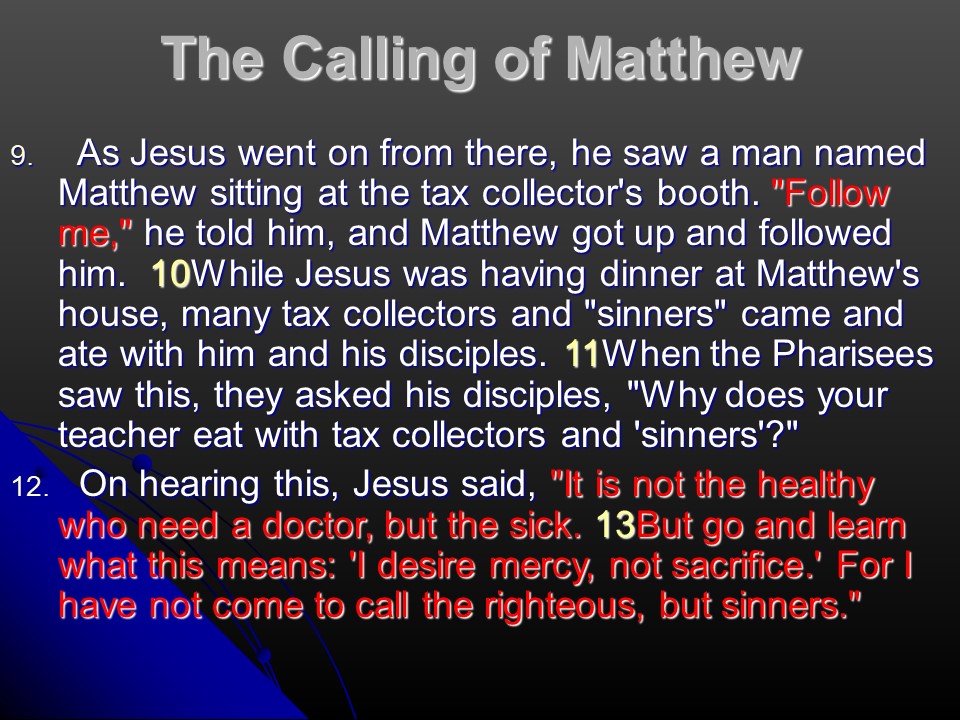
Tax collectors were despised, having colluded with the Romans to collect sometimes much more than required by Roman law. Corruption was rampant.
Today we read about circumcision and its importance, in John 7 and 4 chapters in Genesis. But that is just one part of the story.
John 7:1-24. Jesus pointed out that according to Jewish law, circumcision is more important than keeping Sabbath, so, if the eighth day is on a Sabbath, it must be performed, but healing on a Sabbath is not permitted.
In Genesis15 God promised Abram a son, and Abram believed God and it was counted to him as righteousness.
But in Genesis 16 Abram badly wanted an heir, so Sarai, being too old, gave her handmaiden Hagar to be mother of Abram’s son, Ishmael. Sarai regrets what she had done, and Hagar was sent away with Ishmael into the wilderness.
Thirteen years later, in Genesis 17, Ishmael was back with Abram, God promised Abram his seed of promise, changed Abram’s name to Abraham and Sarai’s name became Sarah, established with an eternal covenant, the covenant of Circumcision, and it was performed on Abraham, Ishmael and all Abraham’s male servants.
Which brings us to Genesis 18 with Abraham still waiting for his promised offspring. He was visited by three angels that promised him he will have a son within a year. Sarah heard it and found it laughable, but God confirmed this promise, and was also proclaiming the destruction of Sodom and Gomorrah. Abraham tried to bargain with God at no avail.
The question to ponder: Why is circumcision important for Jews and Muslims, but not for Christians? Hint: read the Acts of the Apostles, chapter 15.

Please, go away, Jesus. You are bad for business.
January 9:John 6:25-71, Genesis 12, Genesis 13,
The four chapters chosen for today are significant and thought provoking.
In John 6:25-71. Jesus had fed 5000 and been seen walking on water. In spite of these miracles the Jews demanded a sign. Jesus responds in kind saying he is the bread of life, and if people want to have eternal life they must come to him and eat of his flesh and drink of his blood. When hearing this, many abandoned Jesus, but Peter said: To whom shall we go? You have the words of eternal life.
Then in Genesis 12 Abram was called to leave his home in Ur. He traveled to a land he did not know, promised by God, and he obeyed, but when a famine came he went to Egypt and resorted to deceit rather than trusting God.
In Genesis 13 Abram and his sidekick Lot went back from Egypt and separated paths. Lot chose the fertile plain of Jordan, and Abram went to the hills of Mamre.
And in Genesis 14 Lot got in trouble and was taken captive by a local Mafia. Abram rescued Lot, and on the way back gave a tithe to Melchizedek, king of Salem – (later to become Jerusalem), after God gave him success in battle.
Question: Who was Melchizedek, and why is that important?
John 6:1-24. Jesus performed miracles 4 and 5 recorded by the Apostle John, feeding 5000 (plus women and children) and walking on water.
Genesis 11 tells about the Tower of Babel, and how different languages arose, all by being disobedient to God.
Psalm 3 is a Psalm of David from when he fled from his son Absalom.
 Len Bilén's blog, a blog about faith, politics and the environment.