Today’s reading is very interesting. In John7:25-53 the people started asking Jesus if he was the Christ. Rather than answering directly Jesus promised “Streams of living water”and more, but they were not ready to understand it yet, and to be honest neither would I if I had been part of the crowd at that time. But the pharisees understood that he was a threat to their world order.
And in Genesis 19 Sodom and Gomorrah were destroyed. There is ample evidence this is a historical true event, the Bible is verified true even here. God provided for Lot, his wife and two daughters to escape.They did, but Lot’s wife looked back towards the city and was no more. After that the strange story about Lot and his two daughters is recorded , and all I can say about that is that it is not good to take matters in your own hands rather than listen to God and let Him guide.
In Genesis 20 Abraham claimed Sarah was his sister. Why? Sarah was his half-sister, so Abraham stretched the truth, also called a lie, or sin. This chapter shows God’s protection even when we do wrong.
Psalm 4 is David’s appeal to righteousness, and the blessings that follow is David’s appeal to righteousness, and the blessings that follow.
Today we read about circumcision and its importance; in John 7 and one of the four chapters in Genesis selected for today. But that is just one part of the story.
John 7:1-24. Jesus pointed out that according to Jewish law, circumcision is more important than keeping Sabbath, so, if the eighth day is on a Sabbath, it must be performed on that day, but healing on a Sabbath is not permitted.
In Genesis15 God promised Abram a son. Abram believed God and it was counted to him as righteousness.
But in Genesis 16 Abram badly wanted an heir, so Sarai, being too old, gave her handmaiden Hagar to be the mother of Abram’s son, Ishmael. Sarai regretted what she had done, and Hagar was sent away with Ishmael into the wilderness.
Thirteen years later, in Genesis 17, Ishmael was back with Abram, God promised Abram his seed of promise, changed Abram’s name to Abraham and Sarai’s name became Sarah, established with an eternal covenant, the covenant of Circumcision, and it was performed on Abraham, Ishmael and all Abraham’s male servants.
Which brings us to Genesis 18 with Abraham still waiting for his promised offspring. He was visited by three angels that promised him he will have a son within a year. Sarah heard it and found it laughable, but God confirmed this promise, and was also proclaiming the destruction of Sodom and Gomorrah. Abraham tried to bargain with God at no avail.
The question to ponder: Why is circumcision important for Jews and Muslims, but not for Christians? Hint: read the Acts of the Apostles, chapter 15.
The four chapters chosen for today are thought provoking and begins with
John 6:25-71. Jesus had fed the five thousand and been seen walking on water. In spite of these miracles the Jews demanded a sign. Jesus responded in kind by saying he is the bread of life, and if people want to have eternal life they must come to him and eat of his flesh and drink of his blood. When hearing this, many abandoned Jesus, but Peter said: To whom shall we go? You have the words of eternal life.
Then in Genesis 12 Abram was called to leave his home in Ur. He obeyed and traveled to a land he did not know, promised by God, but when a famine came he went to Egypt and acted deceitfully rather than trusting God completely.
In Genesis 13 Abram and his sidekick Lot went back from Egypt and their paths separated . Lot chose the fertile plain of Jordan, and Abram went to the hills of Mamre.
Finally in Genesis 14 Lot got in trouble and was taken captive by a local Mafia. Abram rescued Lot, and on the way back gave a tithe to Melchizedek, king of Salem – (later to become Jerusalem), after God had given him success in battle.
Question: Who was Melchizedek, and why is that important? He is mentioned again in Psalm 110 and in Hebrews 5-7.
At first glance there is not much that combines the New and old Testament readings selected for today. In John 6:1-24. Jesus performed miracles 4 and 5 recorded by the Apostle John, feeding five thousand (plus women and children), and then during the night walking on water.
Then in the Old Testament Genesis 11 it tells about the Tower of Babel, and how different languages arose, all by being disobedient to God.
Then again in Psalm 3 David prayed earnestly when he fled from his son Absalom.
The common thread is we always seek to get some favors from God, and thus be able to control the outcome. But God may have other plans for us.
Today we read in John 5:31-47 how Jesus defended His testimony.
In Genesis 9 God established His covenant with Noah (The Noahic Covenant), and as a sign He established the rainbow in the sky. Noah planted a vineyard, got drunk and exposed his nakedness. This lead to “the curse of Ham,” which gave the excuse that the black race was destined for servanthood and slavery. It was in reality the curse of Canaan, the original inhabitants of the yet to be promised land. Ponder that!
Genesis 10 is a genealogy of the descendants of Noah. It describes how the earth was repopulated. This is quite interesting to see how the different tribes developed.
The common thread for today is Jesus redefining the meaning of the Sabbath and Noah being part of the new beginning. Psalm 2 defines Jesus as the Son and God the ruler of all, and mankind still trying to do it all by themselves at no avail.
John 5:1-30, describes how Jesus healed a man at the pool of Bethesda on the Sabbath, which offended the Jews. In addition Jesus claimed to be equal with the Father, for which the Jews sought to kill him, but Jesus defended His testimony.
Genesis 7 tells of Noah, having completed the ark, took with him seven (pairs) of clean animals and one male and one female of each specie of unclean animals, and also birds. The aquatic life did just fine. After the animals had entered, God shut the door and it rained forty days and forty nights.
Genesis 8. The water receded and Noah sent out a raven and later a dove that returned empty. The second time the dove was sent out, it returned with an olive branch in its beak. The dove has since become the universal peace symbol. After exiting the ark Noah built an altar and sacrificed from the clean animals. God made a promise to Noah: “While the earth remaineth, seedtime and harvest, and cold and heat, and summer and winter, and day and night shall not cease.”
Psalm 2 tells of what happens when “the heathen rage” and this psalm speaks of the fight that is going on even today.
John 4, speaks about the first real evangelist spreading the good news of Christ the Messiah. It is the woman at the well, a Samaritan, scorned and rejected by her many ex husbands, yet used by God to tell the good news.
Genesis 6 . Sin and wickedness got worse and worse on earth. God saw it and decided to start over. But Noah, his wife, his three sons and their wives, eight in all found favor with God, so God told him to build an ark. This Noah did, and it was the biggest ship built until the time of Ptolemy (around 215 BC.)
Ponder that the first evangelist was a scorned woman who happened to meet Jesus, and that Noah, being obedient to God built the ark on dry land, too big to be of any use unless there was going to be a giant flood. This takes faith!
Today we read John 3, the new birth chapter; you must be born again (literally: from above), the new birth is necessary to enter into the Kingdom of God; John 3:16 is the most quoted verse in all the Bible.
Genesis 4 tells of the results of original sin with the story of Cain and Abel and the beginning of animal sacrifice.
The take home for today is there are two births, the physical birth and the spiritual birth (the birth from above), the first murder, the first man (Enoch) to be carried directly to God rather than die. (because ha walked with God).
Today we read in John 2, that Jesus turned water into wine, cleansed the Temple, and when the Jews demanded a sign he gave them just one sign (which they of course did not understand).
Genesis 2 left us with the idyllic Eden, no diseases existed yet. But God created us with free will, and the fall is then described in Genesis 3 . The problem is, after eating from the tree of the knowledge of good and evil, (not an apple tree) and in so doing we think we can build a better world without God.
The question to ponder is: Why did God create us with a free will? He knew the result from the beginning, and knew He would have to send His Son to redeem us back to Himself. In fact He knew it from before the beginning: “All inhabitants of the earth will worship the beast—all whose names have not been written in theLamb’s book of life, theLamb who was slain from the creation of the world.” (Revelation 13:8, NIV)
Answer: We are created in God’s image, male and female, not so much physical, but spiritual, and free will is part of the package. Without free will there is no fellowship with God, only puppetry.
Psalm 1 is a beautiful poem about righteous living, and only one person could fulfill all the conditions mentioned, the exception to ” There is none righteous, no, not one” (Romans 3: 10)
This saying is old, and was circulated both when I was in private industry and when I worked at the University. During my 56 years in the U.S. I have watched the cost of medical care rise from 6% of GNP to over 20% of GNP. Part of it is of course that we are getting older, and people used to die at their first heart attack, and now they can survive multiple heart attacks, just to name one disease.
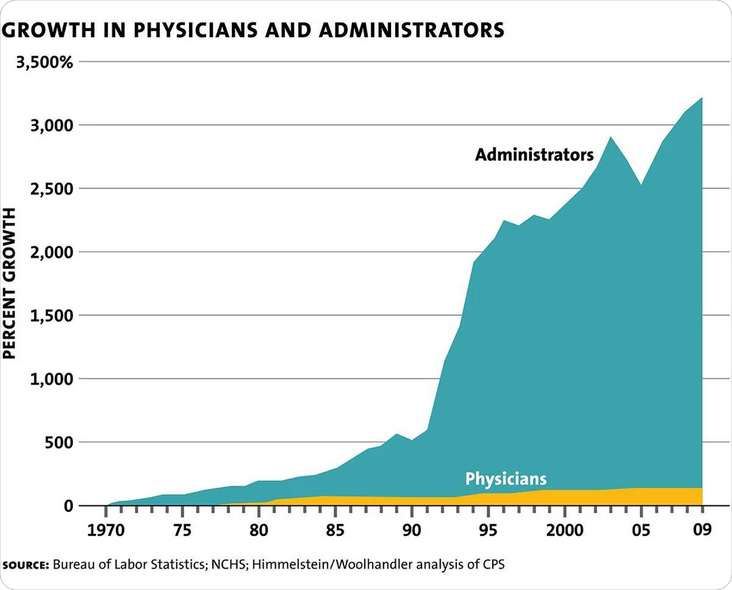
I got a hint at the real reason seeing this official chart:
While the number of doctors have slightly more than doubled, the number of administrators have risen thirty-twofold. and that was in 2009. Things are even worse now, since another level of federal bureaucracy have come between the doctors and the patients. It used to be simple, you paid the doctor, and that was it. The problem with this was that many could not afford a doctor, so during the second world war companies offered free health care since there was wage controls and competition for available workers was strong. This got institutionalized, and unions negotiated the best contracts, so pressure for national health care, which was the norm in many parts of the world never materialized.
Obamacare was finally enacted in 2010 and we now have the worst of all possible health care systems. The pharmaceutical establishment operate under their mission statement: “To cure a patient is not a sustainable business model” and so all pharmaceutical research is directed to control diseases, not to find permanent cures. Granted, there are many doctors that want to cure their patients, but they are swamped by incentives to control the diseases instead; the U.S. and New Zealand are the only two countries in the world that allow medical advertisements. The doctors operate in a difficult regulatory environment, there are local and state regulations, overlayed by federal regulations, often in conflict with each other. The hospitals are burdened with a lot of patients that are not willing or able to pay leading to people that are able to pay with horrendous bills, that they have to pay for the rest of their lives. I could go on, but you get the picture.
There has been much ballyhoo about to control the cost of medicine, like limit the cost of insulin to no more than 35 dollars per month. this all makes sense, since a person with type 1 diabetes is totally dependent on insulin for survival.
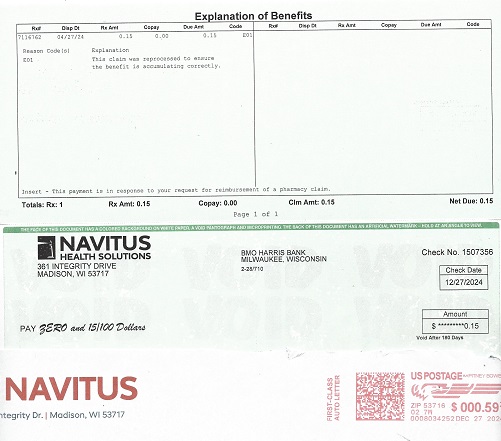
Yesterday I received a reimbursement for overpaying a drug. They really try to control drug costs!
This is how bureaucracy works. Thanks for the 15 cents back.The stamp alone was 59.3 cents. And the letter included the obligatory “Discriminating is against the law” page. Just to be sure, it was the bureaucracy itself that made the request, not me.
 Len Bilén's blog, a blog about faith, politics and the environment.