Molten Salt nuclear Reactors operate under Atmospheric pressure conditions, no risk for explosions. Materials subjected to high radiation tend to get brittle or soften up. Molten Salt Thorium nuclear reactors operate under atmospheric conditions so the choice of materials that can withstand both high temperatures and high radiation is much greater, leading to a superior and less expensive design. There is no high pressure gas buildup and the separation stage can be greatly simplified.
Category: science
The need to develop Thorium based Nuclear Energy as the major electric energy supply. 9. Molten Salt Thorium Reactors cannot have a meltdown, the fuel is already molten.
With Molten Salt nuclear Reactors there is no risk for a meltdown, the fuel is already molten, and that is a safe design. The fissile fuel in a Thorium reactor is U-233 in the form of UraniumFluoride (UF4) salt which also contains Lithium and Beryllium. In its molten form it has a very low vapor pressure. The salt flows easily through the heat exchangers and the separators. The salt is very toxic, but it is completely sealed. Being a fluid, it is constantly mixed for optimum efficiency. The reactor will never have to be shut down for refueling, it is a continuous flow process. Uranium-235 Nuclear reactors on the other hand have to be shut down for refueling and rebalancing of the fuel rods a little more often than once every two years. The average shutdown is 35 days, or about 5% of the time. Then comes the major problem of safely and securely transporting and reprocessing the spent fuel.
The need to develop Thorium based Nuclear Energy as the major electric energy supply. 8. Molten Salt Thorium Reactors are earthquake safe.
Molten Salt Thorium Reactors are earthquake safe. Thorium reactors have a very simple and compact design where gravity is the only thing needed to stop the nuclear reaction. Conventional nuclear reactors depend on external power to shut down after a SCRAM, where poison rods fall down to halt the reaction. The next figure shows the concept of a Thorium reactor.

The idea is to empty the fissile U-233 core through gravity alone. All that is needed is a melt-plug that is constantly cooled by cold air. In an earthquake the cold air flow automatically shuts off, and since the fuel is already molten, it will then run down into channels like pig-iron into cooling heat exchangers with water supplied through gravity alone. 
As we can see the reactor hardened structure is compact, and can be completely earthquake and tsunami proof. What can be sheared off are the steam pipes and external power, but the reactor shutdown will complete safely without additional power, even if the earthquake is so bad the reactor is broken into pieces.
The need to develop Thorium based Nuclear Energy as the major electric energy supply. 7. Produces isotopes that helps cure certain cancers.
Produces isotopes that helps cure certain cancers. For decades, medical researchers have sought treatments for cancer. Now, Alpha Particle Immunotherapy offers a promising treatment for many forms of cancer, and perhaps a cure. Unfortunately, the most promising alpha-emitting medical isotopes, actinium-225 and its daughter, bismuth-213, are not available in sufficient quantity to support current research, much less therapeutic use. In fact, there are only three sources in the world that largely “milk” these isotopes from less than 2 grams of thorium source material. Additional supplies were not forthcoming. Fortunately, scientists and engineers at Idaho National Laboratory identified 40-year-old reactor fuel stored at the lab as a substantial untapped resource and developed Medical Actinium for Therapeutic Treatment, or MATT, which consists of two innovative processes (MATT-CAR and MATT-BAR) to recover this valuable medical isotope.
The need to develop Thorium based Nuclear Energy as the major electric energy supply. 6. Thorium based nuclear power is not suited for making nuclear bombs.
Thorium based Nuclear Power does not produce Plutonium239, which is the preferred material used in nuclear bombs. The higher Plutonium isotopes and other TRansUraniums are about as nasty as they get, and need expensive protection against terror attacks, and need to be stored for a very long time.
One anecdote from my youth. The time had come to apply to University, and to my delight I was accepted to Chalmers’ University in Sweden as a Technical Physics major. I felt, maybe I can do my part by becoming a Nuclear Engineer and help solve the energy needs of the future. The Swedes at that time championed the heavy water – natural Uranium program together with the Canadians. Sweden is a non-aligned country, so it was not privy to any atomic secrets, it had to go it alone. They settled on the heavy water moderated natural Uranium process because Sweden had an ambition to produce its own nuclear bomb. Officially this was never talked about, and I was not aware of it at that time. They could have gone with Thorium instead, but a Thorium based nuclear reactor produces very little Plutonium, and what it produces is PU-238, not suitable for bomb making.
I was excited to learn about all the possibilities and signed up for a couple of nuclear classes. One lab was to design a safety circuit, then run the heavy water research reactor critical and hopefully watch the reactor shut down from the safety circuit before the system safety circuit shutdown. About that time the word came that U.S. will sell partially enriched uranium at bargain basement prices if Sweden agreed to abandon the heavy water project and sign the nuclear non-proliferation treaty, a treaty being formulated by U.N.
Sweden was in awe about U.N, all the problems of the world were to be solved through it, and it had such capable General Secretary in Dag Hammarskjöld, a Swede. I looked at the light water, partially enriched Uranium nuclear power plants being developed and decided to have no part with it, not due to safety concerns but it was the design that produced the most nuclear waste of any of the available designs. At that time there was still optimism that fusion would be ready by about the year 2010 or so. The cost of maintaining spent fuel in perpetuity was never considered, so light water reactors became the low cost solution.
India on the other hand refused to join the nuclear non-proliferation treaty, kept their heavy water program going and had by 1974 produced enough plutonium for one nuclear bomb, which they promptly detonated. They still use heavy water moderated reactors, but since India is low on Uranium but rich in Thorium they have now converted one heavy water reactor to thorium with a Plutonium glow plug. It went on-line in 2011.
They are also developing molten salt Thorium reactors, but full production is still a few years off.
There we have it. We could have gone with Thorium from the beginning, but the cold war was on, and the civilian peaceful use of nuclear energy was still all paid for by nuclear weapons research and development. Once all the bombs we could ever need were developed the greatest asset of nuclear power became its greatest liability.
The need to develop Thorium based Nuclear Energy as the major electric energy supply. 5. Radioactive waste from an LFTR decays down to background radiation in 300 years compared to a million years for U-235 based reactors.
Radioactive waste from an LFTR (Liquid Fluoride Thorium Reactor) decays down to background radiation in 300 years instead of a million years for U-235 based reactors. Initially LFTRs produce as much radioactivity as an U-235 based nuclear reactor, since fission converts mass to heat, but the decay products have a much shorter half-life. See the figure below.

The need to develop Thorium based Nuclear Energy as the major electric energy supply. 4. Thorium based nuclear power produces Pu-238, needed for space exploration.
A Thorium based nuclear power generator produces Pu-238 as one of the final TRansUranium products, which is in short supply and much in demand for space exploration nuclear power.
NASA relies on pu-238 to power long-lasting spacecraft batteries that transform heat into electricity. With foreign and domestic supplies dwindling, NASA officials are worried the shortage will prevent the agency from sending spacecraft to the outer planets and other destinations where sunlight is scarce. Thorium reactors produce PU-238 as a “free” byproduct. In 2009 Congress denied a request to produce more Pu-238 by traditional means, instead relying on Russia to sell us the plutonium. (Remember the Russian reset?) Russia made their last delivery in 2010. PU-238 production has since been restarted by converting Ne-237 to Pu-238 at a cost of 8 million dollars per kilogram. The Ceres-Dawn spacecraft used over 22 Kg of Pu-238 as electricity generator.
The need to develop Thorium based Nuclear Energy as the major electric energy supply. 2. Thorium already mined, ready to be extracted.
Thorium is a by-product of mining heavy metals and rare earth metals. The price is the cost of extracting and refining, which can be as low as $40/Kg. No extra mining is required for extracting the Thorium, and we all know that mining is a major source for pollution.
The first thing we must realize is that rare earth metals are not all that rare. They are a thousand times or more abundant than gold or platinum in the earth crust and easy to mine, but a little more difficult to refine. Thorium and Uranium will be mined together with rare earth metals.

U.S. used to be the major supplier for rare earth metals, which was fine up to around 1984. Then the U.S. regulators determined that Uranium and Thorium contained in the ore made the ore radioactive, so they decided to make rare metal ore a “source material” with all what that meant for record keeping and control.  This made mining in the U.S. unprofitable so in 2001 the last mine closed down. China had no such scruples, such as human and environmental concerns, so they took over the rare earth metals concession and in 2010 controlled over 95% of the world supply, which was according to their long term plan of controlling the world by 2025. Luckily this has now been rectified with U.S. and Australian mines reopened.

So, why is this important? Just take a look at all the uses for rare earth metals. The most sought after pays all the cost of mining and refining, and the rest are readily available at nominal cost.
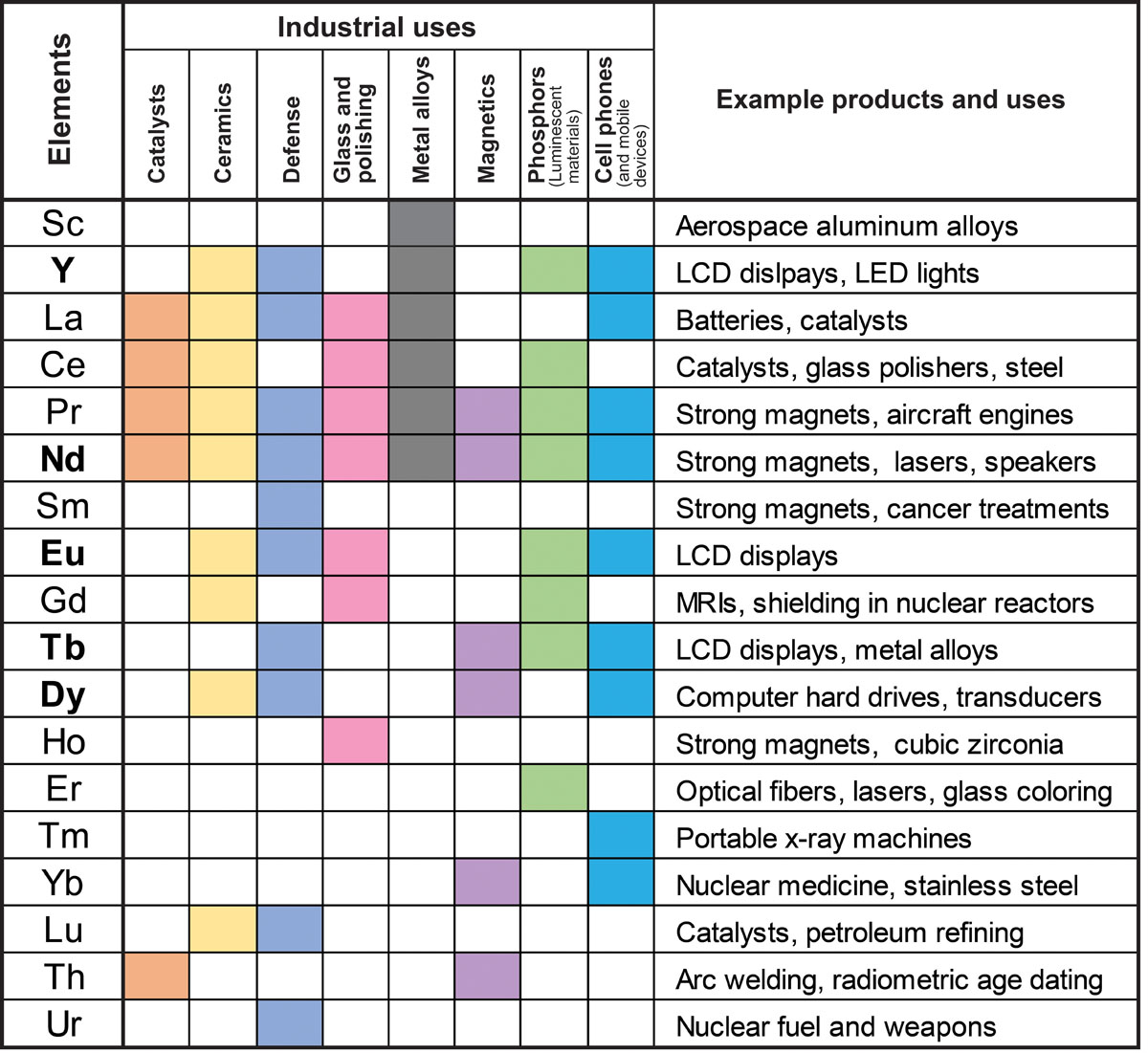
The Chinese almost got away with it, and that is but one reason the trade negotiations are so complicated and hard fought, but necessary. Donald Trump fights for reciprocity and fair competition.
The need to develop Thorium based Nuclear Energy as the major electric energy supply. 1. A million years supply at today’s consumption levels.
We live in challenging times with enormous environmental challenges. It takes a lot of energy to clean up the mess we have generated over the ages. It would be a shame to use up our remaining coal, oil and gas to produce the electricity needed to clean up. Oil coal and gas will eventually be depleted and we need to save some for our great grandchildren so they can enjoy flying like we have become accustomed to. Like the famous conservationist Sarah Palin once said: “for when it’s gone, it’s gone.”
The need to develop a Thorium based molten salt fast breeder nuclear reactor to develop our energy needs for the future can not be overstated. Lest anyone should be threatened by the words fast breeder, it simply means it uses fast neutrons instead of thermal neutrons, and breeder means it produces more fissible material than it consumes, in the case of Thorium the ratio is about 1.05.
There is enough Thorium around to last for a million years at today’s worldwide electricity generation levels. Uranium is in short supply. The consumption exceeds production, and the worldwide major importer of Uranium is the U.S. (The fact that we sold 20% of our uranium ore to the Russians did not help)
There are of course the sustainable energy sources such as wind, solar, hydroelectric, biomass, geothermal, tidal and wave energy, and they should be pursued where economically and environmentally appropriate. These are a separate but important subjects.
Climate panic. New terms to use for climate change according to the Guardian (U.K.)
“We want to ensure that we are being scientifically precise, while also communicating clearly with readers on this very important issue,” said the editor-in-chief of the British newspaper the Guardian, Katharine Viner.
To accomplish this the Guardian suggested these new terms to replace the old ones.
Old term : “climate change” New terms: “climate emergency,” “climate crisis,” “climate breakdown”.
Old term: “global warming”. New term: “global heating“.
Old term: “climate skeptic” New term: “climate science denier”
In October, the UN IPCC (Intergovernmental Panel on Climate Change) said carbon emissions must halve by 2030 to avoid even greater risks of drought, floods, extreme heat and poverty for hundreds of millions of people.
Lucky for us, we still have a beautiful world around us and it has not suffered a thermal runaway yet, even though the yearly CO2 emissions have doubled since 1982. But, for most of this time we have worldwide satellite and other data to see and verify how the global ecosystem has responded to this unprecedented CO2 increase. As every true scientist knows, validation by observation beats theoretical models every time.
Let us concentrate on just one aspect of weather: Tornadoes. They occur when there is cold, dry atmosphere next to warm, wet air, usually on each side of the jet stream. We are having a tornado outbreak right now
This is the second longest-streak without an EF5/F5 tornado since records began in 1950 and it is just the second time dating to 1950 the U.S. has gone five years or longer with no twisters rated EF5/F5.
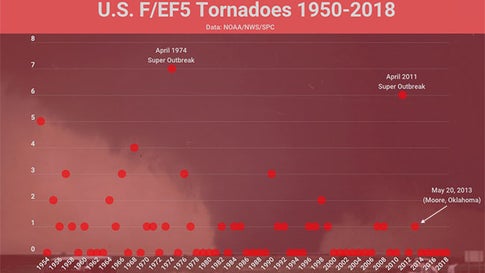
The number of F/EF5 tornadoes in the U.S. by year from 1950-2018.
(Data: NOAA/SPC; Graph: Infogram) As we can see from the chart, catastrophic tornadoes are in a slight downward trend.

The number of tornadoes are well within the normal range, and no supertornadoes yet.
The amount of hail is running below normal, which is good.

What we have is a much better reporting of tornadoes and hail and the damage it causes, accompanied with the explanation “climate change” or climate emergency or words to that effect. Meanwhile, this climate observer dubbed climate science denier still goes by observations.
 Len Bilén's blog, a blog about faith, politics and the environment.