Today we read in John 2, that Jesus turned water into wine, cleansed the Temple, and when the Jews demanded a sign he gave them just one sign (which they of course did not understand).
Genesis 2 left us with the idyllic Eden, no diseases existed yet. But God created us with free will, the ability to do independent critical thinking, and the inevitable fall is then described in Genesis 3 . The problem is, after eating from the tree of the knowledge of good and evil, (not an apple tree) and in so doing we think we can build a better world without God.
The question to ponder is: Why did God create us with a free will? He knew the result from the beginning, and knew He would have to send His Son to redeem us back to Himself. In fact He knew it from before the beginning: “All inhabitants of the earth will worship the beast—all whose names have not been written in theLamb’s book of life, theLamb who was slain from the creation of the world.” (Revelation 13:8, NIV)
Answer: We are created in God’s image, male and female, not so much physical, but spiritual, and free will is part of the package. Without free will there is no fellowship with God, only puppetry.
Psalm 1 is a beautiful poem about righteous living, and only one person could fulfill all the conditions mentioned, the exception to ” There is none righteous, no, not one” (Romans 3: 10)
Today’s reading of the Bible begins with John 1: 19-51. John the Baptist testified about the Messiah: “Make straight the way for the Lord”. When he met Jesus he referred him as “The Lamb of God” that “takes away the sin of the world”, and “this is the Son of God”. Jesus called his first disciples, Andrew and Peter, Philip and Nathaniel.
Genesis 2 tells of how God created woman out of man, showing that creation was not complete without man and woman as a unit. This must be taken spiritually, since in Genesis 1 he already created man in His own image, male and female. God’s design is one man, one woman, one lifetime. This would still be the case if we let God chose our mate. If we had followed God’s intent, many sicknesses would not exist, especially sexually transmitted diseases. “He who finds a wife finds what is good and receives favor from the Lord.” Proverbs 18:22
To find out how God created woman we move to verse 21 So the Lord God caused the man to fall into a deep sleep; and while he was sleeping, he took one of the man’s ribs and then closed up the place with flesh. 22 Then the LORD God made a woman from the rib he had taken out of the man, and he brought her to the man.“The rib” is from the Greek Septuagint translation of the Old Testament. The original Hebrew meaning is “took part of the man’s side“, but since the Greek Septuagint was the most used version of the Scriptures for the early Christians, the rib won.
Don’t get stuck on the detail if it was from the side or from a rib. That is not the point of the story. Some take it to only mean “the two shall be one flesh” is only for procreation, but it is more than that. I can attest it works, having been married now to my wife for over 57 years. It works through communication and fellowship with God. This fellowship is broken in Genesis 3 and forward in the Old Testament.
The Holy Bible is the most influential book ever written. According to Wikipedia it has been translated in its entirety into 724 languages, and the New Testament has been translated into 1617 languages. At least one part of the Bible has bee translated into 3,589 languages, and more translations are coming every year, especially from the Wycliffe translators.
Both the New Testament and the Old Testament begin with the words “In the beginning”.
Genesis 1 deals with the physical creation with spiritual emphasis, laying the groundwork for spiritual understanding of how and why we exist.
We are existing in time and space. The question is: What was there before time and space existed, before the beginning?
Answer: God, existing in three persons, God the Father, God the Son (the Word) and God’s Spirit, (the Holy Ghost).
The Three-in-one God alone are eternal, everything else, including time and space, is created.
Another Question: Why did God say “it was good” for day 1,3,4 and 5 but not for day 2 and it was very good after day 6?
Answer: The ecosystem is a work in progress and will function differently for each phase and finally come to completion when all parts are set in place, which includes people. We are responsible to God to be good stewards of the earth and leave it a better place than we found it. The main regulator of temperature on earth is the clouds. They cool by day and warm by night. The time of day they appear is also very important, and there is no risk for the earth to overheat.
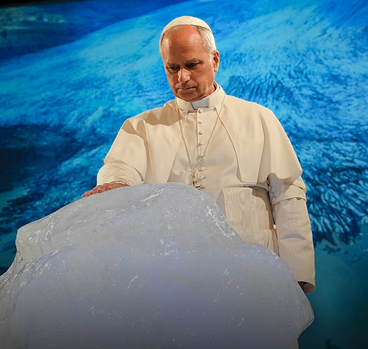
Pope Leo XIV, the newly elected pope, has recently championed the Vatican’s plan to become the world’s first carbon-neutral state by developing a large solar farm on land near Rome. This initiative is inspired by the environmental legacy of Pope Francis and aims to generate enough electricity to meet the Vatican’s needs and potentially provide excess energy to the local community. The Vatican’s efforts are part of a broader push for climate action, with Leo XIV actively promoting the transition away from fossil fuels and emphasizing the moral imperative of environmental stewardship. He also took part in the “Raising Hope for Climate Justice” International Conference in Castelgandolfo, Italy on Oct 1, where he blessed a chunk of a Greenland iceberg. See the picture:
Pope Leo asked eloquently: “What must be done now to ensure that caring for our common home and listening to the cry of the earth and the poor do not appear as mere passing trends or, worse still, are seen and felt as divisive issues?”
“Everyone in society, through nongovernmental organizations and advocacy groups, must put pressure on governments to develop and implement more rigorous regulations, procedures and controls,” the pope said.
“Citizens need to take an active role in political decision-making at national, regional and local levels,” he said. “Only then will it be possible to mitigate the damage done to the environment.”
What they still do not know is that rising CO2 levels is responsible for less than 10% of the climate change, and water in all its forms; ice, water, water vapor and clouds is responsible for over half of climate change. Land use changes are also more important. Let me explain it further:
Many years ago, around 1976 Dr. James Lovelock bought a number of Hewlett Packard 5840 Gas Chromatographs to be set up in some of the most remote places of the earth to study pollution and its effect on the climate. What he found was an unexpectedly large amount of dimethylsulphide (DMS) in the atmosphere, and that acted as a
condensation point for cloud formation. He was then a longtime paid consultant for Hewlett Packard, so he came over from his native England a couple of times a year, always willing to hold a seminar for us engineers working at Hewlett Packard Analytical, and at one of them he sprung “Daisy-world” on us before it was published; mostly to see if we could poke holes in his hypothesis. It involved a world that consisted of only two flowers, black daisies and white daisies. The computer simulation starts out with a cold world and a weak sun. The sun slowly warms up (about 1 percent every ten million years), and at some time suddenly black daisies appear and cover the earth. This warms the earth some more and white daisies appear. As the sun varies in intensity the mix of white and black daisies changes and this keeps the earth at a stable temperature, as they have different reflective properties. He then went on to say that the whole earth is like a living organism. Some time later he presented the paper and afterwards we asked him how it was received. “You won’t believe it”, he answered. ”Now there are people who actually believe the earth is a living organism. They demand follow-up articles that justifies their belief.” He had partly himself to blame, the name he had chosen was “the GAIA hypothesis,” Gaia being the Mother Earth Goddess. Talking about religion the Mother Earth people now had their goddess, and expressions like. “The earth has a temperature” became commonplace. For me, being a Christian I read with wonderment what God has to say about Creation and the Ecosystem.
Starting in Genesis 1:1; In the beginning God created the heavens and the earth. This can be described in scientific terms: From nothing God created space and matter. What happened to “In the beginning”? It turns out that matter has to be accompanied with space or it will not work. And time is a derived property from the existence of matter and space. Without space and matter time does not exist. So the creation of matter and space also defined the beginning of time. What about God? The laws of physics tells us you cannot create something out of nothing. This proves that we and everything else cannot possibly exist. But we do, and therefore there must have been something existing before anything existed. This is God, and He can be defied in one word: Presence. When Moses saw the burning bush he asked who it was. And God answered “I am that I am”, in a way describing the eternal presence, without beginning and end. This is the God I believe in: Out of time and space since He created it, and also in time and space since it is part of His creation.
The expression “in the beginning” is in Hebrew bereshit which means in the beginning. The same phrase begins the gospel of John 1:1 “Inthebeginning was theWord, and theWord was with God, and theWord was God.” Here the word translated beginning is “Arch” like in archangel and means “the chief” or “the most important one’ referring to the Word. It is in past tense which means that the Word existed before the beginning. Another reference is found in Titus 1:1 “inthe hope of eternal life, which God, who does not lie, promised before thebeginning of time,” In this verse the word eternal and the word time is in Greek aionion , which means a very long time, like the time span of a dynasty. Nowadays eon has a meaning of a thousand million years in Geology and Astronomy, but the original meaning is a very long time which may or may not be defined. It is sometimes translated of the ages. Here is a song that spiritually speaks to me:
John 21 tells of the eighth miracle of Jesus. This miracle, a great catch of fish happened after Jesus resurrection and was a sign of new beginnings. Jesus reinstated Peter and told him: “Feed my sheep.”
Exodus 12 tells of how God instituted the Passover. The name comes from the action of the night the angel of death came to kill every firstborn in Egypt; if he saw the blood of the pascal lamb om the doorposts and the lentil of the house, he would pass over that house. The chapter is fantastic, read it and marvel!
In Exodus 13 the feast of unleavened bread is defined and the consecrating of the firstborn to the LORD. The Hebrews have escaped from Egypt, and a proposed route is suggested.
John 20 deals with the resurrection, and Jesus was not there, only his grave clothes, strips of cloth, not the “Turin Shroud.” It was the first day of the week and Jesus showed himself to all the disciples except Thomas. He doubted their testimony, and it is from this we have the expression “Doubting Thomas.” Later, when even he saw Jesus, he bowed down and worshiped him saying “My Lord, and my God”. Jesus also gave the promise they would receive the Holy Spirit.
Exodus 10: Two more plagues, the plague of locusts and the plague of darkness. For these two plagues the LORD hardened Pharaoh’s heart.
In Exodus 11 Moses and Aaron proclaimed the tenth and final plague: The death of the firstborn. Interestingly enough the plagues of Egypt are also in the Quran, four are the same, five are different, and one is missing altogether. Guess which one!
Psalm 11 has the phrase “flee as a bird to the mountain”, which bring back memories of songs we used to sing in choir.
John 19:16b-42. I took the liberty to incorporate all the “seven words of Christ on the cross.” This requires to take passages from the Gospel of Luke, as well as from the Gospel pf Matthew or Mark. It helped me a lot to get the time-order of events as well as the completeness of Christ substitutionary sacrifice on the Cross. It is finished!
In Exodus 9 there are three more plagues, the plague of livestock, the plague of boils and the plague of hail. In the fifth and seventh plague Pharaoh’s heart remained hard, but for the sixth plague the LORD hardened Pharaoh’s heart.
John 18:28-40 deals with the last 24 hours of Jesus’ life, from the trial before Annas and the Sanhedron Jesus was paraded before Pilate, seeing a way out, Pilate sent him to Herod, who sent him back to Pilate, Pilate offered to release Jesus or Barabbas and the people demanded that Barabbas be released.
In Exodus 4 God gave Moses his call. At first Moses came up with one objection after another, but God persuaded him with signs that he must go back to Egypt, face Pharaoh and lead his people.
In Exodus 5 Moses and Aaron went to Pharaoh and asked for a 3 day reprieve for their people so they could go and worship God. Like all dictators Pharaoh reacted to this petition by making life even more miserable for the Hebrews; he wanted them to gather their own straw and still make as many bricks as before. The Hebrews blamed Moses for stirring up trouble for them.
And in Exodus 6 the LORD (Jehovah) promised deliverance from Pharaoh and He would give them the land He had promised Abraham. The narrative continues with an interlude where the names of the heads of the clans of Israel are listed. Moses protested and did not want to talk to Pharaoh any more, so Aaron would have to do the speaking.
John 18:1-27 deals with some of the last 24 hours of Jesus life, the prayer in the garden of Gethsemane and the subsequent arrest of Jesus, the trial before Annas, Peter’s first denial, Jesus trial before Caiaphas, Peter’s second and third denial and the cock crowing.
Exodus 3 tells where God revealed Himself to Moses in the form of a burning bush and declared “I am that I am”. Jesus made a similar declaration in John 8:58 “Before Abraham, I am”.
In the Septuagint Psalm 9 and Psalm 10 belong together. They speak of God’s faithfulness and the only temporary victories of the wicked one.
John 17 is commonly known as Jesus’ high priestly prayer. In some conservative circles it is also called “The Lord’s prayer.” In it Jesus prayed for himself, then he prayed for his disciples followed by prayer for all future believers. In the end of the chapter he prayed that the believers will see his glory, the glory God gave him before the creation of the world.
A few hundred years has passed since the end of Genesis. Exodus 1 tells how the Hebrews multiplied and became a perceived threat to the Egyptians. The Egyptians told the Hebrew midwives that every boy they delivered must be thrown into the Nile, but every girl were to be let to live.
Which seamlessly leads into Exodus 2, how Moses when he was born was placed in a papyrus basket, which then was thrown into the Nile and the child was left crying in the reeds. Pharaoh’s daughter heard it, picked him up and asked her servant to find somebody to nurse him. Of course she found Moses’ own mother to nurse him. After he was weaned Moses grew up in Pharaoh’s household and got educated. He did remember he was a Hebrew, so when he saw an Egyptian mistreat a Hebrew he killed the Egyptian. This became known and Moses fled to Midian, where he spent 40 years tending flocks. This is great reading.
 Len Bilén's blog, a blog about faith, politics and the environment.