At first glance there is not much that combines the New and old Testament readings selected for today. In John 6:1-24. Jesus performed miracles 4 and 5 recorded by the Apostle John, feeding five thousand (plus women and children) and then during the night walking on water.
Then in the Old Testament Genesis 11 it tells about the Tower of Babel, and how different languages arose, all by being disobedient to God.
Then again in Psalm 3 David prayed earnestly when he fled from his son Absalom.
The common thread is we always seek to get some favors from God, and thus be able to control the outcome. But God may have other plans for us.
Today we read in John 5:31-47 how Jesus defended His testimony.
In Genesis 9 God established His covenant with Noah (The Noahic Covenant), and as a sign He established the rainbow in the sky. Noah planted a vineyard, got drunk and exposed his nakedness. This lead to “the curse of Ham,” which gave the excuse that the black race was destined for servanthood and slavery. It was in reality the curse of Canaan, the original inhabitants of the yet to be promised land. Ponder that!
Genesis 10 is a genealogy of the descendants of Noah. It describes how the earth was repopulated. This is quite interesting to see how the different tribes developed.
The common thread for today is Jesus redefining the meaning of the Sabbath and Noah being part of the new beginning. Psalm 2 defines Jesus as the Son and God the ruler of all and mankind still trying to do it all by themselves at no avail.
John 5:1-30, describes how Jesus healed a man at the pool of Bethesda on the Sabbath, which offended the Jews. In addition Jesus claimed to be equal with the Father, for which the Jews sought to kill him, but Jesus defended His testimony.
Genesis 7 tells of Noah, having completed the ark, took with him seven (pairs) of clean animals and two of unclean animals, and also birds. The aquatic life did just fine. After the animals had entered, God shut the door and it rained forty days and forty nights.
Genesis 8. The water receded and Noah sent out a raven and later a dove that returned empty. The second time the dove was sent out, it returned with an olive branch in its beak. This has now become the universal peace symbol. After exiting the ark Noah built an altar and sacrificed from the clean animals. God made a promise to Noah: “While the earth remaineth, seedtime and harvest, and cold and heat, and summer and winter, and day and night shall not cease.”
Psalm 2 tells of what happens when “the heathen rage” and this psalm speaks of the fight that is going on even today.
John 4, speaks about the first real evangelist spreading the good news of Christ the Messiah. It is the woman at the well, a Samaritan, scorned and rejected by her many ex husbands, yet used by God to tell the good news.
Genesis 6 . Sin and wickedness got worse and worse on earth. God saw it and decided to start over. But Noah, his wife, his three sons and their wives, eight in all found favor with God, so God told him to build an ark. This Noah did, and it was the biggest ship built until the time of Ptolemy (around 215 BC.)
Ponder that the first evangelist was a scorned woman who happened to meet Jesus, and that Noah, being obedient to God built the ark on dry land, too big to be of any use unless there was going to be a giant flood. This takes faith!
Today we read John 3, the new birth chapter; you must be born again (literally: from above), the new birth is necessary to enter into the Kingdom of God; John 3:16 is the most quoted verse in all the Bible.
Genesis 4 tells of the results of original sin with the story of Cain and Abel and the beginning of animal sacrifice.
The take home for today is there are two births, the physical birth and the spiritual birth (the birth from above), the first murder, the first man (Enoch) to be carried directly to God rather than die. (because ha walked with God).
Today we read in John 2, that Jesus turned water into wine, cleansed the Temple, and when the Jews demanded a sign he gave them just one sign (which they of course did not understand).
Genesis 2 left us with the idyllic Eden, no diseases existed yet. But God created us with free will, and the fall is then described in Genesis 3 . The problem is, after eating from the tree of the knowledge of good and evil, (not an apple tree) and in doing so we think we can build better without God.
The question to ponder is: Why did God create us with a free will? He knew the result from the beginning, and knew He would have to send His Son to redeem us back to Himself. In fact He knew it from before the beginning: “All inhabitants of the earth will worship the beast—all whose names have not been written in theLamb’s book of life, theLamb who was slain from the creation of the world.” (Revelation 13:8, NIV)
Answer: We are created in God’s image, male and female, not so much physical, but spiritual, and free will is part of the package. Without free will there is no fellowship with God, only puppetry.
Psalm 1 is a beautiful poem about righteous living, and only one person could fulfill all the conditions mentioned, the exception to ” There is none righteous, no, not one” (Romans 3: 10)
Today’s reading of the Bible begins with John 1: 19-51. John the Baptist testified about the Messiah: “Make straight the way for the Lord”. When he met Jesus he referred him as “The Lamb of God” that “takes away the sin of the world”, and “this is the Son of God”. Jesus called his first disciples, Andrew and Peter, Philip and Nathaniel.
Genesis 2 tells of how God created woman out of man, showing that creation was not complete without man and woman as a unit. This must be taken spiritually, since in Genesis 1 he already created man in His own image, male and female. God’s design is one man, one woman, one lifetime. This would still be the case if we let God chose our mate. If we had followed God’s intent, many sicknesses would not exist, especially sexually transmitted diseases. “He who finds a wife finds what is good and receives favor from the Lord.” Proverbs 18:22
The Holy Bible is the most influential book ever written. According to Wikipedia it has been translated in its entirety into 724 languages, and the New Testament has been translated into 1617 languages. At least one part of the Bible has bee translated into 3,589 languages, and more translations are coming every year, especially from the Wycliffe translators.
Both the New Testament and the Old Testament begin with the words “In the beginning”.
Genesis 1 deals with the physical creation with spiritual emphasis, laying the groundwork for spiritual understanding of how and why we exist.
We are existing in time and space. The question is: What was there before time and space existed, before the beginning?
Answer: God, existing in three persons, God the Father, God the Son (the Word) and God’s Spirit, (the Holy Ghost).
The Three-in-one God alone are eternal, everything else, including time and space, is created.
Another Question: Why did God say “it was good” for day 1,3,4 and 5 but not for day 2 and it was very good after day 6?
Answer: The ecosystem is a work in progress and will function differently for each phase and finally come to completion when all parts are into place, which includes people. We are responsible to God to be good stewards of the earth and leave it a better place than we found it.
The fool hath said in his heart, There is no God” (Psalm 14:1)
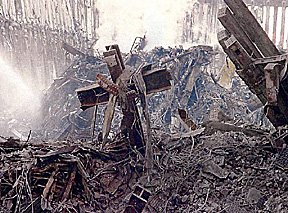
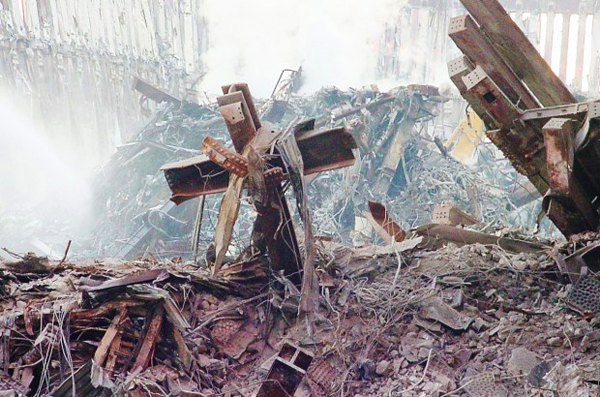
The original location where the iron cross was found.
For Muslims the cross is an offense since it contradicts the Holy Quran. For them Jesus did not die on the ctoss but was directly translated to God. For atheists and humanists the cross is an offense since it is to them suggests we need a redeemer, and to them it is the stench of death. But to us who believe it is the symbol of redemption and new eternal life in Christ. If they were not pricked in their hearts when they see the cross they would not be offended.
Christ died on the cross at Ground Zero.
We have only one risen hero.
But the fools reject grace,
stay condemned, cannot face
The truth in The Cross at Ground Zero.
For God so loved the world, that he gave his only begotten Son, that whosoever believeth in him should not perish, but have everlasting life. For God sent not his Son into the world to condemn the world; but that the world through him might be saved. (St. John 3:16-17)
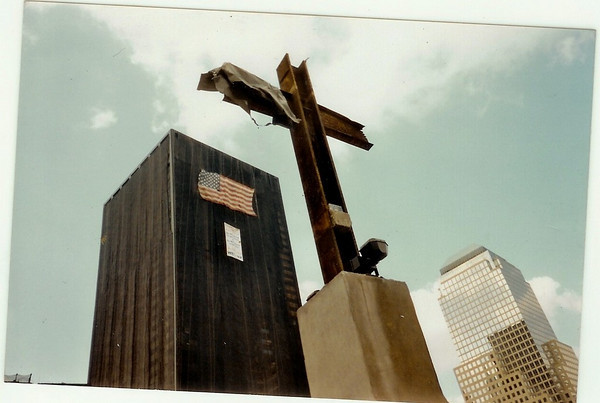
An intermediate location for the cross
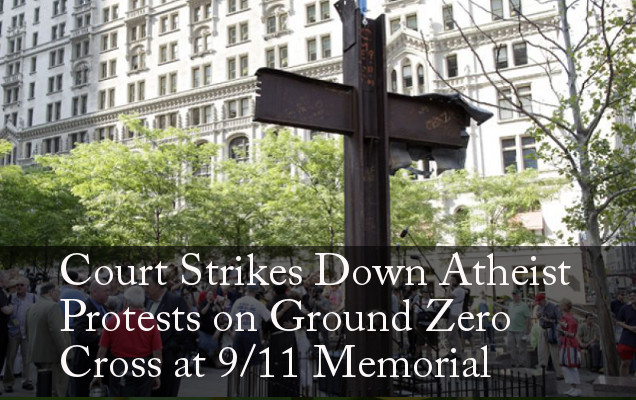
The final place for the Iron cross near the 9/11 museum.
In 2015, the guest host on OAN shared these thoughts on Aug 28, in preparation for 9/11.
These were the final words of Governor Sarah Palin after a successful week anchoring “On Point” with the One America News.
Governor Palin is a true servant. Her parents, Chuck and Sally Heath, worked at the stinky Fresh Kills landfill in Staten Island, New York in January and February 2002 as part of a federal Department of Agriculture program.
In a telephone interview, Mr. Heath said he and his wife had worked to keep sea gulls and rats from scavenging the human remains in the debris. Mr. Heath, then 70, a retired science teacher, and Mrs. Heath, then 68, a retired secretary, had worked for the Agriculture Department for 15 years. They traveled around the world dealing with “nuisance” animals like rats and bears.
“A lot of people just didn’t like the job, it was kind of a morbid thing,” he said of the work at the landfill. “But I thought it was part of history.”
This is the attitude of a servant.
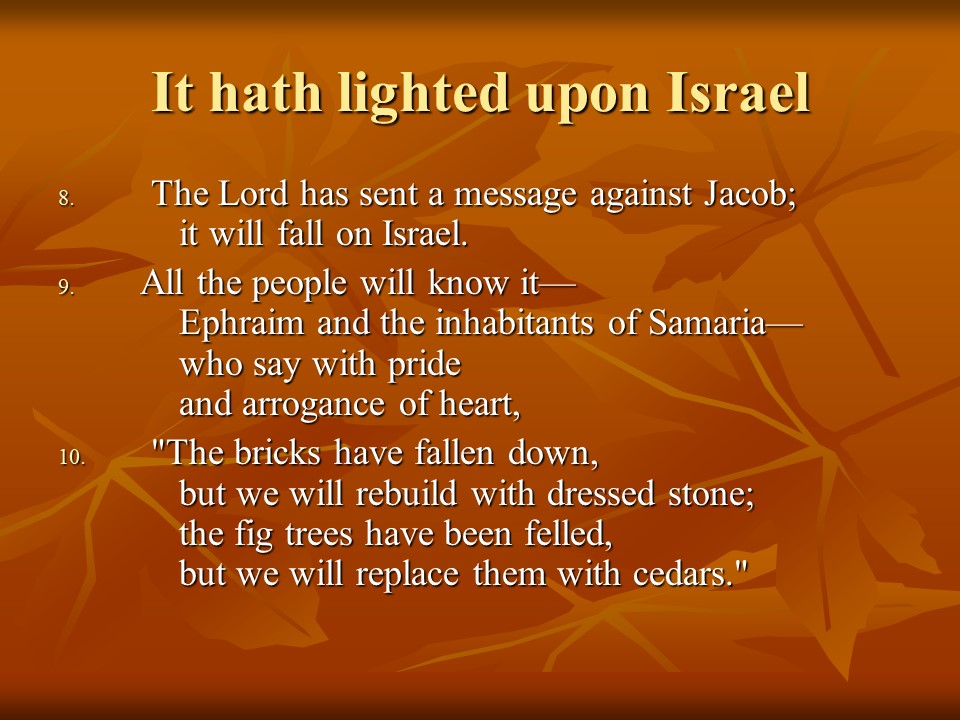
After the 9/11 attack the country got together to rebuild the country again. Many quoted Isaiah 9:10 “The bricks have fallen down, but we will rebuild with dressed stone; the fig trees have been felled, but we will replace them with cedars.”
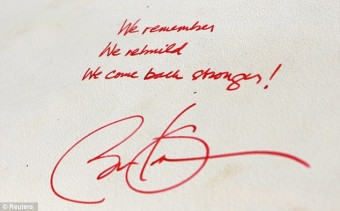
Isaiah 9:10 has been quoted by politicians as a message of resilience and hope. This message was scribbled by President Obama in 2012 on a building near Ground Zero. Other Politicians have quoted Isaiah 9:10. John Edwards quoted it directly on the third anniversary of 9/11, not realizing that the message is not one of hope, but of utter arrogance. Today’s message by President Biden is “Build back better”, same message, one of utter arrogance. It is clear from the context:
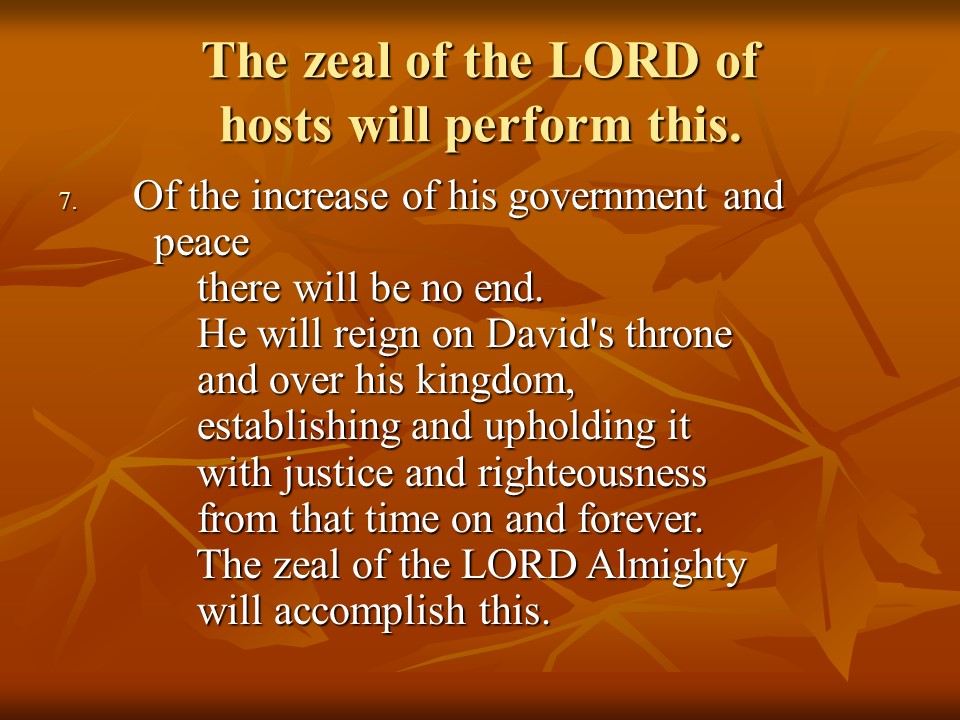
What comes before the message that came down on Israel? Of course verse 6 and 7:
Child born: Shows the humanity of Christ
Son given, shows the deity of Christ
It also shows the unity of God as Father, Prince of Peace as Son and Wonderful Counselor which is the Holy Spirit, three aspects of God, three in one, the triune God, the Trinity.
This message brings us full circle back to Jesus Christ, the one who died at the original Ground Zero, but rose again. There will be no “build back better” unless there is a revival, a return to God, a great awakening. This present government has by its actions shown that American Exceptionalism is dead, we will do better by abandoning our citizens and allies and negotiate with terrorists who will be fully installed in Afghanistan on 9/11. We will from now on be under Global Governance.
The aim of China is to be the dominant force in the world by 2030. Recent events have made them speed up the time table by at least 5 years after successfully interfering in the last election by openly favoring Joe Biden. The greatest fear of the Chinese Government are the 300 million or so closet Christians, a number that just keeps growing. The other fastest growing churches are the Christians in Iran and Afghanistan. In Myanmar Christians are now openly persecuted and some are killed, in Pakistan many are persecuted for blasphemy. There are now more Christian martyrs than ever in history, and even our own State Department considers evangelical Christians our greatest threat, greater than Taliban.
Pray for a worldwide revival of God’s people and an even greater awakening of Biblical Proportion!
Matthew 7:21-29 We are coming to the end of the sermon on the mount. It grows to a crescendo with people claiming to have done good deeds, proclaim prophesies and perform miracles in Jesus’ name. And Jesus answered them: “I never knew you”. I took the liberty to add my own discovery of the meaning of these verses. The chapter ends with the parable of the foolish and the wise builders.
Leviticus 5 completes the description of the sin offering and continues with the guilt offering.
Leviticus 6 tells of the restitution necessary in the burnt offering, the grain offering and the sin offering,
And Leviticus 7 defines the guilt offering and the peace(fellowship) offering. It furthermore forbids the people to eat fat or blood. In a fellowship offering the priest must get his share, and the share is specified.

 Len Bilén's blog, a blog about faith, politics and the environment.