Duck, Duck, Go bankrupt, California’s energy policy.

Depend on renewable power

is chancy in sunshine or shower.

California’s surge

is becoming a scourge;

the losses add up every hour.

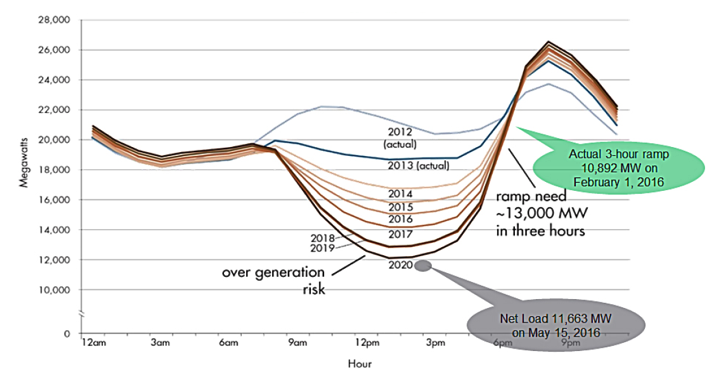
It started innocently enough. In 2012 the California power demand was nearly constant, with power varying 20% from maximum to minimum hourly demand.

Image result for duck curve california

Then California decided to have 50% of renewable energy by 2030, mostly by solar and wind, and passed it into law, but the hydroelectric capacity could not be increased due to “environmental concerns”.

The push for renewable energy has succeeded beyond their wildest dreams, so the goal may be met in 2020, not 2030. There is one major problem.

What can be done when the wind doesn’t blow and the sun doesn’t shine? The electric need must still be met. And therein lies the problem. The sun only shines during daytime, and there is already a surplus of energy in the middle of the day. This affects the prices for peak power, so mush so, that wind and sun generated energy has to pay to feed the grid. They are heavily subsidized, so as long as the amount they have to pay is less than the subsidy the grid will be fed, and the base generation will have to be lowered to stabilize the grid. The prices range from minus five cents/kWh to about 55 c/kWh. (The peak price has been as high as 98 c/kWh during peak demand.

Image result for duck curve california

Burt that is only part of the problem. The non-renewable electricity providers will have to double the electricity production every day between 5 and 8 p.m. every day. Using capacitors to even out the grid variations solves 0.3% of the problem.Some can be done by using the dams for power generation, but the grid is not built to handle the drastically increased demand, and environmental fights makes it impossible to build out the grid. In addition, the dams are far away from the areas that need the electricity, in other words, it is a mess.

And the consumer is left to pay the extra costs, and the taxpayer is left to pay the extra subsidies.

Talking about subsidies: Electric cars are subsidized to the tune of 2500 to 7500 dollars, and they are recharged when? They are driven mostly during daytime, and when people come home they are put in the charger – at 55 c/kWh to the utility.

Clean energy is not cheap, and it is not clean since the non renewable electric production capacity still has to be fully built up for the time when the sun doesn’t shine and the wind doesn’t blow.

Climate Change on trial in San Francisco Wednesday! A Limerick.

The Climate Changes models on trial

Alarmists are still in denial

Elementary flaw

was the models last straw.

The feedback does not move the dial.

Global warming on trial: Global warming goes on trial at 8.00 am this Wednesday, 21 March 2018, in Court 8 on the 19th floor of the Federal Building at 450 Golden Gate Avenue, San Francisco. Court 8 is the largest of the courtrooms in the Federal District Court of Northern California. They’re clearly expecting a crowd. The 8 am start, rather than the usual 10 am, is because the judge in the case is an early bird.

The judge: His Honor Judge William Haskell Alsup, who will preside over the coyly-titled “People of California” v. British Petroleum plc et al., is not to be underestimated. Judge Alsup, as the senior member of the Northern California Bench (he has been there for almost two decades), gets to pick the cases he likes the look of.  Before he descended to the law (he wanted to help the civil rights movement), he earned a B.S. in engineering at Mississippi State University, and as such will actually understand the science of thermodynamics.

For you all who are interested in the scientific arguments I refer you to:

Global warming on trial and the elementary error of physics that caused the global warming scare

For the rest of you I leave you with this graph:

clip_image016

The feedback term is not positive, clouds provide negative feedback, leaving the global temperature feedback term almost neutral.

clip_image028

The outcome of the case: What will His Honor make of all this? My guess is that he will allow our amicus brief to be filed. With his engineering background, he will have no difficulty in understanding why we say that the notion of catastrophic rather than moderate global warming is rooted in the elementary physical error we have discovered.

Therefore, we hope His Honor will ask all parties to provide formal responses to our brief. On any view, it plainly raises a serious question about whether global warming matters at all – a question that strikes right to the heart not only of the case before him but of numerous other such cases now arising in several jurisdictions – and showing some evidence of careful co-ordination.

Conclusion: The anthropogenic global warming we can now expect will be small, slow, harmless, and even net-beneficial. It is only going to be about 1.2 K this century, or 1.2 K per CO2 doubling. If the parties are not able to demonstrate that we are wrong, and if His Honor accepts that we have proven the result set out publicly and in detail here for the first time, then the global warming scare was indeed based on a strikingly elementary error of physics.

The avowedly alarmist position too hastily adopted by governments and international bureaucratic entities has caused the most egregious misallocation of resources in history.

Ladies and gentlemen, we call time on a 50-year-old scam, in which a small number of corrupt and politicized scientists, paid for by scientifically-illiterate governments panicked by questionable lobby-groups funded by dubious billionaires and foreign governments intent on doing down the West, and egged on by the inept and increasingly totalitarian news media, have conspired to perpetrate a single falsehood: that the science was settled.

Well, it wasn’t.  Christopher Monckton of Brenchley

Third time snow in Sahara desert after 40 year absence.

Up to 16 inches of snow has fallen on a town in the Sahara desert after a freak winter storm hit the area on Sunday.

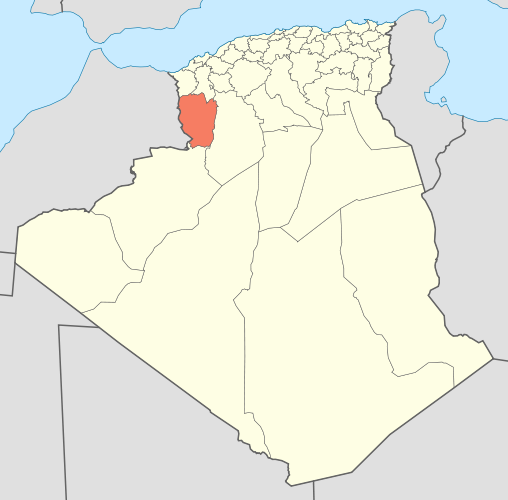
This is the third time in 37 years that the town of Ain Sefra in Algeria has seen snow cover the red sand dunes of the desert.

Snow started falling in the early hours of Sunday morning Jan 7 and it quickly began settling on the sand.

Does this mean global warming is ending and the beginning phases of the next Ice Age has started?

No, not necessary, but it is a consequence of increased water vapor in the atmosphere. You see, in the tropics it is all regulated by the cumulus clouds and thunderstorms and the temperature of the oceans. If the oceans heat up ever so little, they release more water vapor into the atmosphere, and the amount of CO2 is of no consequence. All greenhouse warming is done by the water vapor, since you cannot absorb more than all energy available in the frequency band of absorption of the gas, and since in the tropics water vapor is counted in percent rather than parts per million as is the case of CO2. As the water vapor increases, clouds form and act as a  strong negative feedback to keep the temperature stable in the tropics.

Not so at the poles. On Greenland and on the Arctic ice cap it snows more, and the increased water vapor leads to more storms coming up the Pacific and up the Atlantic. Some of them swirls back into Africa leading to these rare snowfalls.

If it were not for the increased CO2, we would already be back into a new little ice age, but thanks to increased generation of CO2 the onset of the next ice age will be delayed by maybe a thousand years.

Another good thing with more snow at the poles. The poles are getting warmer, and this leads to a smaller temperature difference between hot and cold regions, making for weaker storms, fewer tornadoes and hurricanes, less violent rains spreading over larger regions, all good.

The snow comes earlier and earlier, but it also melts earlier. Blame China for that. They already use 47% of the world’s mined coal, and does not do a good job of cleaning up the exhaust gases despite their claims.

Wither Bitcoin? Up, up, and away, crashing or banned?

Bitcoin was first issued in March 2010 with a value set at $ 0.003/unit.

In May 2010, 10,000 bitcoins were traded for 2 pizzas in Jacksonville, Florida.

Since then the bitcoin price has gone up and down, mostly up, but five times it has gone down drastically, sometimes crashing by as much as 80 percent.

This year it has had a meteoric rise and is now at $18,600 or about six million times its original offering price.

Bitcoin is anonymous trading between a willing buyer and a willing seller, totally safe and untraceable, an ideal vehicle for money laundering and transfer of  money to terrorists and allies alike. It is also the vehicle of choice for ransomware.

So who is keeping custody of the chain of transactions to keep the bitcoin safe and secure?

This is what one might call the ultimate revenge of the geeks. The inventors of bitcoin let the geeks mine more bitcoins as a reward for keeping complete records of all transactions in bitcoin since its conception (heavily encrypted of course). They only had to solve a hashing algorithm made more complicated for every new transaction.  In the beginning it was not very difficult, but now, since one has to find all chains of custody for every bitcoin since the start, and they are distributed worldwide it becomes more and more a drain on the internet and computing power in the servers.

It is now so bad, that even though there are only 17 million bitcoins in the world today, to keep track of them and mine some more is now consuming 1/700 of the total electricity generated in the world, or about 35 TeraWatthours. At a production cost of about 6 cents per KiloWatthour  it  would come to about 2 billion dollars to maintain 17 million or over a hundred dollars per bitcoin in electricity consumption alone.

It will only get worse from now on. While mining of new bitcoins are getting more complicated exponentially, the issuing of new bitcoins will become stagnant and will stop around 30 million, when it will consume about 60% of the world’s electrical energy.

The Greens will not like it. Bitcoins already belch  more than 17 million tons of CO2 into the air annually, set to double every two years.

On the other hand , it is transactions that are free of the tyranny of the one world banking system.

This is unsustainable. People will stop maintaining the chain of custody of all transactions and the scheme will collapse.

When?

Who knows?


And then there was one. U.S. alone fights climate change the right way.

At the climate conference in Bonn, Germany, Syria signed the so called Paris Accord on Climate Change, leaving the United States alone as a non-signer.

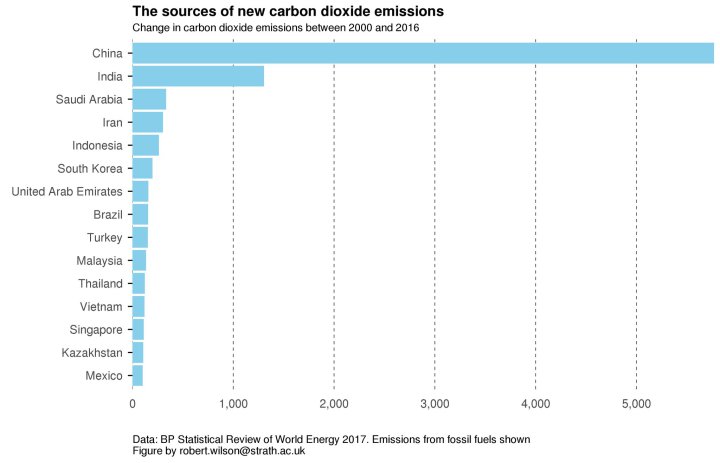
Our European friends are quite upset about this. After all, countries like Denmark and Germany have the highest residential electricity rates in the world to pay for their wind and solar power installed. Here are the countries with reduced CO2 emissions this century:

But if one looks at the absolute decline in CO2 emissions, the U.S. leads the pack hands down:

So, who is the biggest CO2 villain? It is China by 6500 million tons of oil equivalent increase since 2000.    According to the Paris accord China is allowed to emit 6 times as much CO2 as the U.S. And not only that, the U.S. would pay them as one of the “developing” countries to do that!

New term for climate change in advance of Climate Week in NYC: “Existential threat”

The Climate Group Week in New York

attracts every Climate Change dork.

Global Governance bet.

“existential threat”

the Earth is not saved by more pork.

Thanks, Anthony Watts (wattsupwiththat.com) for pointing to this paper:

New climate risk classification created to account for potential ‘existential’ threats

Researchers identify a one-in-20 chance of temperature increase causing catastrophic damage or worse by 2050

From the UNIVERSITY OF CALIFORNIA – SAN DIEGO

A new study evaluating models of future climate scenarios has led to the creation of the new risk categories “catastrophic” and “unknown” to characterize the range of threats posed by rapid global warming. Researchers propose that unknown risks imply existential threats to the survival of humanity.

Well Under 2 Degrees Celsius:
Fast Action Policies to Protect People and the Planet from Extreme Climate Change
Report of the Committee to Prevent Extreme Climate Change
Chairs:
V. Ramanathan, M. L. Molina, and D. Zaelke
Published September, 2017
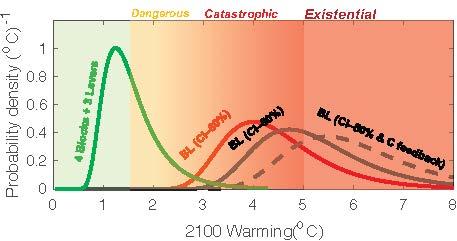
Prominently and up front is a diagram that is supposed to explain everything:
 If we look at the last curve in dotted line they explain everything
BL (CI – 80% & C feedback). They explain that BL beans baseline (whatever baseline they mean is not explained). Then CI – 80%?

What does CI mean?

From the free encyclopedia: The term is usually used within the law enforcement world, where they are officially known as confidential or criminal informants (CI), and can often refer pejoratively to the supply of information without the consent of the other parties with the intent of malicious, personal or financial gain.

Well, that explains a lot, no need to understand the rest.

Switching from coal to pellets to save the environment?

One way governments have been trying to combat climate change is to subsidize renewable energy such as wind, solar and biomass. Wind and solar makes some sense since they do not emit any CO2, but biomass?

Ever since the people began to use fire to cook their food, biomass has been the  fuel of choice. In forested areas wood was preferred, but if there were no trees grass was used, and if there was no grass people used and still use dried cow dung. It is used to cook the meal of the day in an open fire, a primitive stove or a clay oven. It is very polluting, and the fertilizing properties of cow dung is lost, depriving the land of replenishing the ground. The environment would benefit immensely by switching to electric. The fastest and least expensive way to electrify developing countries is to build coal fired plants. The only benefit of cow dung is that it is locally produced, and transportation is one of the hindering factors for modernizing.

The lawmakers in the British parliament are very concerned about Climate Change, and to that end they legislated a de-carbonization project. The DRAX group jumped at the opportunity.

DRAX  is not a take off of Drax the destroyer, it is actually worse.

They used to burn coal. Now they burn biomass.

And it is dirtier.

emissions of particulates from the site [DRAX] were 897 tons last year compared to 382 tons in 2008 when they were still burning coal.”

The power station uses about seven million tons of biomass or wood pellets a year, much of it imported, particularly from the US”

“Last year, DRAX received subsidies of £558 million for its biomass operation, a figure that is expected to rise to around £800 million this year as the third biomass unit comes on stream.”

https://notalotofpeopleknowthat.wordpress.com/2017/08/18/drax-power-station-biomass-emissions-dangerous-worse-than-coal-claim-environmentalists/

So they switched from coal to wood pellets and subsidized it to the cost of about 100 dollars a ton, and since they are producing electricity it is running at less than 40% efficiency. It would be far better to burn them in a cast iron wood/pellet stove, and burn clean at about 80% efficiency. No subsidies needed. Wood pellets or wood briquettes provide a wonderful heat, and it works even if the electricity is gone in an ice storm. And it burns much cleaner than coal or improperly dried wood.

The Great Eclipse of 2017 and Trump voters.

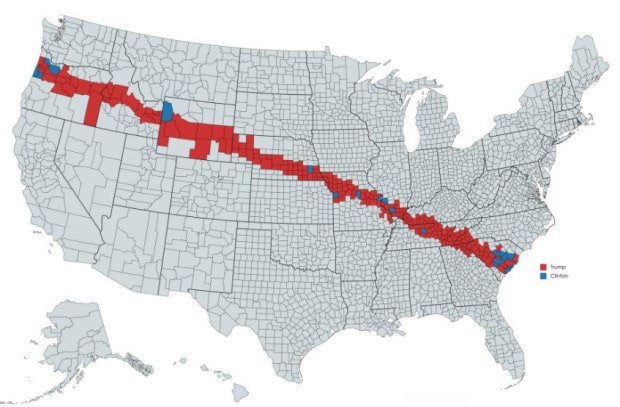
“It has been dubbed the Great American Eclipse, and along most of its path, there live almost no black people,” Ristroph wrote in a mind-numbing, 4,500-word post in The Atlantic.

Boston Globe added this map, showing the path of totality goes almost exclusively through counties that voted for Trump.

But nearly the whole country voted for Trump according to this map.

The map shows the great divide of the country. Republicans are in the majority in rural areas, Democrats dominate the cities, especially the inner cities.

People living in rural areas are different from people dwelling in inner cities in many ways, but I will mention only one thing, their attitude to Climate Change.

Rural people see the sun rise, watch the clouds form, marvel at the tremendous stability of the weather in spite of storms, tornadoes, hail, snow, rain and floods. It is all coming from the sun, and has nothing to do with increasing CO2. Things were worse during the dust bowl years, max temperatures were higher, hurricanes worse, and so on.

They will be vindicated when they experience the sudden drop intemperature during the eclipse. It is all from the sun.

Not so the inner city dwellers. They experience global warming. The heat from the street and the stench from diesel engines are enough to make believers of them. In addition they rarely if ever experience a sunrise and a sunset, and the pollution and decaying buildings convince them global warming is real.

For a city dweller all Climate Change is man made. By en large they do not know about the Ice Age and all the climate changes that has taken place since then, they believe this is unprecedented and disaster looms.

To them everything they see is man-made and even we cannot fix the weather we can sure fix the earth’s climate since we made this mess in the first place.

The great Arctic ice recovery of 2017.

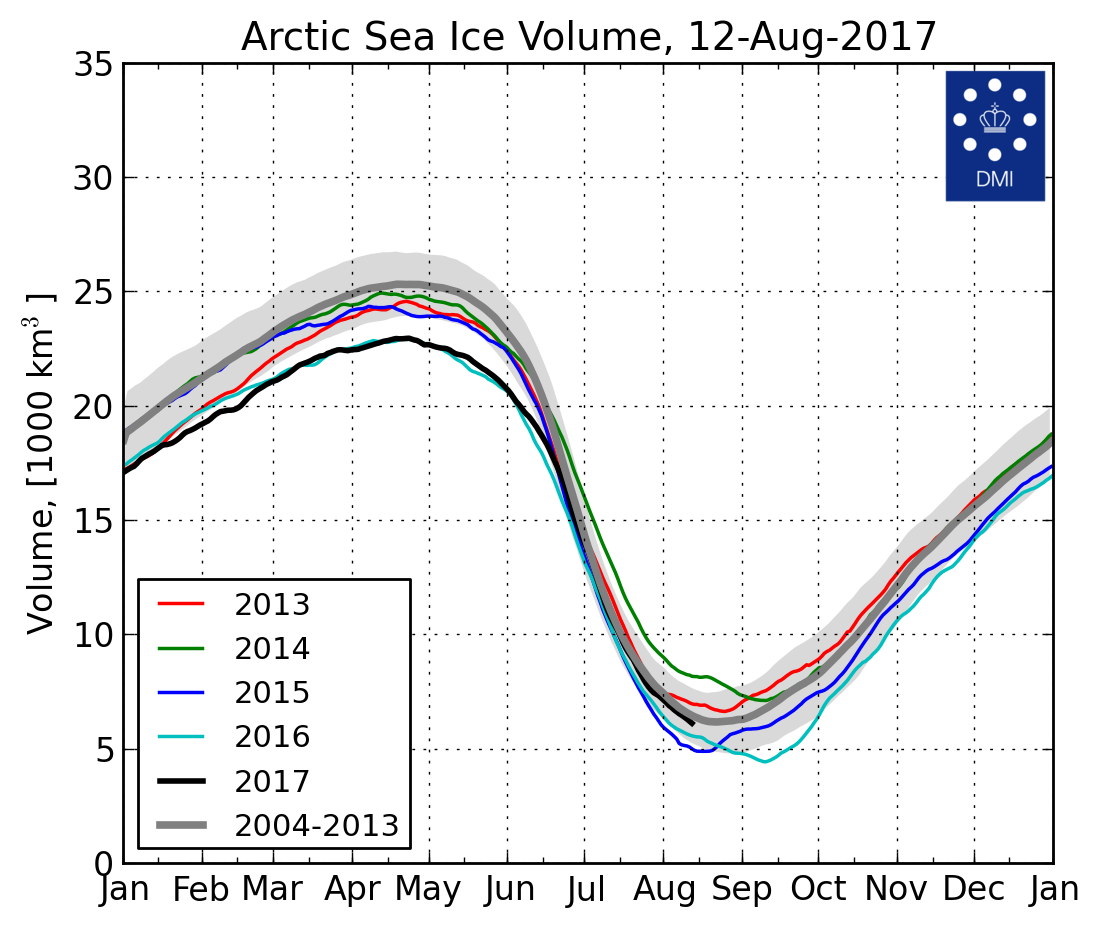
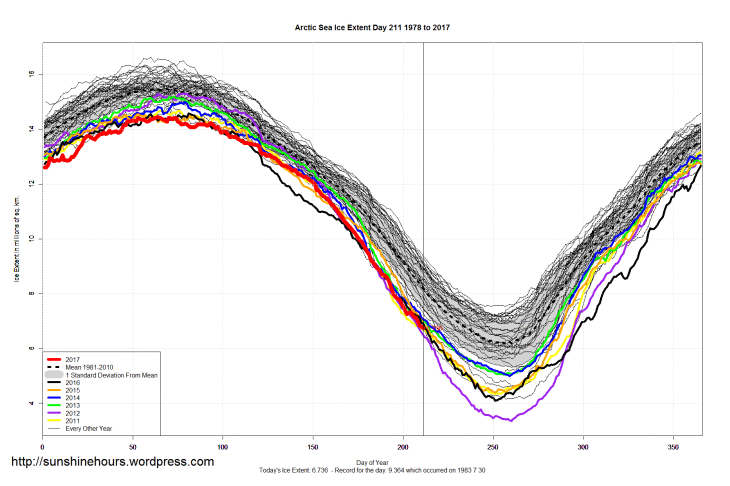
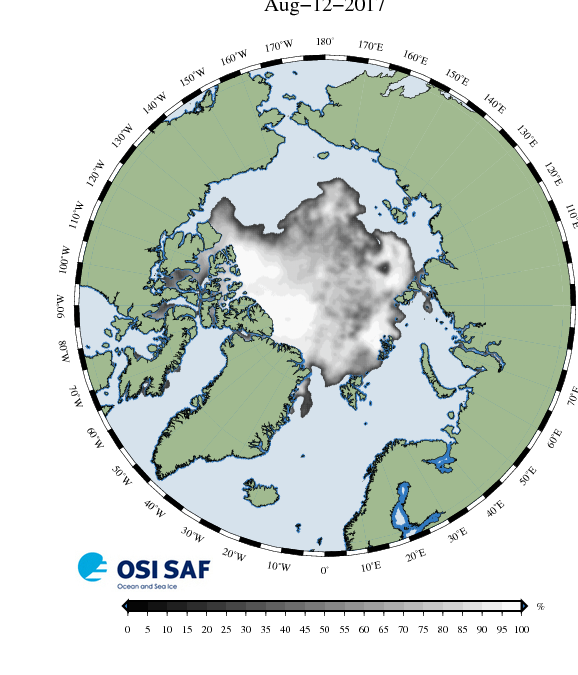
It was very warm in the Arctic above the 80th latitude last winter. Late summer two hurricane strength storms broke up a lot of ice up and transported it south to areas where it was bound to melt. The ice area reached a new low, except for the year 2012, but the ice volume hit a new all time low on Sep 9 2016.

Since then the ice volume has recovered to equal the  previous all time winter low around April 20, 2017, but the ice area hit an all time low maximum as early as March 5.

What happened?

The unusually warm temperatures averaging 7 degrees C above normal with a spike as high as 20 degrees C above normal and no days below was not because of increased CO2, but because it snowed. Anyone that has shoveled snow knows that while it snows it is usually not that cold, especially if the winds are calm. Then, when the snowing stops it gets cold indeed. Nowhere is that shown better than what happened on Greenland this winter.  It snowed and snowed from one winter storm after another starting in the Philippines, raining and snowing over California, regaining strength from the Mexican Gulf and then racing up the Eastern Seaboard snowing out over Greenland.

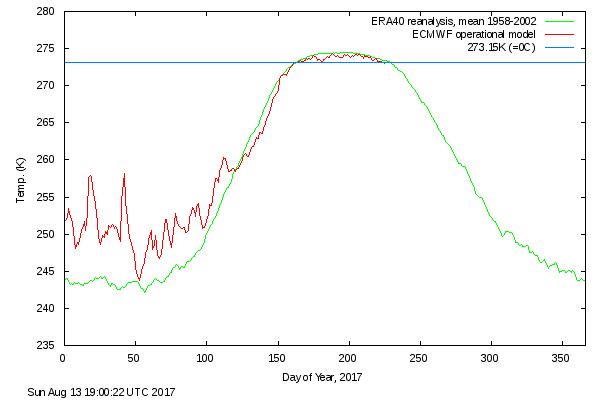
Then on May 5 it all changed. From having been warmer than normal the Arctic became colder than normal, in fact there has been no day since then that temperatures has been above normal. Today, Aug 13 it even dipped below freezing for the first time since summer max, five days before normal.

The ice area will still decrease for another month or so since sea ice does not start forming until temperatures are -4 degree C, but the ice volume is near its minimum since snow season in the Arctic has already started, and new snow on ice stays, and fresh snow has a higher albedo than old, tired ice.

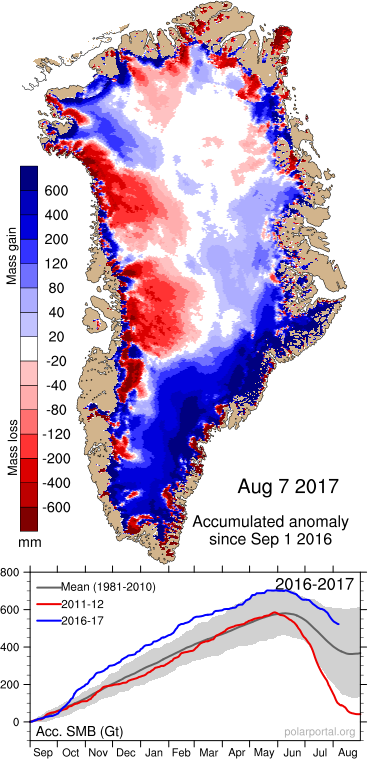
How much more ice? As of today the sea ice volume is 500 to 1000 km3 larger than last two years, not much, but enough to make a trend. In addition the ice on Greenland has increased by 150 km3, reversing many years of decline.

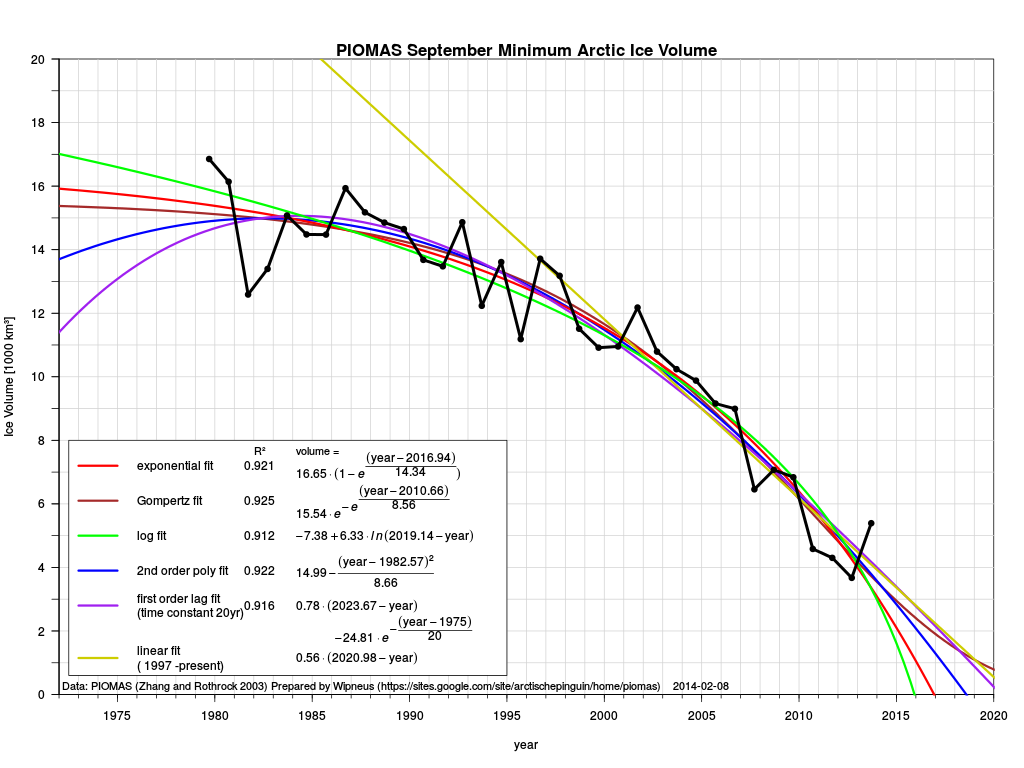
The prediction that the Arctic ice would be melted by 2016 was foolish extrapolation, but the chart looked good at the time.

This year’s minimum will be about 6,000 km3.

The moral of this story. Beware of extrapolations. Don’t trust models, go with observations.

And one more thing. In 2016 the sailboat Polar Ocean Challenge managed to sail through both the North East Passage and the North West Passage in the same season. In 2015 it would have been no problem The North East Passage choke point Cape Chelyuskin was ice free late July. In 2016 it was still ice covered Aug 5, but the first summer storm cleared out the ice plug. This year Cape Chelyuskin is still full of ice

This year they could not have made the journey. There is not enough time left until the North West Passage freezes over.


Sea levels rising? Not so fast, Mr. Gore (and Mr. Obama!)

In Al Gore’s new “documentary” bomb, “An inconvenient sequel” he has wisely backed away from his previous “Documentary” “An inconvenient truth”, where he predicted (in January 2006) that the “point of no return” would happen within 10 years with accelerating sea level rises, more hurricanes, droughts, floods, tornadoes and extreme heat rendering the earth uninhabitable. However, Mr. Gore still defends his claim that the street flooding that occurred during Hurricane Sandy was a fulfillment of his prediction that Manhattan would be underwater due to global warming!

This is Al Gore’s rhetoric. What really speaks is his actions.  He flies all over the world in a private jet spreading his gospel of minimizing CO2 emissions. One time in Gothenburg, Sweden on a cold winter evening he let his limousine idle for the whole time he was making his appearance at the local environmentalist hysteria convention. Sweden has a 2 min limit on idling to save fuel and minimize pollution, so for his carelessness for the environment he got rightfully fined. Then there is the issue with the energy consumption in his houses. His 3 main homes consume as much energy as 34 normal households use.

One of his homes is near the beach in Montecito Ca, an area that would be severely impacted by his predicted sea level rise.

And for that matter , former President Obama is jetting around the world with secret service protection, visiting tropical paradises, that believe it or not have the largest carbon footprints in the world since everything western has to be imported. It is also rumored that he, through agents has secured the former “Hawaii 5-0” beachfront mansion, and we “know” that the Hawaiian islands are sinking fast.

This is all rhetoric. What are the observed facts so far?

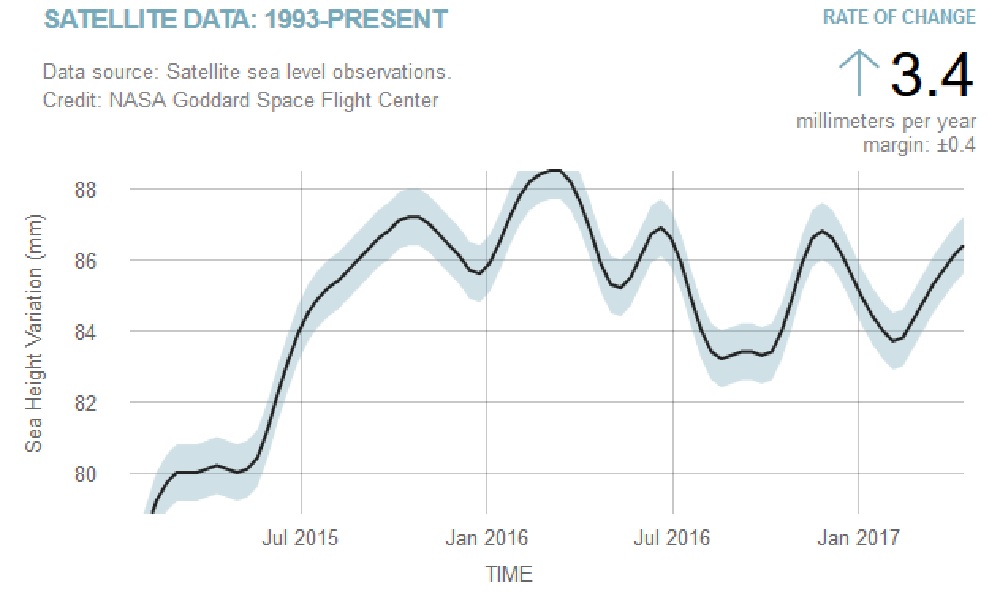
Global average sea levels have not risen at all the last 2 years.
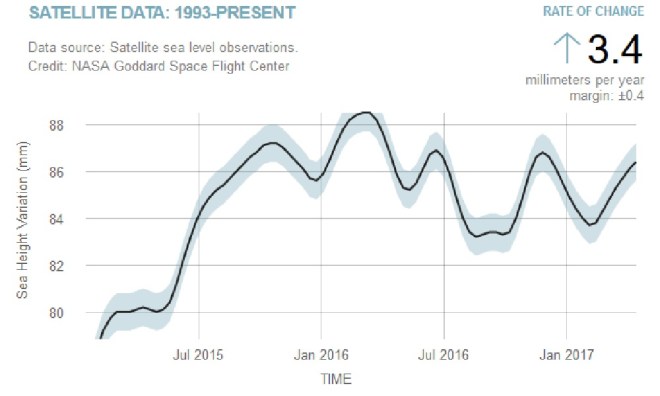
And if we look at the data from 1993 (the year satellite measurements began) the amount of sea level rise is not increasing.
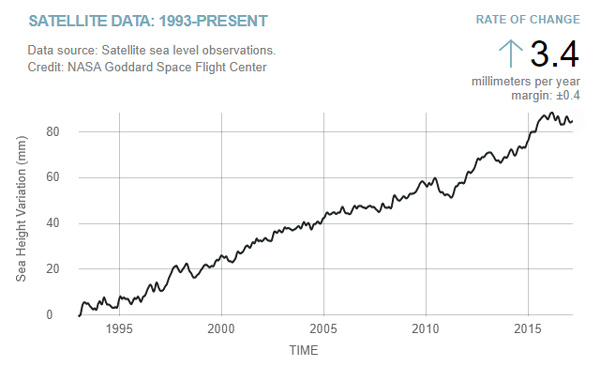
The average sea level rise over the whole world is 3.4 mm/year or about a foot per century, and is not increasing more rapidly recently. We are still recovering from the last ice age. The planet is becoming less ovoid, more like a sphere. In the Bothnian Bay land is rising out of the ocean at a rate of about 3 feet per century and in Hudson Bay the rise is as much as 4 feet per century. It is by no means over yet.

csm_DTRF2014_v_greenland_scandinavia_plateboundaries_481f1121db The displaced water gets redistributed over the rest of the earth. In addition the Mid-Atlantic ridge is expanding and rising with numerous undersea volcanoes, maybe up to one third of all undersea volcanoes are located between Jan Mayen and Svalbard. Tectonic plate movements explain the rest.
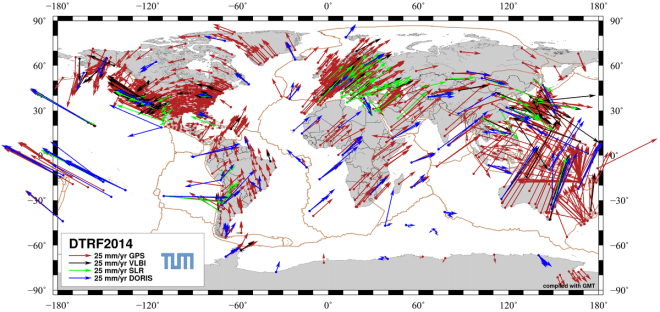
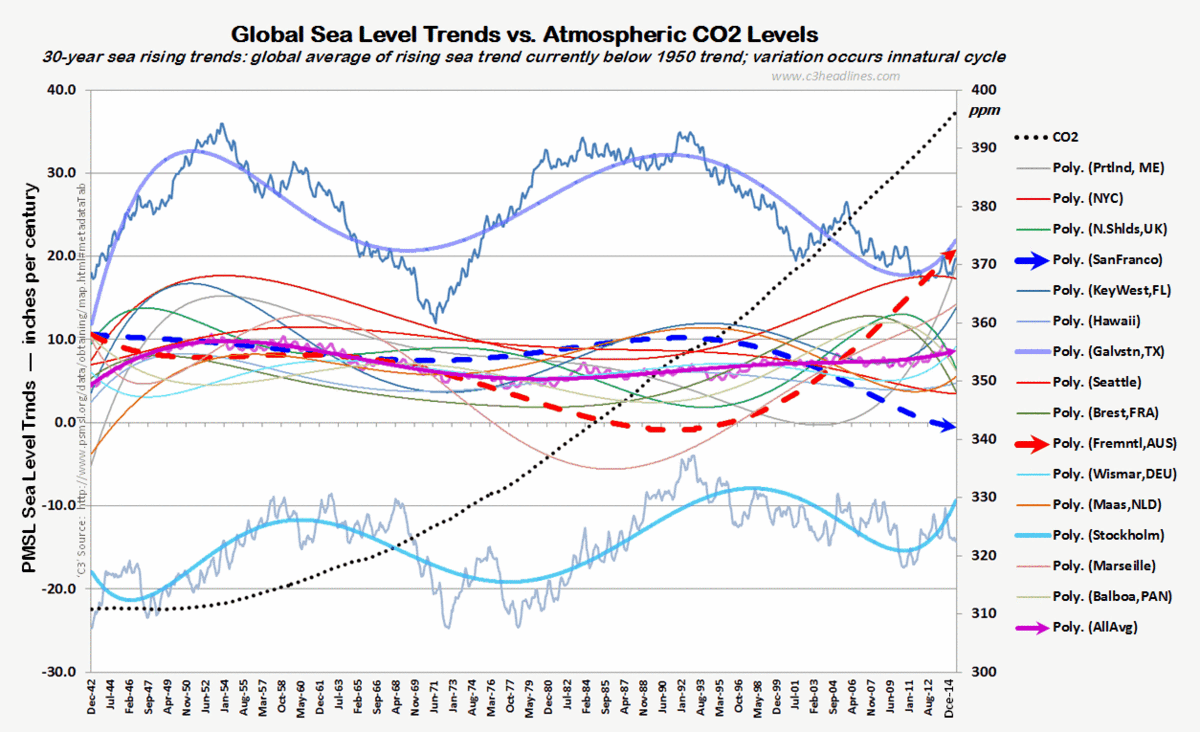
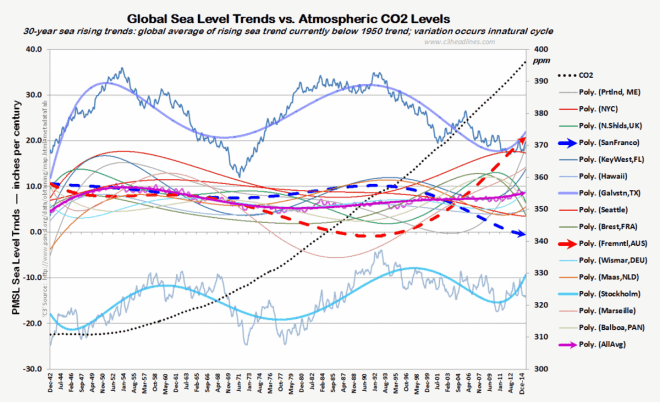
csm_DTRF2014_hz_global_plateboundaries_5ac4c94f02The Eastern Seaboard is slowly sinking into the sea, more than the rest of the world. The expansion of the ocean is not accelerating.The take home from this picture is that there are cyclical factors quite apart from rising CO2, but sea level rise is not accelerating.
So, what about Al Gore’s claim that superstorm Sandy was caused by global warming?

As usual, Al Gore is totally wrong on this, too.

 Contrary to popular reporting of the unprecedented storm surge during superstorm Sandy there has been two recorded hurricanes with higher storm surges. They both occurred in the 1600’s, during the little ice age and can be explained by a late hurricane coming up the East coast being drawn inland by an early outbreak of cold arctic air.
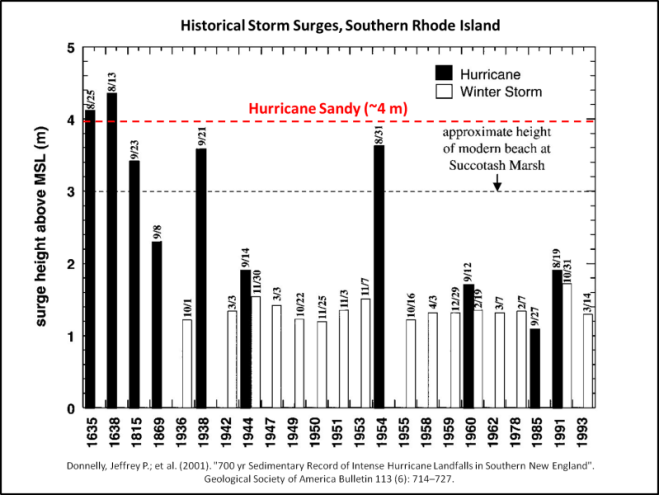
NE_Storm_SurgesWinter arrived early in the Arctic that year and pulled in hurricane Sandy making it a superstorm with not much wind but a very strong storm surge lasting a long time over a large area.

What’s the worst-case scenario?

CO2 concentration is rising at an unprecedented rate, more than half a percent per year, an order of magnitude faster than the CO2 rise coming out of the ice age. The Arctic ice cap just showed a record low maximum, and the Antarctic ice cap was recently at a new low  since measurements began. So why am I not worried?

Well, I am, but not for the reason you think. What we are seeing is the rain-out after the last el-nino. But not only that, we are in a general cooling trend which the rain-out is masking. Let me explain.

This winter the Arctic was about 12 degrees F warmer than normal on average with a spike of 30 degrees F warmer than normal, well documented.                  What happened?  There came one storm after another all the way from the Philippines or China and caused record rain and snowfall in California.
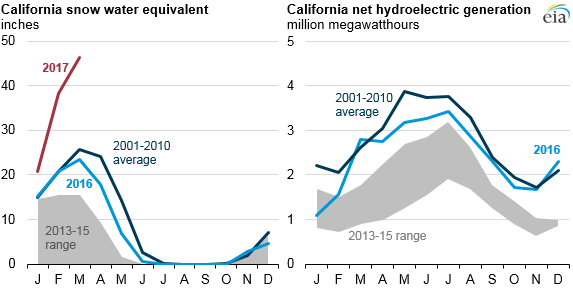
So much for California’s “unending drought”.

Then the storms went over the West, picked up more moisture from the Mexican Gulf and went up the East Coast, rained in the North Atlantic and snowed out in the Arctic and Greenland. The picture on the right shows just much it has snowed this winter over Greenland, a record snow accumulation so far. And it is concentrated to  East Greenland while North and West Greenland had normal snowfalls. The storms went up through Iceland and it rained as far north as Svalbard, preventing the Barents Sea from freezing, but delivering so much snow to the rest of the Arctic that the ice accumulation was near normal in spite of the unusually warm winter.
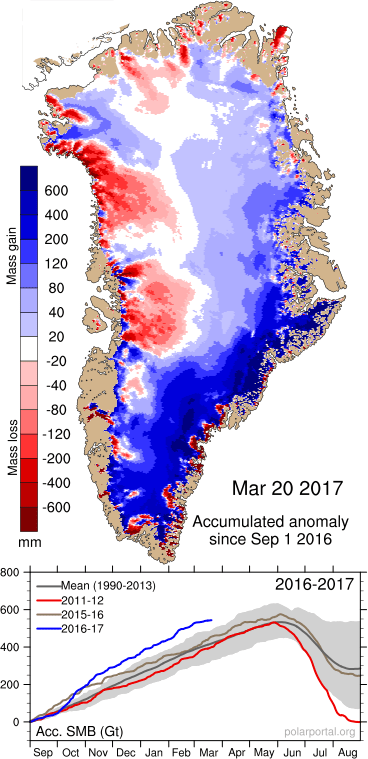
Come spring Arctic temperatures will be lower than normal, as they have been the last two years snow melt will go slower than normal, and there will be more multi-year ice than the year before. Worldwide temperatures will no longer get the boost they got from the unusually warm winter, so the “18 year pause” will be back, now as a 19 year pause.

What worries me are a number of factors, all leading to a new ice age much faster than what can be expected even with our best efforts to increase the CO2 level.

The next solar cycle, cycle 25 will be weaker than predicted, surpassing even the Maunder minimum. The Maunder minimum coincided with the little ice age.
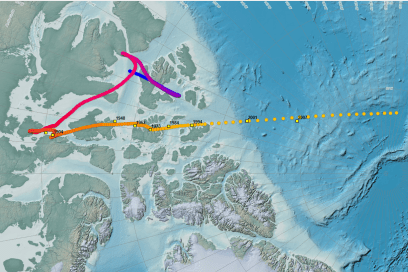
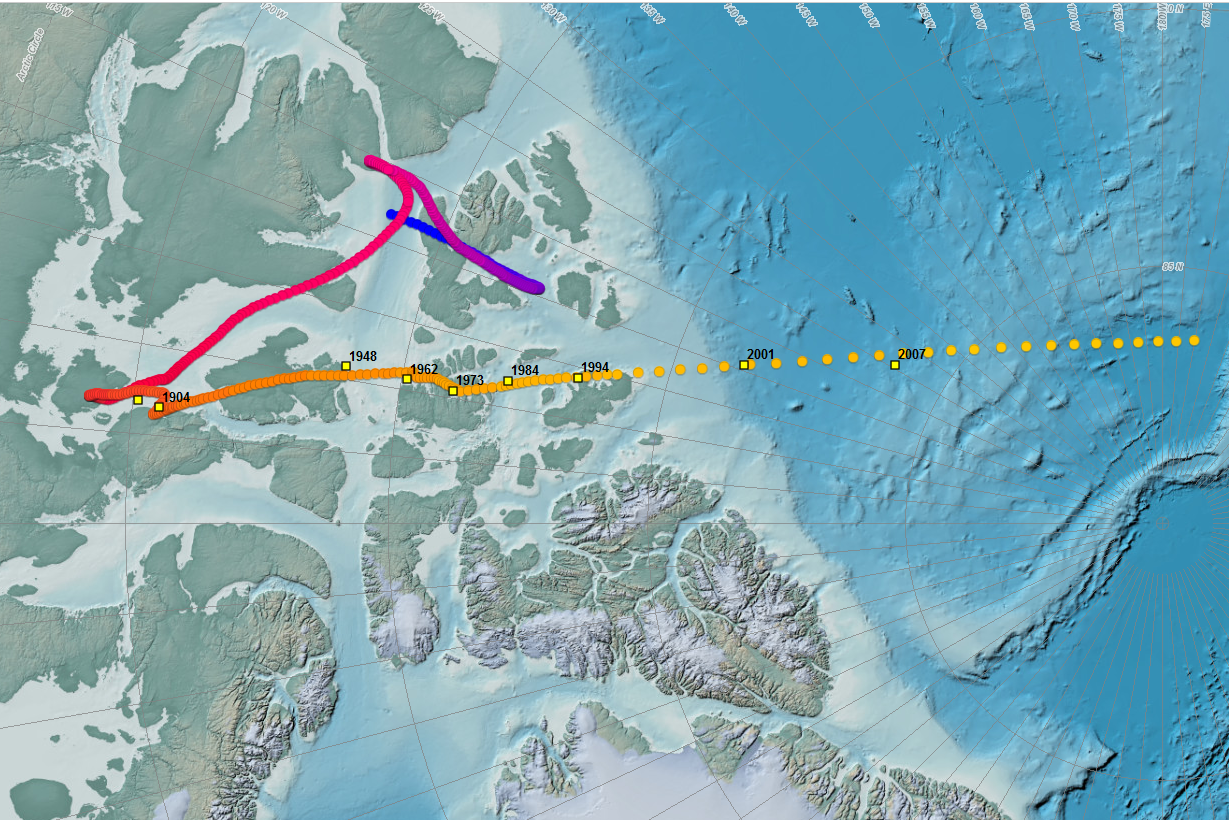
The earth’s magnetic field is starting to act erratically. The magnetic north pole is speeding up and is now way up in the Arctic, near the North pole. The chart on the right shows the observed north dip poles during 1831 – 2007 as yellow squares. Modeled pole locations from 1590 to 2020 are circles progressing from blue to yellow. In addition the magnetic field is getting substantially weaker, maybe a breakup is possible having two North Poles and two South Poles. If this occurs, the protection from the cosmic radiation from the Sun will be weakened, causing more clouds and maybe trigger the next ice age.

Then there is the double star KIC 9832227. They are only 1,800 light-years away, are an eclipsing binary pair, which means as they revolve around one another, each one briefly blots out the other from the perspective of a viewer on Earth. In 2021 or 2022 we will see them merge into one causing a red supernova. When this happens, because they are so near, we may even observe gravity waves. But from a climate standpoint there will be a burst of cosmic radiation, first the gamma rays coming at the speed of light, then with a slight delay the other cosmic radiation, coming at a time of the solar minimum and an unusually weak earth magnetic field.

This is new territory, and the best we can do is to increase CO2. It will not help much, but CO2 will help rather than hurt.

Then there is always the possibility of a supervolcanic explosion spewing ash way up into the stratosphere.

And for people who want to worry, don’t forget supersized meteorites!

All these worst case fears lead to a cooling earth.

On the other hand, the Sun is heating up at a rate of about 1% per 100 million years, not enough to worry about.