China and rare earth metals. Can China be trusted? Consider COVID-19 and pharmaceutical supplies.

In early May, 2019, President Xi and Vice Premier Liu He, China’s top trade negotiator, visited a rare earth metals mine in Jiangxi province. This has led to the rumor that China is seriously considering restricting rare earth exports to the US. China may also take other countermeasures in the future. The trade negotiations between U.S. and China got a lot more serious. It extended far beyond tariffs and intellectual property, it began to involve strategic materials.

The first thing we must realize is that rare earth metals are not all that rare. They are a thousand times or more abundant than gold or platinum in the earth crust and easy to mine, but a little more difficult to refine. Thorium and Uranium will  also be mined at the same time as the rare earth metals since they appear together in the ore.

Related image

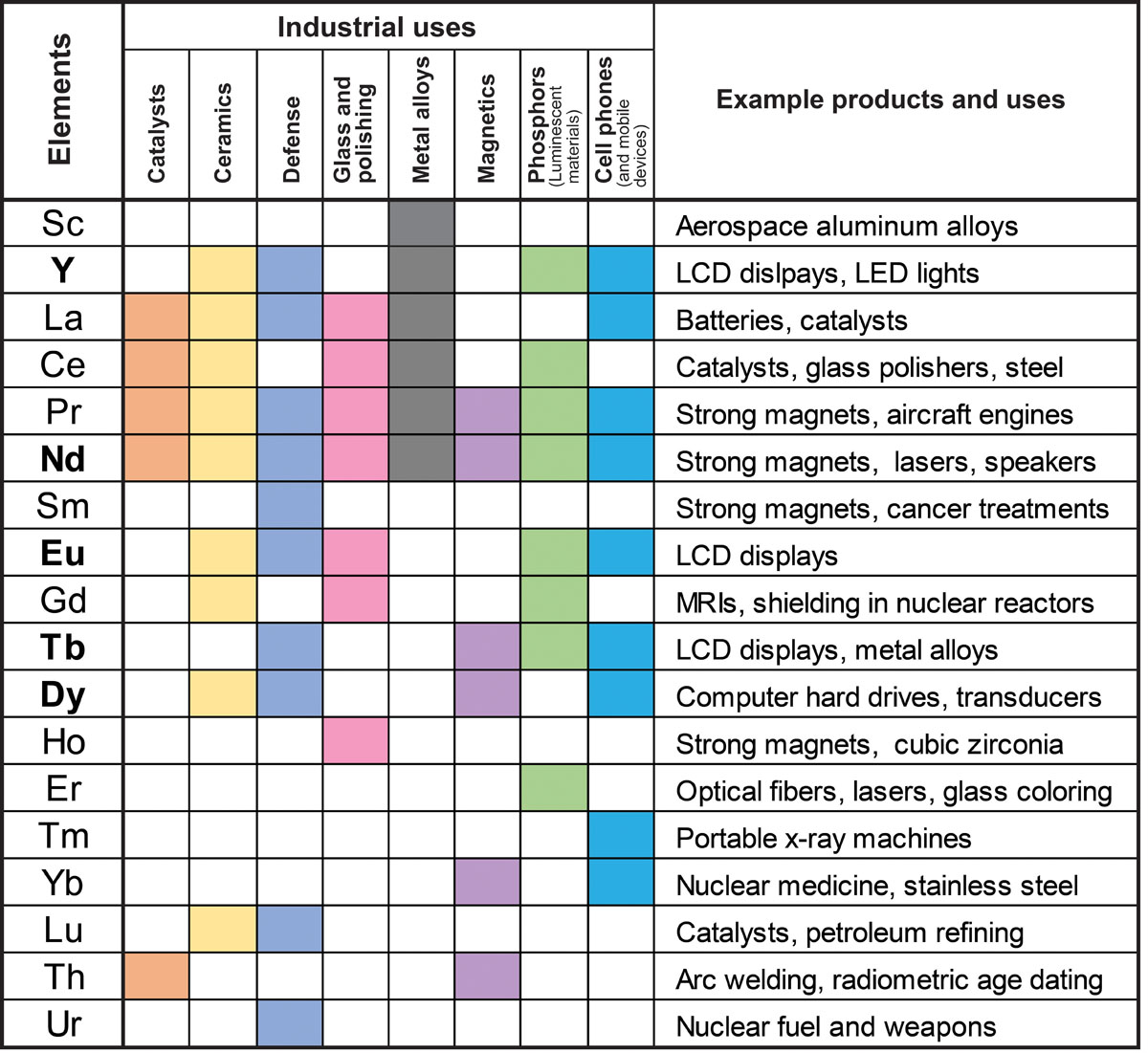
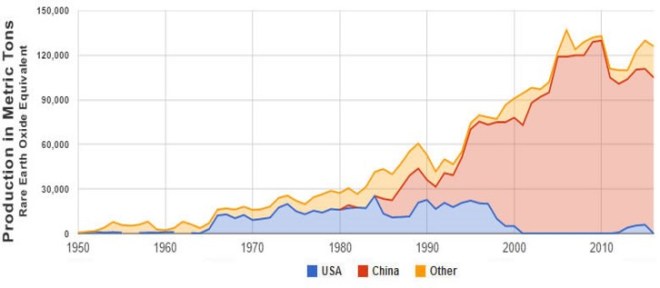
U.S. used to be the major supplier of rare earth metals, which was fine up to around 1984. Then the U.S. regulators determined that Uranium and Thorium contained in the ore made the ore radioactive, so the regulatory agencies decided to make rare earth metal ore subject to nuclear regulations with all what that meant for record keeping and control. This made mining of rare earth metals in the U.S. unprofitable so in 2001 the last domestic mine closed down. China had no such scruples, such as human and environmental concerns, so they took over the rare earth metals mining and in 2010 controlled over 95% of the world supply, which was according to their long term plan of controlling the world by 2025.

Rare Earth Element Production

The U.S. used to have a strategic reserve of rare earth metals, but that was sold off in 1998 as being no longer cost effective or necessary. Two years later the one U.S. rare earth metals mine that used to supply nearly the whole world, the Mountain Pass Mine in California closed down, together with its refining capacity. From that day all rare earth metals were imported. In 2010 it started up again together with the refining capacity but went bankrupt in 2015, closed down the refining but continued selling ore to China. They just announced they will start up refining again late 2020. Meanwhile China is slapping on a 25% import tariff on imported ore starting July 1. Rare earth metals may be in short supply for a while.

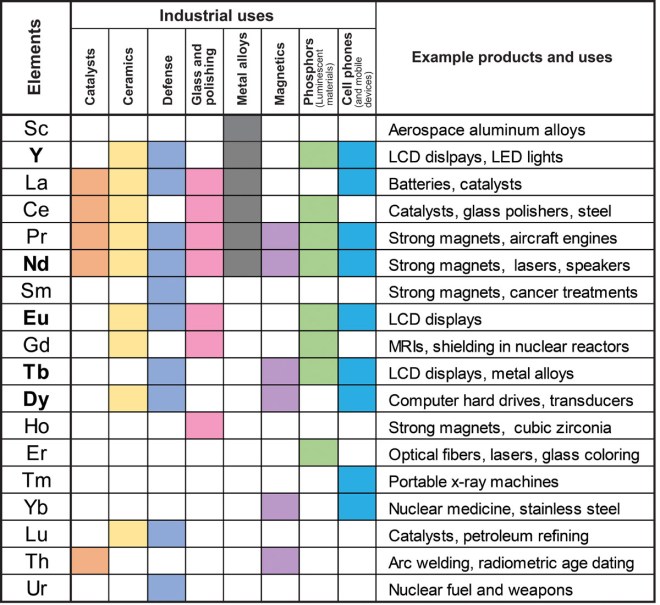
So, why is this important? Just take a look at all the uses for rare earth metals. The most sought after pays all the cost of mining and refining, and the rest are readily available at nominal cost.

The Chinese almost got away with it, and that is but one reason the trade negotiations are so complicated and hard fought, but necessary. Donald Trump fights for reciprocity and fair competition.

For example, according to a 2013 report from the Congressional Research Service, each F35 Lightning II aircraft requires 920 pounds of rareearth materials. Who is making the most critical parts to this airplane? You guessed it – China, from our drawings and according to our specifications.

But it is getting worse. the COVId-19 virus hit China bad, probably in November or so, nobody knows and China won’t tell. Then they told us there was a small outbreak, but it is not contagious from person to person. Then on January 10 the first case of the Wuhan virus hit the U.S.A. Late January President Trump halted entry into the U.S. from foreigners having been in China recently. At one of the daily COVID-19 briefings President Trump got excited about a potential treatment. He had been shown the result of a french study. Here it is:

To make matters a little more complicated, China has stopped export of one of the ingredients in making this medicine, and they are the only source, until we have started up production of our own. We have to do it in days, not weeks.

It turns out that China had been, and is treating their COVID-19 patients with this medicine, both as a preventive, and as a cure for months, but they never told the world until now.

Why did China stop this medical export? There are at least two possibilities, either they are lying through their teeth about the COVID-19 cases and they need it for their own consumption but didn’t tell us, or, which is even worse, they do want to maximize the damage in the rest of the world.

This is the real China. The people are wonderful, but their government is evil.

Teaching online at Penn State University. All real breakthroughs occur at the crossroads of science. This is an opportunity!

I have always loved to teach. I especially enjoyed the person to person contact when you tell of something and get a smile back – they got it. One of the objects of teaching the so called Capstone Course for engineers to be is to teach cross-science, for it is in the intersection between different branches of science, crafts and engineering disciplines that real breakthroughs are made. The object is to revolutionize the students thinking. Up to now they have learnt – and learnt it well – do as your teacher have taught you, and you will get an A. Any deviation is a negative – and bothersome for the teacher. This is an attempt for me to change that – even in an online session, but since there is no direct feedback, it is really an offline instruction. see what you think – did it change your thinking?


This tree, the green one was planted upside down. The branches became roots, the roots became branches. It is planted just east of  Penn State Main building. Think root cause analysis.

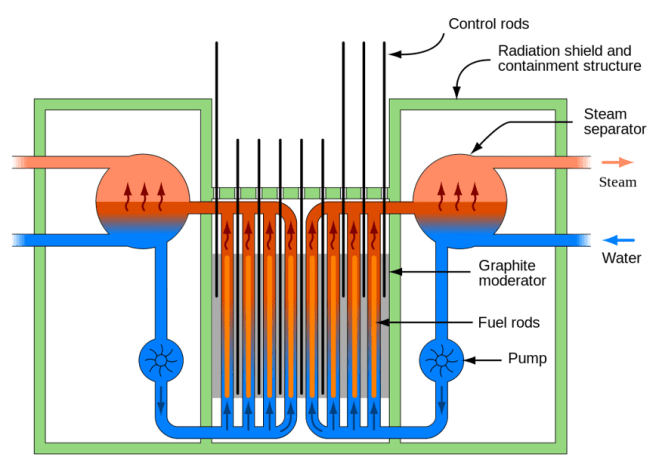
Chernobyl was a carbon moderated Nuclear reactor. Its failure mode was to go prompt critical and splat in an uncontrolled nuclear reaction. No containment vessel could contain the explosion, so why go to the extra expense of building one? Rely instead on multiple safety circuits. The night crew disabled some safety circuits to capture power on an orderly shutdown. They had never been properly trained.

The cloud. Sweden was the first to report on the accident. Two reactors shut down due to excessive radiation in the air outside the plants.

With a Molten Salt Reactor, accidents like Chernobyl are impossible. The Three Mile Island accident was bad. The Chernobyl disaster was ten million times worse. Ah yes, I remember it well.

One morning at work, after the Three Mile Island incident, but before Chernobyl a fellow co-worker, a Ph.D. Chemist working on an Electron Capture Detector containing a small amount of Nickel 63, came with a surprising question: You know nuclear science, how come the reactors in Chernobyl don’t have a containment vessel? Well – I answered, it is because they are carbon moderated and their failure mode is that they go prompt critical, and no containment vessel in the world can hold it in, so they skip it. He turned away in disgust. A few weeks later my wife’s father died, and we went to Denmark to attend the funeral. The day of the return back to the U.S. we heard that there had been a nuclear incident in Sweden, too much radiation had caused two nuclear power stations to close down. The Chernobyl disaster had happened 26 April 1986, and this was the first time anyone outside of Chernobyl has heard about it, two days later. This was still the Soviet Union, and nothing ever did go wrong in it worthy of reporting.

(But the carbon moderated Uranium reactors are the most efficient in producing Pu-239 the preferred nuclear bomb material.)

This has nothing to do with anything, but Chernobyl can be translated wormwood. It is mentioned in the Bible, Revelation 8: 10-11 “ And the third angel sounded, and there fell a great star from heaven, burning as it were a lamp, and it fell upon the third part of the rivers, and upon the fountains of waters; And the name of the star is called Wormwood: and the third part of the waters became wormwood; and many men died of the waters, because they were made bitter.

Molten Salt Thorium reactors cannot be used to supply bomb material, and they are far safer than even Light water Uranium reactors.

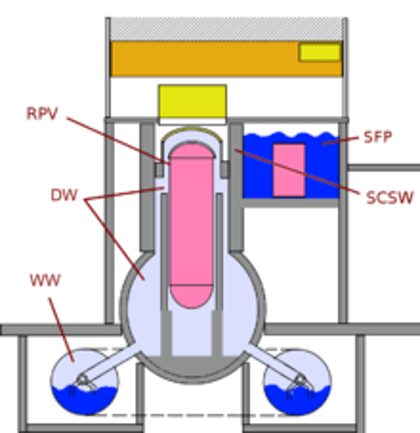
With Molten Salt Reactors, a catastrophe like Fukushima cannot happen.  It began with a magnitude 9.0 earthquake not far from the Fukushima 6 Nuclear reactor complex. The impact was a magnitude 6.8 earthquake and the operators immediately scrammed the safety rods to stop all the reactors. This succeeded! The reactors were designed with earthquakes in mind, and they passed the test. The backup power started up successfully so the cooling pumps could operate. There was one major problem though. The earthquake was so bad that the water in the spent fuel holding tanks splashed out and exposed the spent fuel rods to air making them emit radioactivity into the air.

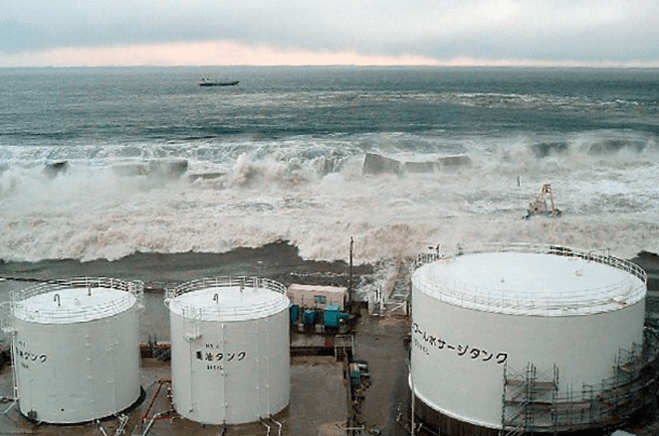
The water pumps worked for a while, but then came the tsunami. All the reactors were inside a tsunami wall, so far, so good

But the fuel storage tanks for the backup power generators were outside the tsunami wall and were washed away. The batteries were only supposed to last until backup power was established, and with water circulation ended the meltdown started.

This disaster was even bigger than Chernobyl and contamination is still spreading.

In the periodic table, iron has the densest core. Fusion can occur with elements with a lower atomic number than iron, fission can begin with  with elements after lead. What happens in a supernova?

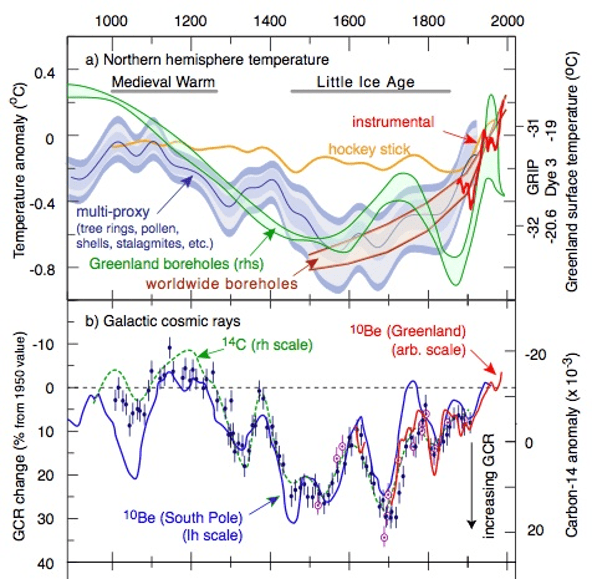
On climate change: Temp records come from boreholes, seashells, and looking at isotope variations among other sources . Of particular interest is the medieval warm period and the little ice age. How did the little ice age happen? There was no decrease in CO2 during that time.

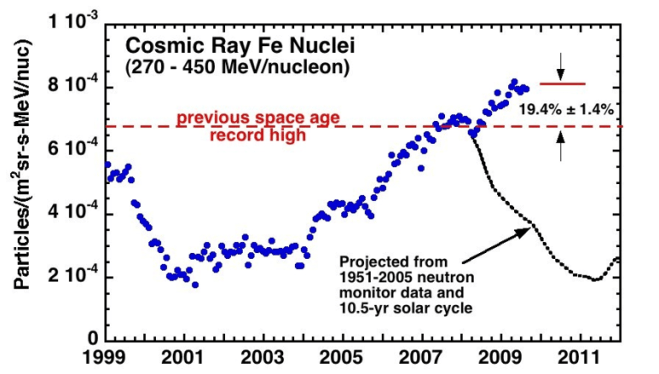
Especially interesting is cosmic radiation that does not come from the sun. It varies a lot, and consists mostly of iron nuclei and comes from distant supernovas. There was two of them, in 1572 and 1604 A.D., both shone brighter in the sky than Venus. Since then we have not seen any supernovas anywhere nearly as bright . Did they trigger the little ice age?

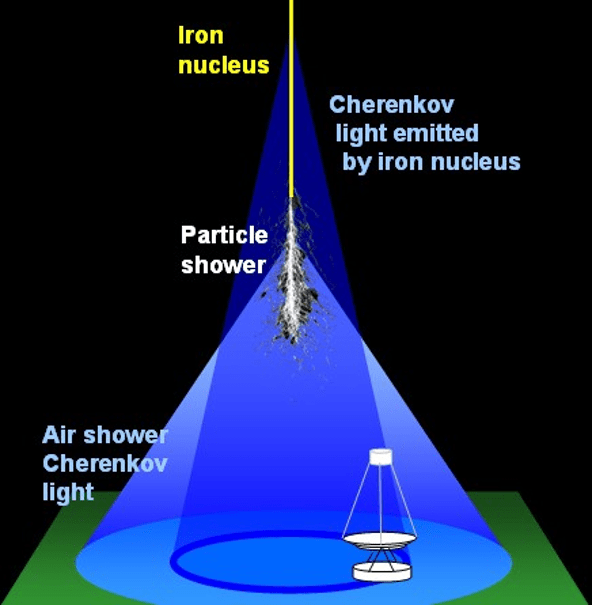
A single iron nucleus can ionize thousands of air molecules, causing condensation and forming the beginning of a cloud.

The iron nuclei enter the earth’s atmosphere with a speed that exceeds the speed of light in atmosphere, causing this eerie blue light. It spreads like a sonic boom.

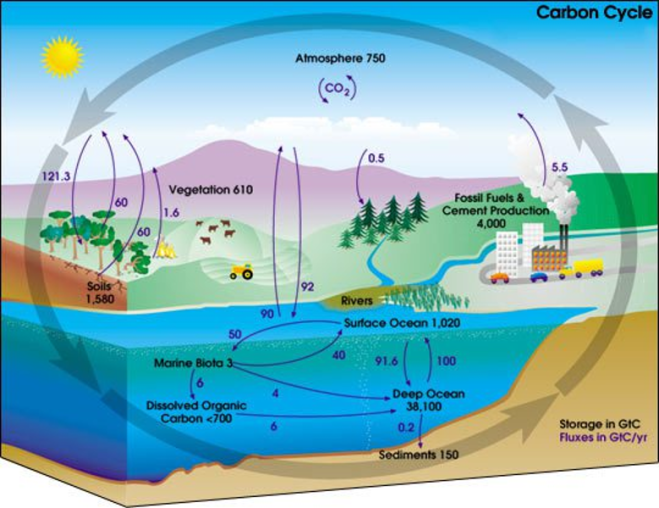
Cosmic radiation in the form of iron nuclei is the major source of the generation of Carbon 14. When fossil fuel is burned there is very little C14 in the CO2 generated, but if it is burned by digestion of food, by fermentation, by burning wood or by wildfire, it contains the same concentration of C14 as was in the air at the time of the generation of the biomass. Since C14 has a half life of  5700 +- 40 years, we could find out the age of that biomass – or could we?

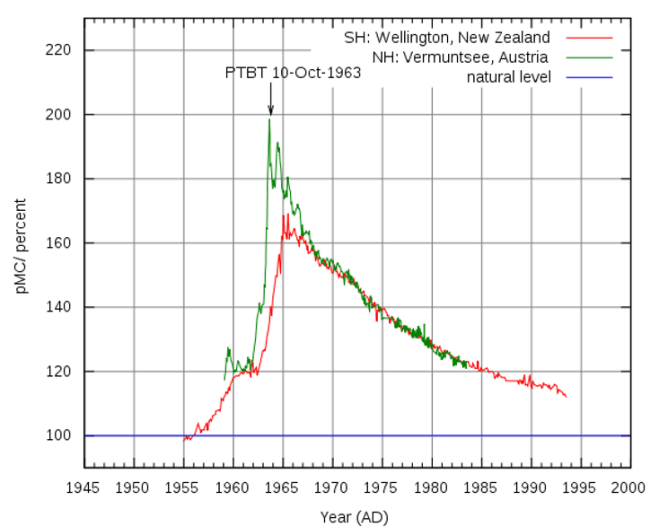
This is one of my very favorite slides. The best way of finding out how a black body responds is by introducing an impulse and see what happens. In this case the impulse was open air Nuclear bomb tests, performed mostly by United States and the Soviet Union, but all in the Northern Hemisphere. Test stations to see the amount of C14 in the air were set up in Austria and New Zealand. What did we learn? We learn that the air mixes between the Northern and the Southern Hemisphere in about 2 years, and because the half-life of C14 shown here is 12.5 years, not 5700 years, it shows the absorption rate in the oceans. Both of these values would have been difficult if not impossible to find out without open air Nuclear tests, Were they bad? You bet, but since they happened, glean what you can from it. What else did we learn? You can no longer use carbon dating if there is any chance of chance of contamination with newer biomass, or if it is newer than 1955 A.D. Is the specimen appearing to be older or younger?

Since we have shown that the amount of C14 in the air has not been constant over time the age curve has to be calibrated. How do we do that? By using artifacts of known age.

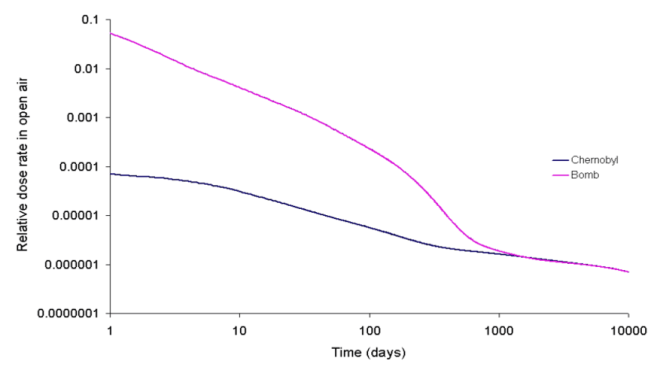
The radioactive fallout decay from a Nuclear test occurs faster than from the Chernobyl disaster. Every nuclear fallout fingerprint is different.

A Liquid Fluoride Thorium based fast breeder nuclear reactor produces much less TRansUranium waste, 0.01% waste products compared to a Uranium-235 fast breeder. The Thorium process has a much higher efficiency of fission than  the Uranium process.

Pu = Plutonium, Am = Americum, Cm = Curium, all TRansUraniums, nasty stuff.

With Thorium based Nuclear power, there are no real problems, with traditional U235 power long tern storage is an immense and urgent problem, and has been since the 1960’s. At that time Sweden had a heavy water  U-238 nuclear power program going, but abandoned it in favor of traditional U-235 power. U.S. promised to provide the material and take care of the reprocessing and final storage of all nuclear waste at cost if Sweden joined the nuclear proliferation treaty. Reprocessing was to be done in Washington State, and one of the final storage sites mentioned was Yucca Mountain in Nevada, having the ideal Geological properties.

Time goes by and in 1982 – Congress passed the Nuclear Waste Policy Act, requiring the establishment of a deep geologic repository for nuclear waste storage and isolation. Yucca Mountain was high on the list out of 9 possible sites.

Time goes by, and Congress is still not able to decide on a solution. Meanwhile, TRU’s from spent and reprocessed fuel is piling up in less than ideal locations. Thorium based nuclear power would go a long way to alleviate this problem.

Radioactive waste from an LFTR (Liquid Fluoride Thorium Reactor)  decays down to background radiation in 300 years instead of a million years for U-235 based reactors. Initially LFTRs produce as much radioactivity as an U-235 based nuclear reactor, since fission converts mass to heat, but the decay products have a much shorter half-life.

And Fukushima is still aglow.

The first thing we must realize is that rare earth metals are not all that rare. They are a thousand times or more abundant than gold or platinum in the earth crust and easy to mine, but a little more difficult to refine. Thorium and Uranium will also be mined at the same time as the rare earth metals since they appear together in the ore.

The U.S. used to have a strategic reserve of rare earth metals, but that was sold off in 1998 as being no longer cost effective or necessary. Two years later the one U.S. rare earth metals mine that used to supply nearly the whole world, the Mountain Pass Mine in California closed down, together with its refining capacity. From that day all rare earth metals were imported. In 2010 it started up again together with the refining capacity but went bankrupt in 2015, closed down the refining but continued selling ore to China. They will start up refining again late 2020. Meanwhile China is slapping on a 25% import tariff on imported ore starting July 1 2020. Rare earth metals may be in short supply for a while.

U.S. used to be the major supplier of rare earth metals, which was fine up to around 1984. Then the U.S. regulators determined that Uranium and Thorium contained in the ore made the ore radioactive, so they decided to make rare earth metal ore subject to nuclear regulations with all what that meant for record keeping and control. This made mining in the U.S. unprofitable so in 2001 the last domestic mine closed down. China had no such scruples, such as human and environmental concerns, so they took over the rare earth metals mining and in 2010 controlled over 95% of the world supply, which was according to their long term plan of controlling the world by 2025.


Climate change is real and positive for the environment. The real challenge is clean and available water in the 10-40 region.

The safe, clean water essential to all life is rapidly running out in much of the world. Yet the politicians are concentrating on air pollution in the form of CO2 and methane as if a catastrophe is about to hit us. Western US, most of the 10-40 window (the area between the 10th and the 40th latitude), Australia and western South America are using up its safe and drinkable water supply much faster than it is replenished. In addition, what is left is getting polluted.Let me give you an anecdotal example.

More than twenty years ago I was part of a team that made wet processing equipment for making computer chip wafers. It involved cleaning and etching using isopropyl alcohol, hydrocloric, sulphuric, and hydrofluoric acid as well as Ozone, all potent stuff. To collect the used chemicals we had designed a 5-way output port, so the chemicals could be collected separately after use. The equipment was made and shipped off to South Korea. It was assembled in a brand new, state of the art positive air pressure clean room facility. The processing machine was installed by the Koreans, but under the 5-way port was a large funnel, going to the drain and directly out in the sewer.

A couple of years before, in the US we had a valve in a similar machine that sprung a leak, so a small amount of hydrofluoric acid got discharged into the sewage. This poisoned the sewage processing plant, and a large fine was levied. No such worry in Asia. The sewage went directly out in the ocean to be diluted. How could they be persuaded not to dump the alcohol and acid directly into the sewage? There were no environmental regulations prohibiting them from doing so. The only argument that persuaded them was economic. It was cheaper to collect the used alcohol and hydrofluoric acid, clean and reuse it rather than dump it. Unfortunately sulphuric acid and hydrocloric acid was too cheap to buy new, so that was still dumped. This is the mindset of many developing countries.

In China many of these facilities are inland, so large water aquifers get poisoned for centuries to come. These are the people we up to now have entrusted with our future production of just about everything, since they do not have the environmental protection laws they can produce the stuff much cheaper. But it comes at a price. The yellow river now does not anymore reach the ocean for part of the year.

As I have explained in a previous post: https://lenbilen.com/2020/02/28/climate-change-is-real-and-is-caused-by-rising-co2-levels-leading-to-less-extreme-weather-this-is-on-balance-good-for-the-environment/  global warming is real, but it only occurs in temperate regions, and predominantly in the winter. Summertime maxima are actually decreasing slightly, so the net effect of climate change is that it is positive for the environment.

Not so with water pollution. It is a much bigger and dangerous problem, and only by shifting our attention to it and from CO2 can we begin to solve it. To clean up the environment will take a lot of energy, and the only solution I see is switching our electric energy supply away from fossil fuel and to Thorium based nuclear energy. Here are

Twenty-five reasons to rapidly develop Thorium based Nuclear Power generation.

We need badly to develop and build Thorium based molten salt fast breeder nuclear reactors to secure our energy needs in the future. Lest anyone should be threatened by the words fast breeder, it simply means it uses fast neutrons instead of thermal neutrons, and breeder means it produces more fissible material than it consumes, in the case of Thorium the ratio is about 1.05.

1. A million years supply at today’s consumption levels.

2. Thorium already mined, ready to be extracted.

3. One ten-thousandth of the TRansUranium waste compared to a U-235 based fast breeder reactor.

4. Thorium based nuclear power produces Pu-238, needed for space exploration.

5. Radioactive waste from an LFTR decays down to background radiation in 300 years compared to a million years for U-235 based reactors.

6. Thorium based nuclear power is not suited for making nuclear bombs.

7. Produces isotopes that helps cure certain cancers.

8. Molten Salt Thorium Reactors are earthquake safe.

9. Molten Salt Thorium Reactors cannot have a meltdown, the fuel is already molten.

10. Molten Salt Nuclear Reactors have a very high negative temperature coefficient leading to a safe and stable control.

11. Atmospheric pressure operating conditions, no risk for explosions.

12. Virtually no spent fuel problem, very little on site storage or transport.

13. Thorium Nuclear Power generators  scale  beautifully from small portable generators to full size power plants.

14. No need for evacuation zones, can be placed near urban areas.

15. Liquid Fluoride Thorium Reactors will work both as Base Load and Load Following power plants.

16. Liquid Fluoride Thorium Reactors will lessen the need for an expanded national grid.

17. Russia has an active Thorium program.

18. China is having a massive Thorium program.

19. India is having an ambitious Thorium program.

20. United States used to be the leader in Thorium usage. What happened?

21. With a Molten Salt Reactor, accidents like the Three Mile Island disaster will not happen.

22. With a Molten Salt Reactor, disasters like Chernobyl are impossible.

23. With Molten Salt Reactors, a catastrophe like Fukushima cannot happen.

24. Produces electrical energy at about 4 cents per KWh.

25. Can deplete some of the existing radioactive waste and nuclear weapons stockpiles.

Climate change and our divided nation. Is it a top priority and a threat to mankind as most Democrats believe, or is it not much to worry about, and maybe even beneficial, as most Republicans believe?

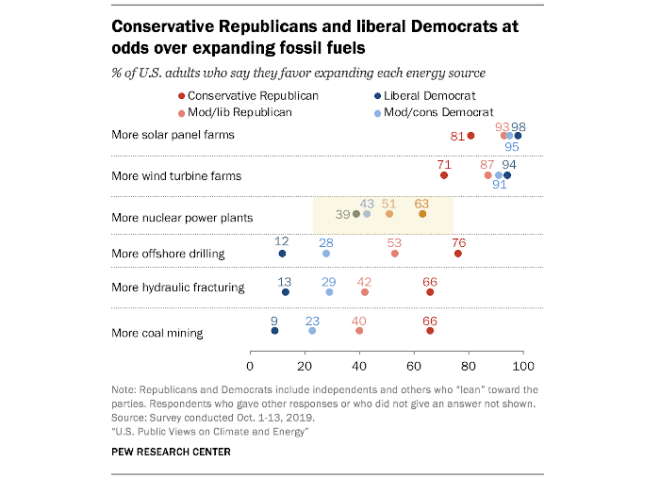
We are a divided nation indeed. In no other area is this more apparent than in our attitudes towards Climate Change. Democrats regard is as a top priority more and more, while Republicans maintain it is not much to worry about, way down in the importance of things that need fixing. The PEW research center shows the growing discrepancy:

Republicans live in over 90% of the area of the United States, Democrats are concentrated to urban areas, and in areas of majority black or Hispanic population.

Most of the Democrats live concentrated in Urban areas, and they have already experienced climate change! The Urban Heat Island effect can be as high as 7 degree Celsius on a dog day in August, with humidity to boot!

Most Republicans on the other hand live in rural areas where there are no heat islands. If anything, they are realizing that the winters are less severe, and the summers are not getting hotter. They see good in the climate change, such as we can now feed another 2 billion people on earth, thanks to the fertilizing effect of increasing CO2.

I have put in the reasons why Rising CO2 levels may actually be on balance beneficial : https://lenbilen.com/2020/02/28/climate-change-is-real-and-is-caused-by-rising-co2-levels-leading-to-less-extreme-weather-this-is-on-balance-good-for-the-environment/

Now for the question: Should we expand the burning of fossil fuels?

Even though increasing levels of CO2 is beneficial for the climate we should not expand, but reduce the mining, drilling and fracking of fossil fuels. There are better ways of supply the energy needs of the future. We should leave some of the fossil fuels for our great grandchildren not yet born.

More solar panel farms. This I see as a niche market. China still control 90% of the rare earth metal mining we should only use them in urban areas to lessen the need for an expanded grid. One area that is ideal for more solar panels is to put them up as roofs in open parking lots, especially those that are covered with black asphalt. Parked cars will be cooler and dryer, and it will lessen the urban heat effect.

More wind turbine farms: I love birds, especially large birds such as eagles and raptors. The eagles like to build their aeries on top of the wind turbines, and – you guessed it – they get whacked by the rotor blades. During the Obama administration they upped the yearly allowable kill of bald eagles from from 1100 to 4200. If you kill a golden eagle there is still a 250000 dollar fine. If we increase the number of wind-farms we could run out of large birds.

Hydro-electric power: This is mostly already utilized to capacity. One exception is the river Congo in Africa, still waiting to produce electric power.

Nuclear plants: This is the only realistic solution, but not the common U235 power plants. No, we need a Manhattan-like project to fast track Molten Salt Thorium Nuclear reactors. Here are 25 r3qsons why this is the only realistic solution until we master fusion power, which is always a couple of decades away from commercialization.

Twenty-five reasons to rapidly develop Thorium based Nuclear Power generation.

We need badly to develop and build Thorium based molten salt fast breeder nuclear reactors to secure our energy needs in the future. Lest anyone should be threatened by the words fast breeder, it simply means it uses fast neutrons instead of thermal neutrons, and breeder means it produces more fissible material than it consumes, in the case of Thorium the ratio is about 1.05.

1. A million years supply at today’s consumption levels.

2. Thorium already mined, ready to be extracted.

3. One ten-thousandth of the TRansUranium waste compared to a U-235 based fast breeder reactor.

4. Thorium based nuclear power produces Pu-238, needed for space exploration.

5. Radioactive waste from an LFTR decays down to background radiation in 300 years compared to a million years for U-235 based reactors.

6. Thorium based nuclear power is not suited for making nuclear bombs.

7. Produces isotopes that helps cure certain cancers.

8. Molten Salt Thorium Reactors are earthquake safe.

9. Molten Salt Thorium Reactors cannot have a meltdown, the fuel is already molten.

10. Molten Salt Nuclear Reactors have a very high negative temperature coefficient leading to a safe and stable control.

11. Atmospheric pressure operating conditions, no risk for explosions.

12. Virtually no spent fuel problem, very little on site storage or transport.

13. Thorium Nuclear Power generators  scale  beautifully from small portable generators to full size power plants.

14. No need for evacuation zones, can be placed near urban areas.

15. Liquid Fluoride Thorium Reactors will work both as Base Load and Load Following power plants.

16. Liquid Fluoride Thorium Reactors will lessen the need for an expanded national grid.

17. Russia has an active Thorium program.

18. China is having a massive Thorium program.

19. India is having an ambitious Thorium program.

20. United States used to be the leader in Thorium usage. What happened?

21. With a Molten Salt Reactor, accidents like the Three Mile Island disaster will not happen.

22. With a Molten Salt Reactor, disasters like Chernobyl are impossible.

23. With Molten Salt Reactors, a catastrophe like Fukushima cannot happen.

24. Produces electrical energy at about 4 cents per KWh.

25. Can deplete some of the existing radioactive waste and nuclear weapons stockpiles.


Climate change is real and is caused by rising CO2 levels, leading to less extreme weather. This is on balance good for the environment!

We have experienced a 50% increase in CO2 levels since the beginning of industrialization. In the last 30 years the level has risen 17%, from about 350 ppm to nearly 410 ppm. Is this good or bad for the climate?

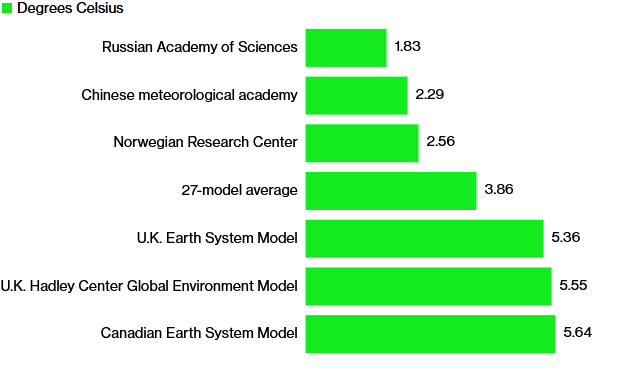
The traditional way to approach the problem of guessing what effect of rising CO2 levels has on the climate is by creating climate models. Thy have recently been adjusted, and they suddenly show a much higher rate of future temperature increase, in this case what is supposed to happen to global temperatures for a doubling of CO2 from pre-industrial times, from 270ppm to 540ppm.

https://lenbilen.com/wp-content/uploads/2020/02/screenshot_2020-02-07-climate-models-are-running-red-hot-and-scientists-done28099t-know-why1.png

The first thing that strikes you is the great discrepancies between the models. The Russian, Chinese and Norwegian models show a much slower temperature rise than  rest of the models. Why is that?

There are two ways to approach this problem. The climate models make certain assumptions about the behavior of the changing atmosphere, and based on these assumptions model future temperature changes. This is the approach from IPCC for the last 32 years. These models are failing miserably when compared to actual temperature changes. This is the traditional way.

The other way i to observe what is actually happening to our temperature over time as the CO2 increases. We have over 50 years of excellent global temperature data, so with these we can see where, when and by how much the earth has warmed.

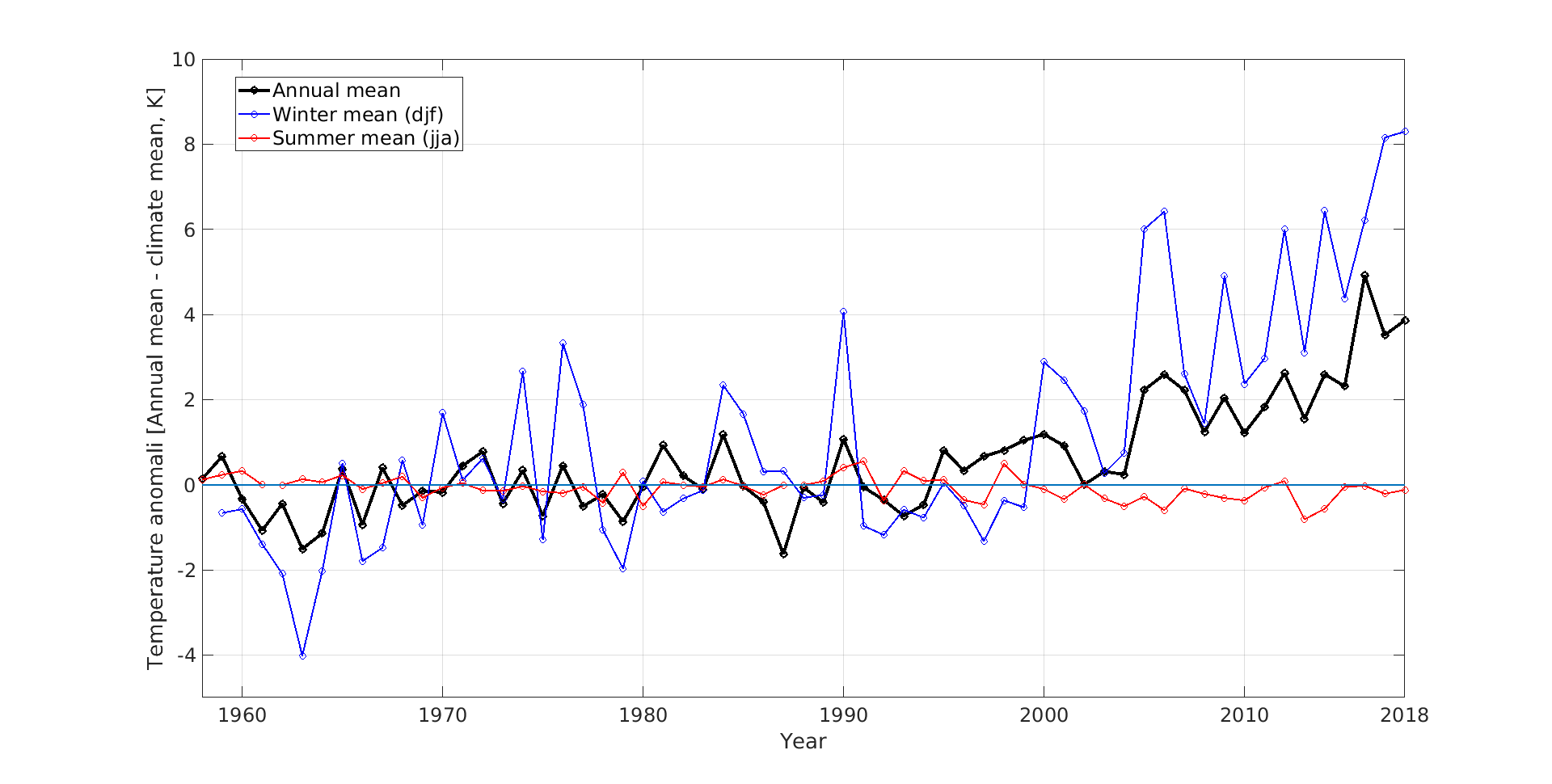
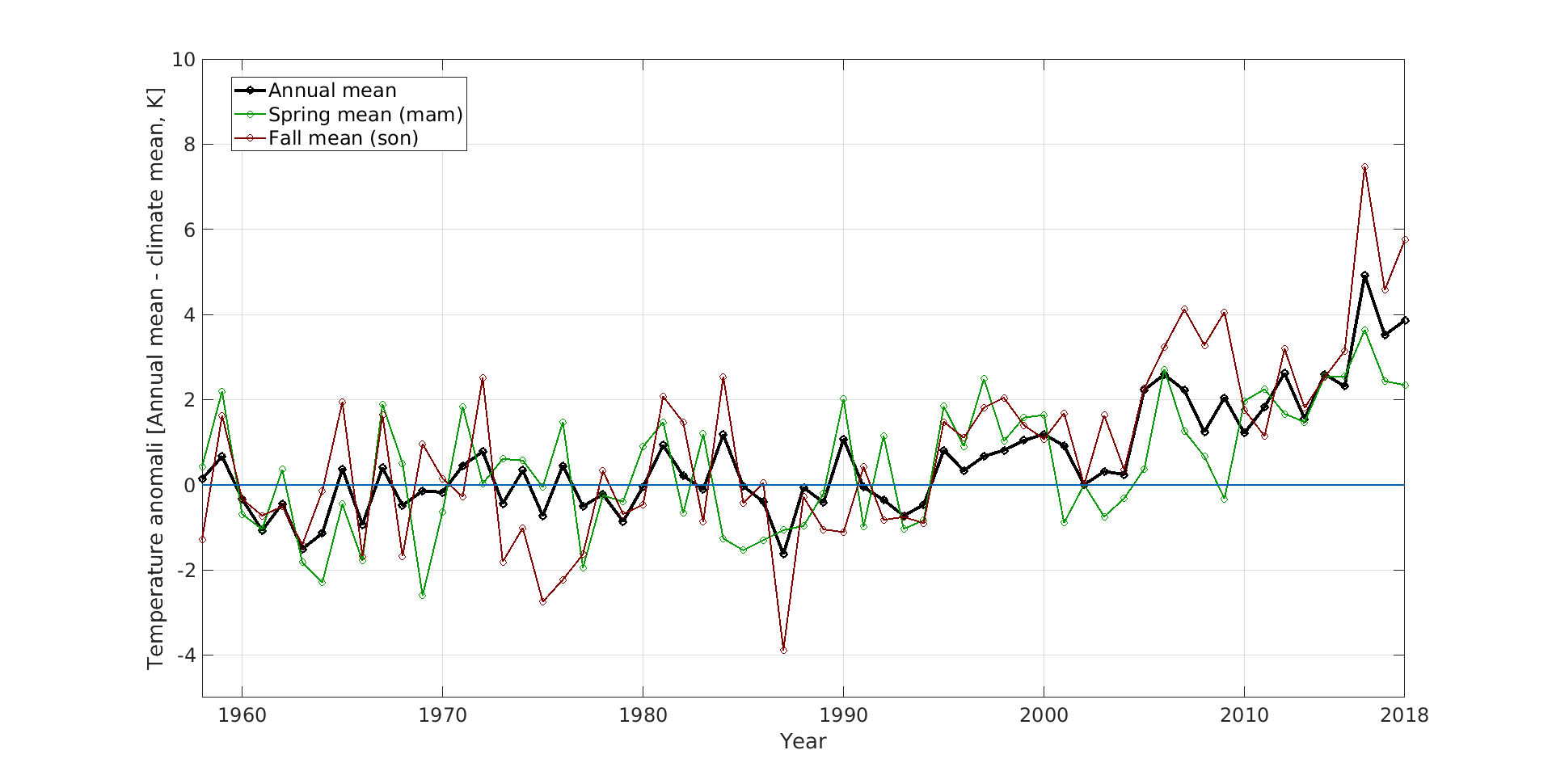
The most drastic temperature rise on earth has been in the Arctic above the 80th latitude. In the winter of 2018 it was 8C above the 50 year average. See charts from the Danish Meteorological Institute:
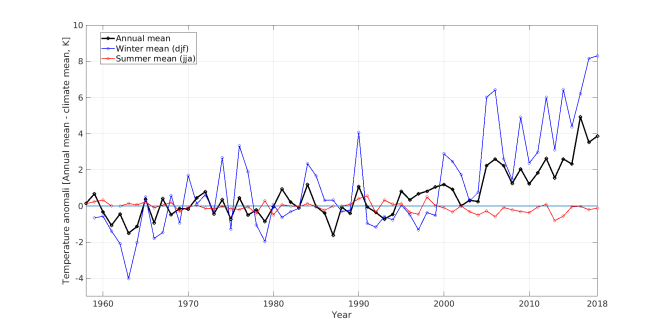
Note, there is no increase at all in the summer temperatures!
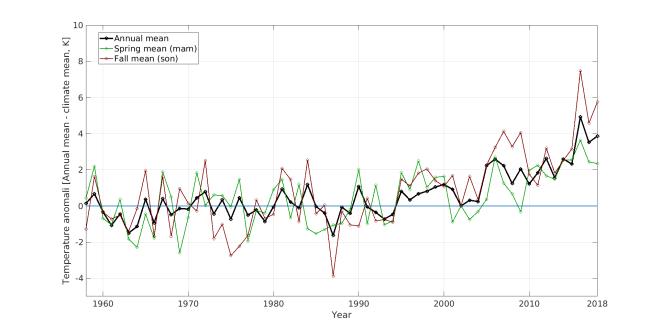
The fall temperature saw an increase of 5C and the spring temperature saw an increase of about 2.5C.

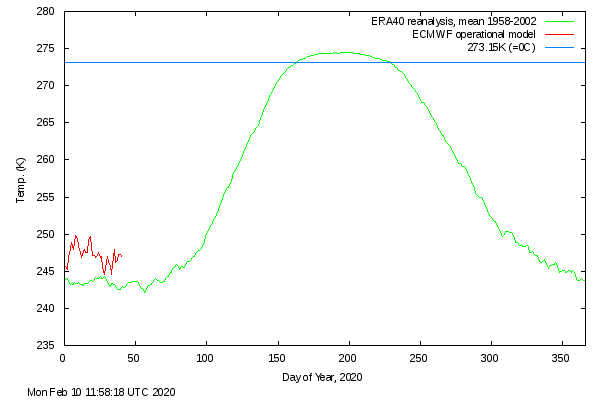
The 2020 winter has so far seen an about 5c increase Source: DMI.

This 8C ( or 5C) rise in winter temperatures is significant, most would even say alarming, but my response is, why is that?

To get the answer we must study molecular absorption spectroscopy and explain a couple of facts for the 97% of all scientists who have not studied molecular spectroscopy. IPCC and most scientists claim that the greenhouse effect is dependent on the gases that are in the atmosphere, and their combined effect is additive according to a logarithmic formula. This is true up to a certain point, but it is not possible to absorb more than 100% of all the energy available in a certain frequency band! For example: If water vapor absorbs 50% of all incoming energy in a certain band, and CO2 absorbs another 90% of the energy in the same band, the result is that 95% is absorbed, (90% + 50% * (100% – 90%)),  not 140%, (90% + 50%).

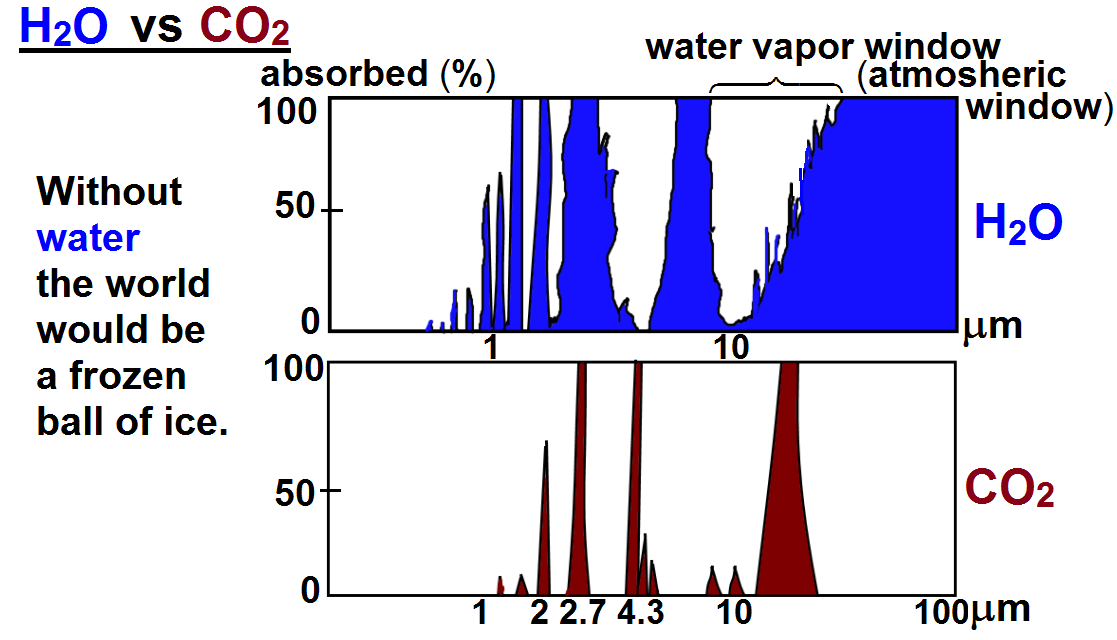
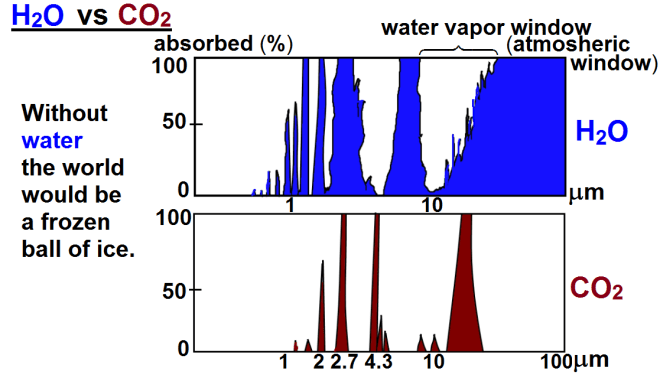
The following chart shows both CO2 and H2O are absorbing greenhouse gases, with H20 being the stronger greenhouse gas, absorbing over a much wider spectrum, and they overlap for the most part. But it also matters in what frequency ranges they absorb.
To better understand the importance of frequency spectra this we will look at the frequency ranges of the incoming solar radiation and the outgoing black body radiation of the earth. It is the latter that causes the greenhouse effect. Take a look at this chart:
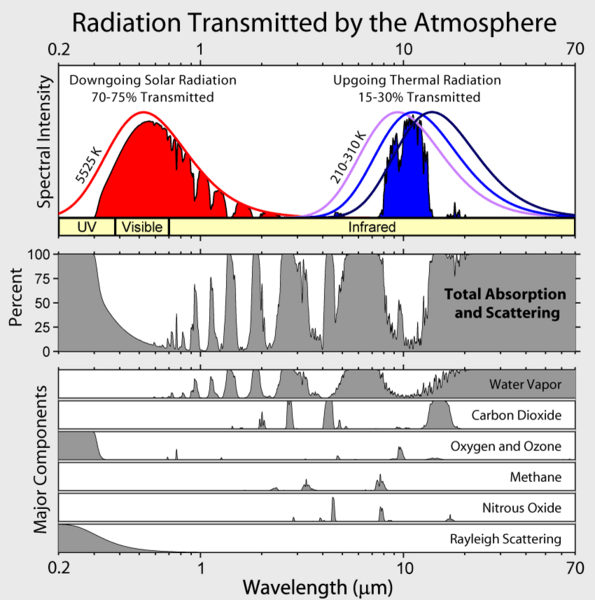
The red area represents the observed amount of solar radiation that reaches the earth’s surface. the white area under the red line represents radiation absorbed in the atmosphere. Likewise, the blue area represents the outgoing black body radiation that is re-emitted. The remaining white area under the magenta, blue or black line represents the retained absorbed energy that causes the greenhouse effect.

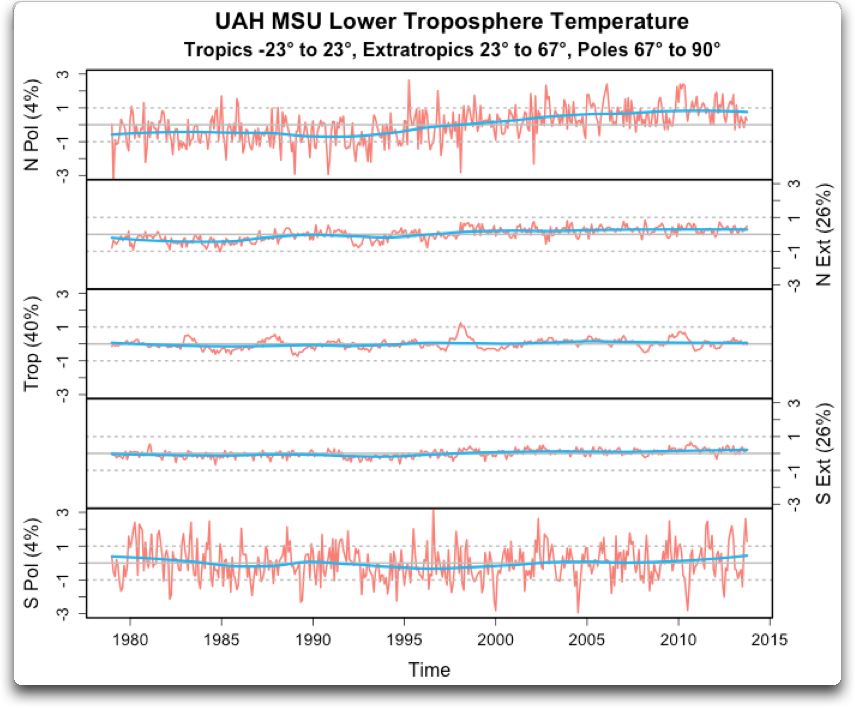
Let us now take a look at the Carbon Dioxide bands of absorption, at 2.7, 4.3 and 15 microns. Of them the 2.7 and 4.3 micron bands absorb where there is little black body radiation, the only band that counts is at 15 microns, and that is in a band where the black body radiation has its maximum. However it is also in a band where water vapor also absorb, not as much as CO2,only about 20% to 70% as much. Water vapor or absolute humidity is highly dependent on the temperature of the air, so at 30C there may be 50 times as much water vapor, at 0C there may be ten times as much water vapor, and at -25C there may be more CO2 than water vapor. At those low temperatures the gases are mostly additive. In the tropics with fifty times more water vapor than CO2, increased CO2 has no influence on the temperature whatsoever. Temperature charts confirm this assertion:

The temperature in the tropics displays no trend whatsoever. It follows the temperature of the oceans, rises in an el niño and falls in a la niña. We are now in the end of an el niño, soon to be followed by a rather strong la niña.The temperature in the southern hemisphere shows no trend. In the northern temperate region there is a slight increase, but the great increase is occurring in the Arctic. There is no increase in the Antarctic yet even though the increase in CO2 is the same in the Antarctic as it is in the Arctic and the winter temperature in the Antarctic is even lower than in the Arctic. So CO2 increase cannot be the sole answer to the winter temperature increase in the Arctic.

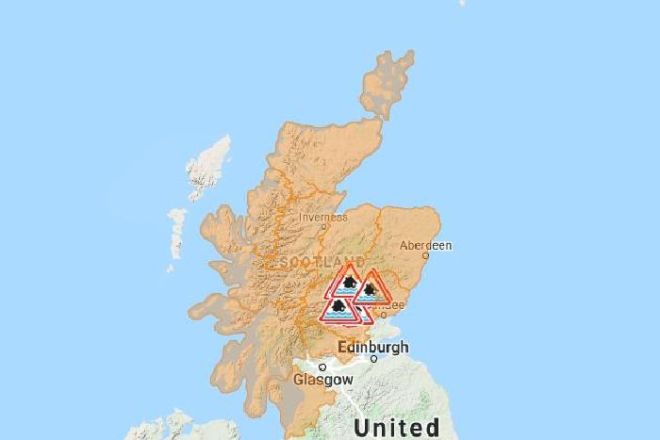
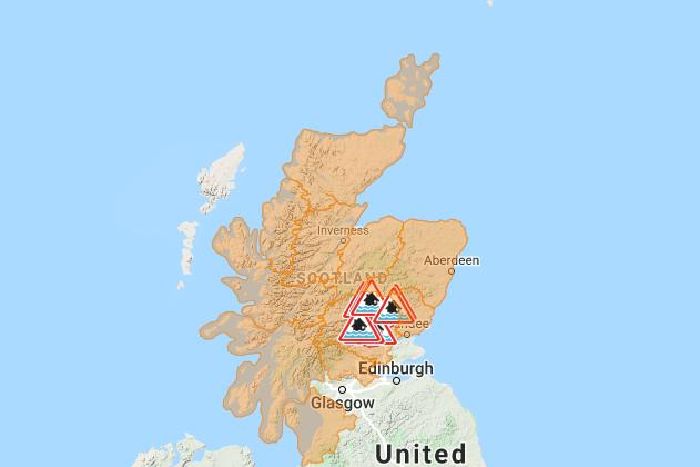
A few days ago there was a storm of historic magnitude, filled with moisture going up from the Mexican Gulf through the Atlantic and really sacked Scotland and Norway. The weather warnings called for severe floods and hurricane-like winds:
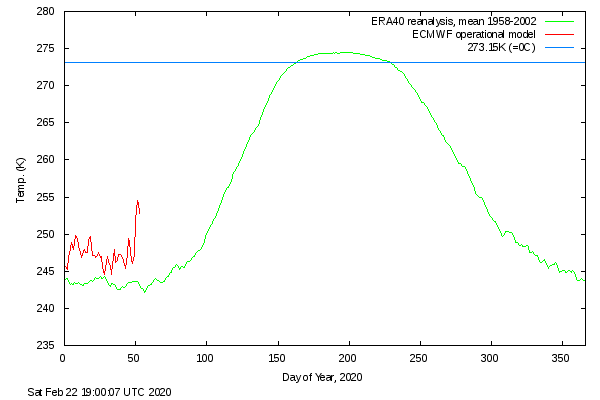
What happened to the temperature when the storm arrived?

The Arctic temperature above the 80th latitude rose about 12C, from about -30C to about -18C, and most of the moisture snowed out. What happened to the ice cover when the storm arrived? Let’s see the most recent Arctic ice cover.

As the storm arrives, some of the ice breaks up, but at the end of the storm it bounces back, helped with all the snow that just fell. After the snowfall ends the ice formed easily breaks up again.

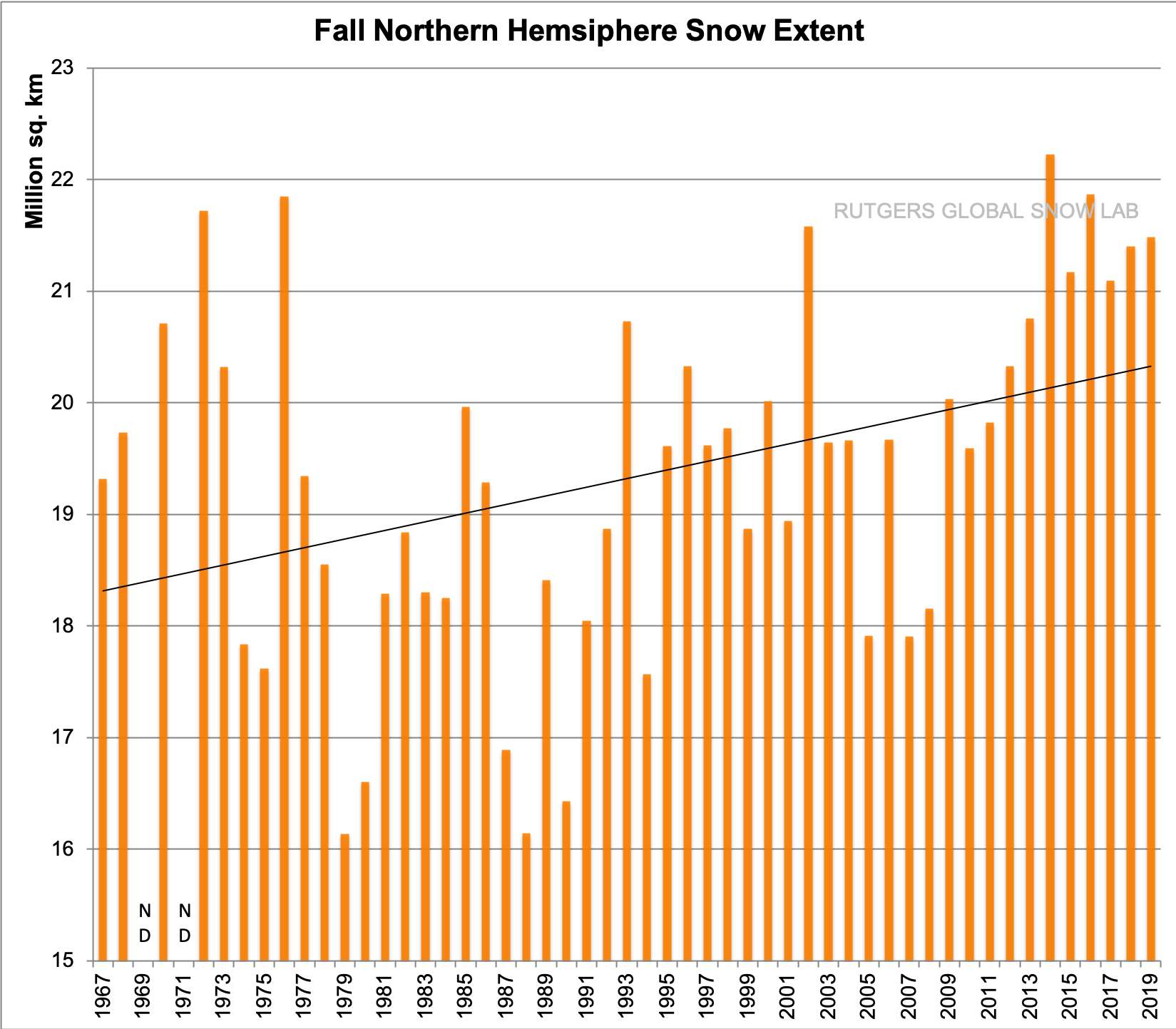
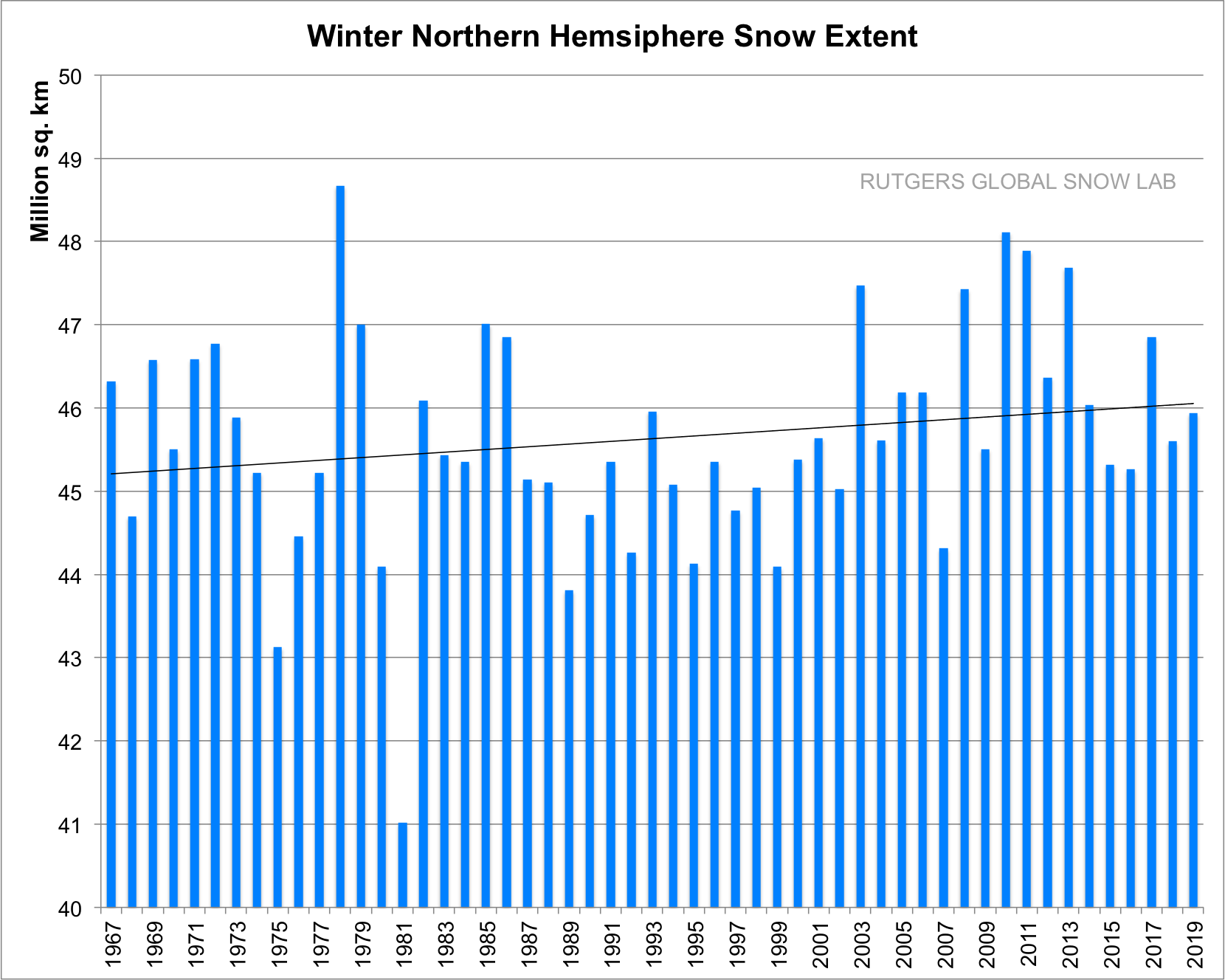
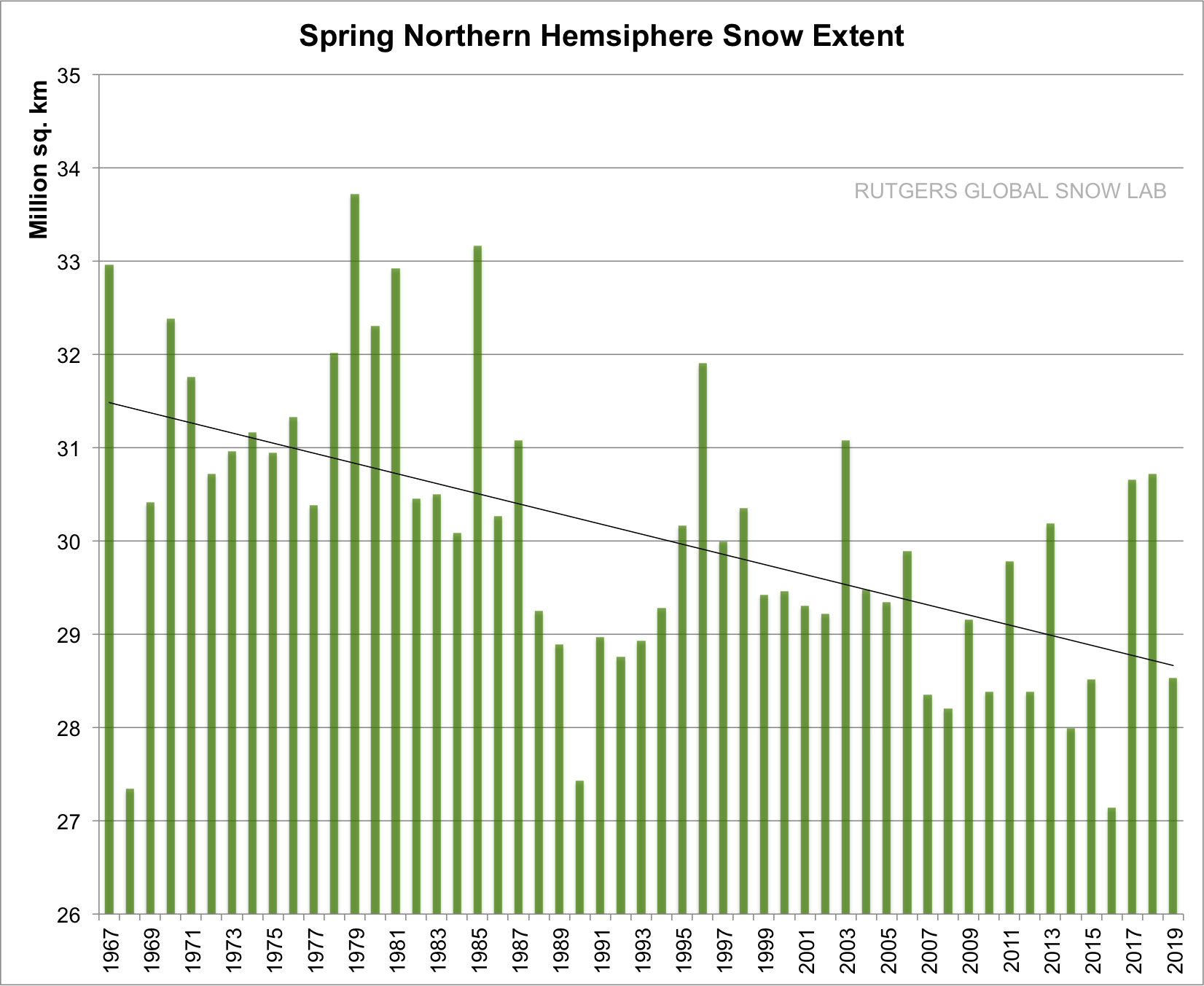
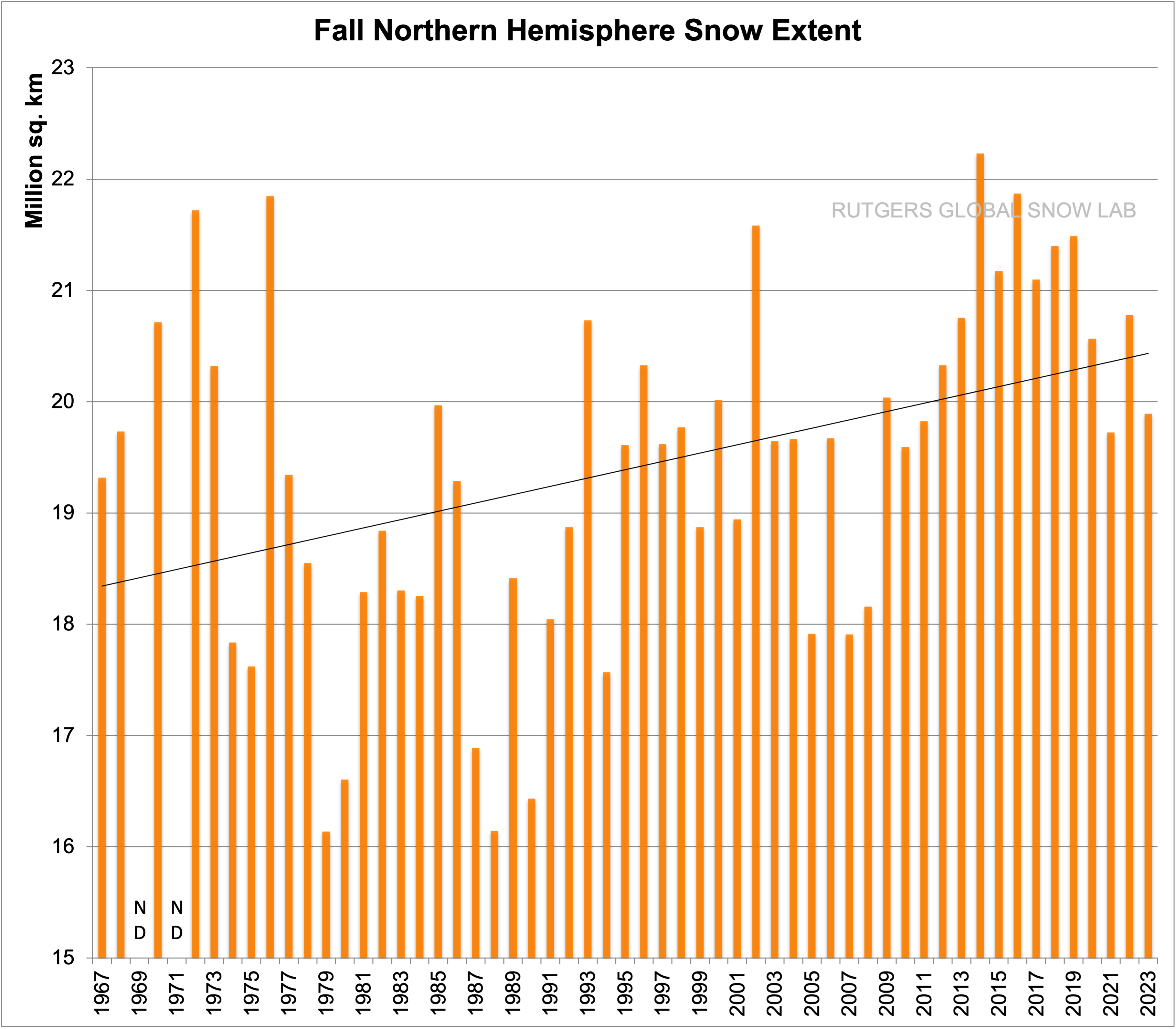
Is the snow cover increasing in the Arctic? Let us see what the snow statistics show. These are from the Rutgers snow lab.
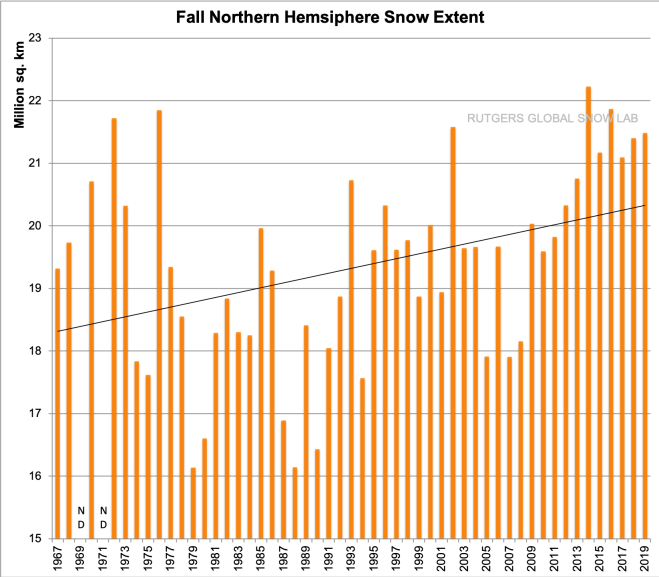
The fall snow extent is increasing by more than 2 percent per year.
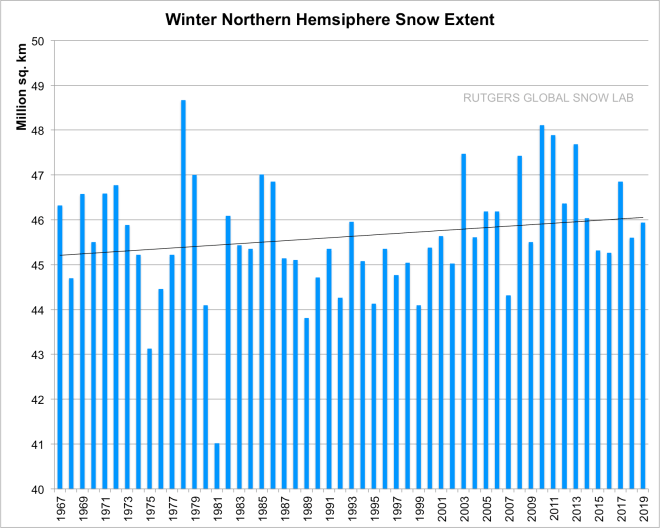
The winter snowfall has also increased but only by 0.04 percent per year.
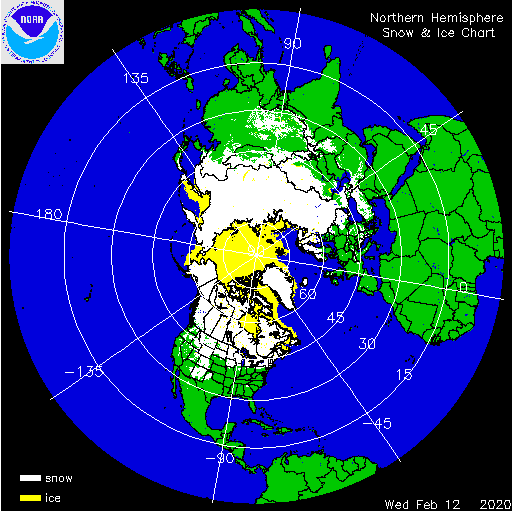
The snow covers all of Russia, Northern China, Mongolia, Tibet, Kashmir and northern Pakistan, Northern Afghanistan, Northern Iran, Turkey, Part of Eastern Europe, Scandinavia, Canada, Alaska, Greenland and parts of Western and Northern United States.
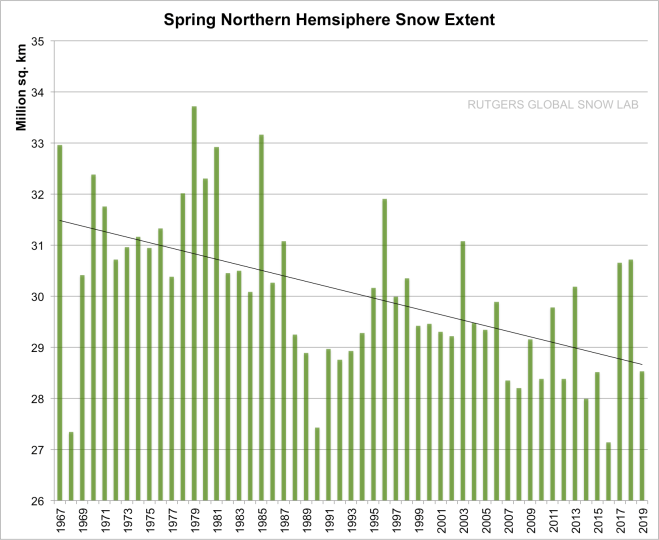
In the spring on the other hand the snow pack is melting faster, about 1.6 percent less snow per year. One of the major reasons for an earlier snow-melt is that the air is getting dirtier, especially over China, and to some extent Russia. The soot from burning coal and mining and manufacturing changes the albedo of the snow. The soot is visible on old snow all the way up to the North Pole. The other reason is that the poles are getting warmer. In the fall and winter it is mostly due to increased snowfall, but in the spring, as soon as the temperature rises over the freezing point, melting occurs.

Moving down to the continental U.S. there are even more good news.

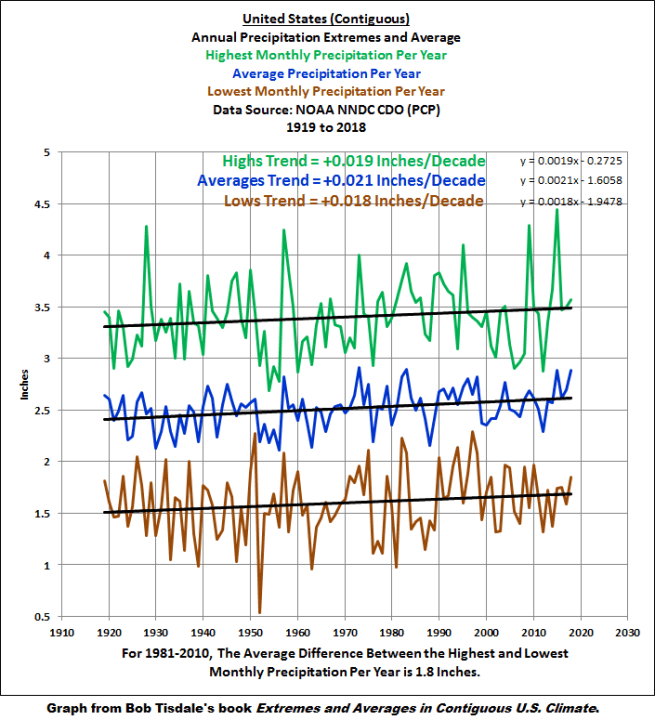
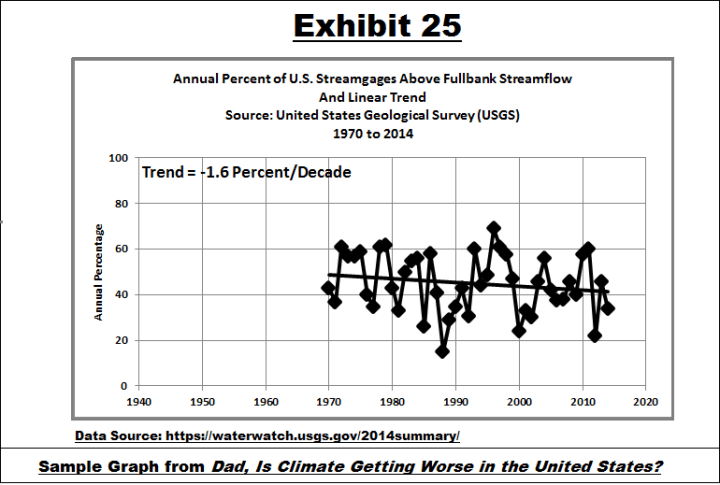
The data presented in the next six graphs were extracted from the data available at the NOAA National Data Center Climate Data Online (NNDC CDO) website.

Yes, rain (and snow) are increasing, but it is also raining slightly more often and regularly, so the net result is a slight decrease in flooding.
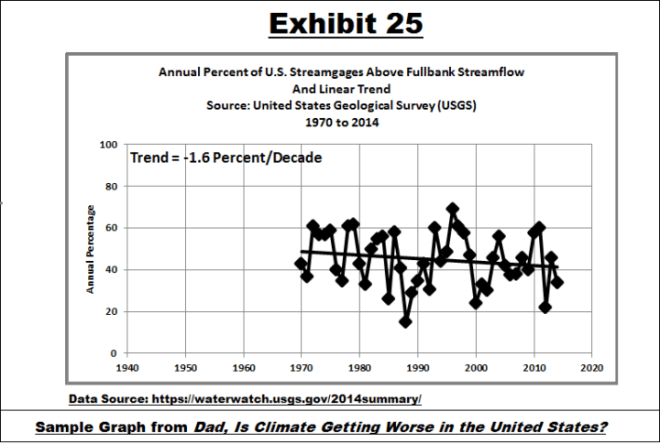
Of course, this could change in the future, and we need to watch the rain patterns, as they are constantly changing. Building more levees is not always the answer, since this will increase the risk for flooding in other places. It may be necessary to let certain areas, mostly farmland and woodland be flooded from time to time.
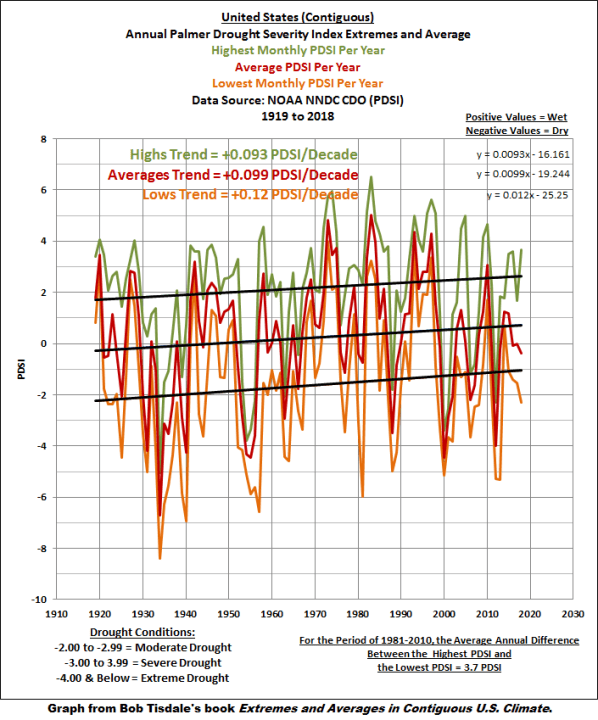
The Palmer Drought Severity Index (PDSI) uses readily available temperature and precipitation data to estimate relative dryness. It is a standardized index that generally spans -10 (dry) to +10 (wet). The chart shows Continental U.S. is getting wetter, about 0.01 PDSI index per year with the lows trend is getting wetter the fastest. This is good news.
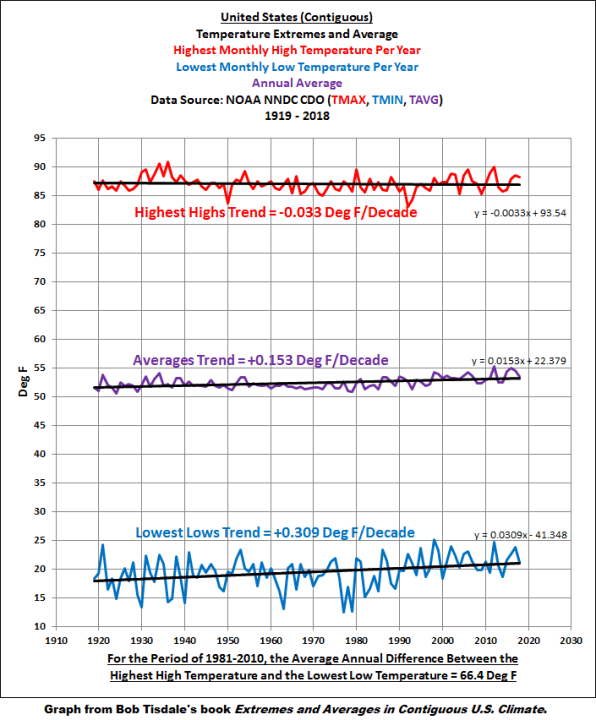
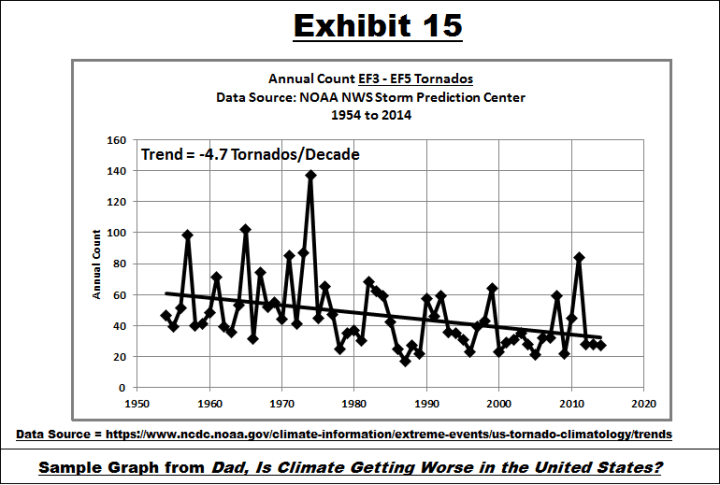
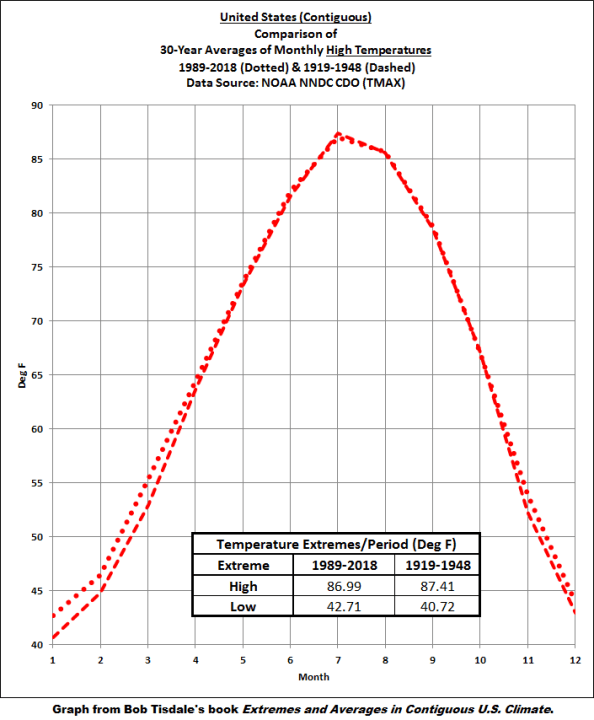
The temperature extremes keep narrowing, the maximum temperatures decrease by 0.033 degree F/decade, but the minimum temperatures increase by 0.309 degree F/decade. This is good, since tornadoes are a result of extreme temperature differences, most often associated with cold fronts.

 The Continental U.S. has not had an EF5 tornado (the most severe) since 2013. Let us hope this trend continues.

Contrary to popular belief, hurricanes making landfall on the U.S. mainland are decreasing slightly, especially major hurricanes.

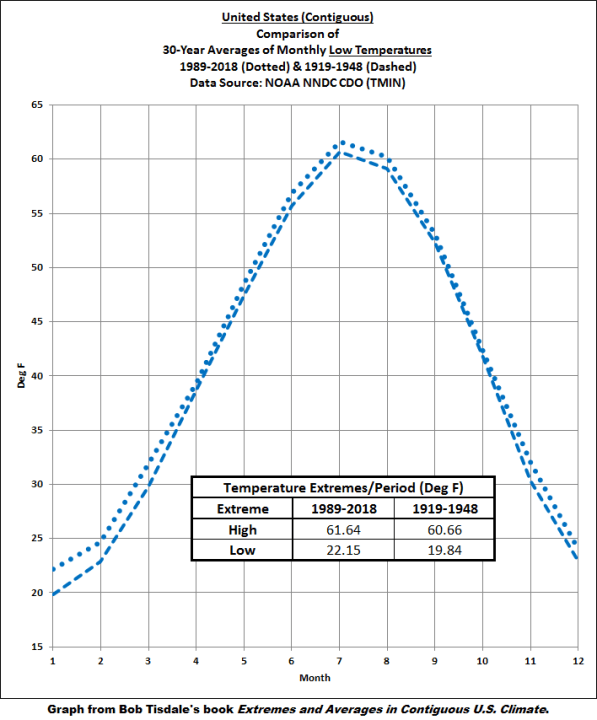
Taking a closer look at the seasonal temperature trends  we can see that the winter aveerage temperatures are rising by about 0.3F per decade but the summer temperatures rise only about one seventh as much, (0.04F/decade)  .
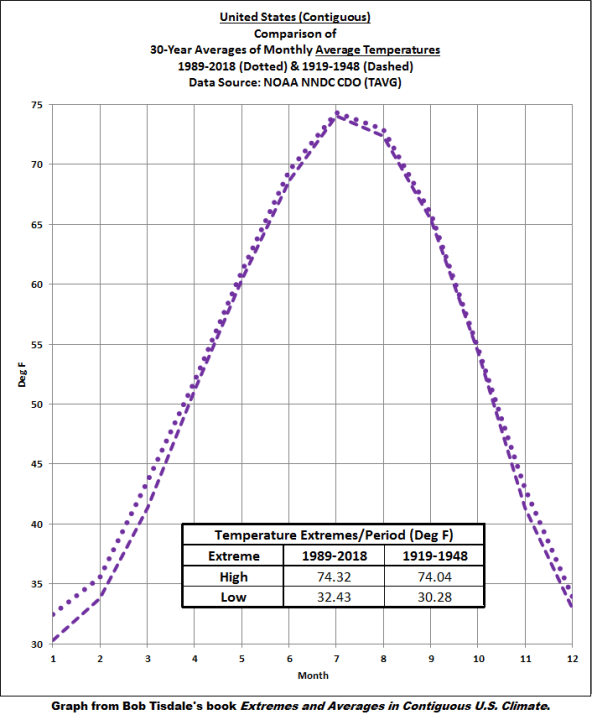
These are the average temperatures. The minimum average temperatures rise in all seasons, but mostly in the winter,

The maximum temperatures barely budge. They rise in the winter and decrease ever so slightly in the summer.

Watching the warming of the poles, and even the continental U.S., far from being an impending end of mankind as we know it, may even be beneficial. Warmer poles in the winter means less temperature gradient between the poles and the tropics, leading to less severe storms. They will still be there, but less severe.

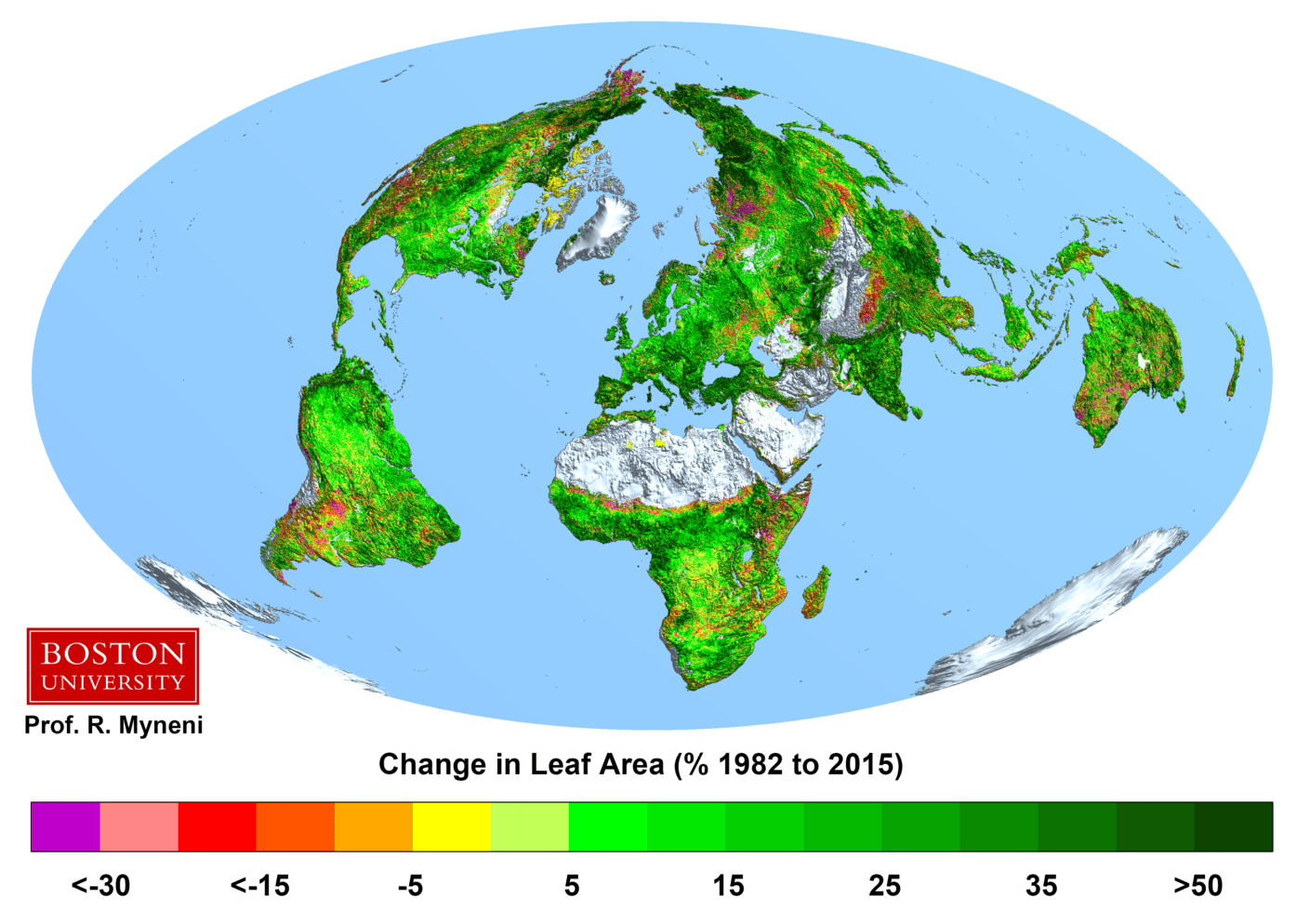
There is one great benefit of increased CO2, the greening of the earth.
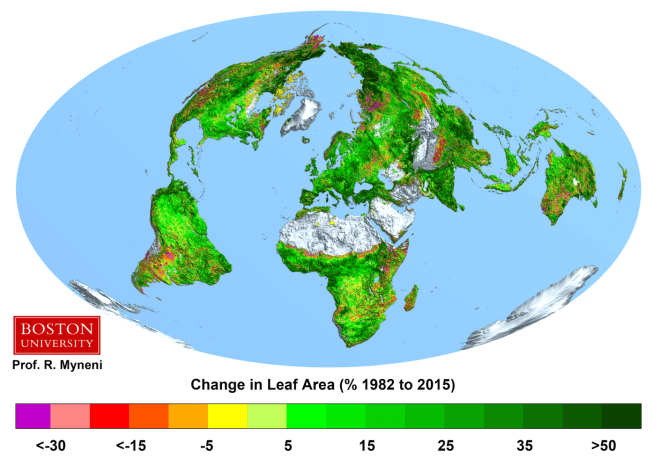
Thanks to this greening, which is accomplished with the fertilizer effect of CO2, the earth can now keep another 2 billion people from starvation, not to mention what it does to plants and wildlife.

Having said that, I am still a conservationist. Coal, oil and gas will run out at some time, and I for one would like to save some for our great grandchildren, not yet born. In addition I would like to minimize the need for mining, which can be quite destructive. We have immense environmental problems, like water pollution, deforestation, intoxication of the soil, over-fertilization with nitrogen, real air pollutants, such as Sulfur compounds and soot, just to name a few. They have one thing in common: It takes lots of energy to do the cleanup.

The best solution is to switch most electricity generation to Thorium molten salt nuclear power. There are multiple reasons why this should be done as a priority by streamlining regulation and facilitate competition in development of the best solutions to the energy problems.


The many cases why Thorium Nuclear Power is the only realistic solution to the world’s energy problems.

The climate change caused by rising CO2 levels leads to less extreme weather, not more, weather statistics prove.

We have experienced a 50% increase in CO2 levels since the beginning of industrialization. In the last 30 years the level has risen 17%, from about 350 ppm to nearly 410 ppm. Is is time to panic and reduce the CO2  emissions to stop the rise?

The traditional way to approach the problem of guessing what effect of rising CO2 levels has on the climate is by creating climate models. Thy have recently been adjusted, and they suddenly show a much higher rate of future temperature increase, in this case what is supposed to happen to global temperatures for a doubling of CO2 from pre-industrial times, from 270ppm to 540ppm.

There are two ways to approach this problem. The models make certain assumptions about the behavior of the changing atmosphere and model future temperature changes. This is the approach from IPCC for the last 32 years. These models are all failing miserably when compared to actual temperature changes.

The other way i to observe what is actually happening to our temperature over time as the CO2 increases. We have 50 years of excellent global temperature data, so with these we can see where, when and by how much the earth has warmed.

The most drastic temperature rise on earth has been in the Arctic above the 80th latitude. In the winter of 2018 it was 8C above the 50 year average. See charts from the Danish Meteorological Institute:

Note, there is no increase at all in the summer temperatures!

The fall temperature saw an increase of 5C and the spring temperature saw an increase of about 2.5C.

The 2020 winter has so far seen an about 4c increase Source: DMI.

This 8C winter rise of temperature is significant, most would even say alarming, but my response is, why is that?

To get the answer we must study molecular absorption spectroscopy and explain a couple of facts for the 97% of all scientists who have not studied molecular spectroscopy. IPCC and most scientists claim that the greenhouse effect is dependent on the gases that are in the atmosphere, and their combined effect is additive according to a logarithmic formula. This is true up to a certain point, but it is not possible to absorb more than 100% of all the energy available in a certain frequency band! For example: If water vapor absorbs 90% of all incoming energy in a certain band, and CO2 absorbs another 50% of the energy in the same band, the result is that 95% is absorbed, (90% + 50% * (100% – 90%)),  not 140%, (90% + 50%).

The following chart shows both CO2 and H2O are absorbing greenhouse gases, with H20 being the stronger greenhouse gas, absorbing over a much wider spectrum, and they overlap for the most part. But it also matters in what frequency range s they absorb.

For this we will have to look at the frequency ranges of the incoming solar radiation and the outgoing black body radiation of the earth. It is the latter that causes the greenhouse effect. Take a look at this chart:

The red area represents the observed amount of solar radiation that reaches the earth’s surface. the white area under the red line represents radiation absorbed in the atmosphere. Likewise, the blue area represents the outgoing black body radiation that is re-emitted. The remaining white area under the magenta, blue or black line represents the retained absorbed energy that causes the greenhouse effect.

Let us  now take a look at the Carbon Dioxide bands of absorption, at 2.7, 4.3 and 15 microns. Of them the 2.7 and 4.3 micron bands absorb where there is little black body radiation, the only band that counts is at 15 microns, and that is in a band where the black body radiation has its maximum. However it is also in a band where water vapor also absorb, not as much as CO2,only about 20% to 70% as much. Water vapor or absolute humidity is highly dependent on the temperature of the air, so at 30C there may be 50 times as much water vapor, at 0C there may be ten times as much water vapor, and at -25C there may be more CO2 than water vapor. At those low temperatures the gases are mostly additive. In the tropics with fifty times more water vapor than CO2, increased CO2 has no influence on the temperature whatsoever. Temperature charts confirm this assertion:

Here the temperature in the tropics displays no trend whatsoever. It follows the temperature of the oceans, rises in an el nino and falls in a la nina. The temperature in the southern hemisphere shows no trend. In the northern temperate region there is a slight increase, but the great increase is occurring in the Arctic. There is no increase in the Antarctic yet even though the increase in CO2 is greater in the Antarctic and the winter temperature in the Antarctic is even lower than in the Arctic. So CO2 increase cannot be the sole answer to the winter temperature increase in the Arctic.

A few days ago there was a storm of historic magnitude, filled with moisture going up from the Mexican Gulf through the Atlantic and really sacked Scotland and Norway. The weather warnings called for severs floods and hurricane-like winds:

What happened to the temperature when the storm arrived?

ice The Arctic temperature above the 80th latitude rose about 12C, from about -30C to about -18C, and most of the moisture snows out. What happens to the ice covercover when the storm arrives? Let’s see the most recent Arctic ice cover.

As the storm arrives, some of the ice breaks up, but at the end of the storm it bounces back, helped with all the snow that just fell.

Is the snow cover increasing in the Arctic?Let us see what the snow statistics show. These are from the Rutgers snow lab.

The fall snow extent is increasing, and has increased by more than 2 percent per year.

The winter snowfall has also increased but only by 0.04 percent per year. The snow covers all of Russia, Northern China, Mongolia, Tibet, Kashmir and northern Pakistan, Northern Afghanistan, Northern Iran, Turkey, Part of Eastern Europe, Scandinavia, Canada, Alaska, Greenland and part of Western and Northern United States.

In the spring on the other hand the snow pack is melting faster, about 1.6 percent less snow per year. One of the major reasons for an earlier snowmelt is that the air is getting dirtier, especially over China, and to some extent Russia. The soot from burning coal and mining and manufacturing changes the albedo of the snow. The soot is visible on old snow all the way up to the North Pole. The other reason is that the poles are getting warmer. In the fall and winter it is mostly due to increased snowfall, but in the spring, as soon as the temperature rises over the freezing point, melting occurs.

Moving down to the continental U.S. there are even more good news.

The data presented in the next six graphs were extracted from the data available at the NOAA National Data Center Climate Data Online (NNDC CDO) website.

Yes, rain (and snow) are increasing, but it is also raining slightly more often and regularly, so the net result is a slight decrease in flooding.

Of course, this could change in the future, and we need to watch the rain patterns, as they are constantly changing. Building more levees is not always the answer, since this will increase the risk for flooding in other places. It may be necessary to let certain areas, mostly farmland and woodland be flooded from time to time.

The Palmer Drought Severity Index (PDSI) uses readily available temperature and precipitation data to estimate relative dryness. It is a standardized index that generally spans -10 (dry) to +10 (wet). The chart shows Continental U.S. is getting wetter, about 0.01 PDSI index per year. This is good news.

The temperature extremes keep narrowing, the maximum temperatures decrease by 0.033 degree F/decade, but the minimum temperatures increase by 0.309 degree F/decade. This is good, since tornadoes are a result of extreme temperature differences, most often associated with cold fronts.

 The Continental U.S. has not had an EF5 tornado (the most severe) since 2013. Let us hope this trend continues.

Contrary to popular belief, hurricanes making landfall on the U.S. mainland are decreasing slightly, especially major hurricanes.

Taking a closer look at the seasonal temperature trends  we can see that the winter temperatures are rising. but the summer temperatures stay the same.

hh

These are the average temperatures. The minimum temperatures rise in all seasons, but mostly in the winter,

The maximum temperatures barely budge. They rise in winter and decrease ever so slightly in the summer.

Watching  the warming of the poles, and even the continental U.S., far from being an impending end of mankind as we know it, may even be beneficial. Warmer poles in the winter means less temperature gradient between the poles and the tropics, leading to less severe storms. They will still be there, but less severe.

There is one great benefit of increased CO2, the greening of the earth.

Thanks to this greening, done with only the fertilizer of CO2 the earth can now keep another 2 billion people from starvation, not to mention what it does to plants and wildlife.

Having said that, I am still a conservationist. Coal, oil and gas will run out at some time, and I for one would like to save some for my great grandchildren, not yet born. In addition I would like to minimize the need for mining, which can be quite destructive. We have immense environmental problems, like water pollution, deforestation, intoxication of the soil, over-fertilization with nitrogen, real air pollutants, such as Sulfur compounds and soot, just to name a few. They have one thing in common: It takes lots of energy to do the cleanup.

The best solution is to switch most electricity generation to Thorium molten salt nuclear power. There are multiple reasons why this should be done as a priority.

Twenty-five reasons to rapidly develop Thorium based Nuclear Power generation.

We need badly to develop and build Thorium based molten salt fast breeder nuclear reactors to secure our energy needs in the future. Lest anyone should be threatened by the words fast breeder, it simply means it uses fast neutrons instead of thermal neutrons, and breeder means it produces more fissible material than it consumes, in the case of Thorium the ratio is about 1.05.

1. A million years supply at today’s consumption levels.

2. Thorium already mined, ready to be extracted.

3. One ten-thousandth of the TRansUranium waste compared to a U-235 based fast breeder reactor.

4. Thorium based nuclear power produces Pu-238, needed for space exploration.

5. Radioactive waste from an LFTR decays down to background radiation in 300 years compared to a million years for U-235 based reactors.

6. Thorium based nuclear power is not suited for making nuclear bombs.

7. Produces isotopes that helps cure certain cancers.

8. Molten Salt Thorium Reactors are earthquake safe.

9. Molten Salt Thorium Reactors cannot have a meltdown, the fuel is already molten.

10. Molten Salt Nuclear Reactors have a very high negative temperature coefficient leading to a safe and stable control.

11. Atmospheric pressure operating conditions, no risk for explosions.

12. Virtually no spent fuel problem, very little on site storage or transport.

13. Thorium Nuclear Power generators  scale  beautifully from small portable generators to full size power plants.

14. No need for evacuation zones, can be placed near urban areas.

15. Liquid Fluoride Thorium Reactors will work both as Base Load and Load Following power plants.

16. Liquid Fluoride Thorium Reactors will lessen the need for an expanded national grid.

17. Russia has an active Thorium program.

18. China is having a massive Thorium program.

19. India is having an ambitious Thorium program.

20. United States used to be the leader in Thorium usage. What happened?

21. With a Molten Salt Reactor, accidents like the Three Mile Island disaster will not happen.

22. With a Molten Salt Reactor, disasters like Chernobyl are impossible.

23. With Molten Salt Reactors, a catastrophe like Fukushima cannot happen.

24. Produces electrical energy at about 4 cents per KWh.

25. Can deplete some of the existing radioactive waste and nuclear weapons stockpiles.
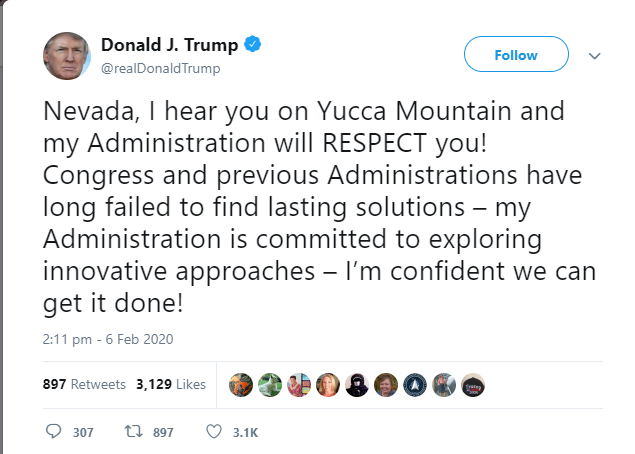
President Trump promises innovative approaches to eliminate nuclear waste. Thorium is the answer! A limerick.

The nuclear waste meant for Yucca

would destine Nevada the sucka

But with Thorium we rid

us of waste that is hid

No need for that waste to be trucka!

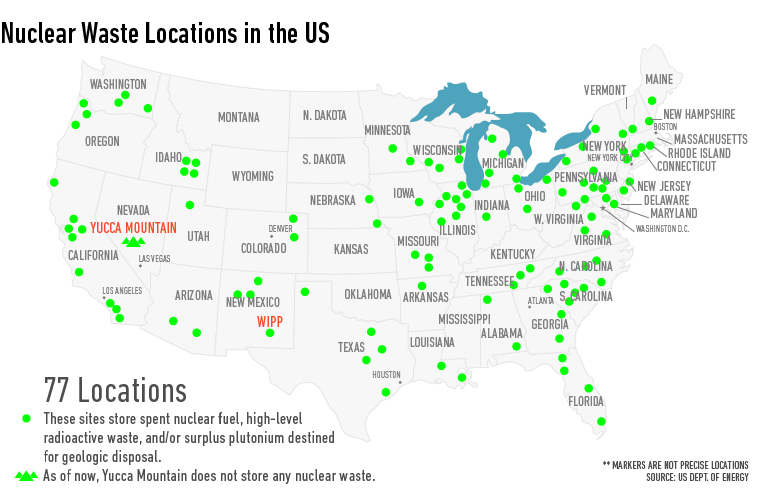
Where is the storage for spent nuclear fuel and other nuclear waste now? Look at the map, it is scary.


And this is just the U.S. installations!

Many years ago I studied Engineering at Chalmers’ University in Sweden and I thought I would become a nuclear engineer. Sweden had at that time a peaceful heavy water based nuclear power program together with Canada and India. The advantage with heavy water as moderator is that it can use natural, un-enriched Uranium. One of the end products is of course Plutonium 239, the preferred material to make nuclear bombs, but it could also use Thorium, and the end product is then Plutonium 238, used in space exploration, and we were dreaming big. One of the advantages of Thorium as fuel is that it produces about 0,01%  of trans-Uranium waste compared to Uranium as fuel. About that time the U.S. proposed we should abandon the heavy water program and switch to light water enriched Uranium based nuclear power. They would sell the enriched Uranium, and reprocess the spent fuel at cost. They also had the ideal final resting place for the radioactive waste products in Nevada. This was an offer the Swedish government could not refuse. This was in the 1960’s! India on the other hand did refuse, and they eventually got the nuclear bomb. In disgust I switched my attention back to control engineering.


What did President Trump mean with innovative approaches?

This is where Thorium comes in!

Here is a list of

Twenty-five reasons to rapidly develop Thorium based Nuclear Power generation.

We need badly to develop and build Thorium based molten salt fast breeder nuclear reactors to secure our energy needs in the future. Lest anyone should be threatened by the words fast breeder, it simply means it uses fast neutrons instead of thermal neutrons, and breeder means it produces more fissible material than it consumes, in the case of Thorium the ratio is about 1.05.
1. A million years supply at today’s consumption levels.
2. Thorium already mined, ready to be extracted.

3. One ten-thousandth of the TRansUranium waste compared to a U-235 based fast breeder reactor.

4. Thorium based nuclear power produces Pu-238, needed for space exploration.

5. Radioactive waste from an LFTR decays down to background radiation in 300 years compared to a million years for U-235 based reactors.

6. Thorium based nuclear power is not suited for making nuclear bombs.

7. Produces isotopes that helps cure certain cancers.

8. Molten Salt Thorium Reactors are earthquake safe.

9. Molten Salt Thorium Reactors cannot have a meltdown, the fuel is already molten.

10. Molten Salt Nuclear Reactors have a very high negative temperature coefficient leading to a safe and stable control.

11. Atmospheric pressure operating conditions, no risk for explosions.

12. Virtually no spent fuel problem, very little on site storage or transport.

13. Thorium Nuclear Power generators  scale  beautifully from small portable generators to full size power plants.

14. No need for evacuation zones, can be placed near urban areas.

15. Liquid Fluoride Thorium Reactors will work both as Base Load and Load Following power plants.

16. Liquid Fluoride Thorium Reactors will lessen the need for an expanded national grid.

17. Russia has an active Thorium program.

18. China is having a massive Thorium program.

19. India is having an ambitious Thorium program.

20. United States used to be the leader in Thorium usage. What happened?

21. With a Molten Salt Reactor, accidents like the Three Mile Island disaster will not happen.

22. With a Molten Salt Reactor, disasters like Chernobyl are impossible.

23. With Molten Salt Reactors, a catastrophe like Fukushima cannot happen.

24. Produces electrical energy at about 4 cents per KWh.

25. Can deplete some of the existing radioactive waste and nuclear weapons stockpiles.

Look carefully at note 17. We can do better than Russia!

No “Climate Catastrophe,” but a more clouded future. A Limerick.

The clouds that we see in the sky
is really the reason for why
we will not overheat;
Shield us from solar heat.
A feedback, on which we rely.
I am a climate realist, that means I look at the totality of what is happening to the climate with increasing CO2 levels, and what it means for our future.

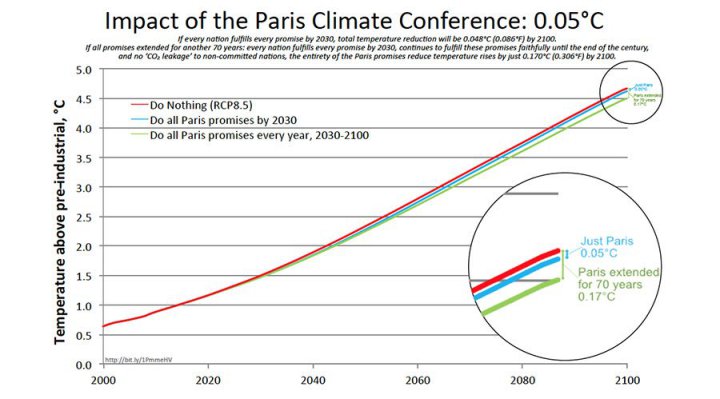
Climate alarmists and IPCC believe that the thermal response to increasing CO2 has a positive feedback from the increasing water vapor that results from higher ocean temperatures, melting permafrost releasing Methane and melting of the polar ice caps. All this leads to much higher temperatures. Current climate model averages indicate a temperature rise of 4.7 C by 2100 if nothing is done, 4.65 C if U.S keeps all its Paris commitments and 4.53 C if all countries keep their part of the agreement. In all cases, with or without Paris agreement we are headed for a disaster of biblical proportions.

As the chart indicates, implementing all of the Paris agreement will delay the end of mankind as we know it by at most 4 years.

Myself and quite a few scientists, meteorologists and engineers believe the feedback loop in nature is far more complicated than that, in fact, there is a large negative feedback in the system, preventing a temperature runaway, and we have the observations to prove it.  The negative feedback manifests itself in 2 ways:

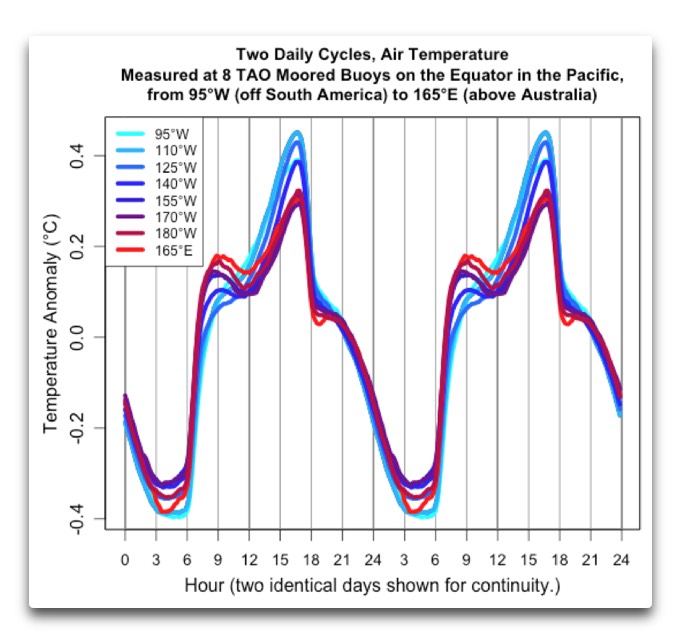
Inorganic feedback, represented by clouds. If there were no clouds, the tropics would average a temperature of  140 F  thanks to the greenhouse effect. The clouds reflect back up to 300 W/m2 into space rather than the same energy being absorbed into water or soil. Clouds are highly temperature dependent, especially cumulus and cumulonimbus clouds. The figure below shows temperatures at the equator in the Pacific Ocean.

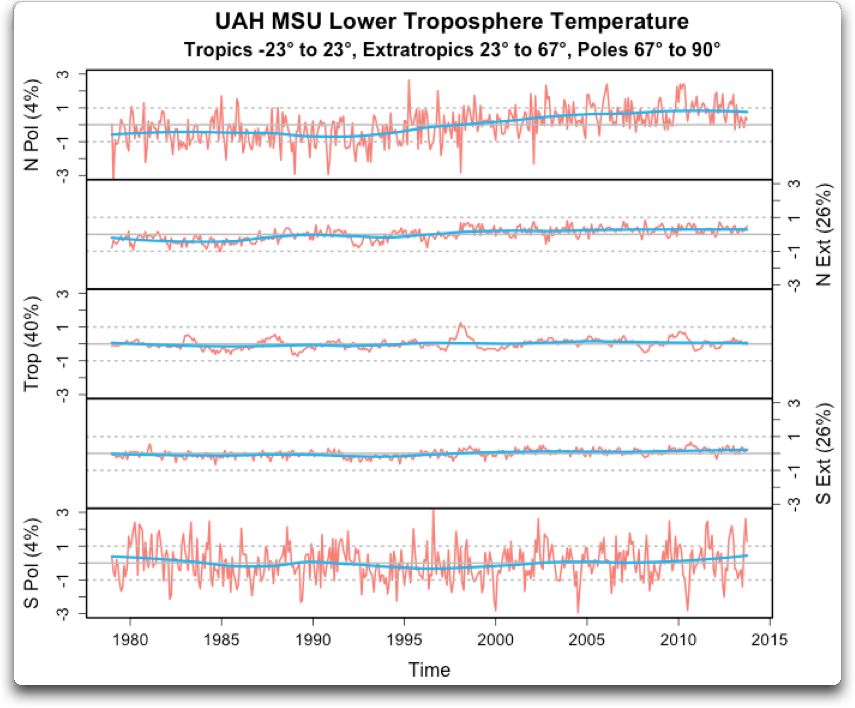
Cumulus clouds are formed in the morning, earlier the warmer it is, and not at all if it is cold, thunderstorms appear when it is warm enough. The figure shows how temperature in the equatorial Pacific rises until about 8:30 a.m, then actually declines between 9 and 12 a.m. even as the sun continues to rise. The feedback, which was positive at low temperatures becomes negative at warmer temperatures, and in the equatorial doldrums, surface temperature has found its equilibrium. No amount of extra CO2 will change that. Equatorial temperatures follow  the temperature of the ocean, warmer when there is an el niño, cooler when there is a la niña. Here is a chart of temperature increases since satellite measurements began as a function of latitude.

The tropics follow the ocean temperature closely, no long term rising trend, the extratropics are also stable.

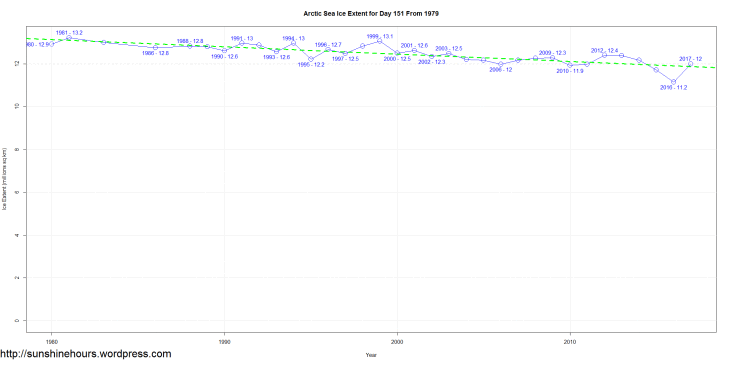
Not so at the poles. the temperature record indicate a noticeable warming with large spikes up and down, up to 3 degree Celsius difference from year to year, especially the Arctic. So, how much has the Arctic melted? Here is a chart of Arctic ice cover for 31 May for the last 39 years.

If this trend continues, all ice may melt altogether in May in 300 to 400 years, faster if there is further warming and nothing else is changing. Let’s take a look at the Arctic above the 80th latitude, an area of about 3,85 million square kilometers, less than 1% of the earth’s surface, but it is there where global warming is most pronounced. Here are two charts from the last 2 years, ending with Sep 23 2019. (Source: Danish Meteorological Institute.)

https://i0.wp.com/ocean.dmi.dk/arctic/plots/meanTarchive/meanT_2019.png

We see clearly that the winter temperatures are rising at the poles, but the summer temperatures have remained steady ore below average year after year.

Something else must be going on. Take a look at the fall snow cover in the northern hemisphere: (Thanks, Rutgers Global Snow lab)

Yes the fall snowfall is increasing with increasing CO2!

The counter-intuitive conclusion is that it may very well be that warmer temperatures produces accumulation of snow and ice, colder temperatures with less snow accumulate less. What happens during the short Arctic summer? With more snow accumulated it takes longer to melt last years snow, so the temperature stays colder longer. This year the Arctic temperature has been running colder than normal every day between early June  and late August. If this melting period ends without melting all snow, multi year ice will accumulate, and if it continues unabated, a new ice age will start.

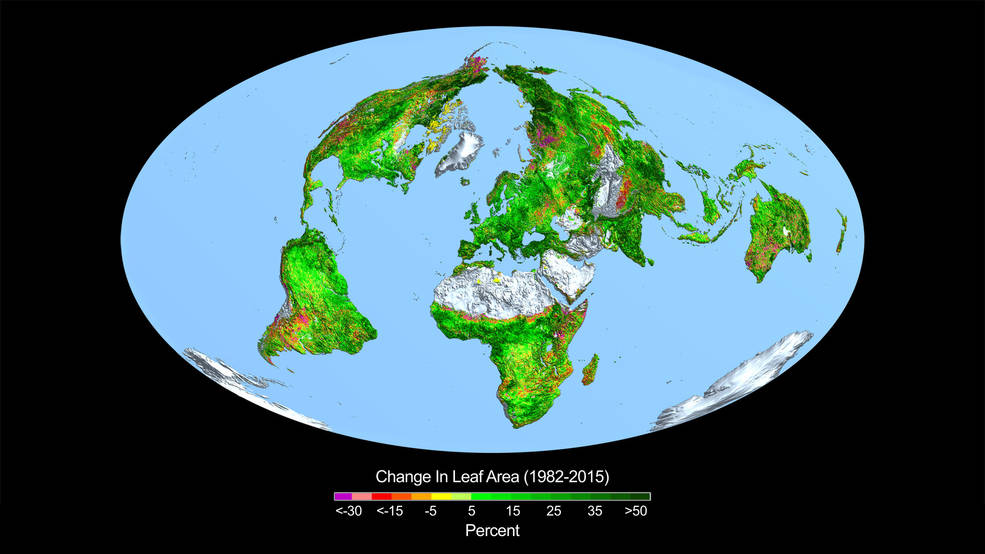
The second feedback loop is organic. More CO2 means more plant growth.  According to NASA there has been a significant greening of the earth, more than 10% since satellite measurements begun. This results in a cooling effect everywhere, except in areas that used to be treeless where they have a warming effect. The net effect is that we can now feed 2 billion more people than before without using more fertilizer. Check this picture from NASA, (now they can publish real science again) showing the increased leaf area extends nearly everywhere.

In addition, more leafs changes the water cycle, increases evapotranspiration, but, ant that is the good news, with more CO2 photosynthesis works better even in droughts, and more trees and vegetation reduces erosion and unwanted runoff. Good news all around.

In short, taking into account the negative feedback occurring, the earth will warm up less than 0.5 degrees with a doubling of the CO2 content, not at all in the tropics, and less than 6 degrees at the poles. Without the Paris agreement there will be no increase in the death rates in the cities, except from the slight increase of city temperatures due to the urban heat effect. With the Paris agreement we will have to make draconian cuts in our use of electricity, meaning using much less air conditioning and even less heating, and life expectancy will decline.

We need energy. It takes a lot of energy to clean up the planet. Developing nations should be encouraged to use electricity rather than cooking by dried cow-dung. Coal is limited, and we should leave some for our great great grandchildren. Oil and gas should be preserved for aviation, since there is no realistic alternative with a high enough energy density. Therefore I am an advocate for Thorium based nuclear energy, being safer than Uranium based nuclear energy, and, properly implemented will produce about 0.01% of the long term radioactive waste compared to conventional nuclear power plants. And there is a million year supply  of Thorium available. Once the electricity power plants have fully switched away from coal and gas, then and only then is it time to switch to electric cars, since they will until then have to be recharged by electricity generated from coal.  https://lenbilen.com/2017/07/14/twenty-five-reasons-to-rapidly-develop-thorium-based-nuclear-power-generation/

Climate Catastrophe? No, but an environmental challenge. A Limerick.

Is climate change all in the cloud?

Acknowledge it is not allowed.

Settled science, they say.

Buckle up and portray

disaster! Close rank, join the crowd.

I believe in climate change. It is obvious by observing how the climate has changed over the years. Here is a chart of global temperature and CO2 for the last 600 million years.

The chart is smoothed over millions of years, but it shows that the global average tempera ture stabilizes at 22C regardless of CO2 levels, and there is precious little correlation between temperature and CO2 level. Taking a look at the last 450,000 years it shows an interesting pattern:

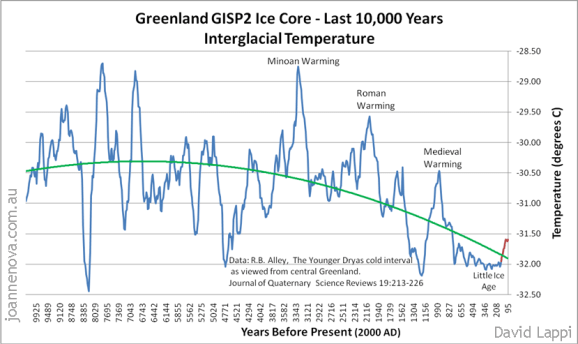
It shows that more than 90 percent of the time the earth has been colder than today, most of that time in a series of ice ages, interrupted with inter-glacial periods of between 5,000 and 20,000 years.  This inter-glacial period is of interest, since it points to our future – another ice age, the question is: When it will start? According to the Milanković cycles we are still in the moderate temperatures sweetspot, and it will last for another few thousand years, but the trend is down, tne next ice age is inevitable. In fact, except for the little ice age and the time between the Roman warm period and the medieval warm period,  the global temperatures have been higher than now for the last ten thousand years. This shows the temperature from the Greenland ice cores for the last 10000 years:

Greenlandgisp-last-10000-new

All of these changes in climate occurred with a relative constant CO2 level of about 260 ppm!

This time is different; CO2 levels are now over 400 ppm, rising about 2 ppm per year with no end in sight. The question is: Is this increase good or bad? If it is bad, how bad is it going to be?

To answer this question the world spends over 400 billion dollars a year in climate research and are starting to spend much more in climate remediation. Over 30 nations are making climate models trying to predict future temperature trends. Of the models so far all but one fail miserably when compared to what actually is happening. The sole exception is the Russian model which tries to fit their  model to past temperature records rather than postulate that response from CO2 and water vapor are always additive.

There is a better, far simpler way to predict future temperature trends. The reason CO2 and water vapor are not always additive is because water vapor is a condensing gas, sometimes forming clouds, which drastically alter the temperature of the surface. Clouds forming at day reflects a large portion of the sunlight back into space, clouds at night keep the heat in.

Willis Eschenbach has made en excellent analysis of 19 years of data from CERES (Clouds and the Earth’s Radiant Energy System from NASA). He compensates for the effect of Advection (horizontal heat transfer of energy from one place on earth to another.) The results are startling:

The 3.7 W/m2 is the expected increase of heat retention for a doubling of CO2 as per IPCC  (the U.N  Intergovernmental Panel on Climate Change). A similar result is obtained if one is to include data from HadCRUT (Temperature data from the Hadley Centre of the UK Met Office)

This agrees very well with my own, much coarser examination of data, but should include that the expected temperature increase observed for a doubling of CO2 is by no means evenly distributed. In addition, if temperature rises 0,39C there will be  about 2.6 % more water vapor in the air which would rise temperature another 0.35 C. This too is not evenly distributed. Here are the expected result:

In the tropical doldrums there will be no change at all, the water vapor is all dominant and thunderstorms keep the average temperature constant.

In the 10-40 latitude there will be an increase, but increased clouds will moderate the increase except in the most arid deserts that will experience around a 0.9 C increase.

The temperate regions will experience about a 0.4 C increase in the wet areas, and about a 0.6 C in the arid parts.

Most of the increase will be experienced around the poles, with minimum temperatures rising five to ten degrees, but maximum temperatures staying about the same. We are seeing this increase in the Arctic, and the rise is nearly all due to rising winter minimum temperatures.

Source: Danish Meteorology Institute

Why is that? With on the average 2.6 % increase in water vapor there will be an increase in the rainfall,  about 2.6% on average, but since there is no change in the tropics it will be concentrated at the higher latitudes, especially around the poles where it will manifest itself as more snow, and that is the main reason for the increased minimum temperatures. Notice there has been no increase in summer temperatures!

So, how bad is it going to get if nothing is done to stop the increase in CO2?

The temperature difference between poles and equator will be less, which means:

Fewer and less severe hurricanes, less severe tornadoes, less severe winter storms, less droughts.

But there will be about 2% more average cloud cover, more rain and more flooding.

So, with an 0.4C average temperature we will not even be back to the medieval warm period, much less the Roman warm period, not to speak of the Minoan warm period.

The sinking eastern seaboard is a problem that has very little to do with ocean rising, and all to do with tectonic plates movements, which we will have to accept.

Will anything else good come out of this climate change?

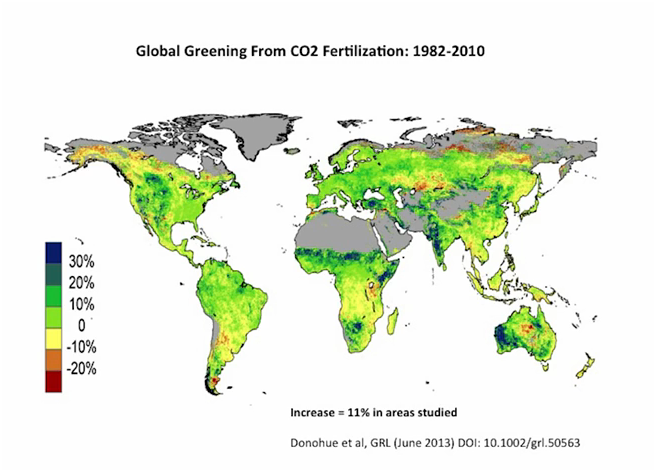
Yes, indeed. With a doubling of CO2 there will be a corresponding response from plant life increasing biological productivity 30 to 60%. It is not linear, and above 800 ppm it tapers of for most plant species. But we will be able to feed at least another 3 billion people and keep them from hunger, but also much cattle and wild animals, (yes that includes flies and gnats, but I digress)

https://lenbilen.com/wp-content/uploads/2016/11/increase.png?w=660

This picture gives us hope for the future. Notice the most significant increase was in Sub-Saharan Africa, western United States, western Australia and western India. These are the areas that need more rain the most!

If increasing CO2 concentration is not the problem, then what is? Let us take a look at the sources  from which U.S. generates electrical energy.

Image result for us electricity generation by source

We live in challenging times indeed, with enormous environmental challenges. It takes a lot of energy to clean up the mess we have generated over the ages. It would be a shame to use up our remaining coal, oil and gas to produce the electricity needed to clean up. Oil coal and gas will eventually be depleted and we need to save some for our great grandchildren so they can enjoy flying like we have become accustomed to. Like the famous conservationist Sarah Palin once said: “for when it’s gone, it’s gone.

Solar generation is about 4 times more expensive (without subsidies) to produce energy than coal and gas, but has important niche applications, such as on roofs for backup in case of short grid failures and for peak power assist. The Amish people have given many practical applications on how to live off the grid.

Wind power is cheaper when the wind blows, but the full generation capacity has to be there even when the wind doesn’t blow, so the only gain from wind power is to lessen the mining or extraction of carbon. In addition, wind power kills birds, the free yearly quota of allowable Bald Eagle kills was upped from 1200 to 4200 during the Obama administration. Golden Eagles and a few other rare birds have a quarter of a million dollar fine associated with their kills. If wind power is increased without finding a solution to the bird kills, whole species may become extinct.

Hydroelectric power is for all practical purpose maxed out, except one large untapped resource; the Kongo river in Africa. Some hydro electrical project do more harm than good, such as the Aswan Dam in Egypt, and some are waiting for the next big earthquake, such as the Three Gorges Dam in China.

Geothermal power is good but difficult and risky to utilize in geologically unstable areas.

Biomass should never be burned for electricity production but be used for soil regeneration to combat erosion. Only polluted biomass such as medical waste and plastics should be incinerated at high temperature, complete with scrubbers to eliminate poisonous gases.

All necessary cleanup and recycling consume a lot of energy, and it has to be generated somehow. We would like save some Coal, Natural Gas and Petroleum for our great grandchildren. This leaves us only

Nuclear power.  After a nearly thirty year hiatus in building new nuclear power plants they are slowly being built again. The permit process is fraught with citizen opposition (NIMBY), very strict bureaucratic delay, first by the Three Mile Island incident, then by the Chernobyl disaster/unintended sabotage, and finally by the Fukushima catastrophe. In addition conventional nuclear power produces large amounts of transuranium waste products that has to be stored for a million years. The Obama administration ended reprocessing of spent fuel rods, so not only must the transuranium products be stored, but also some unused U235. This makes conventional nuclear power using enriched Uranium too expensive to compete against coal or natural gas. But there are powerful commercial interests to keep it this way. After the Westinghouse bankruptcy GE has a virtual monopoly on nuclear power. They are in no hurry to make any changes.

There is a better way: Thorium Nuclear power. The advantages are:

1. A million years supply at today’s consumption levels.

2. Thorium already mined, ready to be extracted.

3. One ten-thousandth of the TRansUranium waste compared to a U-235 based fast breeder reactor.

4. Thorium based nuclear power produces Pu-238, needed for space exploration.

5. Radioactive waste from an LFTR decays down to background radiation in 300 years compared to a million years for U-235 based reactors.

6. Thorium based nuclear power is not suited for making nuclear bombs.

7. Produces isotopes that helps cure certain cancers.

8. Molten Salt Thorium Reactors are earthquake safe.

9. Molten Salt Thorium Reactors cannot have a meltdown, the fuel ia already molten.

10. Molten Salt Nuclear Reactors have a very high negative temperature coefficient leading to a safe and stable control.

11. Atmospheric pressure operating conditions, no risk for explosions.

12. Virtually no spent fuel problem, very little on site storage or transport.

13. Thorium Nuclear Power generators  scale  beautifully from small portable generators to full size power plants.

14. No need for evacuation zones, can be placed near urban areas.

15. Liquid Fluoride Thorium Reactors will work both as Base Load and Load Following power plants.

16. Liquid Fluoride Thorium Reactors will lessen the need for an expanded national grid.

17. Russia has an active Thorium program.

18. China is having a massive Thorium program.

19. India is having an ambitious Thorium program.

20. United States used to be the leader in Thorium usage. What happened?

21. With a Molten Salt Reactor, accidents like the Three Mile Island disaster will not happen.

22. With a Molten Salt Reactor, disasters like Chernobyl are impossible.

23. With Molten Salt Reactors, a catastrophe like Fukushima cannot happen.

24. Produces electrical energy at about 4 cents per KWh.

25. Can deplete some of the existing radioactive waste and nuclear weapons stockpiles.

There is no time to waste. This is my suggestion list:

1. Immediately take Thorium off the list of “source materials”. While Thorium is radioactive slightly above background radiation no amount of Thorium can make it go critical, and it cannot be source material for making bombs.

2. Make separate regulations for Thorium based Nuclear plants apart from Uranium plants. One thing that goes away is the need for evacuation zones due to the inherent safety of Thorium Nuclear plants.

3. Declare Thorium Nuclear Power to be the preferred replacement for Coal or Gas powered electric plants.

4. Streamline the permit process, like Uranium powered plants enjoyed when there was a desire to build Nuclear Bombs.

5. Increase research and development into Liquid Fluoride Thorium reactors to speed up their development.

6. Develop hybrid Tokamak powered Thorium reactors like the one Russia is developing to burn off transuraniun  nuclear waste products.

With all this done, I envision coal, gas and biofuel Power stations to be eliminated within ten years, and transuranium waste products to be eliminated within twenty years.

When Coal, gas and biofuel are eliminated as source for Electric Power, then it is time to switch most of the transportation to electric cars and trucks, but not before.

in another twenty years, maybe, just maybe it is time for Fusion Power to take over.

Let us get going!


50 year anniversary since the first moon landing. A Limerick.

https://lenbilen.com/wp-content/uploads/2012/12/wb.jpg

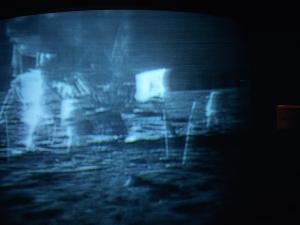
I remember it like yesterday. We sat up late in the evening of July 20 1969 and watched the first landing on the moon, in real-time and transmitted over all 3 networks. Later President Nixon commented: “This is the greatest week in the history of the world since Creation.” Be that as it may, it was watched by about 500 million people world-wide and the future looked bright. Look at us since then:

Fifty years since “a small step for man.”

It seemed we lost sight of the plan.

Now it’s back to the Moon

with the Gateway, and soon

for with Thorium power, we can.

The ambition is to build a space colony on the moon, have a space station, the “Gateway”, and from there launch unmanned and finally manned Mars missions. A very ambitious program. The only way it is possible by utilizing molten salt Thorium nuclear reactors on the moon to cope with the 14 day nights on the moon. This 10 min video tells it well.