Produces isotopes that helps cure certain cancers. For decades, medical researchers have sought treatments for cancer. Now, Alpha Particle Immunotherapy offers a promising treatment for many forms of cancer, and perhaps a cure. Unfortunately, the most promising alpha-emitting medical isotopes, actinium-225 and its daughter, bismuth-213, are not available in sufficient quantity to support current research, much less therapeutic use. In fact, there are only three sources in the world that largely “milk” these isotopes from less than 2 grams of thorium source material. Additional supplies were not forthcoming. Fortunately, scientists and engineers at Idaho National Laboratory identified 40-year-old reactor fuel stored at the lab as a substantial untapped resource and developed Medical Actinium for Therapeutic Treatment, or MATT, which consists of two innovative processes (MATT-CAR and MATT-BAR) to recover this valuable medical isotope.
Tag: Thorium
The need to develop Thorium based Nuclear Energy as the major electric energy supply. 6. Thorium based nuclear power is not suited for making nuclear bombs.
Thorium based Nuclear Power does not produce Plutonium239, which is the preferred material used in nuclear bombs. The higher Plutonium isotopes and other TRansUraniums are about as nasty as they get, and need expensive protection against terror attacks, and need to be stored for a very long time.
One anecdote from my youth. The time had come to apply to University, and to my delight I was accepted to Chalmers’ University in Sweden as a Technical Physics major. I felt, maybe I can do my part by becoming a Nuclear Engineer and help solve the energy needs of the future. The Swedes at that time championed the heavy water – natural Uranium program together with the Canadians. Sweden is a non-aligned country, so it was not privy to any atomic secrets, it had to go it alone. They settled on the heavy water moderated natural Uranium process because Sweden had an ambition to produce its own nuclear bomb. Officially this was never talked about, and I was not aware of it at that time. They could have gone with Thorium instead, but a Thorium based nuclear reactor produces very little Plutonium, and what it produces is PU-238, not suitable for bomb making.
I was excited to learn about all the possibilities and signed up for a couple of nuclear classes. One lab was to design a safety circuit, then run the heavy water research reactor critical and hopefully watch the reactor shut down from the safety circuit before the system safety circuit shutdown. About that time the word came that U.S. will sell partially enriched uranium at bargain basement prices if Sweden agreed to abandon the heavy water project and sign the nuclear non-proliferation treaty, a treaty being formulated by U.N.
Sweden was in awe about U.N, all the problems of the world were to be solved through it, and it had such capable General Secretary in Dag Hammarskjöld, a Swede. I looked at the light water, partially enriched Uranium nuclear power plants being developed and decided to have no part with it, not due to safety concerns but it was the design that produced the most nuclear waste of any of the available designs. At that time there was still optimism that fusion would be ready by about the year 2010 or so. The cost of maintaining spent fuel in perpetuity was never considered, so light water reactors became the low cost solution.
India on the other hand refused to join the nuclear non-proliferation treaty, kept their heavy water program going and had by 1974 produced enough plutonium for one nuclear bomb, which they promptly detonated. They still use heavy water moderated reactors, but since India is low on Uranium but rich in Thorium they have now converted one heavy water reactor to thorium with a Plutonium glow plug. It went on-line in 2011.
They are also developing molten salt Thorium reactors, but full production is still a few years off.
There we have it. We could have gone with Thorium from the beginning, but the cold war was on, and the civilian peaceful use of nuclear energy was still all paid for by nuclear weapons research and development. Once all the bombs we could ever need were developed the greatest asset of nuclear power became its greatest liability.
The need to develop Thorium based Nuclear Energy as the major electric energy supply. 5. Radioactive waste from an LFTR decays down to background radiation in 300 years compared to a million years for U-235 based reactors.
Radioactive waste from an LFTR (Liquid Fluoride Thorium Reactor) decays down to background radiation in 300 years instead of a million years for U-235 based reactors. Initially LFTRs produce as much radioactivity as an U-235 based nuclear reactor, since fission converts mass to heat, but the decay products have a much shorter half-life. See the figure below.

The need to develop Thorium based Nuclear Energy as the major electric energy supply. 4. Thorium based nuclear power produces Pu-238, needed for space exploration.
A Thorium based nuclear power generator produces Pu-238 as one of the final TRansUranium products, which is in short supply and much in demand for space exploration nuclear power.
NASA relies on pu-238 to power long-lasting spacecraft batteries that transform heat into electricity. With foreign and domestic supplies dwindling, NASA officials are worried the shortage will prevent the agency from sending spacecraft to the outer planets and other destinations where sunlight is scarce. Thorium reactors produce PU-238 as a “free” byproduct. In 2009 Congress denied a request to produce more Pu-238 by traditional means, instead relying on Russia to sell us the plutonium. (Remember the Russian reset?) Russia made their last delivery in 2010. PU-238 production has since been restarted by converting Ne-237 to Pu-238 at a cost of 8 million dollars per kilogram. The Ceres-Dawn spacecraft used over 22 Kg of Pu-238 as electricity generator.
The need to develop Thorium based Nuclear Energy as the major electric energy supply. 3. One ten-thousandth of the TRansUranium waste compared to a U-235 based fast breeder reactor.
A Thorium based fast breeder nucear reactor produces much less TRansUranium waste, 0.01% waste products compared to a Uranium-235 fast breeder. The Thorium process has a much higher efficiency of fission than the Uranium process. See the figure below. 
Pu = Plutonium, Am = Americum, Cm = Curium, all TRansUraniums, nasty stuff.
With Thorium based Nuclear power, there are no real problems, with traditional U235 power long tern storage is an immense and urgent problem, and has been since the 1960’s. At that time Sweden had a heavy water U-238 nuclear power program going, but abandoned it in favor of traditional U-235 power. U.S. promised to provide the material and take care of the reprocessing and final storage of all nuclear waste at cost if Sweden joined the nuclear proliferation treaty. Reprocessing was to be done in Washington State, and one of the final storage sites mentioned was Yucca Mountain in Nevada, having the ideal Geological properties.
Time goes by and in 1982 – Congress passed the Nuclear Waste Policy Act, requiring the establishment of a deep geologic repository for nuclear waste storage and isolation. Yucca Mountain was high on the list out of of 9 possible sites.
Time goes by, and Congress is still not able to decide on a solution. Meanwhile, TRU’s from spent and reprocessed fuel is piling up in less than ideal locations. Thorium based nuclear power would go a long way to alleviate this problem.
The need to develop Thorium based Nuclear Energy as the major electric energy supply. 2. Thorium already mined, ready to be extracted.
Thorium is a by-product of mining heavy metals and rare earth metals. The price is the cost of extracting and refining, which can be as low as $40/Kg. No extra mining is required for extracting the Thorium, and we all know that mining is a major source for pollution.
The first thing we must realize is that rare earth metals are not all that rare. They are a thousand times or more abundant than gold or platinum in the earth crust and easy to mine, but a little more difficult to refine. Thorium and Uranium will be mined together with rare earth metals.

U.S. used to be the major supplier for rare earth metals, which was fine up to around 1984. Then the U.S. regulators determined that Uranium and Thorium contained in the ore made the ore radioactive, so they decided to make rare metal ore a “source material” with all what that meant for record keeping and control.  This made mining in the U.S. unprofitable so in 2001 the last mine closed down. China had no such scruples, such as human and environmental concerns, so they took over the rare earth metals concession and in 2010 controlled over 95% of the world supply, which was according to their long term plan of controlling the world by 2025. Luckily this has now been rectified with U.S. and Australian mines reopened.

So, why is this important? Just take a look at all the uses for rare earth metals. The most sought after pays all the cost of mining and refining, and the rest are readily available at nominal cost.
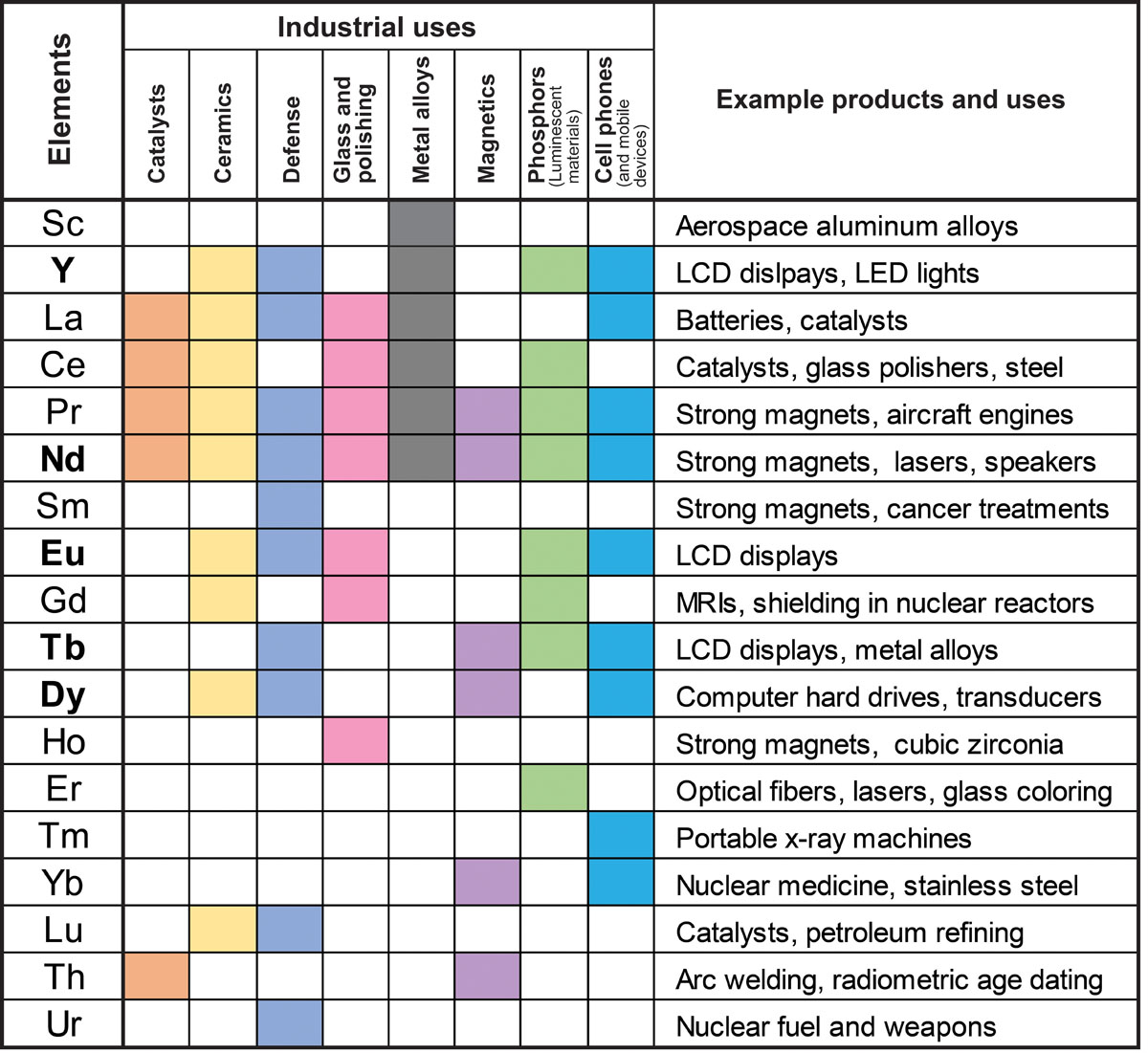
The Chinese almost got away with it, and that is but one reason the trade negotiations are so complicated and hard fought, but necessary. Donald Trump fights for reciprocity and fair competition.
The need to develop Thorium based Nuclear Energy as the major electric energy supply. 1. A million years supply at today’s consumption levels.
We live in challenging times with enormous environmental challenges. It takes a lot of energy to clean up the mess we have generated over the ages. It would be a shame to use up our remaining coal, oil and gas to produce the electricity needed to clean up. Oil coal and gas will eventually be depleted and we need to save some for our great grandchildren so they can enjoy flying like we have become accustomed to. Like the famous conservationist Sarah Palin once said: “for when it’s gone, it’s gone.”
The need to develop a Thorium based molten salt fast breeder nuclear reactor to develop our energy needs for the future can not be overstated. Lest anyone should be threatened by the words fast breeder, it simply means it uses fast neutrons instead of thermal neutrons, and breeder means it produces more fissible material than it consumes, in the case of Thorium the ratio is about 1.05.
There is enough Thorium around to last for a million years at today’s worldwide electricity generation levels. Uranium is in short supply. The consumption exceeds production, and the worldwide major importer of Uranium is the U.S. (The fact that we sold 20% of our uranium ore to the Russians did not help)
There are of course the sustainable energy sources such as wind, solar, hydroelectric, biomass, geothermal, tidal and wave energy, and they should be pursued where economically and environmentally appropriate. These are a separate but important subjects.
Water vapor and CO2 – why nearly all climate models fail.
The candidate Beto O’Rourke
on Climate change is but a dork.
He does not understand
that the world will not end.
Fake News! – Only New Green Deal pork!
Quote from Beto O’Rourke:
“The scientists are unanimous on this. We have no more than 12 years to take incredibly bold action on this crisis, can we make it? I don’t know. It’s up to every one of us. Do you want to make it?”
I beg to differ.
We live in only one world. As a concerned citizen I realize we have immense environmental challenges before us, with water pollution; from plastics in the ocean, excess fertilizer in the rivers, poison from all kinds of chemicals, including antibiotics, birth control and other medicines flushed down the toilet after going through our bodies, animals fed antibiotics, pest control, weed control and so on. Increasing CO2 is not one of the problems, it will in fact help with erosion control, and allow us to feed more people on less agricultural land with proper management, and require less fertilizer and water to do so. In fact, proper water management is a larger problem, with some rivers no longer reaching the ocean. All water is already spoken for, especially in the 10 to 40 degrees latitude, where most people live.
Allow me to be somewhat technical and give the background to why I know we will never experience the thermal runaway they are so afraid of.
Many years ago I worked at Hewlett Packard on an Atomic Absorption Detector. It was a huge technical success but a commercial failure, as it was too expensive to use for routine applications. However it found a niche and became the detector of choice when dismantling the huge nerve gas stockpiles remaining from the cold war. I was charged with doing the spectrum analysis and produce the final data from the elements. One day two salesmen came and tried to sell us a patented device that could identify up to 21 different elements with one analysis. They had a detector that divided the visual band into 21 parts, and bingo, with proper, not yet “fully developed” software you could now analyze up to 21 elements with one gas chromatic analysis. What could be better? We could only analyze correctly four or five elements simultaneously. It turns out the elements are absorbing in the same wavelength bands, scientifically speaking they are not orthogonal, so software massaging can only go so far. It turned out that the promised new detector was inferior to what we already had and could only quantify three or 4 elements at the most.
In the atmosphere the two most important greenhouse gases are water vapor and CO2 with methane a distant third. Water vapor is much more of a greenhouse gas everywhere except near the tropopause high above the high clouds and near the poles when the temperature is below 0 F, way below freezing. A chart shows the relationship between CO2 and water vapor:

Source: http://notrickszone.com/2017/07/31/new-paper-co2-has-negligible-influence-on-earths-temperature/
Even in Barrow, Alaska water vapor is the dominant greenhouse gas. Only at the South Pole (And North Pole) does CO2 dominate (in the long winter).
All Climate models take this into account, and that is why they all predict that the major temperature increase will occur in the polar regions with melting icecaps and other dire consequences. But they also predict a uniform temperature rise from the increased forcing from CO2 and the additional water vapor resulting from the increased temperature.
This is wrong on two accounts. First, CO2 and H2O gas are nor orthogonal, that means they both absorb in the same frequency bands. There is three bands where CO2 absorb much more than H2O in the far infrared band, but other than that H2O is the main absorber. If H2O is 80 times as common as CO2 as it is around the equator, water vapor is still the dominant absorber.
Secondly gases cannot absorb more than 100% of the energy available in any given energy wavelength! So if H2O did absorb 80% of the energy and CO2 absorbed 50% the sum is not 130%, only 90%. (0.8 + 0.5×0,2 or 0.5 + 0.8×0.5). In this example CO2 only added one quarter of what the models predicted.
How do I know this is true? Lucky for us we can measure what increasing CO2 in the atmosphere has already accomplished. For a model to have credibility it must be tested with measurements, and pass the test. There is important evidence suggesting the basic story is wrong. All greenhouse gases work by affecting the lapse rate in the tropics. They thus create a “hot spot” in the tropical troposphere. The theorized “hot spot” is shown in the early IPCC publications. (Fig A)
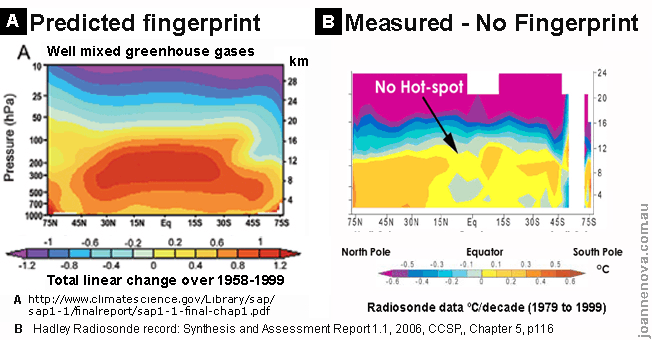 Fig. B shows observations. The hotspot is not there. If the hotspot is not there, the models must be wrong. So what is wrong with the models? This was reported in 2008 and the models still assume the additive nature of greenhouse gases, even to the point when more than 100% of the energy in a given band is absorbed.
How about Methane? Do not worry, it absorbs nearly exclusively in the same bands as water vapor and has no measurable influence on the climate.
But it will get warmer at the poles. That will cause melting of the ice-caps? Not so fast. When temperature rises the atmosphere can hold more water vapor, so it will snow more at higher latitudes. While winter temperatures will be higher with more snowfall, this will lower the summer temperatures until the extra snow has melted. And that is what is happening in the Arctics

As we can see from this picture, the winters were about 5 degrees warmer, but starting from May through August temperatures were lower. It takes time to melt all the extra snow.
These are my suggestions
- Do not worry about increasing CO2 levels. The major temperature stabilizer is clouds, and they will keep the earth from overheating by reflecting back into space a large amount of incoming solar radiation. Always did, and always will, even when the CO2 concentration was more than 10000 ppm millions of years ago. Ice ages will still come, and this is the next major climate change, maybe 10000 years from now.
- Clean up rivers, lakes and oceans from pollution. This is a priority.
- Limit Wind turbine electric energy to areas not populated by large birds to save the birds. Already over 1.3 million birds a year are killed by wind turbines, including the bald Eagles that likes to build their aeries on top of turbines.
- Do not build large solar concentration farms. They too kill birds.
- Solar panels are o.k. not in large farms, but distributed on roofs to provide backup power.
- Explore geothermal energy in geologically stable areas.
- Where ever possible add peak power generation and storage capacity to existing hydroelectric power plants
- Add peak power storage dams, even in wildlife preserves. The birds and animals don’t mind.
- Develop Thorium based Nuclear Power. Russia, China, Australia and India are ahead of us in this. Streamline permit processes. Prioritize research.
- Put fusion power as important for the future but do not rush it, let the research and development be scientifically determined.
- When Thorium power is built up and do replace coal and gas fired plants, then is the time to switch to electric cars, not before.
- Standard Nuclear Power plants should be replaced by Thorium powered nuclear plants, since they have only 0,01% of the really bad long term nuclear waste.
- Start thinking about recovering CO2 directly from the air and produce aviation fuel. This should be done as Thorium power has replaced coal and gas fired power plants.
- This is but a start, but the future is not as bleak as all fearmongers state.
One more reason to switch to Thorium as feed-stock for nuclear power.
Uranium is the feed-stock for nuclear power. It is also the material necessary to make nuclear bombs.
The United States has 138,200 tonnes of Uranium reserves recoverable at less than $260 per kilogram, 1.9% of the world total.
The United States has, as of 2014, produced 343,075 tons of Uranium, or about 13% of the world total.
The United States consumed in 2016 18,69 tons of Uranium, about 29% of the world total, about 90% of which was imported.
Which brings up the following question: Why did the Obama administration sell 20% of our proven reserves of this strategically important material to Russia?
It is of utmost importance to immediately restart the development of nuclear reactors that use Thorium as its feed-stock.
The other 22 reasons to switch to Thorium are listed here:
Twenty-two reasons to rapidly develop Thorium based Nuclear Power generation.
Twenty-two reasons to rapidly develop Thorium based Nuclear Power generation.
(The reasons keep piling up. A more updated 25 reasons are found here ).
We need badly to develop a Thorium based molten salt fast breeder nuclear reactor to develop our energy needs in the future. Lest anyone should be threatened by the words fast breeder, it simply means it uses fast neutrons instead of thermal neutron, and breeder means it produces more fissible material than it consumes, in the case of Thorium the ratio is about 1.05.
Here are 22 good reasons for Thorium:
1. Cheap and unlimited raw material.
2. Much less TRansUranium waste, 0.01% waste products compared to a Uranium-235 fast breeder.
3. Produces Pu-238 as one of the final TRans Uranium products, in short supply and much in demand for space exploration nuclear power.
4. Radioactive waste decays down to background radiation in 300 years instead of a million years.
5. Does not produce Plutonium 239, which is the preferred material used in nuclear bombs.
6. Produces isotopes that helps cure certain cancers.
7. Thorium Nuclear Reactors are earthquake safe.
8. No risk for a meltdown, the fuel is already molten.
9. Very high negative temperature coefficient leading to a safe and stable control.
10. Atmospheric pressure operating conditions, no risk for explosions.
11. Virtually no spent fuel problem, no storage or transport.
12. Scales beautifully from small portable generators to full size power plants.
13. No need for evacuation zones, can be placed near urban areas.
14. Rapid response to increased or decreased power demands.
15. Lessens the need for an expanded national grid.
16. Russia has a Thorium program.
17. China is having a massive Thorium program.
18. India has an active Thorium program.
19.Lawrence Livermore Laboratories is developing a small portable self-contained Thorium reactor capable of being carried on a low-bed trailer.
20. The need for a Yucca Mountain nuclear storage facility will eventually go away.
21. Produces electricity at a cost of about 4 c/kWh.
22. Can deplete some of the existing radioactive waste and nuclear weapons stockpiles.
1. Cheap and unlimited raw material. There is enough Thorium around for a million years at today’s worldwide energy generation level , and not only that, it is a by-product of mining heavy metals and rare earth metals. The price is the cost of extracting and refining, which can be as low as $40/Kg. No extra mining required for extracting the Thorium.
2. Much less TRansUranium waste, 0.01% waste products compared to a Uranium-235 fast breeder. The Thorium process has a much higher efficiency in fission than the Uranium process. See the figure below.
3. Produces Pu-238 as one of the final TRans Uranium products, in short supply and much in demand for space exploration nuclear power.
NASA relies on pu-238 to power long-lasting spacecraft batteries that transform heat into electricity. With foreign and domestic supplies dwindling, NASA officials are worried the shortage will prevent the agency from sending spacecraft to the outer planets and other destinations where sunlight is scarce. Thorium reactors produce PU-238 as a “free” byproduct. In 2009 Congress denied a request to produce more Pu-238 by traditional means, instead relying on Russia to sell us the plutonium. (Remember the Russian reset?) Russia made their last delivery in 2010.
4. Radioactive waste decays down to background radiation in 300 years instead of a million years. Initially a Thorium reactor produces as much radioactivity as other nuclear reactors, since fission converts mass to heat, but the decay products have a much shorter half-life. See the figure below.
5. Does not produce Plutonium239, which is the preferred material used in nuclear bombs. The higher Plutonium isotopes and other TRansUraniums are about as nasty as they get, and need expensive protection against terror attacks, and need to be stored for a very long time.
6. Produces isotopes that helps cure certain cancers. For decades, medical researchers have sought treatments for cancer. Now, Alpha Particle Immunotherapy offers a promising treatment for many forms of cancer, and perhaps a cure. Unfortunately, the most promising alpha-emitting medical isotopes, actinium-225 and its daughter, bismuth-213, are not available in sufficient quantity to support current research, much less therapeutic use. In fact, there are only three sources in the world that largely “milk” these isotopes from less than 2 grams of thorium source material. Additional supplies were not forthcoming. Fortunately, scientists and engineers at Idaho National Laboratory identified 40-year-old reactor fuel stored at the lab as a substantial untapped resource and developed Medical Actinium for Therapeutic Treatment, or MATT, which consists of two innovative processes (MATT-CAR and MATT-BAR) to recover this valuable medical isotope.
7. Earthquake safe. Thorium reactors have a very simple and compact design where gravity is the only thing needed to stop the nuclear reaction. Conventional Nuclear reactors depend on external power to shut down after a SCRAM, where poison rods fall down to halt the reaction. The next figure shows the concept of a Thorium reactor.

The idea is to empty the fissile U-233 core through gravity alone. Since the fuel is already molten, it can run out into channels like pig-iron into cooling heat exchangers with water supplied through gravity alone. 
As we can see the reactor hardened structure is compact, and can be completely earthquake and tsunami proof. What can be sheared off are the steam pipes and external power, but the shutdown can complete without additional power.
8. No risk for a meltdown, the fuel is already molten. The fuel in a Thorium reactor is U-233 in the form of UraniumFluoride (UF4) salt that also contains Lithium and Beryllium, in its molten form it has a very low vapor pressure. The salt flows easily through the heat exchangers and the separators. The salt is very toxic, but it is completely sealed.
9. Very high negative temperature coefficient leading to a safe and stable control. This is another beauty of the molten salt design. The temperature coefficient is highly negative, leading to a safe design with simple and consistent feedback. What does that mean? It means that if temperature in the core rises, the efficiency of the reaction goes down, leading to less heat generated. There is no risk for a thermal runaway. In contrast, Chernobyl used graphite moderated Uranium , and it suffered a thermal runaway as the operators bypassed three safety circuits trying to capture the last remaining power during a normal shut-down. The reactor splat, the graphite caught fire and the rest is history. Five days later two nuclear installations in Sweden shut down their reactors due to excessive radiation, but it took a while before they could figure out what had happened. First then did the Soviets confess there had been an accident.
10. Atmospheric pressure operating conditions, no risk for explosions. Materials subjected to high radiation tend to get brittle or soften up. Thorium reactors operate under atmospheric conditions so the choice of materials that can withstand both high temperatures and high radiation is much greater, leading to a superior and less expensive design. There is no high pressure gas buildup and the separation stage can be greatly simplified.
11. Virtually no spent fuel problem, no storage or transport. I am following the events at Fukushima Nuclear Power plants with great interest. How ironic that the greatest risk is with the spent fuel, not with the inability to shut down the working units. The spent fuel issue is the real Achilles’ heel of the Nuclear Power Industry. Thorium power works differently as nearly all fuel gets consumed as it is generated. When the process shuts down, that is it. Only the radioactivity that is en route so to say will have to be accounted for, not everything generated thus far in the process. The difference is about 10000 to one in the size of the problem. Time to switch over to Thorium.
12. Scales beautifully from small portable generators to full size power plants. One of the first applications was as an airborne nuclear reactor.
 Granted this was not a Thorium breeder reactor, but it proves nuclear reactors can be made lightweight. Thorium reactor may be made even lighter as long as they are not of the breeder type.
13. No need for evacuation zones, can be placed near urban areas. Thorium reactors operate at atmospheric pressure and have a very high negative temperature coefficient, so there is no risk for a boil-over. They are easily made earthquake-safe since no pressure vessel is needed.
14. Rapid response to increased or decreased power demands. The increase in power output to increased power demand is faster than in coal-fired power plant. All you have to do is increase the speed of flow in the core and it will respond with raised temperature.
15. Lessens the need for an expanded national grid. The National Electric grid is at the breaking point. It needs to be expanded, but neighborhood resistance is building in many areas where they need an expansion the most. The grid is also sensitive to terrorism activities.
 As we can see the national grid is extensive, and under constant strain. A way to lessen the dependency on the national grid is to sprinkle it with many small to medium sized Thorium Nuclear Power generators. They can be placed on barges in rivers and along the coast, giving the grid maximum flexibility to respond in case of an emergency.
16. Russia has a Thorium program  This is a self-contained Thorium Nuclear Reactor on a barge. Coolant readily available. Hoist it a couple of cables and the town will have all the power it needs.
17. China is having a massive Thorium program. The People’s Republic of China has initiated a research and development project in thorium molten-salt reactor technology, it was announced in the Chinese Academy of Sciences (CAS) annual conference on Tuesday, January 25. An article in the Wenhui News followed on Wednesday. Chinese researchers also announced this development on the Energy from Thorium Discussion Forum. Led by Dr. Jiang Mianheng, a graduate of Drexel University in electrical engineering, the thorium MSR efforts aims not only to develop the technology but to secure intellectual property rights to its implementation. This may be one of the reasons that the Chinese have not joined the international Gen-IV effort for MSR development, since part of that involves technology exchange. Neither the US nor Russia have joined the MSR Gen-IV effort either. A Chinese delegation led by Dr. Jiang travelled to Oak Ridge National Lab last fall to learn more about MSR technology and told lab leadership of their plans to develop a thorium-fueled MSR.The Chinese also recognize that a thorium-fueled MSR is best run with uranium-233 fuel, which inevitably contains impurities (uranium-232 and its decay products) that preclude its use in nuclear weapons. Operating an MSR on the “pure” fuel cycle of thorium and uranium-233 means that a breakeven conversion ratio can be achieved, and after being started on uranium-233, only thorium is required for indefinite operation and power generation.
18. India has an active Thorium program. • India has a flourishing and largely indigenous nuclear power program and expects to have 20,000 MWe nuclear capacity on line by 2020 and 63,000 MWe by 2032. It aims to supply 25% of electricity from nuclear power by 2050. • Because India is outside the Nuclear Non-Proliferation Treaty due to its weapons program, it was for 34 years largely excluded from trade in nuclear plant or materials, which has hampered its development of civil nuclear energy until 2009. • Due to these trade bans and lack of indigenous uranium, India has uniquely been developing a nuclear fuel cycle to exploit its reserves of thorium. • Now, foreign technology and fuel are expected to boost India’s nuclear power plans considerably. All plants will have high indigenous engineering content. • India has a vision of becoming a world leader in nuclear technology due to its expertise in fast reactors and thorium fuel cycle. • India’s Kakrapar-1 reactor is the world’s first reactor which uses thorium rather than depleted uranium to achieve power flattening across the reactor core. India, which has about 25% of the world’s thorium reserves, is developing a 300 MW prototype of a thorium-based Advanced Heavy Water Reactor (AHWR). The prototype is expected to be fully operational by 2011, following which five more reactors will be constructed. Considered to be a global leader in thorium-based fuel, India’s new thorium reactor is a fast-breeder reactor and uses a plutonium core rather than an accelerator to produce neutrons. As accelerator-based systems can operate at sub-criticality they could be developed too, but that would require more research. India currently envisages meeting 30% of its electricity demand through thorium-based reactors by 2050.
19.Lawrence Livermore Laboratories is developing a small portable self-contained Thorium reactor capable of being carried on a low-bed trailer. A Democratic member of the United States House of Congress (Joseph Sestak) in 2010 added funding for research and development for a reactor that could use thorium as fuel and fit on a destroyer-sized ship. Lawrence Livermore national laboratories are currently in the process of designing such a self-contained (3 meters by 15 meters) thorium reactor. Called SSTAR (Small, Sealed, Transportable, Autonomous Reactor), this next-generation reactor will produce 10 to 100 megawatts electric and can be safely transported via ship or truck. The first units are expected to arrive in 2015, be tamper resistant, passively failsafe and have a operative life of 30+ years.

20. The need for a Yucca Mountain nuclear storage facility will eventually go away. Since Thorium consumes the fissile material as it is getting created, the need for a long term storage facility of the Yucca Mountain type will eventually go away. In remote locations there can be built Thorium Nuclear Power generators that consume spent material from other nuclear processes. The need to do it in remote locations is the hazard of the already existing nuclear wastes. It should be possible to reduce the existing stockpile of nuclear wastes and nuclear bombs by about 90% and make electricity in the process. The cost to do this is higher than the normal process due to the additional cost of security.
21. Produces electricity at a cost of about 4 c/kWh.  The cost to produce electricity with Thorium generators should be about 40% less than Advanced Nuclear and about 30 % less than from Coal (with scrubbers). Solar generation is about 4 times more expensive (without subsidies) Wind power is cheaper when the wind blows, but the generation capacity has to be there even when the wind doesn’t blow, so the only gain from wind power is to lessen the mining or extraction of carbon. Even if we double the renewable power we will only go from 3.6% to 7.2% of total energy needed. Hydroelectric power is for all practical purpose maxed out, so all future increase must come from Coal, Natural Gas, Petroleum or Nuclear. Thorium powered Nuclear Generators is the way to go.
Many of the pictures are from a slide presentation given by David Archibald in Melbourne Feb 5 2011. He posted it “for the benefit of all” which I have interpreted as waving the copyright of the pictures
http://wattsupwiththat.com/2011/02/12/david-archibald-on-climate-and-energy-security/
 Len Bilén's blog, a blog about faith, politics and the environment.