The case for Thorium 20. China is having a massive Thorium program.

China is having a massive Thorium program. The People’s Republic of China has initiated a research and development project in thorium molten-salt reactor technology. The thorium MSR efforts aims not only to develop the technology but to secure intellectual property rights to its implementation. This may be one of the reasons that the Chinese have not joined the international Gen-IV effort for MSR development, since part of that involves technology exchange. Neither the US nor Russia have joined the MSR Gen-IV effort either.
China is currently the largest emitter of CO2 and air pollutants by far, and according to the Paris accord was allowed to emit six times as much pollutants as the U.S. by 2030, being a “developing nation”. Their air quality is already among the worst in the world so something had to be done if they were to achieve world dominance by 2025 and total rule by 2030. Only Thorium can solve the pollution problem and provide the clean energy needed for the future. Regular Uranium Nuclear reactors require large amounts of water and Molten Salt Thorium reactors require little water to operate.

Geneva, Switzerland, 21 August 2018 – As the world struggles with a record-breaking heatwave, China correctly places its trust in the fuel Thorium and the Thorium Molten Salt Reactor (TMSR) as the backbone of its nation’s plan to become a clean and cheap energy powerhouse.
​​The question is if China will manage to build a homegrown mega export industry, or will others have capacity and will to catch up?
For China, clean energy development and implementation is a test for the state’s ability. Therefore, China is developing the capability to use the “forgotten fuel” thorium, which could begin a new era of nuclear power.​
The first energy system they are building is a solid fuel molten salt reactor that achieves high temperatures to maximize efficiency of combined heat and power generation applications.
However, to fully realize thorium’s energy potential and in this way solve an important mission for China – the security of fuel supply – requires also the thorium itself to be fluid. This is optimized in the Thorium Molten Salt Reactor (TMSR).
The TMSR takes safety to an entirely new level and can be made cheap and small since it operates at atmospheric pressure, one of its many advantages. Thanks to its flexible cooling options it can basically be used anywhere, be it a desert, a town or at sea. In China this is of special interest inland, where freshwater is scarce in large areas, providing a unique way to secure energy independence.
“Everyone in the field is extremely impressed with how China saw the potential, grabbed the opportunity and is now running faster than everyone else developing this futuristic energy source China and the entire world is in a great need of.”
– Andreas Norlin, Thorium Energy World
Picture
China is not telling all they are doing on Nuclear Energy.

COVID response for Sweden and Michigan. Which response is better?

Of all the states in America Michigan is the state that is most like Sweden.

Michigan has a population of 10 million, Sweden 10.2 million

Median age in Michigan is 39.8 years, Sweden’s is 41.1 years.

Michigan has the Upper Peninsula, Sweden has Norrland.

Michigan has slightly colder winters and slightly warmer summers than Sweden, but the average temperature is about the same.

Both Michigan and Sweden got hit hard by the corona virus, but their response was quite different.

Sweden never closed the schools for children under 15, Michigan is still debating when to open the schools again after they were shutdown.

Sweden never closed the stores or restaurants completely, Michigan did.

Both Michigan and Sweden closed large events and other gatherings. No sports, and no concerts.

In Sweden wearing masks is not mandatory, only recommended, as long as social distancing and personal hygiene is practiced.

Sweden did what they could to shield the most vulnerable from the injection, in Michigan they moved COVID infected patients from overcrowded nursing homes in the Detroit area to nursing homes upstate with excess capacity.

Michigan recently delayed the partial opening of the state for another two weeks, one more delay of many. In addition the Governor, Gretchen Wittmer issued draconian regulation on what could or could not be done, leading to protests. One protest sign read:

Other regulations were just as ridiculous, you could go out in a row-boat or a sailboat as long as you were no more than two in the boat, but motorboats were verboten. And don’t even dream about visiting your cottage in the woods; horror of horrors!

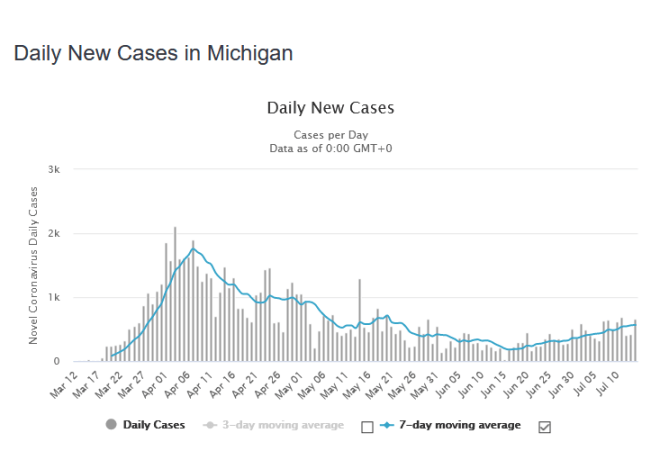
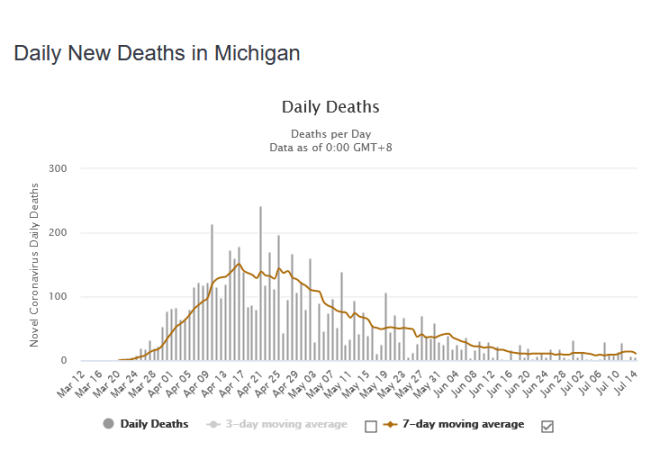
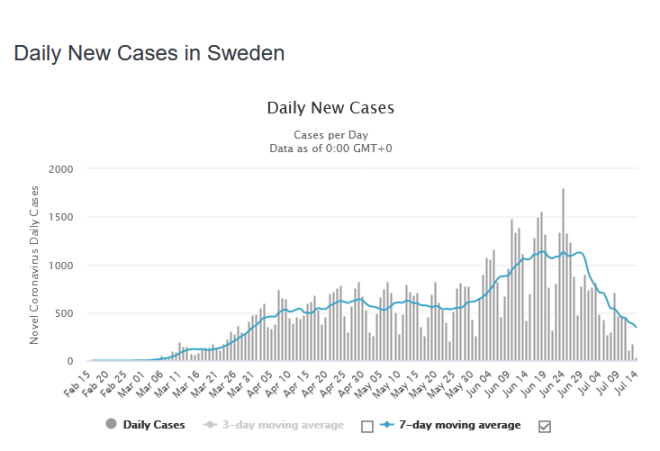
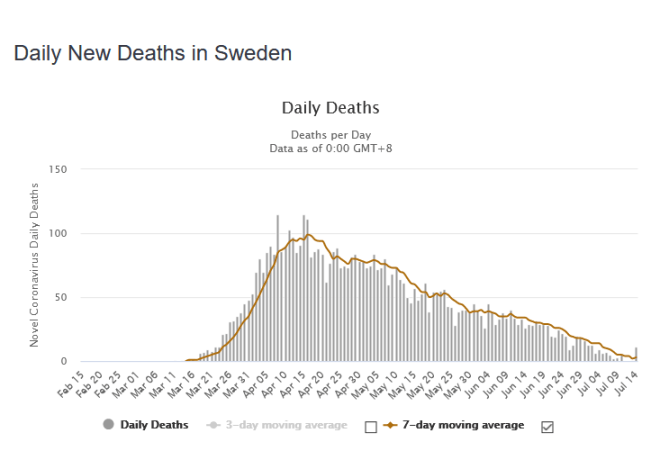
How did Sweden and Michigan fare? Check these charts and judge for yourselves:

Michigan total cases as of July 14: 78,914 total deaths 6,330 Sweden total cases 76,001, total deaths 5,455

Cases started rising around Jun 15, two weeks after the protests started

The number of deaths daily has stabilized and remained constant for the last month

The new cases are in a rapid decline. Sweden may be close to have achieved herd immunity.

The number of new death are racing to nearly zero.


The evidence is clear. The rise in COVID cases is due to protests, not reopening the economy

On May 25 George Floyd was murdered by a policeman in broad daylight. What followed was protests, night after night in many cities. Over 500 cities have had protest rallies. The rallies, while mostly peaceful all violate COVID protocol, many protestors do not wear masks, social distancing is not practiced, and loud shouting, breathing hard through your mouth emitting COVID mist is going on for hours.

The incubation time for COVID infection is from 5 to 15 days, the COVID cases should start increase about June 8 or so, it took a few days for the protesters to get organized. The typical age for protesters is 20 to 25 years, so death rates would not necessarily increase, since the risk for death from the coronavirus doubles for every 9 years you age.

On the other hand, if the spike in COVID cases is due to reopening the economy, the death rate should follow the increase in cases by about 10 days.

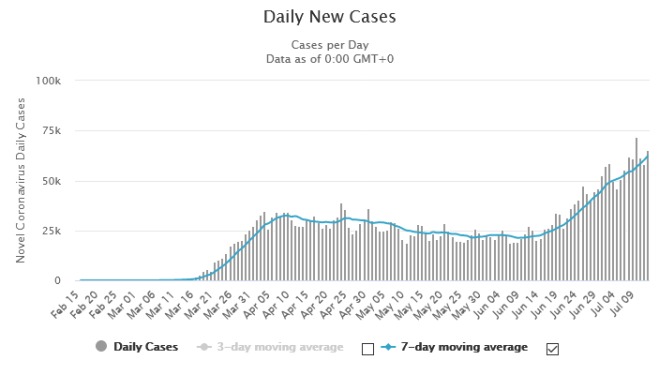
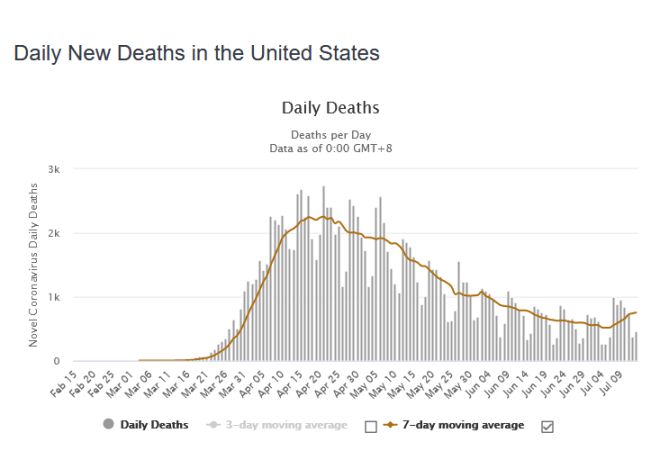
Let us look at the COVID cases for U.S.A. as of July 13:

As we can see, the U.S.A. was on a slow decline in cases until about June 14, and a much larger decline in death cases until about Jul 8. The rise in cases since June 14 is much larger than the rise in deaths. This means the increase in cases is from protestors, not from opening the economy.

A most interesting case is Florida

From new cases being about 1000 per day, they started increasing on about June 8 and are now over 10,000 a day. Death rates on the other hand have less than doubled.

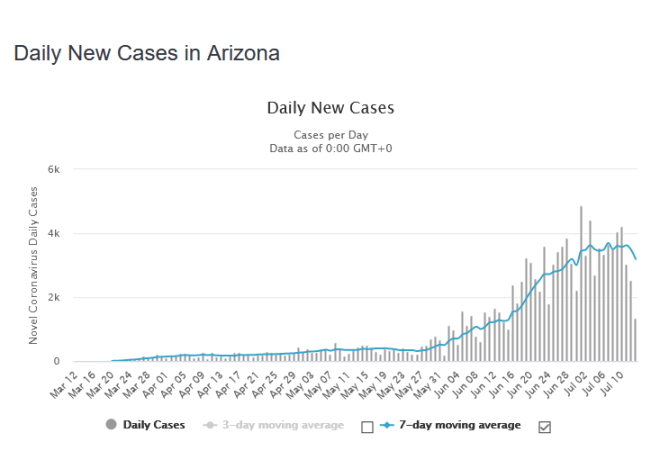
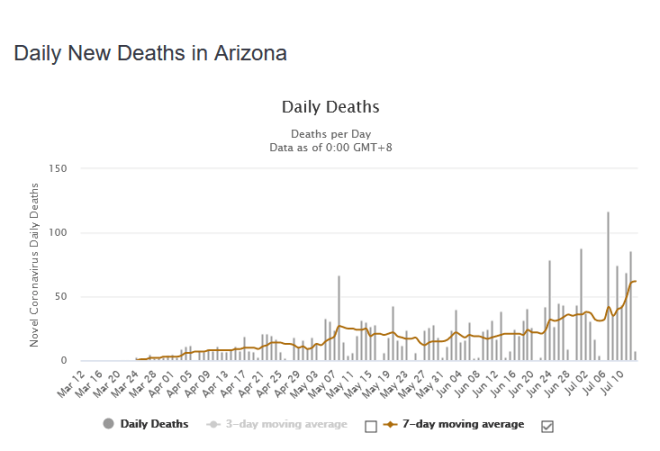
Another interesting state id Arizona:

From about 300 new cases a day up to June 5, it has  since increased tenfold. The death rate meanwhile has less than tripled, which again means it is the young people that are getting the virus.

There has been about 20 million protestors since the process started. It is impossible to contact trace 20 million people, many of which want to do away with all authority anyway, so we will have to settle for herd immunity. Following the example of Sweden herd immunity should start to manifest itself in a month or so, In New York City it has already started.

In any case, we will probably achieve herd immunity before a vaccine is available.


The case for Thorium. 16. Liquid Fluoride Thorium Reactors will work both as Base Load and Load Following power plants.

Liquid Fluoride Thorium Reactors will work both as Base Load and Load Following power plants. LFTR’s operate at a much higher temperature than conventional power plants and operate at about 45% electricity conversion efficiency, as opposed to 38% or lower for steam generators. In addition, because of the higher operating temperature it is ideal for hydrogen generation. The reactor would use the electricity generation to satisfy the current demand and produce hydrogen during times of low demand. This hydrogen would be temporarily stored and used for electricity production at peak demand. And  hydrogen power produces only water when burned, no CO2  or polluting fumes are generated. With the objective of reducing the cost of hydrogen production,  solid oxide electrolyser cells (SOECs) are especially well suited.  SOECs operate at high temperatures, typically around 800 °C. At these high temperatures a significant amount of the energy required can be provided as thermal energy (heat), and as such is termed High temperature electrolysis.

The case for Thorium. 15. No need for evacuation zones, Liquid Fuel Thorium Reactors can be placed near urban areas.

No need for evacuation zones, can be placed near urban areas. Molten Salt Thorium reactors operate at atmospheric pressure and have a very high negative temperature coefficient, so there is no risk for a boil-over. They are easily made earthquake-safe and no pressure vessel is needed. This will greatly simplify the approval process, no need for elaborate evacuation plans have to be developed. Since the Three Mile Island accident there was a thirty year gap in approvals for new nuclear plants. The “not in my backyard ” mentality reigned supreme, and delay and denial was the rule of the years. But the lawyers still got their share, leading to escalating cost for new nuclear power. In the early days of nuclear power France took the approach of building some of their nuclear plants near the Belgian and German border, so they only had to develop half of an  evacuation plan, leaving the other half to their understanding neighbors. It also leads to placing the nuclear plants where there is the least resistance, not where they are needed the most, adding to the strain on the electric grid. Liquid Fluoride Thorium Reactors have one additional advantage. They do not need access to water, so they can be placed even in desert areas.

Sweden was right! No lock-down but hygiene, social separation and limited gatherings will work just as well. Herd immunity is possible to achieve.

As Europe and North America continue suffering their steady economic and social decline as a direct result of imposing “lockdown” on their populations, other countries have taken a different approach to dealing with the coronavirus threat. You wouldn’t know it by listening to western politicians or mainstream media stenographers, there are also non-lockdown countries. They are led by Sweden, Iceland, Belarus, Japan, South Korea and Taiwan. Surprisingly to some, their results have been as good or better than the lockdown countries, but without having to endure the socio-economic chaos we are now witnessing across the world. For this reason alone, Sweden and others like them, have already won the policy debate, as well as the scientific one too.

Unlike many others, Sweden has not enforced any strict mass quarantine measures to contain COVID-19, nor has it closed any of its borders. Rather, Swedish health authorities have issued a series of guidelines for social distancing and other common sense measures covering areas like hygiene, travel, public gatherings, and protecting the elderly and immune compromised. They have kept all preschools, primary and secondary schools open, while closing college and universities who are now doing their work and lectures online. Likewise, many bars and restaurants have remained open, and shoppers do not have to perform the bizarre ritual of queuing around the block standing 2 meters apart in order to buy groceries.

According to the country’s top scientists, they are now well underway to achieving natural herd immunity. It seems this particular Nordic model has already won the debate.

Because Sweden decided to follow real epidemiological science and pursue a common sense strategy of herd immunity, it doesn’t need to “flatten of the curve” because its strategic approach has the added benefit of achieving a much more gradual and wider spread.

This chart proves the point:

This was in May. It is now July 10, and here are the updated charts:
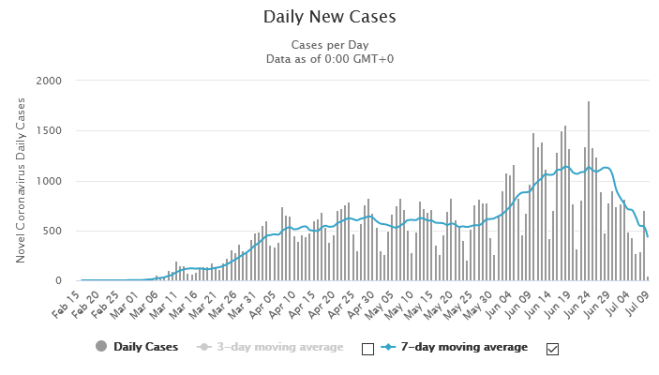
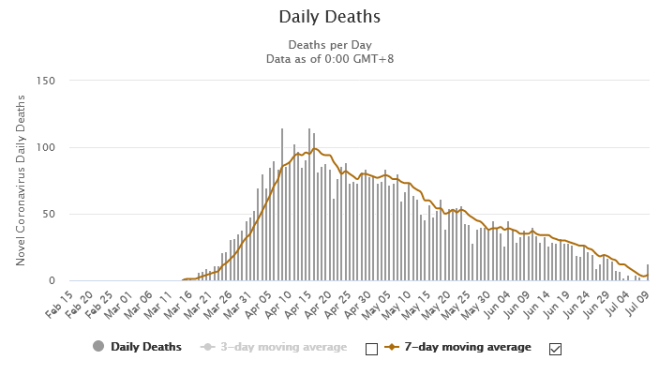
From a peak of 100 deaths /day and 550 cases/day Sweden is now down to an average of 4 deaths/day and an average of 435 cases/day.

Sweden is well on its way to herd immunity.

How well are the other non-lockdown countries doing?

Iceland  has a total case count of 1882 and a death count of 10, all between March 21 and April 20.  This was achieved by contact tracing and quarantine alone.

Belarus has a total case count of 64,604 and a death count of 454, and the case and death charts look like this:
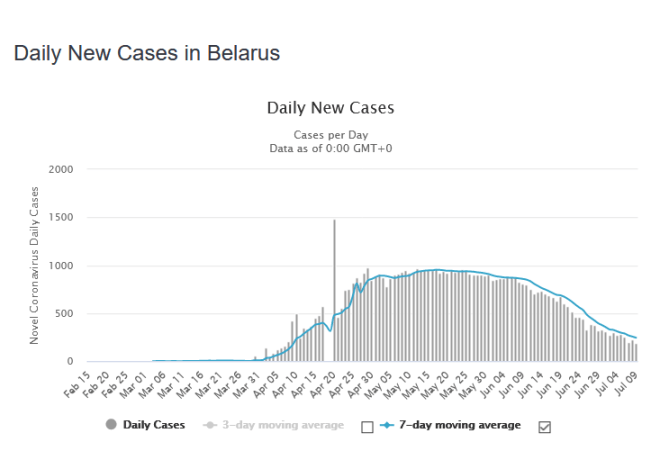
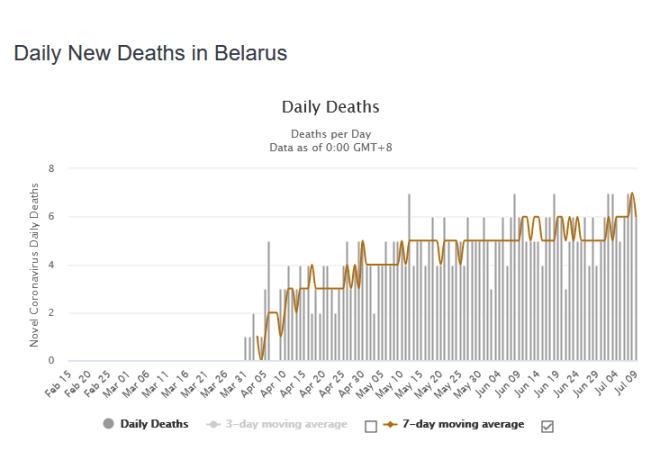
Here the daily death count has not risen above 7 per day. in a country of 9.5 million.


Japan has a total case count of 20,371 and a death count of 981, and the case and death charts look like this:
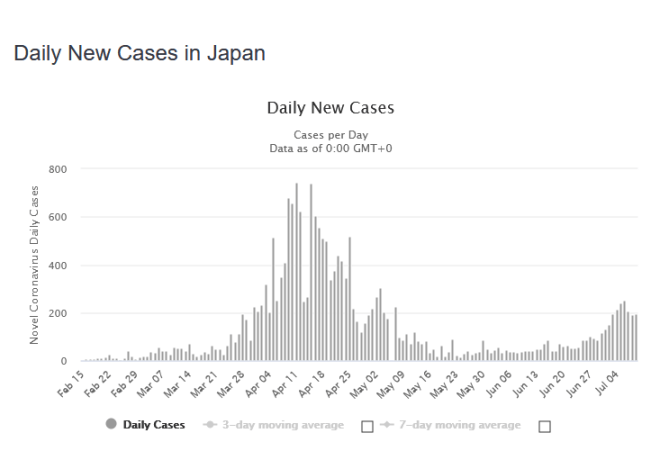
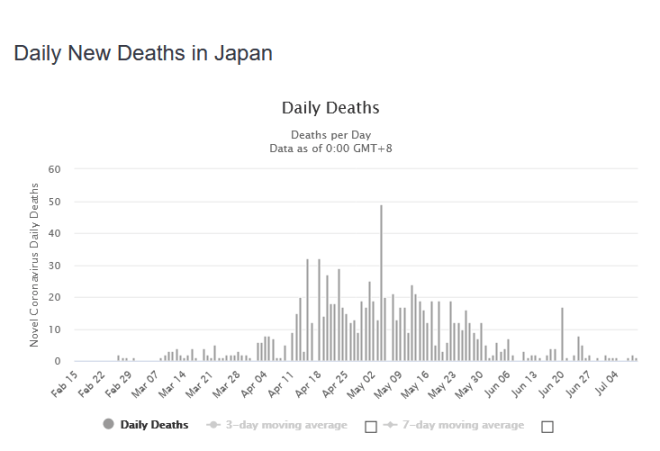
Japan shows a unique pattern: It looked that they had beaten the coronavirus early, but then in April it started up again, and again in July, but always at manageable levels. Japan is still far away from herd immunity.


South Korea has a total case count of 13338 and a death count of 288, and the case and death charts look like this:
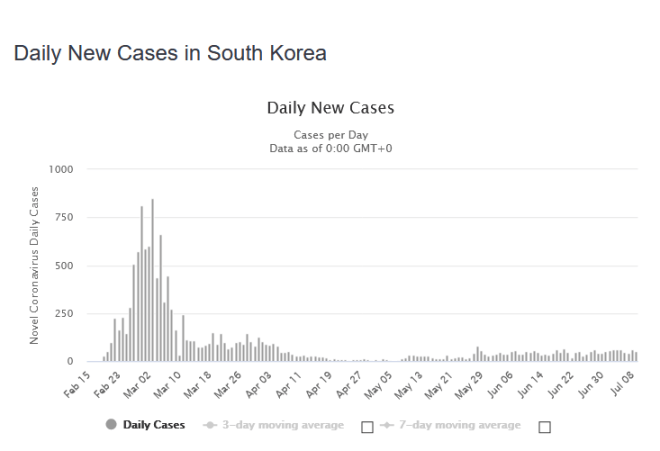
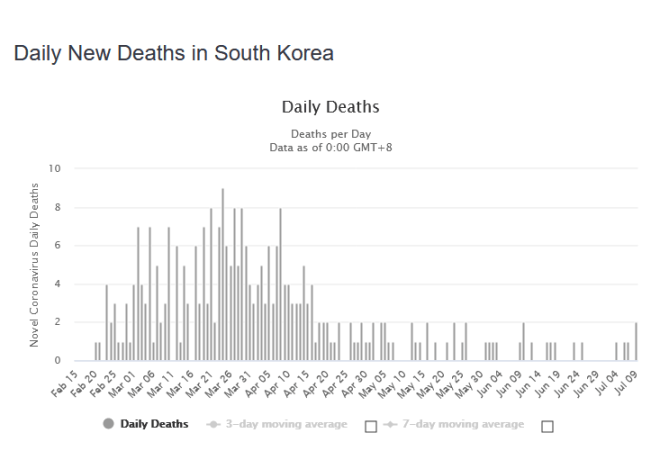
The death count rises, then stays constant for about 2 months and then declines, but slower than the new case count. South Korea took another approach than trying to reach herd immunity. They gave HydroxyChloroQuine to all people that showed symptoms as early as possible. The result is nothing short of remarkable, less than 1 coronavirus death per day in a country of 51 million people!

Taiwan has a total case count of 451 and a death count of 7. And this in a country of 24 million!

How is the United States faring compared to these countries? Is herd immunity achievable in the near future? Current cases are 3,250,705 and the current deaths are 136,158, the highest in the world/

United States has a total case count of 3,250,705 and a death count of 136,158, and the case and death charts look like this:
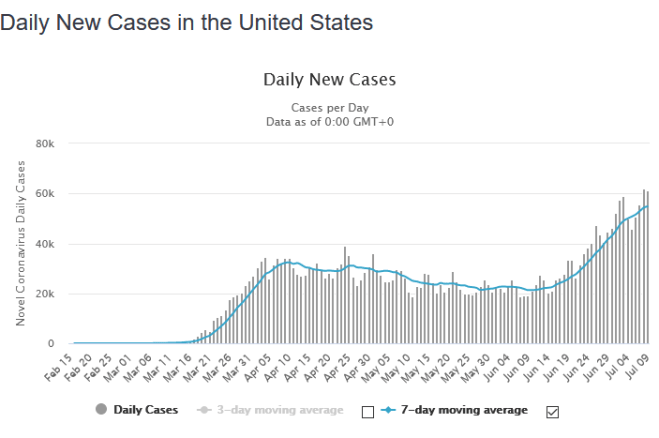
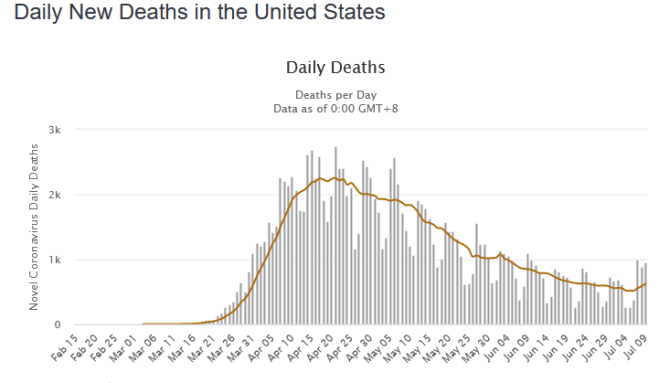
From a peak case rate of 31,000 cases per day and a death rare of 2,200/day the case rate has climbed to 55,000/day and the death rate has come down to about 625/day , and it seems the U.S. is lagging Sweden by about 5 weeks. In about 2 months or so the U.S. should be well on its way to herd immunity.

The death rates would be reduced to less than half if the United States adopted the policy of South Korea (and at least 9 other countries) and began to administer HydroxyChloroQuine to nearly all people that showed symptoms as early as possible.

Quotes from https://www.zerohedge.com/health/why-sweden-has-already-won-debate-covid-19-lockdown-policy


The case for Thorium 13. Virtually no spent fuel problem, very little on site storage or transport.

 Virtually no spent fuel problem, very little on site storage or transport. I have been following the events at Fukushima Nuclear Power plants disaster with great interest. How ironic that one of the greatest problems was with the spent fuel, not with the inability to shut down the working units. The spent fuel issue is the real Achilles’ heel of the Nuclear Power Industry. The cost of reprocessing and storing spent reactor fuel will burden us for centuries after the reactors themselves have been decommissioned after their useful life. Molten Salt Thorium nuclear power works differently from  conventional Uranium fueled Reactors as  the fissile fuel gets generated in the breeding process itself and nearly all fuel gets consumed as it is generated. When the process shuts down, that is it. Only the radioactivity that is en route so to say will have to be accounted for, not everything generated thus far in the process. The difference is about ten thousand to one in the size of the problem. It is high time to rebuild and expand our Nuclear power generation by switching to Thorium.

The case for Thorium. 12. Atmospheric pressure operating conditions, no risk for explosions. Much safer and simpler design.

Molten Salt nuclear Reactors operate under Atmospheric pressure  conditions, no risk for explosions. Materials subjected to high radiation tend to get brittle or soften up. Molten Salt Thorium nuclear reactors operate under atmospheric conditions so the choice of materials that can withstand both high temperatures and high radiation is much greater, leading to a superior and less expensive design.  There is no high pressure gas buildup and the separation stage can be greatly simplified, leading to a much safer design. (From Wikipedia:)

The LFTR needs a mechanism to remove the fission products from the fuel. Fission products left in the reactor absorb neutrons and thus reduce neutron economy. This is especially important in the thorium fuel cycle with few spare neutrons and a thermal neutron spectrum, where absorption is strong. The minimum requirement is to recover the valuable fissile material from used fuel.

Removal of fission products is similar to reprocessing of solid fuel elements; by chemical or physical means, the valuable fissile fuel is separated from the waste fission products. Ideally the fertile fuel (thorium or U-238) and other fuel components (e.g. carrier salt or fuel cladding in solid fuels) can also be reused for new fuel. However, for economic reasons they may also end up in the waste.

On site processing is planned to work continuously, cleaning a small fraction of the salt every day and sending it back to the reactor. There is no need to make the fuel salt very clean; the purpose is to keep the concentration of fission products and other impurities (e.g. oxygen) low enough. The concentrations of some of the rare earth elements must be especially kept low, as they have a large absorption cross section. Some other elements with a small cross section like Cs or Zr may accumulate over years of operation before they are removed.

As the fuel of a LFTR is a molten salt mixture, it is attractive to use pyroprocessing, high temperature methods working directly with the hot molten salt. Pyroprocessing does not use radiation sensitive solvents and is not easily disturbed by decay heat. It can be used on highly radioactive fuel directly from the reactor. Having the chemical separation on site, close to the reactor avoids transport and keeps the total inventory of the fuel cycle low. Ideally everything except new fuel (thorium) and waste (fission products) stays inside the plant.

One potential advantage of a liquid fuel is that it not only facilitates separating fission-products from the fuel, but also isolating individual fission products from one another, which is lucrative for isotopes that are scarce and in high-demand for various industrial (radiation sources for testing welds via radiography), agricultural (sterilizing produce via irradiation), and medical uses (Molybdenum-99 which decays into Technetium-99m, a valuable radiolabel dye for marking cancerous cells in medical scans).

Mo-99 is used in hospitals to produce the technetium-99m employed in around 80% of nuclear imaging procedures. Produced in research reactors, Mo-99 has a half-life of only 66 hours and cannot be stockpiled, and security of supply is a key concern. Most of the world’s supply currently comes from just four reactors in Belgium, the Netherlands, Russia and South Africa, and recent years have illustrated how unexpected shutdowns at any of those reactors can quickly lead to shortages. Furthermore, most Mo-99 is currently produced from HEU targets, which are seen as a potential nuclear proliferation risk.

With the Mo-99 having a half-life of 66 hours and being continuously separated out from the fertile core in a LFTR, this seems to be the ideal vehicle to cheaply produce ample supplies of this valuable medical resource.

The case for Thorium. 11. Molten Salt Nuclear Reactors have a very high negative temperature coefficient leading to a safe and stable control.

Molten Salt Nuclear Reactors have a very high negative temperature coefficient leading to a safe and stable control. This is another beauty of the molten salt design. The temperature coefficient is highly negative, leading to a safe design enabling simple and consistent feedback. What does that mean?  It means that when the temperature of the fissile core rises, the efficiency of the reaction goes down, leading to less heat generated. There is no risk for a thermal runaway. In contrast,  graphite moderated generators can have a positive temperature coefficient which leads to complicated control, necessitating many safety circuits to ensure proper startup, operation and shutdown. Their worst failure mode is they go prompt critical, and no containment vessel can contain the explosion that would occur, so they were built without one. There have been several major accidents in graphite moderated reactors, with the Windscale fire and the Chernobyl disaster probably the best known.

The case fatality rate of COVID-19 is reduced by a factor of 2.8 if HCQ + Zinc is administered as soon as possible. 1.2 Million cases are proof enough!

President Donald Trump ripped the “Fake News” media on Tuesday for not reporting that the U.S. has the lowest COVID-19 mortality rate in the world.

The president tweeted a Washington Times article that discusses the decreasing death rate.

“We have the lowest Mortality Rate in the World,” Trump wrote. “The Fake News should be reporting these most important of facts, but they don’t!”

His press secretary Kayleigh McEnany in her press briefing posted this chart to boost his claim.

The article covers a Monday White House press conference. McEnany told reporters that the American death toll has fallen for weeks and the virus fatality rate is below France, the United Kingdom and Germany.

She said the death toll has significantly dropped from the height of the outbreak when the U.S. logged 2,500 deaths per day to 254 deaths on Saturday, according to the article.

To confirm it the case fatality rate for Germany is as of July 7: 4.59%

The corresponding number for U.S.A.: 4.33%

Is that the lowest percentage in the world?

There are more than ten countries with a lower case fatality rate. At least ten of them have one thing in common. These ten countries prescribe the use of  HydroxyChloroQuine to all people that show symptoms of COVID-19, even before a positive test is confirmed.

Turkey: 2.53%

South Korea: 2.15%

Senegal: 1.82%

Morocco: 1.64%

Russia: 1.48%

Malaysia: 1.39%

United Arab Emirates: 0.62%

Costa Rica: 0.42%

Bahrain: 0.32%

Qatar: 0.13%, but since 88% of the population are migrant workers between 20 and 60, the adjusted death rate for the permanent residents would be maybe 8 times higher, or about 1%

The total number of positive cases for these ten countries are over 1.2 million, far more than any double blind test could ever produce.

Taking the average, adjusted for the number of positive cases, the average adjusted death rate for ten countries, where people are taking HCQ + Zinc as soon as they are showing symptoms or diagnosed positive, is 1.51%.

This means that the risk of death is reduced by a factor of 2.8 if HZQ + Zinc is taken as early as possible after showing symptoms or after a positive diagnosis for corona-virus!