John 14:1-14 records the events of the hour after the Passover meal before they all depart to Gethsemane. Jesus told his disciples he is going away to prepare a mansion, more precisely a dwelling place for them. Thomas, always questioning him, asked him “How can we know the way?” And Philip added “Show us the Father“. Jesus answer? “Believe in me“.
Genesis 40 deals with dreams. Joseph’s two fellow cellmates in prison each had a dream, Joseph interpreted the dreams that the cup-bearer would be released and restored to his former position, while the baker would be hanged on a tree.
In Genesis 41 Pharaoh himself had a dream, and Joseph was released from prison to interpret the dream. It dealt with seven years of plenty and seven years of famine. Joseph interpreted the dream so well that Pharaoh put Joseph in charge of all affairs of Egypt. The seven years of plenty came and good harvests filled the storehouses. Then came the seven years of famine.
Psalm 8 has been set to music many times. Even I have sung it many times, both as a choir number, and the first verse as an introit. Looking for the music I found a far better, very free rendition of the Psalm, this one by Marty Goetz.
God created the universe; first in a vision or a dream, then He spoke; and it was so. We have the proof by existing and living in the created universe. Jesus explains the eternal future for believers, but we can only see it as the dream yet, but then we shall see fully as we are fully known. Thomas had trouble with that, he required visual proof.
The Old Testament connection is Joseph, able to both have and interpret dreams. This lead him both in trouble and victory.
These dreams are recorded to help us better understand God’s ways, and the miracles of Jesus that are recorded occurred often on a Sabbath, but Jesus saved and healed people all the time.
John 13 begins the telling of the last 24 hours before the crucifixion of Jesus. Jesus washed the disciples’ feet before the Passover meal, a task normally performed by the lowest servant. During the meal he announced his betrayal, and then he gave the disciples a new commandment “love one another”. He also predicted Simon Peter’s denial.
Genesis 38 tells the story of Judah and Tamar. One of the rules of the Old Testament is that if a man dies without producing an heir, it was the duty of his brother to try to produce an offspring to his widow. Onan shirked this responsibility, and that was the sin of Onan. Tamar was thus still barren, so she tricked Judah into committing adultery. You can read it for yourself. Judah finally confessed: “She is more righteous than I.”
Genesis 39 then picks up the story of Joseph and Potiphar’s wife. The story is a classic, and for doing the right thing Joseph was falsely accused and thrown in jail.
Psalm 7 is a shiggaion, a dithyrambic ode of David. I would love hearing how the music to this Psalm sounded.
The common thread in today’s selection is betrayal and renewal. Jesus washed all the disciples’ feet, making the betrayal complete. Onan refused to do the brother’s responsibility to produce an offspring for his dead brother, so he was too killed. Tamar took matters in her own hands and tricked Judah into doing his responsibility through adultery.
The story of the scarlet thread is also remarkable. When Tamar gave birth to twins only one hand came out, so she tied a scarlet thread around his wrist. Then the other baby came wholly out first, but the one with the scarlet thread was still considered the firstborn. This proves that if any part of the baby is outside the body the baby is born, and it means that partial birth abortion is murder.
We were created by God in his image with an expanded brain, capable of lifelong learning. This included a spiritual connection directly with God through His Spirit. This is the connection that died when Adam sinned and people decided they could function quite well without constant communication with God. Yet there remained a god-shaped void in their brains, a longing that wanted to be satisfied.
The question for us now is: Are we the way we are as a result of nature or nurture? Up to now we have dealt with the physical universe, the creation of all forms of life, and finally the creation of mankind, where mankind is unique in that it is created to have a special functioning connection with God. This is the only physical difference between us and the animals. A dog has better sense of smell, a cat hears better, an eagle sees better a bat uses echolocation to see at night, a dolphin has a better sonar than what scientists has been able to duplicate, many animals can sense changes in magnetic disturbances and so on.
We can separate the nature-nurture question two ways: Spiritually and environmentally. We start to develop much sooner after conception than people think, and the brain as it develops starts to record sounds and begins feeling way before birth.These impressions become hardwired into the brain and some insists that listening to classical music is the best environment for the developing baby, but the voice of the mother, both language and accent start to get imprinted before birth. The baby can also sense mood changes, arguments, stress and unrest. Some of this is already imprinted in their brain before the baby is born! If the mother gets sick, takes drugs, eats or drinks improper things, this too affects the baby’s development. Then comes birth, and so many things have to come to pass in right time and order for the birth to succeed, and yet it normally does. This is a miracle. Granted, when you see a cow give birth, she licks the calf off, and one hour later the calf rises up and starts to follow the mare, while a baby is helpless for a long time. When a child grows up, all it senses, hears, sees smells, tastes and feels gets uploaded into the brain, but only a small part is forever stored into memory, and what is stored permanently is often in connection with a traumatic event, good or bad. The events as memorized can be seen as nurture, but how they are handled are more part of nature. Some learn and change for the better, others change for the worse.
For all of us that are over 45 we will never forget January 28 1986. The space shuttle was ready and loaded to send up “teacher in space”, every classroom that had access to a television had it loaded and President Regan was ready to give the State of the Union speech the same night. The sky was perfect, but there had been a short dip below freezing and the dew had condensed thick on the main tank and even formed icicles from the cold from the liquid oxygen and liquid hydrogen. The boosters were not certified to work safely below 50 F, but they had done successful cold liftoffs before. A friend Ph.D chemist was working in the next cubical and together we were terrified that they would not scrub the mission. They could not find one engineer to sign off on the mission, but they went ahead anyway. The State of the Union speech was more important than safety. We all know what happened.With nearly all school-age children watching online the shuttle blew up and all seven astronauts were instantly killed. Some took it very hard, especially most teachers that had looked forward to this special moment in history. Some children had nightmares for a long time, but for others it was just another video-game. I can still remember some children coming home from school laughing: We now know what NASA stands for: “Need Another Seven Astronauts”. – The only one punished for this disaster was the one refusing to approve the mission and not accepting the white-washing of management responsibility; another sign of the fallen human nature.
It is of great importance where you spent your childhood. If you are born and raised on a subsistence farm, your experience is quite different from being raised on a modern specialized farm. If you are raised in the asphalt jungle of a modern city where crime and rape is commonplace, drugs are everywhere and corruption is the dominant method of doing business, that will shape how you see the world. Every memory impression will shape the way you behave and react.
If you are born in the country you will observe nature, and see how weather and climate affect all aspects of life, and you will see how beautifully God controls the weather. You learn to read the clouds and be a part of nature. Not so in the big cities! All is covered up, the sky tells you nothing. There are of course cultural events, sports, shows and spectacles, and many are drawn to that.
All this will be important in how you deal with the big question: Why are we here in the first place?
Today we read about circumcision and its importance; in John 7 and one of the four chapters in Genesis selected for today. But that is just one part of the story.
John 7:1-24. Jesus pointed out that according to Jewish law, circumcision is more important than keeping Sabbath, so, if the eighth day is on a Sabbath, it must be performed on that day, but healing on a Sabbath is not permitted.
In Genesis15 God promised Abram a son. Abram believed God and it was counted to him as righteousness.
But in Genesis 16 Abram badly wanted an heir, so Sarai, being too old, gave her handmaiden Hagar to be the mother of Abram’s son, Ishmael. Sarai regretted what she had done, and Hagar was sent away with Ishmael into the wilderness.
Thirteen years later, in Genesis 17, Ishmael was back with Abram, God promised Abram his seed of promise, changed Abram’s name to Abraham and Sarai’s name became Sarah, established with an eternal covenant, the covenant of Circumcision, and it was performed on Abraham, Ishmael and all Abraham’s male servants.
Which brings us to Genesis 18 with Abraham still waiting for his promised offspring. He was visited by three angels that promised him he will have a son within a year. Sarah heard it and found it laughable, but God confirmed this promise, and was also proclaiming the destruction of Sodom and Gomorrah. Abraham tried to bargain with God at no avail.
The question to ponder: Why is circumcision important for Jews and Muslims, but not for Christians? Hint: read the Acts of the Apostles, chapter 15.
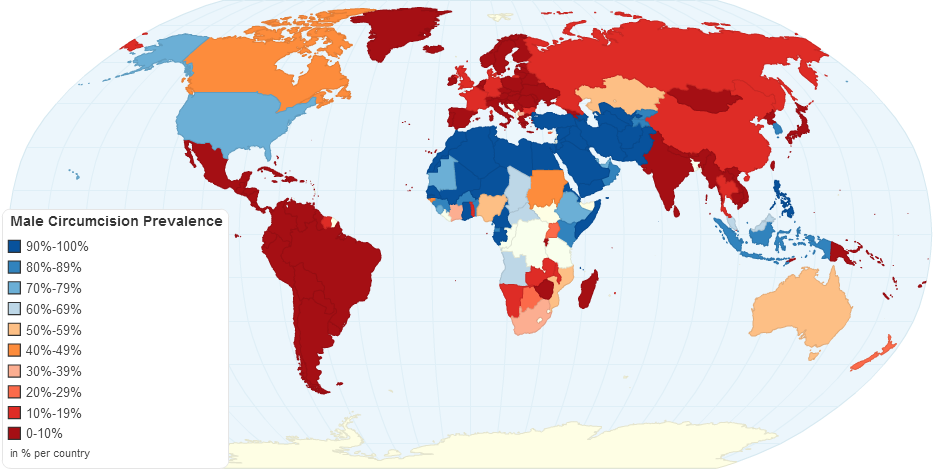
here is a map of the prevalence of male circumcision:
As we can see, circumcision is almost universal in Muslim countries, but very low in Europe and South America. In the U.S the circumcision rate is around 70%. Why is that? U.S. is a mostly Christian nation and we are told in Acts 15 that we should not be circumcised. There is an interesting aspect to circumcision and prostate cancer. The Mayo Clinic conducted a study a long time ago about the correlation between prostate cancer and circumcision, and they found a strong link, circumcised males had much lower risk of prostate cancer. There was one fatal fault with the study; it was done in Minnesota with a lot of people of Swedish descent, and the Swedes do not circumcise, and they have a much higher genetic propensity for developing prostate cancer than other population groups.
When our first son was born in 1969 the nurse nonchalantly handed me a clipboard and said: Sign here, it is standard procedure but it requires your signature. When I read through it I found out it was about circumcision, so I refused. She snarled and left and I overheard her saying to another nurse: Those Scandinavians; they are so backwards – she even wants to breast feed – how primitive!
Today’s reading of the Bible begins with John 1: 19-51. John the Baptist testified about the Messiah: “Make straight the way for the Lord”. When he met Jesus he referred him as “The Lamb of God” that “takes away the sin of the world”, and “this is the Son of God”. Jesus called his first disciples, Andrew and Peter, Philip and Nathaniel.
Genesis 2 tells of how God created woman out of man, showing that creation was not complete without man and woman as a unit. This must be taken spiritually, since in Genesis 1 he already created man in His own image, male and female. God’s design is one man, one woman, one lifetime. This would still be the case if we let God chose our mate. If we had followed God’s intent, many sicknesses would not exist, especially sexually transmitted diseases. “He who finds a wife finds what is good and receives favor from the Lord.” Proverbs 18:22
To find out how God created woman we move to verse 21 So the Lord God caused the man to fall into a deep sleep; and while he was sleeping, he took one of the man’s ribs and then closed up the place with flesh. 22 Then the LORD God made a woman from the rib he had taken out of the man, and he brought her to the man.“The rib” is from the Greek Septuagint translation of the Old Testament. The original Hebrew meaning is “took part of the man’s side“, but since the Greek Septuagint was the most used version of the Scriptures for the early Christians, the rib won.
Don’t get stuck on the detail if it was from the side or from a rib. That is not the point of the story. Some take it to only mean “the two shall be one flesh” is only for procreation, but it is more than that. I can attest it works, having been married now to my wife for over 57 years. It works through communication and fellowship with God. This fellowship is broken in Genesis 3 and forward in the Old Testament.
The Holy Bible is the most influential book ever written. According to Wikipedia it has been translated in its entirety into 724 languages, and the New Testament has been translated into 1617 languages. At least one part of the Bible has bee translated into 3,589 languages, and more translations are coming every year, especially from the Wycliffe translators.
Both the New Testament and the Old Testament begin with the words “In the beginning”.
Genesis 1 deals with the physical creation with spiritual emphasis, laying the groundwork for spiritual understanding of how and why we exist.
We are existing in time and space. The question is: What was there before time and space existed, before the beginning?
Answer: God, existing in three persons, God the Father, God the Son (the Word) and God’s Spirit, (the Holy Ghost).
The Three-in-one God alone are eternal, everything else, including time and space, is created.
Another Question: Why did God say “it was good” for day 1,3,4 and 5 but not for day 2 and it was very good after day 6?
Answer: The ecosystem is a work in progress and will function differently for each phase and finally come to completion when all parts are set in place, which includes people. We are responsible to God to be good stewards of the earth and leave it a better place than we found it. The main regulator of temperature on earth is the clouds. They cool by day and warm by night. The time of day they appear is also very important, and there is no risk for the earth to overheat.
But God was not finished. He continued in Genesis 1:26-27 Then God said, “Let us make man in our image, in our likeness, so that he may rule over the fish in the sea and the birds in the sky, over the livestock and all the earth and over all the creatures that move along the ground.”
27 So God created man in his own image, in the image of God he created him; male and female he created them.
The keywords here are God’s Image. Man contains the same building blocks as all mammals, similar DNA, RNA and all instructions are of the same kind as the mammals. It says God made them male and female (and only male and female), so He cannot mean a physical image. It must mean we are spiritually made in the image of God.
Continuing in Genesis1:28-31 God blessed them and said to them, “Be fruitful and increase in number; fill the earth and subdue it. Rule over the fish in the sea and the birds in the sky and over every living creature that moves on the ground.”
29 Then God said, “I give you every seed-bearing plant on the face of the whole earth and every tree that has fruit with seed in it. They will be yours for food. 30 And to all the beasts of the earth and all the birds in the sky and all the creatures that move along the ground—everything that has the breath of life in it—I give every green plant for food.” And it was so.
31 God saw all that he had made, and it was VERY good. And there was evening, and there was morning—the sixth day.
Yes, once God had created man, it was very good.
Continuing in Genesis 2:1-3Thus the heavens and the earth were completed in all their vast array.2 By the seventh day God had finished the work he had been doing; so on the seventh day he rested from all his work. 3 Then God blessed the seventh day and made it holy, because on it he rested from all the work of creating that he had done.
Up to this point the name of God is Elohim, which in Hebrew means ‘the strongest strong ones’, signifying the power of God in creation and life. Both animals and man have in them ‘the breath of life, and this signifies physical life.
The second account of creation of man is spiritual, not physical, and so the name of God changes from Elohim to JEHOVAH Elohim. Genesis 2:4 This is the account of the heavens and the earth when they were created, when the LORD God made the earth and the heavens.
Skipping to Genesis 2:7 Then the LORD God formed man from the dust of the ground and breathed into his nostrils the breath of life, and man became a living soul.
This was the second birth, first comes the physical birth, formed from the dust of the ground, followed by the spiritual birth. Skipping the garden of Eden story we move to verse 21 So the Lord God caused the man to fall into a deep sleep; and while he was sleeping, he took one of the man’s ribs and then closed up the place with flesh. 22 Then the LORD God made a woman from the rib he had taken out of the man, and he brought her to the man.
“The rib” is from the Greek Septuagint translation of the Old Testament. The original Hebrew meaning is “took part of the man’s side“, but since the Septuagint was the most used version of the Scriptures for the early Christians, the rib won.
So in verse 23 The man said,
“This is now bone of my bones and flesh of my flesh; she shall be called ‘woman,’ for she was taken out of man.”
And in verse24 That is why a man leaves his father and mother and cleave unto his wife, and they become one flesh. They are united in their bodies through procreation, but also in spirit, united in the Holy Spirit.
25 Adam and his wife were both naked, and they felt no shame. These were ideal conditions, God and man had unhindered fellowship. All was perfect. But God had also created man with free will, so He had to put some boundaries on man. Genesis 2:15 The Lord God took the man and put him in the Garden of Eden to work it and take care of it. 16 And the Lord God commanded the man, “You are free to eat from any tree in the garden; 17 but you must not eat from the tree of the knowledge of good and evil, for when you eat from it you will certainly die.”
Most of us know the story: Eve (Adam’s wife) was deceived by the tempter and ate, and Adam ate too, but willfully; so the guilt of the so called original sin fell on Adam, and they died that day. But Adam lived another 930 years, so he did die spiritual death, not physical.. The spiritual death is that the fellowship with God is severed, and God can no longer spiritually help us in all situations of life.
People took this in stride. “We can do all things well without God interfering.” In fact, when disaster struck they sad: “We will build back better.” (Paraphrased from Isaiah 9:10) And from a human point the brainpower we have to be able to think for ourselves is impressive!
We were created by God in his image with an expanded brain, capable of lifelong learning. This included a spiritual connection directly with God through His Spirit. This is the connection that died when Adam sinned and people decided they could function quite well without constant communication with God. Yet there remained a god-shaped void in their brains, a longing that wanted to be satisfied.
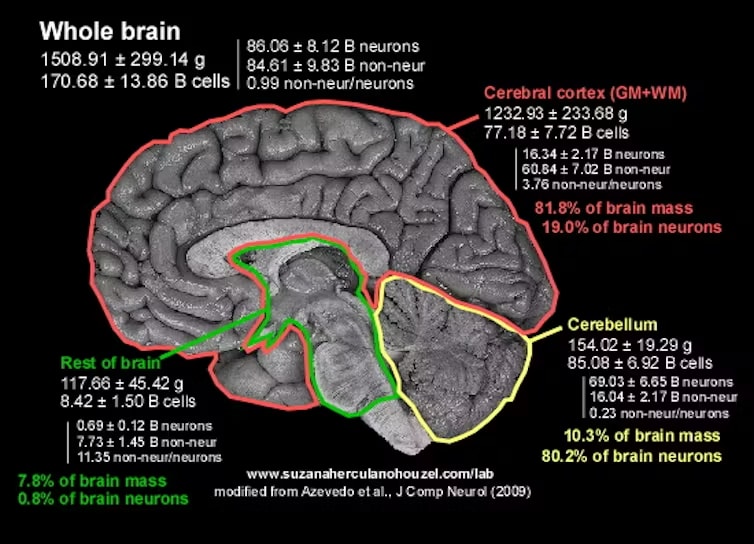
No more rough estimates. The average male human brain contains 86 billion neurons and 85 billion non-neuronal cells. Suzana Herculano-Houzel, CC BY-ND
With this brain you can store up to 2.5 million gigabytes of memory, which when stored fully compressed is equivalent to 3 million hours of watching standard resolution TV, but recalling memory is quite another thing. This starts to decline even before the brain is fully matured.
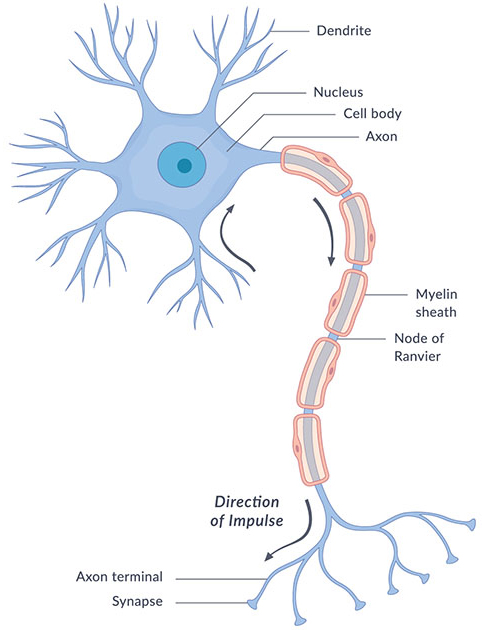
In addition we have about seven trillion nerve cells, close to twenty percent of all cells in our body. Their function is to send messages to and from all parts of the body, muscles, bones, ligaments, inner organs, the five senses and the brain.
We think of the nerves only as serving the sensory organs, but they are the chief messengers for just about everything concerning the body, so when we say: ‘Its only the nerves’ this is about as wrong as it gets. For a human body to function nearly everything has to function, it is good for us many organs are multiplied such as the lymph nodes, but many of the central organs such as heart, brain , stomach and so on are not duplicated. The nerves are the major communicators that makes it possible to develop from embryo to full maturity and help in the final decline in life.
But all mammals have the same or similar parts, so what is the difference between us and the animals?
We were created by God in his image with an expanded brain, capable of lifelong learning. This included a spiritual connection directly with God through His Spirit. This is the connection that died when Adam sinned and people decided they could function quite well without constant communication with God. Yet there remained a god-shaped void in their brains, a longing that wanted to be satisfied.
The next installment: Are we the way we are through nature or through nurture?
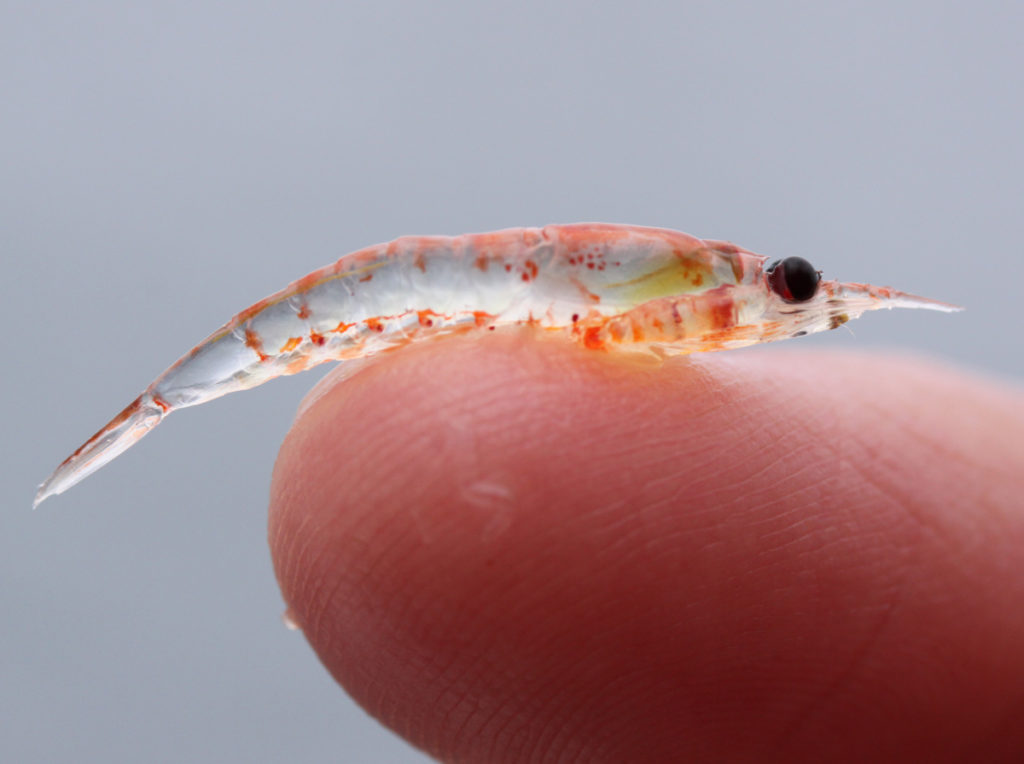
In Genesis 1:20-23:And God said, “Let the water teem with living creatures, and let birds fly above the earth across the expanse of the sky.” 21 So God created the great creatures of the sea and every living thing with which the water teems and that moves about in it, according to their kinds, and every winged bird according to its kind. And God saw that it was good. 22 God blessed them and said, “Be fruitful and increase in number and fill the water in the seas, and let the birds increase on the earth.” 23 And there was evening, and there was morning—the fifth day. It was now time for animal life to be created. There was plenty of carbohydrates in the form of algae and phytoplankton and enough oxygen generated by the plant life. One of the most important was the creation of krill.
It does not use hemoglobin for oxygen transport to metabolize but uses an open circulatory system. They do eat algae and most phytoplanktons. In fact a blue whale can eat up to 8000 pounds of krill a day in peak season. It is the major source of food for a variety of fish. Fish have hemoglobin that is similar to human hemoglobin but comes in different forms dependent on water conditions such as varying Ph and temperature. Some fishes are very sensitive to Ph changes, and during the period of acid rain and nearly unrestrained water pollution Lake Erie was unofficially declared dead. Mites, spiders and insects use venting air pockets inside their shells to provide the oxygen necessary for energy production. Birds have hemoglobin similar to human hemoglobin, but some is adapted for high altitudes. The Rüppell’s griffon vulture (Gyps rueppellii) holds the record for the highest-flying bird, having been documented at altitudes of up to 37.000 feet. The air pressure at that altitude is less than one sixth of sea level air pressure, which makes it hard to fly and breathe.
It has always puzzled me that God said “let there be light” on “day one” of creation, but did not associate it with the sun. This, in a strange way convinced me that the story of creation came from God and not from man. If it were from man they would of course have started with the sun to explain night and day as a 24 hour period.
In 1927, Georges Lemaître, a Belgian cosmologist and Catholic priest published a paper that provided a compelling solution to the equations of General Relativity for the case of an expanding universe. This was confirmed in 1931 by Edwin Hubble, and the expanding universe became widely accepted, and the Big Bang hypothesis, where the whole universe could be explained by having started by a singularity. Without being able to explain how a singularity could possibly happen, it was a convenient way to explain away God, And after the Hubble telescope was launched nearly all astronomers agreed it was so, and the universe was 13.88 Billion years old. This lasted until the Webb telescope was launched, and much of what had been accepted as true was not so, for instance they found galaxies that were over 14 billion years old. In addition they found that intergalactic water was found in mass earlier than the Big Bang theory had predicted that water could form. The earth and the Solar System were in a state of chaos until about 4.6 Billion years ago. This was in the middle of “day 3”. Our solar system is formed as a result of earlier supernovas having generated all the natural elements in the right proportions for life to be possible. The mixture of hydrogen and all elements finally formed a disc, and hydrogens got concentrated into a cloud, and the 10 planets, including earth making clouds at their proper distances from the center. The Earth got fully formed, but the Sun concentrated all its gasses as a protostar for another 10 to 50 million years until the core temperature reached 15 million degrees Celsius so fusion could really begin and stabilize. Therefore it states in Genesis 1:14-19:And God said, “Let there be lights in the expanse of the sky to separate the day from the night, and let them serve as signs to mark sacred times, and days and years, 15 and let them be lights in the expanse of the sky to give light on the earth.” And it was so. 16 God made two great lights—the greater light to govern the day and the lesser light to govern the night. He also made the stars. 17 God set them in the expanse of the sky to give light on the earth, 18 to govern the day and the night, and to separate light from darkness. And God saw that it was good. 19 And there was evening, and there was morning—the fourth day.
The Moon was formed later. One theory is that about 4.5 billion years ago, a Mars-sized protoplanet named Theia collided with the young Earth and separated from it.
With the Sun warming up fully, the algae and other plants really started growing, so God was then in a position to create something to consume the carbohydrates and all that plant life produced. It also helped that in the young earth the CO2 concentration was more than 10,000 ppm, or more than 50 times what it is today. It also happened that the Sun produced just the right amount of heat, and the Earth is just at the right distance from the sun to produce an ecosystem that produced the ideal temperature range to sustain organic life.
Let’s look what happens in Genesis 1: 9-13; And God said, “Let the water under the sky be gathered to one place, and let dry ground appear.” And it was so. 10 God called the dry ground “land,” and the gathered waters he called “seas.” And God saw that it was good. So now water is organized and land has appeared, and the earth is fully formed. This completes the physical creation, and in the 1983 book The Intelligent Universe, the famous astronomer Fred Hoyle wrote, “The list of anthropic properties, apparent accidents of a non-biological nature without which carbon-based and hence human life could not exist, is large and impressive.” The “fine tuning” of the universe is specifically designed to make life possible.
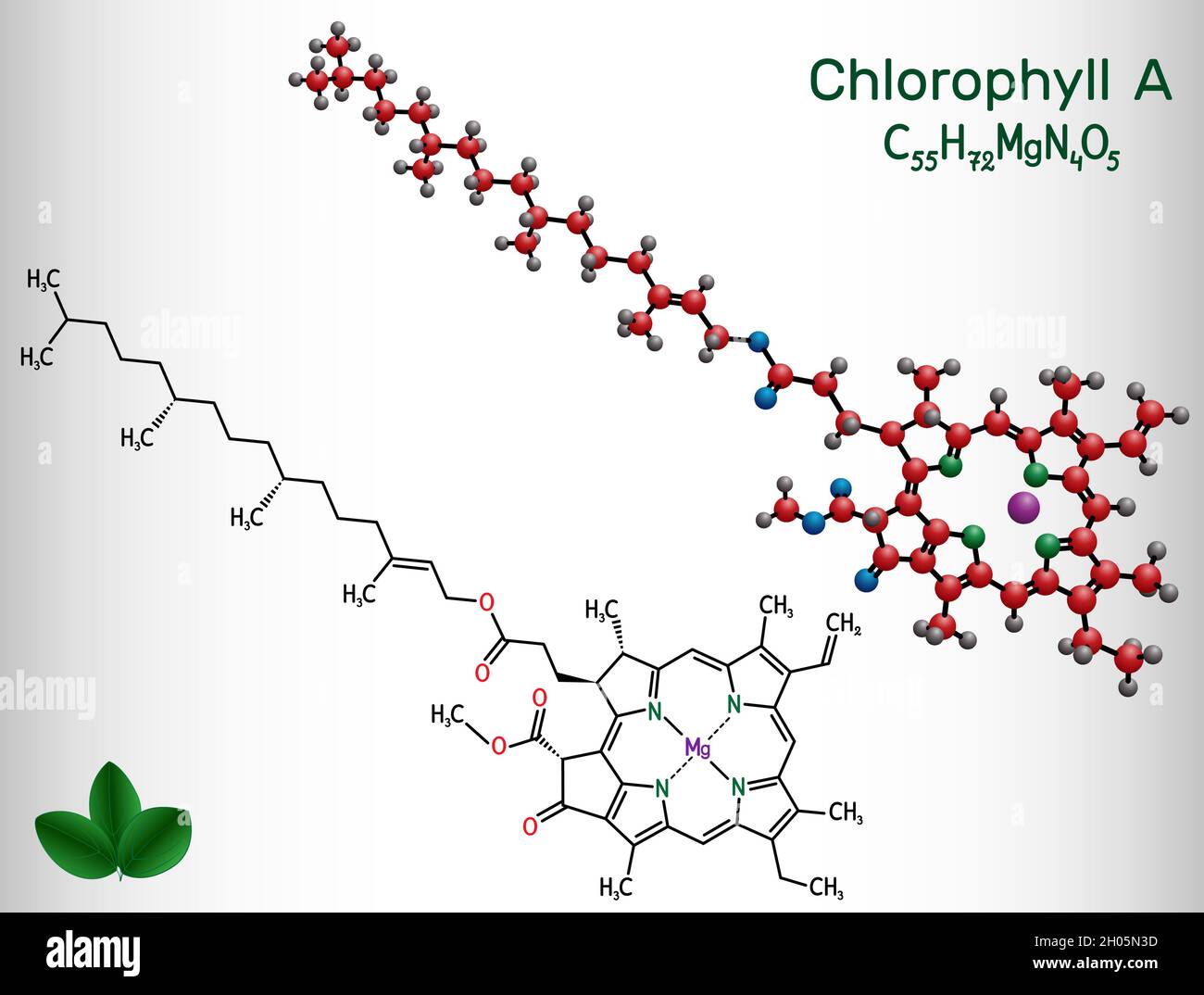
God is producing an ecosystem for the earth, but there is yet no physical life. Here God is silent on what lifeforms He created first. Scientists are trying to reproduce the conditions which make spontaneous creation of life possible, using all their intelligence and having the right combination of amino acids and other chemical conditions come together to form life. One thing is for sure; they did not imagine random processes in “the primordial soup” but tried to fabricate the best estimate of the environment using every ounce of scientific knowledge available. Whenever an amino acid is formed via lightning or whatever, half are created of the left type and half of the right type. (When one drinks fresh squeezed orange juice the vitamin C is all left oriented, but if the vitamin C is taken in a manufactured tablet it is half left, half right oriented. Only the left oriented vitamin is useful, the right oriented is just acid and is not generated by life and cannot be used by life.) So they are not able to reproduce life or even be able to explain how it could have happened since so many left oriented processes have to come together at the same time without being interfered by the unusable right oriented molecules hindering the process. And this is the generation of the simplest life form! Rather than trying to explain the inexplicable apart from creation, I will jump right in with Phytoplankton. These are very primitive plants, living mostly in oceans, wetlands, rivers and lakes but can also be found on land providing there is enough water, Most phytoplankton contains chlorophyll and absorbs carbon and generates oxygen.
God omits all the discussion of how life on earth started and jumps right into explaining that plant life started first, and what follows is a list of all kinds of flora. It is found in Genesis 1:11-13
Then God said, “Let the land produce vegetation: seed-bearing plants and trees on the land that bear fruit with seed in it, according to their various kinds.” And it was so. 12 The land produced vegetation: plants bearing seed according to their kinds and trees bearing fruit with seed in it according to their kinds. And God saw that it was good. 13 And there was evening, and there was morning—the third day.
In fact this is a step that evolutionists skip, because there is no plausible explanation how life could emerge out of dead matter. Some have suggested that life could have entered from outer space, and indeed the Webb telescope, when looking at the “empty” part of universe, have found that it is not totally empty but seems to have some rudimentary amino-acids and even metals, which are necessary but by no means sufficient building blocks for life.
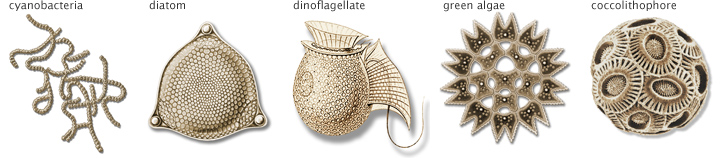
Let us take a look at one of the simplest phytoplanktons, the cyanobacteria.
The cyanobacteria is the simplest form of reproducing organism that contains chlorophyll and produces its own food; carbohydrates:
To produce its own food, it needs additional nutrition, among them Aluminum and Nitrogen compounds. They have to be included for photosynthesis to function via RNA interpreters, proteins and sunlight. The main food is CO2 and the process exhausts O2. The one celled organism looks like this:
This is the simplest of the phytoplanktons. It has all the necessary functions to be able to duplicate itself. To do it it must have a nucleus contained inside a cell wall, and how to create the cell wall is programmed in the nucleus. This is a very simple nucleus and the smallest of the cyanobacteria has a nucleus of about 1.4 million base pairs. 3 base pairs form one codon and tells which amino aid to use to add one link in the protein to build. The rest of the DNA was thought to be evolutionary redundant “junk DNA,” but recent analyses have shown that they are start codes and stop codes to show where, when and how to build it, with processes not yet understood. All this is interpreted by RNAs and other compounds, and together they enable how to build and duplicate themselves. The information stored in the DNA is about the same as is contained in a large fiction novel. All this was prepared in creation “day 3” and led to all plant life. Nowadays phytoplanktons generate about half of all carbohydrates and release half of all Oxygen in the world.
The first origin of life can only have come to pass thru a creative act of God, since it involves a catch 22 conflict many times over. But the first live substance may not have been based on sunlight and photosynthesis, but could have been microbes known as methanotrophs that convert methane gas into carbon dioxide and biomass. Scientists are unsure how these microbes get all the nutrients they need to accomplish this task. But this we know: God did not give us the story of creation to be scientifically complete. The only thing He says about mildew is that it is bad and how to get rid of it. The grass and the trees were created by God when the environmental conditions were right for them to appear, nearly all of them after the sun was lit.
Next installment: The sun, moon and the stars were formed on “day 4.”

 Len Bilén's blog, a blog about faith, politics and the environment.