The four chapters chosen for today are significant and thought provoking.
In John 6:25-71. Jesus had fed 5000 and been seen walking on water. In spite of these miracles the Jews demanded a sign. Jesus responds in kind saying he is the bread of life, and if people want to have eternal life they must come to him and eat of his flesh and drink of his blood. When hearing this, many abandoned Jesus, but Peter said: To whom shall we go? You have the words of eternal life.
Then in Genesis 12 Abram was called to leave his home in Ur. He traveled to a land he did not know, promised by God, and he obeyed, but when a famine came he went to Egypt and resorted to deceit rather than trusting God.
In Genesis 13 Abram and his sidekick Lot went back from Egypt and separated paths. Lot chose the fertile plain of Jordan, and Abram went to the hills of Mamre.
And in Genesis 14 Lot got in trouble and was taken captive by a local Mafia. Abram rescued Lot, and on the way back gave a tithe to Melchizedek, king of Salem – (later to become Jerusalem), after God gave him success in battle.
Question: Who was Melchizedek, and why is that important?
“Before I formed you in the womb I knew you, before you were born I set you apart; I appointed you as a prophet to the nations.” ( Jeremiah 1:5)
I woke up one morning with a chorus we sang in Church in the 70:s.
With eternity’s values in view, Lord,
With eternity’s values in view.
May I do each day’s work for Jesus
With eternity’s values in view.
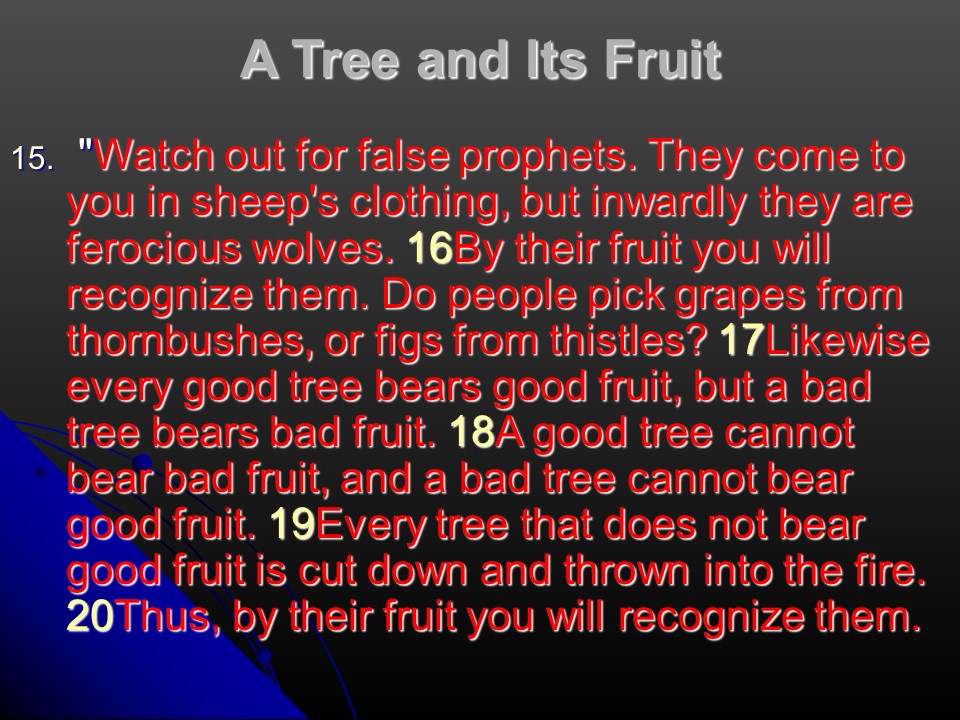
Then it hit me: Is this really right? It sounds so good, but is it right? The words from Jesus in Matthew 7: 21-23 rang in my ears:
21 “Not everyone who says to me, ‘Lord, Lord,’ will enter the kingdom of heaven, but only the one who does the will of my Father who is in heaven. 22 Many will say to me on that day, ‘Lord, Lord, did we not prophesy in your name and in your name drive out demons and in your name perform many miracles?’ 23 Then I will tell them plainly, ‘I never knew you. Away from me, you evildoers!’
In the case of the prophet Jeremiah God knew him before he was even conceived, but in the case of the false follower, Jesus never knew him in spite of all the things he did for Jesus. Why the drastic difference? Does God pick winners and losers, or is there anything we can do to be assured to be on God’s side?
The answer may lie in one more quote, this one from the apostle Paul in Romans 12:1-2 Therefore, I urge you, brothers and sisters, in view of God’s mercy, to offer your bodies as a living sacrifice, holy and pleasing to God—this is your true and proper worship. Do not conform to the pattern of this world, but be transformed by the renewing of your mind. Then you will be able to test and approve what God’s will is—his good, pleasing and perfect will.
There we have it: God doesn’t want us to do things for Christ, God wants us – all of us as a living sacrifice. He wants us to die to self and be resurrected to new life in Christ. This is available to anybody – a new life in Christ. Then the Holy Spirit can lead us into God’s perfect will.
One more quote. Many can quote Ephesians 2:8-9, but the answer is really in verse 10: 8 For it is by grace you have been saved, through faith—and this is not from yourselves, it is the gift of God— 9 not by works, so that no one can boast. 10 For we are God’s handiwork, created in Christ Jesus to do good works, which God prepared in advance for us to do.
By the way, the word handiwork is in the Greek ποιημα (poiema) from which we get the word poem. We are God’s poem. I like that.
Genesis 9, God established His covenant with Noah (The Noahic Covenant), and as a sign He established the rainbow in the sky. Noah planted a vineyard, got drunk and exposed his nakedness. This lead to “the curse of Ham,” which gave the excuse that the black race was for slavery. It was in reality the curse of Canaan, the original inhabitants of the yet to be promised land. Ponder that!
Genesis 10 is a genealogy of the descendants of Noah. It describes how the earth was repopulated.
John 5:1-30, describes how Jesus healed a man at the pool of Bethesda on a Sabbath, which offended the Jews. In addition Jesus claimed to be equal with the Father, for which the Jews sought to kill him, but Jesus defended His testimony.
Genesis 7 tells of Noah, having completed the ark, took with him seven (pairs) of clean animals and two of unclean animals, and also birds. The aquatic life did just fine. After the animals had entered God shut the door and the rain started forty days and forty nights.
Genesis 8. The water receded and Noah sent out a raven and later a dove, returning empty. The second time the dove was sent out, it returned with an olive branch in its beak. This has now become the universal peace symbol. After exiting the ark Noah built an altar and sacrificed from the clean animals. God made a promise to Noah: “While the earth remaineth, seedtime and harvest, and cold and heat, and summer and winter, and day and night shall not cease.”
Psalm 2 tells of what happens when “the heathen rage” and this psalm speaks of what is going on today.
John 4, speaks about the first real evangelist spreading the good news of Christ the Messiah. It is the woman at the well, a Samaritan, scorn and rejected by her many husbands, yet used by God to tell the good news.
Genesis 6 . Sin and wickedness got worse and worse on earth. God saw it and decided to start over. But Noah, his wife, his three sons and their wives, eight in all found favor with God, so God told him to build an ark. This Noah did, and it was the biggest ship built until the time of Ptolemy (around 215 BC.)
Ponder that the first evangelist was a scorned woman who happened to meet Jesus, and that Noah, being obedient to God built the ark on dry land, too big to be of any use unless there was going to be a giant flood. This takes faith!
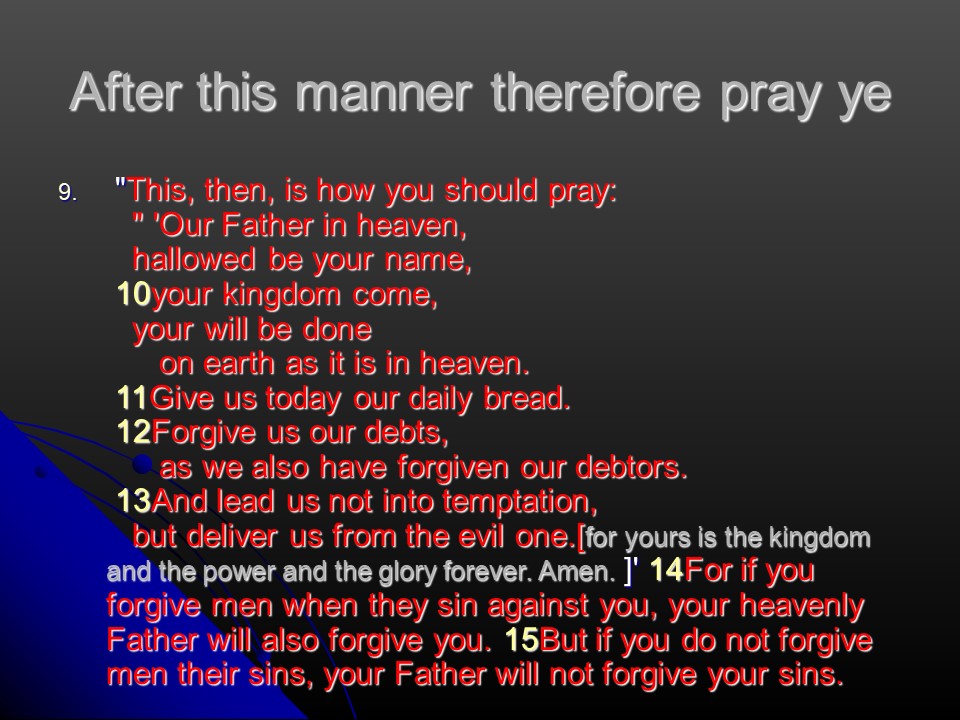
Matthew 6:1-18, do good, the Lord’s model prayer, fasting.
Pope Francis has called for a rewriting of the Lord’s Prayer, saying the current translation gives God a bad name and, essentially, does not give the devil his due.
Described in the Bible as a prayer taught by Jesus, the Lord’s Prayer is viewed in the catechism of the Roman Catholic Church as “the summary of the whole gospel.”
In a TV interview December 2017, Pope Francis said that the line asking God to “Lead us not into temptation,” or in Italian, “non indurci in tentazione,” should be changed.
Jesus spoke in Aramaic and this prayer in the gospel of Matthew is originally written in Greek, and it says:
και μη εισενεγκης ημας εις πειρασμον αλλα ρυσαι ημας απο του πονηρου and not bring us into temptation(or testing), but rescue us from – evil.
The Roman Catholic church of France has changed the translation of this verse to “and do not let us fall into temptation” and somehow Pope Francis thinks this would improve on what God has said.






 Len Bilén's blog, a blog about faith, politics and the environment.