Matthew 20:17-34. Jesus predicted his death. After that the mother of Zebedee’s sons asked Jesus to have her sons to be seated with Jesus in the kingdom of heaven, but Jesus answer was that is only for the Father to decide. The other disciples got angry, but Jesus admonished them all that the kingdom of heaven means to be a servant. The chapter ends with Jesus, out of compassion healed two blind men.
In Deuteronomy 4 God promised the people they will enter the promised land, but if they are disobedient they will be scattered all over the earth. Obedience means no idolatry “for the LORD, your God is a consuming fire, even a jealous God”. Three Cities of Refuge are mentioned.
In Matthew 20:1-16 Jesus told the parable of the workers in the vineyard; God is always fair even when we don’t think so.
Deuteronomy 2 tells of the first 38 years of wandering in the the Desert. The generation entering the desert had died off and with the help of God King Sihon was defeated.
Deuteronomy 3 describes how King Og was defeated and how the Israelites conquered the land East of Jordan, but Moses was forbidden to cross the Jordan and enter the Promised Land.
By our standards the parable of the workers in the vineyards is not fair. Can you imagine a labor negotiation coming to that result? The people that wandered in the desert for forty years was not allowed to enter the land (except for Joshua and Caleb), and even Moses was forbidden to enter the land because of disobedience. God does not judge people the way we do. Below is a limerick I wrote to Billy Graham’s 95’th birthday.
Matthew 19:13-30 contains some of the most important aspects of life. Here is a jewel: “Let the little children come to me…” After Jesus gave that lesson, a rich young ruler asked what good thing he must do to get eternal life. Jesus answered: “If thou wilt be perfect, go and sell that thou hast, and give to the poor, and thou shalt have treasure in heaven: and come and follow me.” This he could not do, so he sighed and walked away. Jesus then commented “It is easier for a camel to go through the eye of a needle than for a rich man to enter the Kingdom of God,” in other words, impossible. But cheer up, “with God all things are possible.” And God’s pecking order is not economic or based on power. Instead, sometimes “the first shall be last, and the last shall be first.” There are many idioms in the English language taken from the Bible. Yet the origin of these quotations are no longer allowed to be taught in public schools. Ponder that.
Deuteronomy 1 starts with the LORD’s command telling the Israelites to leave Horeb and enter Canaan. Leaders were appointed and spies sent out, but Israel refused to enter the land. The penalty for Israel’s rebellion was that no one would enter the promised land except Caleb and Joshua.
Matthew 19:1-12 is relatively short but contains some of the most important aspects of life, such as marriage and divorce. “What therefore God hath joined together, let no man put asunder.”
Ecclesiastes 8. Obey authorities for God’s Sake, and yes, this too is in Ecclesiastes: “Eat, drink and be merry.” It fits with the theme of vanity.
Psalm 19, of David. “This Psalm reflects, more than any other, the beauty and splendor of the Hebrew poetry found in the Psalter. C.S. Lewis wrote, ‘I take this to be the greatest poem in the Psalter and one of the greatest lyrics in the world.’” (VanGemeren)
Psalm 20, of David. The people’s prayer for the King is heard by the LORD. The most quoted part is: “ Some trust in chariots, and some in horses: but we will remember the name of the Lord our God.” The Lord saves, we pray for the King.
Psalm 21, of David. The New Testament references from Revelation 14 seems to fit. When I read the Psalm the battle hymn of the republic kept ringing in my ears.
Matthew 18:10-35. This chapter contains the parable of the lost sheep, which leads naturally into the subject of forgiveness, reconciliation and church discipline. Jesus also promised that “where two or three come together in my name, there am I with them”. The chapter ends with the parable of the unmerciful servant.
Numbers 33 is a reciting of Israel’s Journey from Egypt, and provides instructions on how the Israelites were to conquer Canaan.
Numbers 34, defines the Boundaries of Canaan and mentions all the leaders appointed to divide the land.
Numbers 35 defines the forty-two Cities for the Levites and their six Cities of Refuge.
Numbers 36 tells about the Inheritance of Zelophehad’s Daughters and why the Israelite women must marry within their tribe.
Matthew 18:1-10. As an object lesson to the question: “Who is the greatest in the kingdom of heaven?” Jesus called a little child. Then he expanded the question and elaborated on the subject of sin.
In Numbers 29 the specifications for offerings continue, Offerings at the Feast of Trumpets, Offerings at the Day of Atonement and finally Offerings at the Feast of Tabernacles.
Numbers 30 is short, and it deals with what the Law says about vows.
Numbers 31. The Israelites executed vengeance on the Midianites, returned from the war and dividied the spoils.
Numbers 32, The Reubenites, the Gadites and the half-tribe of Manasseh decided to settle East of Jordan.
Psalm 18 is the fourth longest psalm. David wrote it ” To the Chief Musician. A Psalm of David the servant of the LORD, who spoke to the LORD the words of this song on the day that the Lord delivered him from the hand of all of his enemies and from the hand of Saul. And he said:” (Read it, ponder and enjoy.)
Matthew 17:14-27. The disciples tried to heal a boy with epilepsy but failed. Jesus healed him immediately. The disciples could not do it because they had so little faith. Jesus also predicted his death, and the tax collectors came to Peter to collect the poll tax. Jesus solved this by telling Peter to go fishing and from the first fish he caught he would take the four drachma coin swallowed by the fish. That did take care of the tax for both Peter and Jesus.
Numbers 26 lists in detail, by tribe, the Second Census of Israel.
Numbers 27 defines inheritance laws, and it was decided that Joshua should succeed Moses.
Numbers 28 is all about offerings, the Daily Offerings, Sabbath Offerings, Monthly Offerings, Offerings at Passover and Offerings at the Feast of Weeks.
Psalm 17 demonstrates David’s total trust in God and not in self in spite of David’s best efforts. It can be summarized: “Keep me as the apple of Your eye; Hide me under the shadow of Your wings” with regard to the threats from David’s enemies.
Matthew 17:1-13 describes the transfiguration on the mount. It shows Jesus joining Moses and Elijah. Jesus tells his disciples: Elijah has already come.
Numbers 23 tells of Balaam’s first oracle, his second oracle, and the beginning of his third oracle.
Numbers 24 continues with Balaam’s third oracle, his fourth, and his final oracles.
Matthew 16:13-28. Peter made his famous confession: “Thou art the Christ, the Son of the living God.” Right after that Jesus predicted his death, to which Peter said “Never” and Jesus answered “Get behind me, Satan.” Those were strong words. Jesus furthermore said “Whosoever will lose his life for my sake shall find it.” Finally Jesus predicted his transfiguration.
In Numbers 21 the Canaanites were defeated in Hormath. The people kept speaking against God, so God sent venomous snakes their way and many died. Moses made a bronze snake, put it on a pole and when people looked at it, they got healed. (Does that remind you of a symbol used even today?) The travels continued.
Numbers 22 tells the story of how Balak sent for Balaam, and how Balaam’s Donkey behaved when he saw the Angel.
Matthew 16:1-12. the Jews demanded a sign. Jesus told them the there will be no sign other than the sign of Jonah: Three days and three nights in the belly of a great fish. The disciples had forgotten to bring bread and Jesus coincidentally told them : Beware of the yeast of the Pharisees and the Sadducees. Huh? Jesus had to explain to them he meant their doctrine, not literal yeast.
Numbers 18 describes the duties of Priests and Levites, offerings for Supporting the Priests, tithes Supporting the Levites and the tithe of the Levites. As representatives of the LORD they were entitled to get the best part.
Numbers 19 details the laws and procedures of Purification, and introduces the red heifer.
In Numbers 20. Moses committed a major error in Kadesh. Thy were short on water, so God told Moses to speak to the rock. Instead, Moses smote the rock. Water sprung forth but God punished Moses and his people so severely that that generation was not allowed to enter the promised land. Why did God give them this harsh punishment? The rock was to be smitten only once, the second time Moses was to speak to the rock, a foreshadowing of Jesus, who was smitten once for our sins. At the end of the chapter Aaron died.
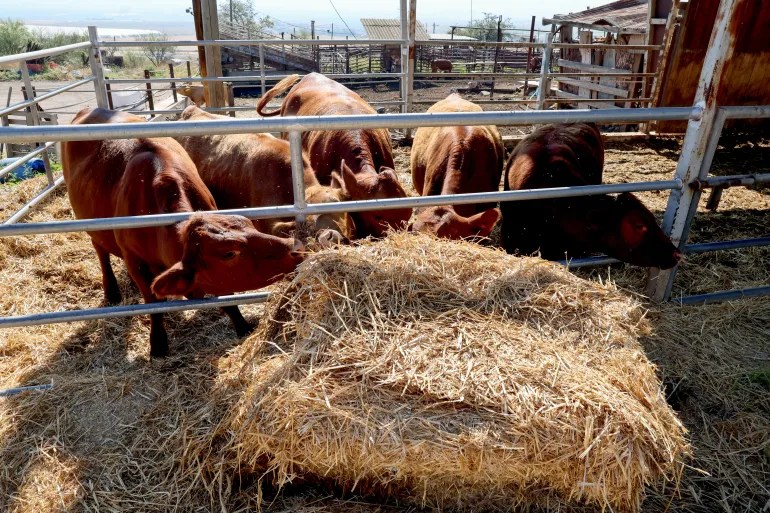
In chapter 15 of Matthew Jesus explained it is not what you eat that makes you unclean, and that you do not need ceremonial cleansing before eating. In chapter 16 Jesus warns his disciples to beware of the extra regulations required by the Sadducees and the Pharisees to live a clean living. Numbers 19 is introduces the red heifer, the ashes of which had to be mixed in with the water of cleansing. In September 2022, five, perfectly red, blemish-free heifers were flown from Texas to Israel to be used in purification rituals, as required by biblical tradition for rebuilding the Third Temple. These animals are currently being kept in Shiloh and monitored by the Temple Institute. Two of the heifers have been disqualified for developing blemishes, but the remaining three are now of required age to be sacrificed. As of early 2026, the Temple Institute continues to maintain the remaining candidates for a potential future ritual, which proponents believe is a prerequisite for restoring ritual purity and eventually rebuilding the Third Temple.
 Len Bilén's blog, a blog about faith, politics and the environment.