Genesis 1:1 In the beginning God created the heavens and the earth.
What did God create? Continuing in Genesis 1:2; Now the earth was formless and empty, darkness was over the surface of the deep, and the Spirit of God was hovering over the waters. The earth was formless, meaning chaotic and unorganized; and empty meant without any form of life. But there was water; yes, that is right; water existed in abundance way before the sun was formed. Water is necessary for life to exist, and its unique property of freezing at 0 C and boiling at 100C makes it ideal for organic life. The fact that ice is lighter than water makes ir possible for marine life to survive the winters even in shallow lakes since the ice sits on top of the lake and isolates for further freezing.. Here is introduced God’s Spirit moving over the waters, doing what?
Then in Genesis 1:3; And God said, “Let there be light,” and there was light. Light is very interesting. It is just a massless piece of energy traveling at the speed of light. Since it travels at the speed of light it has no time. It is created and extinguished at the same time but in different places. From our perspective we see it as traveling at the speed of light, but that is because we are stuck in place in time and space. Dead matter cannot do anything, but with the energy in form of light it might be possible. Therefore
in Genesis 1:4; God saw that the light was good, and he separated the light from the darkness.
So in Genesis 1:5: God called the light “day,” and the darkness he called “night.” And there was evening, and there was morning—the first day. At this time God just defined the term day and night. But notice that darkness comes before light.
But do not forget this one thing, dear friends: With the Lord a day is like a thousand years, and a thousand years are like a day. (2 Peter 3:8)
1 John 3:1-10. We are children of God, or as the King James Bible calls it “Behold, what manner of love the Father hath bestowed upon us, that we should be called the sons of God:” As children of God we do not continue to sin, for if we do, we don’t have the spirit of God in us.
Proverbs 23, Sayings of the Wise. Do not be a glutton, do not desire riches, do not be a moocher, do not argue with a fool, do not change ancient landmarks, do not withhold correction from a child, do not envy sinners because they are having fun, do not drink wine to excess, do not despise your mother when she is old, honor your father and mother, keep away from harlots, stay sober and do not succumb to alcohol.
Psalm 134 is the last of the songs of ascents. 3 verses short and to the point. Bless the Lord and He will bless you from Zion.
Psalm 135 is a Psalm of praise and thanksgiving to the uniqueness and superiority of the LORD, His name and all that He has done! Compare that to the worthless idols!
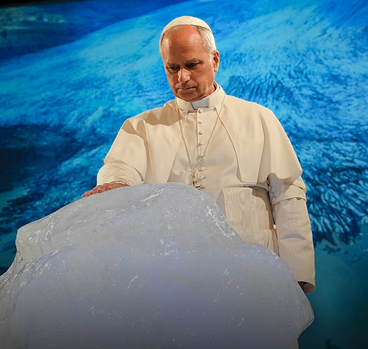
Pope Leo XIV, the newly elected pope, has recently championed the Vatican’s plan to become the world’s first carbon-neutral state by developing a large solar farm on land near Rome. This initiative is inspired by the environmental legacy of Pope Francis and aims to generate enough electricity to meet the Vatican’s needs and potentially provide excess energy to the local community. The Vatican’s efforts are part of a broader push for climate action, with Leo XIV actively promoting the transition away from fossil fuels and emphasizing the moral imperative of environmental stewardship. He also took part in the “Raising Hope for Climate Justice” International Conference in Castelgandolfo, Italy on Oct 1, where he blessed a chunk of a Greenland iceberg. See the picture:
Pope Leo asked eloquently: “What must be done now to ensure that caring for our common home and listening to the cry of the earth and the poor do not appear as mere passing trends or, worse still, are seen and felt as divisive issues?”
“Everyone in society, through nongovernmental organizations and advocacy groups, must put pressure on governments to develop and implement more rigorous regulations, procedures and controls,” the pope said.
“Citizens need to take an active role in political decision-making at national, regional and local levels,” he said. “Only then will it be possible to mitigate the damage done to the environment.”
What they still do not know is that rising CO2 levels is responsible for less than 10% of the climate change, and water in all its forms; ice, water, water vapor and clouds is responsible for over half of climate change. Land use changes are also more important. Let me explain it further:
Many years ago, around 1976 Dr. James Lovelock bought a number of Hewlett Packard 5840 Gas Chromatographs to be set up in some of the most remote places of the earth to study pollution and its effect on the climate. What he found was an unexpectedly large amount of dimethylsulphide (DMS) in the atmosphere, and that acted as a
condensation point for cloud formation. He was then a longtime paid consultant for Hewlett Packard, so he came over from his native England a couple of times a year, always willing to hold a seminar for us engineers working at Hewlett Packard Analytical, and at one of them he sprung “Daisy-world” on us before it was published; mostly to see if we could poke holes in his hypothesis. It involved a world that consisted of only two flowers, black daisies and white daisies. The computer simulation starts out with a cold world and a weak sun. The sun slowly warms up (about 1 percent every ten million years), and at some time suddenly black daisies appear and cover the earth. This warms the earth some more and white daisies appear. As the sun varies in intensity the mix of white and black daisies changes and this keeps the earth at a stable temperature, as they have different reflective properties. He then went on to say that the whole earth is like a living organism. Some time later he presented the paper and afterwards we asked him how it was received. “You won’t believe it”, he answered. ”Now there are people who actually believe the earth is a living organism. They demand follow-up articles that justifies their belief.” He had partly himself to blame, the name he had chosen was “the GAIA hypothesis,” Gaia being the Mother Earth Goddess. Talking about religion the Mother Earth people now had their goddess, and expressions like. “The earth has a temperature” became commonplace. For me, being a Christian I read with wonderment what God has to say about Creation and the Ecosystem.
Starting in Genesis 1:1; In the beginning God created the heavens and the earth. This can be described in scientific terms: From nothing God created space and matter. What happened to “In the beginning”? It turns out that matter has to be accompanied with space or it will not work. And time is a derived property from the existence of matter and space. Without space and matter time does not exist. So the creation of matter and space also defined the beginning of time. What about God? The laws of physics tells us you cannot create something out of nothing. This proves that we and everything else cannot possibly exist. But we do, and therefore there must have been something existing before anything existed. This is God, and He can be defied in one word: Presence. When Moses saw the burning bush he asked who it was. And God answered “I am that I am”, in a way describing the eternal presence, without beginning and end. This is the God I believe in: Out of time and space since He created it, and also in time and space since it is part of His creation.
The expression “in the beginning” is in Hebrew bereshit which means in the beginning. The same phrase begins the gospel of John 1:1 “Inthebeginning was theWord, and theWord was with God, and theWord was God.” Here the word translated beginning is “Arch” like in archangel and means “the chief” or “the most important one’ referring to the Word. It is in past tense which means that the Word existed before the beginning. Another reference is found in Titus 1:1 “inthe hope of eternal life, which God, who does not lie, promised before thebeginning of time,” In this verse the word eternal and the word time is in Greek aionion , which means a very long time, like the time span of a dynasty. Nowadays eon has a meaning of a thousand million years in Geology and Astronomy, but the original meaning is a very long time which may or may not be defined. It is sometimes translated of the ages. Here is a song that spiritually speaks to me:
1 John 2:18-29. The Apostle John explained there will come a last hour’s deception, so let the truth abide in You. Remember you are children of God.
Obadiah is a prophecy on the coming judgment on Edom, the descendants of Esau, Jacob’s brother. Edom mistreated his brother and this will lead to Israel’s final triumph.
Psalm 131. This is the shortest of the songs of ascents, only 3 verses. David showed his contentment in hoping in the Lord.
Psalm 132. This is the longest of the song of ascents, 18 verses. Remember God’s promise to David, to Israel and to the future Messiah.
Psalm 133, a Song of Ascents, of David. This Psalm too has only three verses, and the point of it is that it is good to dwell in unity.
1 John 2:1-17. The Apostle John explained for us how you can test if you know Him, warned of sin and was concerned for their spiritual state.
Proverbs 22, Proverbs of Solomon. This is a great chapter of wise advice, how to handle riches, and if not – how to come to poverty, how to raise children properly and how not to be a sluggard. It also contains some sayings of the wise.
Psalm 127, a Song of Ascents. This Psalm is written by Solomon, and tells that God is the real builder of houses, cities and families.
Psalm 128, a Song of Ascents. It states that the fear of the Lord gives blessings to families, it will go well with them, and they get to live to see their grandchildren.
Psalm 129, a Song of Ascents. In spite of many afflictions, Israel prevails thanks to the blessing of the Lord.
Psalm 130, a Song of Ascents. “Out of the depths” God helps and forgives. Wait for the Lord in hope, and He will redeem Israel.
1 John 1. From the Beginning, what was heard, seen and touched we proclaim, that is the Word of Life. How can we have fellowship with God and with one Another? The Word of God through the Apostle John tells us how.
Amos 6. The prophet issued woe to Zion and woe to Samaria. God abhorred the pride of Jacob.
Amos 7. The prophet had a vision of the Locusts, a vision of fire and a vision of the plumb Line. Amaziah told Amos not to prophesy bad things, but that is why Amos, a poor shepherd, was called.
Amos 8. The prophet had a vision of the summer fruit. That seemed good at first, but it signaled the beginning of the destruction of Israel.
Amos 9. The final chapter of Amos is depicting the destruction of Israel and the promise that Israel will be restored.
2 Peter 2. Even in the first century there arose destructive doctrines from a multitude of false teachers. They were all doomed because of their depravity and attempts to deceive.
Amos 1. The prophet proclaimed judgment on Tyre and Sidon.
Amos 2. The prophet proclaimed judgment on Moab, Judah and Israel.
2 Peter 1:12-21. The Apostle Peter reminded the faithful of his approaching death and kept emphasizing the trustworthiness of the prophetic word.
Proverbs 21, Proverbs of Solomon. Yes, there is a difference between a wise and righteous man, and an evil, foolish and lazy man, thinking only about himself and his pleasures, and “It is better to dwell in the wilderness, than with a contentious and an angry woman.”
Psalm 123, a Song of Ascents. This is a short but fervent prayer for mercy.
Psalm 124, a Song of Ascents. This one is of David. Thank God! Only He can do the impossible.
Psalm 125 is a song of Ascents, sung by pilgrims on the way to Jerusalem to one of the three yearly prescribed feasts.
Psalm 126 likewise is a Song of Ascents. One verse: “They that sow in tears shall reap in joy.”
2 Peter 1:1-11. The Apostle was greeting the faithful, urging them to be fruitful in the faith as they apply the eight godly virtues. Peter reminded them of his approaching death and kept emphasizing the trustworthiness of the prophetic word.
Joel 3. In this final chapter of the prophet Joel God judges the nations, bringing war to the valley of Jehoshaphat: “Beat your plowshares into swords and your pruning hooks into spears: let the weak say, I am strong.” And afterwards God will bless His people.
Psalm 120 is a song of ascents, that means it was sung as the people went up to Jerusalem on their way to celebrate one of the Jewish festivals.
Psalm 121, a Song of Ascents. Psalms 120 to 134 were sung on the way to Jerusalem during the festivals.
Psalm 122, a Song of Ascents. This one is of David.

 Len Bilén's blog, a blog about faith, politics and the environment.