2 Corinthians 3. Believers are Christ’s Epistle with the the spirit of the living God living within them.“The letter killeth, but the spirit giveth life” , that is the glory of the New Covenant, and “where the spirit of the Lord is, there is liberty”
Isaiah 9. A must read chapter of Isaiah. It speaks of “The people that walked in darkness have seen a great light: they that dwell in the land of the shadow of death, upon them hath the light shined.” Then it states: “For unto us a child is born, unto us a son is given: and the government shall be upon his shoulder: and his name shall be called Wonderful, Counsellor, The mighty God, The everlasting Father, The Prince of Peace.” It speaks of Christ, the coming Messiah, both his humanity (a child) and his deity (son of God).
2 Corinthians 2. The Apostle Paul sent a very loving and encouraging letter to the Corinthians. In it he emphasized they should be no more Sorrowful, forgive the offender and triumph in Christ.
In Isaiah 6 is told the famous call of Isaiah: “Here am I, send me“. God answered by telling Isaiah of all the hardships that will come with answering such a call. The people will harden their hearts as Pharaoh hardened his.
Isaiah 7. “Behold, a virgin shall conceive, and bear a son, and shall call his name Immanuel.” After that promise God spoke of a coming disaster.
Isaiah 8. Prophetically Assyria will invade Israel, an instrument of God to execute judgement on the unfaithful. The remedy is to fear God and Him alone.
2 Corinthians 1. After Paul’s customary greeting he gave praise to the God of all comfort, which includes comfort in suffering and consolation from suffering. Paul told the Corinthians of his sincerity and his change of plans and of God sparing the Church.
Isaiah 4. “In that day”. This refers to the Messianic reign after the Day of the LORD. “The Branch” is introduced.
Isaiah 5. The Song of the Vineyard. The chapter starts out beautifully, but then tells of judgement. In chapter three was proclaimed two woes. In chapter five God proclaimed six more woes.
1 Corinthians 16. The Apostle Paul urged the believers to take up collections for the saints in Jerusalem. He mentioned personal plans, gave final exhortations, final greetings and farewell.
Isaiah 2. The famous chapter containing “beating swords into plowshares” “study war no more” and the Day of the LORD is introduced.
In Isaiah 3 the prophet proclaimed judgment on Jerusalem and Judah.
Psalm 70, of David, a short, urgent petition for deliverance, full of praise.
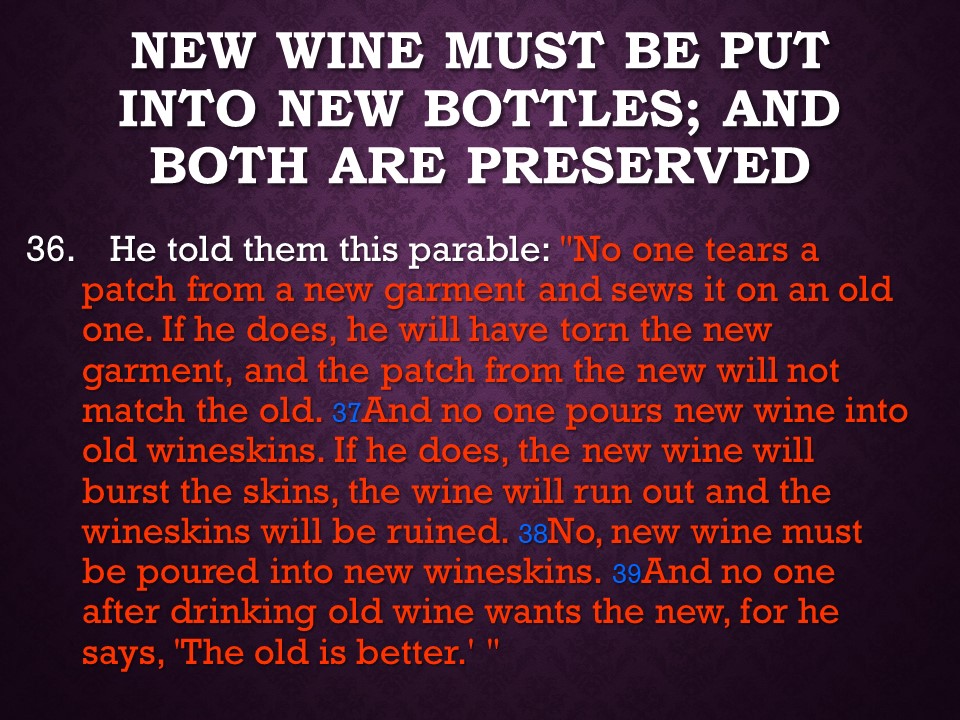
This passage in the Gospel according to Luke, chapter 5, is one that puzzled me for a long time: (Jesus speaking)
First, let ‘s dispense with the King James’ translation, the original Greek mentions wineskins, not bottles.
Wine is made from grapes, and the sugar content of grapes is about 16%. The wine making process is to convert the sugar into ethanol via fermentation, and grapes come replenished with their own yeast, so the fermentation starts whether you like it or not. If you leave the grapes out in the air they will ferment and the ethanol will oxidize into vinegar, so they must ferment in a vessel that locks out oxygen. The fermentation has two phases, the first phase is fairly fast, a little more than 10 days, where the sugar converts to ethanol. This process releases CO2; nearly half of the weight of the sugar goes up in the air in the form of CO2, the rest is ethanol. No wineskin can handle that, so fermentation was usually done in a clay vessel with a lid on to prevent air to enter. At the end of 10 to 15 days they had “new wine”.
Bur the fermentation was not over, the aging process began, and that lasted from a few weeks to a few months. During that time there is a slow release of CO2, but the vessel had to be air tight so no oxygen would spoil the wine and turn it into vinegar.
This is where newwineskins come in, they can handle this process by being ever so slightly permeable, if they are made from young goatskin, properly prepared.
Old wineskins on the other hand are hardened and can even be brittle, like an old leather glove that has been lost in the snow for the winter, and when it is found in the spring, it is ruined.
Jesus did not teach wine-making when he used that parable, in the parable the wine is the Holy Spirit and we are the wineskins.
Many people, me and my wife included have been praying for a great new, worldwide revival, and following that, a great worldwide awakening. Revivals usually start small and local, but with great intensity. The intensity will be greatest among young people, and they will celebrate with a new song in their heart. They are the new wineskins, they will be filled with new wine, and their new music will be less refined, raw and unpolished, or so it will seem to us old wineskins. We better prepare for the outpouring of the Holy spirit in our old wineskins by rejuvenate them with the oil of joy to make us ready to receive the old wine, aged to perfection with the full bouquet, like when Jesus turned water into wine. Then we who have been saved for many years can join with the young and appreciate each other, we appreciate their youthful enthusiasm and music, and they will appreciate the good wine that comes from lifelong experience.
There is a great passage in Isaiah 25, a song of praise coming right after the dreadful chapter 24. It speaks of aged wine being the finest of wines.
Revelation 7:17: For the Lamb at the center of the throne will be their shepherd; ‘he will lead them to springs of living water.’ ‘And God will wipeaway every tear from their eyes.’”
Yes, there will be a great worldwide revival, and an even greater awakening.
Psalm 101, of David. A song of praise and a vow that reads like a new year’s resolution.
Psalm 102. A penitential psalm. It recalls the great deeds and miracles God did for His people in the wilderness, and how they disobeyed and turned to idols, even to the point of child sacrifice. In spite of this God is still merciful and there is still hope. It ends with a Hallelujah!
Isaiah 66 speaks of judgement and hope, and true and false worship. Yet, the LORD will vindicate Zion; “Behold, I will extend peace to her like a river, and the glory of the Gentiles like a flowing stream“. Finally, God via Isaiah wraps up the scroll with a description of the Day of the LORD and its sobering aftermath.
2 Thessalonians 2 tells of the great apostasy, when the man of lawlessness is revealed and usher in the tribulation. People will believe “The Lie” and be destroyed. Stand fast, Jesus will destroy him at his return.
Isaiah 62. Zion’s new name will be called Hephzibah and the land will be called Beulah, salvation is coming.
Isaiah 63. The day of the Lord’s vengeance is coming where “the grapes of wrath are trod” and there was no one to help. Then God will show His mercy and provide salvation, but will people listen?
2 Thessalonians 1, After the customary greeting and prayer of thanksgiving, Paul dealt with God’s final judgment and God’s glory.
Isaiah 60. Arise, shine, for your light has come. Gross darkness covers the people. It tells of the glory of Zion and ends with a millennial prophecy of the New Jerusalem.
Isaiah 61. This is the year of the Lord’s favor. Jesus started his ministry finding this prophecy in the scroll of Isaiah and read it but stopped mid-sentence. It also gives “beauty for ashes” and proclaims the good news of salvation.


 Len Bilén's blog, a blog about faith, politics and the environment.