This brings us to verses 80 and 81 of the Obama Impeachment song (as if sung by President Barack Hussein Obama to the tune of “Please release me, let me go”)
Hillary Clinton thinks the border is secure. This is what she said in a Phoenix TV interview:
“I think we’ve done a really good job securing the border.” During the interview, Clinton asserted that “immigration from Mexico has dropped considerably” over the past few years and that it’s “just not happening anymore.”
On a totally unrelated matter Hillary Clinton said this about her e-mail server:
“Well, the system we used was set up for President Clinton’s office. And it had numerous safeguards. It was on property guarded by the Secret Service. And there were no security breaches.”
This adds one more verse to the Hillary Clinton nursery rhyme:
During an interview September 9, 2014 Hillary Clinton said this:
“Every time I went to countries like China or Russia, I mean we couldn’t take our computers, we couldn’t take our personal devices, we couldn’t take anything off the plane because they’re so good. They would penetrate in a nanosecond,”
Knowing this she still read and sent e-mails from her unsecured blackberry to her unsecured server while on foreign trips.
This adds one verse to the Hillary Clinton nursery rhyme:
Hillary, Hillary, where have you been?
“It’s none of your business, for I am the queen.”
……………… more ……………..
Hillary, Hillary, have you been hacked?
“Indeed, I’ve been hacked, code cracked and bushwhacked.”
Democratic presidential front-runner Hillary Clinton committed her second gaffe in as many days on the campaign trail Monday night, claiming that the U.S. “didn’t lose a single person” in Libya during her time as secretary of state.
Clinton made the comment defending her push for regime change in the war-torn North African nation at an Illinois town hall hosted by MSNBC.
This adds one more verse to the Hillary Nursery rhyme:
Engineer, graduated from Chalmers Technical University a long time ago with a degree in Technical Physics. Career in Aerospace, Analytical Chemistry, and chip manufacturing. Presently adjunct faculty at PSU, teaching one course in Computer Engineering, the Capstone Course. View all posts by lenbilen
Appearing at a CNN town hall in Columbus, Ohio, on Sunday, Democratic presidential candidate Hillary Clinton promised that in her administration, “We’re going to put a lot of coal miners and coal companies out of business.”
This adds one more verse to the Hillary Nursery rhyme:
(anh-usa.org) Hillary Clinton’s campaign has released a letter from one of her doctors giving her a clean bill of health after a full medical exam and attesting to her physical ability to serve as president. The letter revealed that Mrs. Clinton is being treated with the drug Coumadin to help prevent blood clots, which she experienced in 1998, 2009, and 2012. Coumadin (also called warfarin) is an anticoagulant intended to prevent blood clots, heart attacks, and strokes.
We’ve written before about how dangerous this and other drugs like it can be. It is one of the leading causes of emergency room fatalities. In 2011, it was the subject of 1,106 serious adverse event reports, including seventy-two deaths—and that is just in hospitals!
Warfarin has a long list of nasty side effects, including bleeding gums, blood in the urine, blurred vision, chest pain, peeling skin, serious bone loss, and confusion. It can also cause necrosis—the death of skin tissue. One study found that long-term warfarin use after myocardial infarction (that is, after a heart attack) did not reduce mortality or reinfarction, but is associated with significantly more major bleeding.
One more thing. Warfarin is used as rat poison, but some rats develop tolerance to warfarin.
This adds one more verse to the Hillary Nursery rhyme:
Hillary, Hillary, where have you been?
“It’s none of your business, for I am the queen.”
……more……………
Hillary, Hillary, are you insane?
“My rat poison clot drugs play tricks with my brain.”
Background: Montpelier, Vt. (AP) — Colleges and universities worldwide are incorporating into their curriculums the evolving genre of literature that focuses on the changes coming to Earth as the result of climate change — “cli-fi.”
Some of the books and movies now being considered part of the genre are old classics, while others were written more recently in direct response to today’s changing climate.
“It’s a very, very energized time for this where people in literature have just as much to say as people who are in hard science fields, or technology and design fields, or various social-science approaches to these things,” said Jennifer Wicke, an English professor at the University of Virginia who will be teaching a course this June on climate fiction at the Bread Loaf campus of Middlebury College in Ripton, Vermont.
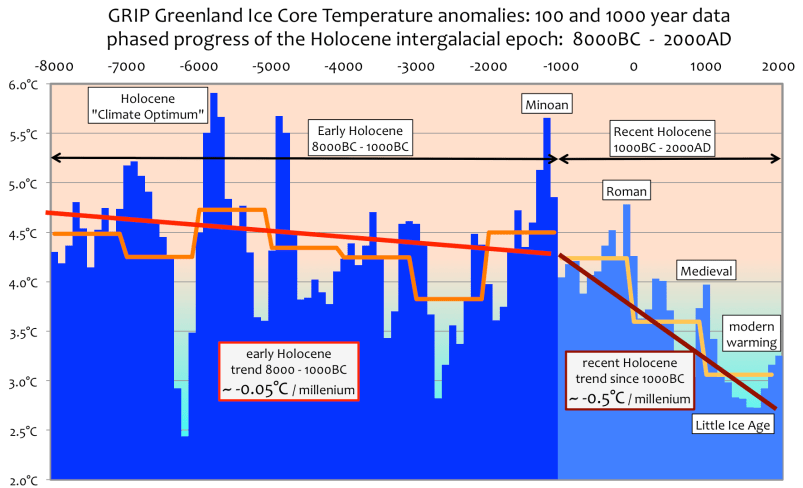
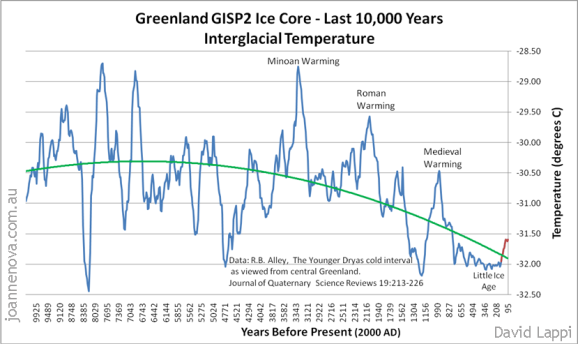
During the last Ice-age snowfall over Greenland was less than half what it is now. As the Earth came out of the ice-age temperatures rose sharply, CO2 rose with a lag of about 800 years, snowfall increased until the Minoan temperature optimum was reached. Since then there has been a slow decrease in global temperatures until the little ice age, after which there has been a temperature recovery. At the same time CO2 levels have increased, and there seemed to be a correlation from 1950 until “the pause”. What controls temperature is not CO2 but clouds. Check the chart below:
We are still in the coldest 1000 years since the end of the ice-ageThere is a strong correlation between temperature and CO2, not in the temperatures themselves, but in the temperature adjustments, also called homogenization. The adjustments are made to make old temperatures conform better to the climate models. The chart:
Clouds have always been my fascination. They come and go, form and disappear, cool by day and warm by night. But most impressive of all are thunderstorms, forming when the temperature and humidity are high, transport a lot of water vapor to higher elevations, there condensing as rain or ice, coming down, cooling and watering the earth. Clouds and thunderstorms are the thermostat of the earth. Without it the earth would respond like climate models, predicting a sharp temperature rise as carbon dioxide levels increase. The models are all flawed, since they predict a hot spot in the troposphere over the equator, but there is none. The thunderstorms in the tropical doldrums take care of that. “Settled science” instead has settled on ignoring the lack of the hot spot, for to acknowledge it would make the global warming claim invalid.
I thank God for providing us with a thermostat that protects the earth from overheating, and especially for thunderstorms!
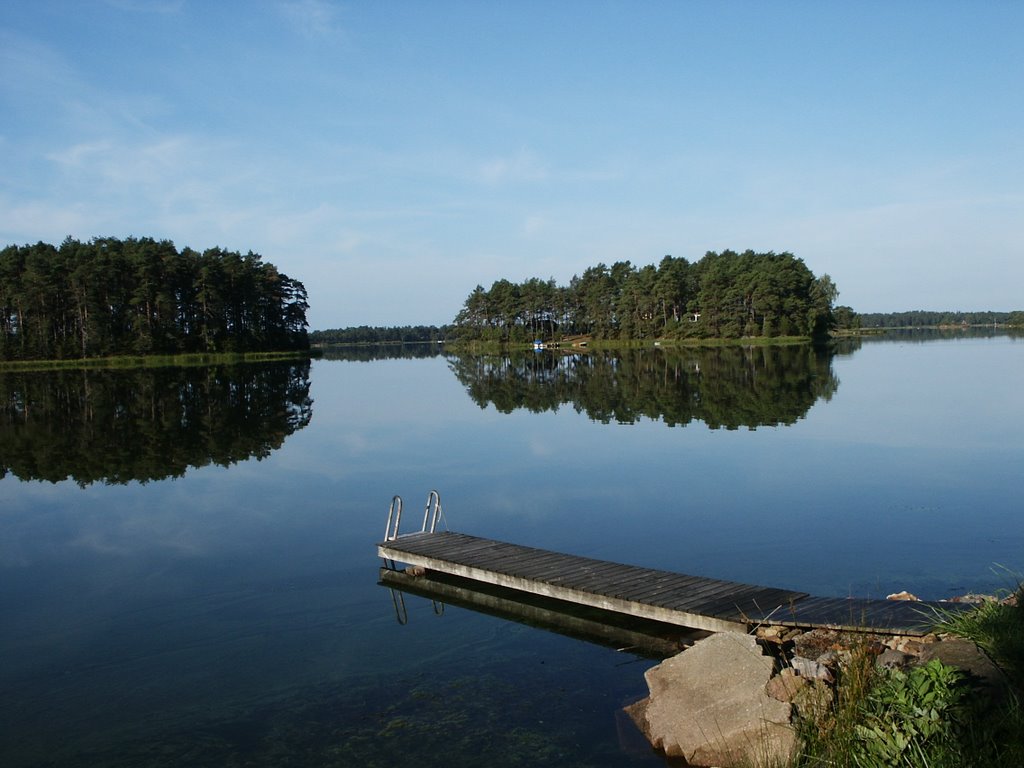
Such was the case in July 1885, when Carl Boberg, a 26 year young pastor of a small congregation of the Swedish Missionary society was the honored guest of the ladies’ auxiliary annual picnic, held in a meadow near Mönsteråsviken, (a bay of the Baltic Sea in southeastern Sweden). The day was perfect, the sky was clear, pleasant temperatures, the cows were grazing on the meadow, the birds were singing, in short, a pastoral idyll. Then it happened. In a few short minutes thunderclouds appeared out of nothing. There was no time to go home, so they all sought shelter in a barn close by. The rain came down hard, and lightning struck a nearby tree. Then as suddenly as it started the rain stopped and all was calm. In Sweden it turns much cooler after a thunderstorm, and the birds sing like they got a new lease on life.
They all went home, and the young pastor pondered the events of the day. He
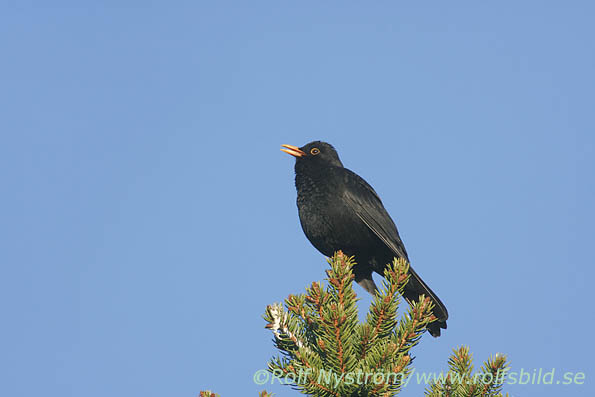
080419-11, digital 28,8 mb RAW, 12-00 Koltrast, Turdus merula Uppland
heard the Coalthrush singing its melodic, beautiful drill and in a distance he heard the church bells ringing from Kronobäck’s church. The bay was calm like a mirror, and inspired he started penning the song “O store Gud”. Here is the first verse:
O Lord my God, When I in awesome wonder, Consider all the works Thy Hands have made; I see the stars, I hear the mighty thunder, Thy power throughout the universe displayed.
Refrain: Then sings my soul, My Savior God, to Thee, How great Thou art, How great Thou art. Then sings my soul, My Savior God, to Thee, How great Thou art, How great Thou art!
He continued to write and write of all the mighty works that God has made and what He has given us through His word, and continued long into the night. Before going to bed he had penned over twenty verses. The next Sunday he wove the poem into his sermon. They all loved it, but that was about it. Slowly the word got around the poem was pretty good, after much editing down 9 verses were published in the local newspaper Mönsteråstidningen in 1886. Carl Boberg didn’t make any efforts to publish it further, and was surprised when he heard it sung a few years later to a Swedish folk melody (in 3/4 tempo). This was then published in the periodical “Sanningsvittnet” (witness of the truth) in 1891.
It was translated into German by an Estonian, Manfred von Glehn. Five years later it was translated into Russian by Ivan S. Prokanoff, the Martin Luther of modern Russia. It was published in a book with the title “Cymbals”.
Later, while in the Carpathian Mountains of what is now Western Ukraine the English Missionary couple Hine heard the song sung in Russian, this time as a wandering song in march tempo. He got impressed by God’s great works in the Polish mountains, and as Stuart Hine heard the people singing it on their way to church he penned a translation. This become the second verse:
When through the woods, and forest glades I wander, And hear the birds sing sweetly in the trees. When I look down, from lofty mountain grandeur And see the brook, and feel the gentle breeze.
Refrain
From now on the English version is different than the Swedish original. This is the origin of the third verse: It was typical of the Hines to ask if there were any Christians in the villages they visited. In one case, they found out that the only Christians that their host knew about were a man named Dmitri and his wife Lyudmila. Dmitri’s wife knew how to read — evidently a fairly rare thing at that time and in that place. She taught herself how to read because a Russian soldier had left a Bible behind several years earlier, and she started slowly learning by reading that Bible. When the Hines arrived in the village and approached Dmitri’s house, they heard a strange and wonderful sound: Dmitri’s wife was reading from the gospel of John about the crucifixion of Christ to a houseful of guests, and those visitors were in the very act of repenting. In Ukraine (as I know first hand!), this act of repenting is done very much out loud. So the Hines heard people calling out to God, saying how unbelievable it was that Christ would die for their own sins, and praising Him for His love and mercy. They just couldn’t barge in and disrupt this obvious work of the Holy Spirit, so they stayed outside and listened. Stuart wrote down the phrases he heard the Repenters use, and (even though this was all in Russian), it became the third verse that we know today: And when I think, that God, His Son not sparing; Sent Him to die, I scarce can take it in; That on the Cross, my burden gladly bearing, He bled and died to take away my sin.
Refrain
The second world war broke out, and the Hines were forced to return back to England, but they continued their ministry. The fourth verse was was added by Stuart Hine after the Second World War. His concern for the exiled Polish community in Britain, who were anxious to return home, provided part of the inspiration for Hine’s final verse. Hine and David Griffiths visited a camp in Sussex, England, in 1948 where displaced Russians were being held, but where only two were professing Christians. The testimony of one of these refugees and his anticipation of the second coming of Christ inspired Hine to write the fourth stanza of his English version of the hymn. According to Ireland: One man to whom they were ministering told them an amazing story: he had been separated from his wife at the very end of the war, and had not seen her since. At the time they were separated, his wife was a Christian, but he was not, but he had since been converted. His deep desire was to find his wife so they could at last share their faith together. But he told the Hines that he did not think he would ever see his wife on earth again. Instead he was longing for the day when they would meet in heaven, and could share in the Life Eternal there. These words again inspired Hine, and they became the basis for his fourth and final verse to ‘How Great Thou Art’:
When Christ shall come, with shout of acclamation, And take me home, what joy shall fill my heart. Then I shall bow, in humble adoration, And then proclaim: “My God, how great Thou art!”
Refrain
The complete song was soon published, not in England but in the Soviet Union (in English). The famous Gospel singer George Beverly Shea got hold of it, liked it a lot, but he wanted to change two words in the first verse: Instead of works, he wanted to use worlds, and instead of mighty he wanted to use rolling. Very reluctantly Stuart Hine agreed, but only for use in the Billy Graham Crusades. It was first sung in Canada in 1955. It became so popular that in Billy Graham’s 1956 New York Crusade it was sung at all 99 events, and from there the song spread out through all the world, even back in Sweden where the new version became the popular one.
There have been over seventeen hundred documented recordings of “How Great Thou Art”. It has been used on major television programs, in major motion pictures, and has been mentioned as the favorite Gospel song of at least three United States’ presidents.








 Len Bilén's blog, a blog about faith, politics and the environment.