January 19: Read through the Holy Bible in a year.

John 12:20-50 . Some Greeks came to Jesus and Jesus prophesied  about his being “lifted up, and draw all men to himself”, and some believed. Many Jews also believed but kept quiet for fear of being kept out of the synagogues.

In Genesis 36 is recorded the genealogy of Esau and the rulers of Edom.

Genesis 37 tells of Joseph’s dreams, outrageous as they were they made his brothers jealous, so they sold him into slavery to Potiphar in Egypt.

January 18: Read through the Holy Bible in a year.

John 12:1-19 begins the last week before the Crucifixion. It is important when this happened, so I have inserted a piece on the correct dates for Passover and the Holy week. Jesus was anointed at Bethany, on Sunday and, as prophecised, he rode on an unbroken donkey colt in the triumphal entry.

Trouble started in Genesis 34. Dinah was violated by an uncircumcised person, two of her brothers executed revenge on not only the violator but every male in the whole town, killing them all. Jacob said: “You have troubled me to make me a stink among the inhabitants of the land.” And so trouble started.

Genesis 35. Jacob returned to Bethel, got rid of all the idols and built an altar. Moving on from Bethel, Rachel gave birth to Benjamin, a birth so hard Rachel died in childbirth. Finally it tells of the death of Isaac.

January 17: Read through the Holy Bible in a year.

John 11:45-57. Because Jesus had raised Lazarus from the dead, the ruling Jews were worried that Jesus would become ruler and then the Romans would destroy their nation. This lead to Caiaphas’ inadvertent prophecy “You know nothing at all! You do not realize that it is better for you that one man die for the people than that the whole nation perish.

The sons of Laban were displeased, so in Genesis 31 Jacob fled from Laban. However, as Jacob, wives and children all were set to depart, Rachel stole Laban’s idols. Laban found out the idols were missing, pursued Jacob and caught up with him. Laban looked for the idols, at no avail, Rachel had hid them under the saddle of her camel and sat on it claiming she had her period. Finally Laban gave in, said farewell to all and he and Joseph established the Mizpah.

In Genesis 32 Jacob, schemer as he was, prepared to meet Esau. He figured Esau wanted to kill him, so he split up his company in two, and gave instructions to his messengers on what to say to make Esau less vindictive. Then the Jacob family crossed the Ford of Jabbok. On the other side they camped for the night, and Jacob wrestled with an angel of God and prevailed, but got a limp in his hip. God then gave Jacob a new, spiritual name, Israel.

And in Genesis 33 Jacob finally met up with Esau, and it turned out that Esau rejoiced to see Jacob and all his children.

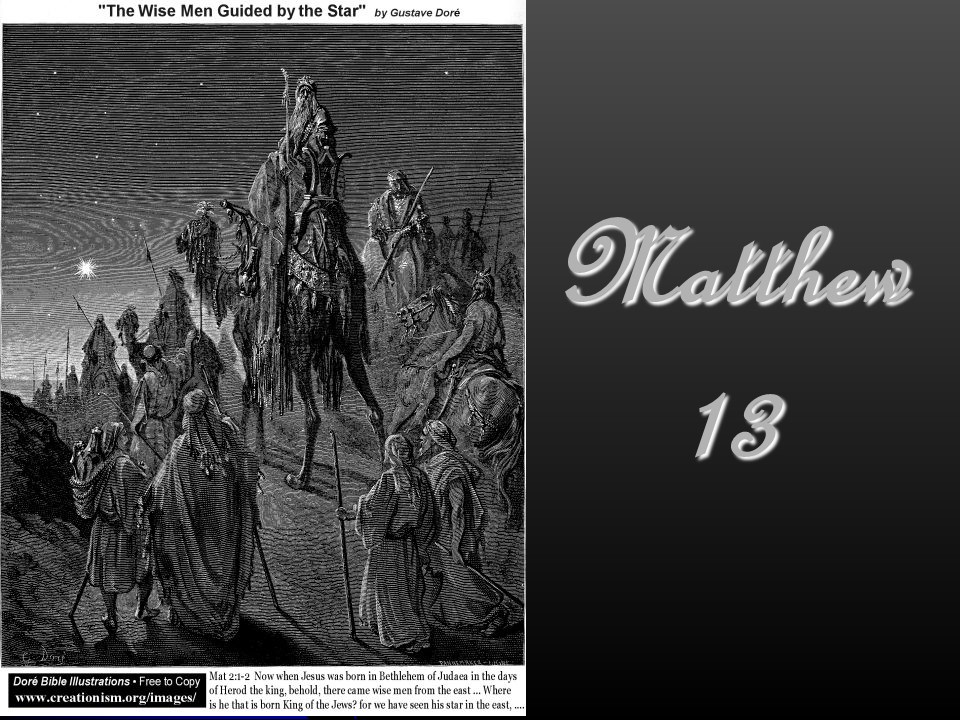
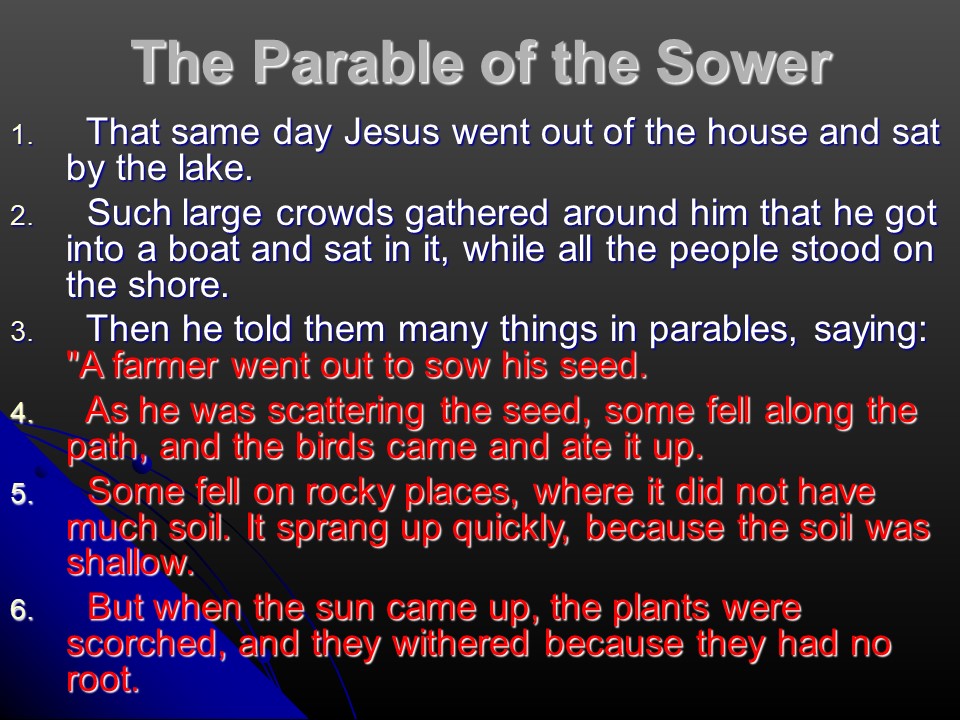
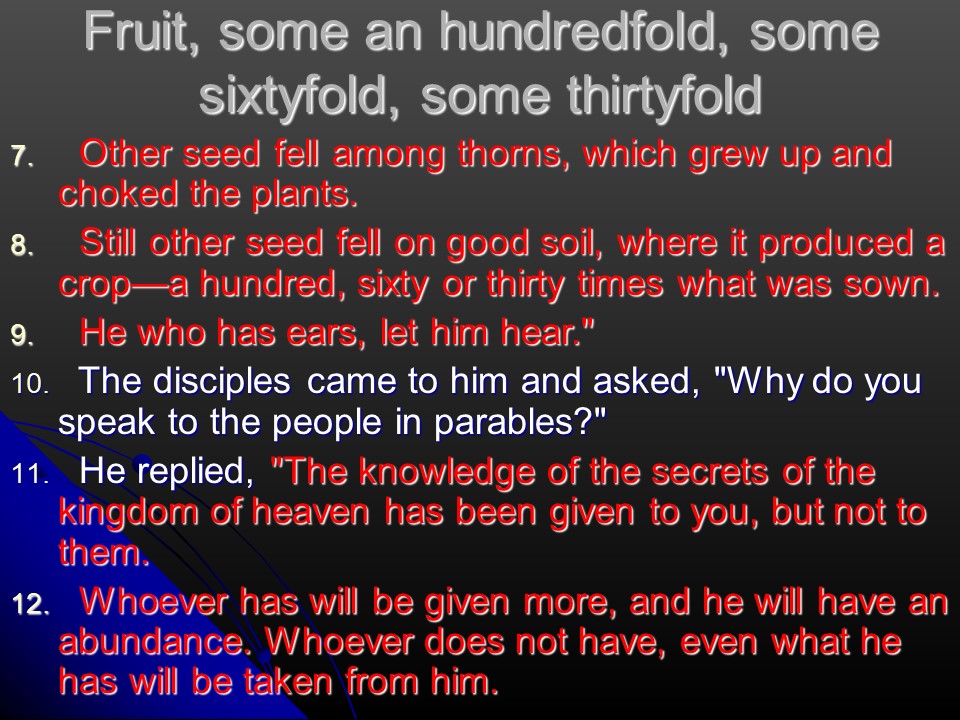
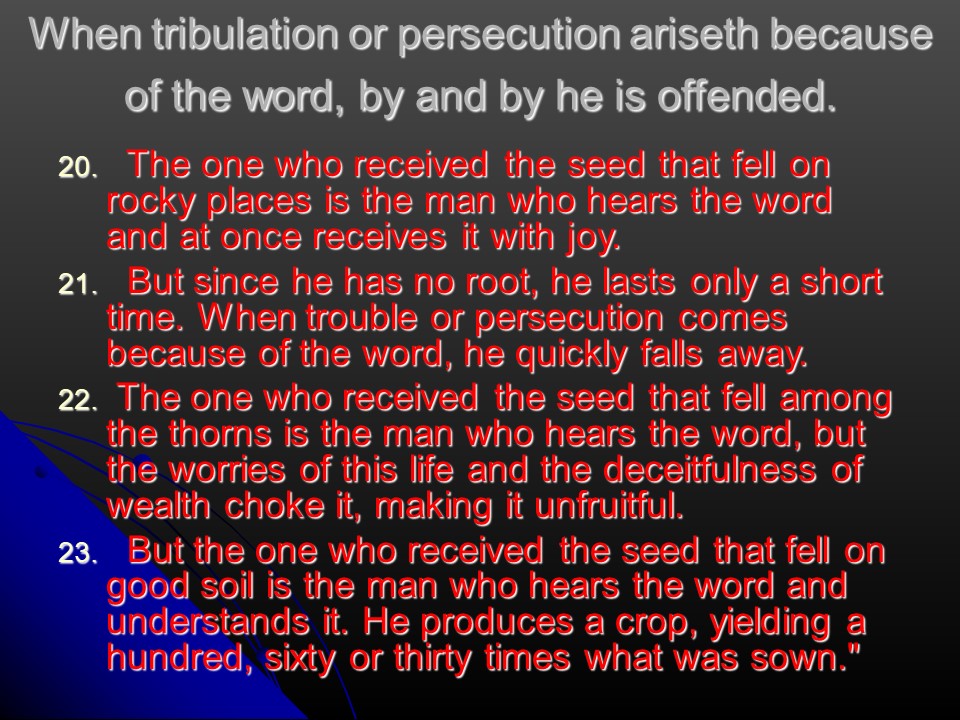
Matthew 13:1-30, Jesus’ parables on the kingdom of heaven: the sower, the wheat and the tares.

Matthew 13:1-30, Jesus’ parables on the kingdom of heaven: the sower, the wheat and the tares.

January 16: Read through the Holy Bible in a year.

John 11:1-44 describes how Jesus raised Lazarus from the dead (on the fourth day no less).

Jacob arrived in Paddan Aram in Genesis 29, fell in love with Rachel, worked seven years to be allowed to marry her, but her father Laban tricked Jacob, so he got Leah instead. Then he worked another “seven years for Rachel”. But it was Leah that gave him his first four children, Reuben, Simeon, Levi and Judah.

Genesis 30 records the remaining children born to Jacob (except Benjamin, who will be born later). It also tells a story about Rachel, desperate to get a child of her own was bargaining with Leah for Reuben’s mandrakes. After Joseph was born, Jacob wanted to leave and go back to the promised land, but Laban bargained with him to stay and make them even more prosperous. Through selective breeding Jacob acquired the majority of the flocks, and became wealthy.

Psalm 6 is a prayer, this time of a humble David asking for mercy, but also asking God to humiliate David’s enemies.

January 15: Read through the Holy Bible in a year.

In John 10:22-42 Jesus claimed to be one with his Father. This is of course blasphemy unless it is true, so for that the Jews wanted to stone him.

In Genesis 27 Jacob deceived Isaac to get the blessing of the firstborn instead of Esau. Esau got one too, but just the regular blessing, so to avoid more trouble Jacob fled to Laban.

In Genesis 28, Jacob went to Paddan Aram to get a wife. On the way he had a dream, commonly known as “Jacob’s Ladder”. Meanwhile, Esau took yet another wife, the daughter of Ishmael. The promise of Jacob’s dream was that God was to give the land to Jacob’s descendants. Jacob made a vow to God and named the place Bethel.

Psalm 5 is a prayer extolling the joy of praising God and praying towards Jerusalem, but is also an urgent prayer to do away with and destroy all wickedness and wicked people.

January 14: Read through the Holy Bible in a year.

In John 10:1-21 Jesus told he is the good shepherd and all what that means.

After Sarah’s death, in Genesis 25 Abraham married his concubine Ketorah, who had already borne him six children. Before his death he sent them all away with ample gifts and provisions but his inheritance he gave to Isaac. Isaac and Ishmael buried Abraham, and then Ishmael’s genealogy is written down. Finally is told the story of Jacob and Esau, and how Esau sold his birthright for a bowl of lentil stew and some bread.

Genesis 26 tells of Isaac and Rebekah, how Isaac too said Rebekah was his sister, like father, like son. In spite of that lie God protected them, and the rest of the chapter deals with the eternal Mideast dispute: Water rights.

January 13: Read through the Holy Bible in a year.

In John 9 Jesus opened the eyes of a man blind from birth, Since this was done on a Sabbath trouble arose from the Pharisees. In the arguments that followed Jesus again claimed his divinity.

In Genesis 23 Abraham’s wife Sarah died and Abraham purchased a grave in Mamre, where Abraham, Isaac and Ishmael buried her.

Genesis 24 tells the beautiful story of Isaac and Rebekah.


January 12: Read through the Holy Bible in a year.


 John 8 begins with a sinful woman who was about to be stoned for adultery. Jesus last words to her was “Go and sin no more”. Jesus did not condemn her for the past but forgave and pointed to the future. The he got into an argument with the religious powers about his and their ancestry. They claimed to be descendants of Abraham, and they questioned the legitimacy of Jesus. Jesus answered “Before Abraham, I am”. Jesus claimed to be God. This was of course blasphemy, unless it is true.

Genesis 21 tells about the birth of Isaac and when Ishmael made fun of it, Sarah got angry and Hagar and Ismael were sent away to die in the desert, but God protected them. The chapter also features the treaty between Abraham and Abimelech at Beersheba.

In  Genesis 22 Abraham was told by God to offer up his son Isaac to be sacrificed on Mount Moriah, the same mountain that Jesus was crucified on. Obeying God he did what he was told, but at the last moment God provided a substitute sacrifice in the form of a ram.

January 11: Read through the Holy Bible in a year.

John7:25-53. The people started asking Jesus if he is the Christ. Rather than answering directly Jesus promised “Streams of living water”and more, but they were not ready to understand it yet.

So in Genesis 19 Sodom and Gomorrah were destroyed. There is ample evidence this is a historical true event, the Bible is verified true even here. God provided for Lot, his wife and two daughters to escape.They did, but Lot’s wife looked back towards the city and was no more. After that is recorded the strange story about Lot and his two daughters, and all I can say about that is that it is not good to take matters in our own hand rather than listen to God and let Him guide.

In Genesis 20 Abraham claimed Sarah was his sister. Why? Sarah was his half-sister, so Abraham stretched the truth, also called a lie, or sin. The chapter shows God’s protection even when we do wrong.

Psalm 4 is David’s appeal to righteousness, and the blessings that follow is David’s appeal to righteousness, and the blessings that follow.