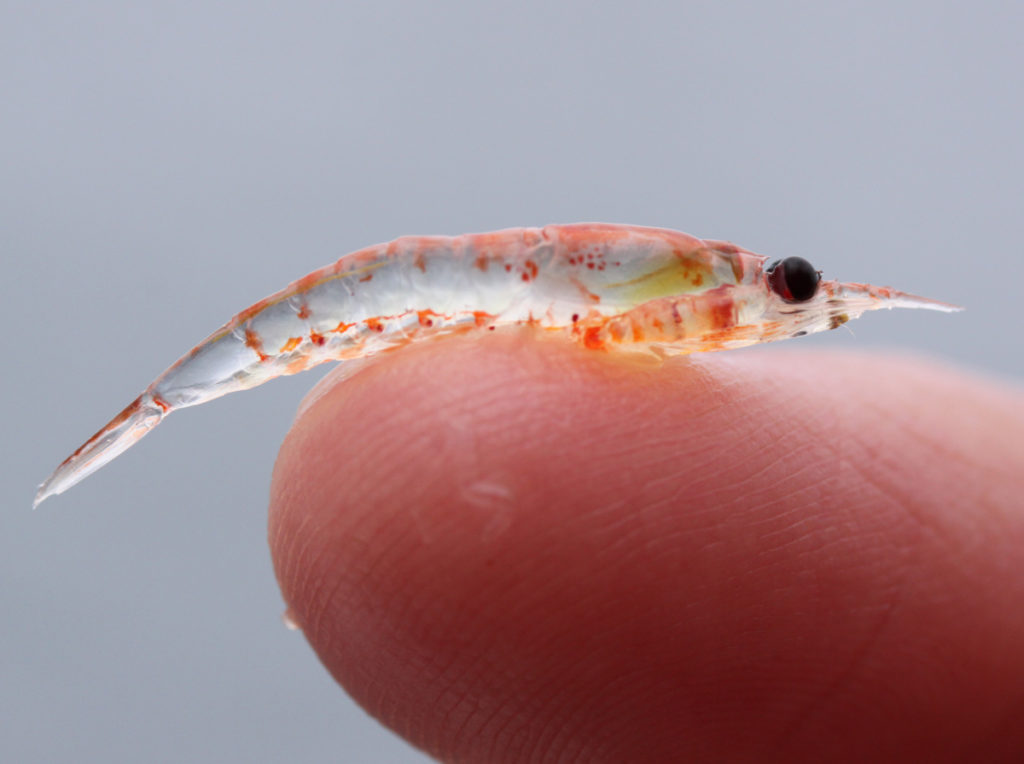
In Genesis 1:20-23:And God said, “Let the water teem with living creatures, and let birds fly above the earth across the expanse of the sky.” 21 So God created the great creatures of the sea and every living thing with which the water teems and that moves about in it, according to their kinds, and every winged bird according to its kind. And God saw that it was good. 22 God blessed them and said, “Be fruitful and increase in number and fill the water in the seas, and let the birds increase on the earth.” 23 And there was evening, and there was morning—the fifth day. It was now time for animal life to be created. There was plenty of carbohydrates in the form of algae and phytoplankton and enough oxygen generated by the plant life. One of the most important was the creation of krill.
It does not use hemoglobin for oxygen transport to metabolize but uses an open circulatory system. They do eat algae and most phytoplanktons. In fact a blue whale can eat up to 8000 pounds of krill a day in peak season. It is the major source of food for a variety of fish. Fish have hemoglobin that is similar to human hemoglobin but comes in different forms dependent on water conditions such as varying Ph and temperature. Some fishes are very sensitive to Ph changes, and during the period of acid rain and nearly unrestrained water pollution Lake Erie was unofficially declared dead. Mites, spiders and insects use venting air pockets inside their shells to provide the oxygen necessary for energy production. Birds have hemoglobin similar to human hemoglobin, but some is adapted for high altitudes. The Rüppell’s griffon vulture (Gyps rueppellii) holds the record for the highest-flying bird, having been documented at altitudes of up to 37.000 feet. The air pressure at that altitude is less than one sixth of sea level air pressure, which makes it hard to fly and breathe.
It has always puzzled me that God said “let there be light” on “day one” of creation, but did not associate it with the sun. This, in a strange way convinced me that the story of creation came from God and not from man. If it were from man they would of course have started with the sun to explain night and day as a 24 hour period.
In 1927, Georges Lemaître, a Belgian cosmologist and Catholic priest published a paper that provided a compelling solution to the equations of General Relativity for the case of an expanding universe. This was confirmed in 1931 by Edwin Hubble, and the expanding universe became widely accepted, and the Big Bang hypothesis, where the whole universe could be explained by having started by a singularity. Without being able to explain how a singularity could possibly happen, it was a convenient way to explain away God, And after the Hubble telescope was launched nearly all astronomers agreed it was so, and the universe was 13.88 Billion years old. This lasted until the Webb telescope was launched, and much of what had been accepted as true was not so, for instance they found galaxies that were over 14 billion years old. In addition they found that intergalactic water was found in mass earlier than the Big Bang theory had predicted that water could form. The earth and the Solar System were in a state of chaos until about 4.6 Billion years ago. This was in the middle of “day 3”. Our solar system is formed as a result of earlier supernovas having generated all the natural elements in the right proportions for life to be possible. The mixture of hydrogen and all elements finally formed a disc, and hydrogens got concentrated into a cloud, and the 10 planets, including earth making clouds at their proper distances from the center. The Earth got fully formed, but the Sun concentrated all its gasses as a protostar for another 10 to 50 million years until the core temperature reached 15 million degrees Celsius so fusion could really begin and stabilize. Therefore it states in Genesis 1:14-19:And God said, “Let there be lights in the expanse of the sky to separate the day from the night, and let them serve as signs to mark sacred times, and days and years, 15 and let them be lights in the expanse of the sky to give light on the earth.” And it was so. 16 God made two great lights—the greater light to govern the day and the lesser light to govern the night. He also made the stars. 17 God set them in the expanse of the sky to give light on the earth, 18 to govern the day and the night, and to separate light from darkness. And God saw that it was good. 19 And there was evening, and there was morning—the fourth day.
The Moon was formed later. One theory is that about 4.5 billion years ago, a Mars-sized protoplanet named Theia collided with the young Earth and separated from it.
With the Sun warming up fully, the algae and other plants really started growing, so God was then in a position to create something to consume the carbohydrates and all that plant life produced. It also helped that in the young earth the CO2 concentration was more than 10,000 ppm, or more than 50 times what it is today. It also happened that the Sun produced just the right amount of heat, and the Earth is just at the right distance from the sun to produce an ecosystem that produced the ideal temperature range to sustain organic life.
Let’s look what happens in Genesis 1: 9-13; And God said, “Let the water under the sky be gathered to one place, and let dry ground appear.” And it was so. 10 God called the dry ground “land,” and the gathered waters he called “seas.” And God saw that it was good. So now water is organized and land has appeared, and the earth is fully formed. This completes the physical creation, and in the 1983 book The Intelligent Universe, the famous astronomer Fred Hoyle wrote, “The list of anthropic properties, apparent accidents of a non-biological nature without which carbon-based and hence human life could not exist, is large and impressive.” The “fine tuning” of the universe is specifically designed to make life possible.
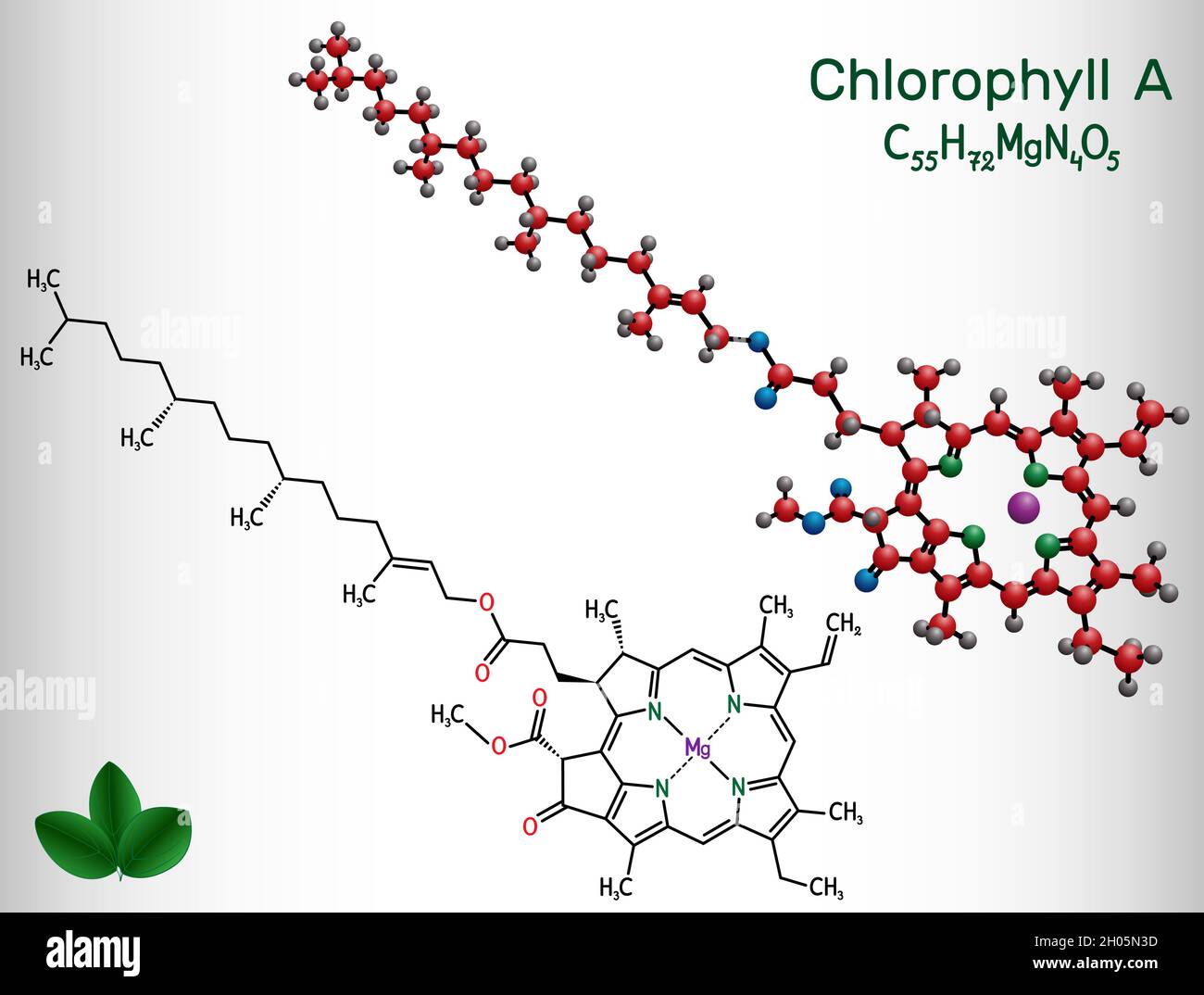
God is producing an ecosystem for the earth, but there is yet no physical life. Here God is silent on what lifeforms He created first. Scientists are trying to reproduce the conditions which make spontaneous creation of life possible, using all their intelligence and having the right combination of amino acids and other chemical conditions come together to form life. One thing is for sure; they did not imagine random processes in “the primordial soup” but tried to fabricate the best estimate of the environment using every ounce of scientific knowledge available. Whenever an amino acid is formed via lightning or whatever, half are created of the left type and half of the right type. (When one drinks fresh squeezed orange juice the vitamin C is all left oriented, but if the vitamin C is taken in a manufactured tablet it is half left, half right oriented. Only the left oriented vitamin is useful, the right oriented is just acid and is not generated by life and cannot be used by life.) So they are not able to reproduce life or even be able to explain how it could have happened since so many left oriented processes have to come together at the same time without being interfered by the unusable right oriented molecules hindering the process. And this is the generation of the simplest life form! Rather than trying to explain the inexplicable apart from creation, I will jump right in with Phytoplankton. These are very primitive plants, living mostly in oceans, wetlands, rivers and lakes but can also be found on land providing there is enough water, Most phytoplankton contains chlorophyll and absorbs carbon and generates oxygen.
God omits all the discussion of how life on earth started and jumps right into explaining that plant life started first, and what follows is a list of all kinds of flora. It is found in Genesis 1:11-13
Then God said, “Let the land produce vegetation: seed-bearing plants and trees on the land that bear fruit with seed in it, according to their various kinds.” And it was so. 12 The land produced vegetation: plants bearing seed according to their kinds and trees bearing fruit with seed in it according to their kinds. And God saw that it was good. 13 And there was evening, and there was morning—the third day.
In fact this is a step that evolutionists skip, because there is no plausible explanation how life could emerge out of dead matter. Some have suggested that life could have entered from outer space, and indeed the Webb telescope, when looking at the “empty” part of universe, have found that it is not totally empty but seems to have some rudimentary amino-acids and even metals, which are necessary but by no means sufficient building blocks for life.
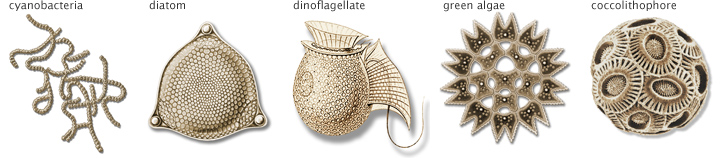
Let us take a look at one of the simplest phytoplanktons, the cyanobacteria.
The cyanobacteria is the simplest form of reproducing organism that contains chlorophyll and produces its own food; carbohydrates:
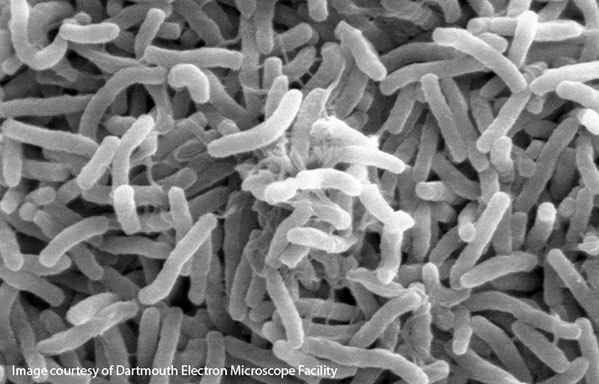
To produce its own food, it needs additional nutrition, among them Aluminum and Nitrogen compounds. They have to be included for photosynthesis to function via RNA interpreters, proteins and sunlight. The main food is CO2 and the process exhausts O2. The one celled organism looks like this:
This is the simplest of the phytoplanktons. It has all the necessary functions to be able to duplicate itself. To do it it must have a nucleus contained inside a cell wall, and how to create the cell wall is programmed in the nucleus. This is a very simple nucleus and the smallest of the cyanobacteria has a nucleus of about 1.4 million base pairs. 3 base pairs form one codon and tells which amino aid to use to add one link in the protein to build. The rest of the DNA was thought to be evolutionary redundant “junk DNA,” but recent analyses have shown that they are start codes and stop codes to show where, when and how to build it, with processes not yet understood. All this is interpreted by RNAs and other compounds, and together they enable how to build and duplicate themselves. The information stored in the DNA is about the same as is contained in a large fiction novel. All this was prepared in creation “day 3” and led to all plant life. Nowadays phytoplanktons generate about half of all carbohydrates and release half of all Oxygen in the world.
The first origin of life can only have come to pass thru a creative act of God, since it involves a catch 22 conflict many times over. But the first live substance may not have been based on sunlight and photosynthesis, but could have been microbes known as methanotrophs that convert methane gas into carbon dioxide and biomass. Scientists are unsure how these microbes get all the nutrients they need to accomplish this task. But this we know: God did not give us the story of creation to be scientifically complete. The only thing He says about mildew is that it is bad and how to get rid of it. The grass and the trees were created by God when the environmental conditions were right for them to appear, nearly all of them after the sun was lit.
Next installment: The sun, moon and the stars were formed on “day 4.”
We find this in Genesis 1:6-8 (NIV) And God said, “Let there be an expanse between the waters to separate water from water.” 7 So God made the expanse and separated the water under the expanse from the water above it. And it was so. 8 God called the expanse “sky.” And there was evening, and there was morning—the second day. But God did NOT say: “It was good” The creation story is interesting reading. God takes a whole day out His busy schedule of creation just to form an environment with water in all its forms in what we call the atmosphere or “sky”. He has yet to create life. Could it be, that water in all its forms are necessary to form and sustain life, so a sustainable ecosystem had to be prepared first?
God created the earth too be just heavy enough to hold on to water vapor, and water is unique because its melting point and boiling point is within the range of bring able to participate in sustaining life. It also has the second (after ammonia) highest specific heat capacity of all known substances. To melt 1 gram of ice takes 80 calories, to heat it takes 1 calorie per gram and to boil it at ground levels takes 539 calories. (The calories you eat are actually kilo-calories). This makes water the ideal substance to moderate and regulate climate. Water vapor evaporates from the ocean, cooling it down and water vapor, being lighter than air rises and condenses as clouds form. The clouds are the most important temperature regulator, much more important than all other greenhouse gases combined. Clouds transport heat from the equator to the temperate areas and to the poles. Without this the equator temperature would be in excess of 145 F. In addition clouds have a high reflection of incoming sunlight, reflecting incoming heat back into space. The earth has never been to warm to sustain complicated life, nor is there any danger of overheating unless clouds disappear. In fact, the next major climate change is the next ice age.
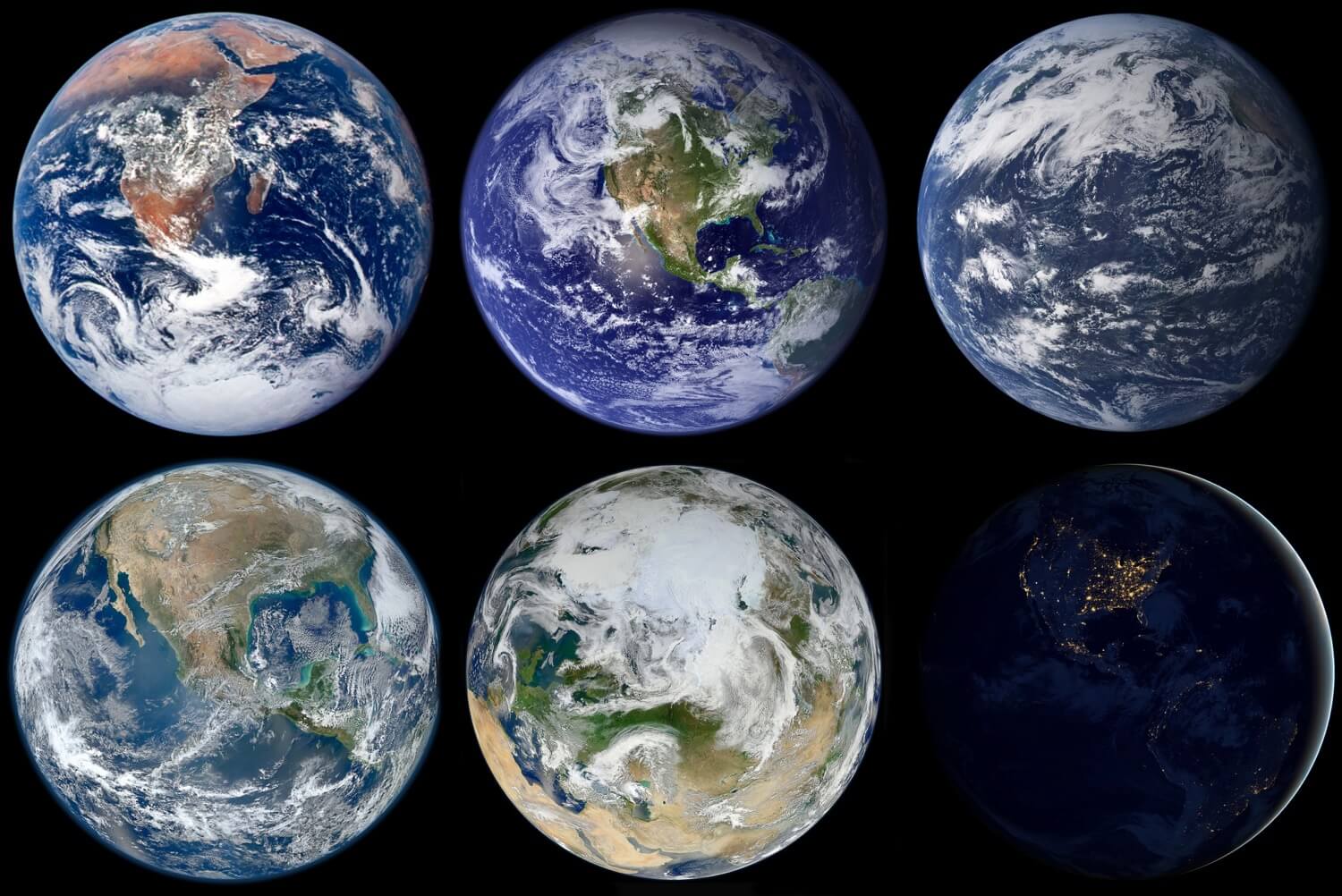
The picture above shows the friendly earth we are living in today. On the second “day” of creation situation was quite different. The sun was not fully created yet, and the earth was still in its chaotic state. All God did was to prepare the ecosystem. The earth was still cooling down from creation, and water evaporated and formed a cloud that covered the whole earth. This is why God did NOT say “it was good” on the second day, it was just the preparation.
Genesis 1:1 In the beginning God created the heavens and the earth.
What did God create? Continuing in Genesis 1:2; Now the earth was formless and empty, darkness was over the surface of the deep, and the Spirit of God was hovering over the waters. The earth was formless, meaning chaotic and unorganized; and empty meant without any form of life. But there was water; yes, that is right; water existed in abundance way before the sun was formed. Water is necessary for life to exist, and its unique property of freezing at 0 C and boiling at 100C makes it ideal for organic life. The fact that ice is lighter than water makes ir possible for marine life to survive the winters even in shallow lakes since the ice sits on top of the lake and isolates for further freezing.. Here is introduced God’s Spirit moving over the waters, doing what?
Then in Genesis 1:3; And God said, “Let there be light,” and there was light. Light is very interesting. It is just a massless piece of energy traveling at the speed of light. Since it travels at the speed of light it has no time. It is created and extinguished at the same time but in different places. From our perspective we see it as traveling at the speed of light, but that is because we are stuck in place in time and space. Dead matter cannot do anything, but with the energy in form of light it might be possible. Therefore
in Genesis 1:4; God saw that the light was good, and he separated the light from the darkness.
So in Genesis 1:5: God called the light “day,” and the darkness he called “night.” And there was evening, and there was morning—the first day. At this time God just defined the term day and night. But notice that darkness comes before light.
But do not forget this one thing, dear friends: With the Lord a day is like a thousand years, and a thousand years are like a day. (2 Peter 3:8)
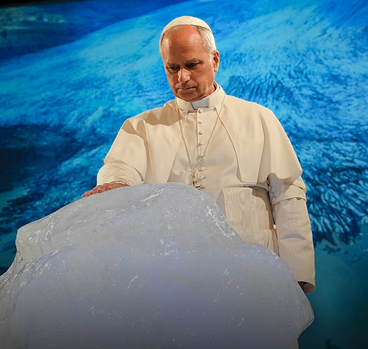
Pope Leo XIV, the newly elected pope, has recently championed the Vatican’s plan to become the world’s first carbon-neutral state by developing a large solar farm on land near Rome. This initiative is inspired by the environmental legacy of Pope Francis and aims to generate enough electricity to meet the Vatican’s needs and potentially provide excess energy to the local community. The Vatican’s efforts are part of a broader push for climate action, with Leo XIV actively promoting the transition away from fossil fuels and emphasizing the moral imperative of environmental stewardship. He also took part in the “Raising Hope for Climate Justice” International Conference in Castelgandolfo, Italy on Oct 1, where he blessed a chunk of a Greenland iceberg. See the picture:
Pope Leo asked eloquently: “What must be done now to ensure that caring for our common home and listening to the cry of the earth and the poor do not appear as mere passing trends or, worse still, are seen and felt as divisive issues?”
“Everyone in society, through nongovernmental organizations and advocacy groups, must put pressure on governments to develop and implement more rigorous regulations, procedures and controls,” the pope said.
“Citizens need to take an active role in political decision-making at national, regional and local levels,” he said. “Only then will it be possible to mitigate the damage done to the environment.”
What they still do not know is that rising CO2 levels is responsible for less than 10% of the climate change, and water in all its forms; ice, water, water vapor and clouds is responsible for over half of climate change. Land use changes are also more important. Let me explain it further:
Many years ago, around 1976 Dr. James Lovelock bought a number of Hewlett Packard 5840 Gas Chromatographs to be set up in some of the most remote places of the earth to study pollution and its effect on the climate. What he found was an unexpectedly large amount of dimethylsulphide (DMS) in the atmosphere, and that acted as a
condensation point for cloud formation. He was then a longtime paid consultant for Hewlett Packard, so he came over from his native England a couple of times a year, always willing to hold a seminar for us engineers working at Hewlett Packard Analytical, and at one of them he sprung “Daisy-world” on us before it was published; mostly to see if we could poke holes in his hypothesis. It involved a world that consisted of only two flowers, black daisies and white daisies. The computer simulation starts out with a cold world and a weak sun. The sun slowly warms up (about 1 percent every ten million years), and at some time suddenly black daisies appear and cover the earth. This warms the earth some more and white daisies appear. As the sun varies in intensity the mix of white and black daisies changes and this keeps the earth at a stable temperature, as they have different reflective properties. He then went on to say that the whole earth is like a living organism. Some time later he presented the paper and afterwards we asked him how it was received. “You won’t believe it”, he answered. ”Now there are people who actually believe the earth is a living organism. They demand follow-up articles that justifies their belief.” He had partly himself to blame, the name he had chosen was “the GAIA hypothesis,” Gaia being the Mother Earth Goddess. Talking about religion the Mother Earth people now had their goddess, and expressions like. “The earth has a temperature” became commonplace. For me, being a Christian I read with wonderment what God has to say about Creation and the Ecosystem.
Starting in Genesis 1:1; In the beginning God created the heavens and the earth. This can be described in scientific terms: From nothing God created space and matter. What happened to “In the beginning”? It turns out that matter has to be accompanied with space or it will not work. And time is a derived property from the existence of matter and space. Without space and matter time does not exist. So the creation of matter and space also defined the beginning of time. What about God? The laws of physics tells us you cannot create something out of nothing. This proves that we and everything else cannot possibly exist. But we do, and therefore there must have been something existing before anything existed. This is God, and He can be defied in one word: Presence. When Moses saw the burning bush he asked who it was. And God answered “I am that I am”, in a way describing the eternal presence, without beginning and end. This is the God I believe in: Out of time and space since He created it, and also in time and space since it is part of His creation.
The expression “in the beginning” is in Hebrew bereshit which means in the beginning. The same phrase begins the gospel of John 1:1 “Inthebeginning was theWord, and theWord was with God, and theWord was God.” Here the word translated beginning is “Arch” like in archangel and means “the chief” or “the most important one’ referring to the Word. It is in past tense which means that the Word existed before the beginning. Another reference is found in Titus 1:1 “inthe hope of eternal life, which God, who does not lie, promised before thebeginning of time,” In this verse the word eternal and the word time is in Greek aionion , which means a very long time, like the time span of a dynasty. Nowadays eon has a meaning of a thousand million years in Geology and Astronomy, but the original meaning is a very long time which may or may not be defined. It is sometimes translated of the ages. Here is a song that spiritually speaks to me:
Hebrews 5. Jesus, a priest forever in the order of Melchizedek. As being forever, Jesus is God, as being born of Mary, he is man, as being adopted of Joseph, he is King, and as of the order of Melchizedek, he is Priest. Priests offer sacrifices, first for themselves because of sin, but Jesus, being without sin offered himself for our sins, died and rose again for our justification. Thanks to this, we have the hope of eternal life!
Ezekiel 25 gives prophecies against Ammon, Moab, Edom and Philistia.
Ezekiel 26 is a devastating prophecy against Tyre.
Psalm 103, of David. There are many songs of praise in the Bible. This is probably the purest of them all. It combines God’s mercifulness and our shortcomings, His healing power and our frailty and above all our very limited life here on earth and the eternity of God.
2 Thessalonians 2 tells of the great apostasy, when the man of lawlessness is revealed and usher in the tribulation. People will believe “The Lie” and be destroyed. Stand fast, Jesus will destroy him at his return.
Jeremiah 30. Jeremiah sent a letter to the exiles, a letter of hope, and a promise of return “And ye shall seek me, and find me, when ye shall search for me with all your heart.And I will be found of you, saith the Lord: and I will turn away your captivity, and I will gather you from all the nations, and from all the places whither I have driven you, saith the Lord“. Then follows a message to Shemaiah, a not so promising message.
Jeremiah 31 is a most remarkable chapter. Jeremiah, in a dream heard God say “Yea, I have loved thee with an everlasting love” and God continued by promising that the remnant of Israel will be saved. Then, in verse 15 God provided an abrupt change “A voice was heard in Ramah, lamentation, and bitter weeping; Rachel weeping for her children refused to be comforted for her children, because they were not.” Returning to the dream God gave an even more remarkable statement “O thou backsliding daughter? for the Lord hath created a new thing in the earth, A woman shall compass a man.” After this Jeremiah woke up from his pleasant dream. God continued speaking, promising mercy on Ephraim, future prosperity to Israel, and promised the New Covenant: “But this shall be the covenant that I will make with the house of Israel; After those days, saith the Lord, I will put my law in their inward parts, and write it in their hearts; and will be their God, and they shall be my people. And they shall teach no more every man his neighbour, and every man his brother, saying, Know the Lord: for they shall all know me, from the least of them unto the greatest of them, saith the Lord: for I will forgive their iniquity, and I will remember their sin no more.”
In Matthew 12:1-21 Jesus proclaimed he is the Lord of the Sabbath and healed a man with a withered hand. Since this was on a Sabbath it was considered blasphemy. Jesus continued to heal all to fulfill the prophecy of the Prophet Isaiah.
After completing the book of Leviticus we take a one day break before we continue with Numbers, and read
Ecclesiastes 5. Fear God, keep your vows. There is vanity in amassing riches, even vanity in seeking honor.
Ecclesiastes 6. Vanity is the theme, this time the vanity of desire.
Psalm 14 is short and to the point. It begins: “The fool has said in his heart, there isNO GOD.”
Psalm 15 is only 5 verses long but full of truth which carries on into the New Testament. Fittingly there are five 5 references from the New Testament given.
Psalm 16, of David. A wonderful psalm of confidence in the LORD even in times of trouble. This is a prophetic psalm pointing to Jesus resurrection, it is quoted in the New Testament.
Matthew 7:1-20 is a continuation of the sermon on the mount. Jesus was admonishing us not to be judgmental but to look to our own faults before condemning others. And don’t waste your time by casting pearls before swine. Ask, seek, knock is another theme. and so is doing to others what you would have them do to you. This sums up the Law and the Prophets. Enter through the narrow gate. A tree is known by its fruit. This should still be taught in school, it is the opposite of Critical Race Theory, which divides us all.
The book of Leviticus tells about Mosaic Law. I for one am glad I am not under the Law anymore, but redeemed with the blood of Jesus. However, it is interesting reading, and it is still valid proof that we cannot fulfill all the law.
Leviticus 1 tells of how the burnt offering shall be performed.

 Len Bilén's blog, a blog about faith, politics and the environment.