Of the total temperature rise from 1775 to 2050, how much is due to greenhouse gas increases, and how much is due to CO2 increase? (Updated 4-30; Methane and NO2)

The 6th IPCC assessment report still suffers from the same fatal flaw that was in the first assessment report regarding greenhouse gases. It assumes greenhouse gases are additive, when in fact it is impossible to absorb more than all energy emitted for any given energy band! With that obvious fact in mind I will present the real greenhouse effect and its rise from 1775 to 2050. Nitrogen concentration staying constant, Oxygen concentration staying constant, Water vapor increasing 10% assuming relative humidity staying constant and average temperature increasing 1.5 C, CO2 rising from 280 ppm to 460 ppm, Methane from 0.725 ppm to 1.9 ppm, N2O from 0.27 ppm to 0.32 ppm, Ozone holding steady, since I do not have any worldwide concentration trends for it, and finally the man-made greenhouse gasses CFCs and HFCs.

The real temperature increase from 1776 to 2050 from greenhouse gases increase.

The greenhouse effect of Nitrogen.

Nitrogen is the most abundant gas in the atmosphere, consisting of 75 to 77% of all the air dependent on humidity. It has a small absorption band at 4.29 micrometer and another way out in the far infrared region where earth emission is negligible In the 4.29 range water vapor absorption is about 90% of available energy, and we only include the 2.2% increase coming from the 1.5 C temperature increase, so the net greenhouse effect is 0.11 * 0,1 * 0,022 w/m2, or about 0.0002 W/m2, not enough to care about.

The greenhouse effect of Oxygen.

Oxygen is the second most abundant gas with a concentration of about 21% in the atmosphere, but unlike Nitrogen it has a strong absorption band right in the middle of the atmospheric window. see picture:
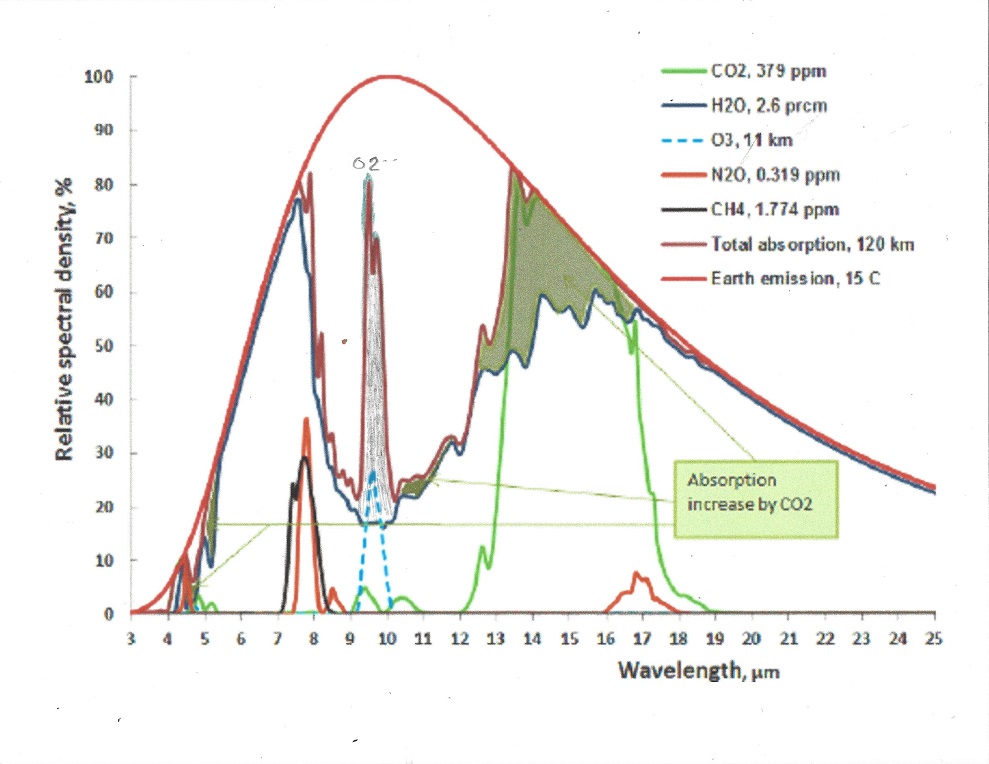
The greenhouse effect of the Oxygen band at 9.4 micrometer is 1.2 C and the increase in greenhouse effect when temperature rises 1.5 C is 0.026 C in the tropics and 0.003 C at the poles due to their lower water content.

The greenhouse effect of Argon.

Argon is nearly 1% of the atmosphere, bur since it is a noble gas and absorbs in lines rather than bands, and there are no strong absorption lines in the infrared region it is not a factor.

The greenhouse effect of water vapor.

During the little ice age the earth was significantly colder than today, but there was special factors that led to this: The Maunder solar minimum and two super novas, one discovered in 1572 by Tycho Brave and the other in 1604 by Kepler.

I will begin the time of industrialization with the invention of the steam engine 1775 by James Watt. While not the original inventor he improved it so much that it became in common use for power generation. Up to that time people had depended on water and wind power and in a few cases tidal power. This increased the use of coal, which up to that point had been used exclusively for heating.

Since 1775 the global temperature of the earth has increased by about 1.2 C and is expected to increase another 0.3C by 2050.

When global temperature increases 1.5 degrees and relative humidity stays the same there will be 10% more water vapor in the air. How much of the temperature rise is attributable to a 10% increase in water vapor?

To answer that we must take a look at the greenhouse effect. Without it the earth would be an ice ball with an average temperature about 33C cooler than today. The earth can be considered a black body that obeys laws for black body radiation, the Stefan–Boltzmann law that states that the total energy radiation is proportional to the fourth power of the absolute temperature (Kelvin), so an increase in global temp from 13C t0 14.5C results in an increase of 2.11% in the total greenhouse effect.
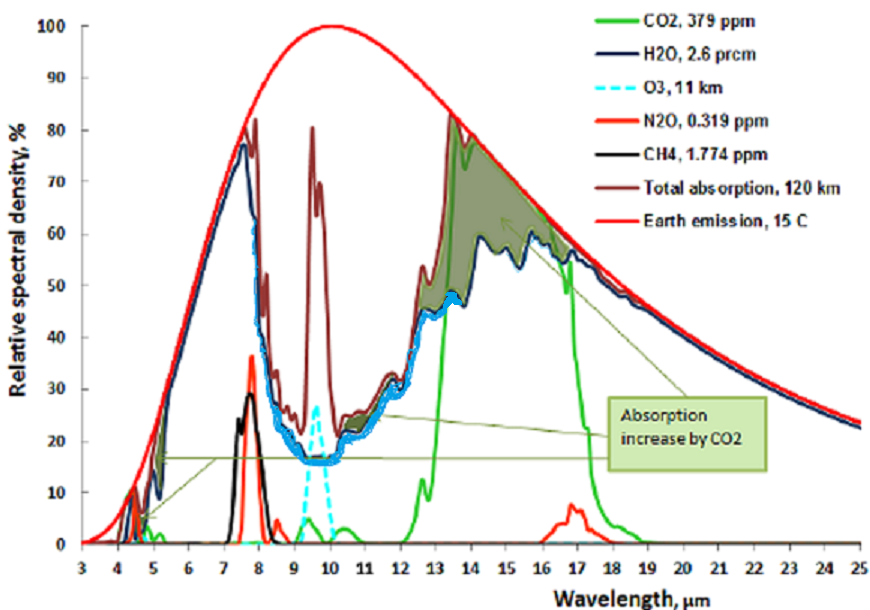
To sum it up: Since water vapor is fundamental I will count it first, and the effect of all the other greenhouse gases will be included later, remembering that the total absorption in any frequency band can never exceed 100% of available energy. The increase of absorption occurs in the atmospheric window, Together, they make up 90% of the greenhouse gas temperature rise, or 29.7 degree C. When global temperatures increase by 1,5 C there will be 10% more water water vapor assuming relative humidity will stay constant, there will be an additional 0.65 C temperature rise.

The greenhouse effect of CO2.

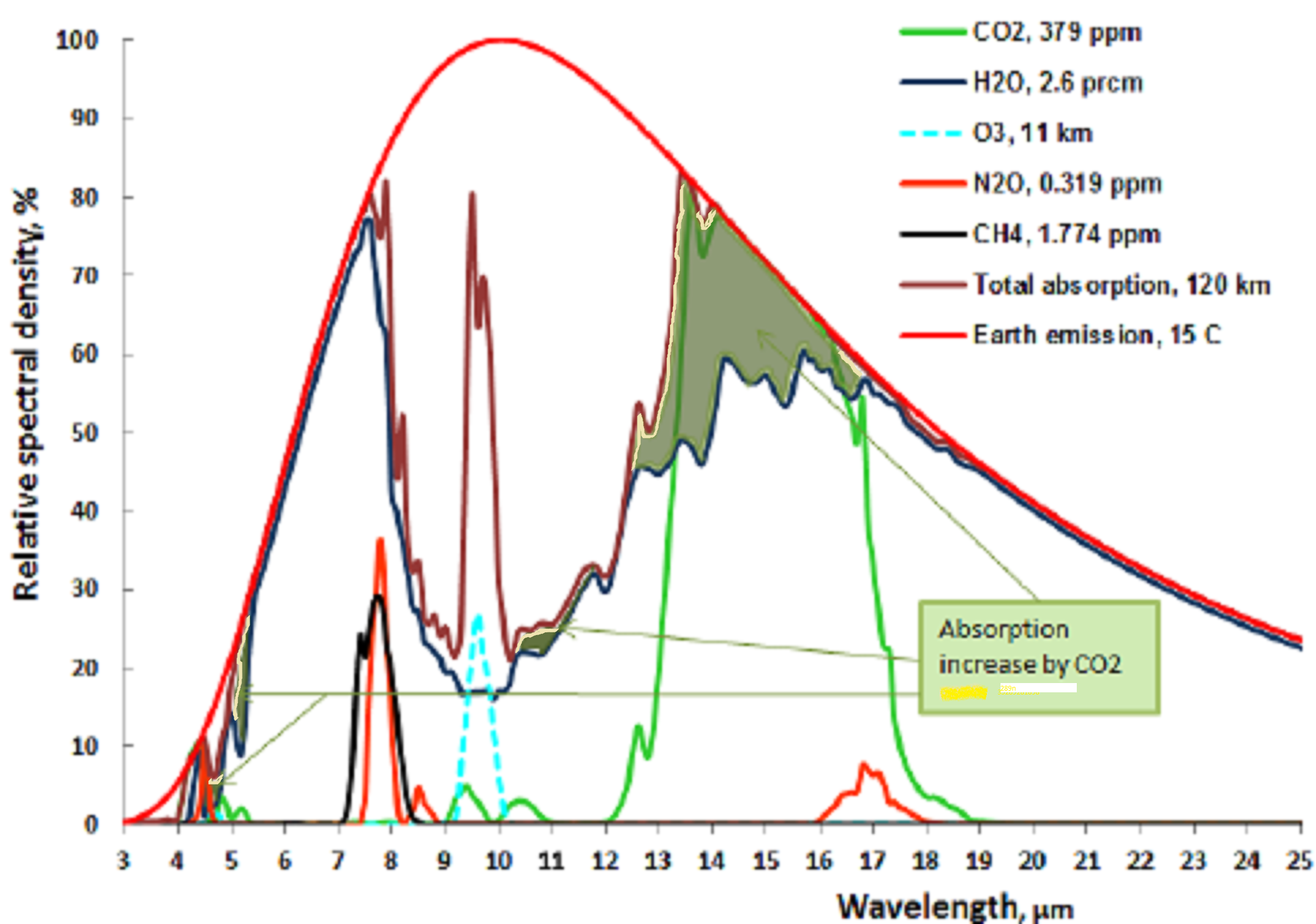
The following chart shows both CO2 and H2O are absorbing greenhouse gases, with H20 being the stronger greenhouse gas, absorbing over a much wider spectrum, and they overlap for the most part. But it also matters in what frequency ranges they absorb.
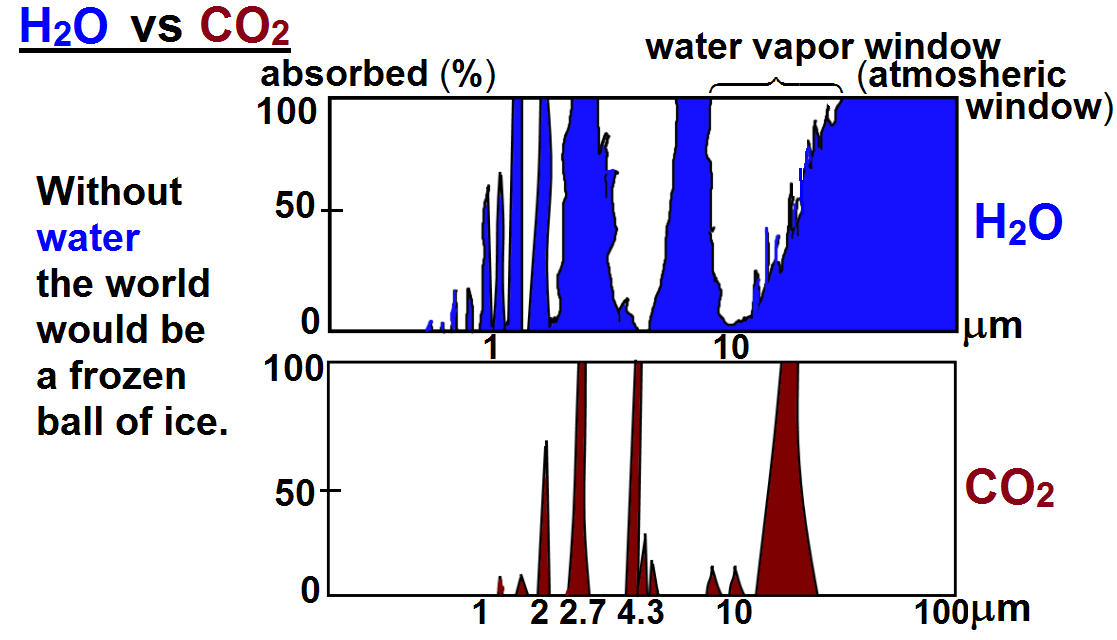
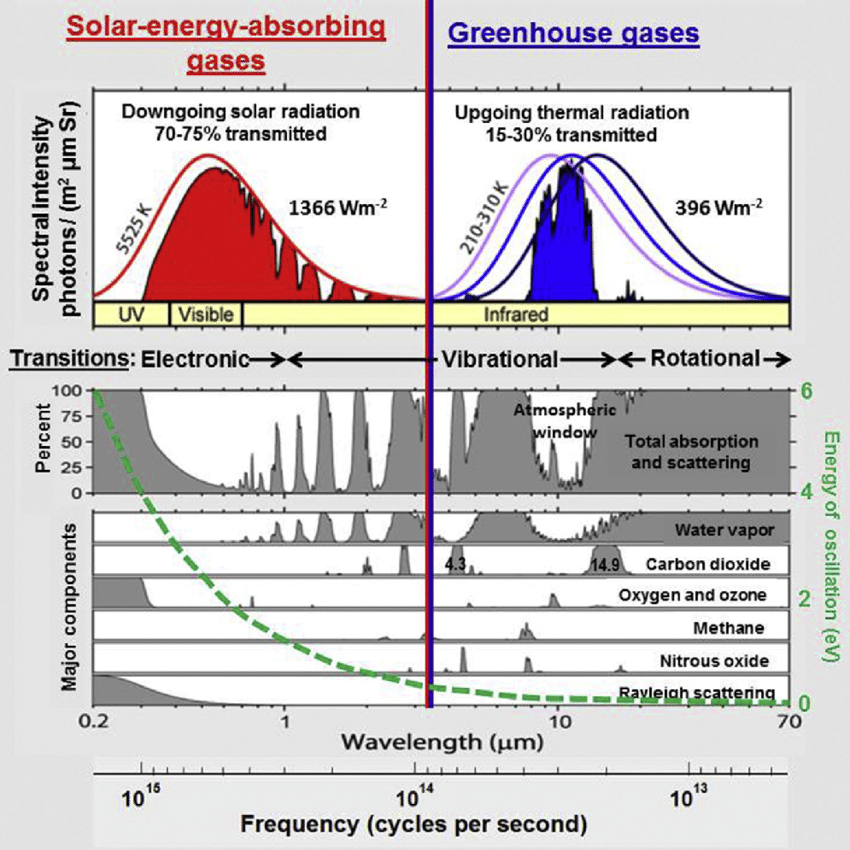
For this we will have to look at the frequency ranges of the incoming solar radiation and the outgoing black body radiation of the earth. It is the latter that causes the greenhouse effect. Take a look at this chart:
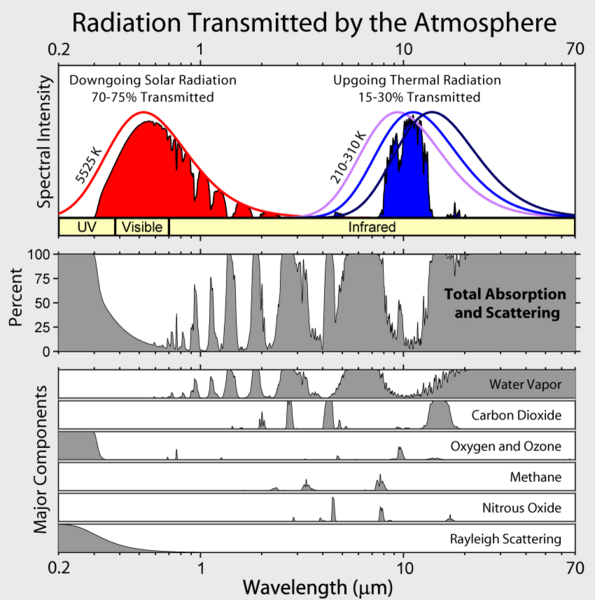
The red area represents the observed amount of solar radiation that reaches the earth’s surface. the white area under the red line represents radiation absorbed in the atmosphere. Likewise, the blue area represents the outgoing black body radiation that is not absorbed. The remaining white area under the magenta, blue or black line represents the retained absorbed energy that causes the greenhouse effect.

Let us now take a look at the Carbon Dioxide bands of absorption, at 2.7, 4.3 and 15 μm. Of them the 2.7 and 4.3 μm bands absorb where there is little black body radiation, the only band that counts is at 14.9 μm, and that is in a band where the black body radiation is near its maximum. Let us first consider the CO2 alone in a dry atmosphere, that is one with no water vapor at all. We will investigate the concentration of 280 ppm (in 1775) and 460 ppm (in 2050)
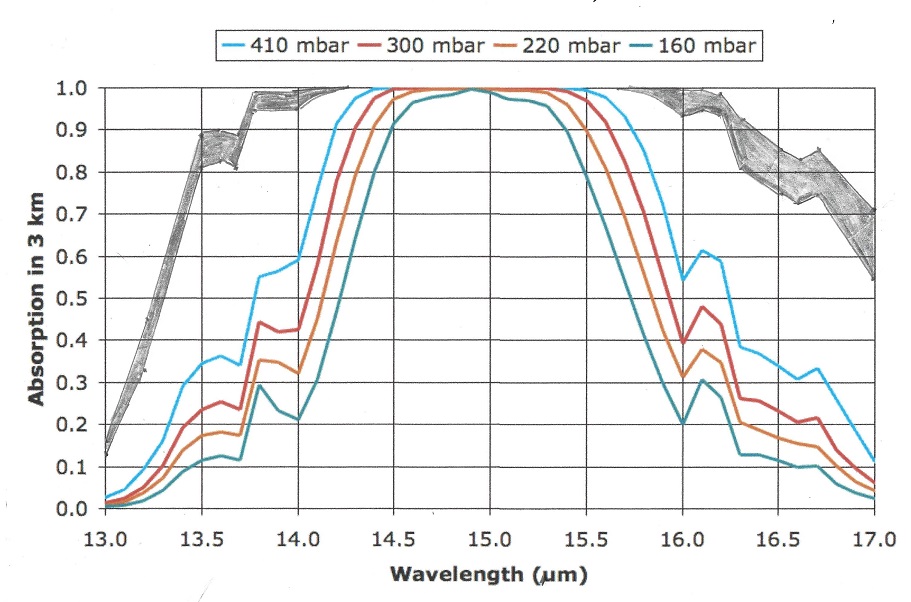
The very top line of the top black band represents total absorption at 460 ppm, the bottom of the black black band represents absorption at 280 ppm. Divide the frequency spectrum in 3 parts, below 14 μm, 14-16 μm, and above 16 μm, In the 13 to 14 μm band 65% of available energy is absorbed at 280 ppm, 71% at 460 ppm. in the 14 to 16 μm band 100% of available energy is absorbed at both 280 and 460 ppm. In the > 16 μm the numbers are also 65 and 71%. In addition, temperature is 1.5 C higher at 460 than at 280 ppm, so available energy is 2.2 % higher at 460 ppm.

The net result is greenhouse gas contribution for CO2 is 5.0 C at 280 ppm and 5.34 C at 460 ppm and 1.5C higher ambient temperature for a dry atmosphere.

The normal way to account for greenhouse gasses contribution is to simply add together the CO2 contribution and the contribution from water vapor. This leads to the wrong result for in doing so, the total result is more than 100% for some energy band, because it is impossible to add more than 100% of all available energy for a given wavelength. Again, the spectrum of interest is 13 to 17.4 μm.
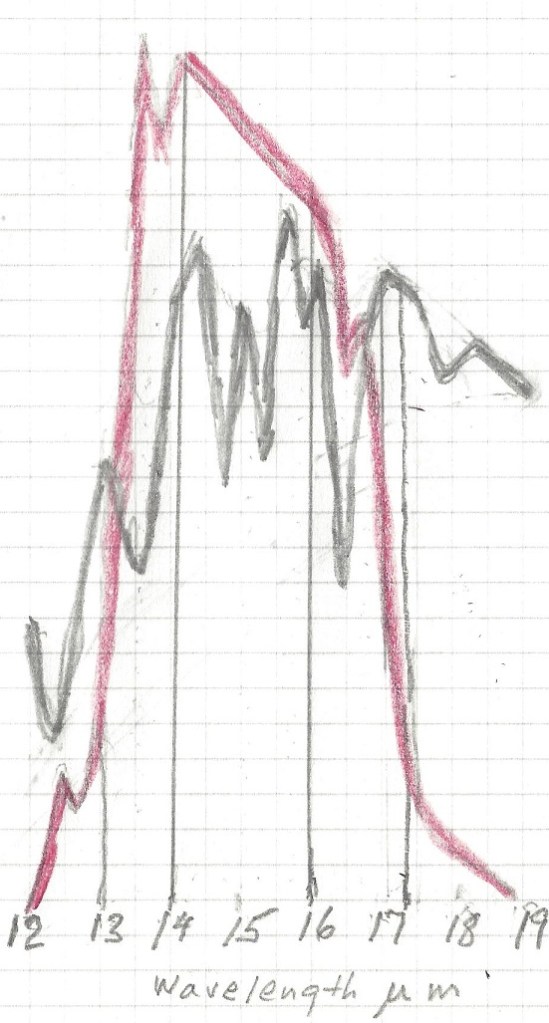
The first thing to notice is that no absorption exceeds 100% , so at 14.9 μm wavelength CO2 absorbed 100%, and water vapor absorbed another 75%, the total sum is still 100%. It is impossible to absorb more than 100% of the total energy available for that wavelength. Therefore between the wavelengths 14 and 16 μm all energy was absorbed regardless of CO2 concentration and water vapor concentration. The only fair way to allocate the absorption is proportionally, 57% to CO2 and 43% to water vapor. Likewise, the 13 to 14 μm band is not fully saturated, so the total absorption is 62% of available energy for CO2 and 33% for water vapor. In the 16 to 17.4 μm range the total absorption is 44% for CO2 and 55 % for water vapor. For CO2 at 280 ppm and average temp 13C the total temperature rise, when proportionally allocated comes to 2.73 C for the CO2 and 2.30 C for the water vapor. For CO2 ar 460 ppm and an average temp 1.5 C higher, at 14.5 C average the net temperature increase in the 13 to 17.4 μm band is 0.11C for the water vapor and also 0.11C for the CO2.

The greenhouse effect of Methane.

Atmospheric methane levels averaged 1,895.7 ppb (parts per billion) during 2021, or around 162% greater than at pre-industrial levels. It is a 28 times stronger greenhouse gas by itself unlike CO2, because its absorption is not saturated in the atmosphere. On the other hand the lifetime of Methane in the atmosphere is 10 to 15 years, some of the Methane eating bacteria will do its job. There is only one significant absorption band that absorbs in the black body emission spectrum, at 7.7 μm.
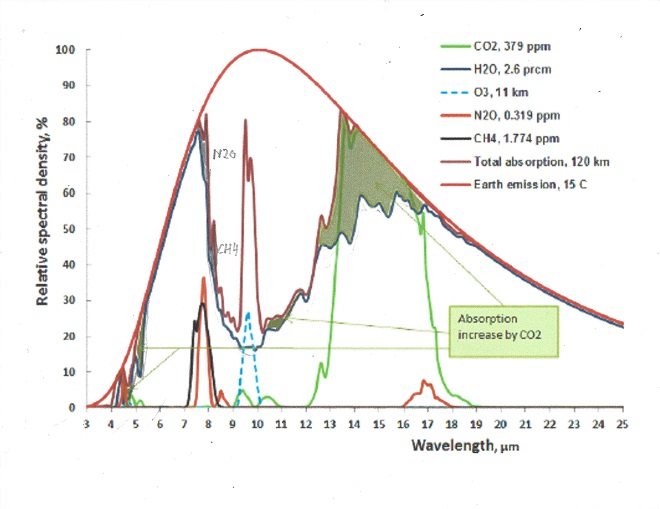
The picture shows a small peak at 7.7μm. This is because at lower wavelengths absorption from water vapor has nearly eliminated the CH4 contribution. Remember that total absorption can never exceed 100 %, so the maximum absorption from CH4 occurs at 7.7μm. At 1.8 ppm it amounts to a greenhouse effect of 0.80 C for a dry gas.

The only major absorption line at 7.7 μm has two side lobes, at 7.5 and 7.9 μm. In the 7.5 μm sideband water vapor already absorbs nearly all energy, so the NH4 is of little effect. In the 7.9 μm sideband water vapor is 60% saturated at that level and the NH4 net absorption is 20% the net greenhouse effect is one sixth of the effect for a dry gas, or 0.13 C. Before industrialization the CH4 concentration was 0.725 ppm and will be 2.13 ppm in 2050 which results in an increase of the greenhouse effect of 0.1C from rising levels of Methane since 1775.

The greenhouse effect of N2O.

Atmospheric N2O levels averaged 310 ppb (parts per billion) during 2021, about 19 % greater than at pre-industrial levels. It is a 300 times stronger greenhouse gas than CO2 by itself, because its absorption is not saturated in the atmosphere. When water vapor is dominant it is diminished by over 70% since it is at the edges of the Atmospheric window. On the other hand the lifetime of N20 in the atmosphere is short and is typically greatest at 5 p.m. One of the major reasons for the N2O increase is the increase of fertilization with nitrates, the other is from diesel fumes from trains, boats, ships, trucks and mining equipment

The picture shows a double N2O peak at 7.4 and 7.8 μm. . At 0.32 ppm in 2050 it amounts to a greenhouse effect of 0.31 C for a dry gas. In the 7.4 μm band water vapor is saturated, in the 7.8 μm band 80% is saturated by water vapor.Before industrialization the N2O concentration was 0.27 ppm which results in an increase of the greenhouse effect of 0.005 C from rising levels of N2O since before industrialization .

N2O is commonly called laughing gas, and is hazardous in high concentrations, and should be limited in confined places, but in concentrations of under 1 ppm nobody laughs because of that.

The greenhouse effect of Ozone.

Ozone or 03 is good if it is in the stratosphere. There it helps to absorb the ultraviolet and cosmic rays from the sun and other cosmic radiation. Ozone is bad if it is near the ground. The total proportion of O3 in the troposphere is about 0.01 ppm, yet it is a substantial greenhouse gas because it forms by uv radiation in the stratosphere and mesosphere, and thus protecting us from uv damage. See figure:
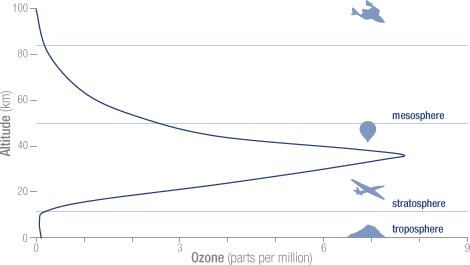
The O3 in the troposphere on the other hand is bad. It is normally around 0.01 ppm, but is considered damaging if people are exposed to more than 0.08 ppm in an 8 hour period. This can happen in urban environments in warm and stagnant weather, typically through car traffic. It is a great greenhouse gas because its main absorption band is at 9.5 μm, right in the atmospheric window where the outgoing black body radiation is the greatest. See fig:

The dotted blue line at 9.5 microns represents the tropospheric absorption, the total absorption is between the brown and the solid blue line. The total greenhouse effect from O3 is 0.88C, but the stratosphere does not interact very much with the troposphere, so the stratospheric O3 does not count as a greenhouse gas, only tropospheric O3. The total contribution to the greenhouse effect from tropospheric O3 is about 1/6 of the total, or 0.15C. When the earth’s temperature rises by 1.5C, from pre-industrial times to 2050, the amount of tropospheric O3 probably rises by 3% (Lacking good data I am guessing wildly, in urban areas it may be much more, but this is global average). This comes to 0.005C temperature increase from O3, from pre-industrial times until 2050.

The greenhouse effect of CFC gasses.

ChloroFluoroCarbon (CFC) gasses started to be manufactured at the beginning of the refrigeration age, replacing ice as the refrigerant. It soon appeared in the atmosphere, mostly due to leaks in the air conditioner compressor seals. It didn’t amount to much as a greenhouse gas even though it was five thousand times more efficient than CO2 as a greenhouse gas. It was discovered that CFCs ate up the Ozone in the stratosphere, and if it continued to increase it could deplete the protective Ozone layer faster than it could be produced. In fact it created an Ozone hole over Antarctica. So it got forbidden. Since then CFC are decreasing by about 1% per year, but there is still cheating, especially among poorer nations and China. By 2050 it will probably have a greenhouse effect of 0.01C

The greenhouse effect of HFC gasses.

CFC started to be phased out and replaced by HydroFluoroCarbons (HFC), less efficient and more expensive, but at least they do not deplete the Ozone layer that protects us from cancer. Some of the HFCs are even bigger greenhouse effect generators than CFC, but well worth it to protect the Ozone layer. If e dont do anything they will increase drastically from now until 2050. See fig: NOAA Research News
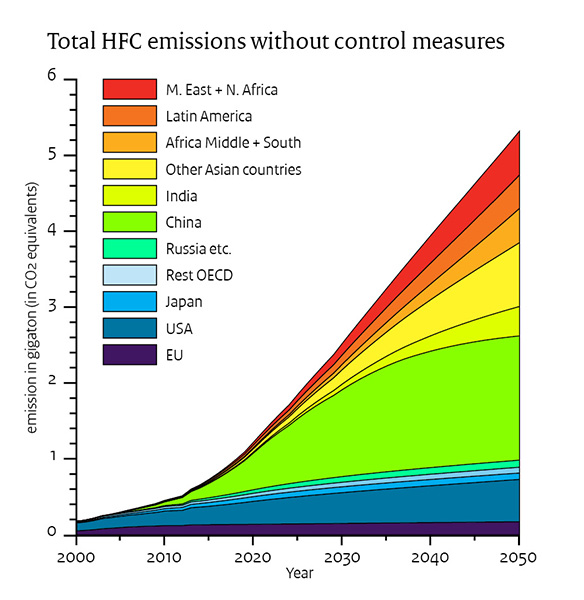
If we assume worst case scenario; no control measures, the temperature increase will be 0.06 C by 2050.

Summary of greenhouse gases, their size in 1775 and increase until 2050.

Gas,………………temperature……Increase 1775 – 2950. ………………………..contribution C

N2…………………0………………………………….0

O2………………….0.026………………………….0.003

Argon……………0…………………………………0

Water vapor..29.4………………………………0.65

CO2………………2.73……………………………..0.11

CH4……………..0.16………………………………0.10

N2O……………..0.03……………………………….0.005

O3……………….0.15……………………………….0.005

CFC………………..0……………………………………….0.01

HFC……………….0……………………………………….0.06

Total ……..….32.496……………………………..0.916

The CO2 contribution to the greenhouse effect increase is less than 12% of the greenhouse effect. Even if the multiplier effect from water vapor is included it is less than 24%.

The IPCC Sixth assessment report, sources of greenhouse effect, their forcing and expected temperature rise from pre-industrial times to 2050.

The 6th IPCC assessment report still suffers from the same fatal flaw that was in the first assessment report regarding greenhouse gases. It assumes greenhouse gases are additive, when in fact it is impossible to absorb more than all energy emitted for any given energy band! With that obvious fact in mind I will present the real greenhouse effect and its rise from 1775 to 2050. Nitrogen concentration staying constant, Oxygen concentration staying constant, Water vapor increasing 10% assuming relative humidity staying constant and average temperature increasing 1.5 C, CO2 rising from 280 ppm to 460 ppm, Methane from 0.725 ppm to 1.9 ppm, N2O from 0.27 ppm to 0.32 ppm, and finally Ozone holding steady, since I do not have any worldwide concentration trends for it.

The real temperature increase from 1776 to 2050 from greenhouse gases increase.

The greenhouse effect of Nitrogen.

Nitrogen is the most abundant gas in the atmosphere, consisting of 75 to 77% of all the air dependent on humidity. It has a small absorption band at 4.29 micrometer and another way out in the far infrared region where earth emission is negligible In the 4.29 range water vapor absorption is about 90% of available energy, and we only include the 2.2% increase coming from the 1.5 C temperature increase, so the net greenhouse effect is 0.11 * 0,1 * 0,022 w/m2, or about 0.0002 W/m2, not enough to care about.

The greenhouse effect of Oxygen.

Oxygen is the second most abundant gas with a concentration of about 21% in the atmosphere, but unlike Nitrogen it has a strong absorption band right in the middle of the atmospheric window. see picture:

The greenhouse effect of the Oxygen band at 9.4 micrometer is 1.2 C and the increase in greenhouse effect when temperature rises 1.5 C is 0.026 C in the tropics and 0.003 C at the poles due to their lower water content.

The greenhouse effect of Argon.

Argon is nearly 1% of the atmosphere, bur since it is a noble gas and absorbs in lines rather than bands, and there are no strong absorption lines in the infrared region it is not a factor.

The greenhouse effect of water vapor.

During the little ice age the earth was significantly colder than today, but there was special factors that led to this: The Maunder solar minimum and two super novas, one discovered in 1572 by Tycho Brave and the other in 1604 by Kepler.

I will begin the time of industrialization with the invention of the steam engine 1775 by James Watt. While not the original inventor he improved it so much that it became in common use for power generation. Up to that time people had depended on water and wind power and in a few cases tidal power. This increased the use of coal, which up to that point had been used exclusively for heating.

Since 1775 the global temperature of the earth has increased by about 1.2 C and is expected to increase another 0.3C by 2050.

When global temperature increases 1.5 degrees and relative humidity stays the same there will be 10% more water vapor in the air. How much of the temperature rise is attributable to a 10% increase in water vapor?

To answer that we must take a look at the greenhouse effect. Without it the earth would be an ice ball with an average temperature about 33C cooler than today. The earth can be considered a black body that obeys laws for black body radiation, the Stefan–Boltzmann law that states that the total energy radiation is proportional to the fourth power of the absolute temperature (Kelvin), so an increase in global temp from 13C t0 14.5C results in an increase of 2.11% in the total greenhouse effect.

To sum it up: Since water vapor is fundamental I will count it first, and the effect of all the other greenhouse gases will be included later, remembering that the total absorption in any frequency band can never exceed 100% of available energy. The increase of absorption occurs in the atmospheric window, Together, they make up 90% of the greenhouse gas temperature rise, or 29.7 degree C. When global temperatures increase by 1,5 C there will be 10% more water water vapor assuming relative humidity will stay constant, there will be an additional 0.65 C temperature rise.

The greenhouse effect of CO2.

The following chart shows both CO2 and H2O are absorbing greenhouse gases, with H20 being the stronger greenhouse gas, absorbing over a much wider spectrum, and they overlap for the most part. But it also matters in what frequency ranges they absorb.

For this we will have to look at the frequency ranges of the incoming solar radiation and the outgoing black body radiation of the earth. It is the latter that causes the greenhouse effect. Take a look at this chart:

The red area represents the observed amount of solar radiation that reaches the earth’s surface. the white area under the red line represents radiation absorbed in the atmosphere. Likewise, the blue area represents the outgoing black body radiation that is not absorbed. The remaining white area under the magenta, blue or black line represents the retained absorbed energy that causes the greenhouse effect.

Let us now take a look at the Carbon Dioxide bands of absorption, at 2.7, 4.3 and 15 μm. Of them the 2.7 and 4.3 μm bands absorb where there is little black body radiation, the only band that counts is at 14.9 μm, and that is in a band where the black body radiation is near its maximum. Let us first consider the CO2 alone in a dry atmosphere, that is one with no water vapor at all. We will investigate the concentration of 280 ppm (in 1775) and 460 ppm (in 2050)

The very top line of the top black band represents total absorption at 460 ppm, the bottom of the black black band represents absorption at 280 ppm. Divide the frequency spectrum in 3 parts, below 14 μm, 14-16 μm, and above 16 μm, In the 13 to 14 μm band 65% of available energy is absorbed at 280 ppm, 71% at 460 ppm. in the 14 to 16 μm band 100% of available energy is absorbed at both 280 and 460 ppm. In the > 16 μm the numbers are also 65 and 71%. In addition, temperature is 1.5 C higher at 460 than at 280 ppm, so available energy is 2.2 % higher at 460 ppm.

The net result is greenhouse gas contribution for CO2 is 5.0 C at 280 ppm and 5.34 C at 460 ppm and 1.5C higher ambient temperature for a dry atmosphere.

The normal way to account for greenhouse gasses contribution is to simply add together the CO2 contribution and the contribution from water vapor. This leads to the wrong result for in doing so, the total result is more than 100% for some energy band, because it is impossible to add more than 100% of all available energy for a given wavelength. Again, the spectrum of interest is 13 to 17.4 μm.

The first thing to notice is that no absorption exceeds 100% , so at 14.9 μm wavelength CO2 absorbed 100%, and water vapor absorbed another 75%, the total sum is still 100%. It is impossible to absorb more than 100% of the total energy available for that wavelength. Therefore between the wavelengths 14 and 16 μm all energy was absorbed regardless of CO2 concentration and water vapor concentration. The only fair way to allocate the absorption is proportionally, 57% to CO2 and 43% to water vapor. Likewise, the 13 to 14 μm band is not fully saturated, so the total absorption is 62% of available energy for CO2 and 33% for water vapor. In the 16 to 17.4 μm range the total absorption is 44% for CO2 and 55 % for water vapor. For CO2 at 280 ppm and average temp 13C the total temperature rise, when proportionally allocated comes to 2.73 C for the CO2 and 2.30 C for the water vapor. For CO2 ar 460 ppm and an average temp 1.5 C higher, at 14.5 C average the net temperature increase in the 13 to 17.4 μm band is 0.11C for the water vapor and also 0.11C for the CO2.

The greenhouse effect of Methane.

Atmospheric methane levels averaged 1,895.7 ppb (parts per billion) during 2021, or around 162% greater than at pre-industrial levels. It is a 28 times stronger greenhouse gas by itself unlike CO2, because its absorption is not saturated in the atmosphere. On the other hand the lifetime of Methane in the atmosphere is 10 to 15 years, some of the Methane eating bacteria will do its job. There is only one significant absorption band that absorbs in the black body emission spectrum, at 7.7 μm.

The picture shows a small peak at 7.7μm. This is because at lower wavelengths absorption from water vapor has nearly eliminated the CH4 contribution. Remember that total absorption can never exceed 100 %, so the maximum absorption from CH4 occurs at 7.7μm. At 1.8 ppm it amounts to a greenhouse effect of 0.97 C for a dry gas. Because water vapor is 40% saturated at that level the net greenhouse effect is 058 C. Before industrialization the CH4 concentration was 0.725 ppm which results in an increase of the greenhouse effect of 0.35 C from rising levels of Methane since 1775.

The greenhouse effect of N2O.

Atmospheric N2O levels averaged 310 ppb (parts per billion) during 2021, about 19 % greater than at pre-industrial levels. It is a 300 times stronger greenhouse gas than CO2 by itself, because its absorption is not saturated in the atmosphere. When water vapor is dominant it is diminished by over 70% since it is at the edges of the Atmospheric window. On the other hand the lifetime of N20 in the atmosphere is short and is typically greatest at 5 p.m. One of the major reasons for the N2O increase is the increase of fertilization with nitrates, the other is from diesel fumes from trains, boats, ships, trucks and mining equipment

The picture shows a double N2O peak at 7.4 and 7.8 μm. . At 0.32 ppm in 2050 it amounts to a greenhouse effect of 0.31 C. Before industrialization the N2O concentration was 0.27 ppm which results in an increase of the greenhouse effect of 0.05 C from rising levels of N2O since before industrialization .

N2O is commonly called laughing gas, and is hazardous in high concentrations, and should be limited in confined places, but in concentrations of under 1 ppm nobody laughs because of that.

The greenhouse effect of Ozone.

Ozone or 03 is good if it is in the stratosphere. There it helps to absorb the ultraviolet and cosmic rays from the sun and other cosmic radiation. Ozone is bad if it is near the ground. The total proportion of O3 in the troposphere is about 0.01 ppm, yet it is a substantial greenhouse gas because it forms by uv radiation in the stratosphere and mesosphere, and thus protecting us from uv damage. See figure:

The O3 in the troposphere on the other hand is bad. It is normally around 0.01 ppm, but is considered damaging if people are exposed to more than 0.08 ppm in an 8 hour period. This can happen in urban environments in warm and stagnant weather, typically through car traffic. It is a great greenhouse gas because its main absorption band is at 9.5 μm, right in the atmospheric window where the outgoing black body radiation is the greatest. See fig:

The dotted blue line at 9.5 microns represents the tropospheric absorption, the total absorption is between the brown and the solid blue line. The total greenhouse effect from O3 is 0.88C, but the stratosphere does not interact very much with the troposphere, so the stratospheric O3 does not count as a greenhouse gas, only tropospheric O3. The total contribution to the greenhouse effect from tropospheric O3 is about 1/6 of the total, or 0.15C. When the earth’s temperature rises by 1.5C, from pre-industrial times to 2050, the amount of tropospheric O3 probably rises by 3% (Lacking good data I am guessing wildly, in urban areas it may be much more, but this is global average). This comes to 0.005C temperature increase from O3, from pre-industrial times until 2050.

Summary of greenhouse gases, their size in 1775 and increase until 2050.

Gas,……………….temp contribution C Increase 1775 – 2950.

N2…………………0………………………………….0

O2………………….0.026………………………….0.003

Argon……………0…………………………………0

Water vapor.29.7………………………………0.65

CO2………………2.73……………………………..0.11

CH4……………..0.57………………………………0.35

N20……………..0.31……………………………….0.05

O3……………….0.15……………………………….0.005

Total ……….32.973……………………………..1.168

The CO2 contribution to the greenhouse effect increase is less than 10% of the greenhouse effect. Even if the multiplier effect from water vapor is included it is less than 20%.

The components in climate change. 3. The greenhouse effect of Methane.

Atmospheric methane levels averaged 1,895.7 ppb (parts per billion) during 2021, or around 162% greater than pre-industrial levels. It is a much stronger greenhouse gas by itself, unlike CO2 because its absorption is not saturated in the atmosphere. On the other hand the lifetime of Methane in the atmosphere is 10 to 15 years so some of the Methane eating bacteria will do its job. There is only one significant frequency band that absorbs, at 7.6 microns.

The picture shows a much smaller peak at 8.1micron. This is because at lower wavelengths absorption from water vapor has nearly eliminated the CH4 contribution. Remember that total absorption can never exceed 100 %, so the maximum absorption from CH4 occurs at 8.1 micron, At 1.8 ppm it amounts to a greenhouse effect of 0.01 C. Before industrialization the CH4 concentration was 0.725 ppm which results in an increase of the greenhouse effect of 0.0072 C from rising levels of Methane since before industrialization .

So much for cow farts, rice fields, landfills and termites eating tree roots. Methane is the “do not care” gas.

The components in climate change. 2. The greenhouse effect of CO2.

Summary. The total greenhouse effect from CO2 at 280 ppm CO2 is 2.5 C and when CO2 is increased to 460 ppm the additional temperature rise will be 0.2 C if the water vapor staid the same.. When absolute temperature rises 1.5 C the temperature rise will be another 0.057C. When temperature rises 1.5C and relative humidity stays constant there will be a temperature decrease of 0.117C For a total increase of 0.14C. (The temperature rise from 10% increase in water vapor is already taken care of in point 1: The greenhouse effect of water vapor and by adding more CO2 some of that increase must be subtracted out).

At the beginning of the industrialization the CO2 level was 280 ppm. It will be 460 ppm in 2050 if the world keep using CO2 at today’s level, but since China alone plans to build another 1050 coal burning electric plants before then the 2050 level could be higher. If there was no water vapor in the air CO2 alone would contribute 7.1C to the greenhouse effect at 280 ppm, and 7.8C at 460 ppm. To understand why the greenhouse effect increased so little when the CO2 concentration increased 64% let us look at the absorption spectrum for CO2 in the 14.9 micron region.

The CO2 absorption is saturated between 14.2 microns and 15.7 microns at 280 ppm. At 460 ppm it is saturated between 14.0 ppm and 16.0 ppm. Between 13 and 14,2 micron and 16.7 and 18 micron it will absorb more, from about 60% more at low absorption down to almost no extra absorption near saturation. The result is no increased absorption between 14.2 to 15.7 micron; all increase occurs at the edges, so that the total increase will be, not 64% but only 9% if there is only CO2 and no water vapor due to the total saturation of CO2 in the atmosphere for most of the absorption band.

This chart explains the net effect on radiation, from the sun or from the earth.

The incoming solar radiation includes ultraviolet radiation, visible light and near infrared radiation. This is all the heat incoming to the earth, except what is conducted from the earth’s core. All area under the curves of the right half represent greenhouse gases absorption, except the blue area which represents energy radiated into space. The all dominant green-house gas is water vapor but CO2 contributes with absorption bands, at 4.3 microns, 9.4, 10,4 and 14.9 microns. The 4.3 micron absorption is of almost no importance since it occurs at a wavelength where very little radiation is available, neither from the sun, nor from the earth’s black body radiation.

Let us take a closer look at the outgoing black body radiation and the atmospheric window:

The first thing to notice is that no absorption exceeds 100% , so at 14.9 micron wavelength CO2 absorbs 100%, and water vapor absorbs another 80%, the total sum is still 100%. It is impossible to absorb more than 100% of the total energy available for that wavelength. Therefore between the wavelengths 14 and 16 microns all energy is absorbed regardless of CO2 concentration and water vapor concentration. The olive area represents the extra absorption of CO2 at 280 ppm when the water vapor is taken out (you cannot absorb more than 100%). The small yellow slivers represent the extra CO2 absorption at 460 ppm. The white area between the brown total absorption area and the red earth emission line is the total energy emitted through the atmospheric window.

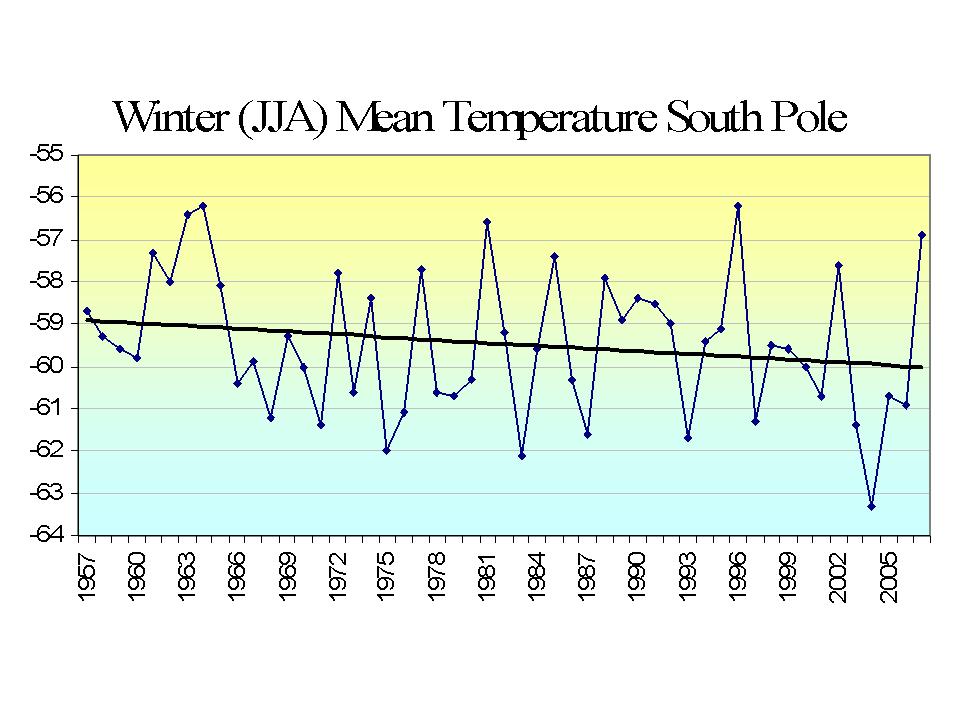
(There exists a good measuring point, where the all dominant greenhouse gases are CO2, Methane, NO2 and O3. At the South Pole in the winter the air is clean, there is almost no water vapor and the winter temperature at the Amundsen–Scott South Pole Station between April and September 2021, a frigid minus-78 degrees (minus-61 Celsius), was the coldest on record dating back to 1957, and the trend is 1 C colder per century. (In the summer humidity increases and for summers the trend is increasing temperatures.) The winter cooling trend is a hint that rising CO2, CH4, N3O and O3 levels are not the dominant factors in temperature rise.)

Besides the absorption window in the 14,9 micron band that absorbs 100% of the available energy water is fundamental and the majority of the energy is already absorbed. But there are smaller absorption in the 10.5, 9.5 and 4.3 micron. The 10.5 and 9.5 micron wavelength do not saturate. so they participate with their full strength when CO2 increases but the 4,3 micron is in a region where there is not much energy emitted , and what is emitted is nearly all absorbed by water vapor. The total greenhouse effect from CO2 at 280 ppm CO2 is 2.5 C and when CO2 is increased to 460 ppm the additional temperature rise will be 0.2 C, if the water vapor staid the same. But the water vapor has increased 10% due to an increase in global temperature by 1.5C. This will lead to a temperature increase from the 2.11% increased absorption from CO2, in the 12.5 to 17 micron band is total CO2 greenhouse effect of 0.2 C x 0.0211 or 0.057C increase when the base increase of water vapor is subtracted out.

The other effect that must be subtracted out is: Temperature is increased 1.5C which results in absolute humidity increase of 10% assuming relative humidity stays constant, so we must subtract out the absorption increase from water vapor in the 12.5 to 14 micron band. The higher wavelengths are of no importance for this calculation since they are already saturated. This amounts to a temperature decrease of 0.117C, so the net temperature increase from a CO2 increase of 64% from 280 ppm to 460 ppm and at the same time water vapor increases 10% is:

0.2 C + 0,057C – 0.117C = 0.14C +- 0.05C.

The components in climate change. 1. The effect of increased water vapor.

During the little ice age the earth was significantly colder than today, but there was special factors that led to this: The Maunder solar minimum and two super novas, one discovered in 1572 by Tycho Brave and the other in 1604 by Kepler.

I will beginthe time of industrialization with the invention of the steam engine 1775 by James Watt. While not the original inventor he improved it so much that it became common use for power generation. Up to that time people had depended on water and wind power and in a few cases tidal power. This increased the use of coal, which up to that point had been used exclusively for heating.

Since 1765 the global temperature of the earth has increased by about 1.4C and is expected to increase another tenth of a degree by 2050.

When global temperature increases 1.5 degrees and relative humidity stays the same there will be 10% more water vapor in the air. How much of the temperature rise is attributable to a 10% increase in water vapor?

To answer that we must take a look at the greenhouse effect. Without it the earth would be an ice ball with an average temperature about 33C cooler than today. The earth can be considered a black body that obeys laws for black body radiation, the Stefan–Boltzmann law that states that the total energy radiation is proportional to the fourth power of the absolute temperature (Kelvin), so an increase in global temp from 13C t0 14.5C results in an increase of 2.11% in the total greenhouse effect (a smaller increase in the atmospheric window).

To sum it up: Since water vapor is fundamental I will count it first, and the effect of all the other greenhouse gases will be additional, remembering that the total absorption in any frequency band can never exceed 100% of available energy.The increase of absorption occurs in the atmospheric window, and in some bands of the incoming sunlight in the near infrared region. The bands are 0.7, 0.8, 0.9, 1.1, 1.4 and 1.9 μm. Together, they make up 90% of the greenhouse gas temperature rise, or 29.9 degree C. When global temperatures increase by 1,5 C there will be 10% more water water vapor assuming relative humidity will stay constant, there will be an additional 0.31 C temperature rise.

Total greenhouse effect 33 C, Greenhouse effect from water vapor is 29.9C

Increased water vapor greenhouse effect from 2.11 % increased black body emissions: 0.52C

Increased greenhouse effect from 10 % water vapor increase 0.31C

Rising CO2 levels is only a very minor cause of climate change. Beside the sun, land use change, pollution, mining and depletion of aquifers are the major causes.

I have always been very interested in the environment. Nature teaches us so many lessons, the diversity of trees, birds, flowers and wildlife is breathtaking and I never cease to wonder. It would be a shame to destroy the beauty of it all. Yet we seem to make it worse by concentrating our effort by trying to limit CO2 emissions, rather than tackling the real and more urgent problems.

Let me first explain why I assert that rising CO2 levels, while real is only a minor player in the climate change equation.

The traditional way to approach this scientifically is making climate models. So far, nearly all, except the Russian model have failed to predict future temperature changes. IPCC is still failing.

The other approach is to take measurements, and it so happens that we have really good global data for over 60 years. The Amundsen Scott – South Pole weather station, the average temperature of Winter season 2021 (April 2021 – September 2021) reached only -61,0°C / -78°F, and at this temperature CO2 is the dominant greenhouse gas by more than a decade over water vapor. We have reliable measurements for the temperature change at the South Pole since 1957. During this time CO2 gas increased 31% to 413ppm, Methane increased 16% to 1.85 ppm and Nitrous oxide decreased, but this is a gas mostly confined to urban areas, and is now below 0.05 ppm. With CO2 increasing by 31% and water vapor negligible one would expect a temperature rise over 64 years of 0.65 C, or one degree Celsius warmer per century according to extrapolated lab measurements. This is the observed trend:

With 2021 value included the temperature trend is two degrees Celsius cooler per century!

At the South Pole snowfall is negligible in the winter, and for the whole year it is only 1.3 inches. No model would have predicted the cooling trend, so there must be other factors that are are more important, since real measurements beat models every time.

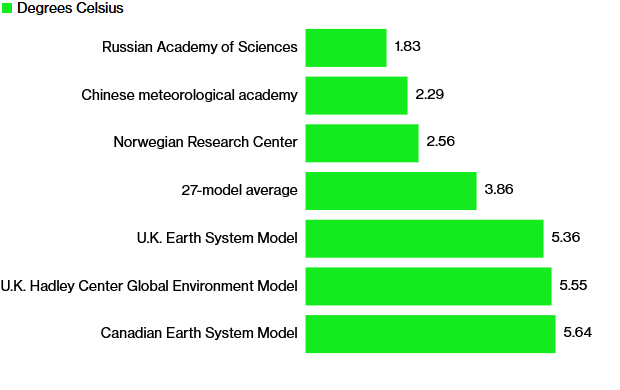
Ignoring the South Pole, the climate models are from time to time adjusted, and they suddenly showed a much higher rate of future temperature increases, in this case what is supposed to happen to global temperatures for a doubling of CO2 from pre-industrial times, from 270ppm to 540ppm.

Source: Mark D Zelinka et al. ” Causes of higher Climate sensitivity in CMIP6 models” Geophysical Research Letters.

There are two ways to approach this problem. The models make certain assumptions about the behavior of the changing atmosphere and model future temperature changes. This is the approach from IPCC for the last 34 years. These models all fail miserably when compared to actual temperature changes.

The other way i to observe what is actually happening to our temperature over time as the CO2 increases. We have over 60 years of excellent global temperature data, so with these we can see where, when and by how much the earth has warmed.

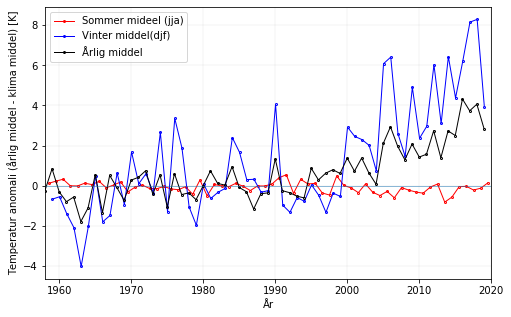
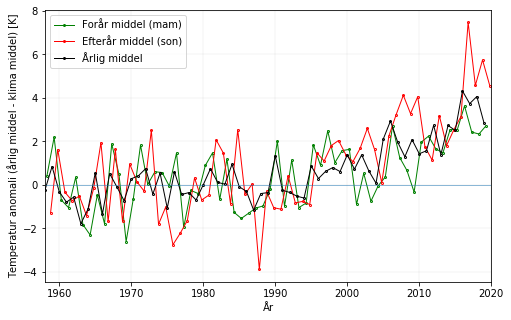
The most drastic temperature rise on earth has been in the Arctic above the 80th latitude. In the winter of 2018 it was 8C above the 50 year average. Since then it has come down to the more normal 4C increase. See charts from the Danish Meteorological Institute:

Summer: red, Jun,Jul, Aug. Winter: green, Dec, Jan, Feb Yearly: black

Note, there are no increase at all in the summer temperatures!

Spring: green, Mar, Apr, May. Fall: red, Sep Oct, Nov. Yearly: black

The fall temperature saw an increase of 4C and the spring temperature saw an increase of about 2.5C.

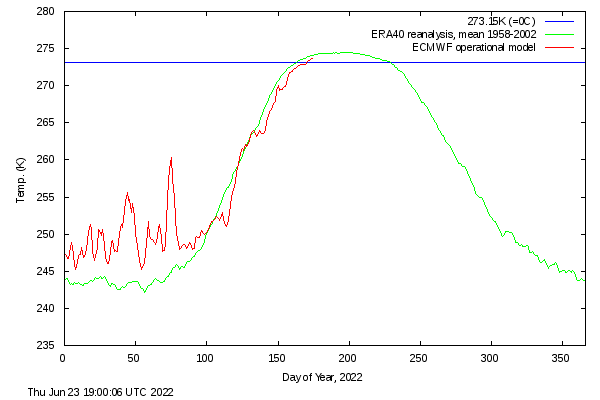
The 2022 winter saw an about 4c increase. The Spring temperatures have from the 10th of March were below or very close to the 1958 – 2002 average. Early Summer temperatures have so far been about 1C below normal. Source: DMI.

There seems to be no cause for immediate panic with the Arctic temperatures. If anything, they seem to moderate. In Antarctic on the other hand the temperatures seem to be decreasing! As we have seen before, the Amundsen Scott – South Pole weather station, the average temperature of Winter season 2021 (April 2021 – September 2021) reached only -61,0°C / -78°F, which is the coldest value in all-time history! This was 2,5°C /4.5°F degrees lower than the most recent 30-year average at this remote station.

Why are the temperatures not behaving like the models predict?

To get the answer we must study molecular absorption spectroscopy. IPCC and most scientists claim that the greenhouse effect is dependent on the gases that are in the atmosphere, and their combined effect is additive according to a logarithmic formula. This is true up to a certain point, but it is not possible to absorb more than 100% of all the energy available in a certain frequency band! For example: If water vapor absorbs 90% of all incoming energy in a certain band, and CO2 absorbs another 50% of the energy in the same band, the result is that 95% is absorbed, (90% + 50% * (100% – 90%)),  not 140%, (90% + 50%).

The following chart shows both CO2 and H2O are absorbing greenhouse gases, with H20 being the stronger greenhouse gas, absorbing over a much wider spectrum, and they overlap for the most part. But it also matters in what frequency range s they absorb.

For this we will have to look at the frequency ranges of the incoming solar radiation and the outgoing black body radiation of the earth. It is the latter that causes the greenhouse effect. Take a look at this chart:

The red area represents the observed amount of solar radiation that reaches the earth’s surface. the white area under the red line represents radiation absorbed in the atmosphere. Likewise, the blue area represents the outgoing black body radiation that is re-emitted. The remaining white area under the magenta, blue or black line represents the retained absorbed energy that causes the greenhouse effect.

Let us now take a look at the Carbon Dioxide bands of absorption, at 2.7, 4.3 and 15 microns. Of them the 2.7 and 4.3 micron bands absorb where there is little black body radiation, the only band that counts is at 15 microns, and that is in a band where the black body radiation has its maximum. However it is also in a band where water vapor also absorb, not as much as CO2,only about 20% to 70% as much. The important thing is that in the frequency band of 14.5 to 15.5 micron CO2 absorbs all the energy available in that spectral range, and it also did it before industrialization when CO2 levels were one third less than today!

The grey area is the difference between total pre-industrial absorption and today, less than 5 % added absorption in the 13 to 17 micron band. Norice that total absorption from ground level to thermopause cannot exceed 100%

From this we can see that increasing CO2 levels is not the cause of climate change, only a very minor player. How about Methane?

Methane has only two major absorption bands, one at 3.3 microns, and the other at 8 microns. The 3,3 micron band is where incoming radiation is negligible, and so is outgoing black-body radiation. The 8 micron band is where water vapor is dominant, so Methane turns out to be the don’t care gas.

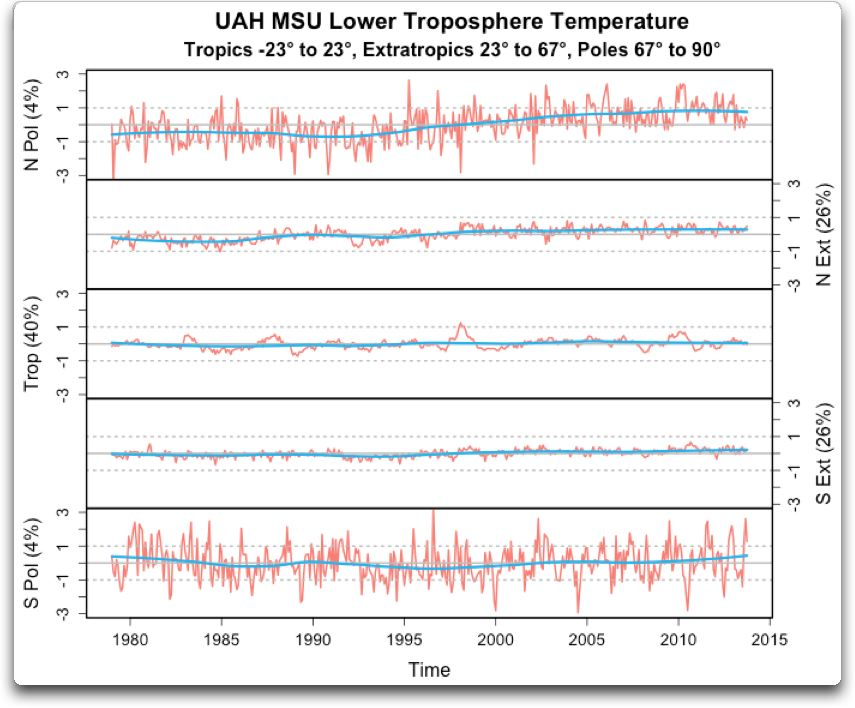
Water vapor or absolute humidity is highly dependent on the temperature of the air, so at 30C there may be 50 times as much water vapor, at 0C there may be ten times as much water vapor, and at -25C there is more CO2 than water vapor. At those low temperatures the gases are mostly additive. In the tropics with fifty times more water vapor than CO2, increased CO2 has no influence on the temperature whatsoever. Temperature charts confirm this assertion:

Here the temperature in the tropics displays no trend whatsoever. It follows the temperature of the oceans, goes up in an el niño and down in a la niña. The temperature in the southern hemisphere shows no trend. In the northern temperate region there is a slight increase, but the great increase is occurring in the Arctic. There is no increase in the Antarctic yet even though the increase in CO2 is as great in the Antarctic and the winter temperature in the Antarctic is even lower than in the Arctic. So CO2 increase cannot be the answer to the winter temperature increase in the Arctic.

There is an obvious answer. When temperatures increase the air can and will contain more moisture and transport this moisture from the tropics all the way to the arctic, where it ends up as snow. Is the snow increasing in the Arctic?

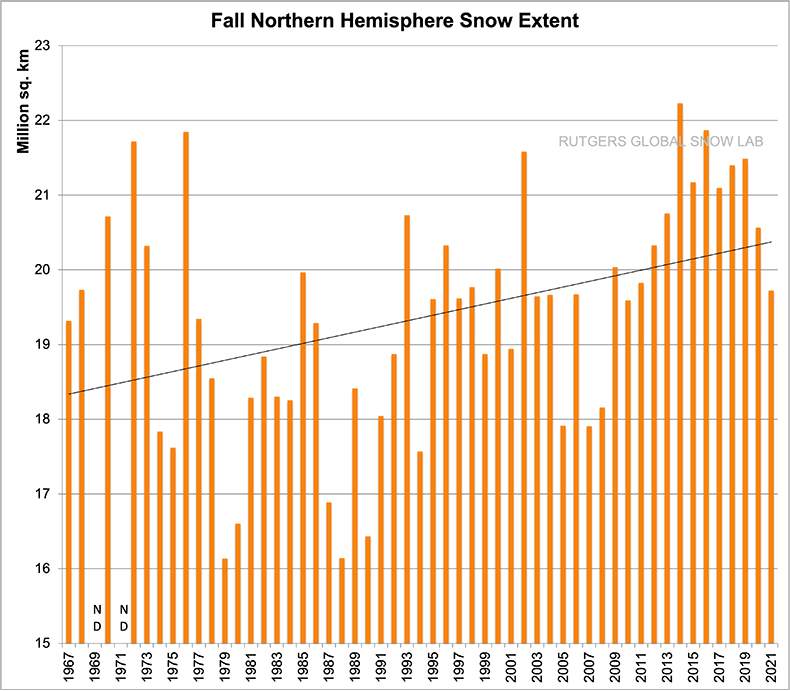
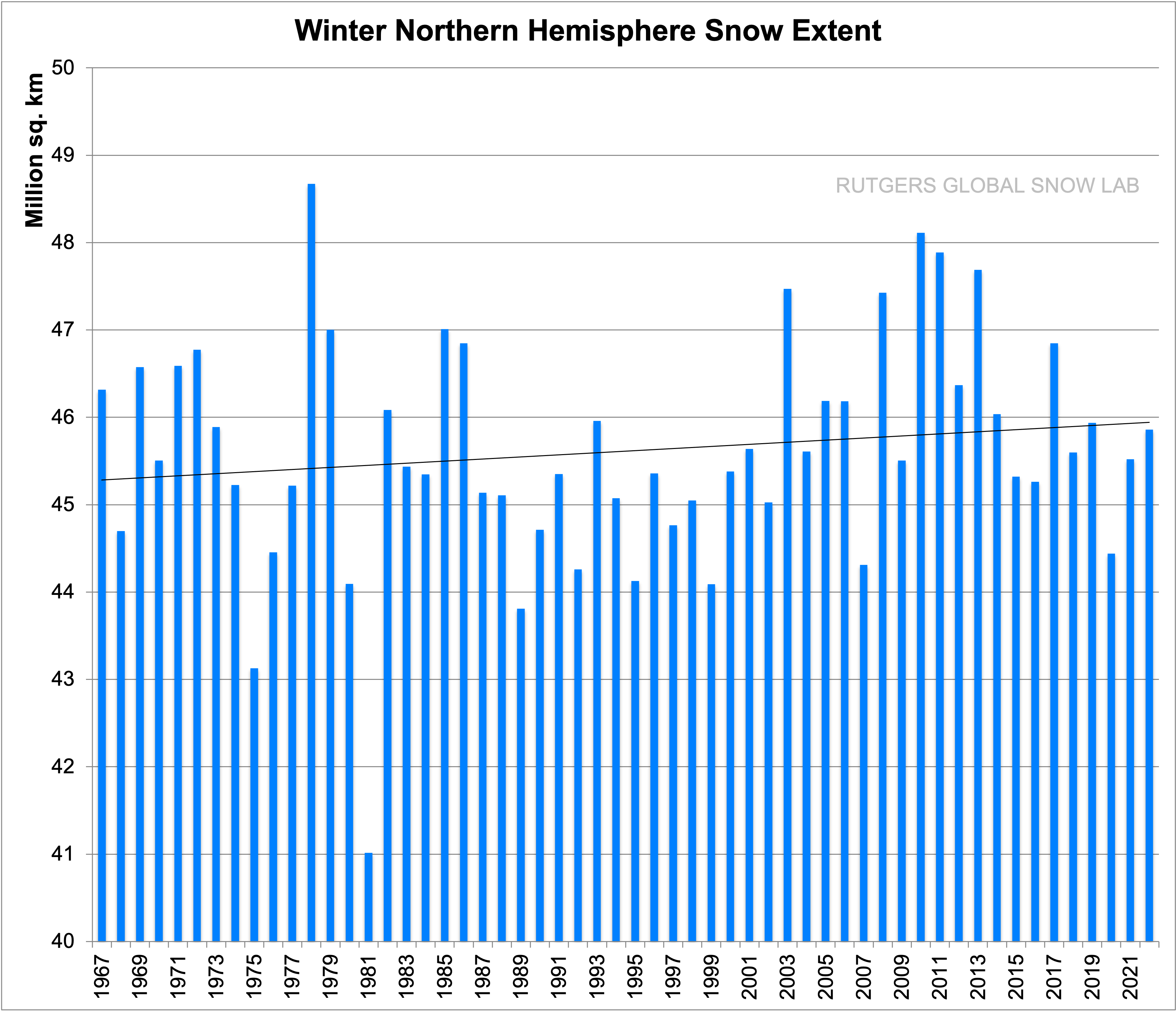
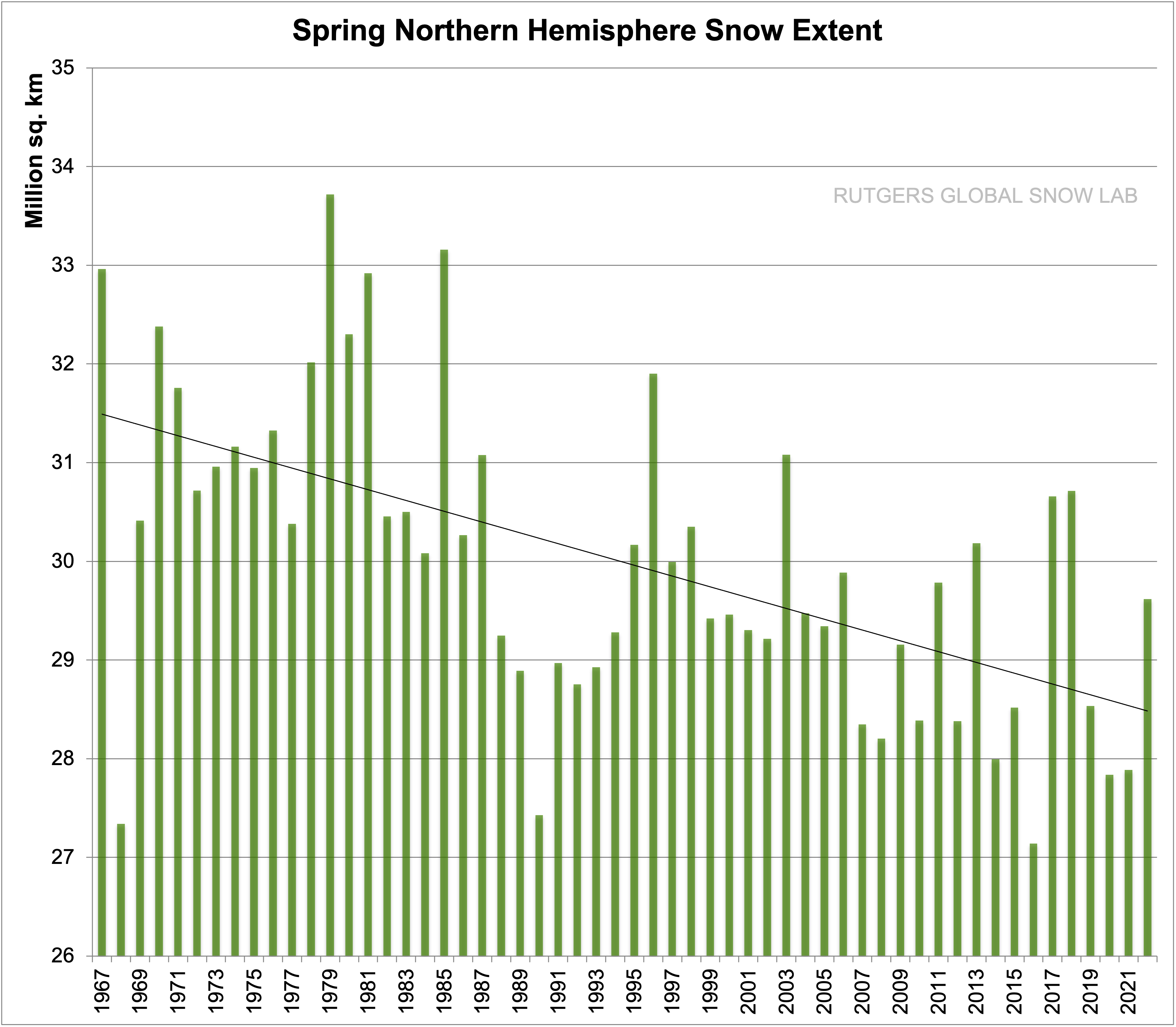
Let us see what the snow statistics show. These are from the Rutgers snow lab.

The fall snow extent is increasing, and has increased by more than 2 percent per year.

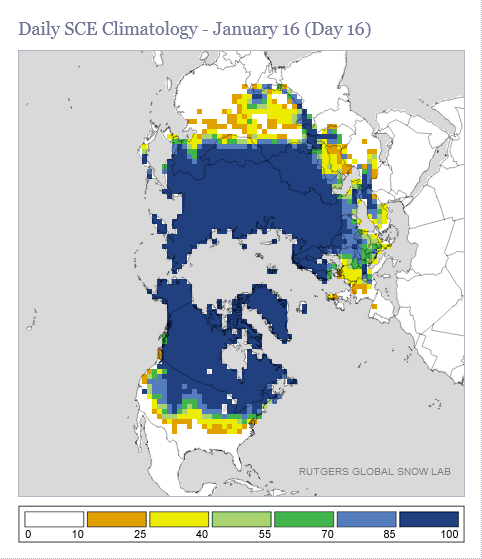
The winter snowfall has also increased but only by 0.04 percent per year. The snow covers all of Russia, Northern China, Mongolia, Tibet, Kashmir and northern Pakistan, Northern Afghanistan, Northern Iran, Turkey, most of Eastern Europe, Scandinavia, Canada, Alaska, Greenland and part of Western, Eastern and Northern United States.

Jan 16,2022

In the spring on the other hand the snow pack is melting faster, about 1.6 percent less spring snow per year. One of the major reasons for an earlier snow melt is that the air is getting dirtier, especially over China, and to some extent Russia. The soot from burning coal, wood and peat, and from mining dust changes the albedo of the snow. The soot is visible on old snow all the way up to the North Pole. The other reason is that the North Pole is getting warmer. In the fall and winter it is mostly due to increased snowfall, but in the spring, as soon as the temperatures rise over the freezing point, melting occurs earlier. But it takes longer time to melt the increasing snow, so the Summer temperatures remain unchanged or lower.

So the warming of the poles, far from being an impending end of mankind as we know it, may even be beneficial. Warmer poles in the winter means less temperature gradient between the poles and the tropics, leading to less severe storms. They will still be there, but less severe.

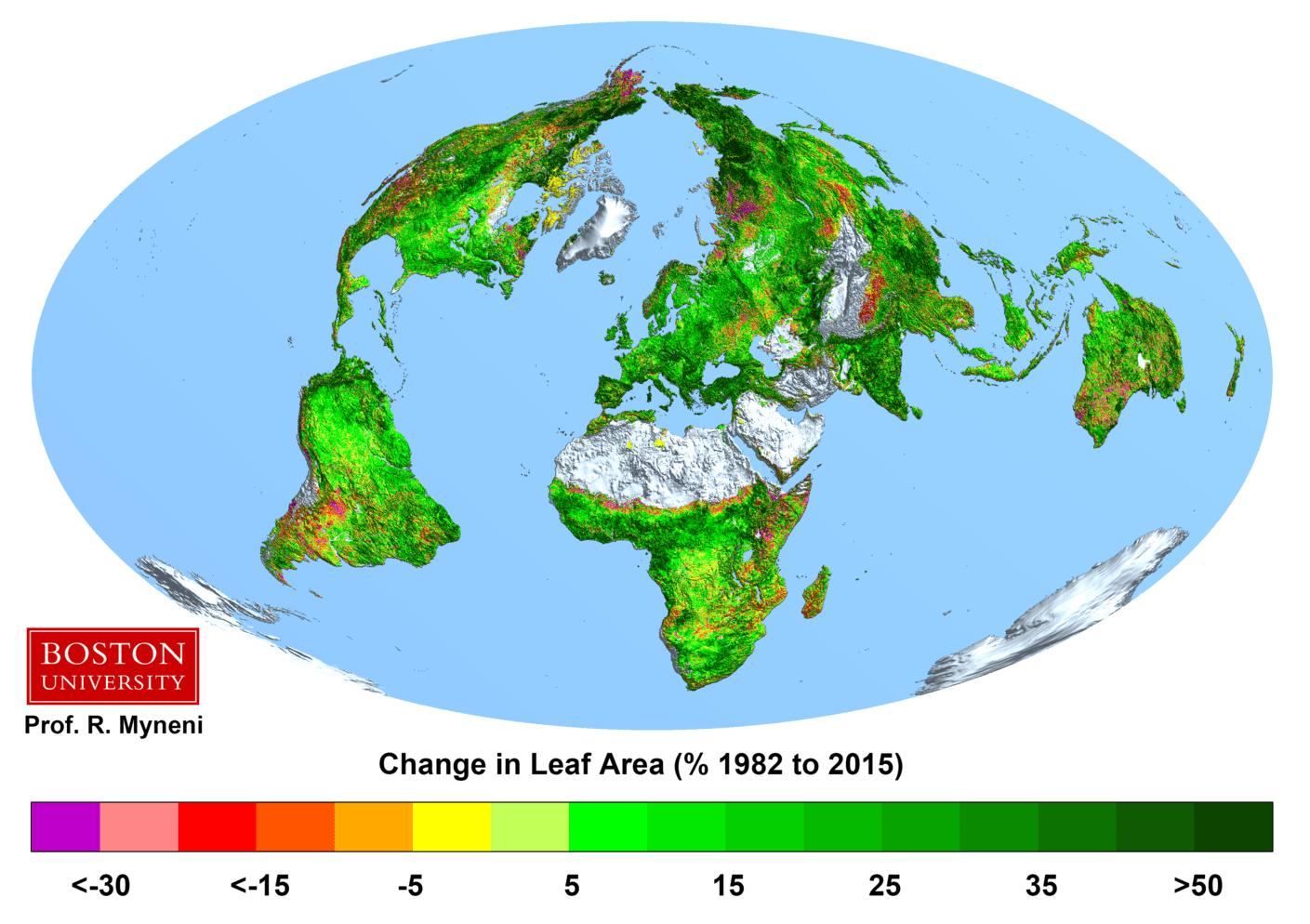
There is one great benefit of increased CO2, the greening of the earth.

Thanks to this greening, done with only the fertilizer of CO2, the earth can now keep another 2 billion people from starvation, not to mention what good it does for plants and wildlife.

So CO2 is not the cause for climate change.

Yet

we face enormous environmental challenges. The American Southwest is slowly becoming a desert, the aquifers are being depleted, Lake Mead and Lake Powell will be empty in a few years if nothing is done. Our total energy use is increasing:

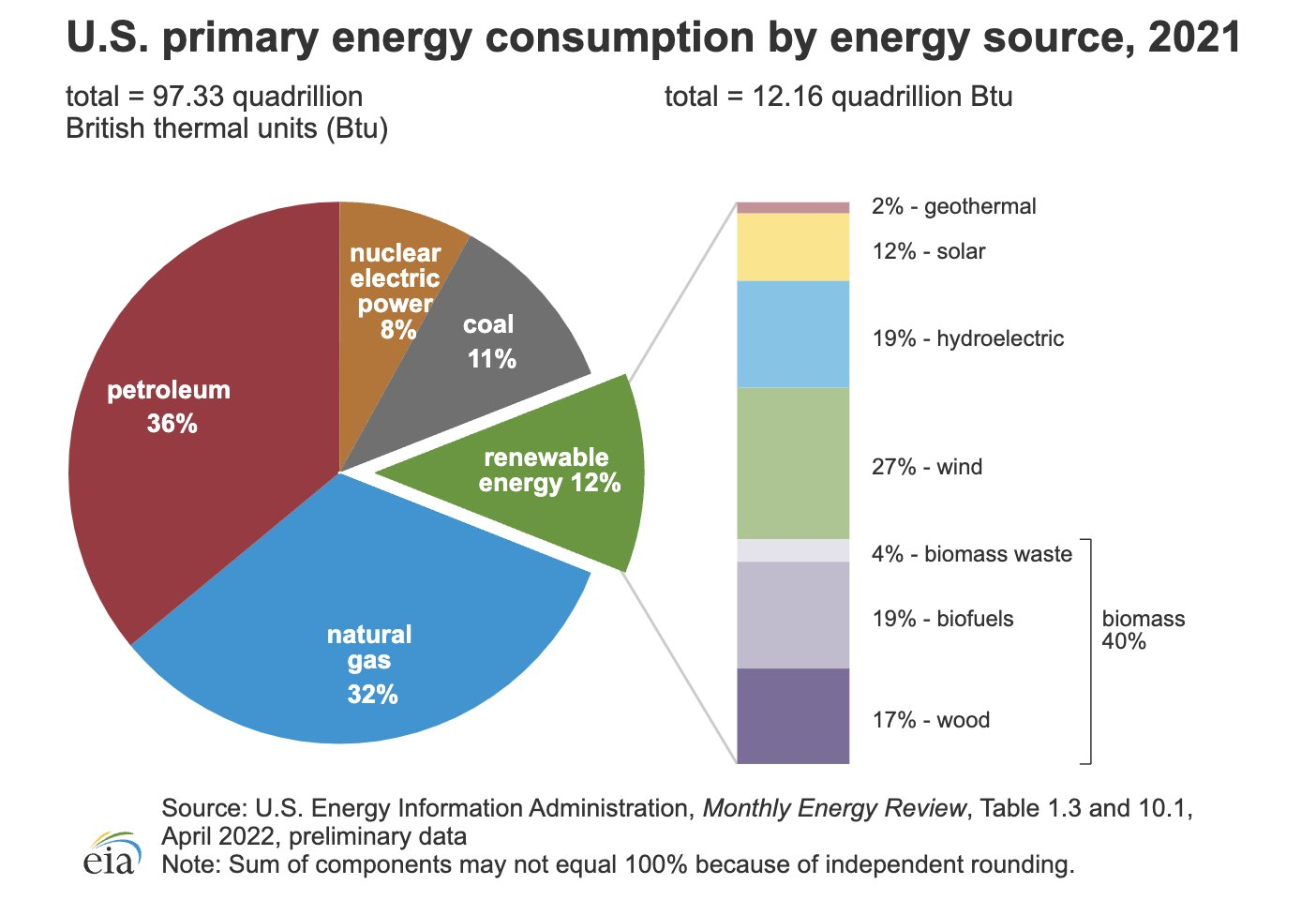
In 2021 solar energy amounted to 1,44% and wind power another 3.24% of total energy production. Hydroelectric power is declining because of the drought in the American Southwest. It used to be of great use for peak power generation. Lake Mead and Lake Powell are for all practical purposes unusable for more peak power generation. Biomass is pretty much peaked out. The use of of some of our best agricultural soil to grow corn and make ethanol is folly. When corn sugar is made into ethanol 48% of its weight is fermented as CO2, and one third of the total energy is gone. Maize growing is one of the most demanding crops, depleting the soil of more nutrition than other grains, needing the most fertilizer, which is made from petroleum products and other energy. It has been called “the syphilis of the soil” because of erosion problems.

The electricity production is but a subset of total energy consumption.

Source EIA

There is a great push to make all new cars, pick ups, delivery trucks, city buses and local trains electric by the year 2030. This does not seem to be incorporated into the eia plans. The “new green energy” plan is to have us carbon neutral by 2050. I don’t see how it can be done unless we take a radically different approach. Texas and California already has all the wind and solar power they can handle. To build it up further it must be complemented with energy batteries to store enough energy for when the wind doesn’t blow and the sun doesn’t shine. These energy batteries require an enormous amount of mining to extract the Lithium needed to make them. Lithium is already in high demand as batteries for vehicles. However, battery technology is rapidly developing, so it may still be possible to expand battery power for the grid. For now, most peak power and reserve power is supplied by natural gas.

A proposal to develop the electric grid, our nation’s transportation needs and reversing the desertification of the American Southwest.

Build a TransContinental Aqueduct. This will solve the water needs for the upper Western Texas, New Mexico, Arizona, lower California, Mexico and the Lower Colorado River basin.

Build a Trans-Rocky Mountain aqueduct. This will solve some of the water needs for Oklahoma, Kansas, Colorado, upper New Mexico and the Upper Colorado river basin.

Build a South Platte River aqueduct. This will solve the water needs for the greater Denver ares and help preserve the noorthern Ogallala aquifer.

This cannot be solved unless there will be a deep commitment to Nuclear power, streamline government permit processes and let private industry find the best solutions without government playing favorites and slowing down the process. Regular U235 power is not sufficient for this, Only Thorium power will do, and there are many reasons for it. Here are 30 of them:

 1. A million year supply of Thorium available worldwide.

 2. Thorium already mined, ready to be extracted.

 3. Thorium based nuclear power produces 0.012 percent as much TRansUranium waste products as traditional nuclear power.

 4. Thorium based nuclear power will produce Plutonium-238, needed for space exploration.

 5. Thorium nuclear power is only realistic solution to power space colonies.

 6. Radioactive waste from an Liquid Fluoride Thorium Reactor decays down to background radiation in 300 years compared to a million years for U-235 based reactors. A Limerick.

 7. Thorium based nuclear power is not suited for making nuclear bombs.

 8. Produces isotopes that helps treat and maybe cure certain cancers.

 9. Liquid Fluoride Thorium Reactors are earthquake safe, only gravity needed for safe shutdown.

10. Molten Salt Liquid Fluoride Thorium Reactors cannot have a meltdown, the fuel is already molten, and it is a continuous process. No need for refueling shutdowns.

11. Molten Salt Nuclear Reactors have a very high negative temperature coefficient leading to a safe and stable control.

12. Atmospheric pressure operating conditions, no risk for explosions. Much safer and simpler design.

13. Virtually no spent fuel problem, very little on site storage or transport.

14. Liquid Fluoride Thorium Nuclear reactors scale beautifully from small portable generators to full size power plants.

15. No need for evacuation zones, Liquid Fuel Thorium Reactors can be placed near urban areas.

16. Liquid Fluoride Thorium Reactors will work both as Base Load and Load Following power plants.

17. Liquid Fluoride Thorium Reactors will lessen the need for an expanded national grid.

18. Russia has an active Thorium program.

19. India is having an ambitious Thorium program, planning to meet 30% of its electricity demand via Thorium based reactors by 2050.

 20. China is having a massive Thorium program.

21. United States used to be the leader in Thorium usage. What happened?

22. With a Molten Salt Reactor, accidents like the Three Mile Island disaster will not happen.

23. With a Molten Salt Reactor, accidents like Chernobyl are impossible.

24. With Molten Salt Reactors, a catastrophe like Fukushima cannot happen.

25. Will produce electrical energy at about 4 cents per kWh.

26. Can deplete most of the existing radioactive waste and nuclear weapons stockpiles.

27. With electric cars and trucks replacing combustion engine cars, only Thorium Nuclear power is the rational solution to provide the extra electric power needed.

28. The race for space colonies is on. Only Molten Salt Thorium Nuclear reactors can fit the bill.

29. President Donald J. Trump on Jan. 5 2021 issued an Executive Order on Promoting Small Modular Reactors for National Defense and Space Exploration. Only Liquid fluoride thorium reactors can meet all the needs.

30. We have to switch from Uranium to Thorium as nuclear feed-stock. We are running out of domestic Uranium.

My favorite Thorium power plant would be a 100 MW Liquid Fluoride Thorium Reactor (LFTR). It is also called a Small Modular Reactor (SMR). It is small enough that all core elements will fit in three standard truck containers, made on an assembly line. It can came in many forms, one is a normal fast breeder reactor, another is adapted to burn nuclear waste. The cost for these reactors, when built on an assembly line will be less than $2 per Watt. They can be placed anywhere, since they are inherently safe, no need for an evacuation zone. Since they are operating at 500C temperature with either gas or liquid lead as heat transfer media there is no need for water as a cooling medium. The only thing better would be fusion power, but that is at least 20 years away, but it is coming. These are exciting times!