We find this in Genesis 1:6-8 (NIV) And God said, “Let there be an expanse between the waters to separate water from water.” 7 So God made the expanse and separated the water under the expanse from the water above it. And it was so. 8 God called the expanse “sky.” And there was evening, and there was morning—the second day. But God did NOT say: “It was good” The creation story is interesting reading. God takes a whole day out His busy schedule of creation just to form an environment with water in all its forms in what we call the atmosphere or “sky”. He has yet to create life. Could it be, that water in all its forms are necessary to form and sustain life, so a sustainable ecosystem had to be prepared first?
God created the earth too be just heavy enough to hold on to water vapor, and water is unique because its melting point and boiling point is within the range of bring able to participate in sustaining life. It also has the second (after ammonia) highest specific heat capacity of all known substances. To melt 1 gram of ice takes 80 calories, to heat it takes 1 calorie per gram and to boil it at ground levels takes 539 calories. (The calories you eat are actually kilo-calories). This makes water the ideal substance to moderate and regulate climate. Water vapor evaporates from the ocean, cooling it down and water vapor, being lighter than air rises and condenses as clouds form. The clouds are the most important temperature regulator, much more important than all other greenhouse gases combined. Clouds transport heat from the equator to the temperate areas and to the poles. Without this the equator temperature would be in excess of 145 F. In addition clouds have a high reflection of incoming sunlight, reflecting incoming heat back into space. The earth has never been to warm to sustain complicated life, nor is there any danger of overheating unless clouds disappear. In fact, the next major climate change is the next ice age.
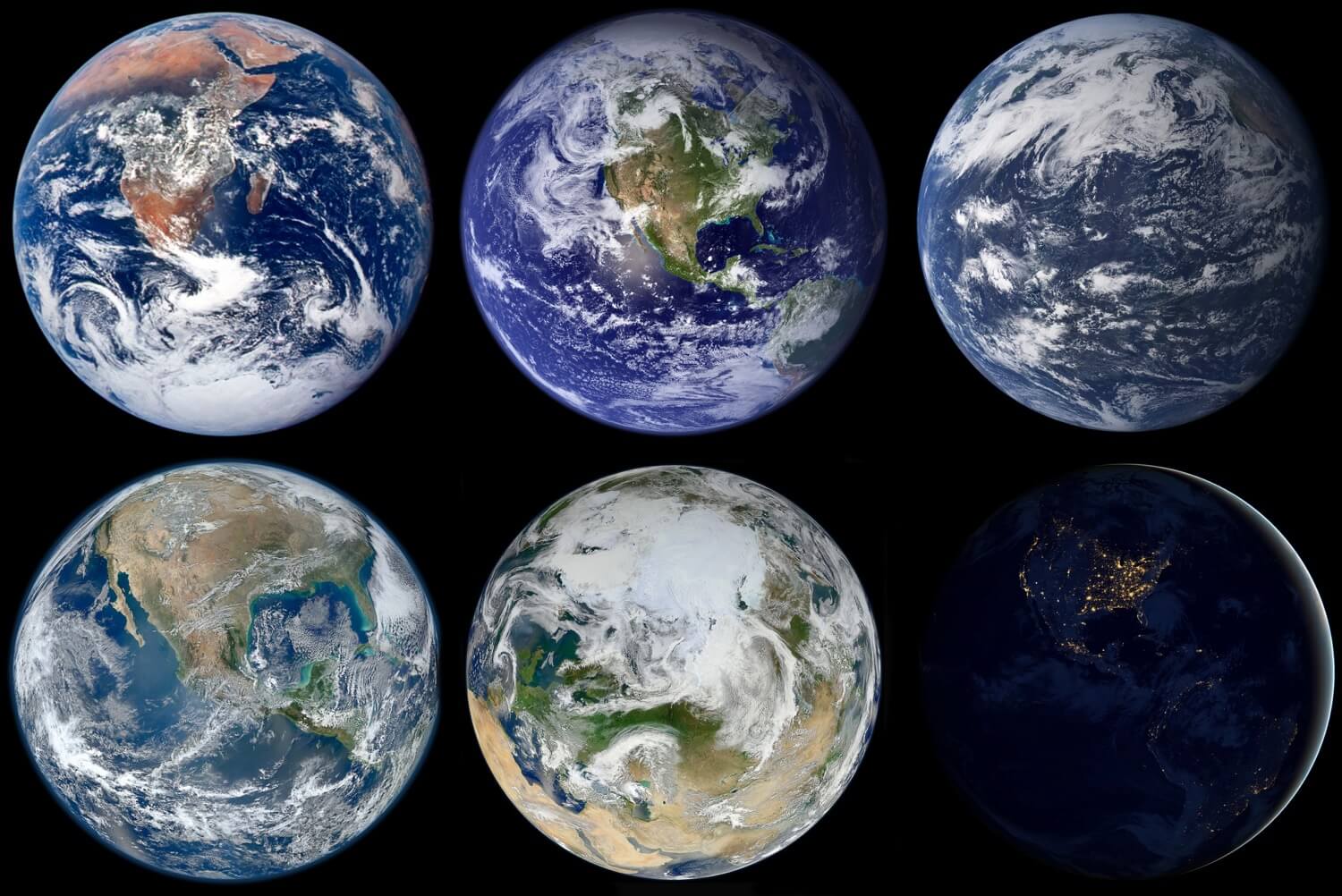
The picture above shows the friendly earth we are living in today. On the second “day” of creation situation was quite different. The sun was not fully created yet, and the earth was still in its chaotic state. All God did was to prepare the ecosystem. The earth was still cooling down from creation, and water evaporated and formed a cloud that covered the whole earth. This is why God did NOT say “it was good” on the second day, it was just the preparation.
Genesis 1:1 In the beginning God created the heavens and the earth.
What did God create? Continuing in Genesis 1:2; Now the earth was formless and empty, darkness was over the surface of the deep, and the Spirit of God was hovering over the waters. The earth was formless, meaning chaotic and unorganized; and empty meant without any form of life. But there was water; yes, that is right; water existed in abundance way before the sun was formed. Water is necessary for life to exist, and its unique property of freezing at 0 C and boiling at 100C makes it ideal for organic life. The fact that ice is lighter than water makes ir possible for marine life to survive the winters even in shallow lakes since the ice sits on top of the lake and isolates for further freezing.. Here is introduced God’s Spirit moving over the waters, doing what?
Then in Genesis 1:3; And God said, “Let there be light,” and there was light. Light is very interesting. It is just a massless piece of energy traveling at the speed of light. Since it travels at the speed of light it has no time. It is created and extinguished at the same time but in different places. From our perspective we see it as traveling at the speed of light, but that is because we are stuck in place in time and space. Dead matter cannot do anything, but with the energy in form of light it might be possible. Therefore
in Genesis 1:4; God saw that the light was good, and he separated the light from the darkness.
So in Genesis 1:5: God called the light “day,” and the darkness he called “night.” And there was evening, and there was morning—the first day. At this time God just defined the term day and night. But notice that darkness comes before light.
But do not forget this one thing, dear friends: With the Lord a day is like a thousand years, and a thousand years are like a day. (2 Peter 3:8)
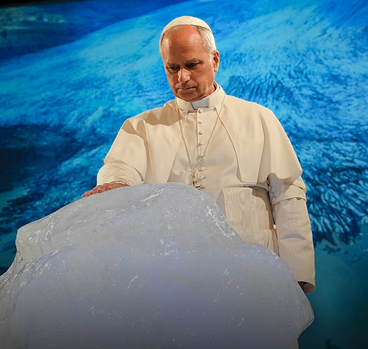
Pope Leo XIV, the newly elected pope, has recently championed the Vatican’s plan to become the world’s first carbon-neutral state by developing a large solar farm on land near Rome. This initiative is inspired by the environmental legacy of Pope Francis and aims to generate enough electricity to meet the Vatican’s needs and potentially provide excess energy to the local community. The Vatican’s efforts are part of a broader push for climate action, with Leo XIV actively promoting the transition away from fossil fuels and emphasizing the moral imperative of environmental stewardship. He also took part in the “Raising Hope for Climate Justice” International Conference in Castelgandolfo, Italy on Oct 1, where he blessed a chunk of a Greenland iceberg. See the picture:
Pope Leo asked eloquently: “What must be done now to ensure that caring for our common home and listening to the cry of the earth and the poor do not appear as mere passing trends or, worse still, are seen and felt as divisive issues?”
“Everyone in society, through nongovernmental organizations and advocacy groups, must put pressure on governments to develop and implement more rigorous regulations, procedures and controls,” the pope said.
“Citizens need to take an active role in political decision-making at national, regional and local levels,” he said. “Only then will it be possible to mitigate the damage done to the environment.”
What they still do not know is that rising CO2 levels is responsible for less than 10% of the climate change, and water in all its forms; ice, water, water vapor and clouds is responsible for over half of climate change. Land use changes are also more important. Let me explain it further:
Many years ago, around 1976 Dr. James Lovelock bought a number of Hewlett Packard 5840 Gas Chromatographs to be set up in some of the most remote places of the earth to study pollution and its effect on the climate. What he found was an unexpectedly large amount of dimethylsulphide (DMS) in the atmosphere, and that acted as a
condensation point for cloud formation. He was then a longtime paid consultant for Hewlett Packard, so he came over from his native England a couple of times a year, always willing to hold a seminar for us engineers working at Hewlett Packard Analytical, and at one of them he sprung “Daisy-world” on us before it was published; mostly to see if we could poke holes in his hypothesis. It involved a world that consisted of only two flowers, black daisies and white daisies. The computer simulation starts out with a cold world and a weak sun. The sun slowly warms up (about 1 percent every ten million years), and at some time suddenly black daisies appear and cover the earth. This warms the earth some more and white daisies appear. As the sun varies in intensity the mix of white and black daisies changes and this keeps the earth at a stable temperature, as they have different reflective properties. He then went on to say that the whole earth is like a living organism. Some time later he presented the paper and afterwards we asked him how it was received. “You won’t believe it”, he answered. ”Now there are people who actually believe the earth is a living organism. They demand follow-up articles that justifies their belief.” He had partly himself to blame, the name he had chosen was “the GAIA hypothesis,” Gaia being the Mother Earth Goddess. Talking about religion the Mother Earth people now had their goddess, and expressions like. “The earth has a temperature” became commonplace. For me, being a Christian I read with wonderment what God has to say about Creation and the Ecosystem.
Starting in Genesis 1:1; In the beginning God created the heavens and the earth. This can be described in scientific terms: From nothing God created space and matter. What happened to “In the beginning”? It turns out that matter has to be accompanied with space or it will not work. And time is a derived property from the existence of matter and space. Without space and matter time does not exist. So the creation of matter and space also defined the beginning of time. What about God? The laws of physics tells us you cannot create something out of nothing. This proves that we and everything else cannot possibly exist. But we do, and therefore there must have been something existing before anything existed. This is God, and He can be defied in one word: Presence. When Moses saw the burning bush he asked who it was. And God answered “I am that I am”, in a way describing the eternal presence, without beginning and end. This is the God I believe in: Out of time and space since He created it, and also in time and space since it is part of His creation.
The expression “in the beginning” is in Hebrew bereshit which means in the beginning. The same phrase begins the gospel of John 1:1 “Inthebeginning was theWord, and theWord was with God, and theWord was God.” Here the word translated beginning is “Arch” like in archangel and means “the chief” or “the most important one’ referring to the Word. It is in past tense which means that the Word existed before the beginning. Another reference is found in Titus 1:1 “inthe hope of eternal life, which God, who does not lie, promised before thebeginning of time,” In this verse the word eternal and the word time is in Greek aionion , which means a very long time, like the time span of a dynasty. Nowadays eon has a meaning of a thousand million years in Geology and Astronomy, but the original meaning is a very long time which may or may not be defined. It is sometimes translated of the ages. Here is a song that spiritually speaks to me:
Hebrews 7:1-10 tells of Jesus, the high priest, after the order of Melchizedek. It presents the case for tithing, paying one tenth of the income to be used and distributed by the church.
Ezekiel 33. The prophet took the role of the watchman and gave a message about God’s Judgment and it’s fairness, he foretold of the fall of Jerusalem and the cause of Judah’s ruin, claiming they were hearing but not doing and that they were still continuing their sinful acts.
Ezekiel 34. The shepherds of Israel are not true shepherds. God is the true shepherd. “And I will set up one shepherd over them, and he shall feed them, even my servant David; he shall feed them, and he shall be their shepherd. And I the Lord will be their God, and my servant David a prince among them; I the Lord have spoken it. And I will make with them a covenant of peace, and will cause the evil beasts to cease out of the land: and they shall dwell safely in the wilderness, and sleep in the woods. And I will make them and the places round about my hill a blessing; and I will cause the shower to come down in his season; there shall be showers of blessing.“
2 Thessalonians 2 tells of the great apostasy, when the man of lawlessness is revealed and usher in the tribulation. People will believe “The Lie” and be destroyed. Stand fast, Jesus will destroy him at his return.
Jeremiah 30. Jeremiah sent a letter to the exiles, a letter of hope, and a promise of return “And ye shall seek me, and find me, when ye shall search for me with all your heart.And I will be found of you, saith the Lord: and I will turn away your captivity, and I will gather you from all the nations, and from all the places whither I have driven you, saith the Lord“. Then follows a message to Shemaiah, a not so promising message.
Jeremiah 31 is a most remarkable chapter. Jeremiah, in a dream heard God say “Yea, I have loved thee with an everlasting love” and God continued by promising that the remnant of Israel will be saved. Then, in verse 15 God provided an abrupt change “A voice was heard in Ramah, lamentation, and bitter weeping; Rachel weeping for her children refused to be comforted for her children, because they were not.” Returning to the dream God gave an even more remarkable statement “O thou backsliding daughter? for the Lord hath created a new thing in the earth, A woman shall compass a man.” After this Jeremiah woke up from his pleasant dream. God continued speaking, promising mercy on Ephraim, future prosperity to Israel, and promised the New Covenant: “But this shall be the covenant that I will make with the house of Israel; After those days, saith the Lord, I will put my law in their inward parts, and write it in their hearts; and will be their God, and they shall be my people. And they shall teach no more every man his neighbour, and every man his brother, saying, Know the Lord: for they shall all know me, from the least of them unto the greatest of them, saith the Lord: for I will forgive their iniquity, and I will remember their sin no more.”
Matthew 7:1-20 is a continuation of the sermon on the mount. Jesus was admonishing us not to be judgmental but to look to our own faults before condemning others. And don’t waste your time by casting pearls before swine. Ask, seek, knock is another theme. and so is doing to others what you would have them do to you. This sums up the Law and the Prophets. Enter through the narrow gate. A tree is known by its fruit. This should still be taught in school, it is the opposite of Critical Race Theory, which divides us all.
The book of Leviticus tells about Mosaic Law. I for one am glad I am not under the Law anymore, but redeemed with the blood of Jesus. However, it is interesting reading, and it is still valid proof that we cannot fulfill all the law.
Leviticus 1 tells of how the burnt offering shall be performed.
Matthew 6:1-18 continues the telling of the sermon on the mount. Jesus spoke of doing good, of fasting and prayer, do it without fanfare, in secret if possible and, above all, be sincere. He then instituted what is called “The Lord’s prayer” which really is a pattern prayer for us, short, direct, but covers the essentials. Fasting should go together with serious prayer, but make it simple.
Exodus 38 records of how the altar of burnt offerings and the basin for washing was made, continuing telling about the courtyard around the tabernacle and all the materials used.
Exodus 39 records how the priestly garments were to be made, the ephod, the breastplate, the bells and pomegranates, the mitre and undergarments and finally the words “Holy to the LORD” to be fastened to the priest’s turban.
And in Exodus 40 the tabernacle was finished, the Priests installed and finally God blessed the tabernacle with His presence when the Glory of the LORD filled it. That ends the book of Exodus.
Matthew 4:12-25. After Jesus was baptized and was led into the wilderness for 40 days and 40 nights he began his ministry and called his first disciples.
Exodus 30 describes the altar of incense, mentions rules for the poll tax and the basin for washing, anointing oil and rules for sacred incense.
Exodus 31 is short; it tells of two named craftsmen to be leaders of performing the artistic aspect of all the work to build the tabernacle. Then there are rules of how to observe the Sabbath, and with that, God finished His message to Moses by giving him the two tablets of stone containing the ten commandments written by the finger of God.
In Exodus 32 Moses did come down from the mountain and what did he find? He found the Golden Calf and the people singing and dancing in orgies. Moses became so angry that he threw down the two tablets with God’s commandments, and they broke in pieces. Then he pleaded with God not to destroy His people.
In Matthew 3:11-17 Jesus came to be baptized by John the Baptist. Afterwards the holy Spirit descended like a dove on Jesus and a voice from heaven said: “This is my son, whom I love; with him I am well pleased”.
Exodus 23 continues with the writing down laws about justice and mercy, how you are to help even someone who hates you. God instituted the Sabbath laws; in six years you may harvest your fields, but the seventh year you will let it go fallow. (In my childhood Sweden this seven year planting cycle was still practiced by many farmers.) The seventh day rest was to be practiced by all and applied to work animals as well. Moses also defined the three annual feasts, the feast of unleavened bread, the feast of harvest and the feast of in-gathering. Finally God warned of worshiping other Gods.
In Exodus 24 God confirmed His covenant with the people, and Moses went up to Mount Sinai and stayed there 40 days and 40 nights, a long time for the people to be without a leader.
In Exodus 25 Moses told the people make an offering, and out of this offering was made three furnishings for the tabernacle, the ark, the table and the lampstand.
Exodus 26. God described to Moses how the tabernacle was to be built.
Matthew 2:1-12 . We get to read about the Magi (probably about 15 of them including servants) who came to Jerusalem to ask about the King of the Jews. This worried King Herod and all Jerusalem, and Herod asked the Scribes and the other learned men where he was to be born. They answered “In Bethlehem of Judea”, but were otherwise remarkably uninterested. The wise men went to Jesus (he is by now at least a few months old), but did not report back to Herod, instead they returned another way.
In Exodus 16 God gave them Manna (what is it?) and quail, and Moses gave the instructions on how to gather it. And they ate Manna for 40 years.
In Exodus 17, lack of water is a recurring theme in the desert. In Rephidim there was no water at all, so God told Moses to strike the rock at the foot of Mount Horeb. Water gushed out and they were all filled with good water. Good it was, for the Amalekites attacked them right afterwards. Joshua and his men fought a good fight, and Moses helped by raising his hands, and as long as he held them high Joshua prevailed. But Moses got tired, so Aaron and Hur held up his hands until sunset, and so the Amalekites were defeated.
Exodus 18 tells of Jethro, Moses’ father-in-law when he visited Moses, who now was in a difficult situation trying to lead his people all by himself, and Jethro gave Moses good advice about real leadership, delegation of management, a practice essential for all governing.
 Len Bilén's blog, a blog about faith, politics and the environment.