January 28, read the Bible in a year in PowerPoint; commented.

John 18:28-40 deals with the last 24 hours of Jesus’ life, from the trial before Annas and the Sanhedron Jesus was paraded before Pilate, seeing a way out, Pilate sent him to Herod, who sent him back to Pilate, Pilate offered to release Jesus or Barabbas and the people demanded that Barabbas be released.

In Exodus 4 God gave Moses his call. At first Moses came up with one objection after another, but God persuaded him with signs that he must go back to Egypt, face Pharaoh and lead his people.

In Exodus 5 Moses and Aaron went to Pharaoh and asked for a 3 day reprieve for their people so they could go and worship God. Like all dictators Pharaoh reacted to this petition by making life even more miserable for the Hebrews; he wanted them to gather their own straw and still make as many bricks as before. The Hebrews blamed Moses for stirring up trouble for them.

And in Exodus 6 the LORD (Jehovah) promised deliverance from Pharaoh and He would give them the land He had promised Abraham. The narrative continues with an interlude where the names of the heads of the clans of Israel are listed. Moses protested and did not want to talk to Pharaoh any more, so Aaron would have to do the speaking.

Yesterday I didn’t comment on the momentous events when Jesus was taken into custody, ans Moses finally understood who God is and why it mattered, but the events of the trial reminded me of recent events in Minnesota. This is the Barabbas effect, one part of the government incites a mob to demand something that would be ridiculous for any thinking person to even contemplate. In this case the mob sides with the criminal, like the mob sided with Barabbas.

With Moses, his request was met with punishment of a whole group for a demand given by one person, a typical response for a ruler keeping control.
January 10, read the Bible in a year in PowerPoint; commented.

Today we read about circumcision and its importance; in John 7 and one of the four chapters in Genesis selected for today. But that is just one part of the story.

John 7:1-24. Jesus pointed out that according to Jewish law, circumcision is more important than keeping Sabbath, so, if the eighth day is on a Sabbath, it must be performed on that day, but healing on a Sabbath is not permitted.

In Genesis15 God promised Abram a son. Abram believed God and it was counted to him as righteousness.

But in Genesis 16 Abram badly wanted an heir, so Sarai, being too old, gave her handmaiden Hagar to be the mother of Abram’s son, Ishmael. Sarai regretted what she had done, and Hagar was sent away with Ishmael into the wilderness.

Thirteen years later, in Genesis 17, Ishmael was back with Abram,  God  promised Abram his seed of promise, changed Abram’s name to Abraham and Sarai’s name became Sarah, established with an eternal covenant, the covenant of Circumcision, and it was performed on Abraham, Ishmael and all Abraham’s male servants.

Which brings us to Genesis 18 with Abraham still waiting for his promised offspring. He was visited by three angels that promised him he will have a son within a year. Sarah heard it and found it laughable, but God confirmed this promise, and was also proclaiming the destruction of Sodom and Gomorrah. Abraham tried to bargain with God at no avail.

The question to ponder: Why is circumcision important for Jews and Muslims, but not for Christians? Hint: read the Acts of the Apostles, chapter 15.

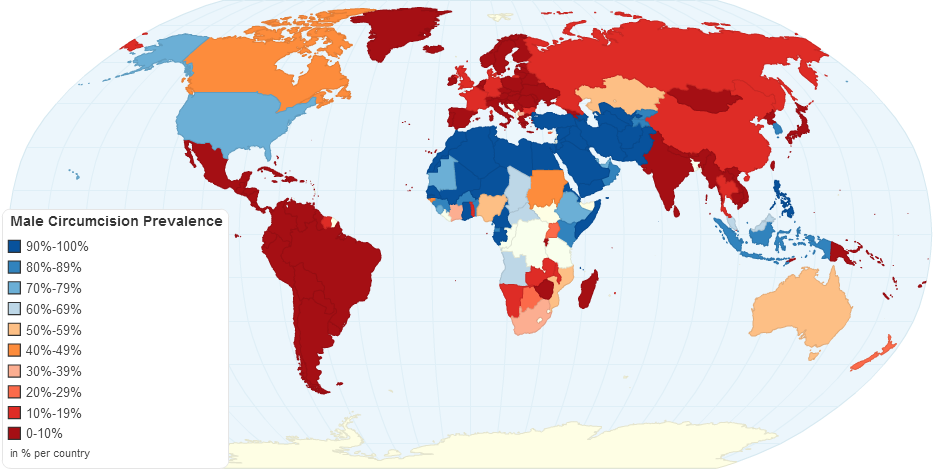
here is a map of the prevalence of male circumcision:

As we can see, circumcision is almost universal in Muslim countries, but very low in Europe and South America. In the U.S the circumcision rate is around 70%. Why is that? U.S. is a mostly Christian nation and we are told in Acts 15 that we should not be circumcised. There is an interesting aspect to circumcision and prostate cancer. The Mayo Clinic conducted a study a long time ago about the correlation between prostate cancer and circumcision, and they found a strong link, circumcised males had much lower risk of prostate cancer. There was one fatal fault with the study; it was done in Minnesota with a lot of people of Swedish descent, and the Swedes do not circumcise, and they have a much higher genetic propensity for developing prostate cancer than other population groups.

When our first son was born in 1969 the nurse nonchalantly handed me a clipboard and said: Sign here, it is standard procedure but it requires your signature. When I read through it I found out it was about circumcision, so I refused. She snarled and left and I overheard her saying to another nurse: Those Scandinavians; they are so backwards – she even wants to breast feed – how primitive!

January 10, read the Bible in a year; in PowerPoint, with comments.

Today we read about circumcision and its importance; in John 7 and one of the four chapters in Genesis selected for today. But that is just one part of the story.

John 7:1-24. Jesus pointed out that according to Jewish law, circumcision is more important than keeping Sabbath, so, if the eighth day is on a Sabbath, it must be performed on that day, but healing on a Sabbath is not permitted.

In Genesis15 God promised Abram a son. Abram believed God and it was counted to him as righteousness.

But in Genesis 16 Abram badly wanted an heir, so Sarai, being too old, gave her handmaiden Hagar to be the mother of Abram’s son, Ishmael. Sarai regrets what she had done, and Hagar was sent away with Ishmael into the wilderness.

Thirteen years later, in Genesis 17, Ishmael was back with Abram,  God  promised Abram his seed of promise, changed Abram’s name to Abraham and Sarai’s name became Sarah, established with an eternal covenant, the covenant of Circumcision, and it was performed on Abraham, Ishmael and all Abraham’s male servants.

Which brings us to Genesis 18 with Abraham still waiting for his promised offspring. He was visited by three angels that promised him he will have a son within a year. Sarah heard it and found it laughable, but God confirmed this promise, and was also proclaiming the destruction of Sodom and Gomorrah. Abraham tried to bargain with God at no avail.

The question to ponder: Why is circumcision important for Jews and Muslims, but not for Christians? Hint: read the Acts of the Apostles, chapter 15.