The normal state of the Earth is being in an ice age. If there were no greenhouse gasses at all, the temperature average for the earth would be about -20 C. But there are greenhouse gasses that increases the present world average temperature to about 15 C.
The earth every now and then warms up and enters an interglaciary period, and then slowly cools down again. People have noticed that for the last few ice ages the CO2 levels have closely tracked temperature, at least for Antarctica.
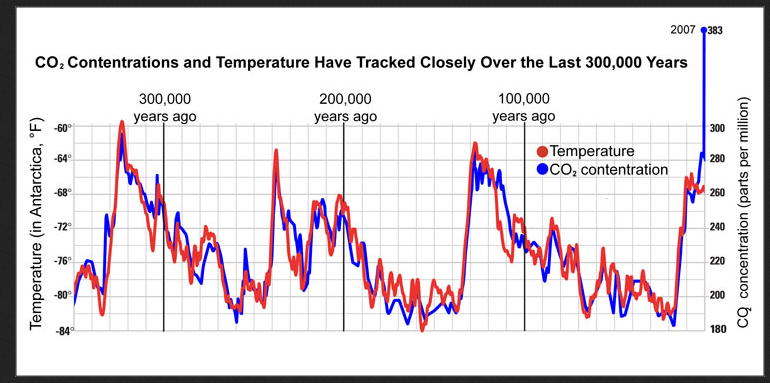
From this chart we can see that for an 18F (10 C) rise in temperature the CO2 level rose 85 PPM. Today;s CO2 level is 425 ppm, a rise of about 165 ppm from pre-industrial levels of about 260 ppm. If the relationship between CO2 levels and temperature still holds we should experience a temperature rise of about 9C for an average temperature on earth to rise to about 23 C (73F) in the near future.
This must be some of the information fed to United Nations Secretary-General Antonio Guterres when he pleaded for immediate radical action on climate change, saying that record-shattering July temperatures show Earth has passed from a warming phase into an “era of global boiling”.
In the book “An inconvenient truth” Al Gore used a very similar chart from the Vostok research site in Antartica, and he used the temperature scale in deviation from normal, hiding the fact that it showed temperatures in Antartica which are not very representative for average temperatures on earth. While the CO2 concentration is about the same everywhere on earth, 20,000 years ago it was about 180ppm. In Vostok, Antarctica the corresponding water vapor concentration was about 50 ppm in the Antarctic winter.
Al Gore chose the Antarctic to show the correlation between temperature and CO2 levels, but does that hold for the rest of the earth?
It was in Antarctica the last Ice age began to end; 19,000 years ago. Why did it end?
To answer that we must look at the
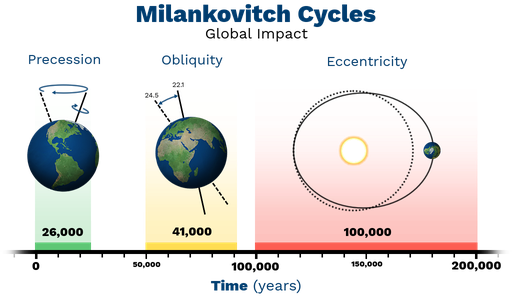
Right now the Earth is near its most circular path, nearing optimum,which is a very good place to be, minimizing yearly temperature cycles globally
Likewise the obliquity angle is about half way between minimum and maximum and is slowly decreasing.This is also good.
The most important of the cycles is the precession cycle. 19,000 years ago it gave most annular heat to the southern hemisphere. This does not normally trigger an end to the ice age, only every 16th cycle or so, when all cycles work together plus the influence of Jupiter and Saturn.One way to describe it is like the rotation in a tilt-a-whirl, popular in many county fairs. You sit peacefully in your car and go around and up and down and nothing happens, and suddenly the centrifugal forces pins you to the back of the car, the more the merrier. But for it to happen, all forces must come together. There could have been a large ice berg break-off, a volcanic eruption spewing ash over the southern hemisphere, an earthquake or a meteoric impact causing a tsunami that caused the start of the beginning of the end of the ice age. One thing is sure, there was no anthropogenic origin (rising CO2 didn’t start it), The question is:
Which came first, rising temperature or rising CO2 level?
The only way to answer that question is to measure what actually happened.
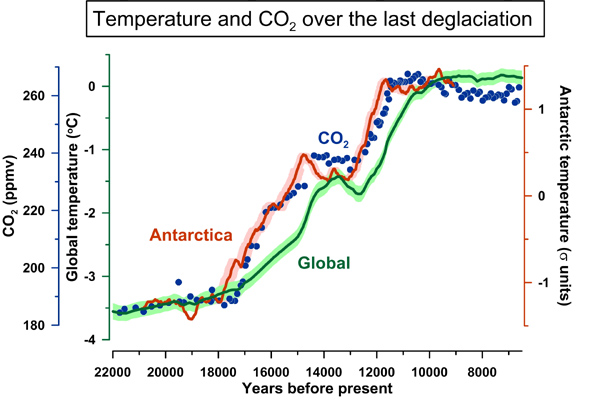
(from LiveScience By Wynne Parry published April 04, 2012.
This chart is very interesting. It shows the Antarctic temperature, starting to rise 19,000 years ago, global temperature and global CO2. The chart clearly shows that Antarctic temperature rose first, followed by rising CO2 levels for the first 4000 years. The CO2 level in the Northern Hemisphere follows the level in the Southern Hemisphere with only a 2 year time lag.
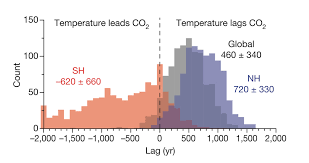
At about 14,000 years ago the Precession changed so solar radiation began to favor the Northern Hemisphere. At this time the CO2 levels had already increased to about 240 PPM but the ocean temperature was still lagging. In the Northern Hemisphere the CO2 rise came before the temperature rise. As we can see from the above picture temperature did lead CO2 levels by about 620 years +- 600 years in the Southern Hemisphere, whereas in the Northern Hemisphere CO2 leads Temperature by about 720+- 300 years for a global lead of CO2 rise over Temperature rise of 400 +- 340 years. But it is important to note that it was temperature that rose first, and as the oceans began to slowly warm up CO2 was released from the warming water hundreds of years later.
Then about 11,500 years ago CO2 levels leveled off at 265 PPM and began a slow decline to 260 PPM while global temperatures rose one degree C during the next 3,500 years. 8,000 years ago began a slow decrease in temperature. Then with no major change in CO2 levels temperatures declined by about 2,5 C until the end of the ‘little ice age’.
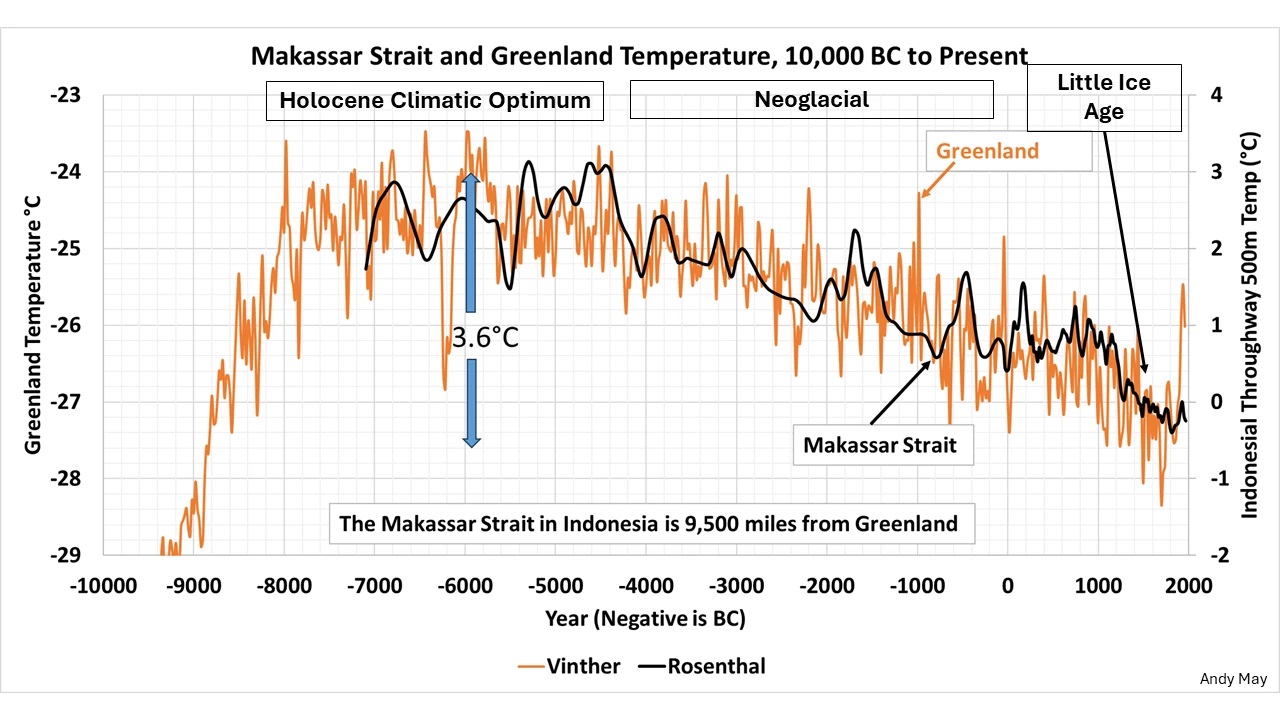
The chart above compares two temperature proxy reconstructions. The orange reconstruction is the Vinther (2009) elevation corrected Greenland temperature reconstruction from ice cores. The black reconstruction is from Rosenthal (2013) and is his 500-meter depth temperature reconstruction in the Makassar Strait, Indonesia. It is thought to represent sea surface temperatures in the North Pacific Ocean. The Greenland temperatures are taken from ice cores from Southeastern Greenland. These are all indirect measures derived from O2 isotopes in Greenland and from sea shells and other sources in the sea bottom of Makassar Strait
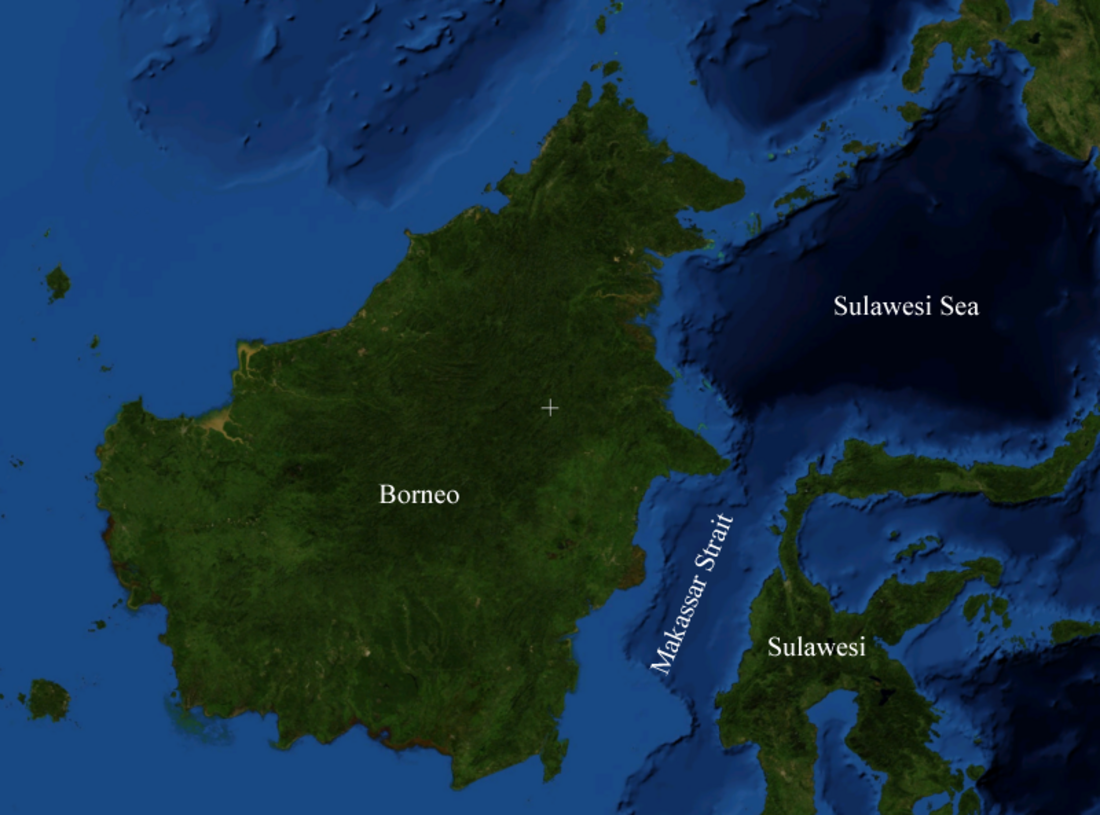
As the graph shows, temperatures follow each other very closely until the industrial revolution, when for the first time in 10,000 years the Greenland temperature start to increase, but the Makassar Strait temp doesn’t. One could argue that ocean temperature change lags atmospheric change by about 300 years.
Let us take a closer look at the temperature changes in the last 46.5 years, the only time we have good satellite records of global temperatures, and they are indeed rising.
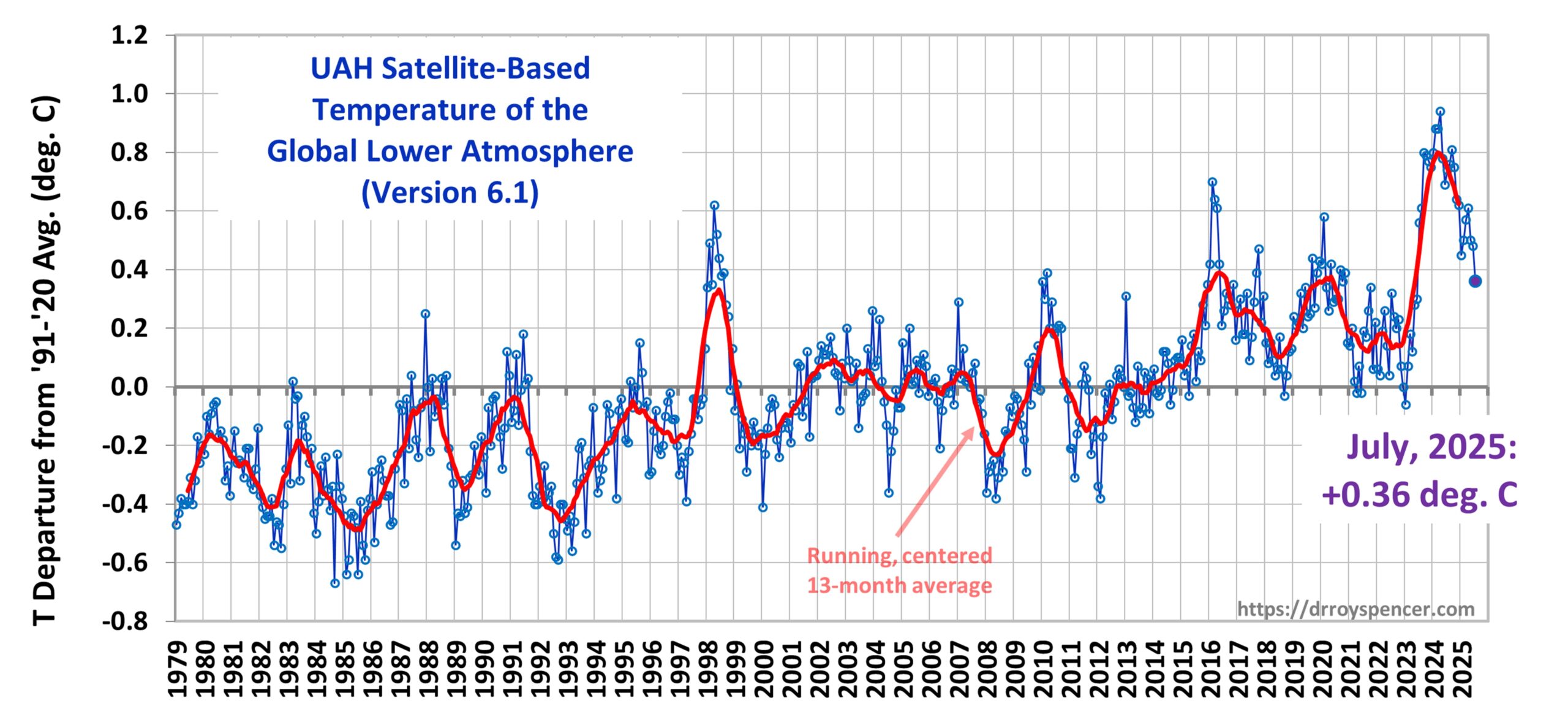
Yes. in the last 46.5 years the global lower atmosphere average temperature has risen about 0.8C. The question is: How much of this is due to rising CO2, how mush to H2O in all its forms: vapor, clouds, liquid, ice; and how much is due to other factors, such as Methane, Nitrous oxide, and the greening of the earth?
When global temperature increases 0.8 degrees Celsius and relative humidity stays the same there will be 5.5% more water vapor in the air. How much of the temperature rise is attributable to a 5.5% increase in water vapor?
To answer that we must take a look at the greenhouse effect. Without it the earth would be an ice ball with an average temperature about 34C cooler than today. The earth can be considered a black body that obeys laws for black body radiation, the Stefan–Boltzmann law that states that the total energy radiation is proportional to the fourth power of the absolute temperature (Kelvin), so an increase in global temp from 14C to 14.8C results in an increase of 1.01% in the total greenhouse effect (a smaller increase in the atmospheric window).
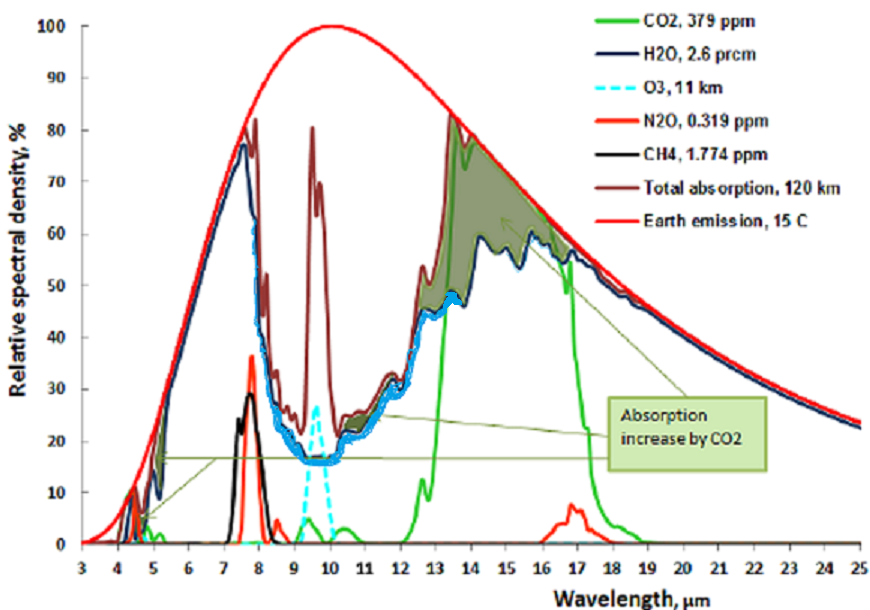
To sum it up: Since water vapor is fundamental I will count it first, and the effect of all the other greenhouse gases will be additional, remembering that the total absorption in any frequency band can never exceed 100% of available energy. Water vapor absorbs all available black body energy in all wavelengths except in the atmospheric window (7 to 17 μm) The increase of absorption occurs in the atmospheric window, and in some bands of the incoming sunlight in the near infrared region. The bands are 0.7, 0.8, 0.9, 1.1, 1.4 and 1.9 μm. Together, they make up 90% of the greenhouse gas temperature rise, or 29.9 degree C. When global temperatures increase by 0.8 C there will be 5.5% more water water vapor assuming relative humidity will stay constant, there will be an additional 0.17 C temperature rise.
Total greenhouse effect 33 C, Greenhouse effect from water vapor is 29.9C
Increased greenhouse effect from 5.5 % water vapor increase 0.17C. This is true only if relative humidity stayed constant. How much has the relative humidity changed?
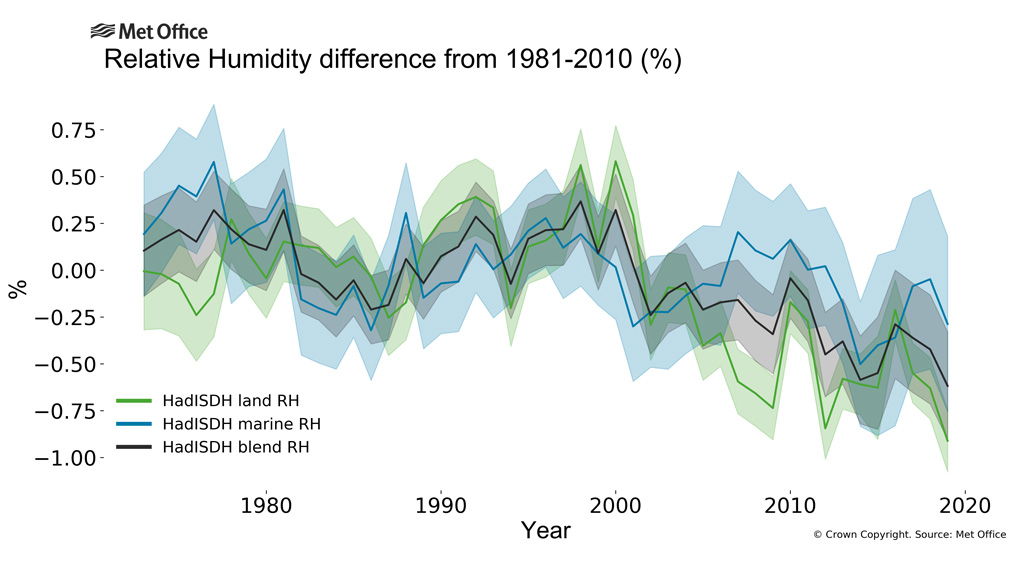
From a temperature increase standpoint the change is too small to change the results. However relative humidity has a great influence in the formation of clouds. We now has the 46.5 years of satellite data of clouds, but I only have the cloud averages. We all know that clouds cool by day and warm by night. During night, what is under clouds will absorb all the black body radiation, but re-emit as a new black body above the clouds, but at a much lower absolute temperature, depending on the cloud height. This is the smaller night effect.
Much more important is the daytime reflection of incoming sunlight. The most important clouds are the low level cumulus clouds that forms from humid air rising in daytime sunshine and disappear in the evening, but all clouds reflect back the incoming sun. All I have is statistics of cloud averages, but not where and when they appear and dissolve, but I will make the assumption that averages prevail. This is recent statistics of world average cloud cover:
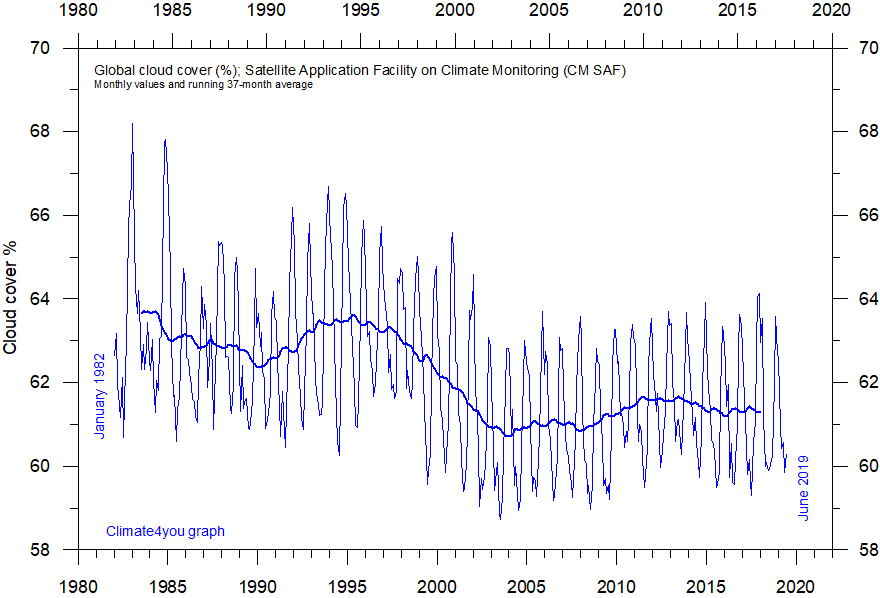
The cloud cover average (extrapolated) has decreased 3.45% in 46.5 years How much has temperature increased in the same time?
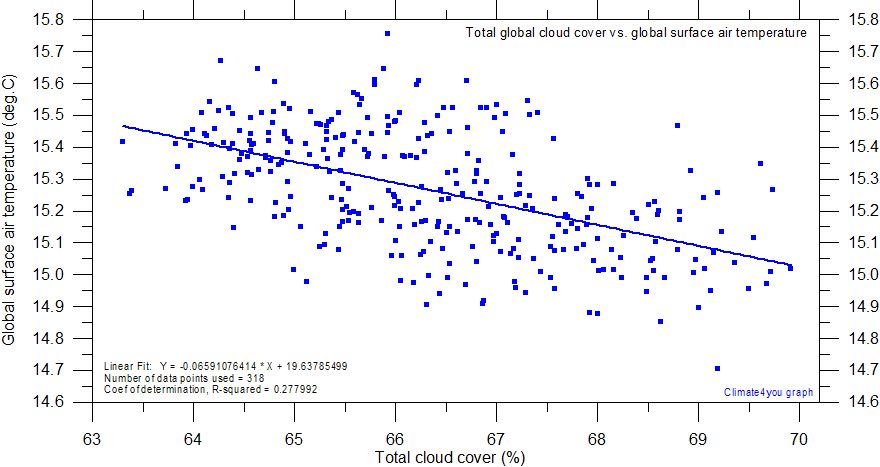
The total temperature rise due to less cloud cover over 46.5 years is 0.23C
Now it is time to see the effect of CO2 increase. In 1979 it was about 327 ppm, now it is about 427 ppm, a 27% rise in 46.5 years. If there was no water vapor in the atmosphere the greenhouse effect of CO2 would be 5.09C at 327 ppm and 5.28 C at 427 ppm. The reason it does not rise more as CO2 rises is that from 13 to 17 μm the temperature rise is limited because all available energy in that band is already fully absorbed. But it gets worse; the water vapor is already the dominant absorber, so the net addition from increased CO2 is only 30% of what would be if there was no water vapor, that is 1.527 C at 327 ppm and 1.584C at 427 ppm for a total CO2 rise of 0.057C.
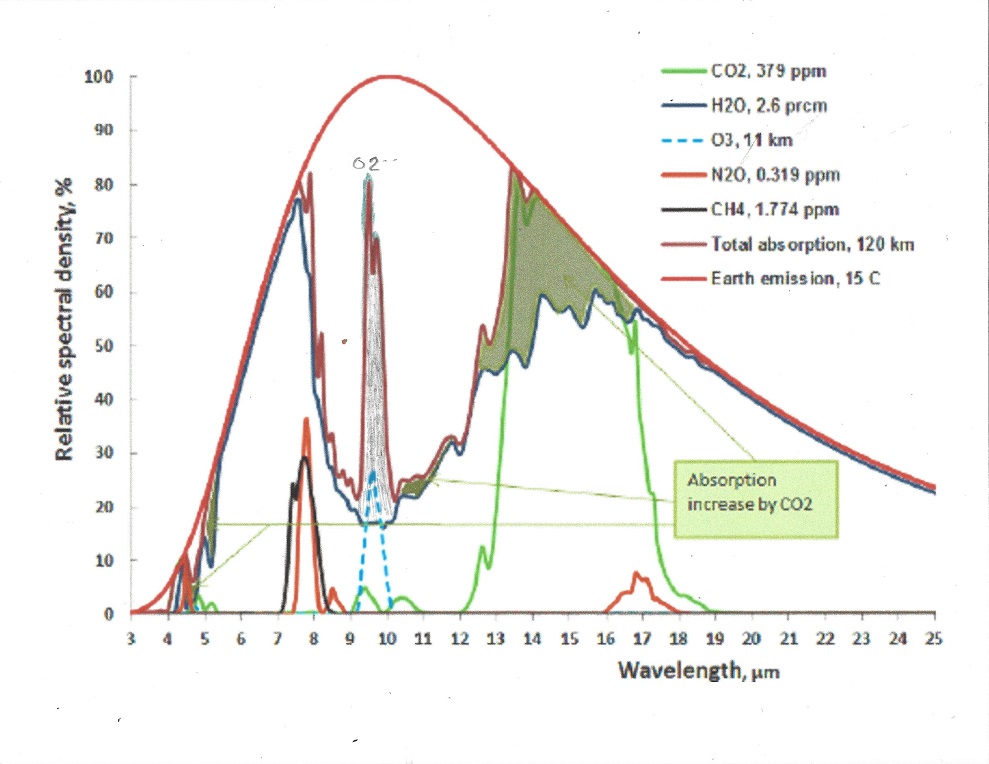
Likewise Methane and N2O absorption both occur around the 8 μm wavelength, where water vapor already absorb about 80% of all available energy, so that means both Methane and N20 are attenuated by about a factor of five from what they would have been had there been no water vapor.
Methane concentration has increased from 1.6 ppm to 1.9 ppm, leading to a temperature increase of 0.03C in 46.5 years.
N2O concentration has increased from 300 ppb to 340 ppb, leading to a temperature increase of 0.006C in 46.5 years.
The Arctic has experienced a temperature rise due to increased cloud cover and snowfall. It is due to increased heat transfer from the American Gulf in the form of water vapor, clouds, rain, and snow. When water vapor condensates into clouds, over 500 calories per gram of energy is released, and when it condensates into snow, another 80 calories per gram gets released. As water vapor increases with temperature, the Arctic gets less cold but snowier. The snow acts as an insulator on the sea ice, allowing the ice to freeze slower in the winter, and melt faster from the underside. This lead to a global warming of 0.06C in the last 46.5 years.
No such heating has occurred as of yet in the Antarctic. It is still the largest desert in the world; a hostile ice desert. (I wonder why Al Gore chose this climate to represent the relation between CO2 and temperature).
Add up all temperature changes so far in the 46.5 years of satellite data
Increased greenhouse effect from 5 % water vapor increase: 0.17C.
Total temperature rise due to less cloud cover over 46.5 years is 0.23C
Total temperature rise due to increased CO2 levels in 46.5 years is 0.057C.
Total temperature rise due to increased Methane levels in 46.5 years is 0.03C.
Total temperature rise due to increased N2O levels in 46.5 years is 0.006C.
Warming in the Arctic (globalized) over 46.5 years: 0.06 C.
Warming due to increased Ozone over 46.5 years: 0.004 C.
Warming due to increased HFC gasses over 46.5 years: 0.0015 C.
The total temperature increase noticed so far: 0.5585C. CO2 is responsible for 10% of the found rise, and Methane for 6% of the experienced rise.
There is one very interesting side effect of rising CO2, and to a much less extent; rising Methane levels. It leads to a substantial greening of the earth. The leaf area has been steadily increasing in areas where the leaf area is not fully saturated:
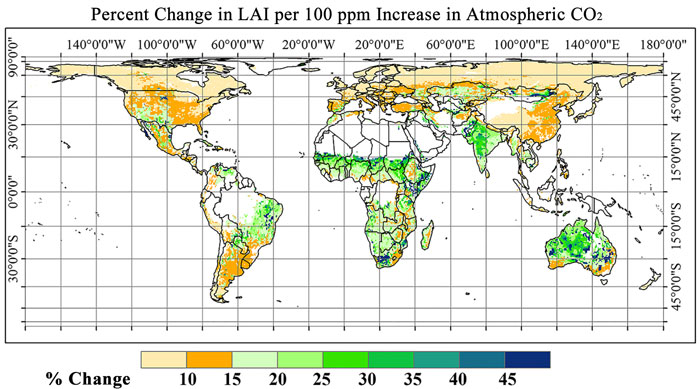
This picture shows the Leaf Area Index increase over the last 46.5 years.As we can see there is no increase in the deserts and in the dense rain forests, but overall there has been between 15 and 20% increase in the LAI. More leafs, more area to absorb CO2.
The rise in CO2 concentration from 327 ppm to 427 ppm makes the effective growth rate of vegetation increase about 25% on average. There is a wide variation between plant sensitivity to increased CO2, but they all react favorably up to more than 1000 ppm concentration.
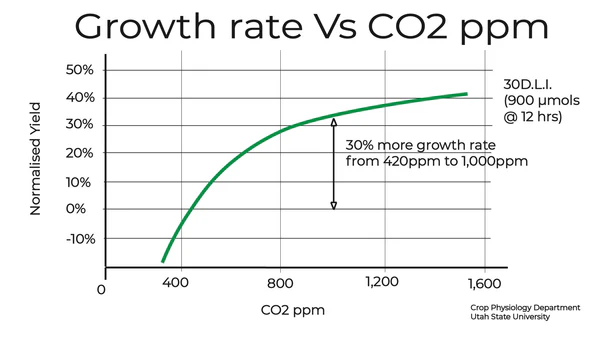
Using this information there should have been an increase in vegetation of 25 + 15% of CO2 uptake by vegetation worldwide without any other use of fertilizer. (Notice that the leaf area index did not increase much in the tropical rain forests since the leaf area is already fully optimized.
If one looks at the total greening of the earth the total leaf area did increase even in the rain forests, in some other areas by as much as 50%.
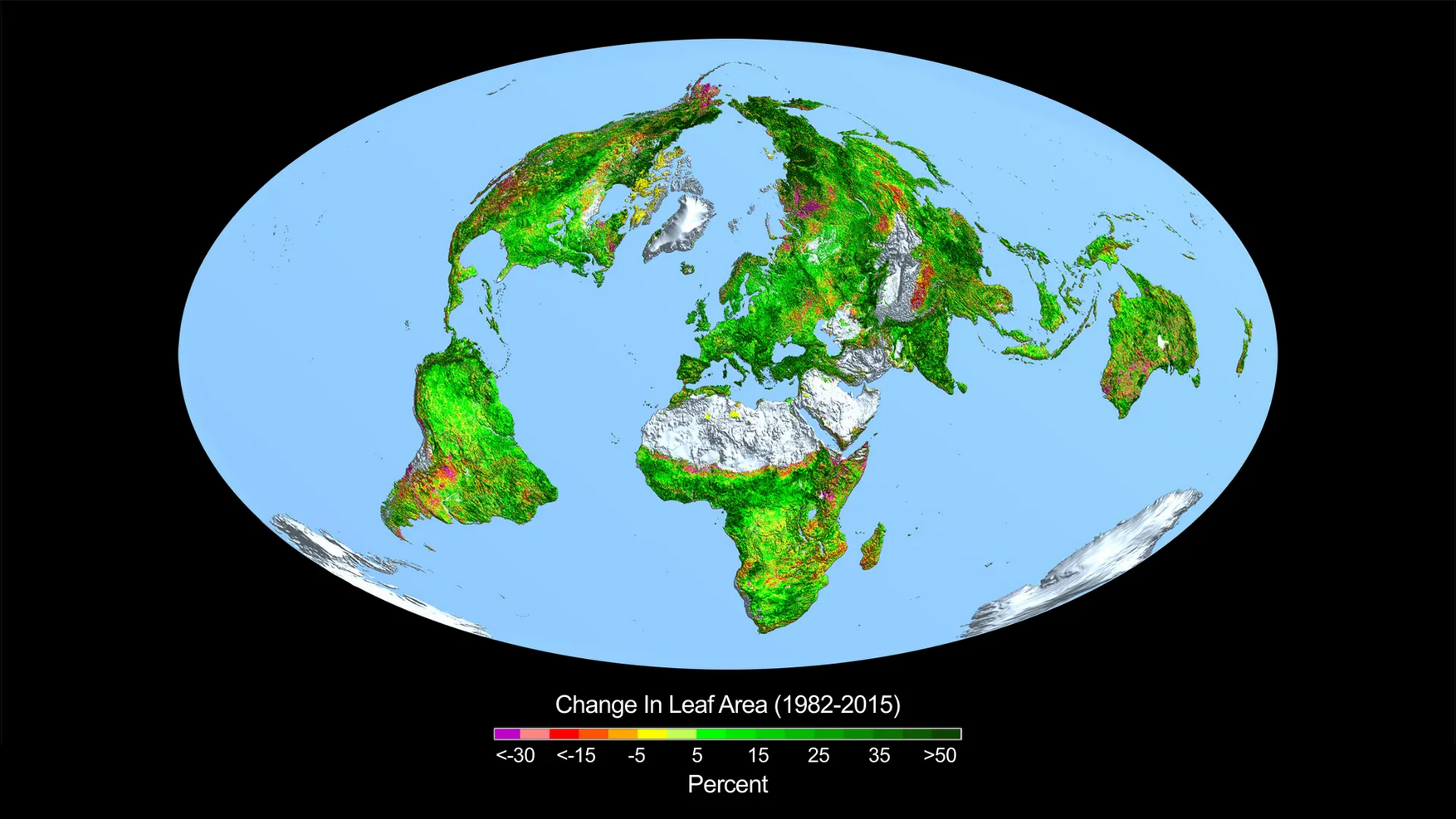
However, there are a few areas where the leaf areas decreased. these areas are where there is a deficit of water for optimal leaf growth. This is worrying, since the areas of water deficiency are areas where people want to live. An extreme example is today’s Iran, where the water reservoirs are running dry, and all water used in the hot summer is taken from aquifers that are also running dry. And it is getting worse:
The following picture shows the drying up of the earth between 2003 and 2013 in sea level equivalence from 0 to 2 mm
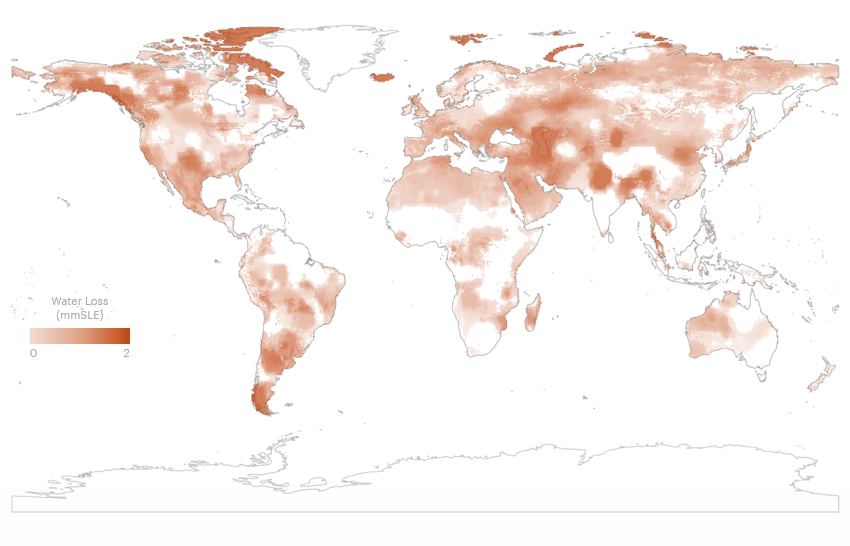
The areas most affected are the U.S. and Mexico Southwest, the South American Pampas, Southern Europe. Northern Africa, The Arabian Peninsula, The Middle East from Syria to Iraq, Iran Kazakhstan, Pakistan and North Western India, This is from 2014 to 2024 and it shows it is getting worse. The aquifers are getting consumed
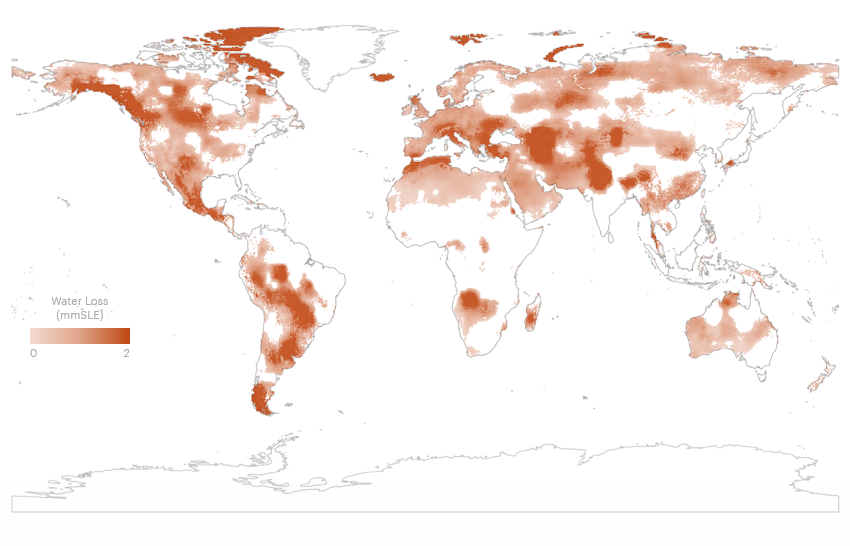
To take water out of aquifers without replacing it leads to an inevitable desertification of the areas where people want to live. Desertification leads to disaster, the rivers dry up and the areas become uninhabitable.
Urban heat islands: The worlds urban areas are growing rapidly and are now housing more than half the world’s population. It is now occupying more than 1% of the land area and has grown 0.15 % of the total area of the world. People living in urban areas, especially in areas with air conditioning are experiencing ‘local global warming’ of about 7F in the U.S. It is still large in all urban areas, maybe 4F on global average. (This is why people living in a megalopolis are convinced in global warming, they are living it.) Total global warming effect in the last 46.5 years: 0.033C
Draining land for infrastructure. We are doing what we can now to preserve wetlands, but wherever a road or other structure such as an airport is being built, proper drainage and land improvement is being performed. In the last 46.5 years about 1% of the worlds land surface has been drained and made dry. This is another heat effect that I estimate to lead to about 2C in the affected areas leading to a world temperature increase of 0.04C
Temperature increase from greening of the earth (without taking into account a changing cloud cover that is accounted for separately 0.002C
Temperature decrease from desertification of the earth: 0.001C
Total estimated temperature rise: 0.6325C
Summary: Temperature change due toWhat to do
Loss of cloud cover: 0.23C or 36%
5% increase in absolute humidity: 0.17C or 27%
Warming in the Arctic: 0.06C 0r 9,5%
Increased CO2: 0.057% or 9%
Infrastructure land use change: 0.04C or 6.3%
Urban heat islands: 0.033C or 5.2%
Increased Methane levels: 4.7%
All 0ther causes: 2.3%
What to do.
To go carbon neutral and do nothing else will solve less than 10% of the perceived problem. Neutralize Methane increase will add less than 5% to the solution
No, the problem is all about water, clouds and desertification.
In the next 100 years or so we will experience a magnetic polar reversal, and this may lead to an unprecedented rash of volcanic activity since the magnetic force reversals will activate magma in ways that we cannot yet foresee. When volcanic ash reaches the stratosphere it stays there for years causing global cooling. The Milankovitch cycles points to a slow cooling down of the earth.
The current rise in CO2 is very good. It has helped us feed another 2 billion people, not to mention all the wild life and plant growth.
The CO2 increase will delay the onset of the next ice age by about 2000 years. Without it we would still be in the little ice age.


 Len Bilén's blog, a blog about faith, politics and the environment.