Lake Oroville going dry, but why?

Once full was the Oroville Lake.

Now empty. How much does it take?

No pumped power galore

for the windmills to store.

Blame Climate change, not your mistake.

In 2016 then Governor Jerry Brown declared that California was in a permanent state of drought, so they might as well atart to prepare for water rationing.

The Lake Oroville Dam had a large crack in its spillway, and it was part of the regular maintenance to fix it, but since they were in a permanent drought the lake would never again be full, so there was no need, and certainly no hurry to fix it. Then in 1917 it started to rain again, the lake started to overflow, and instead of a less than 20 million maintenance task it became an over 1 Billion dollar rescue effort with helicopters trying to dump stones in the eroded parts of the dam
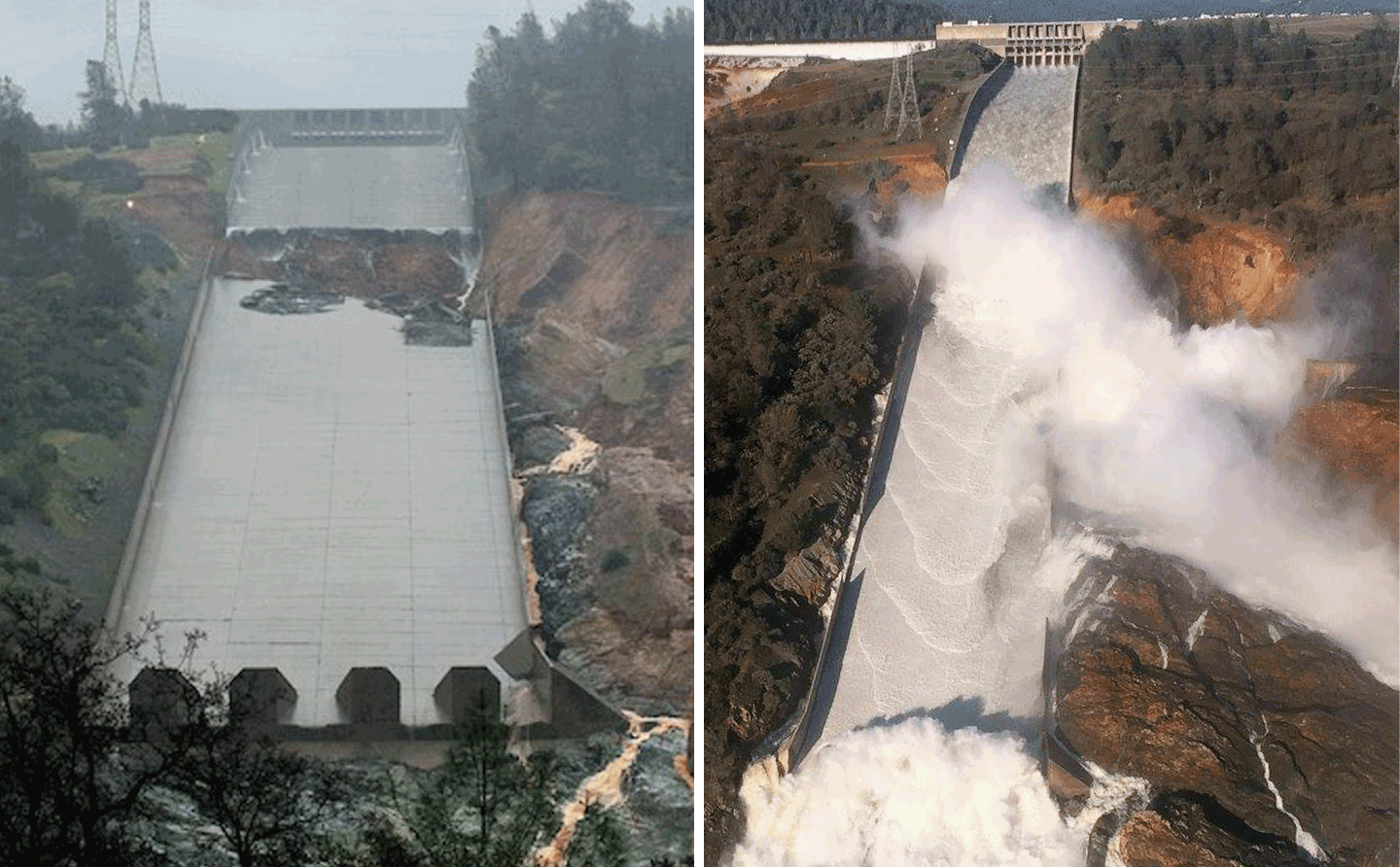
That was in early 2017. then in early 2019 it was full again, and with proper conservation measures there was enough water for 5 to 7 years with normal rainfalls from then on, so not to worry. Look where the lake levels are now:
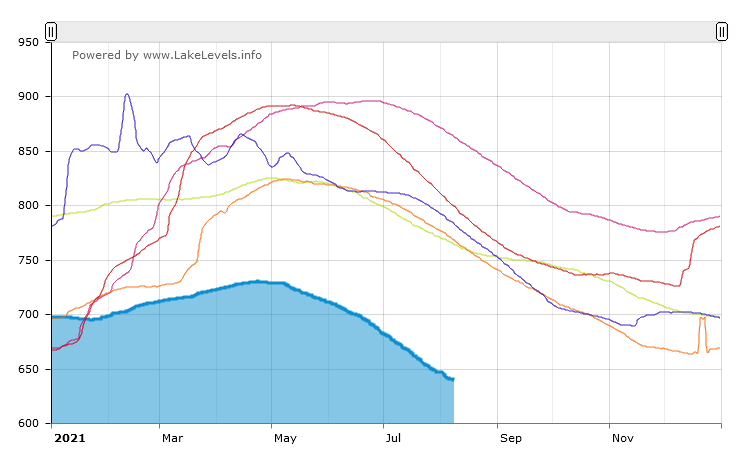

Lake Oroville water level 8 8 639.67 feet

power. But that is not allSince today’s level is below the intake for hydro-power there will be no power from Oroville dam until spring melting season, thus depraving California about 440 MW of power. But that is not all, it also eliminates Oroville Dam of 117 MW power as a Hydro-power storage “battery” for excess wind power, so more wind turbines will have to be shut off when the wind is blowing since there are no customers for excess power. On the other hand, when the wind is not blowing it will have to be replaced by coal or natural gas, which are in insufficient supply. The future is full of brownouts, and rotating blackouts.

This is how the Oroville Lake looks now:
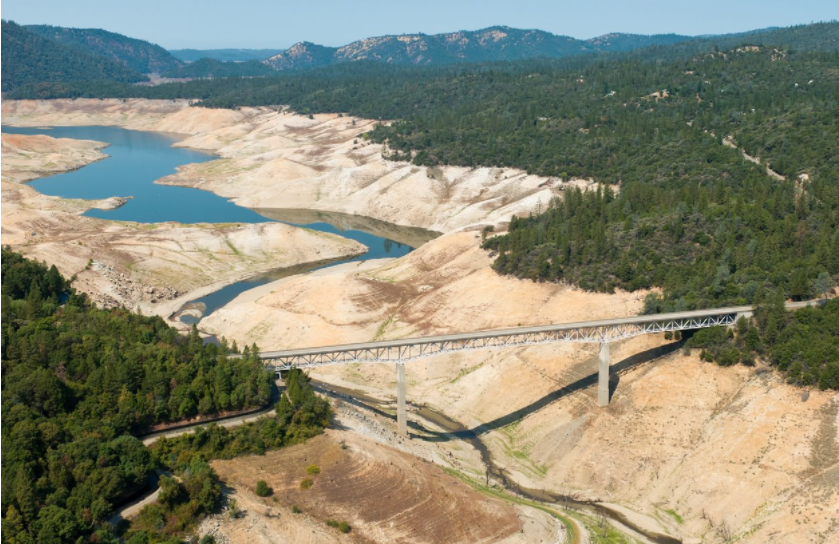
What is most galling is that of the water released in March of this year, before farmers really started to use water, 91% of the released water went into the San Francisco Bay to save the Delta Smelt, a totally useless fish, but protected. For the moment I can not think of a more inept way to run a water and energy business.
Duck, Duck, Go bankrupt, California’s energy policy.

Depend on renewable power

is chancy in sunshine or shower.

California’s surge

is becoming a scourge;

the losses add up every hour.

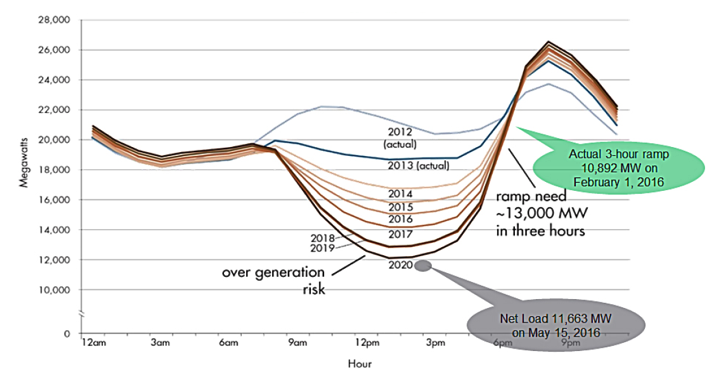
It started innocently enough. In 2012 the California power demand was nearly constant, with power varying 20% from maximum to minimum hourly demand.

Image result for duck curve california

Then California decided to have 50% of renewable energy by 2030, mostly by solar and wind, and passed it into law, but the hydroelectric capacity could not be increased due to “environmental concerns”.

The push for renewable energy has succeeded beyond their wildest dreams, so the goal may be met in 2020, not 2030. There is one major problem.

What can be done when the wind doesn’t blow and the sun doesn’t shine? The electric need must still be met. And therein lies the problem. The sun only shines during daytime, and there is already a surplus of energy in the middle of the day. This affects the prices for peak power, so mush so, that wind and sun generated energy has to pay to feed the grid. They are heavily subsidized, so as long as the amount they have to pay is less than the subsidy the grid will be fed, and the base generation will have to be lowered to stabilize the grid. The prices range from minus five cents/kWh to about 55 c/kWh. (The peak price has been as high as 98 c/kWh during peak demand.

Image result for duck curve california

Burt that is only part of the problem. The non-renewable electricity providers will have to double the electricity production every day between 5 and 8 p.m. every day. Using capacitors to even out the grid variations solves 0.3% of the problem.Some can be done by using the dams for power generation, but the grid is not built to handle the drastically increased demand, and environmental fights makes it impossible to build out the grid. In addition, the dams are far away from the areas that need the electricity, in other words, it is a mess.

And the consumer is left to pay the extra costs, and the taxpayer is left to pay the extra subsidies.

Talking about subsidies: Electric cars are subsidized to the tune of 2500 to 7500 dollars, and they are recharged when? They are driven mostly during daytime, and when people come home they are put in the charger – at 55 c/kWh to the utility.

Clean energy is not cheap, and it is not clean since the non renewable electric production capacity still has to be fully built up for the time when the sun doesn’t shine and the wind doesn’t blow.