Is climate change all in the cloud?
Acknowledge it is not allowed.
Settled science, they say.
Buckle up and portray
disaster! Close rank, join the crowd.
I believe in climate change. It is obvious by observing how the climate has changed over the years. Here is a chart of global temperature and CO2 for the last 600 million years.

The chart is smoothed over millions of years, but it shows that the global average tempera ture stabilizes at 22C regardless of CO2 levels, and there is precious little correlation between temperature and CO2 level. Taking a look at the last 450,000 years it shows an interesting pattern:

It shows that more than 90 percent of the time the earth has been colder than today, most of that time in a series of ice ages, interrupted with inter-glacial periods of between 5,000 and 20,000 years. This inter-glacial period is of interest, since it points to our future – another ice age, the question is: When it will start? According to the Milanković cycles we are still in the moderate temperatures sweetspot, and it will last for another few thousand years, but the trend is down, tne next ice age is inevitable. In fact, except for the little ice age and the time between the Roman warm period and the medieval warm period, the global temperatures have been higher than now for the last ten thousand years. This shows the temperature from the Greenland ice cores for the last 10000 years:
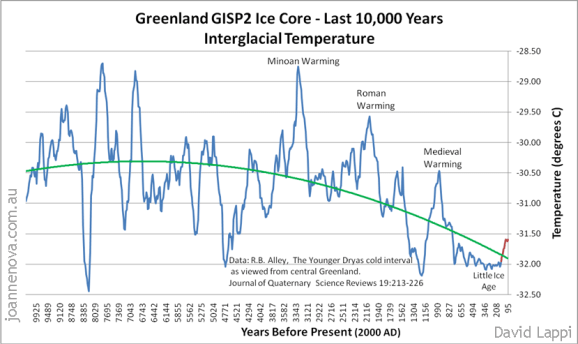
All of these changes in climate occurred with a relative constant CO2 level of about 260 ppm!
This time is different; CO2 levels are now over 400 ppm, rising about 2 ppm per year with no end in sight. The question is: Is this increase good or bad? If it is bad, how bad is it going to be?
To answer this question the world spends over 400 billion dollars a year in climate research and are starting to spend much more in climate remediation. Over 30 nations are making climate models trying to predict future temperature trends. Of the models so far all but one fail miserably when compared to what actually is happening. The sole exception is the Russian model which tries to fit their model to past temperature records rather than postulate that response from CO2 and water vapor are always additive.
There is a better, far simpler way to predict future temperature trends. The reason CO2 and water vapor are not always additive is because water vapor is a condensing gas, sometimes forming clouds, which drastically alter the temperature of the surface. Clouds forming at day reflects a large portion of the sunlight back into space, clouds at night keep the heat in.
Willis Eschenbach has made en excellent analysis of 19 years of data from CERES (Clouds and the Earth’s Radiant Energy System from NASA). He compensates for the effect of Advection (horizontal heat transfer of energy from one place on earth to another.) The results are startling:
The 3.7 W/m2 is the expected increase of heat retention for a doubling of CO2 as per IPCC (the U.N Intergovernmental Panel on Climate Change). A similar result is obtained if one is to include data from HadCRUT (Temperature data from the Hadley Centre of the UK Met Office)

This agrees very well with my own, much coarser examination of data, but should include that the expected temperature increase observed for a doubling of CO2 is by no means evenly distributed. In addition, if temperature rises 0,39C there will be about 2.6 % more water vapor in the air which would rise temperature another 0.35 C. This too is not evenly distributed. Here are the expected result:
In the tropical doldrums there will be no change at all, the water vapor is all dominant and thunderstorms keep the average temperature constant.
In the 10-40 latitude there will be an increase, but increased clouds will moderate the increase except in the most arid deserts that will experience around a 0.9 C increase.
The temperate regions will experience about a 0.4 C increase in the wet areas, and about a 0.6 C in the arid parts.
Most of the increase will be experienced around the poles, with minimum temperatures rising five to ten degrees, but maximum temperatures staying about the same. We are seeing this increase in the Arctic, and the rise is nearly all due to rising winter minimum temperatures.
 Source: Danish Meteorology Institute
Why is that? With on the average 2.6 % increase in water vapor there will be an increase in the rainfall, about 2.6% on average, but since there is no change in the tropics it will be concentrated at the higher latitudes, especially around the poles where it will manifest itself as more snow, and that is the main reason for the increased minimum temperatures. Notice there has been no increase in summer temperatures!
So, how bad is it going to get if nothing is done to stop the increase in CO2?
The temperature difference between poles and equator will be less, which means:
Fewer and less severe hurricanes, less severe tornadoes, less severe winter storms, less droughts.
But there will be about 2% more average cloud cover, more rain and more flooding.
So, with an 0.4C average temperature we will not even be back to the medieval warm period, much less the Roman warm period, not to speak of the Minoan warm period.
The sinking eastern seaboard is a problem that has very little to do with ocean rising, and all to do with tectonic plates movements, which we will have to accept.
Will anything else good come out of this climate change?
Yes, indeed. With a doubling of CO2 there will be a corresponding response from plant life increasing biological productivity 30 to 60%. It is not linear, and above 800 ppm it tapers of for most plant species. But we will be able to feed at least another 3 billion people and keep them from hunger, but also much cattle and wild animals, (yes that includes flies and gnats, but I digress)
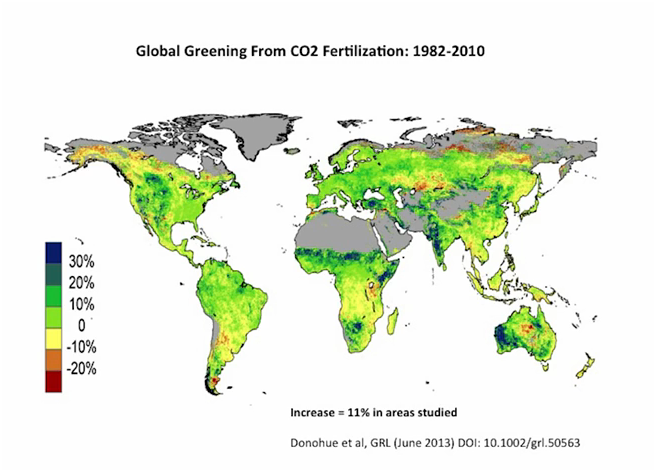
This picture gives us hope for the future. Notice the most significant increase was in Sub-Saharan Africa, western United States, western Australia and western India. These are the areas that need more rain the most!
If increasing CO2 concentration is not the problem, then what is? Let us take a look at the sources from which U.S. generates electrical energy.

We live in challenging times indeed, with enormous environmental challenges. It takes a lot of energy to clean up the mess we have generated over the ages. It would be a shame to use up our remaining coal, oil and gas to produce the electricity needed to clean up. Oil coal and gas will eventually be depleted and we need to save some for our great grandchildren so they can enjoy flying like we have become accustomed to. Like the famous conservationist Sarah Palin once said: “for when it’s gone, it’s gone.”
Solar generation is about 4 times more expensive (without subsidies) to produce energy than coal and gas, but has important niche applications, such as on roofs for backup in case of short grid failures and for peak power assist. The Amish people have given many practical applications on how to live off the grid.
Wind power is cheaper when the wind blows, but the full generation capacity has to be there even when the wind doesn’t blow, so the only gain from wind power is to lessen the mining or extraction of carbon. In addition, wind power kills birds, the free yearly quota of allowable Bald Eagle kills was upped from 1200 to 4200 during the Obama administration. Golden Eagles and a few other rare birds have a quarter of a million dollar fine associated with their kills. If wind power is increased without finding a solution to the bird kills, whole species may become extinct.
Hydroelectric power is for all practical purpose maxed out, except one large untapped resource; the Kongo river in Africa. Some hydro electrical project do more harm than good, such as the Aswan Dam in Egypt, and some are waiting for the next big earthquake, such as the Three Gorges Dam in China.
Geothermal power is good but difficult and risky to utilize in geologically unstable areas.
Biomass should never be burned for electricity production but be used for soil regeneration to combat erosion. Only polluted biomass such as medical waste and plastics should be incinerated at high temperature, complete with scrubbers to eliminate poisonous gases.
All necessary cleanup and recycling consume a lot of energy, and it has to be generated somehow. We would like save some Coal, Natural Gas and Petroleum for our great grandchildren. This leaves us only
Nuclear power. After a nearly thirty year hiatus in building new nuclear power plants they are slowly being built again. The permit process is fraught with citizen opposition (NIMBY), very strict bureaucratic delay, first by the Three Mile Island incident, then by the Chernobyl disaster/unintended sabotage, and finally by the Fukushima catastrophe. In addition conventional nuclear power produces large amounts of transuranium waste products that has to be stored for a million years. The Obama administration ended reprocessing of spent fuel rods, so not only must the transuranium products be stored, but also some unused U235. This makes conventional nuclear power using enriched Uranium too expensive to compete against coal or natural gas. But there are powerful commercial interests to keep it this way. After the Westinghouse bankruptcy GE has a virtual monopoly on nuclear power. They are in no hurry to make any changes.
There is a better way: Thorium Nuclear power. The advantages are:
1. A million years supply at today’s consumption levels.
2. Thorium already mined, ready to be extracted.
3. One ten-thousandth of the TRansUranium waste compared to a U-235 based fast breeder reactor.
4. Thorium based nuclear power produces Pu-238, needed for space exploration.
5. Radioactive waste from an LFTR decays down to background radiation in 300 years compared to a million years for U-235 based reactors.
6. Thorium based nuclear power is not suited for making nuclear bombs.
7. Produces isotopes that helps cure certain cancers.
8. Molten Salt Thorium Reactors are earthquake safe.
9. Molten Salt Thorium Reactors cannot have a meltdown, the fuel ia already molten.
10. Molten Salt Nuclear Reactors have a very high negative temperature coefficient leading to a safe and stable control.
11. Atmospheric pressure operating conditions, no risk for explosions.
12. Virtually no spent fuel problem, very little on site storage or transport.
13. Thorium Nuclear Power generators scale beautifully from small portable generators to full size power plants.
14. No need for evacuation zones, can be placed near urban areas.
15. Liquid Fluoride Thorium Reactors will work both as Base Load and Load Following power plants.
16. Liquid Fluoride Thorium Reactors will lessen the need for an expanded national grid.
17. Russia has an active Thorium program.
18. China is having a massive Thorium program.
19. India is having an ambitious Thorium program.
20. United States used to be the leader in Thorium usage. What happened?
21. With a Molten Salt Reactor, accidents like the Three Mile Island disaster will not happen.
22. With a Molten Salt Reactor, disasters like Chernobyl are impossible.
23. With Molten Salt Reactors, a catastrophe like Fukushima cannot happen.
24. Produces electrical energy at about 4 cents per KWh.
25. Can deplete some of the existing radioactive waste and nuclear weapons stockpiles.
There is no time to waste. This is my suggestion list:
1. Immediately take Thorium off the list of “source materials”. While Thorium is radioactive slightly above background radiation no amount of Thorium can make it go critical, and it cannot be source material for making bombs.
2. Make separate regulations for Thorium based Nuclear plants apart from Uranium plants. One thing that goes away is the need for evacuation zones due to the inherent safety of Thorium Nuclear plants.
3. Declare Thorium Nuclear Power to be the preferred replacement for Coal or Gas powered electric plants.
4. Streamline the permit process, like Uranium powered plants enjoyed when there was a desire to build Nuclear Bombs.
5. Increase research and development into Liquid Fluoride Thorium reactors to speed up their development.
6. Develop hybrid Tokamak powered Thorium reactors like the one Russia is developing to burn off transuraniun nuclear waste products.
With all this done, I envision coal, gas and biofuel Power stations to be eliminated within ten years, and transuranium waste products to be eliminated within twenty years.
When Coal, gas and biofuel are eliminated as source for Electric Power, then it is time to switch most of the transportation to electric cars and trucks, but not before.
in another twenty years, maybe, just maybe it is time for Fusion Power to take over.
Let us get going!

