Mark 8:1-21Mark 8 begins with Jesus as he fed the four thousand, the Pharisees were still looking for a sign, but Jesus warned of the yeast of the Pharisees and Herod, all very confusing for the disciples; they were still not thinking in the spiritual realm.
Judges 4. Every now and then God raises up a woman to lead the people. Deborah was such a woman and judged the people of Israel.
Judges 5 is all about the Song of Deborah. Read it and enjoy!
Judges 6. Things were going bad for Israel, the Midianites oppressed them, God called Gideon. Gideon was reluctant but after speaking with the Angel of the LORD Gideon destroyed the altar of Baal. God wanted Gideon to defeat the Midianites but again Gideon was reluctant, so he demanded the sign of the Fleece (twice). God provided the sign.
One of the many problems facing solar farms is that they produce electricity only when the sun shines, which is less than half the time, so for the rest of the time electricity must be provided some other way. Historically peak power demands were provided by pumped storage plant, but very few have been built since the 70’s. Peak power is now supplied by natural gas electric plants, which is for now the most economic solution. If we want to get real about reducing our fossil fuel dependence, pumped storage must be looked at seriously, especially when changing our vehicle fleet from gasoline or diesel fuel to electric power source.
Here is spur 15 proposal sketch
Spur 15 is 7 miles long, starting at 3950′ and ending at 4750′
Dam 1 is the Poppy Canyon Upper Lake. To fill this lake in a year requires Spur 15 to have a capacity of 330 cfs. It will require 240 GWh to fill the lake from the TCA connection point. It has a 4,000 feet wide and up to 640 feet high dam, topping out at 5400 feet, and the lake holds a volume of up to 240,000 acre-ft of water. It would normally hold a minimum volume of 60,000 acre-feet of water to increase the average height difference between the upper and lower dam.
Dam width 4,500′ height 540′ water storage 230,000 acre-ft
Dam 2 dams the Cove Tank dam. It has a 3,300 feet wide and up to 360 feet high dam, topping out at 4,080 feet, and the lake holds a water volume of up to 110,000 acre-ft. Water is pumped from and released to the upper dam via a 13 mile tunnel
Dam width 6,000′ height 380′ water storage 110,000 acre-ft
Dam 3 is the Poppy Canyon Lower Dam. It has a 3,300 feet wide and up to 460 feet high dam, topping out at 4,900 feet, and the lake holds a water volume of up to 70,000 acre-ft. Water is pumped from and released to the upper lake 1.8 mile tunnel.
How much energy will it generate per day? To dam 2 will be releasde 110,000 acre-ft for 5 hrs generating 115 GWh per day or 23 GW of peak power for 5 hrs. Dam 3 will release 70,000 acre-ft for 5 hrs generating 25 GWh per day or 5 GW of peak power for 5 hrs. To again fill dam 2 and 3 will require 17 GW of power from the solar panels. An alternate power would be 9 GW of LFTR power plants, generating 9 GW of alternate peak power when water is released. Most probably the power sources will be a combination of the two.
This pumped storage plant will add another 120% to the existing U.S. pumped storage capacity.
Mark 7:24-37. Jesus went to the region of Tyre and Sidon and gave an example of Great Faith: The Canaanite woman, and the healing of her daughter. Then Jesus healed a deaf-mute man, and the people said: “He has done everything well.”
Judges 1 describes the continuing conquest of Canaan, and the Israelites’ incomplete conquest of the land.
In Judges 2 God decried Israel’s disobedience, the author recorded the death of Joshua, and chronicled Israel’s unfaithfulness and sin.
Judges 3. The cycle of straying from the LORD and coming back to Him began for the nations remaining in the land. Israel did evil in the sight of the LORD and He raised up Judges: Othniel, Ehud, Shamgar, and during their time there was peace in the land for 40, then 80 years.
One of the many problems facing solar farms is that they produce electricity only when the sun shines, which is less than half the time, so for the rest of the time electricity must be provided some other way. Historically peak power demands were provided by pumped storage plant, but very few have been built since the 70’s. Peak power is now supplied by natural gas electric plants, which is for now the most economic solution. If we want to get real about reducing our fossil fuel dependence, pumped storage must be looked at seriously, especially when changing our vehicle fleet from gasoline or diesel fuel to electric power source.
Here is spur 14 proposal sketch
Spur 14 is 100 miles long, starting at 3000′ and ending at 4700′
Dam 1 is the White Oaks Canyon Lake. To fill this lake in a year requires Spur 14 to have a capacity of 120 cfs. It will require 190 GWh to fill the lake from the aqueduct.. It has a 2000 feet wide and up to 480 feet high dam, topping out at 5140 feet, and the lake holds a volume of up to 100,000 acre-ft of water.
Dam 2 dams the Pine Canyon dam. It has a 2,200 feet wide and up to 240 feet high dam, topping out at 5,620 feet, and the lake holds a water volume of up to 60,000 acre-ft. Water is pumped from and released to the White Oaks Canyon lake to the Pine Canyon pumped storage via a 2 mile tunnel.
Dam 3 dams the Sitting Bull Canyon well above the Sitting Bull Falls recreation area. It has a 2,000 feet wide and up to 360 feet high dam, topping out at 5,610 feet, and the lake holds a water volume of up to 40,000 acre-ft. Water is pumped from and released to the White Oaks Canyon lake to the Pine Canyon pumped storage via a 2.4 mile tunnel.
How much energy will it generate per day? Dam 2 will release 60,000 acre-ft for 5 hrs generating 45 GWh per day or 9 GW of peak power for 5 hrs. Dam 3 will release 40,000 acre-ft for 5 hrs generating 28 GWh per day or 5.6 GW of peak power for 5 hrs. To again fill dam 2 and 3 will require 17 GW of power from the solar panels. An alternate power would be 4.5 GW of LFTR power plants, generating 4.5 GW of alternate peak power when water is released.
This pumped storage plant will add another 70% to the U.S. pumped storage capacity.
Mark 7:1-23, Mark 7. Jesus explained what is clean and what is unclean.
Ecclesiastes 11 explains the value of diligence. One advice: Seek God early in life.
Ecclesiastes 12. “Remember now thy creator in the days of your youth“. “Fear God, and keep his commandments: for this is the whole duty of man.”
Psalm 31, of David. As was so often the case, David was in trouble. He cried out about his woes to God, and yet, the Psalm ends with praise and total confidence in God.
Psalm 32, of David. “This was Saint Augustine’s favorite psalm. Augustine had it inscribed on the wall next to his bed before he died in order to meditate on it better.” (James Montgomery Boice)
Mark 6:14-56. John the Baptist was beheaded. By the way – the name Salome is not in the Bible, only as Herodias’ daughter, we know it because beheading fascinates many. The Salome in the Bible was one of the three that came to the empty grave to anoint Jesus’ body. Then is retold the feeding of the Five Thousand, and after that Jesus walked on the water.
Joshua 24. The Covenant was renewed at Shechem, at which time Joshua retold their history thus far, followed by the death of Joshua, and also the death of Eleazar, Aaron’s son.
This leg will start with a free-flowing Gila River for 30 miles, followed by the painted Rock Reservoir for 20 miles, the Painted Rock Dam.
This picure was taken during high runoff. It is normally dry.
The dam is at elevation 661 feet and runoff starts at 550 feet. Drainage capacity is adequate and maximum storage is 2 million acre-feet. The population of Indians and early settlers are already resettled and compensated. To fill the dam with the 2,500 cfs flow available in phase 1 would take over a year. The reservoir will be used to even out seasonal demand.
After the dam Gila river will be free glowing for 90 miles until it joins the Colorado River in the first pass. In the second pass there will be an aqueduct built with a capacity of 7,100 cfs flow for 100 miles to the
To the Martinez lake it can deliver up to 7,100 cfs. ( The design capacity of the All American canal is 15,155 cfs.) The Martinez lake is puny, and would easily be overwhelmed by surges in the water flow. To accommodate this, the Senator Wash Reservoir will have to be upgraded to be able to pump up or release at least twice as much water as is its present capacity. Lake Martinez is at about 180 feet elevation, and Senator Wash Reservoir is at a maximum elevation of 240 feet.
The Martinez lake and the Senator Wash Reservoir.
The rest of the Transcontinental Aqueduct empties out where the Gila river joins the remainder of the Colorado river a few miles downstream. It will carry on average 2,100 cfs of water to accommodate the needs of Mexico and also provide a modest amount of water to assure the Colorado river again reaches the ocean, maybe restoring some shrimp fishing in the ocean.
The 1944 water treaty with Mexico provides Mexico with 1.5 million acre-ft per year, more or less dependent of drought or surplus. It will be increased only on condition that when the Transcontinental aqueduct is finished, the New River in Mexicali will be cut off at the border, and Mexico will have to do their own complete waste water treatment.
There will be water allocated to the Salton Sea. Proposed will be the world’s largest Lithium mine, mining the deep brine, rich in Lithium. (about a third of the world supply according to one estimate). This requires water, and as a minimum to allow mining in the Salton Sea the water needs to be cleaned. This requires further investigation, but the area around the Salton Sea is maybe the most unhealthy in the United States.
What’s in it for Mexico? Mexico will get sweet , reliable water, much better suited for agriculture..
What’s in it for Arizona? The farming downstream will be better served by reliable sweet water.
What’s in it for California? The All American Canal will get a reliable supply of sweet water.
What’s in it for Lake Mead? The lower Colorado river will get an infusion of about 15,000 cfs, or about 10 MAf, which will allow lake Mead to recover by 8 to 10 MAf per year. This should solve the Colorado River’s water problem until the population served by the Colorado River reaches 60 million people.
Leg 12 of the Transcontinental aqueduct is complicated. The total length of this segment is 105 miles, 20 miles is a 6,200 cfs aqueduct, and 85 miles is the Gila River. This map may help explain it:
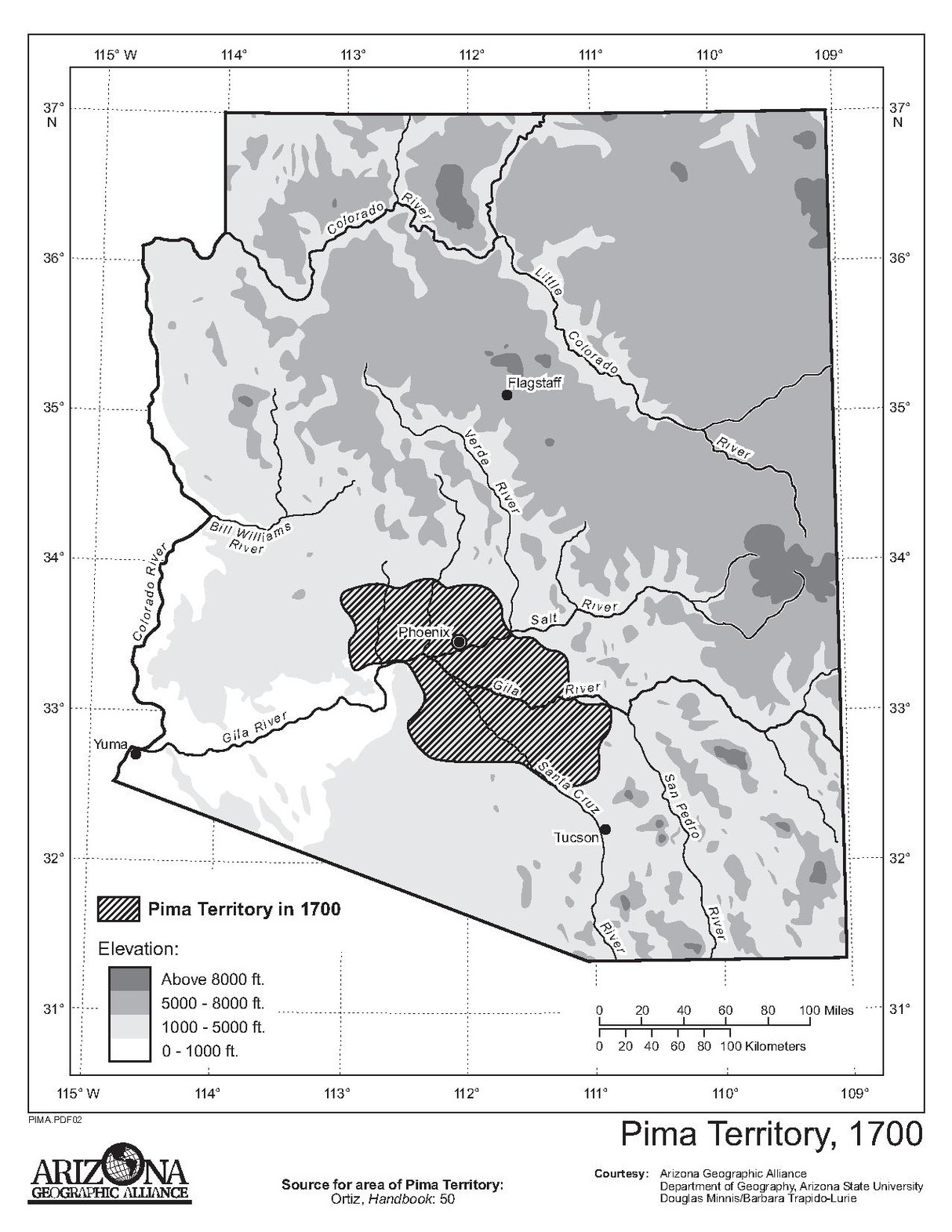
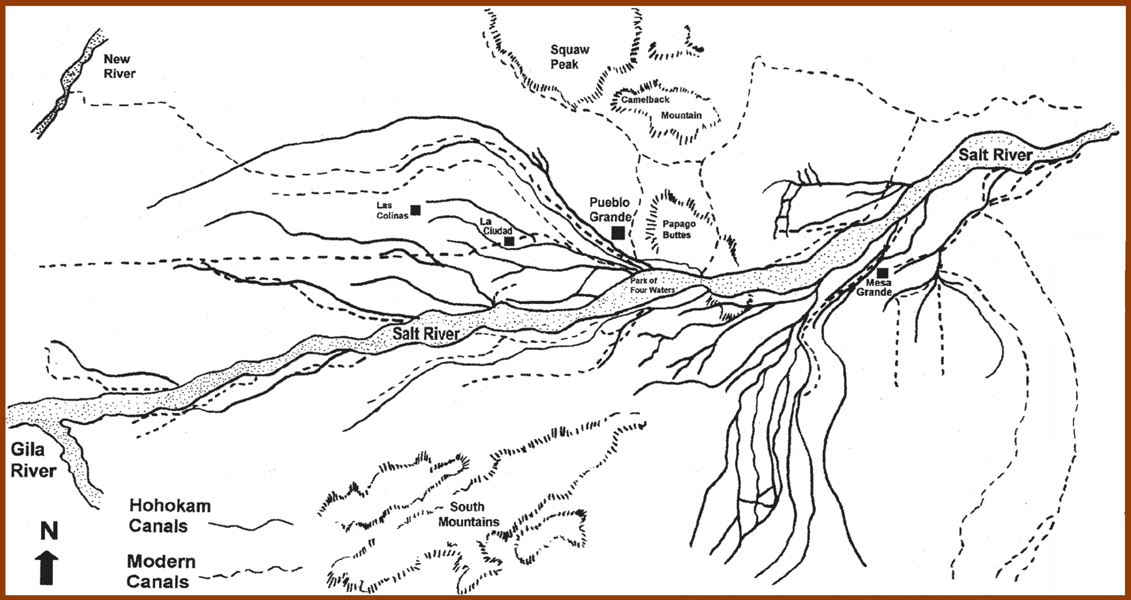
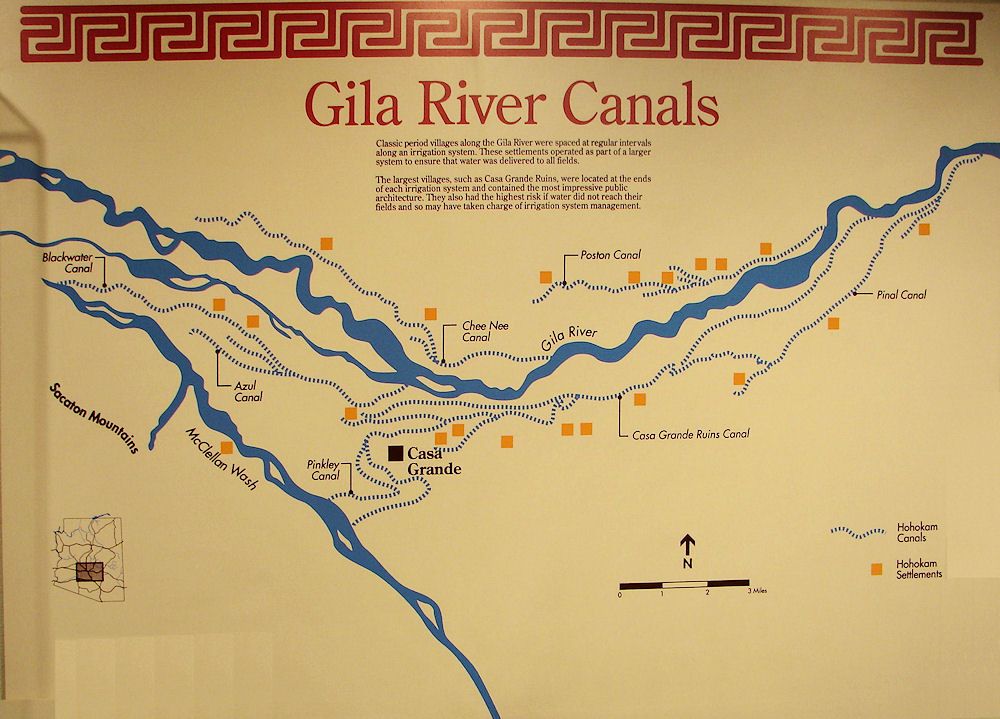
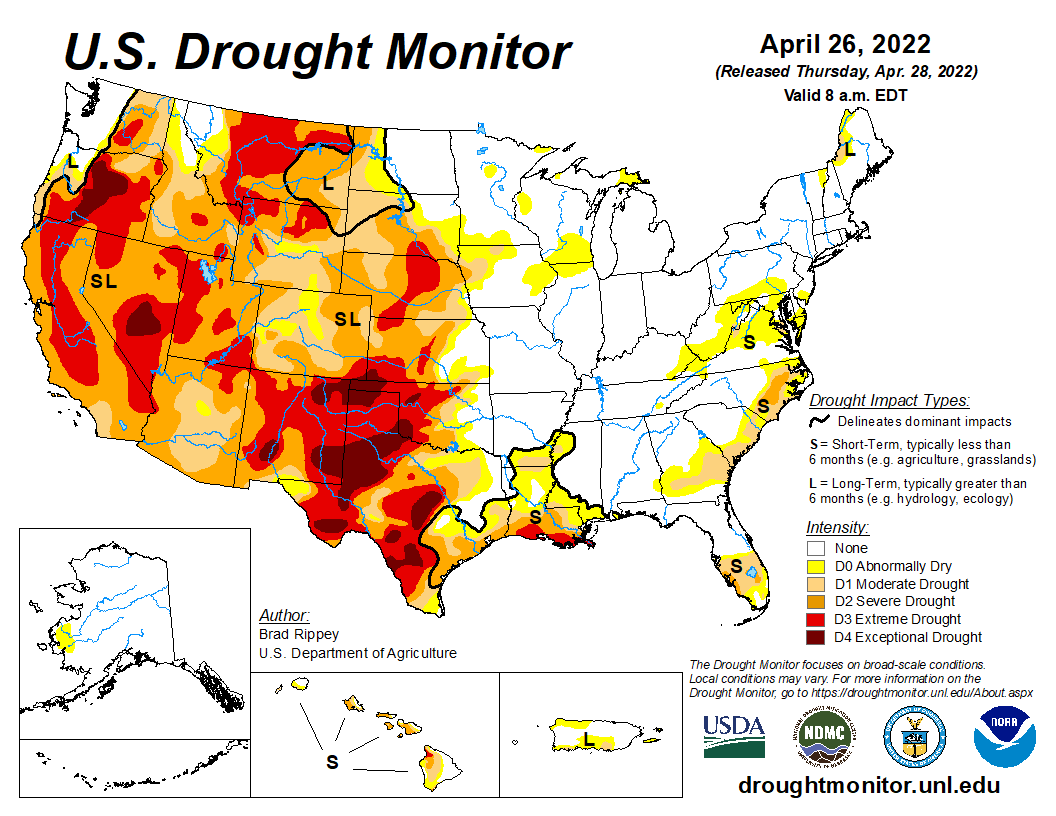
But there is a problem that must be solved. Gila River is now mostly dry, and goes through an Indian reservation. The Gila River used to provide about 1.3 Million Acre-ft per year, snow-melt and monsoon rains providing nearly all of it, but was seasonally dry. Now all the water and then some is spoken for, so the Indians get nothing, and without water you can do no farming, so the reserve is largely depopulated. See map:
The home of the Gila River Indian Community The Salt and Gila Rivers flow east to west. Present day dams that divert the Salt River into a series of canals are indicated. Roosevelt Dam was completed in 1911, creating Theodore Roosevelt Lake, and Coolidge Dam was completed in 1930. Important locations include the Casa Grande structure, an artifact of the Hohokam times, and the city of Florence, site of the Florence Canal, which is described in the text. The Gila Indians today live on the Reserve shown, with headquarters at Sacaton. The related Salt River Pima-Maricopa Indians live on a separate reserve on the Salt.
In Phase 1, the Gila River will free flow. In Phase 2 there will be a55 mile aqueduct thru the Indian reserve dimensioned for 10,000 cfs flow. It will provide some power with a drop of over 400 feet. The maps will look like this:
Leg 12 east starts out at 1580′ and ends at Arlington Dam, 795′Leg 12 west starts at Arlington dam, 705′ and ends at the CAP canal at 1,380′
Total power required for Leg 12 is 160 MW for phase 1 and 320 MW for Phase 2. Since it is continuous it is best served by three 100 MW LFTR reactors.
In Phase 2 the CAP aqueduct will be replaced by one that flows from east to west, and the Mark Wilmer pumping station will be converted to the Mark Wilmer generating station with the same capacity. Electricity generated will be 16% less than the energy that used to be consumed to pump up the water.
Mark Wilmer PP Aerial
March 29, 2012
Central Arizona Project photo by Philip A. Fortnam
What is in it for Arizona? The Greater Phoenix area will get an increased water supply from the canal,since Tucson is already served in Leg 11. The Gila Indian reserve will get back the water supply that was taken away from them, a way of reparation, and will again make the Gila Indian reserve a viable community.
Mark 6:1-13, In Mark 6 Jesus proclaimed ”A Prophet is not without honor, but in his own hometown, and among his own kin.” Jesus sent out the Twelve disciples, and they were amazed they could heal too.
Joshua 20 lists the cities of refuge, three West of Jordan and three East of Jordan.
Joshua 21 lists the 48 towns given to the Levites, they received no land. God’s promise to Israel was Finally fulfilled and the land had rest for a while.
Joshua 22. The Eastern tribes returned to their lands. On their way they built an altar by the Jordan. The Western Tribes thought by doing so they were abandoning the LORD. Not so, they were confirming “it shall be a witness between us that the LORD is God.”
Psalm 30, for the dedication of the Temple. Of David. ( An alternate translation : For the dedication of the House of David.) It was written at the time of the completion of building David’s palace, but Charles Spurgeon, among others, thought that it was actually written prophetically for the dedication of the Temple – which David prepared for, but Solomon built. Commas are important, but are not in the Hebrew text. You decide the best interpretation.
Stage 11 is a true delivery of water on demand aqueduct. The San Carlos lake has a storage capacity of a million acre-ft, the ideal buffer from the peak power demand driven uphill stages to the major delivery stage. San Carlos lake is now mostly empty, but will be normally filled to 85% of capacity, slightly less in advance of the winter snow melt. The Lake would look like this:
San Carlos lake, about half full
The Coolidge dam is now decommissioned, the lake is too often empty and the dam suffered damage in the power plant and it was no longer economical to produce power. The retrofitted dam will have a power generation capacity of up to 17,000 cfs the top of the dam is at 2535 ft, the typical water level is at 2500 ft and the drop is 215 feet, giving a maximum power output of 275 MW. In the first pass, the maximum output is 8,500 cfs , and the maximum power output is 135 MW.
The Coolidge dam before rebuilding.
From there the stream follows the Gila River to the East diversion dam and connects to the Tucson leg of the CAP canal, and delivers 600 cfs of water. It it then disconnected to the bottom of the canal.
The East Diversion dam will be reinforced, and the anal capacity will be increased to 600 cfs.The free flowing Gila River with reinforcements around Hayden and the copper mine.
Whats in it for Arizona? Besides having a reliable flow, Gila river will again be good for fishing if stocked and it will deliver 600 cfs of reliable sweet Mississippi and Arkansas river water to the Tucson area. When fully built out it will deliver up to 275 MW of power.