April 15: Reading the Holy Bible in a year.

Mark 12:1-27 begins with Jesus telling the parable of the unfaithful tenants, and after that the Pharisees tried to entrap Jesus with the question “Is it right to pay taxes to Caesar?” You know the answer, if not, check it and ponder. Then it was the Sadducees’ turn to entrap him with the question what happens to  marriage at the Resurrection. Jesus answered: “He is not the God of the dead, but the God of the living: ye therefore do greatly err.” 

Ruth 1. Elimelech’s family went to Moab, and all the men in the family died.  Naomi returned back to Israel with Ruth, a Moabite. The famous quote from Ruth 1: “Intreat me not to leave thee, or to return from following after thee: for whither thou goest, I will go; and where thou lodgest, I will lodge: thy people shall be my people, and thy God my God:”.

Ruth 2. Ruth met Boaz.

Psalm 35, of David. An urgent call for God to execute His righteous judgment on the enemies of God and vindicate David. (This is the Psalm that has received the most hits of any Psalm on my blog!) A sign of the times we are living in.

April 14: Reading the Holy Bible in a year.

Mark 11 starts what is called the Holy Week with the Triumphal Entry into Jerusalem. Jesus entered, riding on an unbroken foal of a donkey. This was the sign. The next day Jesus cursed a fig tree (symbol of Israel) and cleared the Temple of the money changers (You don’t want to give too much, you know). Following morning the fig tree was withered, and all marveled. Finally, Jesus authority was questioned by the religious authorities.

Proverbs 1. It extols the virtue of wisdom. Read it and apply it. 

Psalm 34, of David. This Psalm is an almost acrostic psalm (except for the letter waw). Like many acrostic Psalms, this is to be sung and memorized as it is full of praise and good advice. It contains one notable prophetic reference: “Many are the afflictions of the righteous, But the LORD delivers him out of them all.
He guards all his bones; Not one of them is broken.”

April 13: Reading the Holy Bible in a year.

Mark 10:17-52. A Rich Young Ruler asks what he must do to receive eternal life, but he cannot make himself do what Jesus required of him, so Jesus commented: ”It is easier for a camel to go through the eye of a needle, than for a rich man to enter into the kingdom of God.” The disciples were astounded and said: “Who then can be saved?” upon which Jesus answered “With men it is impossible, but not with God: for with God all things are possible.” Yes, that’s how it is with salvation. Jesus then  predicted his resurrection. James and John wanted to be great, but Jesus pointed out that greatness comes by serving. The chapter finally ends as Jesus healed Bartimaeus.

Judges 19 tells in painful detail about the Levite’s Concubine and Gibeah’s crime, probably the most gruesome story in all the Bible. The Bible is honest and tells it as it was, totally wicked.

Judges 20 describes Israel’s War with the Benjamites. Another horrendous chapter.

In Judges 21 they had killed nearly all so the Israelites had to find wives for the Benjamites. The book of Judges ends fittingly: “In those days there was no king in Israel: every man did that which was right in his own eyes,” in other words, anarchy.

April 12: Reading the Holy Bible in a year.

In Mark 10:1-16 Jesus explained the Christian concept of Marriage: One man, one woman, one lifetime,6 But from the beginning of the creation God made them male and female. For this cause shall a man leave his father and mother, and cleave to his wife; And they twain shall be one flesh: so then they are no more twain, but one flesh. What therefore God hath joined together, let not man put asunder.” Then  Jesus blessed the little children and said: “Whosoever shall not receive the kingdom of God as a little child, he shall not enter therein.

Judges 16 contains the vivid story of Samson and Delilah and how he finally was captured. In his death Samson slew many more than when he lived.

Judges 17 is short, contains only the telling of Micah’s Idolatry.

Judges 18, as the Danites had failed to take their allotted land from the Philistines they wandered around and finally settled in Laish and changed the name of the city to Dan, and there they still practiced idolatry.

The future expansion of wind power is limited by availability of battery and pumped storage. And they kill birds. Time to consider small, vertical wind turbines.

When I was a little boy is Sweden my father had a dear old friend that was so in love with birds and they with him that he had a great horned owl that came down and sat on his shoulder when he called. I was only three years old at that time, but the sight of this giant bird coming down from the big spruce tree is a sight I will never forget. Since then I have always enjoyed watching birds, normally soaring hawks, but on occasion eagles, rare as they may be.

Later in life I got gloriously saved and started reading the Bible, and one verse from the prophet Isaiah stands out :Isaiah 40:31 But they that wait upon the Lord shall renew their strength; they shall mount up with wings as eagles; they shall run, and not be weary; and they shall walk, and not faint.

I am now at the stage in my life where walk and not faint seems pretty good, but follow what goes on in the world is still exciting, even watching the birds. They inspire and soar effortlessly, seemingly defy limitations.

The big talk is fighting climate change, and the prevailing political belief is that rising CO2 levels is its major cause, so no expense is spared to find renewable energy in the form of wind power, but at what cost?

The Eagle has landed in aerie

on top of a windmill – that’s scary.

Doesn’t know she will die,

whacked right out of the sky

from rotating blades unawary.

The idea of wind farming is to create sustainable energy.

Will the population of eagles and other large birds be sustainable?

Image result for eagles and wind turbines

Eagles like to build their aeries on top of wind turbines, the highest structure in their territory.

It is estimated that the total bird kill by the year 2030 is going to be 1 million three hundred thousand birds. And that is if the Green New Deal is not implemented.

Is the large bird population sustainable even now?

crane-killed-by-turbine

This is a crane killed by a wind turbine blade. In parts of Ohio they have forbidden the turbines to run at night to protect a rare bat.

The allowable yearly limit for killing bald eagles by wind turbines  was upped from 1100 to 4200 per year on Jan 17 2017, still under the Obama administration. The allowable limit for golden eagles is still 0. If the bird-kill exceeds the allowance, heavy fines are imposed, but that is just the price of producing clean energy. in 2013 Duke energy paid a 1.9 million dollar fine for killing 14 golden eagles and 149 other protected birds. Recently, a US-based wind energy firm has been slapped with an $8m fine after at least 150 eagles died at its wind farms across eight states over the last 10 years. The company has also been given five years of probation. In April 2022 ESI Energy, a subsidiary of NextEra Energy, did plead guilty to three counts of violating the Migratory Bird Treaty Act. The company acknowledged the deaths of golden and bald eagles since 2012 at its farms in Wyoming, California, New Mexico, North Dakota, Colorado, Michigan, Arizona and Illinois, see more here.

Now for something completely unrelated: If you as a person poaches an eagle egg, see this picture

And it takes energy to produce energy. The cost of de-icing the average airplane is $1500. And that is without a helicopter.

And I am not sure about the former.

But there is still hope to solve the wind turbine bird kill problem. One potential solution is the vertical wind turbine:

low_cost_n6ujf

It has a somewhat lower wind efficiency than horizontal, 3 blade wind turbines, but can produce electricity for about 4 c per kWh, about the same as horizontal wind turbines, so all is not lost. They do not kill birds, and can be made to function under wind speeds of up to 70 mph, but cut out speed is typically around 30 mph. This is a rapidly developing field, and requires much further analysis. A typical power output for a vertical wind turbine is 1 to 5 kW, 12 or 24 V output, versus the modern horizontal 3 blade wind turbines are 2 to 4 MW. Yet, the cost per kWh is comparable.

Another design, 300W nominal. Simple. eh!

Bur vertical windmills are hardly a new concept. These windmills are from Nashtifan, Iran. Dozens stand atop a wall in the windy city, not far from the Afghanistan border.

From a distance, they look like wooden turnstiles. But they are vertical-axis windmills constructed over 1,000 years ago from wood, straw and clay. And since the blades are arrayed on a vertical axis, energy is translated down the mast to the grindstone without the need for any of the intermediary gears found on horizontal axis windmills.

April 11: Reading the Holy Bible in a year.

Mark 9:33-50. Jesus’ disciples argued among themselves who was the greatest. To give a perfect object lesson Jesus picked up a little child and explained what it means to be “a servant of all”. Jesus taught unity, not division, “whoever is not against us is for us,” and warned of of the dire consequences of offenses and told them to be “salt with savor” and to be at peace with each other.

Judges 12 records Jephthah’s conflict with Ephraim, where they killed people based on their accent. After that three more people, Ibzan, Elon and Abdon led Israel.

Judges 13 tells of bad times for Israel for forty years. Then came a glimmer of hope, the birth of Samson.

Judges 14. Samson started out great, but then he took a Philistine as his Wife.

Judges 15. Samson defeated the Philistines with the jawbone of an ass.

Answers to the Sierra Club full page ad in the local Gazette.

This local Gazette full page ad caught my attention.

As Christians it is our duty to be at peace with everyone if possible and to leave the world a better place than we found it. I totally agree with the Sierra Club that we need to save our planet (NOW). There are certain things we can do, and other things will happen no matter what we do. One of the latter things is Climate Change. I will answer each of the items and then come up with my suggested solution.

2021 one of the hottest years in human history. This is true, if human history starts with the Little Ice Age 800 years ago, but seen over the last 10,000 years, about 8,500 years were hotter. Long term we are entering into another ice age, which is the normal state of our planet.

As evidence from the Medieval warming is “Gården under sanden,” see here. As evidence from the Roman Warm period, see here

Rising sea level. The sea level rise is very uneven in different parts of the world

Up arrows: sea level rise, down arrows: Land rising

As we can see from the picture, most areas of the world experience sea level rise. In the upper Nordic countries, the Hudson Bay area and Alaska the land rises more than 3 feet per century. The North is still recovering from the last Ice Age. The U,S east coast and the northern Mexican Gulf has the largest sea level rise due to tectonic plate movements, but overall sea level rise is not increasing , and is about one foot per century. Besides the fact that most glaciers are decreasing , we are depleting many vulnerable aquifers, and Lake Aral is no more. All this melting and evaporated water ends up in the ocean.

Desertification. After an Aquifer has been used up and depleted, desertification sets in. The rivers that depend on the same aquifers to form and flow finally dry up. Vegetation wilts and dies, and erosion increases until there are only bedrock and sand left. Like Lake Aral began its demise in the 1970’s so the American Southwest is beginning the process now. One side effect of desertification is that the temperature control from well watered forests and grasslands is gone, and the land starts to experience

Heat stress. The people that dwell in the downtown deserts experience the so called urban heat island effect where the temperature can be up to 7 degrees Fahrenheit higher than the surrounding rural areas. This figure shows the extent of the effect:

This can partly explain why Democrats are more adamant about climate change than Republicans. Most Democrats live in urban areas, while Republicans can look at nature and see the wonderful temperature control in nature, water vapor being a condensing gas generates clouds to keep temperature rise within bounds.

Spread of tropical diseases. America is a land of immigrants. I am an immigrant. When I came to America I had with me a tube containing my chest x-rays, proof of negative Wasserman test and a bunch of other medical records. Upon entry at Kennedy Airport the customs officer opened up the tube, took a good look at the chest x-rays and all the medical and immigration records for about 5 minutes not saying a word, during which time the line behind me grew longer and longer. Then he put everything back in the tube, shook my hand and said: Welcome to America! The people that enter illegally may carry with them all kinds of diseases, such as drug resistant tuberculosis, STDs, and many tropical diseases. People entering legally from the Middle East, South Asia, most of Africa and Middle and South America are given a small dose of ivermectin per protocol.

Drought and flooding. America has a problem. The Eastern U.S.A has frequently too much rain, while the American west for the most part is too dry, made worse by multi year droughts. This is mostly because the mountains go north and south blocking the natural weather flows. Droughts and wildfires are not increasing, despite what we see on TV.

Economic losses. The economic losses from losing much of the water for the dry American South West can barely be calculated. It may eventually be in the trillions of dollars.

Severe Storms. No, storms and tornadoes are not increasing, they are just reported better.

Loss of farmland. Whenever a river dries up or an aquifer is exhausted there will be loss of farmland. Another cause is erosion, depleting the fertile topsoil. This is taking place mostly i the drying American West and South West. In the East there is occasional flood damage. Recuse we have made levees rather than letting the land flood and replenishing the soil with new silt the soil becomes depleted from nourishment.

Mass Extinction. Temperature is not the problem, loss of habitat, invasive species and land use changes are major threats, and must be vigilantly monitored to fight back invasive plants and animals, including bugs, fungi and bacteria. There is a problem with wind power. Wind turbines kill birds, and birds are important for a sustainable environment.

Ocean Acidification. Don’t look at us, look at China.

Refugees. Even if U.S. will successfully close the porous borders, there will still be two to three million legal immigrants per year, some of which have waited up to ten years for their immigration. They need to be resettled, and many prefer the dry South West, putting additional pressure on already strained water resources.

International conflict. It is way above my capability to solve international conflicts, but I can pray to God, that He, through the Holy Spirit will lead us into a worldwide revival and awakening, making us think with a sound mind rather than fall for this global insanity. But, since we are called steward the world and leave the world a better place than we entered it I will propose The TransContinental Aqueduct. A realistic way to save Lake Mead and reverse the desertification of the American South West.

It will, when fully built out provide 12 million Acre-feet of water to the American South West. This will save Lake Mead and also provide up to 50 GW of pumped storage power when fully built up. This power will be provided by an optimal mix of Solar, wind and Liquid Fluoride Thorium power to stabilize the net when the electricity demand increases from switching to electric cars and trucks. California has already had their first warning about charging electric cars.

If we switch all cars to electric power we will have to add 1,100 TWh per year to the electric grid. Electricity generated today is about 4,000 TWh per year. The cars will be recharged partly on peak demand, so the need for peak power will increase dramatically.

April 10: Reading the Holy Bible in a year.

Mark 9:1-32,Mark 9 begins with the Transfiguration and gives an explanation regarding Elijah, he had already come. Then a boy with an evil spirit was healed and the disciples asked Jesus why they could not drive out the evil spirit. He answered: “This kind can come forth by nothing, but by prayer and fasting.” Then Jesus predicted his death and resurrection but the disciples did not understand it.

Judges 10. Things went from bad to worse with Tola, Jair and Jephthah as leaders, so the Israelites were again oppressed. They finally repented and got rid of their false gods.

Judges 11 describes the glorious victory and tragic vow of Jephthah. Jephthah’s Daughter is forever memorialized.

Psalm 33 is a Psalm about the sovereignty of God in creation and history. Here and in many other places of the Bible it encourages us to “sing a new song”.

The TransContinental Aqueduct. A realistic way to save Lake Mead and reverse the desertification of the American SouthWest.

The American Southwest has always been subject to drought cycles, some worse than the one that is now devastating the area. Below is a very interesting presentation from ASU about a previous civilization in the Phoenix area, thriving and then gone.

Will it happen again?

The problem:

  1. Lake Mead will be emptied in less than 10 years with the current usage pattern. Then what?
  2. The hydroelectric power from Lake Mead (and Lake Powell) is diminishing as the lakes are emptied.
  3. the aquifers in Arizona, especially in the Phoenix and Tucson area, and to some extent New Mexico and the dry part of Texas are being drawn down and are at risk of being exhausted.
  4. The Salton Sea in the Imperial Valley of California is maybe the most polluted lake in all of U.S.A. It is even dangerous to breathe the air around it sometimes. The area contains maybe the largest Lithium deposit in the world.
  5. The Colorado River water is too salty for good irrigation .
  6. The Colorado river no longer reaches the Gulf of California. Fishing and shrimp harvesting around the Colorado River Delta is no more.
  7. 40 million people depend on the Colorado River for drinking water. The population is still rising rapidly in the West. Will they have water in the future?
  8. Except for California there is not much pumped Hydro-power storage in the American Southwest.
  9. Texas has plenty of wind power, but no pumped hydro-power storage. This makes it difficult to provide peak power when the sun doesn’t shine and the wind doesn’t blow. Nuclear power is of no help, it provides base power only. Peak power has to come from coal and natural gas plants.
  10. New Mexico has some ideal spots for solar panels, but no water is available for pumped storage.
  11. Arizona has a surging population, wind and solar power locations are abundant, but no pumped hydro-power storage.
  12. Arkansas and Oklahoma have a good barge traffic system. This proposal will increase flood control and improve barge traffic by increasing the maximum barge draft from 9 feet to 12 feet and during dry periods reverse the flow of the Arkansas River. The Arkansas river yearly water flow is nearly double that of the Colorado River.

The solution:

Build a transcontinental aqueduct from the Mississippi River to the Colorado River capable of transporting 12 million acre-ft of water yearly through Arkansas, Oklahoma, Texas, New Mexico and Arizona. It will be built similar to the Central Arizona Project aqueduct, supplying water from the Colorado river to the Phoenix and Tucson area, but this aqueduct will be carrying four times more water over four times the distance and raise the water nearly twice as high before returning to near sea level. The original Central Arizona Project cost $4.7 billion in 1980’s money, the Transcontinental Aqueduct will in Phase 1 cost around $200 Billion in 2022 money applying simple scaling up principles.

The Mississippi River has a bad reputation for having polluted water, but since the clean water act the water quality has improved drastically. Fecal coli-form bacteria is down by a factor of more than 100, the water is now used all the way down to New Orleans for drinking water after treatment. The lead levels are down by a factor of 1000 or more since 1979. Plastic pollution and pharmaceutical pollution is still a problem, as is the case with most rivers. The Ph is back to around 8 and salt content is negligible. Mississippi water is good for irrigation, and usable for drinking water after treatment. The Arkansas River is used as a drinking water source.

But the aqueduct will do more than provide sweet Mississippi water to the thirsty South-west, it will make possible to provide peak power to Texas, New Mexico and Arizona. In fact, it is so big it will nearly triple the pumped Hydro-power storage for the nation, from 23 GW for 5 hours a day to up to 66 GW when fully built out.

The extra pumped hydro-power storage will come from a number of dams built as part of the aqueduct or adjacent to it. The water will be pumped from surplus wind and solar power generators when available. This will provide up to 50 GW of power for 5 hours a day. If not enough extra power has been generated during the 19 pumping hours, sometimes power will be purchased from the regular grid. The other source of pumped hydro-power storage is virtual. There will be up to 23 GW of LFTR (Liquid Fluoride salt Thorium Rector) power stations strategically stationed along the waterway providing pumping of water for 19 hours and providing virtual hydro-power output for the remaining 5, when the aqueduct is fully built.

These 43 GW of hydro-power capacity will be as follows: Oklahoma, 0.2 GW; Texas, 18,5 GW (right now, Texas has no hydro-power storage, but plenty of wind power); New Mexico, 10.5 GW; Arizona 13.6 GW. In Addition, when the Transcontinental Aqueduct is fully built out, the Hoover dam can provide a true 2.2 GW hydro-power storage by pumping water back from Lake Mojave; a 3 billion dollar existing proposal is waiting to be realized once Lake Mead is saved.

The amount of installed hydroelectric power storage is:

U.S. operating hydroelectric pumped storage capacity

Most hydroelectric pumped storage was installed in the 70’s. Now natural gas plants provide most of the peak power. This aqueduct will more than double, triple the U.S. pumped peak storage if virtual peak storage is included. By being pumped from surplus wind and solar energy as well as nuclear energy it is true “Green power”. Some people like that.

What follows is a description of each leg of the aqueduct. Each leg except legs 9 and 10 ends in a dam, which holds enough water to make each leg free to operate to best use of available electricity and provide peak power on demand.

Leg 1 of the Trans-Continental aqueduct. From the Mississippi river to the Robert S. Kerr Lock and dam on the Arkansas River. Total length 15miles of aqueduct and 305 miles of river. Cost of water 300 kWh per acre-ft.

Leg 2 of the Transcontinental Aqueduct: From the Robert S. Kerr Lock and dam to the Eufaula Dam on the Canadian River. Total length 42 miles of lake and river. Cost of water 585 kWh per acre-ft.

Leg 3 of the Transcontinental aqueduct. From the Eufaula Dam to Ray Roberts Lake. Total length 42 miles of lake and 125 miles of aqueduct. Cost of water 900 kWh per acre-ft.

Leg 4 of the Transcontinental Aqueduct. From Lake Ray Roberts to the Brad Dam (to be built). Total length 205 miles of aqueduct. Cost of water 1735 kWh per acre-ft.

Leg 5 of the Transcontinental aqueduct. From Brad dam to Deadman Draw dam and pumped storage power plant. Total length 5 miles of lake and 60 miles of aqueduct. Cost of water 2425 kWh per acre-ft. In Phase 2 can provide up to 4 GW of pumped storage power.

Leg 6 of the Transcontinental aqueduct. From Deadman Draw dam and pumped storage power plant to Buffalo Soldier Draw dam and optional pumped storage plant.Total length 205 miles of aqueduct. Cost of water 3711 kWh per acre-ft.In Phase 2 can provide up to 4.8 GW of pumped storage power.

Leg 7, leg 8 and leg 9 of the Transcontinental aqueduct. From the Buffalo Soldier Draw dam to the highest point of the aqueduct 10 miles into Arizona. Leg 7 is 255 miles. Cost of water 6132 kWh per acre-ft. Leg 8 is 125 miles. Cost of water is 5705 kWh per acre-ft. Leg 9 is 160 miles. Cost of water is 6605 kWh per acre-ft.

The Transcontinental Aqueduct. Leg 10: The highest pumping station in Arizona to San Carlos Lake, a distance of 93 miles. Cost of water 5205 kWh per acre-ft.

The Transcontinental Aqueduct. Leg 11: From San Carlos Lake to East Diversion dam, a distance of about 60 miles. Cost of water 4905 kWh per acre-ft.

The Transcontinental aqueduct Leg 12: From the East Diversion dam to connecting to the Central Arizona aqueduct 45 miles WNW of Phoenix. Phase 1 is 20 miles of aqueduct and 85 miles of River. Cost of water is 5105 kWh per acre-ft. Phase 2 adds 130 miles of aqueduct . The cost of water is 5065 kWh per acre-ft.

The Transcontinental aqueduct, Leg 13: From the New Arlington dam to the Colorado River. Leg 13, phase 1 is 130 miles of river.Cost of water is 5105 kWh per acre-ft. Phase 2 adds 15 miles of aqueduct . The cost of water is 5130 kWh per acre-ft.

The Transcontinental Aqueduct, spur 14: The Wilson Canyon Solar farm and pumped storage plant. Can supply 13.5 GW of pumped storage power.

The Transcontinental Aqueduct, spur 15: The Poppy Canyon Solar farm and pumped storage plant. Can provide up to 28 GW of pumped storage power.

The Transcontinental Aqueduct will serve the Lower Colorado River Basin, Southern New Mexico and Western Texas. It will pump up to 12 million acre-ft of water annually from the Arkansas river and Mississippi river all the way to southern Colorado River.

The total electricity needed to accomplish this giant endeavor is about 60 billion kWh annually. or about one and a half percent of the current US electricity demand. In 2020 the US produced 1,586 billion kWh from natural gas, 956 from coal, 337.5 from wind and 90.9 from solar.

For this giant project to have any chance of success there has to be something in it to be gained from every state that will be participating. Here are some of the benefits:

Arizona: Arizona needs more water. The water from Mississippi is less saline and better suited for agriculture and the people growth makes it necessary to provide more water sources. Right now the aquifers are being depleted. Then what? One example: The San Carlos lake is nearly dry half the time and almost never filled to capacity. With the aqueduct supplying water it can be filled to 80 +- 20% of full capacity all the time. In the event of a very large snow melt the lake level can be reduced in advance to accommodate the extra flow. Likewise during Monsoon season the aqueduct flow can be reduced in anticipation of large rain events. Arizona together with New Mexico has the best locations for solar power, but is lacking the water necessary for hydro-power storage. This proposal will give 600 cfs of water to Tucson, 3,100 cfs to the Phoenix area and 3,900 cfs to the lower Colorado River in Phase 1. I phase 2 it will add 3,100 cfs to Lake Havasu and an extra 4,700 cfs to the lower Colorado River. It will also also add 28 GW of hydro-power storage capable of adding 140 GWh of electric peak power daily when it is fully built out in Phase 3.

Arkansas: The main benefit for Arkansas is better flood control and river control of the Arkansas River and allowing it to deepen the draft for canal barges from 9,5 feet to 12 feet, which is standard on the Mississippi river.

California: The water aqueduct serving Los Angeles will be allowed to use maximum capacity at all times. Additional water resources will be given the greater San Diego area. The Imperial valley will be given sweet Mississippi and Arkansas River water, which will improve agriculture yield. The polluted New River will be cut off at the Mexico border. There will be water allocated to the Salton Sea. There is a proposal to mine the world’s largest Lithium ore, mining the deep brine, rich in Lithium. (about a third of the world supply according to one estimate). This requires water, and as a minimum requirement to allow mining in the Salton Sea the water needs to be cleaned. This requires further investigation, but the area around the Salton Sea is maybe the most unhealthy in the United States. It used to be a great vacation spot.

Mexico: During the negotiations about who was going to get the water in Lake Mead Mexico did not get enough water, so they have been using all remaining water for irrigation, and no water is reaching the ocean anymore. In addition the water is too salty for ideal irrigation. This proposal will provide sweet Mississippi and Arkansas River water to Mexico, ensure that some water reaches the Colorado river delta. This will restore the important ecology and restore aquatic life in the delta and the gulf. The town of Mexicali will get some water in exchange for shutting off New River completely.

Nevada: Las Vegas is a catastrophe waiting to happen unless Lake Mead is saved. With this proposal there will be ample opportunity to make the desert bloom.

New Mexico: The state is ideally suited for solar panels. In addition to give much needed water to communities along the length of the aqueduct, it will provide 13.5 GW of pumped storage power to be made available at peak power usage for up to 5 hours a day.

Oklahoma: The main advantage for Oklahoma is a much improved flood control. It will provide the same advantage for river barge traffic as benefits Arkansas.

Texas: The state has a big problem. It has already built up too much wind power and can not give up their coal burning power plants until the electricity is better balanced. They have no hydro-electric power storage at all, and we saw the result of that in a previous year’s cold snap. This proposal will give the Texas electric grid 8.8 GW of hydro-electric power for up to 5 hours a day.

Utah: The state will no longer be bound to provide water to Lake Mead, but can use all of its water rights for Utah, especially the Salt Lake City region.

Wyoming: The state will be free to use the water in the Green River and all the yearly allocated 1.05 million acre-feet of water can be used by the state of Wyoming.

The cost to do all these aqueducts will be substantial, but it can be done for less than 350 billion dollars in 2022 money, and that includes the cost of providing power generation. Considering it involves 40 million people dependent on the Colorado River now and another 10 million east of the Rocky Mountains, it is well worth doing, much more important to do than other “green” projects, since it will save the American Southwest from becoming an uninhabitable desert.

This proposed solution cannot be made possible without changing our approach to power generation. The mantra now is to solve all our power needs through renewables. Texas has shown us that too much wind power without any hydroelectric power storage can lead to disaster. In addition, windmills kill birds, even threatening some species, such as the Golden Eagle and other large raptors that like to build their aeries on top of the generators. Solar panels work best in arid, sunny climate, such as Arizona and New Mexico, but the panels need cooling and cleaning to work best, and that takes water. They are even more dependent on hydro-power storage than wind. The transcontinental aqueduct will triple the hydro-electric power storage for the nation. Without pumped power storage we still need all the conventional power generation capacity for when the sun doesn’t shine and the wind doesn’t blow.

Conventional Nuclear power plants doesn’t work in most places since they depend on water for their cooling, and most of these aqueducts pump water in near deserts, and there would be too much evaporation losses to use water from the aqueducts for cooling.

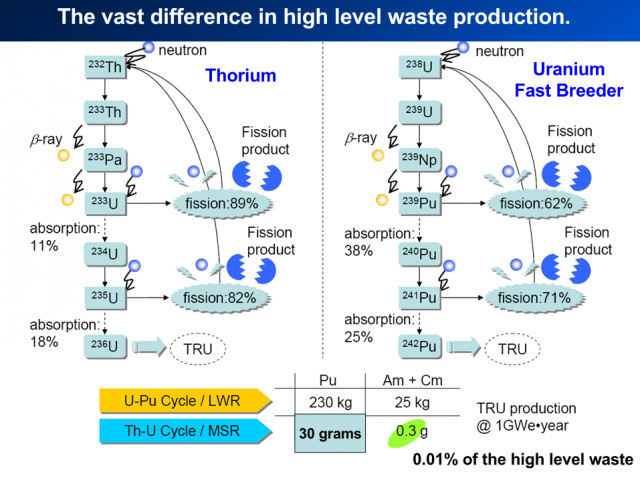
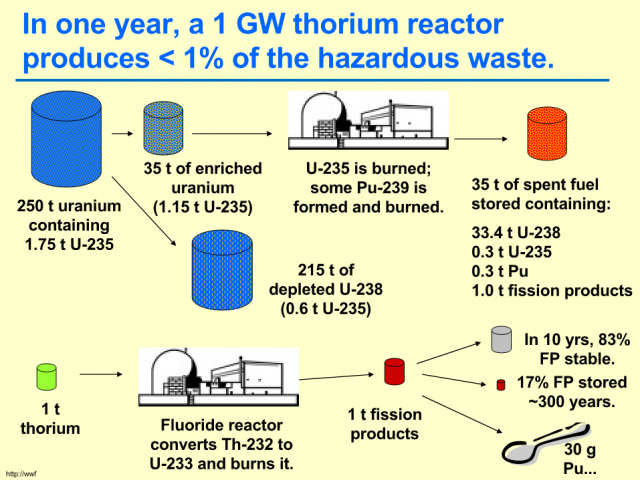
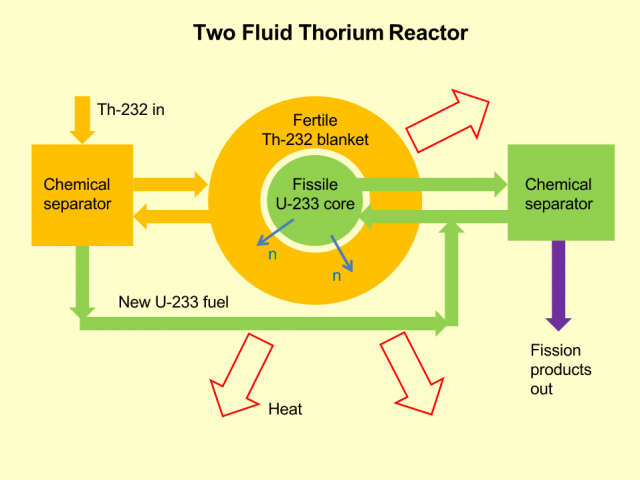
The only realistic approach would be to use LFTR power plants. (Liquid Fluoride Thorium Reactors). There are many advantages for using LFTR. Here are 30 reasons why LFTRs is by far the best choice.

For this project to succeed there must be developed a better way to build SMRs (Small Modular Reactors, less than 250 MW) more effectively. The price to build a LFTR plant should be less than $2.50 per watt. While the LFTR science is well understood, the LFTR engineering is not fully developed yet, but will be ready in less than 5 years if we get to it. In the mean time there should be built one or more assembly plants that can mass produce LFTR reactor vessels small enough so they can be shipped on a normal flatbed trailer through the normal highway system. My contention is that a 100 MW reactor vessel can be built this way and the total cost per plant will be less than 250 Million dollars. To save the American Southwest we will need about 350 of them, or 87,5 billion dollars total. This cost is included in the total calculation. There will be many more of these plants produced to produce all the electric power to power all the electric vehicles that are going to be built. This is the way to reduce fossil fuel consumption. Just switching to electric vehicles will not do the trick. The electric energy must come from somewhere. To convert all cars and trucks and with unchanging driving habits will require another 600 GW of generating capacity by 2050, our present “net zero emissions” goal.

To do this project we need cooperation from all states in providing eminent domain access. The Federal government will need to approve LFTR as the preferred Nuclear process and streamline approval process from many years to less than one year.

Some of the power will come from solar panels and wind turbines, which will reduce the need for LFTR’s. One tantalizing idea is to cover the aqueduct with solar panels. This will do many things, it will not take up additional acreage, water needed to keep the panels clean is readily available, and can even be used to cool the solar panels if economically beneficial. The area available is 152 feet times 1100 miles = 1.6 billion square feet, and one square foot of solar panel produces around 1 W, which means covering the aqueduct with solar panels would produce 882 MW of power. It would also reduce evaporation. The second source of energy will be 165,000 5kW vertical wind turbines producing 825 MW when the wind is blowing. The rest of the power will cme from LFTRs. This idea requires further analysis. Here is one possible implementation of the idea:

Total volume of water is over 1 million acre-ft.

April 9: Reading the Holy Bible in a year.

Mark 8:22-38. Jesus healed a blind man at Bethsaida, followed by Peter’s Confession and Jesus predicting his death.

Judges 7. Gideon called for fighting men. Eighty-two thousand men gathered to fight. God said that was too many, reduce their number, and in two steps they were whittled down to Gideon’s Valiant Three Hundred men. With that “army” and God the Midianites were defeated.

Judges 8. Gideon Defeated the Midianites, the story is getting complicated but read it anyway. After the great victory Gideon made an Ephod from the Ishmaelites’ golden earrings and this became a snare to them all. Finally Gideon died and immediately after the Israelites fell back into idolatry, worshiping Baal.

Judges 9. The Bible tells it as it is, warts and all. So it is with the story of Abimelech’s Conspiracy and the parable of the trees. All the evil led to Abimelech’s downfall. A take home from this chapter is his last words, after his skull was cracked by a millstone, dropped by a woman. “Draw thy sword, and slay me, that men say not of me, A woman slew him.