Climate change is real and is caused by rising CO2 levels, leading to less extreme weather. This is on balance good for the environment!

We have experienced a 50% increase in CO2 levels since the beginning of industrialization. In the last 30 years the level has risen 17%, from about 350 ppm to nearly 410 ppm. Is this good or bad for the climate?

The traditional way to approach the problem of guessing what effect of rising CO2 levels has on the climate is by creating climate models. Thy have recently been adjusted, and they suddenly show a much higher rate of future temperature increase, in this case what is supposed to happen to global temperatures for a doubling of CO2 from pre-industrial times, from 270ppm to 540ppm.
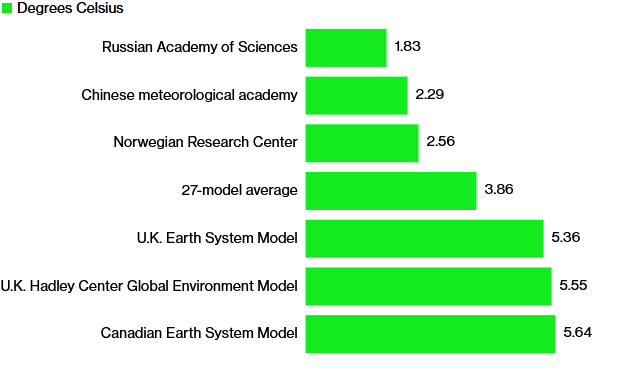

https://lenbilen.com/wp-content/uploads/2020/02/screenshot_2020-02-07-climate-models-are-running-red-hot-and-scientists-done28099t-know-why1.png

The first thing that strikes you is the great discrepancies between the models. The Russian, Chinese and Norwegian models show a much slower temperature rise than  rest of the models. Why is that?

There are two ways to approach this problem. The climate models make certain assumptions about the behavior of the changing atmosphere, and based on these assumptions model future temperature changes. This is the approach from IPCC for the last 32 years. These models are failing miserably when compared to actual temperature changes. This is the traditional way.

The other way i to observe what is actually happening to our temperature over time as the CO2 increases. We have over 50 years of excellent global temperature data, so with these we can see where, when and by how much the earth has warmed.

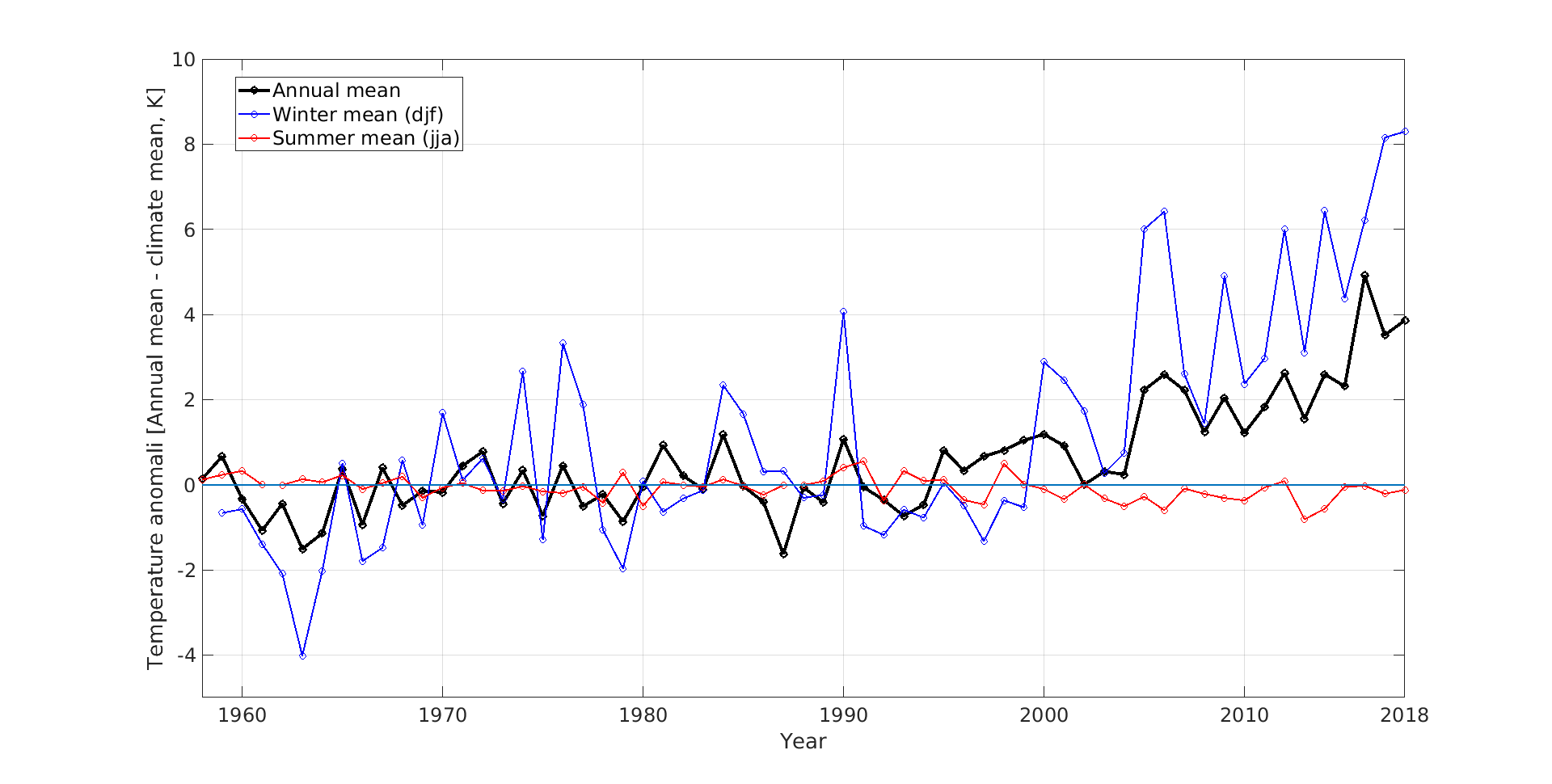
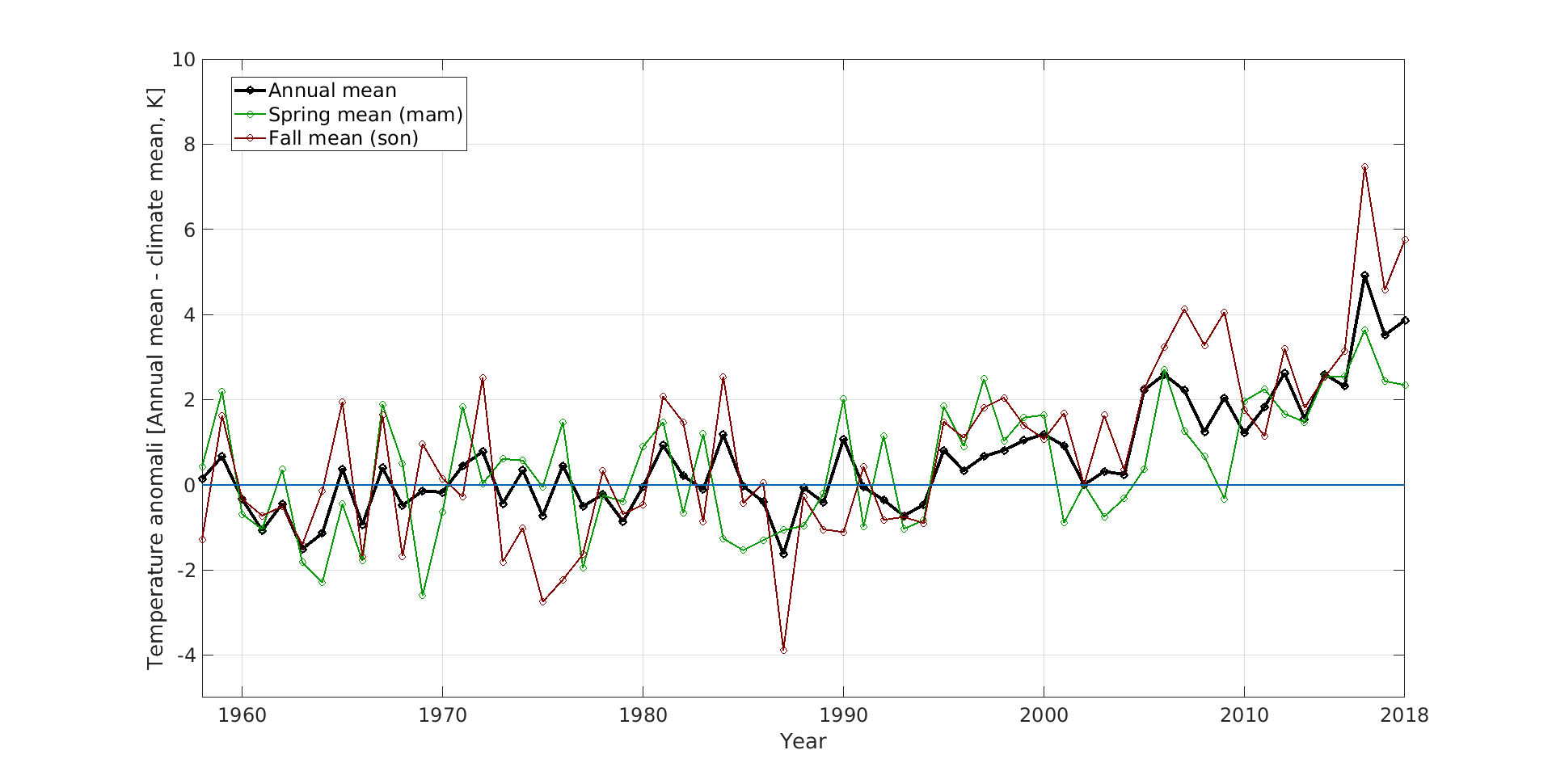
The most drastic temperature rise on earth has been in the Arctic above the 80th latitude. In the winter of 2018 it was 8C above the 50 year average. See charts from the Danish Meteorological Institute:
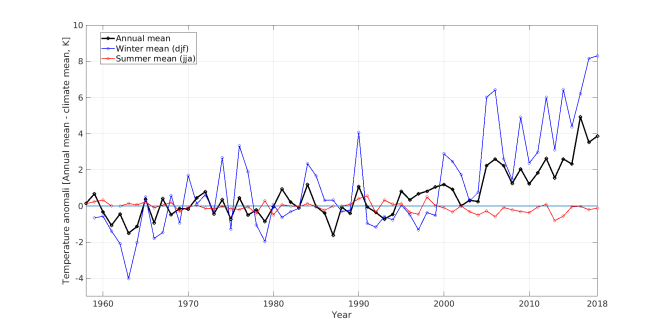
Note, there is no increase at all in the summer temperatures!
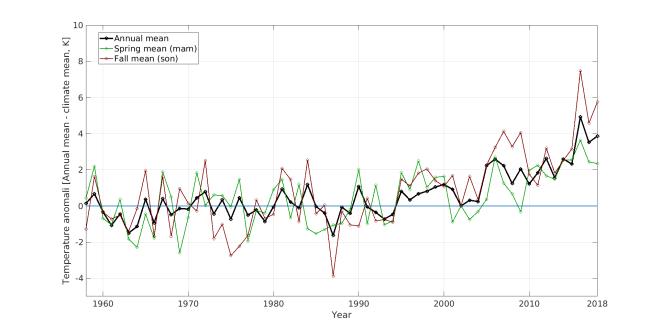
The fall temperature saw an increase of 5C and the spring temperature saw an increase of about 2.5C.

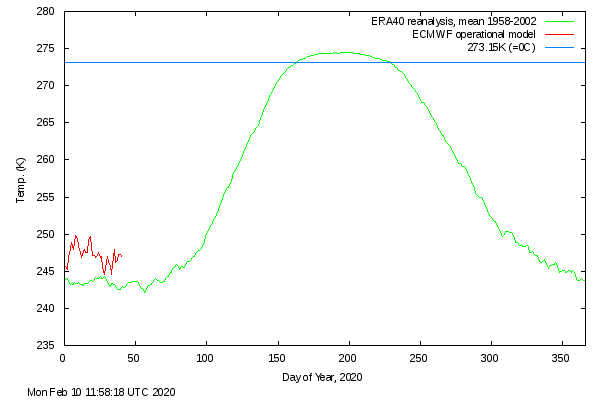
The 2020 winter has so far seen an about 5c increase Source: DMI.

This 8C ( or 5C) rise in winter temperatures is significant, most would even say alarming, but my response is, why is that?

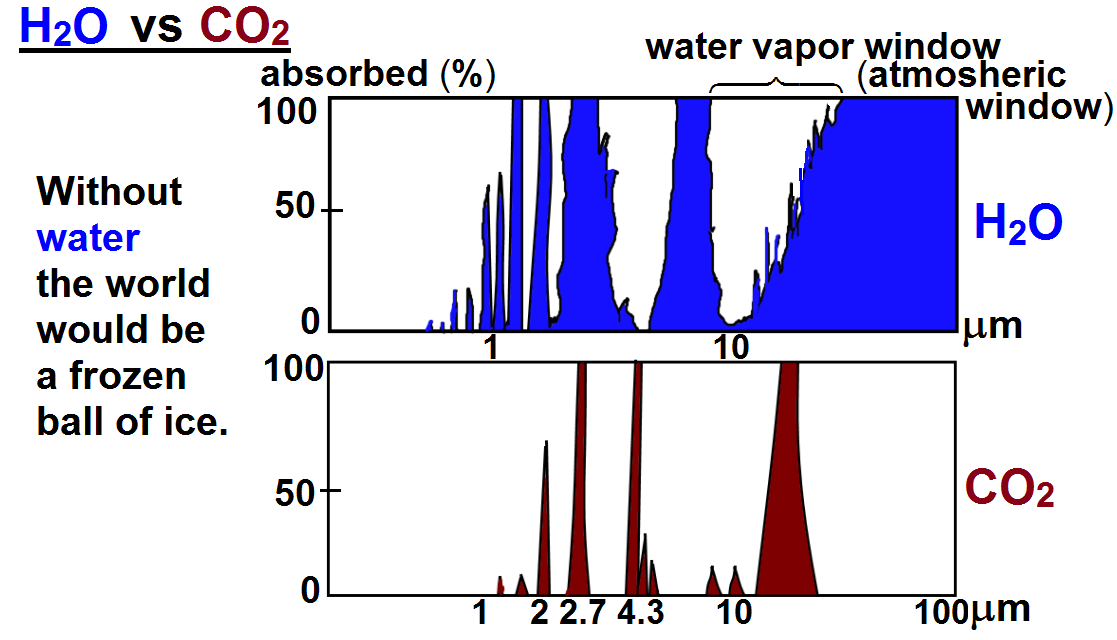
To get the answer we must study molecular absorption spectroscopy and explain a couple of facts for the 97% of all scientists who have not studied molecular spectroscopy. IPCC and most scientists claim that the greenhouse effect is dependent on the gases that are in the atmosphere, and their combined effect is additive according to a logarithmic formula. This is true up to a certain point, but it is not possible to absorb more than 100% of all the energy available in a certain frequency band! For example: If water vapor absorbs 50% of all incoming energy in a certain band, and CO2 absorbs another 90% of the energy in the same band, the result is that 95% is absorbed, (90% + 50% * (100% – 90%)),  not 140%, (90% + 50%).

The following chart shows both CO2 and H2O are absorbing greenhouse gases, with H20 being the stronger greenhouse gas, absorbing over a much wider spectrum, and they overlap for the most part. But it also matters in what frequency ranges they absorb.
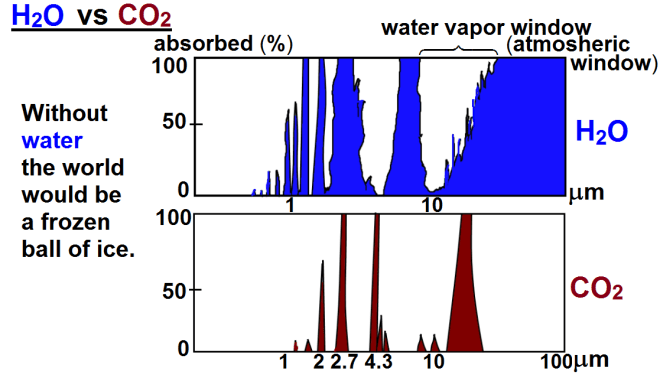
To better understand the importance of frequency spectra this we will look at the frequency ranges of the incoming solar radiation and the outgoing black body radiation of the earth. It is the latter that causes the greenhouse effect. Take a look at this chart:
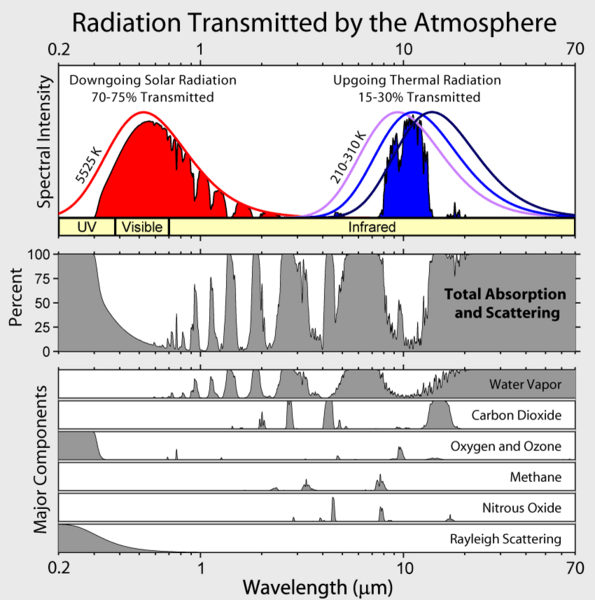
The red area represents the observed amount of solar radiation that reaches the earth’s surface. the white area under the red line represents radiation absorbed in the atmosphere. Likewise, the blue area represents the outgoing black body radiation that is re-emitted. The remaining white area under the magenta, blue or black line represents the retained absorbed energy that causes the greenhouse effect.

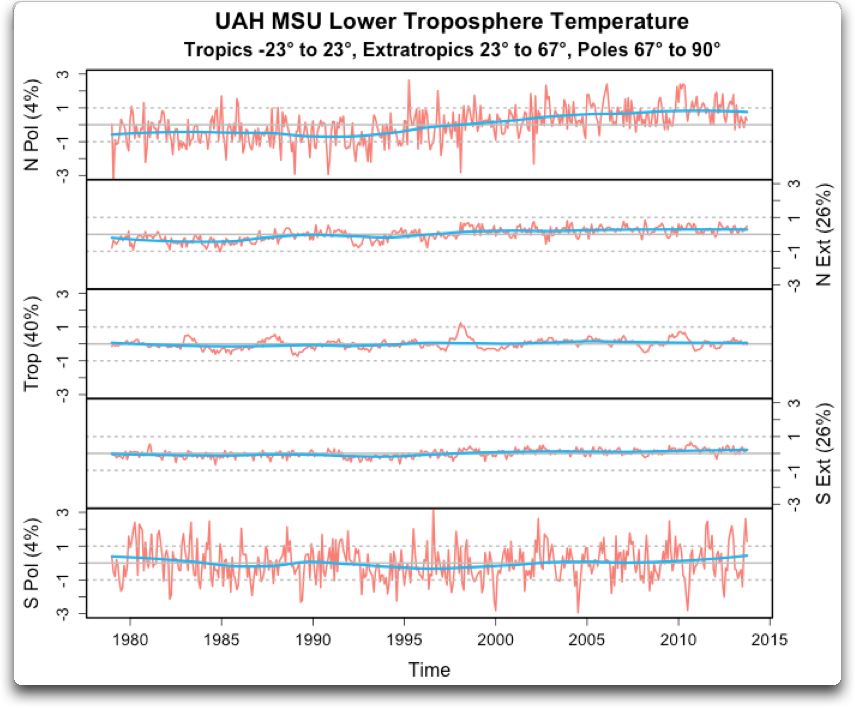
Let us now take a look at the Carbon Dioxide bands of absorption, at 2.7, 4.3 and 15 microns. Of them the 2.7 and 4.3 micron bands absorb where there is little black body radiation, the only band that counts is at 15 microns, and that is in a band where the black body radiation has its maximum. However it is also in a band where water vapor also absorb, not as much as CO2,only about 20% to 70% as much. Water vapor or absolute humidity is highly dependent on the temperature of the air, so at 30C there may be 50 times as much water vapor, at 0C there may be ten times as much water vapor, and at -25C there may be more CO2 than water vapor. At those low temperatures the gases are mostly additive. In the tropics with fifty times more water vapor than CO2, increased CO2 has no influence on the temperature whatsoever. Temperature charts confirm this assertion:

The temperature in the tropics displays no trend whatsoever. It follows the temperature of the oceans, rises in an el niño and falls in a la niña. We are now in the end of an el niño, soon to be followed by a rather strong la niña.The temperature in the southern hemisphere shows no trend. In the northern temperate region there is a slight increase, but the great increase is occurring in the Arctic. There is no increase in the Antarctic yet even though the increase in CO2 is the same in the Antarctic as it is in the Arctic and the winter temperature in the Antarctic is even lower than in the Arctic. So CO2 increase cannot be the sole answer to the winter temperature increase in the Arctic.

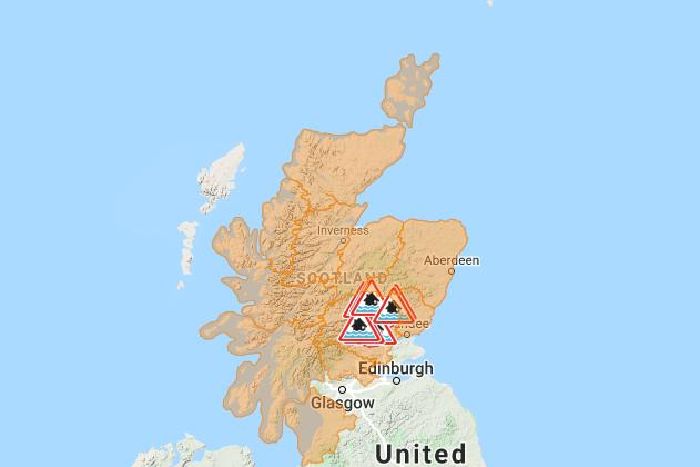
A few days ago there was a storm of historic magnitude, filled with moisture going up from the Mexican Gulf through the Atlantic and really sacked Scotland and Norway. The weather warnings called for severe floods and hurricane-like winds:
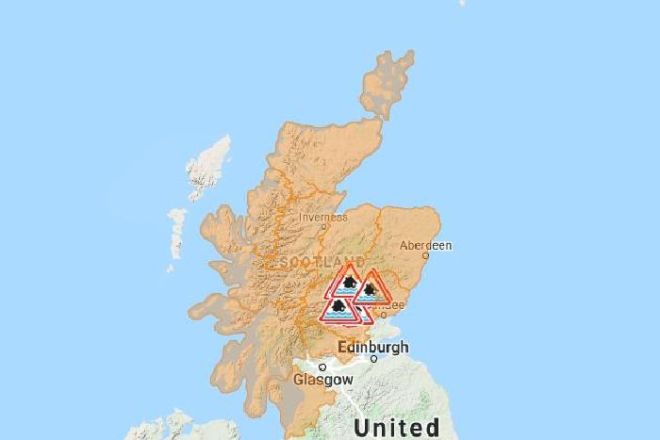
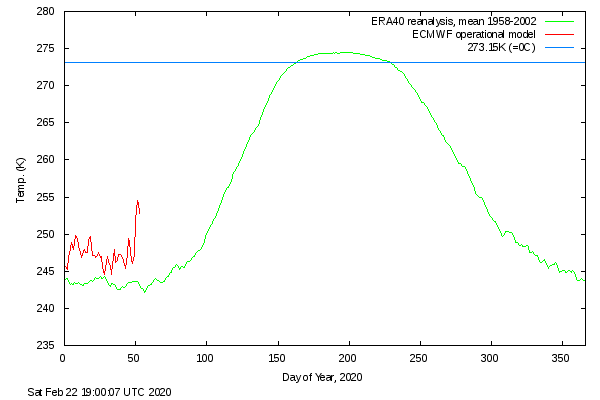
What happened to the temperature when the storm arrived?

The Arctic temperature above the 80th latitude rose about 12C, from about -30C to about -18C, and most of the moisture snowed out. What happened to the ice cover when the storm arrived? Let’s see the most recent Arctic ice cover.

As the storm arrives, some of the ice breaks up, but at the end of the storm it bounces back, helped with all the snow that just fell. After the snowfall ends the ice formed easily breaks up again.

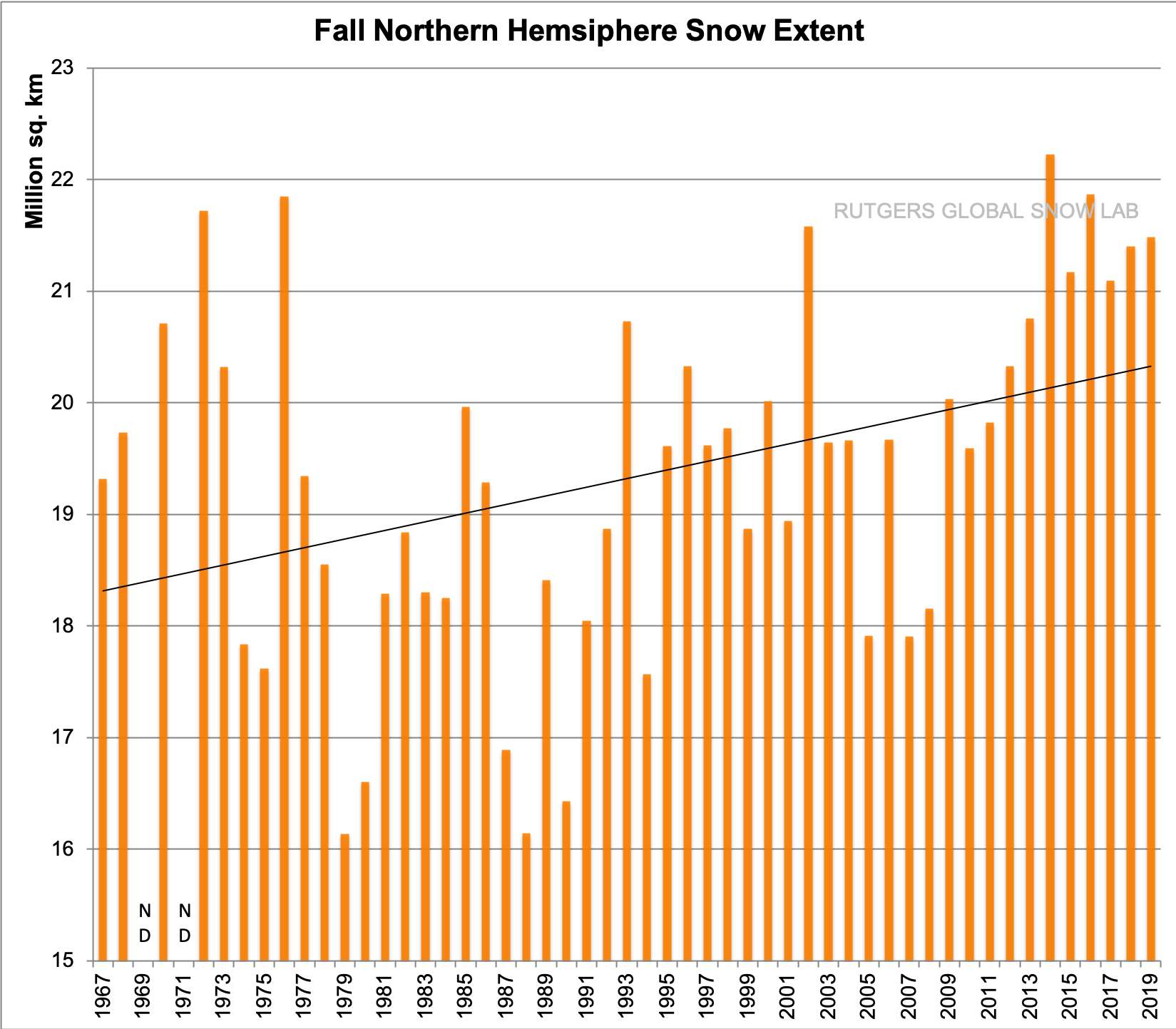
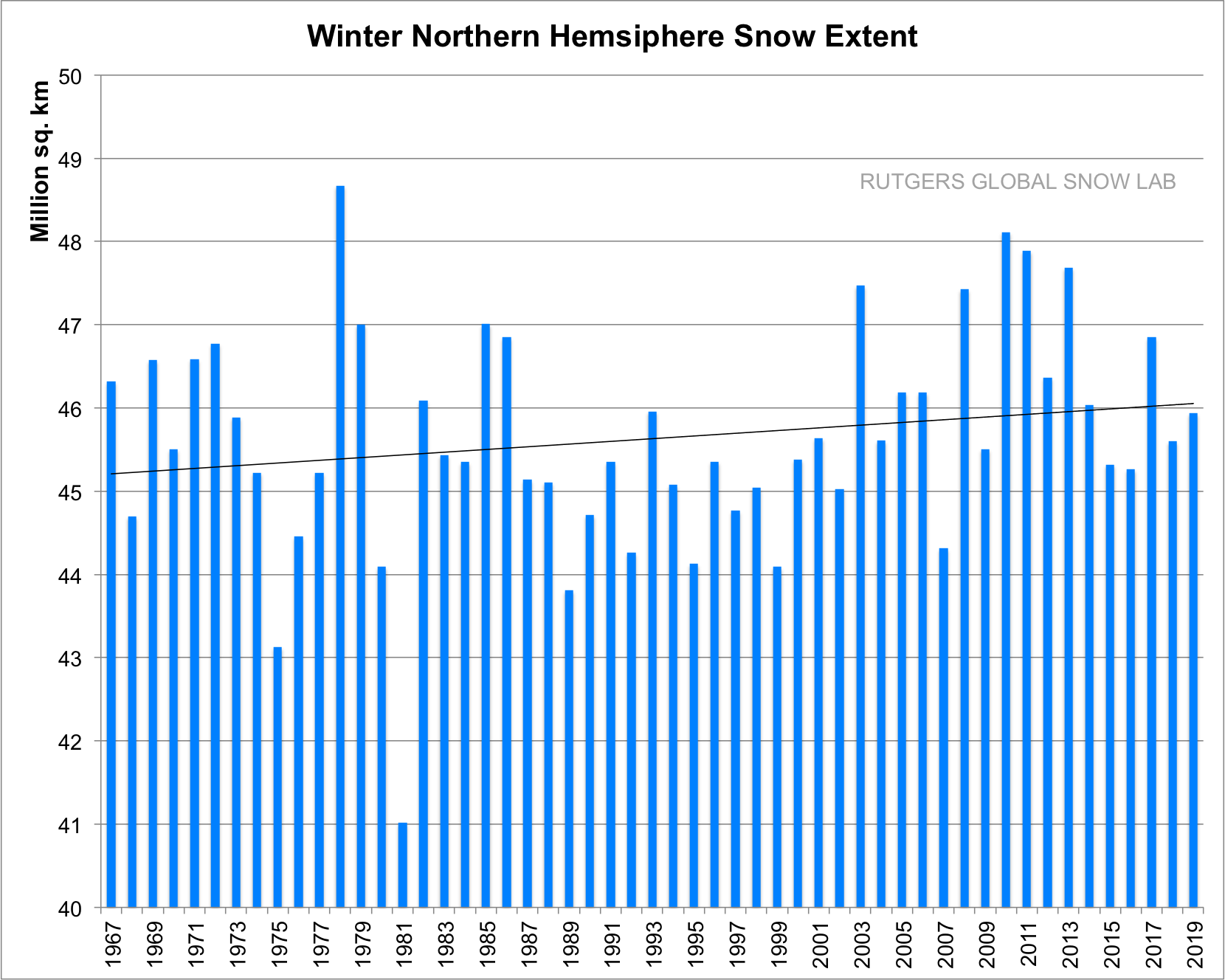
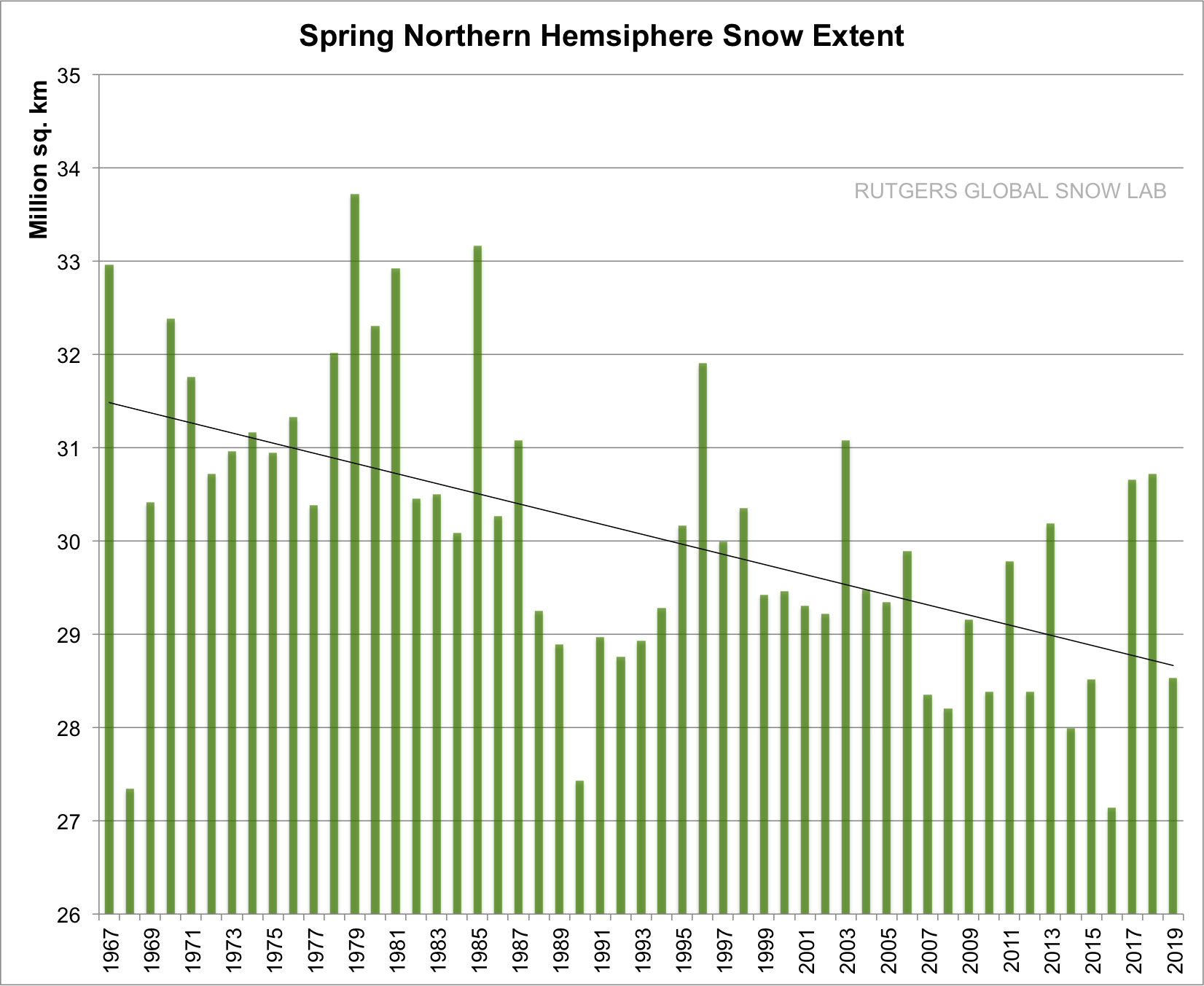
Is the snow cover increasing in the Arctic? Let us see what the snow statistics show. These are from the Rutgers snow lab.
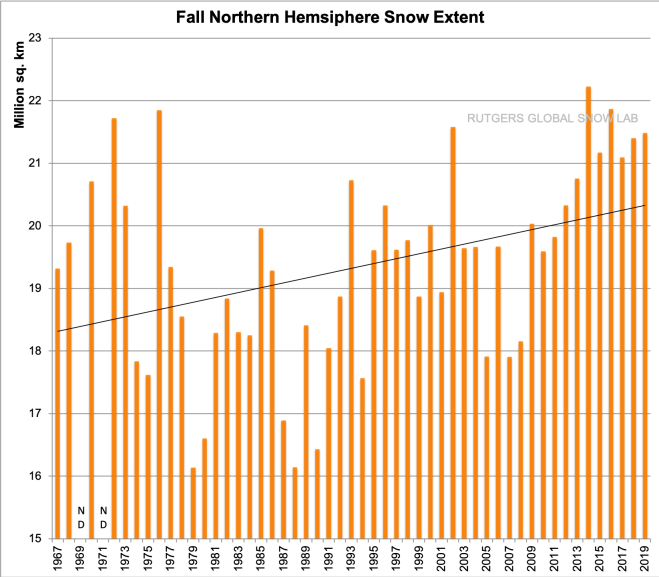
The fall snow extent is increasing by more than 2 percent per year.
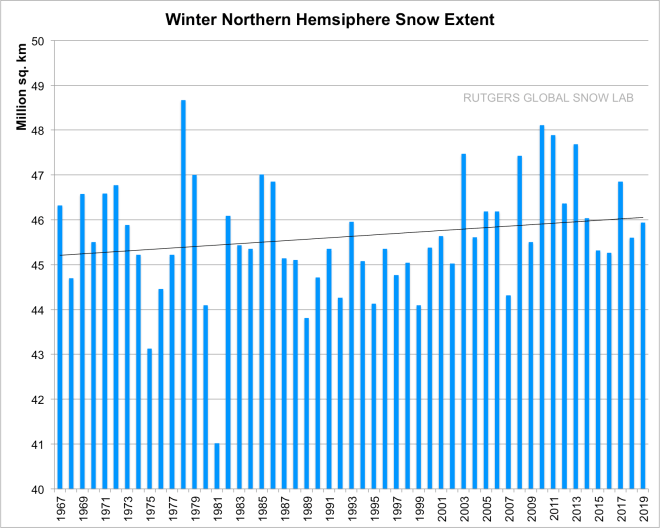
The winter snowfall has also increased but only by 0.04 percent per year.
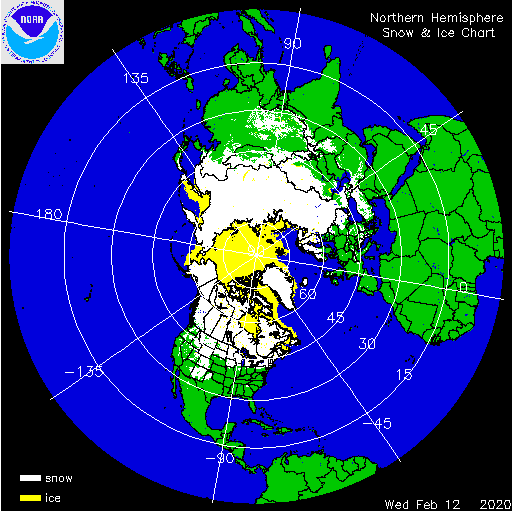
The snow covers all of Russia, Northern China, Mongolia, Tibet, Kashmir and northern Pakistan, Northern Afghanistan, Northern Iran, Turkey, Part of Eastern Europe, Scandinavia, Canada, Alaska, Greenland and parts of Western and Northern United States.
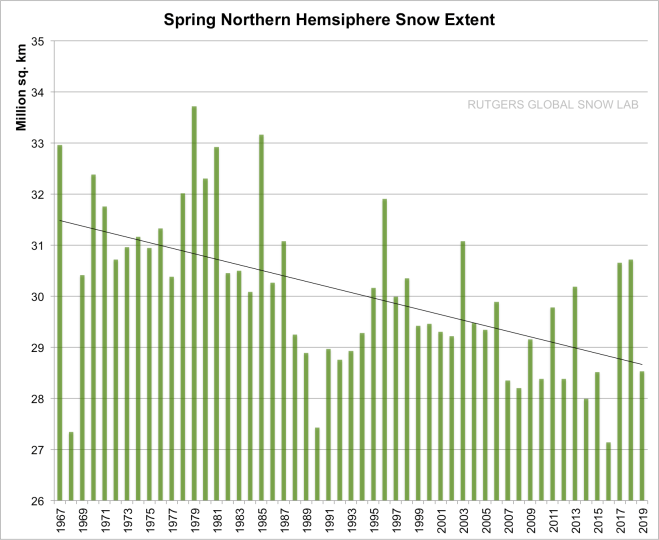
In the spring on the other hand the snow pack is melting faster, about 1.6 percent less snow per year. One of the major reasons for an earlier snow-melt is that the air is getting dirtier, especially over China, and to some extent Russia. The soot from burning coal and mining and manufacturing changes the albedo of the snow. The soot is visible on old snow all the way up to the North Pole. The other reason is that the poles are getting warmer. In the fall and winter it is mostly due to increased snowfall, but in the spring, as soon as the temperature rises over the freezing point, melting occurs.

Moving down to the continental U.S. there are even more good news.

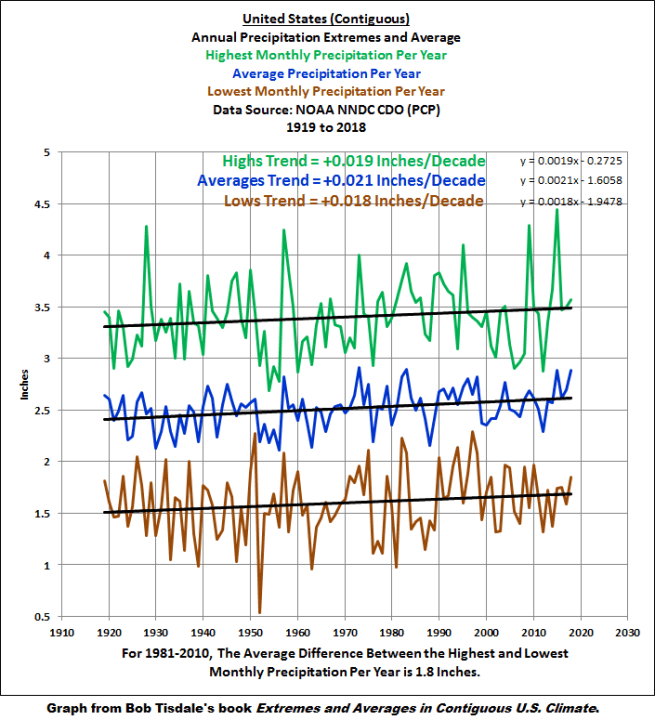
The data presented in the next six graphs were extracted from the data available at the NOAA National Data Center Climate Data Online (NNDC CDO) website.

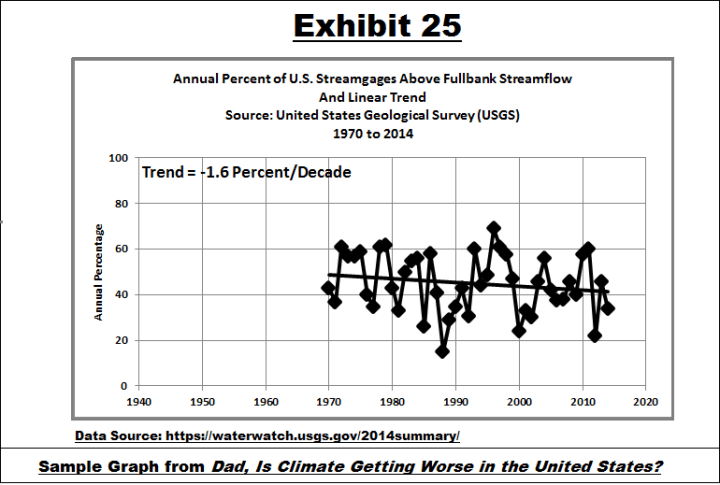
Yes, rain (and snow) are increasing, but it is also raining slightly more often and regularly, so the net result is a slight decrease in flooding.
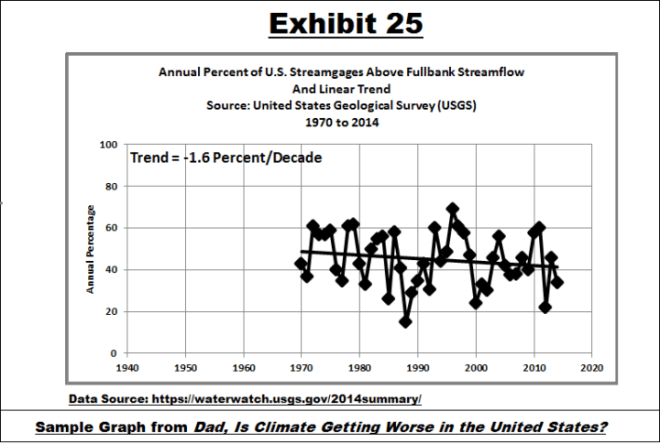
Of course, this could change in the future, and we need to watch the rain patterns, as they are constantly changing. Building more levees is not always the answer, since this will increase the risk for flooding in other places. It may be necessary to let certain areas, mostly farmland and woodland be flooded from time to time.
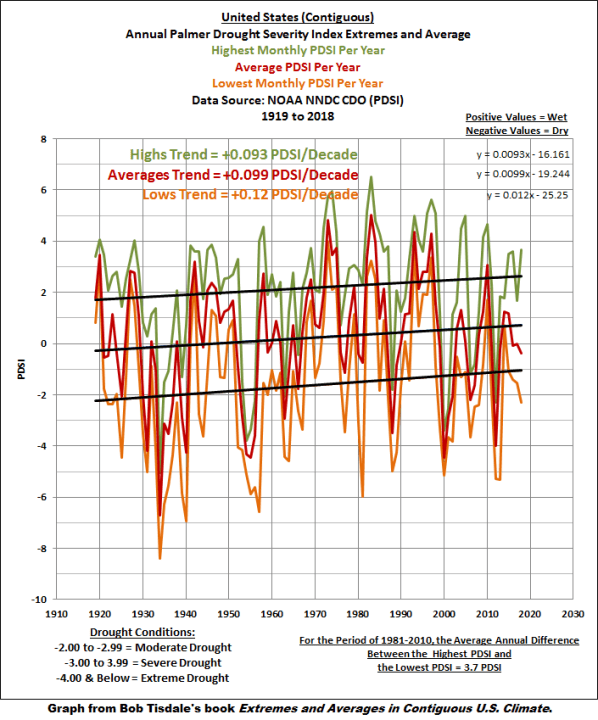
The Palmer Drought Severity Index (PDSI) uses readily available temperature and precipitation data to estimate relative dryness. It is a standardized index that generally spans -10 (dry) to +10 (wet). The chart shows Continental U.S. is getting wetter, about 0.01 PDSI index per year with the lows trend is getting wetter the fastest. This is good news.
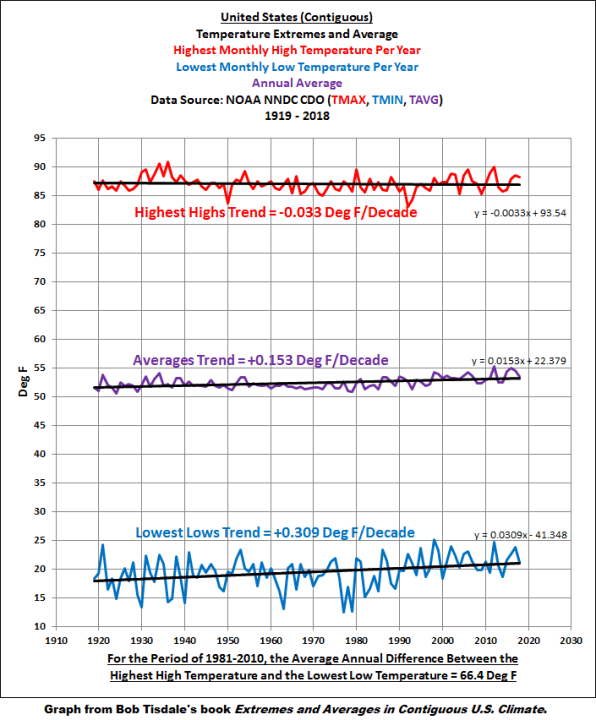
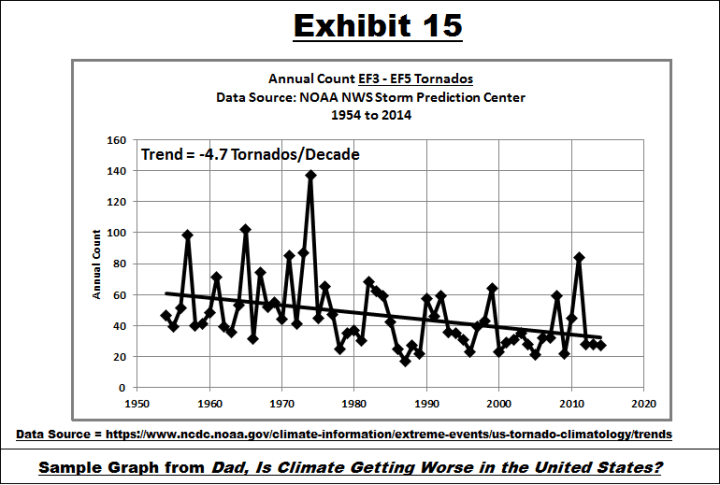
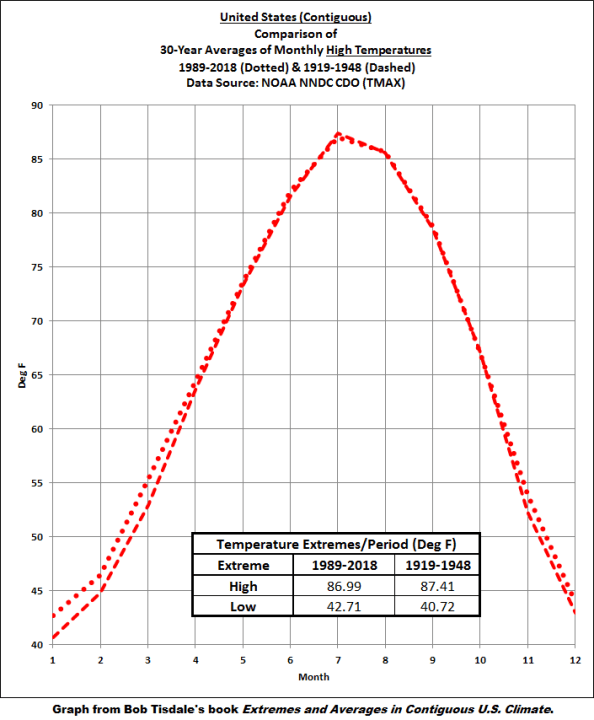
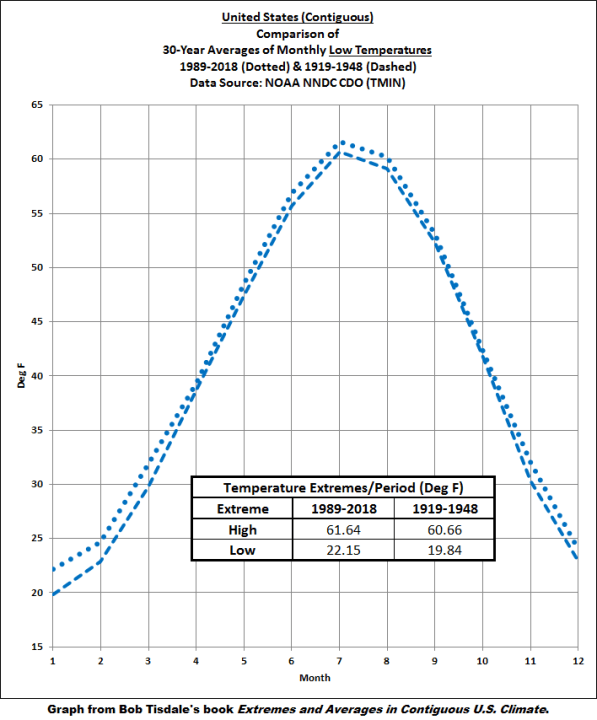
The temperature extremes keep narrowing, the maximum temperatures decrease by 0.033 degree F/decade, but the minimum temperatures increase by 0.309 degree F/decade. This is good, since tornadoes are a result of extreme temperature differences, most often associated with cold fronts.

 The Continental U.S. has not had an EF5 tornado (the most severe) since 2013. Let us hope this trend continues.

Contrary to popular belief, hurricanes making landfall on the U.S. mainland are decreasing slightly, especially major hurricanes.

Taking a closer look at the seasonal temperature trends  we can see that the winter aveerage temperatures are rising by about 0.3F per decade but the summer temperatures rise only about one seventh as much, (0.04F/decade)  .
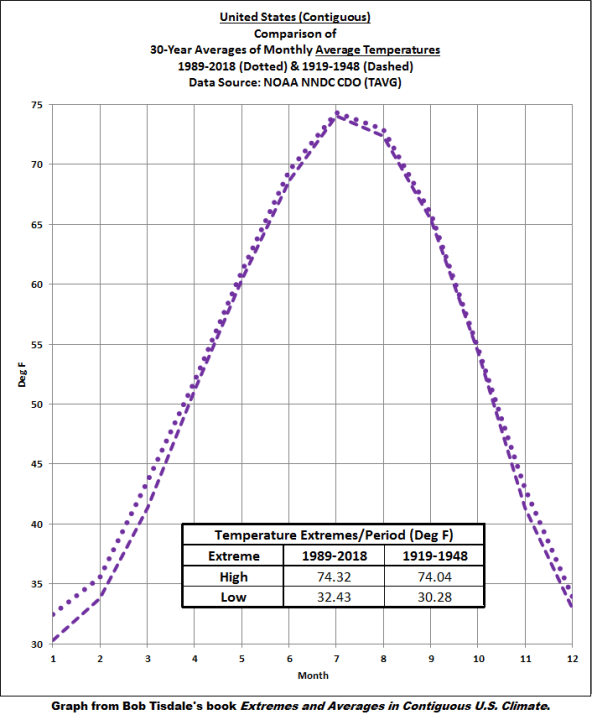
These are the average temperatures. The minimum average temperatures rise in all seasons, but mostly in the winter,

The maximum temperatures barely budge. They rise in the winter and decrease ever so slightly in the summer.

Watching the warming of the poles, and even the continental U.S., far from being an impending end of mankind as we know it, may even be beneficial. Warmer poles in the winter means less temperature gradient between the poles and the tropics, leading to less severe storms. They will still be there, but less severe.

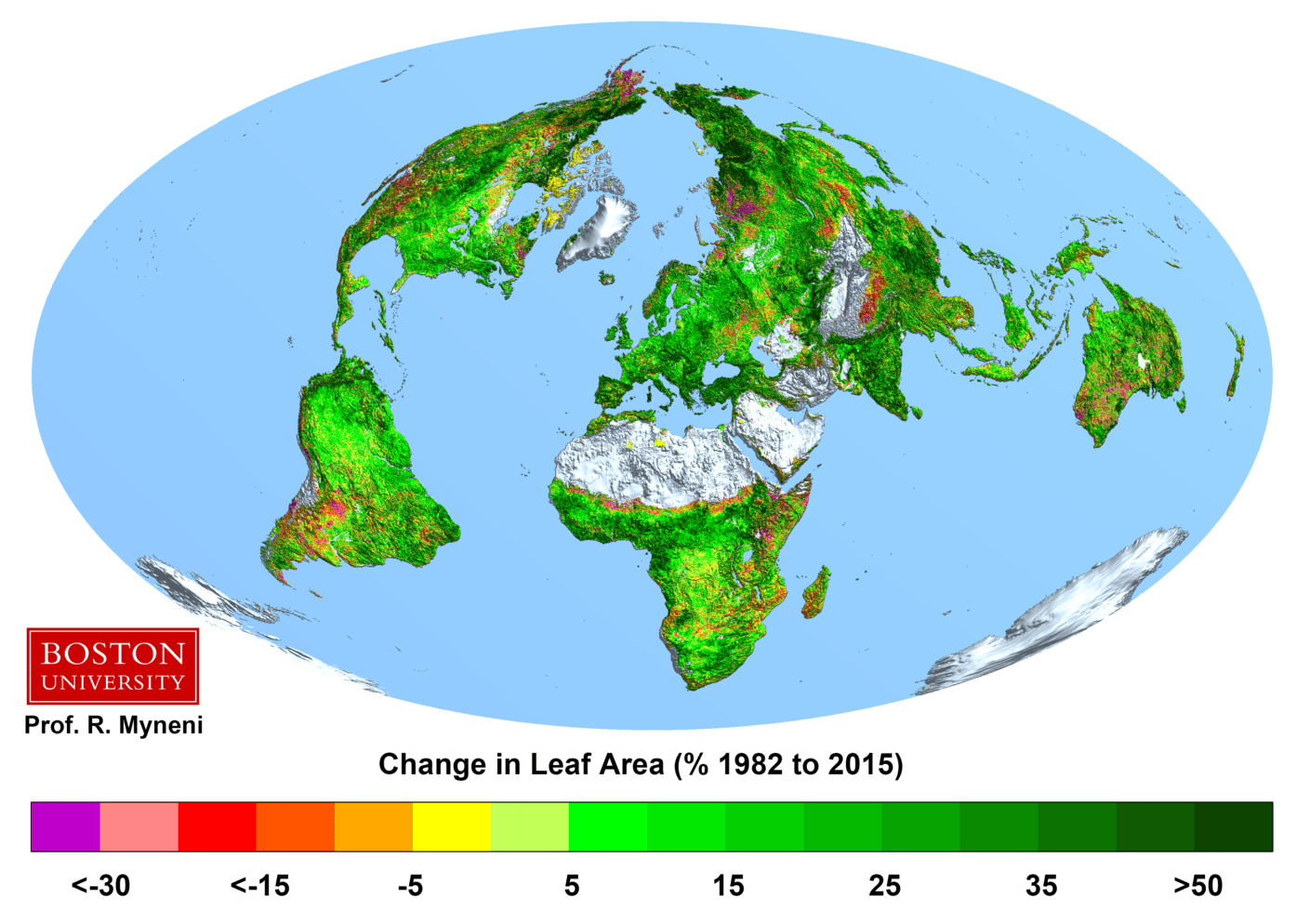
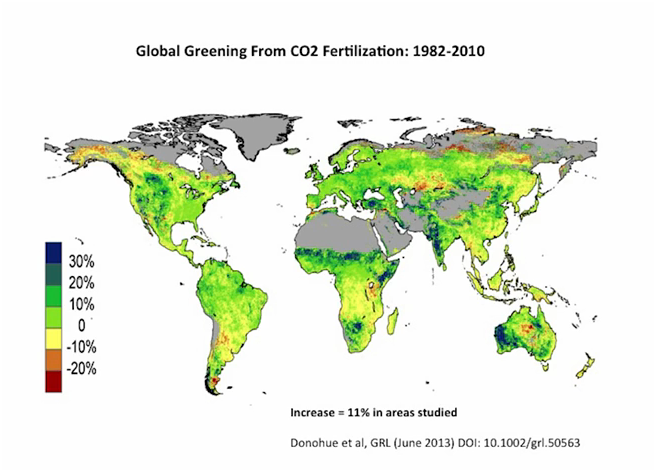
There is one great benefit of increased CO2, the greening of the earth.
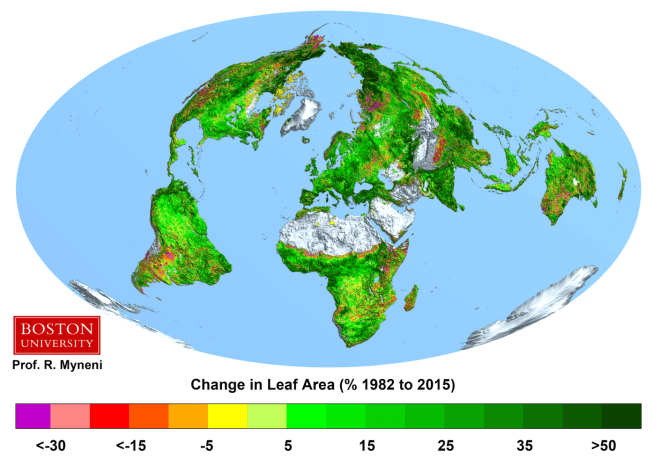
Thanks to this greening, which is accomplished with the fertilizer effect of CO2, the earth can now keep another 2 billion people from starvation, not to mention what it does to plants and wildlife.

Having said that, I am still a conservationist. Coal, oil and gas will run out at some time, and I for one would like to save some for our great grandchildren, not yet born. In addition I would like to minimize the need for mining, which can be quite destructive. We have immense environmental problems, like water pollution, deforestation, intoxication of the soil, over-fertilization with nitrogen, real air pollutants, such as Sulfur compounds and soot, just to name a few. They have one thing in common: It takes lots of energy to do the cleanup.

The best solution is to switch most electricity generation to Thorium molten salt nuclear power. There are multiple reasons why this should be done as a priority by streamlining regulation and facilitate competition in development of the best solutions to the energy problems.
The many cases why Thorium Nuclear Power is the only realistic solution to the world’s energy problems.
The climate change caused by rising CO2 levels leads to less extreme weather, not more, weather statistics prove.

We have experienced a 50% increase in CO2 levels since the beginning of industrialization. In the last 30 years the level has risen 17%, from about 350 ppm to nearly 410 ppm. Is is time to panic and reduce the CO2  emissions to stop the rise?

The traditional way to approach the problem of guessing what effect of rising CO2 levels has on the climate is by creating climate models. Thy have recently been adjusted, and they suddenly show a much higher rate of future temperature increase, in this case what is supposed to happen to global temperatures for a doubling of CO2 from pre-industrial times, from 270ppm to 540ppm.

There are two ways to approach this problem. The models make certain assumptions about the behavior of the changing atmosphere and model future temperature changes. This is the approach from IPCC for the last 32 years. These models are all failing miserably when compared to actual temperature changes.

The other way i to observe what is actually happening to our temperature over time as the CO2 increases. We have 50 years of excellent global temperature data, so with these we can see where, when and by how much the earth has warmed.

The most drastic temperature rise on earth has been in the Arctic above the 80th latitude. In the winter of 2018 it was 8C above the 50 year average. See charts from the Danish Meteorological Institute:

Note, there is no increase at all in the summer temperatures!

The fall temperature saw an increase of 5C and the spring temperature saw an increase of about 2.5C.

The 2020 winter has so far seen an about 4c increase Source: DMI.

This 8C winter rise of temperature is significant, most would even say alarming, but my response is, why is that?

To get the answer we must study molecular absorption spectroscopy and explain a couple of facts for the 97% of all scientists who have not studied molecular spectroscopy. IPCC and most scientists claim that the greenhouse effect is dependent on the gases that are in the atmosphere, and their combined effect is additive according to a logarithmic formula. This is true up to a certain point, but it is not possible to absorb more than 100% of all the energy available in a certain frequency band! For example: If water vapor absorbs 90% of all incoming energy in a certain band, and CO2 absorbs another 50% of the energy in the same band, the result is that 95% is absorbed, (90% + 50% * (100% – 90%)),  not 140%, (90% + 50%).

The following chart shows both CO2 and H2O are absorbing greenhouse gases, with H20 being the stronger greenhouse gas, absorbing over a much wider spectrum, and they overlap for the most part. But it also matters in what frequency range s they absorb.

For this we will have to look at the frequency ranges of the incoming solar radiation and the outgoing black body radiation of the earth. It is the latter that causes the greenhouse effect. Take a look at this chart:

The red area represents the observed amount of solar radiation that reaches the earth’s surface. the white area under the red line represents radiation absorbed in the atmosphere. Likewise, the blue area represents the outgoing black body radiation that is re-emitted. The remaining white area under the magenta, blue or black line represents the retained absorbed energy that causes the greenhouse effect.

Let us  now take a look at the Carbon Dioxide bands of absorption, at 2.7, 4.3 and 15 microns. Of them the 2.7 and 4.3 micron bands absorb where there is little black body radiation, the only band that counts is at 15 microns, and that is in a band where the black body radiation has its maximum. However it is also in a band where water vapor also absorb, not as much as CO2,only about 20% to 70% as much. Water vapor or absolute humidity is highly dependent on the temperature of the air, so at 30C there may be 50 times as much water vapor, at 0C there may be ten times as much water vapor, and at -25C there may be more CO2 than water vapor. At those low temperatures the gases are mostly additive. In the tropics with fifty times more water vapor than CO2, increased CO2 has no influence on the temperature whatsoever. Temperature charts confirm this assertion:

Here the temperature in the tropics displays no trend whatsoever. It follows the temperature of the oceans, rises in an el nino and falls in a la nina. The temperature in the southern hemisphere shows no trend. In the northern temperate region there is a slight increase, but the great increase is occurring in the Arctic. There is no increase in the Antarctic yet even though the increase in CO2 is greater in the Antarctic and the winter temperature in the Antarctic is even lower than in the Arctic. So CO2 increase cannot be the sole answer to the winter temperature increase in the Arctic.

A few days ago there was a storm of historic magnitude, filled with moisture going up from the Mexican Gulf through the Atlantic and really sacked Scotland and Norway. The weather warnings called for severs floods and hurricane-like winds:

What happened to the temperature when the storm arrived?

ice The Arctic temperature above the 80th latitude rose about 12C, from about -30C to about -18C, and most of the moisture snows out. What happens to the ice covercover when the storm arrives? Let’s see the most recent Arctic ice cover.

As the storm arrives, some of the ice breaks up, but at the end of the storm it bounces back, helped with all the snow that just fell.

Is the snow cover increasing in the Arctic?Let us see what the snow statistics show. These are from the Rutgers snow lab.

The fall snow extent is increasing, and has increased by more than 2 percent per year.

The winter snowfall has also increased but only by 0.04 percent per year. The snow covers all of Russia, Northern China, Mongolia, Tibet, Kashmir and northern Pakistan, Northern Afghanistan, Northern Iran, Turkey, Part of Eastern Europe, Scandinavia, Canada, Alaska, Greenland and part of Western and Northern United States.

In the spring on the other hand the snow pack is melting faster, about 1.6 percent less snow per year. One of the major reasons for an earlier snowmelt is that the air is getting dirtier, especially over China, and to some extent Russia. The soot from burning coal and mining and manufacturing changes the albedo of the snow. The soot is visible on old snow all the way up to the North Pole. The other reason is that the poles are getting warmer. In the fall and winter it is mostly due to increased snowfall, but in the spring, as soon as the temperature rises over the freezing point, melting occurs.

Moving down to the continental U.S. there are even more good news.

The data presented in the next six graphs were extracted from the data available at the NOAA National Data Center Climate Data Online (NNDC CDO) website.

Yes, rain (and snow) are increasing, but it is also raining slightly more often and regularly, so the net result is a slight decrease in flooding.

Of course, this could change in the future, and we need to watch the rain patterns, as they are constantly changing. Building more levees is not always the answer, since this will increase the risk for flooding in other places. It may be necessary to let certain areas, mostly farmland and woodland be flooded from time to time.

The Palmer Drought Severity Index (PDSI) uses readily available temperature and precipitation data to estimate relative dryness. It is a standardized index that generally spans -10 (dry) to +10 (wet). The chart shows Continental U.S. is getting wetter, about 0.01 PDSI index per year. This is good news.

The temperature extremes keep narrowing, the maximum temperatures decrease by 0.033 degree F/decade, but the minimum temperatures increase by 0.309 degree F/decade. This is good, since tornadoes are a result of extreme temperature differences, most often associated with cold fronts.

 The Continental U.S. has not had an EF5 tornado (the most severe) since 2013. Let us hope this trend continues.

Contrary to popular belief, hurricanes making landfall on the U.S. mainland are decreasing slightly, especially major hurricanes.

Taking a closer look at the seasonal temperature trends  we can see that the winter temperatures are rising. but the summer temperatures stay the same.

hh

These are the average temperatures. The minimum temperatures rise in all seasons, but mostly in the winter,

The maximum temperatures barely budge. They rise in winter and decrease ever so slightly in the summer.

Watching  the warming of the poles, and even the continental U.S., far from being an impending end of mankind as we know it, may even be beneficial. Warmer poles in the winter means less temperature gradient between the poles and the tropics, leading to less severe storms. They will still be there, but less severe.

There is one great benefit of increased CO2, the greening of the earth.

Thanks to this greening, done with only the fertilizer of CO2 the earth can now keep another 2 billion people from starvation, not to mention what it does to plants and wildlife.

Having said that, I am still a conservationist. Coal, oil and gas will run out at some time, and I for one would like to save some for my great grandchildren, not yet born. In addition I would like to minimize the need for mining, which can be quite destructive. We have immense environmental problems, like water pollution, deforestation, intoxication of the soil, over-fertilization with nitrogen, real air pollutants, such as Sulfur compounds and soot, just to name a few. They have one thing in common: It takes lots of energy to do the cleanup.

The best solution is to switch most electricity generation to Thorium molten salt nuclear power. There are multiple reasons why this should be done as a priority.

Twenty-five reasons to rapidly develop Thorium based Nuclear Power generation.

We need badly to develop and build Thorium based molten salt fast breeder nuclear reactors to secure our energy needs in the future. Lest anyone should be threatened by the words fast breeder, it simply means it uses fast neutrons instead of thermal neutrons, and breeder means it produces more fissible material than it consumes, in the case of Thorium the ratio is about 1.05.

1. A million years supply at today’s consumption levels.

2. Thorium already mined, ready to be extracted.

3. One ten-thousandth of the TRansUranium waste compared to a U-235 based fast breeder reactor.

4. Thorium based nuclear power produces Pu-238, needed for space exploration.

5. Radioactive waste from an LFTR decays down to background radiation in 300 years compared to a million years for U-235 based reactors.

6. Thorium based nuclear power is not suited for making nuclear bombs.

7. Produces isotopes that helps cure certain cancers.

8. Molten Salt Thorium Reactors are earthquake safe.

9. Molten Salt Thorium Reactors cannot have a meltdown, the fuel is already molten.

10. Molten Salt Nuclear Reactors have a very high negative temperature coefficient leading to a safe and stable control.

11. Atmospheric pressure operating conditions, no risk for explosions.

12. Virtually no spent fuel problem, very little on site storage or transport.

13. Thorium Nuclear Power generators  scale  beautifully from small portable generators to full size power plants.

14. No need for evacuation zones, can be placed near urban areas.

15. Liquid Fluoride Thorium Reactors will work both as Base Load and Load Following power plants.

16. Liquid Fluoride Thorium Reactors will lessen the need for an expanded national grid.

17. Russia has an active Thorium program.

18. China is having a massive Thorium program.

19. India is having an ambitious Thorium program.

20. United States used to be the leader in Thorium usage. What happened?

21. With a Molten Salt Reactor, accidents like the Three Mile Island disaster will not happen.

22. With a Molten Salt Reactor, disasters like Chernobyl are impossible.

23. With Molten Salt Reactors, a catastrophe like Fukushima cannot happen.

24. Produces electrical energy at about 4 cents per KWh.

25. Can deplete some of the existing radioactive waste and nuclear weapons stockpiles.

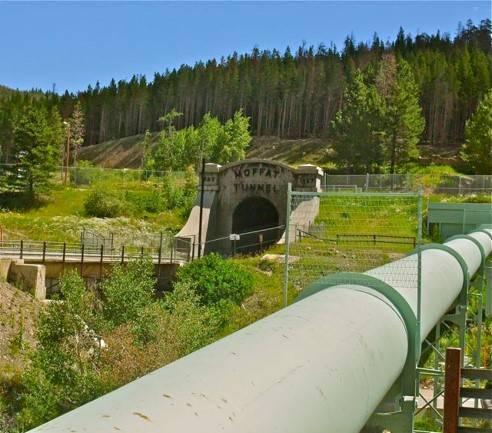
Water shortage? With the population increase west of the Rocky Mountains, is it time to finally close the Moffat tunnel?

Many years ago the city of Denver had a problem. The land east of the Rocky mountains is dry, rain is sparse and the aquifers were being depleted. The city was growing rapidly, still small by today’s standard, but they were thinking big and looked for a really good water supply. There was one fairly nearby: the Colorado river. There was only one small problem, it was on the other side of the continental divide. They were building a railroad tunnel under the continental divide anyway, so for a few million dollars extra they added a water tunnel, with a capacity of 36 m3/s of water flow, and it has been draining water from the Colorado River basin since 1936.

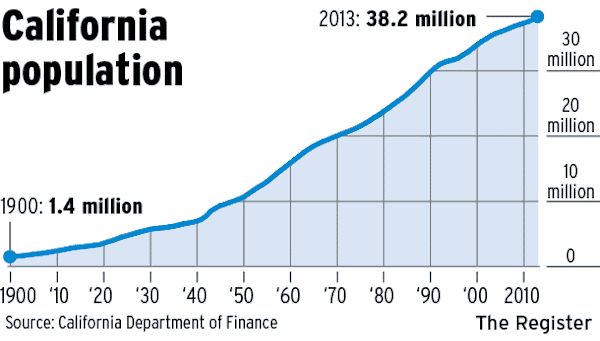
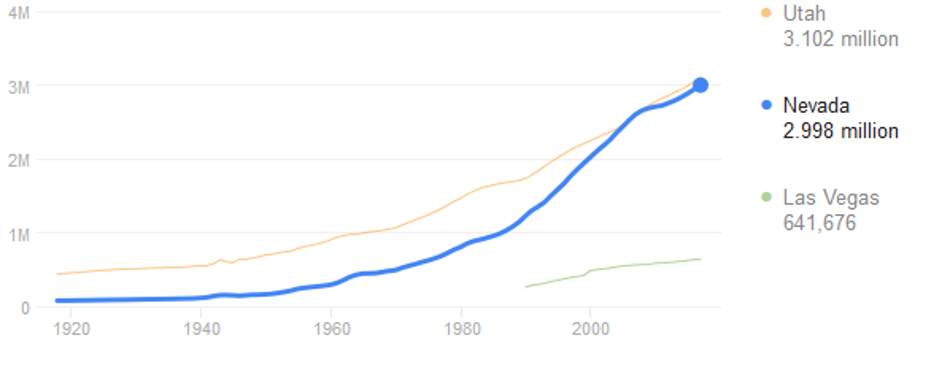
As an engineering feat it was quite impressive, and the population west of the Rocky Mountains was minuscule. This has changed and the demand for water in the Southwest is enormous and increasing. Las Vegas alone is now about the same size as the City of Denver. (The Denver Region is about 5.5 million)


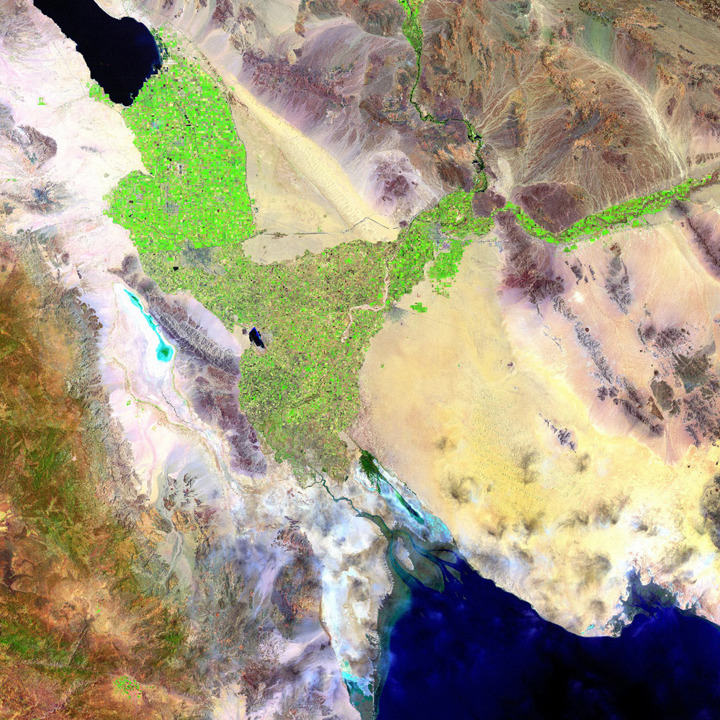
Much of the water in the Colorado River basin is used for agricultural purposes.


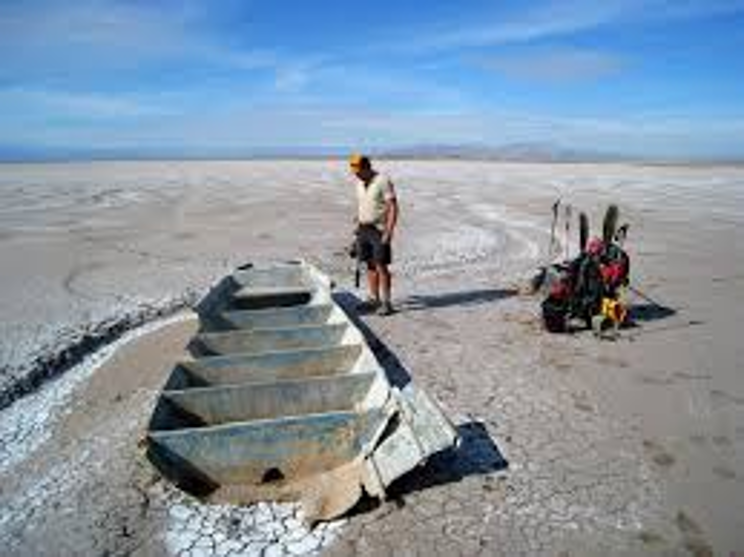
This is important: The Colorado River water is all spoken for. It never reaches the Gulf of California. Once upon a time there was a good shrimp harvest at the mouth of the Colorado River. No more.

In the mean time, water is diverted from the Colorado River Basin to the Mississippi River Basin. There the problem is the opposite: What levees to build next to prevent more and more flooding.

Time to shut down the Moffat Tunnel.


Elizabeth Warren’s wealth tax, a true Pomperipossa like scheme.

Image result for Elizabeth Warren on healthcare

Elizabeth Warren from Mass.

touts “Healthcare for all” with pizzazz.

Tax the rich is her call,

income, wealth, take it all;

a Pomperipossa tax pass.

You may ask: What is a Pomperipossa tax?

The term came into being in a publication, which was published pomperipossain the Swedish evening tabloid  Expressen  on March 3, 1976. It was written in a deliberate style break, from children’s literature to legalese, and I have tried to do a close translation:  https://lenbilen.com/2012/01/24/pomperipossa-in-monismania/

Read it! It tells of how the famous Swedish author, Astrid Lindgren got a 102% tax on her income. It made such a stink that the Swedish Social Democrats, who had been ruling Sweden seemingly forever lost the upcoming election, and got replaced by a basically progressive liberal coalition.

What is then the proposed Warrenesque wealth tax? In short it is a 2% tax on all household wealth over 50 million, 3% on over a billion. Elizabeth Warren herself is relatively poor, her wealth is only about 10 million, but Nancy Pelosi is worth around 100 million, so she will pay. The tax is similar to the so called Zakat in Sharia law which is 2.5% over a poverty minimum and is one of the five pillars in Islam. It is divided into eight parts. (One eighth is to support militant Jihad, but I digress)

The wealth tax is estimated to raise 2.5 trillion over ten years, far short of the estimated 50 trillion that medicare for all will cost over the same time period.

Sweden used to have a wealth tax, but so many rich people emigrated that it was removed and replaced with an ever increasing value added tax. It is now 25%.

Yes, that and a higher income tax just may be enough


Climate Catastrophe? No, but an environmental challenge. A Limerick.

Is climate change all in the cloud?

Acknowledge it is not allowed.

Settled science, they say.

Buckle up and portray

disaster! Close rank, join the crowd.

I believe in climate change. It is obvious by observing how the climate has changed over the years. Here is a chart of global temperature and CO2 for the last 600 million years.

The chart is smoothed over millions of years, but it shows that the global average tempera ture stabilizes at 22C regardless of CO2 levels, and there is precious little correlation between temperature and CO2 level. Taking a look at the last 450,000 years it shows an interesting pattern:

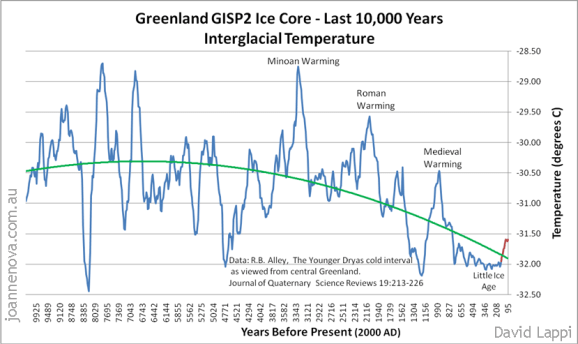
It shows that more than 90 percent of the time the earth has been colder than today, most of that time in a series of ice ages, interrupted with inter-glacial periods of between 5,000 and 20,000 years.  This inter-glacial period is of interest, since it points to our future – another ice age, the question is: When it will start? According to the Milanković cycles we are still in the moderate temperatures sweetspot, and it will last for another few thousand years, but the trend is down, tne next ice age is inevitable. In fact, except for the little ice age and the time between the Roman warm period and the medieval warm period,  the global temperatures have been higher than now for the last ten thousand years. This shows the temperature from the Greenland ice cores for the last 10000 years:

Greenlandgisp-last-10000-new

All of these changes in climate occurred with a relative constant CO2 level of about 260 ppm!

This time is different; CO2 levels are now over 400 ppm, rising about 2 ppm per year with no end in sight. The question is: Is this increase good or bad? If it is bad, how bad is it going to be?

To answer this question the world spends over 400 billion dollars a year in climate research and are starting to spend much more in climate remediation. Over 30 nations are making climate models trying to predict future temperature trends. Of the models so far all but one fail miserably when compared to what actually is happening. The sole exception is the Russian model which tries to fit their  model to past temperature records rather than postulate that response from CO2 and water vapor are always additive.

There is a better, far simpler way to predict future temperature trends. The reason CO2 and water vapor are not always additive is because water vapor is a condensing gas, sometimes forming clouds, which drastically alter the temperature of the surface. Clouds forming at day reflects a large portion of the sunlight back into space, clouds at night keep the heat in.

Willis Eschenbach has made en excellent analysis of 19 years of data from CERES (Clouds and the Earth’s Radiant Energy System from NASA). He compensates for the effect of Advection (horizontal heat transfer of energy from one place on earth to another.) The results are startling:

The 3.7 W/m2 is the expected increase of heat retention for a doubling of CO2 as per IPCC  (the U.N  Intergovernmental Panel on Climate Change). A similar result is obtained if one is to include data from HadCRUT (Temperature data from the Hadley Centre of the UK Met Office)

This agrees very well with my own, much coarser examination of data, but should include that the expected temperature increase observed for a doubling of CO2 is by no means evenly distributed. In addition, if temperature rises 0,39C there will be  about 2.6 % more water vapor in the air which would rise temperature another 0.35 C. This too is not evenly distributed. Here are the expected result:

In the tropical doldrums there will be no change at all, the water vapor is all dominant and thunderstorms keep the average temperature constant.

In the 10-40 latitude there will be an increase, but increased clouds will moderate the increase except in the most arid deserts that will experience around a 0.9 C increase.

The temperate regions will experience about a 0.4 C increase in the wet areas, and about a 0.6 C in the arid parts.

Most of the increase will be experienced around the poles, with minimum temperatures rising five to ten degrees, but maximum temperatures staying about the same. We are seeing this increase in the Arctic, and the rise is nearly all due to rising winter minimum temperatures.

Source: Danish Meteorology Institute

Why is that? With on the average 2.6 % increase in water vapor there will be an increase in the rainfall,  about 2.6% on average, but since there is no change in the tropics it will be concentrated at the higher latitudes, especially around the poles where it will manifest itself as more snow, and that is the main reason for the increased minimum temperatures. Notice there has been no increase in summer temperatures!

So, how bad is it going to get if nothing is done to stop the increase in CO2?

The temperature difference between poles and equator will be less, which means:

Fewer and less severe hurricanes, less severe tornadoes, less severe winter storms, less droughts.

But there will be about 2% more average cloud cover, more rain and more flooding.

So, with an 0.4C average temperature we will not even be back to the medieval warm period, much less the Roman warm period, not to speak of the Minoan warm period.

The sinking eastern seaboard is a problem that has very little to do with ocean rising, and all to do with tectonic plates movements, which we will have to accept.

Will anything else good come out of this climate change?

Yes, indeed. With a doubling of CO2 there will be a corresponding response from plant life increasing biological productivity 30 to 60%. It is not linear, and above 800 ppm it tapers of for most plant species. But we will be able to feed at least another 3 billion people and keep them from hunger, but also much cattle and wild animals, (yes that includes flies and gnats, but I digress)

https://lenbilen.com/wp-content/uploads/2016/11/increase.png?w=660

This picture gives us hope for the future. Notice the most significant increase was in Sub-Saharan Africa, western United States, western Australia and western India. These are the areas that need more rain the most!

If increasing CO2 concentration is not the problem, then what is? Let us take a look at the sources  from which U.S. generates electrical energy.

Image result for us electricity generation by source

We live in challenging times indeed, with enormous environmental challenges. It takes a lot of energy to clean up the mess we have generated over the ages. It would be a shame to use up our remaining coal, oil and gas to produce the electricity needed to clean up. Oil coal and gas will eventually be depleted and we need to save some for our great grandchildren so they can enjoy flying like we have become accustomed to. Like the famous conservationist Sarah Palin once said: “for when it’s gone, it’s gone.

Solar generation is about 4 times more expensive (without subsidies) to produce energy than coal and gas, but has important niche applications, such as on roofs for backup in case of short grid failures and for peak power assist. The Amish people have given many practical applications on how to live off the grid.

Wind power is cheaper when the wind blows, but the full generation capacity has to be there even when the wind doesn’t blow, so the only gain from wind power is to lessen the mining or extraction of carbon. In addition, wind power kills birds, the free yearly quota of allowable Bald Eagle kills was upped from 1200 to 4200 during the Obama administration. Golden Eagles and a few other rare birds have a quarter of a million dollar fine associated with their kills. If wind power is increased without finding a solution to the bird kills, whole species may become extinct.

Hydroelectric power is for all practical purpose maxed out, except one large untapped resource; the Kongo river in Africa. Some hydro electrical project do more harm than good, such as the Aswan Dam in Egypt, and some are waiting for the next big earthquake, such as the Three Gorges Dam in China.

Geothermal power is good but difficult and risky to utilize in geologically unstable areas.

Biomass should never be burned for electricity production but be used for soil regeneration to combat erosion. Only polluted biomass such as medical waste and plastics should be incinerated at high temperature, complete with scrubbers to eliminate poisonous gases.

All necessary cleanup and recycling consume a lot of energy, and it has to be generated somehow. We would like save some Coal, Natural Gas and Petroleum for our great grandchildren. This leaves us only

Nuclear power.  After a nearly thirty year hiatus in building new nuclear power plants they are slowly being built again. The permit process is fraught with citizen opposition (NIMBY), very strict bureaucratic delay, first by the Three Mile Island incident, then by the Chernobyl disaster/unintended sabotage, and finally by the Fukushima catastrophe. In addition conventional nuclear power produces large amounts of transuranium waste products that has to be stored for a million years. The Obama administration ended reprocessing of spent fuel rods, so not only must the transuranium products be stored, but also some unused U235. This makes conventional nuclear power using enriched Uranium too expensive to compete against coal or natural gas. But there are powerful commercial interests to keep it this way. After the Westinghouse bankruptcy GE has a virtual monopoly on nuclear power. They are in no hurry to make any changes.

There is a better way: Thorium Nuclear power. The advantages are:

1. A million years supply at today’s consumption levels.

2. Thorium already mined, ready to be extracted.

3. One ten-thousandth of the TRansUranium waste compared to a U-235 based fast breeder reactor.

4. Thorium based nuclear power produces Pu-238, needed for space exploration.

5. Radioactive waste from an LFTR decays down to background radiation in 300 years compared to a million years for U-235 based reactors.

6. Thorium based nuclear power is not suited for making nuclear bombs.

7. Produces isotopes that helps cure certain cancers.

8. Molten Salt Thorium Reactors are earthquake safe.

9. Molten Salt Thorium Reactors cannot have a meltdown, the fuel ia already molten.

10. Molten Salt Nuclear Reactors have a very high negative temperature coefficient leading to a safe and stable control.

11. Atmospheric pressure operating conditions, no risk for explosions.

12. Virtually no spent fuel problem, very little on site storage or transport.

13. Thorium Nuclear Power generators  scale  beautifully from small portable generators to full size power plants.

14. No need for evacuation zones, can be placed near urban areas.

15. Liquid Fluoride Thorium Reactors will work both as Base Load and Load Following power plants.

16. Liquid Fluoride Thorium Reactors will lessen the need for an expanded national grid.

17. Russia has an active Thorium program.

18. China is having a massive Thorium program.

19. India is having an ambitious Thorium program.

20. United States used to be the leader in Thorium usage. What happened?

21. With a Molten Salt Reactor, accidents like the Three Mile Island disaster will not happen.

22. With a Molten Salt Reactor, disasters like Chernobyl are impossible.

23. With Molten Salt Reactors, a catastrophe like Fukushima cannot happen.

24. Produces electrical energy at about 4 cents per KWh.

25. Can deplete some of the existing radioactive waste and nuclear weapons stockpiles.

There is no time to waste. This is my suggestion list:

1. Immediately take Thorium off the list of “source materials”. While Thorium is radioactive slightly above background radiation no amount of Thorium can make it go critical, and it cannot be source material for making bombs.

2. Make separate regulations for Thorium based Nuclear plants apart from Uranium plants. One thing that goes away is the need for evacuation zones due to the inherent safety of Thorium Nuclear plants.

3. Declare Thorium Nuclear Power to be the preferred replacement for Coal or Gas powered electric plants.

4. Streamline the permit process, like Uranium powered plants enjoyed when there was a desire to build Nuclear Bombs.

5. Increase research and development into Liquid Fluoride Thorium reactors to speed up their development.

6. Develop hybrid Tokamak powered Thorium reactors like the one Russia is developing to burn off transuraniun  nuclear waste products.

With all this done, I envision coal, gas and biofuel Power stations to be eliminated within ten years, and transuranium waste products to be eliminated within twenty years.

When Coal, gas and biofuel are eliminated as source for Electric Power, then it is time to switch most of the transportation to electric cars and trucks, but not before.

in another twenty years, maybe, just maybe it is time for Fusion Power to take over.

Let us get going!


Obamacare made sharing of data between federal departments, including citizenship question possible. A Limerick.

Since the legal delays made it impossible to put the question of citizenship back on the 2020 census forms, where it had been from the 1800’s to 2000, President Trump issued an executive order directing the Commerce Department to obtain citizenship data through means other than the census. That includes documents from the Department of Homeland Security, which houses citizenship and asylum services, and the Social Security Administration.
The order was signed and released to reporters late Thursday night. The Justice Department notified federal district judges of the administration’s decision.
Sharing of data between federal agencies has always been a sticky point, since federal agencies jealously protect their turf. The introduction of Obamacare changed all that, so the legal hindrances were removed for sharing data.


Obamacare did blaze the trail

of sharing of data, no fail.

Who’s a citizen now

can be found out somehow.

It’s better in every detail.

We all remember the introduction of the Obamacare website. It will stand out as an example for all time how not to design a website. The cost was estimated to be 95 million dollars to design and implement. The final cost was more than 2.2 Billion dollars, maybe an all time record for a website. There were many reasons for this overrun, one of which was it had to import a number of data bases and read the data securely. One of the features of Obamacare was that you were not eligible to enroll if you was not a citizen, so they needed full access to all that data. If the need for sharing had arisen first now, imagine the legal delays!

Since the citizenship question on the census form was voluntary, this is a much better way to obtain somewhat accurate data (the drug runners and child traffickers and sex slaves will never be counted accurately anyway)

One final question: Who took the citizen question off the 2010 long form census and why?

Here is the 2000 long form.

The Iranian nuclear deal null and void! A Limerick.

The Iranian Nuclear appeasement:

For Mullahs was quite an achievement.

In a year, give or take

there’ll be nukes, much at stake.

It’s time for a real peace agreement.

According to an article in Iran Watch (http://www.iranwatch.org/our-publications/articles-reports/irans-nuclear-timetable) Iran has enough Uranium to make a number of Nuclear bombs in a very short time.

Using their 6000+ centrifuges agreed to under this contract they can produce 1 nuclear bomb in 1 year assuming they only use the 5060 Ir-1 centrifuges allowed to be operated under the contract and use only natural Uranium as fuel (0.7% U235).

If they use all 9000 existing separators they can produce 1 bomb in 6.8 months. In fact, they have been running them since negotiations began and have now reached the limit of 300  Kg reactor grade Uranium (3.5% U235), enough to produce one Nuclear bomb.

Since they did break the contract Sunday July 7, they are free after 35 days to use all 9000 centrifuges to produce weapons grade Uranium at the rate of 1 bomb every seven weeks.

They also have 1080 IR-2 centrifuges currently not yet operating, far more efficient than the IR- 1 centrifuges ready to be started up.

In addition they have 20% enriched Uranium in the form of yellow cake. This used to be UraniumHexaFlouride gas, ready for further enrichment. According to the agreement it was “neutralized” into yellow cake so it couldn’t be further enriched. It takes less than two weeks to convert it back to gas, and another two weeks to enrich it to weapons grade Uranium. They have enough of this to make 1 bomb.

So, this is why the Mullahs exclaimed: We Won! Death to America!

After the contract is finally totally broken the first bomb will be ready less than 1 month, after that, 1 bomb every seven weeks!

And then again, who is to say that they do not already have nuclear bombs? Deep down in mountains are their military “research” facilities dug down, impervious to normal bombs, with radiation shielding doors so no external measurements can be made by nuclear inspectors. In a side deal, the Iranians are going to do the inspections themselves to assure all is above board and no cheating occurs.

Quite a negotiating feat for the Obama administration!

No wonder president Trump did not force congress to ratify it as a treaty, but declare it no longer valid!

The need to develop Thorium based Nuclear Energy as the major electric energy supply. 14. No need for evacuation zones, can be placed near urban areas.

No need for evacuation zones, can be placed near urban areas. Molten Salt Thorium reactors operate at atmospheric pressure and have a very high negative temperature coefficient, so there is no risk for a boil-over. They are easily made earthquake-safe and no pressure vessel is needed. This will greatly simplify the approval process, no need for elaborate evacuation plans have to be developed. Since the Three Mile Island accident there was a thirty year gap in approvals for new nuclear plants. The “not in my backyard ” mentality reigned supreme, and delay and denial was the rule of the years. But the lawyers still got their share, leading to escalating cost for new nuclear power. In the early days of nuclear power France took the approach of building some of their nuclear plants near the Belgian and German border, so they only had to develop half of an  evacuation plan, leaving the other half to their understanding neighbors. It also leads to placing the nuclear plants where there is the least resistance, not where they are needed the most, adding to the strain on the electric grid.

The need to develop Thorium based Nuclear Energy as the major electric energy supply. 8. Molten Salt Thorium Reactors are earthquake safe.

Molten Salt Thorium Reactors are earthquake safe. Thorium reactors have a very simple and compact design where gravity is the only thing needed to stop the nuclear reaction. Conventional nuclear reactors depend on external power to shut down after a SCRAM, where poison rods fall down to halt the reaction.  The next figure shows the concept of a Thorium reactor.

The idea is to empty the fissile U-233 core through gravity alone. All that is needed is a melt-plug that is constantly cooled by cold air. In an earthquake the cold air flow automatically shuts off, and since the fuel is already molten, it will then run down into channels like pig-iron into cooling heat exchangers with  water supplied through gravity alone.

As we can see the reactor hardened structure is compact, and can be completely earthquake and tsunami proof. What can be sheared off are the steam pipes and external power, but the reactor shutdown will complete safely without additional power, even if the earthquake is so bad the reactor is broken into pieces.