Luke 20:20-47, continuing Holy Week, it is now Tuesday, Jesus was teaching in the Temple and his authority was questioned. Standing in Solomon’s colonnades the religious leaders tried to entrap Jesus so they asked him: “Is it legal to pay Taxes to Caesar?” You know the answer, “Render therefore unto Caesar the things which be Caesar’s, and unto God the things which be God’s.” After that it was the Sadducee’s turn: What about the Resurrection? Jesus answered with scripture: “How can David call his descendant Lord?” Jesus finally warned the people: “Beware of the teachers of the Law.”
Proverbs 5 tells of the perils of adultery and does not mince words.
Luke 20:1-19, continuing Holy Week, it is now Tuesday, Jesus was teaching in the Temple and his authority was questioned. Standing in Solomon’s colonnades he taught the parable of the wicked wine dressers. The religious leaders tried to entrap Jesus, but were afraid of the people.
1 Kings 20. Ahab defeated the Syrians and he did it twice. After that Ahab made a treaty with Ben-Hadad, and that led to the prophecy of Ahab’s Condemnation.
1 Kings 21. Naboth was killed for his vineyard and for that the LORD condemned Ahab.
1 Kings 22. Micalah prophesied against Ahab, Ahab therefore disguised himself for protection but died in battle by a stray arrow. Jehoshaphat became King of Judah, followed by Ahaziah.
Luke 19:28-48. Jesus entered what is called “Holy Week”, beginning with the triumphal entry. Seeing Jerusalem, Jesus wept over it, and after entering Jerusalem Jesus cleansed the Temple.
1 Kings 19. After the fantastic victory at Mount Carmel Elijah fled from Jezebel, the “exhibit A” of names of evil women featured in literature and films. He fled, got strengthened by an angel that fed him a meal that gave him enough strength to go all the way to Mount Horeb. There he heard “The Still Small Voice.” God reminded Elijah that “I have left me seven thousand in Israel, all the knees which have not bowed unto Baal, and every mouth which hath not kissed him.” Leaving Mount Horeb Elijah met Elisha and called him to follow Elijah.
Luke 19:1-27 starts with the story of Zacchaeus ( a wee little man), then is recorded Jesus’ parable of the minas. One take home from that parable is: “Take from him the pound, and give it to him that hath ten pounds. (And they said unto him, Lord, he hath ten pounds.)”
1 Kings 18. This chapter alone makes the reading of 1 Kings up to now worthwhile. Elijah met Obadiah and sent a message to King Ahab. When they met, Elijah challenged Ahab to a competition: Four hundred fifty prophets of Baal and four hundred prophets of Asherah against Elijah alone on Mount Carmel to see whose God is victorious! You know the rest, enjoy reading!
Luke 18 starts by Jesus telling the parable of the persistent widow, meaning we should always pray, then he added: “When the Son of man cometh, shall he find faith on the earth?” After that he taught us humility with the parable of the pharisee and the tax collector, reinforced by Jesus blessing of little children. A rich young ruler wanted to inherit eternal life but was not willing to pay the price to follow Jesus. With men it is impossible to have eternal life , but all things are possible with God. Then Jesus predicted His death, and finally a blind beggar received his sight.
1 Kings 17. With Baal worship in full swing Elijah prayed for a multi-year drought. He then went into the wilderness by a brook and was fed by ravens. But the brook dried up so he went to a widow in Zarephath. He asks her for water and some bread. That was the last of the flower she had, but she gave it to Elijah anyway. Later the widow’s son died and Elijah revived him. The jar of flour and the jug of oil never emptied as long as Elijah was in the house, miracle upon miracle!
Luke 17. Jesus told about the consequences of sin, the importance of faith and the call of duty. Then is recorded the story of ten lepers healed but only one came back and thanked Jesus, and he was a Samaritan! Finally Jesus spoke of the Coming of the Kingdom of God and the end times.
Not much good in 1 Kings 14, it tells of judgment on the house of Jeroboam and his death, and Rehoboam taking over power and his death.
1 Kings 15, the evil king Abijam reigned in Judah. After his death Asa became king over Judah and he was a good king. Meanwhile in Israel Nadab reigned, and after him Baasha both doing evil things in the eyes of the LORD.
1 Kings 16 displays a depressing list of kings over Israel, Baasha, Elah, Zimri, one worse the the other, finally culminating with Ahab, the worst of them all, setting up Baal worship in Israel.
Luke 16. Jesus told the parable of the unjust steward to show it is not enough to follow the practices of the land, one must be above reproach in spiritual things, even if you are following the Law and the Prophets to the letter you will fail. He ended with the parable of the rich man and Lazarus.
1 Kings 12 tells of the revolt against Rehoboam and Jeroboam’s Golden Calves at Bethel and Dan. They were put up so Rehoboam didn’t have to go to Jerusalem to sacrifice.
1 Kings 13. From Judah came a Man of God with a message. It did not go over well, so through lies and intrigues the Man of God was killed by a lion. One quote from this chapter: “After this thing Jeroboam returned not from his evil way, but made again of the lowest of the people priests of the high places: whosoever would, he consecrated him, and he became one of the priests of the high places.” Large portions of the Old Testament describes how not to worship, let this be a warning for us.
Luke 15 is deceptively simple. Just three parables, the lost sheep, the lost coin, and finally the lost son, the most famous story of redemption of them all.
In 1 Kings 10 the Queen of Sheba visited Solomon and praised him “The half had not been told”; of Solomon’s great wisdom and wealth, that is.
1 Kings 11. Solomon’s heart turned from the LORD, ( blame the foreign women and their idolatry). It records Solomon’s adversaries, Jeroboam’s rebellion, and Solomon’s death.
In Luke 14, , again on the Sabbath, at a Pharisee’s house no less, Jesus healed a man with dropsy. Noticing how the people competed for the best places Jesus spoke of the lowly place to be sought rather than the place of honor, and as an object lesson he gave us the parable of the Great Supper and the cost of following Christ. Finally Jesus mentioned the value of good salt and the worthlessness of salt that lost its savor.
1 Kings 8. It was celebration time when the Ark was brought into the Temple, Solomon gave a great speech and a prayer of dedication. Then he blessed the Assembly and dedicated the Temple with lots of sacrifices and it finished with a fourteen day feast.
1 Kings 9 tells of God’s second appearance to Solomon, this time with a promise and a warning. Solomon and Hiram exchanged gifts and the chapter lists more of Solomon’s achievements.
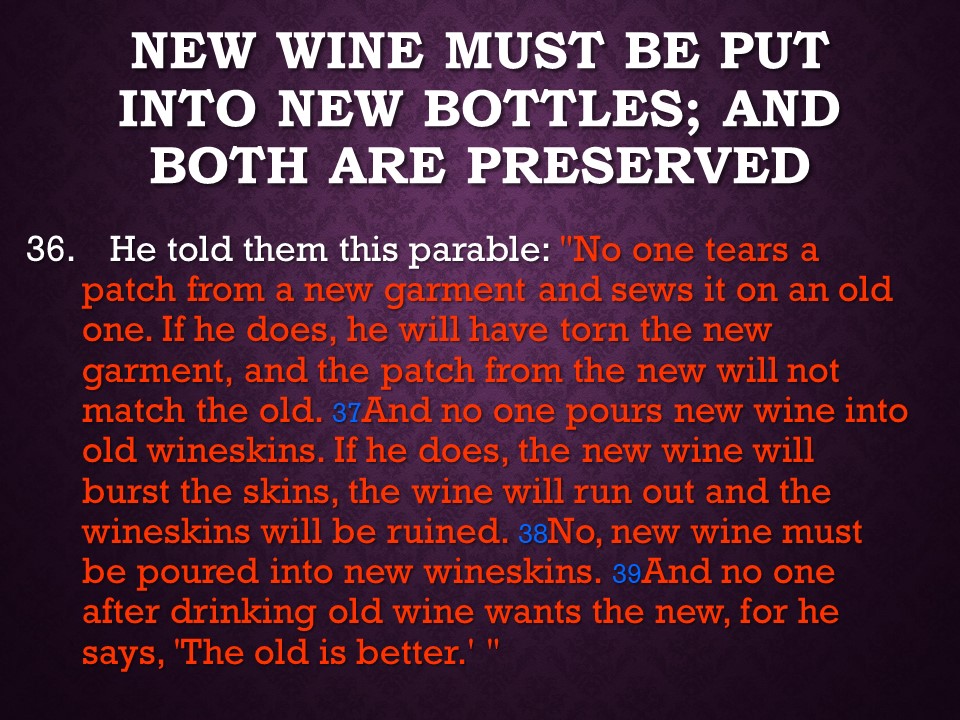
This passage in the Gospel according to Luke, chapter 5, is one that puzzled me for a long time: (Jesus speaking)
First, let ‘s dispense with the King James’ translation, the original Greek mentions wineskins, not bottles.
Wine is made from grapes, and the sugar content of grapes is about 16%. The wine making process is to convert the sugar into ethanol via fermentation, and grapes come replenished with their own yeast, so the fermentation starts whether you like it or not. If you leave the grapes out in the air they will ferment and the ethanol will oxidize into vinegar, so they must ferment in a vessel that locks out oxygen. The fermentation has two phases, the first phase is fairly fast, a little more than 10 days, where the sugar converts to ethanol. This process releases CO2; nearly half of the weight of the sugar goes up in the air in the form of CO2, the rest is ethanol. No wineskin can handle that, so fermentation was usually done in a clay vessel with a lid on to prevent air to enter. At the end of 10 to 15 days they had “new wine”.
Bur the fermentation was not over, the aging process began, and that lasted from a few weeks to a few months. During that time there is a slow release of CO2, but the vessel had to be air tight so no oxygen would spoil the wine and turn it into vinegar.
This is where newwineskins come in, they can handle this process by being ever so slightly permeable, if they are made from young goatskin, properly prepared.
Old wineskins on the other hand are hardened and can even be brittle, like an old leather glove that has been lost in the snow for the winter, and when it is found in the spring, it is ruined.
Jesus did not teach wine-making when he used that parable, in the parable the wine is the Holy Spirit and we are the wineskins.
Many people, me and my wife included have been praying for a great new, worldwide revival, and following that, a great worldwide awakening. Revivals usually start small and local, but with great intensity. The intensity will be greatest among young people, and they will celebrate with a new song in their heart. They are the new wineskins, they will be filled with new wine, and their new music will be less refined, raw and unpolished, or so it will seem to us old wineskins. We better prepare for the outpouring of the Holy spirit in our old wineskins by rejuvenate them with the oil of joy to make us ready to receive the old wine, aged to perfection with the full bouquet, like when Jesus turned water into wine. Then we who have been saved for many years can join with the young and appreciate each other, we appreciate their youthful enthusiasm and music, and they will appreciate the good wine that comes from lifelong experience.
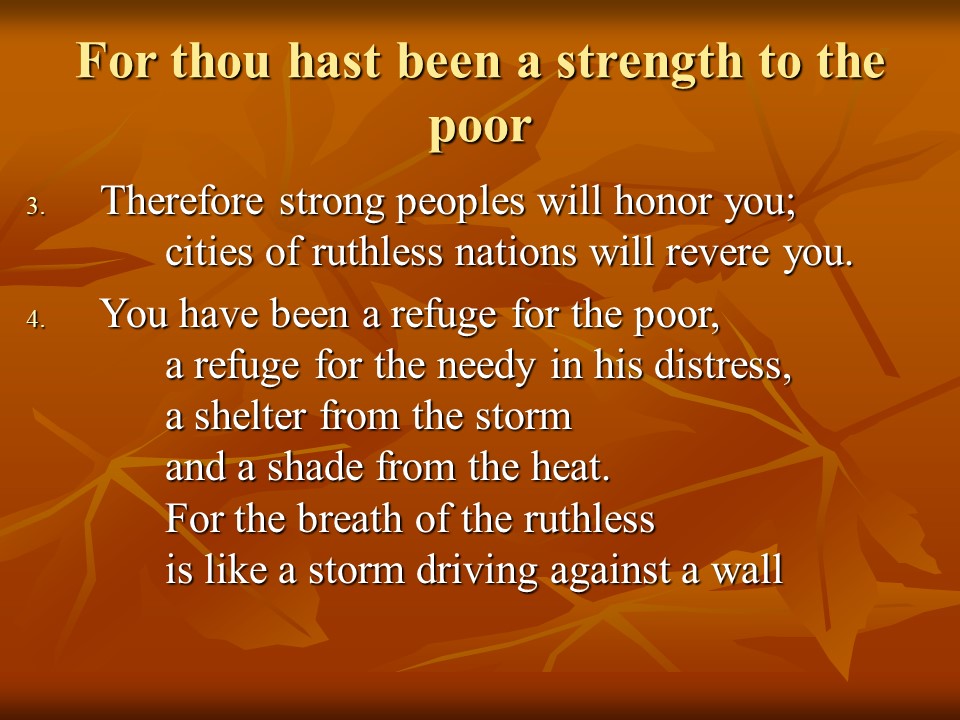
There is a great passage in Isaiah 25, a song of praise coming right after the dreadful chapter 24. It speaks of aged wine being the finest of wines.
Revelation 7:17: For the Lamb at the center of the throne will be their shepherd; ‘he will lead them to springs of living water.’ ‘And God will wipeaway every tear from their eyes.’”
Yes, there will be a great worldwide revival, and an even greater awakening.


 Len Bilén's blog, a blog about faith, politics and the environment.