With a Molten Salt Reactor, accidents like the Three Mile Island disaster will not happen. Ah yes, I remember it well, March 28, 1979. We lived in South East Pennsylvania at the time, well outside the evacuation zone, but a fellow engineer at work took off, took vacation and stayed at a hotel in western Virginia over the weekend fearing a nuclear meltdown. He had just seen the movie “The China Syndrome” that had premiered just twelve days earlier.
My wife went to a Christian retreat a few miles outside the evacuation zone, and none of the participants so much as heard of any problem, there never were any mandatory evacuations. However, since the accident prevented the reactor to shut down properly radioactive gasses including radioactive Iodine had to be released. Governor Dick Thornburgh, on the advice of NRC chairman Joseph Hendrie, advised the evacuation “of pregnant women and pre-school age children…within a five-mile radius of the Three Mile Island facility”. The evacuation zone was extended to a 20-mile radius on Friday, March 30. Within days, 140,000 people had left the area. More than half of the 663,500 population within the 20-mile radius remained in that area. According to a survey conducted in April 1979, 98% of the evacuees had returned to their homes within three weeks.There was concern though, and a disaster it was indeed with a partial meltdown of the core, rendering the installation a total loss, leaving a big, forever cleanup bill. The cost so far has totaled over 2 billion dollars.
A combination of personnel error, design deficiencies and component failures caused the TMI accident, which permanently changed both the nuclear industry and the NRC. Public fear and distrust increased, NRC’s regulations and oversight became broader and more robust, and management of the plants was scrutinized more carefully. Careful analysis of the accident’s events identified problems and led to permanent and sweeping changes in how NRC regulates its licensees – which, in turn, has reduced the risk to public health and safety.
The side effect of increased regulation is increased cost and delay in construction of new nuclear plants. Eventually, more than 120 reactor orders were cancelled, and the construction of new reactors ground to a halt. Of the 253 nuclear power reactors originally ordered in the United States from 1953 to 2008, 48 percent were canceled.
Another side effect of the TMI accident is fear of trying a different and safer approaches, since they conflict with existing regulations. The next Nuclear power reactor came online in 2016, but it is the same type of boiling water reactor as before, not a Molten Salt Thorium reactor with its inherent radically increased safety.
From Denmark comes this interesting sales pitch for a nuclear waste, thorium based nuclear technology. Like most sales pitches it glosses over the remaining problems to implement it, and emphasizes advantages, which are many. Let us take a look at it:
Copenhagen Atomics’ headquarters are co-located with Alfa Laval in Copenhagen.[2]
History
Copenhagen Atomics was founded in 2014 by a group of scientists and engineers meeting at Technical University of Denmark and around the greater Copenhagen area for discussions on thorium and molten salt reactors, who later incorporated in 2015.[3] In 2016, Copenhagen Atomics was part of MIMOSA, a European nuclear molten salt research consortium.[4]
Copenhagen Atomics became the first private company in 2017, to offer a commercial molten salt loop.[5][6]
By the end of 2022, Copenhagen Atomics finished a full-size prototype reactor. The prototype is a full-scale test platform, to test the system in its entirety, with water as its medium. In 2023 a full-scale prototype molten salt reactor will be built to test the entire system with non-radioactive molten salts.[7]
Copenhagen Atomics is pursuing a hardware-driven iterative component-by-component approach to reactor development, instead of a full design license and approval approach. Copenhagen Atomics is actively developing and testing valves, pumps, heat exchangers, measurement systems, salt chemistry and purification systems, and control systems and software for molten salt applications.[9] The company has also developed the world’s only canned molten salt pump and are developing an active electromagnetic bearing canned molten salt pump.[9]
Copenhagen Atomics offers many of their technologies commercially available to the market. This includes pumped molten salt loops for use in molten salt reactor research, as well as highly purified salts for high temperature concentrated solar power, molten salt energy storage, and molten salt chemistry research.[10]
Environmental Impact
According to the website Thorium Energy World: “The CAWB [ed. Copenhagen Atomics Waste Burner] will use thorium to burn out actinides from spent nuclear fuel in order to convert long-lived radioactive waste into short-lived radioactive waste, while producing large amounts of energy and jobs in present time. End of Wikipedia quote.
The limiting factor in this molten salt reactors buildup is the availability of Uranium 233, the result of neutron bombardment of Thorium resulting in Protactinium, which converts to U-233, the real clean nuclear fuel in 29 days. The breeding gain is only 1.05, so it takes quite some time to build up the capacity. The separation stage is the critical stage, and they will not provide it, but the technology is there, but is not yet ready to be commercialized, and they were silent about who was going to do it. It is, which he also acknowledged, expensive with current methods.
China is having a massive Thorium program. The People’s Republic of China has initiated a research and development project in thorium molten-salt reactor technology. The thorium MSR efforts aims not only to develop the technology but to secure intellectual property rights to its implementation. This may be one of the reasons that the Chinese have not joined the international Gen-IV effort for MSR development, since part of that involves technology exchange. Neither the US nor Russia have joined the MSR Gen-IV effort either. China is currently the largest emitter of CO2 and air pollutants by far, and according to the Paris accord was allowed to emit six times as much pollutants as the U.S. by 2030, being a “developing nation”. Their air quality is already among the worst in the world so something had to be done if they were to achieve world dominance by 2025 and total rule by 2030. Only Thorium can solve the pollution problem and provide the clean energy needed for the future. Regular Uranium Nuclear reactors require large amounts of water and Molten Salt Thorium reactors require little water to operate.
Geneva, Switzerland, 21 August 2018 – As the world struggles with a record-breaking heatwave, China correctly places its trust in the fuel Thorium and the Thorium Molten Salt Reactor (TMSR) as the backbone of its nation’s plan to become a clean and cheap energy powerhouse. The question is if China will manage to build a homegrown mega export industry, or will others have capacity and will to catch up?
For China, clean energy development and implementation is a test for the state’s ability. Therefore, China is developing the capability to use the “forgotten fuel” thorium, which could begin a new era of nuclear power. The first energy system they are building is a solid fuel molten salt reactor that achieves high temperatures to maximize efficiency of combined heat and power generation applications. However, to fully realize thorium’s energy potential and in this way solve an important mission for China – the security of fuel supply – requires also the thorium itself to be fluid. This is optimized in the Thorium Molten Salt Reactor (TMSR). The TMSR takes safety to an entirely new level and can be made cheap and small since it operates at atmospheric pressure, one of its many advantages. Thanks to its flexible cooling options it can basically be used anywhere, be it a desert, a town or at sea. In China this is of special interest inland, where freshwater is scarce in large areas, providing a unique way to secure energy independence.
“Everyone in the field is extremely impressed with how China saw the potential, grabbed the opportunity and is now running faster than everyone else developing this futuristic energy source China and the entire world is in a great need of.” – Andreas Norlin, Thorium Energy World
China is not telling all they are doing on Nuclear Energy, but this news item is true:
The Shanghai Institute of Applied Physics (SINAP) – part of the Chinese Academy of Sciences (CAS) – has been given approval by the Ministry of Ecology and Environment to commission an experimental thorium-powered molten-salt reactor, construction of which started in Wuwei city, Gansu province, in September 2018.
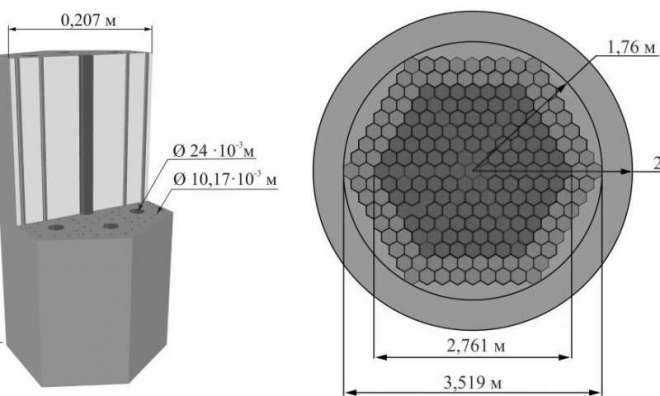
A cutaway of the TMSR-LF1 reactor (Image: SINAP)
In January 2011, CAS launched a CNY3 billion (USD444 million) R&D programme on liquid fluoride thorium reactors (LFTRs), known there as the thorium-breeding molten-salt reactor (Th-MSR or TMSR), and claimed to have the world’s largest national effort on it, hoping to obtain full intellectual property rights on the technology. This is also known as the fluoride salt-cooled high-temperature reactor (FHR). The TMSR Centre at SINAP at Jiading, Shanghai, is responsible.
Construction of the 2 MWt TMSR-LF1 reactor began in September 2018 and was reportedly completed in August 2021. The prototype was scheduled to be completed in 2024, but work was accelerated.
“According to the relevant provisions of the Nuclear Safety Law of the People’s Republic of China and the Regulations of the People’s Republic of China on the Safety Supervision and Administration of Civilian Nuclear Facilities, our bureau has conducted a technical review of the application documents you submitted, and believes that your 2 MWt liquid fuel thorium-based molten salt experimental reactor commissioning plan (Version V1.3) is acceptable and is hereby approved,” the Ministry of Ecology and Environment told SINAP on 2 August.
It added: “During the commissioning process of your 2 MWt liquid fuel thorium-based molten salt experimental reactor, you should strictly implement this plan to ensure the effectiveness of the implementation of the plan and ensure the safety and quality of debugging. If any major abnormality occurs during the commissioning process, it should be reported to our bureau and the Northwest Nuclear and Radiation Safety Supervision Station in time.”
The TMSR-LF1 will use fuel enriched to under 20% U-235, have a thorium inventory of about 50 kg and conversion ratio of about 0.1. A fertile blanket of lithium-beryllium fluoride (FLiBe) with 99.95% Li-7 will be used, and fuel as UF4.
The project is expected to start on a batch basis with some online refueling and removal of gaseous fission products, but discharging all fuel salt after 5-8 years for reprocessing and separation of fission products and minor actinides for storage. It will proceed to a continuous process of recycling salt, uranium and thorium, with online separation of fission products and minor actinides. The reactor will work up from about 20% thorium fission to about 80%.
If the TMSR-LF1 proves successful, China plans to build a reactor with a capacity of 373 MWt by 2030.
As this type of reactor does not require water for cooling, it will be able to operate in desert regions. The Chinese government has plans to build more across the sparsely populated deserts and plains of western China, complementing wind and solar plants and reducing China’s reliance on coal-fired power stations. The reactor may also be built outside China in Belt and Road Initiative nations.
The liquid fuel design is descended from the 1960s Molten-Salt Reactor Experiment at Oak Ridge National Laboratory in the USA. (Researched and written by World Nuclear News)
Yes, it is true. Their design was given to them free, and now PRC is developing the future energy source including claiming intellectual property rights from a source abandoned in 1969 by U.S.A. because of political infighting, not for economical or national security reasons.
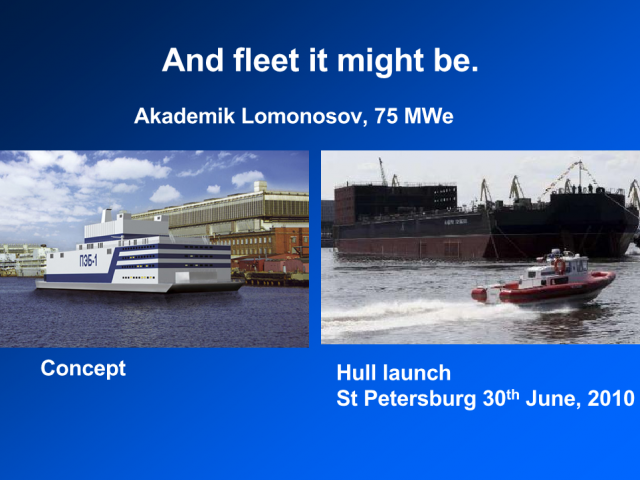
Russia has an active Thorium program.This used to be true, but it was decided that for the Arctisc buildup this barge (below) would be outfitted with regular nuclear power the same type that are in Russia’s nuclear powered ice breakers.
This is a self-contained 7m MW electric or 200 MW heat cogeneration Nuclear Reactor on a barge. Coolant readily available. Hoist it a couple of cables and the town to be serviced will have all the power and heat it needs. This is especially useful in the Arctic. Russia is trying to establish Arctic domination, both commercially and militarily. They have over 30 ice breakers, about half of them nuclear. U.S. has two conventional ice breakers, of which only one is operational.
Now for the good news: Russia is also trying to commercialize hybrid fusion-fission reactors:
Nuclear Engineering International: 29 May 2018
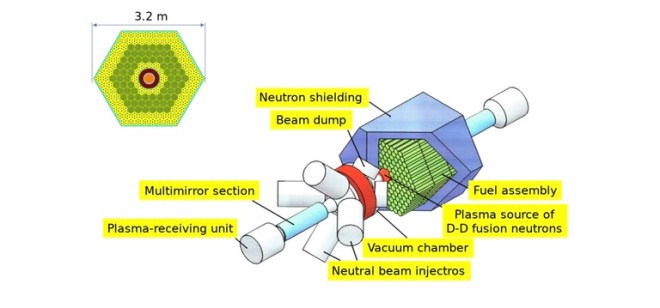
Russia develops a fission-fusion hybrid reactor. A new fission-fusion hybrid reactor will be assembled at Russia’s Kurchatov Institute by the end of 2018, Peter Khvostenko, scientific adviser of the Kurchatov complex on thermonuclear energy and plasma technologies, announced on 14 May. The physical start-up of the facility is scheduled for 2020.The hybrid reactor combines the principles of thermonuclear and nuclear power – essentially a tokamak fusion reactor and a molten salt fission reactor. Neutrons produced in a small tokamak will be captured in a molten salt blanket located around tokamak. The facility will use Thorium as a fuel, which is cheaper and more abundant than uranium. Moreover, unlike a fusion reactor, a hybrid will not require super high temperatures to generate energy.
Thorium has benefits compared with uranium reaction and has been endorsed by Democratic presidential candidate Andrew Yang.
In the reactor, plasma fusion generates neutrons that fuel subsequent fission.
Hybrid reactors reduce the impact of the nuclear fuel cycle on the environment. The concept combines conventional fission processes and fusion reactor principles, comprising a fusion reactor core in combination with a subcritical fission reactor. The results of the fusion reaction, which would normally be absorbed by the cooling system of the reactor, would feed into the fission section, and sustain the fission process. Thorium in a molten salt blanket will enable breeding of uranium-233.
Some of the expected advantages include:
Utilization of actinides and transmutation from long-lived radioactive waste;
An increase in energy recovered from uranium by a large factor;
The inherent safety of the system, which can be shut down rapidly; and
High burnup of fissile materials leaving few by-products.
The hybrid fission-fusion reactor is seen as a near-term commercial application of fusion pending further research on pure fusion power systems.
This is very interesting, and I will follow up when I get more information.
It seems that with the Ukraine war, Russia is preoccupied with other things than to reduce nuclear waste. Ah well.
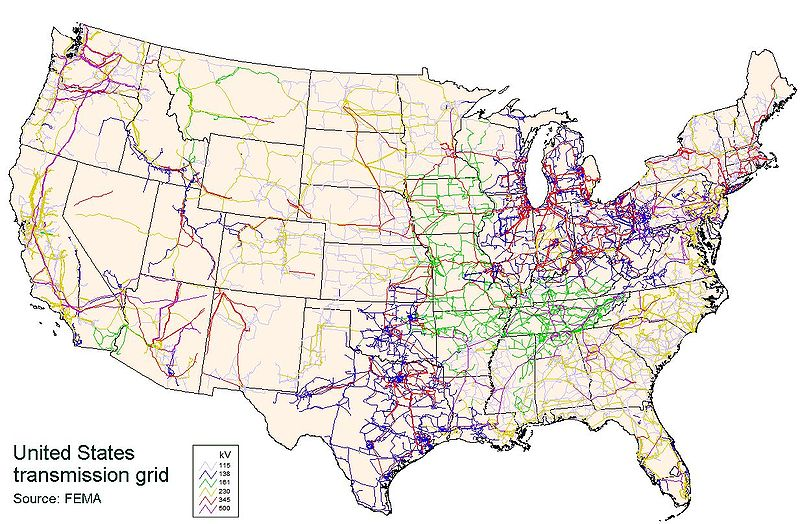
Liquid Fluoride Thorium Reactors will lessen the need for an expanded national grid. The National Electric grid is at the breaking point. It needs to be expanded, but neighborhood resistance is great in many areas where they need an expanded grid the most. The grid is also sensitive to terrorism activities.
As we can see the national grid is extensive. It is also under severe strain at peak demand. Wind power will only increase the strain since most wind power is generated where few people live and work. A way to lessen the dependency on the national grid is to sprinkle it with many small to medium sized Thorium Nuclear Power generators. They can be placed on barges in rivers and along the coast where the need is greatest, giving the grid maximum flexibility to respond in case of an emergency. LFTR’s do not depend on water for their cooling, so they can be placed anywhere, even in extreme arid areas. Since LFTR can be placed very close to urban centers, transmission losses are kept low. (The Texas grid is separately controlled from the rest of the grid.)
With the present push to convert energy sources to green energy, Thorium Nuclear energy is greener than both solar and wind energy if one includes the necessary mining to extract the materials needed for both solar and wind power. In addition thw wind blows where few people live or want to live, and the electric need is largest in the winter in the north when the sun is largely absent and the snow covers the solar panels, and the need in the south is largest in the summer when the wind blows less except for storms and hurricanes. This requires long transmission lines, and the grid is divided up in sections. The only way to solve this is to expand the grid through a HVDC (High Voltage Direct Current Network. This will be done through 1 MV cables, preferably using existing railroad rightaways when possible. One proposal is shown below. This would connect the Eastern, Western and the Texas network and significantly lessen transmission losses. (Transmission losses in the U.S. electrical grid is more than 50 Billion dollars yearly)
Transmission losses in a HVDC network are far less. Better yet is to place the energy source near the energy consumer. LFTR Thorium power would solve this problem. As we switch from gasoline powered to electric cars, the need to expand the grid will be more and more urgent, and the resistance to build more transmission lines is already great and growing, especially in already overloaded urban areas.
No need for evacuation zones, can be placed near urban areas. Molten Salt Thorium reactors operate at atmospheric pressure and have a very high negative temperature coefficient, so there is no risk for a boil-over. They are easily made earthquake-safe and no pressure vessel is needed. This will greatly simplify the approval process, no need for elaborate evacuation plans have to be developed. Since the Three Mile Island accident there was a thirty year gap in approvals for new nuclear plants. The “not in my backyard ” mentality reigned supreme, and delay and denial was the rule of the years. But the lawyers still got their share, leading to escalating cost for new nuclear power. In the early days of nuclear power France took the approach of building some of their nuclear plants near the Belgian and German border, so they only had to develop half of an evacuation plan, leaving the other half to their ‘understanding’ neighbors. It also lead to placing the nuclear plants where there was least popular resistance, not where they were needed the most, adding to the strain and efficiency losses on the electric grid. Liquid Fluoride Thorium Reactors have one additional advantage. They do not need access to water, so they can be placed even in desert areas. When a coal fired, or even a natural gas fired plant is decommissioned, it can be replaced in the same place, the electric connections are already there, so there is no need to go through lengthy and costly eminent domain processes ‘to acquire more land, or even expand the electric grid for that location. Thorium power is clean power.
Thorium Nuclear Power generators scale beautifully from small portable generators to full size power plants. One of the first applications was as an airborne nuclear reactor.
Granted this was not a Thorium breeder reactor, but it proves nuclear reactors can be made lightweight. Thorium reactors can be made even lighter as long as they are not of the breeder type.
Lawrence Livermore, Los Alamos, and Argonne national laboratories are designing a self-contained nuclear reactor with tamper-resistant features. Called SSTAR (small, sealed, transportable, autonomous reactor), this next-generation reactor will produce 10 to 100 megawatts electric and can be safely transported on ship or by a heavy-haul transport truck.
This type of reactor can be transported to disaster areas, and provide emergency power, during rescue and rebuilding efforts. This particular reactor still uses solid fuel and steam heat exchanger. A LFTR reactor with a supercritical CO2 gas heat exchanger would be even more compact and efficient.
From these compact designs, Thorium power can be scaled up to any size. The LFTR reactor will be placed on barges and left moored in navigable rivers or in ocean harbors. This will typically be a one or two 250 MW LFTR with reprocessing capabilities. Where there is only road access the LFTR’s will be one or up to six 100 MW LFTR with one reprocessing fuel capability servicing the nuclear units one at a time on a rotary basis. These will come as complete units tested and ready for use on a number of trucks. It is to be noted that no water is necessary for cooling. There can also be 5 and 10 MW power units for freight trains and large towboats. They will not have reprocessing capabilities on board, but will be serviced regularily by refueling and reprocessing stations in key locations. Oceangoing ships will be fitted with LFTR reactors with reprocessing capability. When all of this is done the need for diesel fuel for nearly all shipping by train, barge or ship will be nearly eliminated.
Admittedly there are security risks associated with this arrangement. Locomotives and barges can be stolen, ships can be hijacked, when the whole reactor vessel came on a truck it can be stolen. By having minimum fuel at all time, it increases safety, but it also makes it possible for terrorists and common thieves to steal shipments of fuel and fissile by-products. This means that there must still be strict security measurements for maintaining chain of security for U-233 and Protactinium.
Virtually no spent fuel problem, very little on site storage or transport. I have been following the events at Fukushima Nuclear Power plants disaster with great interest. How ironic that one of the greatest problems was with the spent fuel, not with the inability to shut down the working units. The spent fuel issue is the real Achilles’ heel of the Nuclear Power Industry. The cost of reprocessing and storing spent reactor fuel will burden us for centuries after the reactors themselves have been decommissioned when their useful life is ended. Molten Salt Thorium nuclear power works differently from conventional Uranium fueled Reactors as the fissile fuel gets generated in the breeding process itself and nearly all fuel gets consumed as it is generated. When the process shuts down, that is it. Only the radioactivity that is en route so to say will have to be accounted for, not everything generated thus far in the process. The difference is about ten thousand to one in the size of the problem. It is high time to rebuild and expand our Nuclear power generation by switching to Thorium..
The detractors of Thorium like to point out that the Thorium-U233 process generates some U 232 in the presence of free neutrons. U-232 decays with a 69-year half-life through 1.9-year half-life Th-228 to Tl-208, which emits a 2.6 MeV gamma ray upon decay. Gamma rays are easily shielded by clean water, so transportation and storage is not a problem. Rather than being a problem, this is a great asset. The 232U decay chain is the source of the high energy gamma rays that make 232U the preferred tracer isotope. Uranium-232 has a half-life of 69.8 years, and the decay chain terminates at 208Pb (National Nuclear Data Center).
With Molten Salt nuclear Reactors there is no risk for a meltdown, the fuel is already molten, and that is a safe design. The fissile fuel in a Thorium reactor is U-233 in the form of UraniumFluoride (UF4) salt which also contains Lithium and Beryllium to lower the melting point, the operating temperature is held below 650C to allow reasonably priced and available alloys that also withstand high radiation. In its molten form the salt has a very low vapor pressure. The salt flows easily through the heat exchangers and the separators. The salt is very toxic, but since it is completely sealed it is not corrosive. Being a fluid, it is constantly mixed for optimum efficiency. The reactor will never have to be shut down for refueling, it is a continuous flow process. Uranium-235 Nuclear reactors on the other hand have to be shut down for refueling and rebalancing of the fuel rods a little more often than once every two years. The average shutdown is 35 days, or about 5% of the time. Then comes the major problem of safely and securely transporting and reprocessing the spent fuel. This problem is not yet solved for conventional Nuclear power plants, so spent fuel is stored on site, sometimes for years. In a LFTR the fuel is spent as it is produced, so the fissile inventory is constantly kept at a minimum, and fission products and extra generated U-233 is separated out. this is a much cleaner process than reprocessing spent fuel. The high operating temperature gives the LFTR a much more efficient carnot cycle conversion factor of more than 40%, whereas conventional nuclear plants with water as a coolant medium cannot exceed 38% efficiency.
Thorium nuclear power is the only realistic solution to power space colonies. To form space colonies, power has to be provided to sustain the colony. This means that Liquid Fluoride Thorium Reactors (LFTR) have to be fully developed and operational here on earth before serious space colony development can even begin. It need to get started in earnest NOW!
Kirk Sorensen has provided an intriguing teaser on the case for Thorium nuclear energy.

.jpg?ext=.jpg)


 Len Bilén's blog, a blog about faith, politics and the environment.


