With Molten Salt nuclear Reactors there is no risk for a meltdown, the fuel is already molten, and that is a safe design. The fissile fuel in a Thorium reactor is U-233 in the form of UraniumFluoride (UF4) salt which also contains Lithium and Beryllium to lower the melting point, the operating temperature is held below 650C to allow reasonably priced and available alloys that also withstand high radiation. In its molten form the salt has a very low vapor pressure. The salt flows easily through the heat exchangers and the separators. The salt is very toxic, but since it is completely sealed it is not corrosive. Being a fluid, it is constantly mixed for optimum efficiency. The reactor will never have to be shut down for refueling, it is a continuous flow process. Uranium-235 Nuclear reactors on the other hand have to be shut down for refueling and rebalancing of the fuel rods a little more often than once every two years. The average shutdown is 35 days, or about 5% of the time. Then comes the major problem of safely and securely transporting and reprocessing the spent fuel. This problem is not yet solved for conventional Nuclear power plants, so spent fuel is stored on site, sometimes for years. In a LFTR the fuel is spent as it is produced, so the fissile inventory is constantly kept at a minimum, and fission products and extra generated U-233 is separated out. this is a much cleaner process than reprocessing spent fuel. The high operating temperature gives the LFTR a much more efficient carnot cycle conversion factor of more than 40%, whereas conventional nuclear plants with water as a coolant medium cannot exceed 38% efficiency.
Molten Salt nuclear Reactors operate under Atmospheric pressure conditions, no risk for explosions. Materials subjected to high radiation tend to get brittle or soften up. Molten Salt Thorium nuclear reactors operate under atmospheric conditions so the choice of materials that can withstand both high temperatures and high radiation is much greater, leading to a superior and less expensive design. There is no high pressure gas buildup and the separation stage can be greatly simplified, leading to a much safer design. (From Wikipedia:)
The LFTR needs a mechanism to remove the fission products from the fuel. Fission products left in the reactor absorb neutrons and thus reduce neutron economy. This is especially important in the thorium fuel cycle with few spare neutrons and a thermal neutron spectrum, where absorption is strong. The minimum requirement is to recover the valuable fissile material from used fuel.
Removal of fission products is similar to reprocessing of solid fuel elements; by chemical or physical means, the valuable fissile fuel is separated from the waste fission products. Ideally the fertile fuel (thorium or U-238) and other fuel components (e.g. carrier salt or fuel cladding in solid fuels) can also be reused for new fuel. However, for economic reasons they may also end up in the waste.
On site processing is planned to work continuously, cleaning a small fraction of the salt as often as practical and sending it back to the reactor. There is no need to make the fuel salt very clean; the purpose is to keep the concentration of fission products and other impurities (e.g. oxygen) low enough. The concentrations of some of the rare earth elements must be especially kept low, as they have a large absorption cross section. Some other elements with a small cross section like Cs or Zr may accumulate over years of operation before they are removed.
As the fuel of a LFTR is a molten salt mixture, it is attractive to use pyroprocessing, high temperature methods working directly with the hot molten salt. Pyroprocessing does not use radiation sensitive solvents and is not easily disturbed by decay heat. It can be used on highly radioactive fuel directly from the reactor. Having the chemical separation on site, close to the reactor avoids transport delays and risks and keeps the total inventory of the fuel cycle low. Ideally everything except new fuel (thorium) and waste (fission products) stays inside the plant.
One potential advantage of a liquid fuel is that it not only facilitates separating fission-products from the fuel, but also isolating individual fission products from one another, which is lucrative for isotopes that are scarce and in high-demand for various industrial (radiation sources for testing welds via radiography), agricultural (sterilizing produce via irradiation), and medical uses (Molybdenum-99 which decays into Technetium-99m, a valuable radiolabel dye for marking cancerous cells in medical scans).
Mo-99 is used in hospitals to produce the technetium-99m employed in around 80% of nuclear imaging procedures. Produced in research reactors, Mo-99 has a half-life of only 66 hours and cannot be stockpiled, and security of supply is a key concern. Most of the world’s supply currently comes from just four reactors in Belgium, the Netherlands, Russia and South Africa, and recent years have illustrated how unexpected shutdowns at any of those reactors can quickly lead to shortages. Furthermore, most Mo-99 is currently produced from HEU targets, which are seen as a potential nuclear proliferation risk.
With the Mo-99 having a half-life of 66 hours and being continuously separated out from the fertile core in a LFTR, this seems to be the ideal vehicle to cheaply produce ample supplies of this valuable medical resource.
While LFTR reactors can be built today safely and profitably, much work remains to be done to achieve the full eight to ten thousand times reduction in TRU waste and maximize the breeding rate of U-233 for optimal speed of expanding the Thorium program.
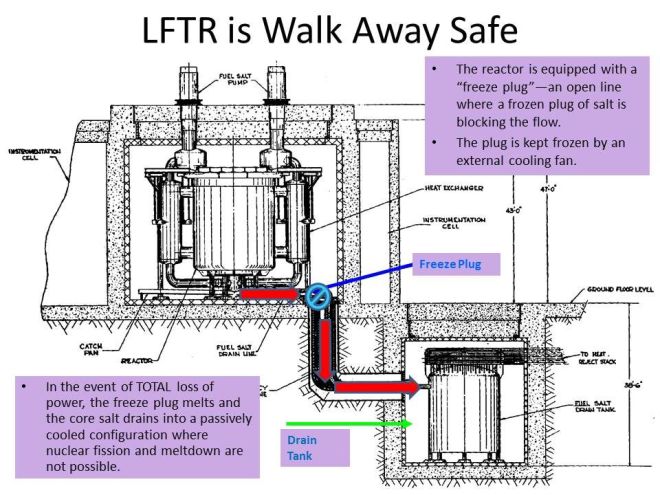
Molten Salt Thorium Reactors are earthquake safe. Thorium reactors have a very simple and compact design where gravity is the only thing needed to stop the nuclear reaction. Conventional nuclear reactors depend on external power to shut down after a SCRAM, where poison rods fall down to halt the reaction. The next figure shows the concept of a Thorium reactor.
The idea is to empty the fissile U-233 core through gravity alone. All that is needed is a melt-plug that is constantly cooled by cold air. In an earthquake or complete electric failure the cold air flow automatically shuts off, and since the fuel is already molten, it will melt the plug, and the molten fluid will run down into channels like pig-iron into heat exchangers that absorb the residual heat.
As we can see the reactor hardened structure is compact, and can be completely earthquake and tsunami proof. What can be sheared off are the steam pipes and external power, but even then the reactor shutdown will be complete safe without any additional power.
One of the advantages of the LFTR reactor is that the fissile compartment is always kept just above critical point for needed power delivery. This means, once it starts draining, the fission process ends immediately. The only nuclear reaction remaining is that the Protactinium generated in the fertile blanket and separator gets converted to U-233 over time, but the amounts are so small that it is always in the safe range.
For decades, medical researchers have sought treatments for cancer. Now, Alpha Particle Immunotherapy offers a promising treatment for many forms of cancer, and perhaps a cure. Unfortunately, the most promising alpha-emitting medical isotopes, actinium-225 and its daughter, bismuth-213, are not available in sufficient quantity to support current research, much less therapeutic use. In fact, there are only three sources in the world that largely “milk” these isotopes from less than 2 grams of thorium source material. Additional supplies were not forthcoming. Fortunately, scientists and engineers at Idaho National Laboratory identified 40-year-old reactor fuel stored at the lab as a substantial untapped resource and developed Medical Actinium for Therapeutic Treatment, or MATT, which consists of two innovative processes (MATT-CAR and MATT-BAR) to recover this valuable medical isotope. One byproduct generated is a valuable isotope for medical uses, Molybdenum-99 which decays into Technetium-99m, a valuable radiolabel dye for marking cancerous cells in medical scans.
In 2019 The US Department of Energy’s National Nuclear Security Administration (NNSA) selected four companies to begin negotiations for potential new cooperative agreement awards for the supply of molybdenum-99 (Mo-99) without using highly enriched uranium (HEU).
Mo-99 is used in hospitals to produce the technetium-99m employed in around 80% of nuclear imaging procedures. Produced in research reactors, Mo-99 has a half-life of only 66 hours and cannot be stockpiled, and security of supply is a key concern. Most of the world’s supply currently comes from just four reactors in Belgium, the Netherlands, Russia and South Africa, and recent years have illustrated how unexpected shutdowns at any of those reactors can quickly lead to shortages. Furthermore, most Mo-99 is currently produced from HEU (Highly enriched Uranium) targets, which are seen as a potential nuclear proliferation risk.
Thorium based Nuclear Power does not produce much Plutonium-239, which is the preferred material used in nuclear bombs. The higher Plutonium isotopes and other TRansUraniums are about as nasty as they get, need expensive protection against terror attacks, and need to be stored for a very long time.
One anecdote from my youth. The time had come to apply to University, and to my delight I was accepted to Chalmers’ University in Sweden as a Technical Physics major. I felt, maybe I can do my part by becoming a Nuclear Engineer and help solve the energy needs of the future. The Swedes at that time championed the heavy water – natural Uranium program together with the Canadians and to some extent with the Indians. Sweden was and to some extent still is a non-aligned country, so it was not privy to any nuclear secrets, it had to go it alone. They settled on the heavy water moderated natural Uranium process because Sweden had an ambition to produce its own nuclear bomb. Officially this was never talked about, and I was not aware of it at that time. They could have gone with Thorium instead, but a Thorium based nuclear reactor produces very little Plutonium, and what it produces is nearly all Pplutonium-238, not fissile and as such not suitable for bomb making.
I was excited to learn about all the possibilities and signed up for a couple of nuclear classes. One lab was to design a safety circuit, then run the heavy water research reactor critical and hopefully watch the reactor shut down from the safety circuit before the system safety circuit shutdown. About that time the word came that U.S. will sell partially enriched uranium at bargain basement prices if Sweden agreed to abandon the heavy water project and sign the nuclear non-proliferation treaty, a treaty being formulated by U.N.
Sweden was in awe about U.N, all the problems of the world were to be solved through it, and it had such a capable General Secretary in Dag Hammarskjöld, a Swede. I looked at the light water, partially enriched Uranium nuclear power plants being developed and decided to have no part with it, not due to safety concerns but it was the design that produced the most nuclear waste of any of the available designs. At that time there was still optimism that fusion would be ready by about the year 2010 or so. The cost of maintaining spent fuel in perpetuity was never considered, so light water reactors became the low cost solution.
India on the other hand refused to join the nuclear non-proliferation treaty, kept their heavy water program going and had by 1974 produced enough plutonium for one nuclear bomb, which they promptly detonated. They still use heavy water moderated reactors, but since India is low on Uranium but rich in Thorium they have now converted one heavy water reactor to Thorium with a Plutonium glow plug. It went on-line in 2011.
They are also developing molten salt Thorium reactors, but full production is still a few years off.
There we have it. We could have gone with Thorium from the beginning, but the cold war was on, and the civilian peaceful use of nuclear energy was still all paid for by nuclear weapons research and development. Once all the bombs we could ever wish for were developed the greatest asset of nuclear power became its greatest liability.
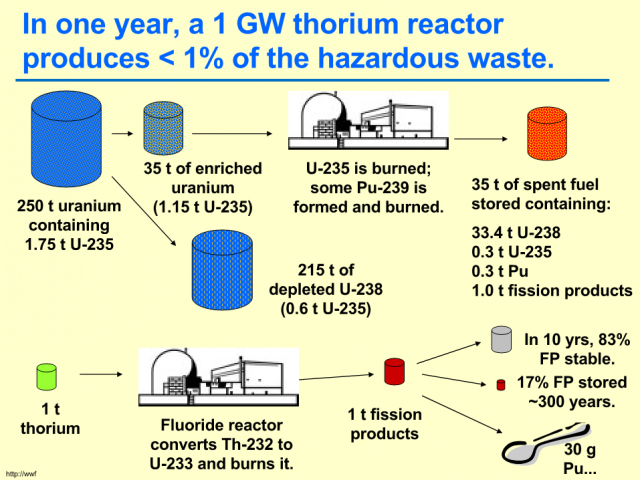
Radioactive waste from an LFTR (Liquid Fluoride Thorium Reactor) decays down to background radiation in 300 years instead of a million years for U-235 based reactors. Initially LFTRs produce as much radioactivity as an U-235 based nuclear reactor, since fission converts mass to heat, but the decay products have a much shorter half-life. See the figure below.
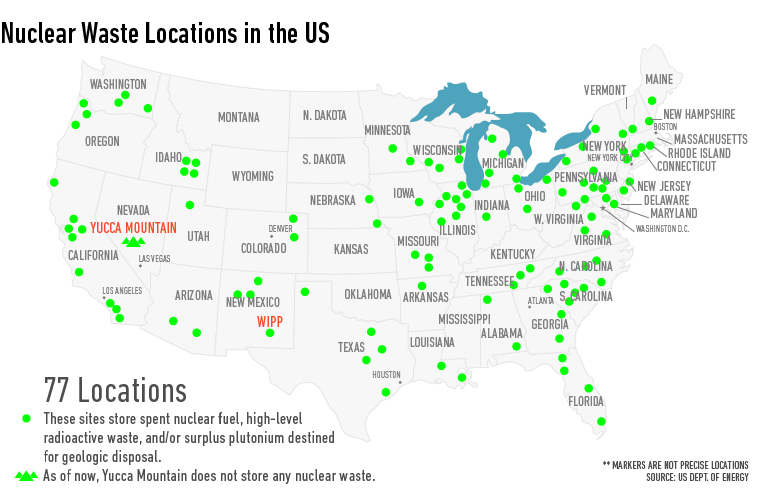
Where is the storage for spent nuclear fuel and other nuclear waste now? Look at the map, it is scary.
And these are just the U.S. installations!
Many years ago I studied Engineering at Chalmers’ University in Sweden and I thought I would become a nuclear engineer. Sweden had at that time a peaceful heavy water based nuclear power program together with Canada and India. The advantage with heavy water as moderator is that it can use natural, un-enriched Uranium. One of the end products is of course Plutonium 239, the preferred material to make nuclear bombs, but it could also use Thorium, and the end product is then mostly Plutonium 238, used in space exploration, and we were dreaming big. One of the advantages of Thorium as fuel is that it produces about 0,01% of trans-Uranium waste compared to Uranium as fuel. About that time the U.S. proposed we should abandon the heavy water program and switch to light water enriched Uranium based nuclear power. They would sell the enriched Uranium, and reprocess the spent fuel at cost. They also had the ideal final resting place for the radioactive waste products in Nevada. This was an offer the Swedish government could not refuse, at the height of the cold war. This was in the 1960’s! India on the other hand did refuse, and they eventually got the nuclear bomb. Since that meant Sweden was never going to use Thorium as nuclear fuel, and I could not figure out how to get rid of all the radioactive waste products, I switched my attention back to control engineering.
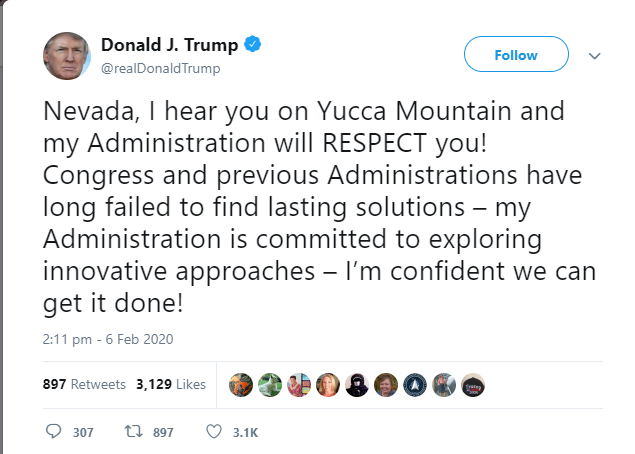
.What did President Trump mean with innovative approaches?
Is this where Thorium comes in!? Thorium solves many problems with nuclear energy. Meanwhile the Biden administration and Congress keep hoarding nuclear waste in local storages.
Thorium nuclear power is the only realistic solution to power space colonies. To form space colonies, power has to be provided to sustain the colony. This means that Liquid Fluoride Thorium Reactors (LFTR) have to be fully developed and operational here on earth before serious space colony development can even begin. It need to get started in earnest NOW!
Kirk Sorensen has provided an intriguing teaser on the case for Thorium nuclear energy.
A Thorium based nuclear power generator produces Pu-238 as one of the final TRansUranium products, which is in short supply and much in demand for space exploration nuclear power.
NASA relies on pu-238 to power long-lasting spacecraft batteries that transform heat into electricity. With foreign and domestic supplies dwindling, NASA officials are worried the shortage will prevent the agency from sending spacecraft to the outer planets and other destinations where sunlight is scarce. Thorium reactors produce PU-238 as a “free” byproduct. In 2009 Congress denied a request to produce more Pu-238 by traditional means, instead relying on Russia to sell us the plutonium. (Remember the Russian reset?) Russia made their last delivery in 2010. PU-238 production has since been restarted by converting Ne-237 to Pu-238 at a cost of over 8 million dollars per kilogram. The Ceres-Dawn spacecraft used over 22 Kg of Pu-238 as electricity generator.
To get the best efficiency of generating Pu-238 out of a molten salt Liquid Fluoride Thorium Reactor, the excess U-233 and TRansUranium products have to be extracted continuously while the reactor is running, and this technology is not yet implemented, but is necessary to implement before we can also have Thorium power on the moon, and Thorium Power is the only viable solution if we are ever going to have a moon colony, so we should rapidly develop the technology privately and with the cooperation of the Space Force and NASA.
Uranium or thorium, or any combination thereof, in any physical or chemical form, or ores that contain, by weight, one-twentieth of one percent (0.05 percent) or more of (1) uranium, (2) thorium, or (3) any combination thereof. Source material does not include special nuclear material. For additional detail, see Source Material.
Thorium 232 has a half life of 14 billion years, about the same as the generally accepted age of the universe until the dell telescope discovered much more than was known
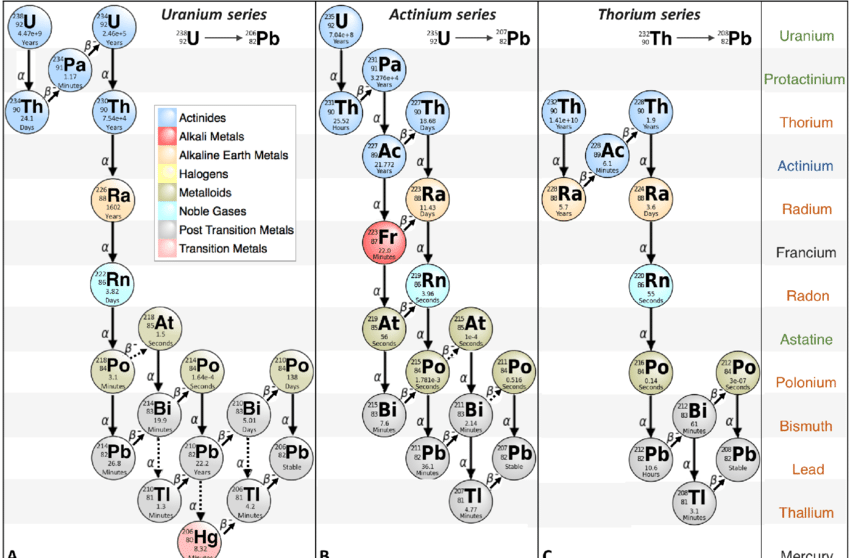
Uranium 238 has a half life of 4.5 billion years and Uranium 235 has a half life of 700 million years.
In addition Uranium has as its first transition Thorium generation on its path down to the final stable state, Lead. This means that Uranium is at least four times as radioactive as Thorium.
It is interesting to observe that in the decay path of both Uranium and Thorium they pass through Radon and emit two alpha particles on the way.
The definition for Source material should therefore be changed to:
Uranium or thorium, or any combination thereof, in any physical or chemical form, or ores that contain, by weight, one-twentieth of one percent (0.05 percent) or more of (1) uranium, 0.2 percent of (2) thorium, or (3) any proportional combination thereof.
Why is this important? The U.S. used to be world leader in rare earth metals production. Then when the regulation on Source Material was instituted, mining rare earth metals with a small amount of Thorium became unprofitable and China took over, and developed a near monopoly on the market, in effect making rare earth metals single sourced. Rare earth metals, as well as Thorium is of great strategic value.
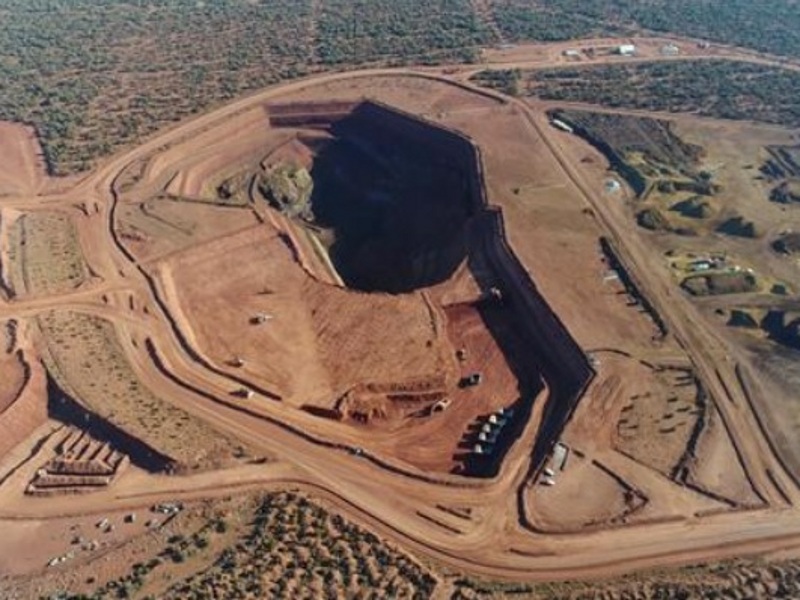
Here is an example:
This is the Mount Weld Rare Earth Mine in Western Australia. It is owned by Lynas Corporation. The mined ore, after concentration is shipped to Malaysia for final refining. The concentrated ore contains 30% rare earth metals ready for separation, but the ore also contains 0.16% Thorium. For the moment, only the most sought after rare earth metals are refined, the rest are left on the slag heap, which includes Thorium. This makes it nuclear waste according to a multitude of protestors, after all it is source material. To complicate matters further, China is looking to grab the mine, so they stir up as much trouble as possible
This is insanity. In 2011 the Oak Ridge Laboratories had a stockpile of 1400 kg U 233. They have been busy downblending it into depleted uranium to render it useless, and there is now only about 450 kg left. Unless this insanity is stopped asap Thorium nuclear power will be set back immensely, since U233 is used as the startplug for the cleanest Thorium nuclear power production
The bill is introduced. It should be immediately passed in the Senate, and be passed in the house without amendments. Any delay is critical. It is that important. We gave the technology to the Chinese so they can build up their naval fleet with molten salt Thorium nuclear power. Meanwhile we still have some u-233 left, worth billions as a National Security asset. At the very least, we must stop downblending immediately, even before the bill is passed.
A bill to provide for the preservation and storage of uranium-233 to foster development of thorium molten-salt reactors, and for other purposes. Tracking Information
Register now for our free OneVote public service or GAITS Pro trial account and you can begin tracking this and other legislation, all driven by the real-time data of the LegiScan API. Providing tools allowing you to research pending legislation, stay informed with email alerts, content feeds, and share dynamic reports. Use our new PolitiCorps to join with friends and collegaues to monitor & discuss bills through the process.
To provide for the preservation and storage of uranium-233 to foster development of thorium molten-salt reactors, and for other purposes.
IN THE SENATE OF THE UNITED STATES
May 18 (legislative day, May 17), 2022
Mr. Tuberville (for himself and Mr. Marshall) introduced the following bill; which was read twice and referred to the Committee on Energy and Natural Resources
A BILL
To provide for the preservation and storage of uranium-233 to foster development of thorium molten-salt reactors, and for other purposes.
Be it enacted by the Senate and House of Representatives of the United States of America in Congress assembled,
SECTION 1. Short title.
This Act may be cited as the “Thorium Energy Security Act of 2022”.
SEC. 2. Findings.
Congress makes the following findings:
(1) Thorium molten-salt reactor technology was originally developed in the United States, primarily at the Oak Ridge National Laboratory in the State of Tennessee under the Molten-Salt Reactor Program.
(2) Before the cancellation of that program in 1976, the technology developed at the Oak Ridge National Laboratory was moving steadily toward efficient utilization of the natural thorium energy resource, which exists in substantial amounts in many parts of the United States, and requires no isotopic enrichment.
(3) The People’s Republic of China is known to be pursuing the development of molten-salt reactor technology based on a thorium fuel cycle.
(4) Thorium itself is not fissile, but fertile, and requires fissile material to begin a nuclear chain reaction. This largely accounts for its exclusion for nuclear weapons developments.
(5) Uranium-233, derived from neutron absorption by natural thorium, is the ideal candidate for the fissile material to start a thorium reactor, and is the only fissile material candidate that can minimize the production of long-lived transuranic elements like plutonium, which have proven a great challenge to the management of existing spent nuclear fuel.
(6) Geologic disposal of spent nuclear fuel from conventional nuclear reactors continues to pose severe political and technical challenges, and costs United States taxpayers more than $500,000,000 annually in court-mandated payments to electrical utilities operating nuclear reactors.
(7) The United States possesses the largest known inventory of separated uranium-233 in the world, aggregated at the Oak Ridge National Laboratory.
(8) Oak Ridge National Laboratory building 3019 was designated in 1962 as the national repository for uranium-233 storage, and its inventory eventually grew to about 450 kilograms of separated uranium-233, along with approximately 1,000 kilograms of mixed fissile uranium from the Consolidated Edison Uranium Solidification Program (commonly referred to as “CEUSP”), divided into approximately 1,100 containers.
(9) The Defense Nuclear Facilities Safety Board issued Recommendation 97–1 (relating to safe storage of uranium-233) in 1997 because of the possibility of corrosion or other degradation around the storage of uranium-233 in a building that was built in 1943.
(10) In response, the Department of Energy published Decision Memorandum No. 2 in 2001 concluding that no Department of Energy programs needed uranium-233 and directed that a contract be placed for disposition of the uranium-233 inventory and decommissioning of its storage facility.
(11) The Department of Energy awarded a contract for the irreversible downblending of uranium-233 with uranium-238 and its geologic disposal in Nevada, which downblending would create a waste form that would pose radiological hazards for hundreds of thousands of years, rather than to consider uranium-233 as a useful national asset.
(12) All 1,000 kilograms of CEUSP uranium-233-based material have been dispositioned (but not downblended) but those containers had little useful uranium-233 in them. The majority of separated and valuable uranium-233 remains uncontaminated by uranium-238 and suitable for thorium fuel cycle research and development. That remaining inventory constitutes the largest supply of uranium-233 known to exist in the world today.
(13) The United States has significant domestic reserves of thorium in accessible high-grade deposits, which can provide thousands of years of clean energy if used efficiently in a liquid-fluoride reactor initially started with uranium-233.
(14) Recently (as of the date of the enactment of this Act), the Department of Energy has chosen to fund a series of advanced reactors that are all dependent on initial inventories and regular resupplies of high-assay, low-enriched uranium.
(15) There is no domestic source of high-assay, low-enriched uranium fuel, and there are no available estimates as to how long the development of a domestic supply of that fuel would take or how expensive such development would be.
(16) The only viable source of high-assay, low-enriched uranium fuel is through continuous import from sources in the Russian Federation.
(17) The political situation with the Russian Federation as of the date of the enactment of this Act is sufficiently uncertain that it would be unwise for United States-funded advanced reactor development to rely on high-assay, low-enriched uranium since the Russian Federation would be the primary source and can be expected to undercut any future United States production, resulting in a dependency on high-assay, low-enriched uranium from the Russian Federation.
(18) The United States has abandoned the development of a geologic repository at Yucca Mountain and is seeking a consenting community to allow interim storage of spent nuclear fuel, but valid concerns persist that an interim storage facility will become a permanent storage facility.
(19) Without a closed fuel cycle, high-assay, low-enriched uranium-fueled reactors inevitably will produce long-lived wastes that presently have no disposition pathway.
(20) The United States possesses enough uranium-233 to support further research and development as well as fuel the startup of several thorium reactors. Thorium reactors do not require additional fuel or high-assay, low-enriched uranium from the Russian Federation.
(21) Continuing the irreversible destruction of uranium-233 precludes privately funded development of the thorium fuel cycle, which would have long term national and economic security implications.
SEC. 3. Sense of Congress.
It is the sense of Congress that—
(1) it is in the best economic and national security interests of the United States to resume development of thorium molten-salt reactors that can minimize long-lived waste production, in consideration of—
(A) the pursuit by the People’s Republic of China of thorium molten-salt reactors and associated cooperative research agreements with United States national laboratories; and
(B) the present impasse around the geological disposal of nuclear waste;
(2) that the development of thorium molten-salt reactors is consistent with section 1261 of the John S. McCain National Defense Authorization Act for Fiscal Year 2019 (Public Law 115–232; 132 Stat. 2060), which declared long-term strategic competition with the People’s Republic of China as “a principal priority for the United States”; and
(3) to resume such development, it is necessary to relocate as much of the uranium-233 remaining at Oak Ridge National Laboratory as possible to new secure storage.
SEC. 4. Definitions.
In this Act:
(1) CONGRESSIONAL DEFENSE COMMITTEES.—The term “congressional defense committees” has the meaning given that term in section 101(a) of title 10, United States Code.
(2) DOWNBLEND.—The term “downblend” means the process of adding a chemically identical isotope to an inventory of fissile material in order to degrade its nuclear value.
(3) FISSILE MATERIAL.—The term “fissile material” refers to uranium-233, uranium-235, plutonium-239, or plutonium-241.
(4) HIGH-ASSAY, LOW-ENRICHED URANIUM.—The term “high-assay, low-enriched uranium” (commonly referred to as “HALEU”) means a mixture of uranium isotopes very nearly but not equaling or exceeding 20 percent of the isotope uranium-235.
(5) TRANSURANIC ELEMENT.—The term “transuranic element” means an element with an atomic number greater than the atomic number of uranium (92), such as neptunium, plutonium, americium, or curium.
SEC. 5. Preservation of uranium-233 to foster development of thorium molten-salt reactors.
The Secretary of Energy shall preserve uranium-233 inventories that have not been contaminated with uranium-238, with the goal of fostering development of thorium molten-salt reactors by United States industry.
SEC. 6. Storage of uranium-233.
(a) Report on long-Term storage of uranium-233.—Not later than 120 days after the date of the enactment of this Act, the Secretary of Energy, in consultation with the heads of other relevant agencies, shall submit to Congress a report identifying a suitable location for, or a location that can be modified for, secure long-term storage of uranium-233.
(b) Report on interim storage of uranium-233.—Not later than 120 days after the date of the enactment of this Act, the Chief of Engineers shall submit to Congress a report identifying a suitable location for secure interim storage of uranium-233.
(c) Report on construction of uranium-233 storage facility at Redstone Arsenal.—Not later than 240 days after the date of the enactment of this Act, the Chief of Engineers shall submit to Congress a report on the costs of constructing a permanent, secure storage facility for uranium-233 at Redstone Arsenal, Alabama, that is also suitable for chemical processing of uranium-233 pursuant to a public-private partnership with thorium reactor developers.
(d) Funding.—Notwithstanding any other provision of law, amounts authorized to be appropriated or otherwise made available for the U233 Disposition Program for fiscal year 2022 or 2023 shall be made available for the transfer of the inventory of uranium-233 to the interim or permanent storage facilities identified under this section.
SEC. 7. Interagency cooperation on preservation and transfer of uranium-233.
The Secretary of Energy, the Secretary of the Army (including the head of the Army Reactor Office), the Secretary of Transportation, the Tennessee Valley Authority, and other relevant agencies shall—
(1) work together to preserve uranium-233 inventories and expedite transfers of uranium-233 to interim and permanent storage facilities; and
(2) in expediting such transfers, seek the assistance of appropriate industrial entities.
SEC. 8. Report on use of thorium reactors by People’s Republic of China.
Not later than 180 days after the date of the enactment of this Act, the Comptroller General of the United States, in consultation with the Secretary of State, the Secretary of Defense, and the Administrator for Nuclear Security, shall submit to Congress a report that—
(1) evaluates the progress the People’s Republic of China has made in the development of thorium-based reactors;
(2) describes the extent to which that progress was based on United States technology;
(3) details the actions the Department of Energy took in transferring uranium-233 technology to the People’s Republic of China; and
(4) assesses the likelihood that the People’s Republic of China may employ thorium reactors in its future navy plans.
SEC. 9. Report on medical market for isotopes of uranium-233.
Not later than 180 days after the date of the enactment of this Act, the Director of the Congressional Budget Office, after consultation with institutions of higher education and private industry conducting medical research and the public, shall submit to Congress a report that estimates the medical market value, during the 10-year period after the date of the enactment of this Act, of actinium, bismuth, and other grandchildren isotopes of uranium-233 that can be harvested without downblending and destroying the uranium-233 source material.
SEC. 10. Report on costs to United States nuclear enterprise.
Not later than 180 days after the date of the enactment of this Act, the Director of the Congressional Budget Office, after consultation with relevant industry groups and nuclear regulatory agencies, shall submit to Congress a report that estimates, for the 10-year period after the date of the enactment of this Act, the costs to the United States nuclear enterprise with respect to—
(1) disposition of uranium-233;
(2) payments to nuclear facilities to store nuclear waste; and
(3) restarting the manufacturing the United States of high-assay, low-enriched uranium.




 Len Bilén's blog, a blog about faith, politics and the environment.
