The case for Thorium. 12. Atmospheric pressure operating conditions, no risk for explosions. Much safer and simpler design.

Molten Salt nuclear Reactors operate under Atmospheric pressure  conditions, no risk for explosions. Materials subjected to high radiation tend to get brittle or soften up. Molten Salt Thorium nuclear reactors operate under atmospheric conditions so the choice of materials that can withstand both high temperatures and high radiation is much greater, leading to a superior and less expensive design.  There is no high pressure gas buildup and the separation stage can be greatly simplified, leading to a much safer design. (From Wikipedia:)

The LFTR needs a mechanism to remove the fission products from the fuel. Fission products left in the reactor absorb neutrons and thus reduce neutron economy. This is especially important in the thorium fuel cycle with few spare neutrons and a thermal neutron spectrum, where absorption is strong. The minimum requirement is to recover the valuable fissile material from used fuel.

Removal of fission products is similar to reprocessing of solid fuel elements; by chemical or physical means, the valuable fissile fuel is separated from the waste fission products. Ideally the fertile fuel (thorium or U-238) and other fuel components (e.g. carrier salt or fuel cladding in solid fuels) can also be reused for new fuel. However, for economic reasons they may also end up in the waste.

On site processing is planned to work continuously, cleaning a small fraction of the salt every day and sending it back to the reactor. There is no need to make the fuel salt very clean; the purpose is to keep the concentration of fission products and other impurities (e.g. oxygen) low enough. The concentrations of some of the rare earth elements must be especially kept low, as they have a large absorption cross section. Some other elements with a small cross section like Cs or Zr may accumulate over years of operation before they are removed.

As the fuel of a LFTR is a molten salt mixture, it is attractive to use pyroprocessing, high temperature methods working directly with the hot molten salt. Pyroprocessing does not use radiation sensitive solvents and is not easily disturbed by decay heat. It can be used on highly radioactive fuel directly from the reactor. Having the chemical separation on site, close to the reactor avoids transport and keeps the total inventory of the fuel cycle low. Ideally everything except new fuel (thorium) and waste (fission products) stays inside the plant.

One potential advantage of a liquid fuel is that it not only facilitates separating fission-products from the fuel, but also isolating individual fission products from one another, which is lucrative for isotopes that are scarce and in high-demand for various industrial (radiation sources for testing welds via radiography), agricultural (sterilizing produce via irradiation), and medical uses (Molybdenum-99 which decays into Technetium-99m, a valuable radiolabel dye for marking cancerous cells in medical scans).

Mo-99 is used in hospitals to produce the technetium-99m employed in around 80% of nuclear imaging procedures. Produced in research reactors, Mo-99 has a half-life of only 66 hours and cannot be stockpiled, and security of supply is a key concern. Most of the world’s supply currently comes from just four reactors in Belgium, the Netherlands, Russia and South Africa, and recent years have illustrated how unexpected shutdowns at any of those reactors can quickly lead to shortages. Furthermore, most Mo-99 is currently produced from HEU targets, which are seen as a potential nuclear proliferation risk.

With the Mo-99 having a half-life of 66 hours and being continuously separated out from the fertile core in a LFTR, this seems to be the ideal vehicle to cheaply produce ample supplies of this valuable medical resource.

July 10, read through the Holy Bible in a year in Power-point, with comments.

Today we read the seventh chapter of the Apostle Paul’s second letter to the Corinthians and finishing up Nehemiah.

July 10: 2 Corinthians 7, Nehemiah 11, Nehemiah 12, Nehemiah 13 (click on the chapter to begin reading)

2 Corinthians 7 is an exhortation to holiness, and the whole church is included. The Apostle Paul rejoiced in their sorrowing to repentance, and in the comfort  Titus had being together with the believers..

Nehemiah 11 lists the people of Jerusalem  and the people outside Jerusalem.

Nehemiah 12 lists the priests and Levites, the time had come for Nehemiah to dedicate  the wall, and the temple responsibilities were specified.

Nehemiah 13. The final reforms of Nehemiah are recorded, the temple service is given its due, and a final admonition from Nehemiah: Observe the Sabbath and don’t marry strange women.

July 9, read through the Holy Bible in a year in Power-point, with comments.

Today we read the sixth chapter of the Apostle Paul’s second letter to the Corinthians and two  chapters of Nehemiah.

July 9: 2 Corinthians 6, Nehemiah 9, Nehemiah 10 (click on the chapter to begin reading)

2 Corinthians 6. “Behold, now is the accepted time; behold, now is the day of salvation.” Paul gave the believers the marks of the ministry, “Do not be yoked with unbelievers“, come out from among them and be holy.

Nehemiah 9. The people did confess their sins and recited Israel’s miraculous history.

Nehemiah 10 lists the people who sealed the covenant and its content.

The case for Thorium. 11. Molten Salt Nuclear Reactors have a very high negative temperature coefficient leading to a safe and stable control.

Molten Salt Nuclear Reactors have a very high negative temperature coefficient leading to a safe and stable control. This is another beauty of the molten salt design. The temperature coefficient is highly negative, leading to a safe design enabling simple and consistent feedback. What does that mean?  It means that when the temperature of the fissile core rises, the efficiency of the reaction goes down, leading to less heat generated. There is no risk for a thermal runaway. In contrast,  graphite moderated generators can have a positive temperature coefficient which leads to complicated control, necessitating many safety circuits to ensure proper startup, operation and shutdown. Their worst failure mode is they go prompt critical, and no containment vessel can contain the explosion that would occur, so they were built without one. There have been several major accidents in graphite moderated reactors, with the Windscale fire and the Chernobyl disaster probably the best known.

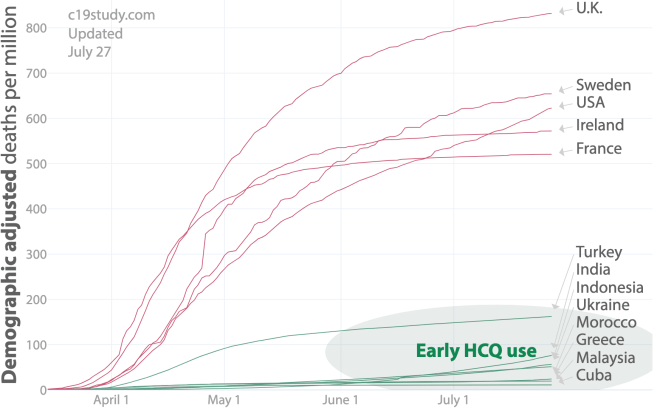
The case fatality rate of COVID-19 is reduced by a factor of 2.8 if HCQ + Zinc is administered as soon as possible. 1.2 Million cases are proof enough!

President Donald Trump ripped the “Fake News” media on Tuesday for not reporting that the U.S. has the lowest COVID-19 mortality rate in the world.

The president tweeted a Washington Times article that discusses the decreasing death rate.

“We have the lowest Mortality Rate in the World,” Trump wrote. “The Fake News should be reporting these most important of facts, but they don’t!”

His press secretary Kayleigh McEnany in her press briefing posted this chart to boost his claim.

The article covers a Monday White House press conference. McEnany told reporters that the American death toll has fallen for weeks and the virus fatality rate is below France, the United Kingdom and Germany.

She said the death toll has significantly dropped from the height of the outbreak when the U.S. logged 2,500 deaths per day to 254 deaths on Saturday, according to the article.

To confirm it the case fatality rate for Germany is as of July 7: 4.59%

The corresponding number for U.S.A.: 4.33%

Is that the lowest percentage in the world?

There are more than ten countries with a lower case fatality rate. At least ten of them have one thing in common. These ten countries prescribe the use of  HydroxyChloroQuine to all people that show symptoms of COVID-19, even before a positive test is confirmed.

Turkey: 2.53%

South Korea: 2.15%

Senegal: 1.82%

Morocco: 1.64%

Russia: 1.48%

Malaysia: 1.39%

United Arab Emirates: 0.62%

Costa Rica: 0.42%

Bahrain: 0.32%

Qatar: 0.13%, but since 88% of the population are migrant workers between 20 and 60, the adjusted death rate for the permanent residents would be maybe 8 times higher, or about 1%

The total number of positive cases for these ten countries are over 1.2 million, far more than any double blind test could ever produce.

Taking the average, adjusted for the number of positive cases, the average adjusted death rate for ten countries, where people are taking HCQ + Zinc as soon as they are showing symptoms or diagnosed positive, is 1.51%.

This means that the risk of death is reduced by a factor of 2.8 if HZQ + Zinc is taken as early as possible after showing symptoms or after a positive diagnosis for corona-virus!


July 8, read through the Holy Bible in a year in Power-point, with comments.

Today we read the fifth chapter of the Apostle Paul’s second letter to the Corinthians and two  chapters of Nehemiah.

July 8: 2 Corinthians 5, Nehemiah 7, Nehemiah 8 (click on the chapter to begin reading)

2 Corinthians 5 gives the assurance of the resurrection, and we must all appear before the judgment seat of Christ. In the meantime we have been given the ministry of reconciliation, and “Therefore if any man be in Christ, he is a new creature: old things are passed away; behold, all things are become new.” This verse was inscribed in the New Testament given to me at my confirmation in Sweden more than half a century ago. I didn’t understand it then, but since I became a believer in the Lord Jesus Christ it all started to make sense.

Nehemiah 7. Finally the wall was finished, and the chapter gives a list of the captives who returned to Jerusalem.

Nehemiah 8. Ezra read the Law and the returnees celebrated the Feast of Tabernacles.

The case for Thorium. 10. Molten Salt Liquid Fluoride Thorium Reactors cannot have a meltdown, the fuel is already molten, and it is a continuous process. No need for refueling shutdowns.

With Molten Salt nuclear Reactors there is no risk for a meltdown, the fuel is already molten, and that is a safe design. The fissile fuel in a Thorium reactor is U-233 in the form of UraniumFluoride (UF4) salt which also contains Lithium and Beryllium to lower the melting point, the operating temperature is around 700C.  In its molten form the salt has a very low vapor pressure. The salt flows easily through the heat exchangers and the separators. The salt is very toxic, but since it is completely sealed it is not corrosive. Being a fluid, it is constantly mixed for optimum efficiency. The reactor will never have to be shut down for refueling, it is a continuous flow process. Uranium-235 Nuclear reactors on the other hand have to be shut down for refueling and rebalancing of the fuel rods a little more often than once every two years. The average shutdown is 35 days, or about 5% of the time. Then comes the major problem of safely and securely transporting and reprocessing the spent fuel. In a LFTR the fuel is spent as it is produced, so the fissile inventory is constantly kept at a minimum, and fission products and extra generated U-233 is separated out. this is a much cleaner process than reprocessing spent fuel.

July 7, read through the Holy Bible in a year in Power-point, with comments.

Today we read the fourth chapter of the Apostle Paul’s second letter to the Corinthians and three chapters of Nehemiah.

July 7: 2 Corinthians 4, Nehemiah 4, Nehemiah 5, Nehemiah 6 (click on the chapter to begin reading)

2 Corinthians 4. Believers are treasures in jars of clay to proclaim the light of Christ’s gospel. They may be cast down but still unconquered “We believe and therefore speak” “we look not at the things which are seen, but at the things which are not seen: for the things which are seen are temporal; but the things which are not seen are eternal.” Read this chapter carefully with thought.

Nehemiah 4. Through strong opposition the building of the wall was defended.

Nehemiah 5, Nehemiah encountered oppression but showed great generosity.

Nehemiah 6, There arose a conspiracy against Nehemiah, but he was on to them and managed to get the wall completed.

The case for Thorium. 9. Liquid Fluoride Thorium Reactors are earthquake safe, only gravity needed for safe shutdown.

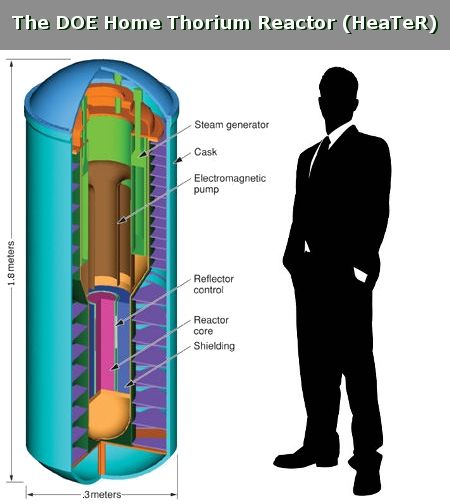
Molten Salt Thorium Reactors are earthquake safe. Thorium reactors have a very simple and compact design where gravity is the only thing needed to stop the nuclear reaction. Conventional nuclear reactors depend on external power to shut down after a SCRAM, where poison rods fall down to halt the reaction.  The next figure shows the concept of a Thorium reactor.

The idea is to empty the fissile U-233 core through gravity alone. All that is needed is a melt-plug that is constantly cooled by cold air. In an earthquake or complete electric failure the cold air flow automatically shuts off, and since the fuel is already molten, it will melt the plug, and the molten fluid will run down into channels like pig-iron into heat exchangers that absorb the residual heat.

As we can see the reactor hardened structure is compact, and can be completely earthquake and tsunami proof. What can be sheared off are the steam pipes and external power, but even then the reactor shutdown will  be complete safe without any additional power.

July 6, read through the Holy Bible in a year in Power-point, with comments.

Today we read the third chapter of the Apostle Paul’s second letter to the Corinthians and the first three chapters of Nehemiah.

July 6: 2 Corinthians 3, Nehemiah 1, Nehemiah 2, Nehemiah 3 (click on the chapter to begin reading)

2 Corinthians 3. Believers are Christ’s Epistle with the the spirit of the living God living within them.“The letter killeth, but the spirit giveth life” , that is the glory of the New Covenant, and “where the spirit of the Lord is, there is liberty

Nehemiah 1 records Nehemiah’s prayer.

Nehemiah 2. After some days of praying Nehemiah went to the King, told  the King why he was sad and was sent to Judah where he  viewed the wall of Jerusalem.

Nehemiah 3 retells the start of rebuilding the wall.