The Earth can be described as a black body with energy coming in, mostly from the sun and an equivalent amount of energy being emitted. This follows the the Stefan–Boltzmann law, which states that the total energy radiated per unit surface area of a black body across all wavelengths per unit time j ⋆ 

The best way to find out how the earth reacts to changes is to provide an impulse and see what happens. One such impulse was the open air atomic tests in the early 1960s.
Cosmic radiation in the form of iron nuclei is the major source of the generation of Carbon 14. When fossil fuel is burned there is very little C14 in the CO2 generated, but if it is burned by digestion of food, by fermentation, by burning wood or by wildfire, it contains the same concentration of C14 as was in the air at the time of the generation of the biomass. Since C14 has a half life of 5700 +- 40 years, we could find out the age of that biomass -or could we?
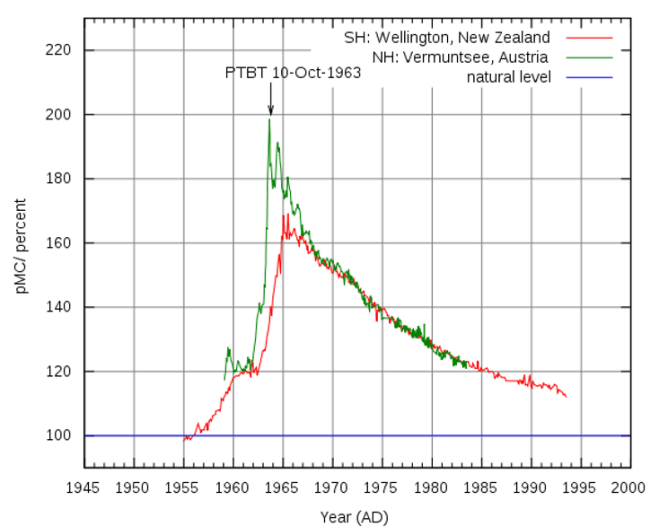
This is one of my very favorite slides. The best way of finding out how a black body responds is by introducing an impulse and see what happens. In this case the impulse was open air nuclear bomb tests, performed mostly by United States and the Soviet Union, but all occurred in the Northern Hemisphere. Test stations to see the amount of C14 in the air were set up in Austria and New Zealand. What did we learn? We learnt that the air mixes between the Northern and the Southern Hemisphere in about 2 years, and because the half-life of C14 shown here is 12.5 years, not 5700 years, it shows the absorption rate in the oceans and into new biomass. These values would have been difficult if not impossible to find out without open air Nuclear tests, Were the tests bad? You bet, but since they happened, you glean what you can from it. What else did we learn? You can no longer use carbon dating if there is any chance of contamination with newer biomass, or if it is newer than 1955 A.D.
In examining a black body, in this case the Earth for distinguishing properties it is very useful to observe how it reacts to impulses. We want to see which impulse response lead to climate change and which are just weather changes. All impulses lead to a response with a time delay.
There are those that say that climate change the worst threat to the world as we know it, worse than all out nuclear war. This is false.
Before we tackle the impulse change that everybody are worried about, the onset and growth of the industrial age and its outputs, let us examine few other impulses first.
The steady state of the earth is an ice age, and in the next segment we will examine how the earth ended the Ice age.

 Len Bilén's blog, a blog about faith, politics and the environment.