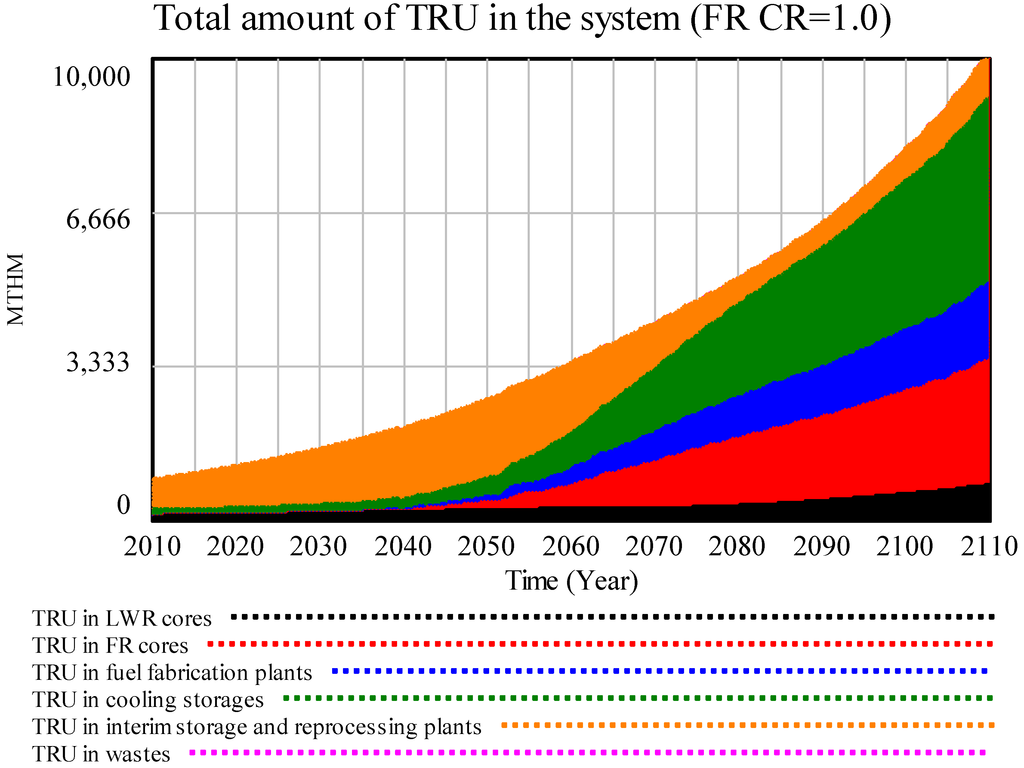
The stockpiles from light water reactor keep growing. The temporary storages are all full and spent nuclear fuel is still coming in with no good place to put it. This is an estimate of future stockpiles:
MTHM: Metric Tons Heavy Metals TRU: TRansUranium metals, a large amount of witch is Plutonium 239
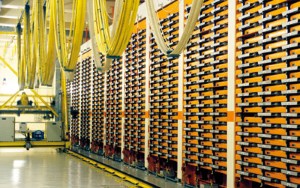
The dry storage is usually very neat and catalogued. After all Plutonium 239 is what you make atomic bombs from, so proliferation security is of utmost importance.
TRU can be reprocessed in a molten salt generator and generate far more energy than was obtained the first time around in the LWR
LFTR is a type of Molten Salt Reactor with equipment to convert plentiful thorium into uranium (U233) to use as fuel. It can also use plutonium from LWR (Light Water Reactor) waste. LFTR is not very efficient at using depleted uranium (need a Fast-Spectrum reactor to fission U-238 effectively; in a thermal-spectrum reactor like LFTR or LWR, would convert some U-238 to plutonium which is fissile). The best solution is a two-fuel molten salt reactor
Because a LFTR fissions 99%+ of the fuel (whether thorium, or plutonium from nuclear waste), it consumes all the uranium and transuraniums leaving little long-term radioactive waste. 83% of the waste products are safely stabilized within 10 years. The remaining 17% need to be stored less than 350 years to become completely benign.
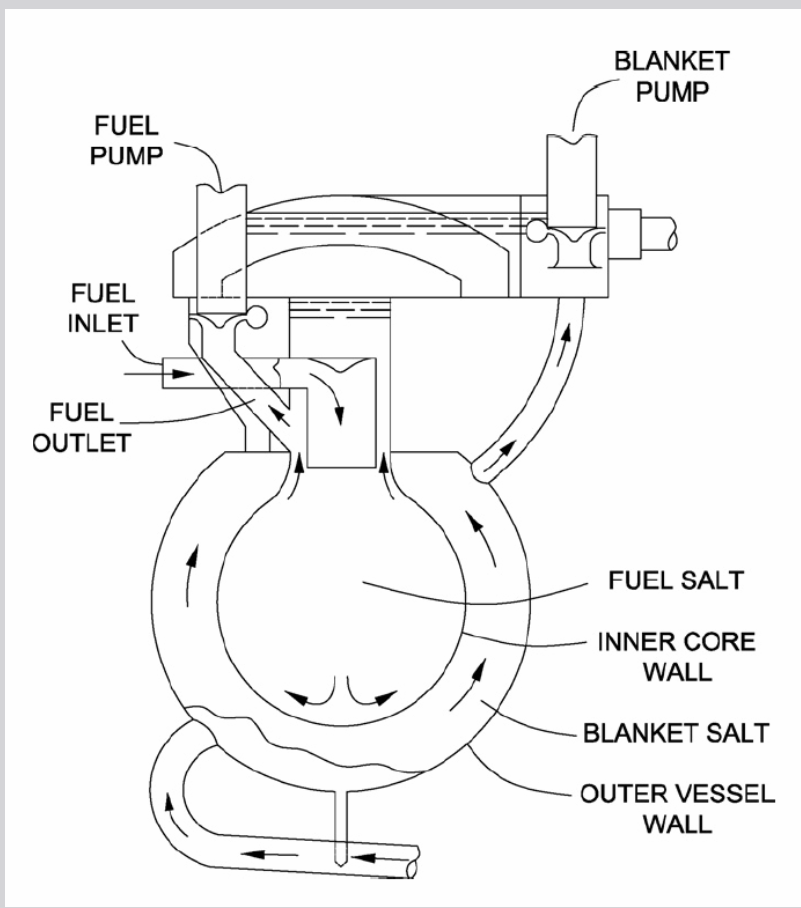
The fuel source would be Trans-Uraniums, mostly Plutonium 239 and some Uranium 233. The blanket would contain Thorium, which when converted to Protactinium would be extracted out and in 28 days half of it would be converted to Uranium 233. The temperature in the fissile core will be around 650C and in the blanker somewhat less, its only purpose is to produce U 233 to be used in other nuclear plants.
“LFTR technology can then be used to reprocess and consume the remaining fissile material in spent nuclear fuel stockpiles around the world and to extract and resell many of the other valuable fission byproducts that are currently deemed hazardous waste in their current spent fuel rod form. The U.S. nuclear industry has already allocated $25 billion for storage or reprocessing of spent nuclear fuel and the world currently has over 340,000 tons of spent LWR fuel with enough usable fissile material to start one 100 MWe LFTR per day for 93 years. (A 100 MW LFTR requires 100 kg of fissile material (U-233, U-235, or Pu-239) to start the chain reaction). LFTR can also be used to consume existing U-233 stockpiles at ORNL ($500 million allocated for stockpile destruction) and plutonium from weapons stockpiles.”
FS-MSRs essentially avoid the entire fuel qualification issue in that they are tolerant of any fissile material composition, with their inherent strong negative thermal reactivity feedback providing the control necessary to accommodate a shifting fuel feed stream. Fast Spectrum Molten Salt Reactor Options,
Some of the pictures are from a slide presentation given by David Archibald in Melbourne Feb 5 2011. He posted it “for the benefit of all” which I have interpreted as waving the copyright of the pictures
Molten Salt Thorium Reactors are earthquake safe. Thorium reactors have a very simple and compact design where gravity is the only thing needed to stop the nuclear reaction. Conventional nuclear reactors depend on external power to shut down after a SCRAM, where poison rods fall down to halt the reaction. The next figure shows the concept of a Thorium reactor.
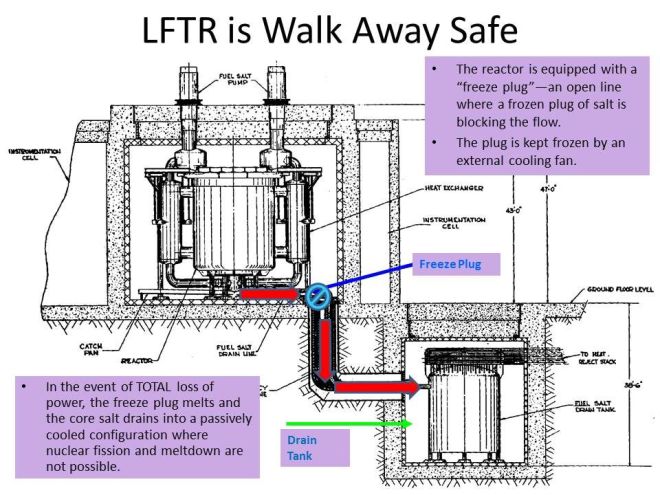
The idea is to empty the fissile U-233 core through gravity alone. All that is needed is a melt-plug that is constantly cooled by cold air. In an earthquake or complete electric failure the cold air flow automatically shuts off, and since the fuel is already molten, it will melt the plug, and the molten fluid will run down into channels like pig-iron into heat exchangers that absorb the residual heat.
As we can see the reactor hardened structure is compact, and can be completely earthquake and tsunami proof. What can be sheared off are the steam pipes and external power, but even then the reactor shutdown will be complete safe without any additional power.
One of the advantages of the LFTR reactor is that the fissile compartment is always kept just above critical point for needed power delivery. This means, once it starts draining, the fission process ends immediately. The only nuclear reaction remaining is that the Protactinium generated in the fertile blanket and separator gets converted to U-233 over time, but the amounts are so small that it is always in the safe range.
This is insanity. In 2011 the Oak Ridge Laboratories had a stockpile of 1400 kg U 233. They have been busy downblending it into depleted uranium to render it useless, and there is now only about 450 kg left.
The bill is introduced. It should be immediately passed in the Senate, and be passed in the house without amendments. Any delay is critical. It is that important. We gave the technology to the Chinese so they can build up their naval fleet with molten salt Thorium nuclear power. Meanwhile we still have some u-233 left, worth billions as a National Security asset. At the very least, we must stop downblending immediately, even before the bill is passed.
Here is the bill itself. The summary is not yet written, but the bill is introduced.
117th CONGRESS 2d Session
S. 4242
To provide for the preservation and storage of uranium-233 to foster development of thorium molten-salt reactors, and for other purposes.
IN THE SENATE OF THE UNITED STATES
May 18 (legislative day, May 17), 2022
Mr. Tuberville (for himself and Mr. Marshall) introduced the following bill; which was read twice and referred to the Committee on Energy and Natural Resources
A BILL
To provide for the preservation and storage of uranium-233 to foster development of thorium molten-salt reactors, and for other purposes.
Be it enacted by the Senate and House of Representatives of the United States of America in Congress assembled,
SECTION 1. Short title.
This Act may be cited as the “Thorium Energy Security Act of 2022”.
SEC. 2. Findings.
Congress makes the following findings:
(1) Thorium molten-salt reactor technology was originally developed in the United States, primarily at the Oak Ridge National Laboratory in the State of Tennessee under the Molten-Salt Reactor Program.
(2) Before the cancellation of that program in 1976, the technology developed at the Oak Ridge National Laboratory was moving steadily toward efficient utilization of the natural thorium energy resource, which exists in substantial amounts in many parts of the United States, and requires no isotopic enrichment.
(3) The People’s Republic of China is known to be pursuing the development of molten-salt reactor technology based on a thorium fuel cycle.
(4) Thorium itself is not fissile, but fertile, and requires fissile material to begin a nuclear chain reaction. This largely accounts for its exclusion for nuclear weapons developments.
(5) Uranium-233, derived from neutron absorption by natural thorium, is the ideal candidate for the fissile material to start a thorium reactor, and is the only fissile material candidate that can minimize the production of long-lived transuranic elements like plutonium, which have proven a great challenge to the management of existing spent nuclear fuel.
(6) Geologic disposal of spent nuclear fuel from conventional nuclear reactors continues to pose severe political and technical challenges, and costs United States taxpayers more than $500,000,000 annually in court-mandated payments to electrical utilities operating nuclear reactors.
(7) The United States possesses the largest known inventory of separated uranium-233 in the world, aggregated at the Oak Ridge National Laboratory.
(8) Oak Ridge National Laboratory building 3019 was designated in 1962 as the national repository for uranium-233 storage, and its inventory eventually grew to about 450 kilograms of separated uranium-233, along with approximately 1,000 kilograms of mixed fissile uranium from the Consolidated Edison Uranium Solidification Program (commonly referred to as “CEUSP”), divided into approximately 1,100 containers.
(9) The Defense Nuclear Facilities Safety Board issued Recommendation 97–1 (relating to safe storage of uranium-233) in 1997 because of the possibility of corrosion or other degradation around the storage of uranium-233 in a building that was built in 1943.
(10) In response, the Department of Energy published Decision Memorandum No. 2 in 2001 concluding that no Department of Energy programs needed uranium-233 and directed that a contract be placed for disposition of the uranium-233 inventory and decommissioning of its storage facility.
(11) The Department of Energy awarded a contract for the irreversible downblending of uranium-233 with uranium-238 and its geologic disposal in Nevada, which downblending would create a waste form that would pose radiological hazards for hundreds of thousands of years, rather than to consider uranium-233 as a useful national asset.
(12) All 1,000 kilograms of CEUSP uranium-233-based material have been dispositioned (but not downblended) but those containers had little useful uranium-233 in them. The majority of separated and valuable uranium-233 remains uncontaminated by uranium-238 and suitable for thorium fuel cycle research and development. That remaining inventory constitutes the largest supply of uranium-233 known to exist in the world today.
(13) The United States has significant domestic reserves of thorium in accessible high-grade deposits, which can provide thousands of years of clean energy if used efficiently in a liquid-fluoride reactor initially started with uranium-233.
(14) Recently (as of the date of the enactment of this Act), the Department of Energy has chosen to fund a series of advanced reactors that are all dependent on initial inventories and regular resupplies of high-assay, low-enriched uranium.
(15) There is no domestic source of high-assay, low-enriched uranium fuel, and there are no available estimates as to how long the development of a domestic supply of that fuel would take or how expensive such development would be.
(16) The only viable source of high-assay, low-enriched uranium fuel is through continuous import from sources in the Russian Federation.
(17) The political situation with the Russian Federation as of the date of the enactment of this Act is sufficiently uncertain that it would be unwise for United States-funded advanced reactor development to rely on high-assay, low-enriched uranium since the Russian Federation would be the primary source and can be expected to undercut any future United States production, resulting in a dependency on high-assay, low-enriched uranium from the Russian Federation.
(18) The United States has abandoned the development of a geologic repository at Yucca Mountain and is seeking a consenting community to allow interim storage of spent nuclear fuel, but valid concerns persist that an interim storage facility will become a permanent storage facility.
(19) Without a closed fuel cycle, high-assay, low-enriched uranium-fueled reactors inevitably will produce long-lived wastes that presently have no disposition pathway.
(20) The United States possesses enough uranium-233 to support further research and development as well as fuel the startup of several thorium reactors. Thorium reactors do not require additional fuel or high-assay, low-enriched uranium from the Russian Federation.
(21) Continuing the irreversible destruction of uranium-233 precludes privately funded development of the thorium fuel cycle, which would have long term national and economic security implications.
SEC. 3. Sense of Congress.
It is the sense of Congress that—
(1) it is in the best economic and national security interests of the United States to resume development of thorium molten-salt reactors that can minimize long-lived waste production, in consideration of—
(A) the pursuit by the People’s Republic of China of thorium molten-salt reactors and associated cooperative research agreements with United States national laboratories; and
(B) the present impasse around the geological disposal of nuclear waste;
(2) that the development of thorium molten-salt reactors is consistent with section 1261 of the John S. McCain National Defense Authorization Act for Fiscal Year 2019 (Public Law 115–232; 132 Stat. 2060), which declared long-term strategic competition with the People’s Republic of China as “a principal priority for the United States”; and
(3) to resume such development, it is necessary to relocate as much of the uranium-233 remaining at Oak Ridge National Laboratory as possible to new secure storage.
SEC. 4. Definitions.
In this Act:
(1) CONGRESSIONAL DEFENSE COMMITTEES.—The term “congressional defense committees” has the meaning given that term in section 101(a) of title 10, United States Code.
(2) DOWNBLEND.—The term “downblend” means the process of adding a chemically identical isotope to an inventory of fissile material in order to degrade its nuclear value.
(3) FISSILE MATERIAL.—The term “fissile material” refers to uranium-233, uranium-235, plutonium-239, or plutonium-241.
(4) HIGH-ASSAY, LOW-ENRICHED URANIUM.—The term “high-assay, low-enriched uranium” (commonly referred to as “HALEU”) means a mixture of uranium isotopes very nearly but not equaling or exceeding 20 percent of the isotope uranium-235.
(5) TRANSURANIC ELEMENT.—The term “transuranic element” means an element with an atomic number greater than the atomic number of uranium (92), such as neptunium, plutonium, americium, or curium.
SEC. 5. Preservation of uranium-233 to foster development of thorium molten-salt reactors.
The Secretary of Energy shall preserve uranium-233 inventories that have not been contaminated with uranium-238, with the goal of fostering development of thorium molten-salt reactors by United States industry.
SEC. 6. Storage of uranium-233.
(a) Report on long-Term storage of uranium-233.—Not later than 120 days after the date of the enactment of this Act, the Secretary of Energy, in consultation with the heads of other relevant agencies, shall submit to Congress a report identifying a suitable location for, or a location that can be modified for, secure long-term storage of uranium-233.
(b) Report on interim storage of uranium-233.—Not later than 120 days after the date of the enactment of this Act, the Chief of Engineers shall submit to Congress a report identifying a suitable location for secure interim storage of uranium-233.
(c) Report on construction of uranium-233 storage facility at Redstone Arsenal.—Not later than 240 days after the date of the enactment of this Act, the Chief of Engineers shall submit to Congress a report on the costs of constructing a permanent, secure storage facility for uranium-233 at Redstone Arsenal, Alabama, that is also suitable for chemical processing of uranium-233 pursuant to a public-private partnership with thorium reactor developers.
(d) Funding.—Notwithstanding any other provision of law, amounts authorized to be appropriated or otherwise made available for the U233 Disposition Program for fiscal year 2022 or 2023 shall be made available for the transfer of the inventory of uranium-233 to the interim or permanent storage facilities identified under this section.
SEC. 7. Interagency cooperation on preservation and transfer of uranium-233.
The Secretary of Energy, the Secretary of the Army (including the head of the Army Reactor Office), the Secretary of Transportation, the Tennessee Valley Authority, and other relevant agencies shall—
(1) work together to preserve uranium-233 inventories and expedite transfers of uranium-233 to interim and permanent storage facilities; and
(2) in expediting such transfers, seek the assistance of appropriate industrial entities.
SEC. 8. Report on use of thorium reactors by People’s Republic of China.
Not later than 180 days after the date of the enactment of this Act, the Comptroller General of the United States, in consultation with the Secretary of State, the Secretary of Defense, and the Administrator for Nuclear Security, shall submit to Congress a report that—
(1) evaluates the progress the People’s Republic of China has made in the development of thorium-based reactors;
(2) describes the extent to which that progress was based on United States technology;
(3) details the actions the Department of Energy took in transferring uranium-233 technology to the People’s Republic of China; and
(4) assesses the likelihood that the People’s Republic of China may employ thorium reactors in its future navy plans.
SEC. 9. Report on medical market for isotopes of uranium-233.
Not later than 180 days after the date of the enactment of this Act, the Director of the Congressional Budget Office, after consultation with institutions of higher education and private industry conducting medical research and the public, shall submit to Congress a report that estimates the medical market value, during the 10-year period after the date of the enactment of this Act, of actinium, bismuth, and other grandchildren isotopes of uranium-233 that can be harvested without downblending and destroying the uranium-233 source material.
SEC. 10. Report on costs to United States nuclear enterprise.
Not later than 180 days after the date of the enactment of this Act, the Director of the Congressional Budget Office, after consultation with relevant industry groups and nuclear regulatory agencies, shall submit to Congress a report that estimates, for the 10-year period after the date of the enactment of this Act, the costs to the United States nuclear enterprise with respect to—
(1) disposition of uranium-233;
(2) payments to nuclear facilities to store nuclear waste; and
(3) restarting the manufacturing the United States of high-assay, low-enriched uranium.


 Len Bilén's blog, a blog about faith, politics and the environment.