November unemployment smoke and mirrors. A Limerick

unemploymentnov

So if you are one of the millions of workers, ready, willing and able to work but not being able to find any for years, you may feel like this:

If unemployed year after year,

discouraged, a case less severe.

Do not go ballistic,

you are a statistic.

A loser, a discard, you hear?

This is one of the reasons why Donald Trump won!

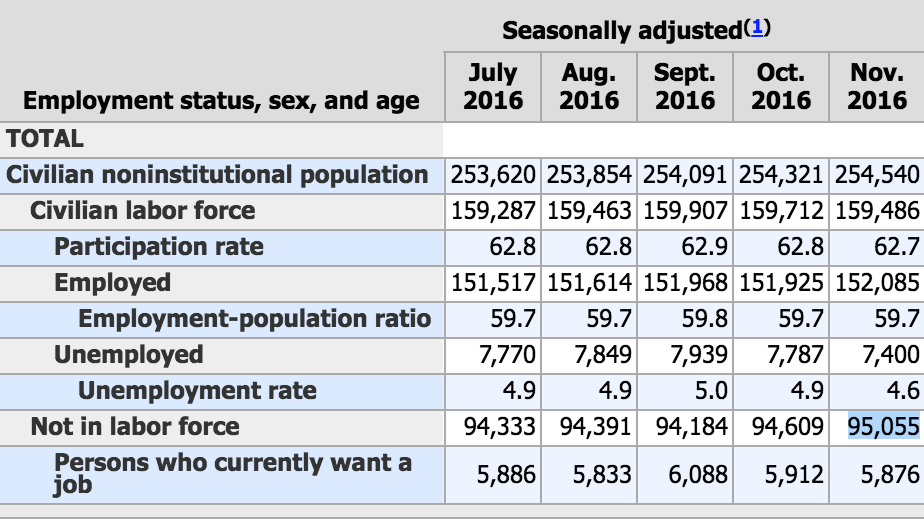
It seems at first glance to be only good news on the labor front with the unemployment rate the lowest in nine years. But on second look it is all massaged data.  The employable population grew by 219,000 people, the labor force shrunk by 226,000 people, the number employed grew by 160,000, much less than the population increase, and yet  the unemployment rate dropped by 0.3%. Why? 445,000 people left or failed to enter the labor force. In addition the average pay declined by 3 cents/hour.

The Trump presidency can’t come soon enough!
Unemployment number 5.6%. Good news? Not with 451000 dropping out of the labor force! A Limerick.

If you have been unemployed more than a year,

you count as “discouraged”, a case less severe.

Do not go ballistic

You are a statistic.

No more unemployed, but a discard. So there!

The Bureau of Labor  Statistics (BLS) nonfarm payroll employment rose by 252,000 in December, and the unemployment rate
declined to 5.6 percent, the U.S. Bureau of Labor Statistics reported today. Job gains occurred in
professional and business services (52000), construction(48000), food services and drinking places(44000), health care(34000), and
manufacturing(17000).
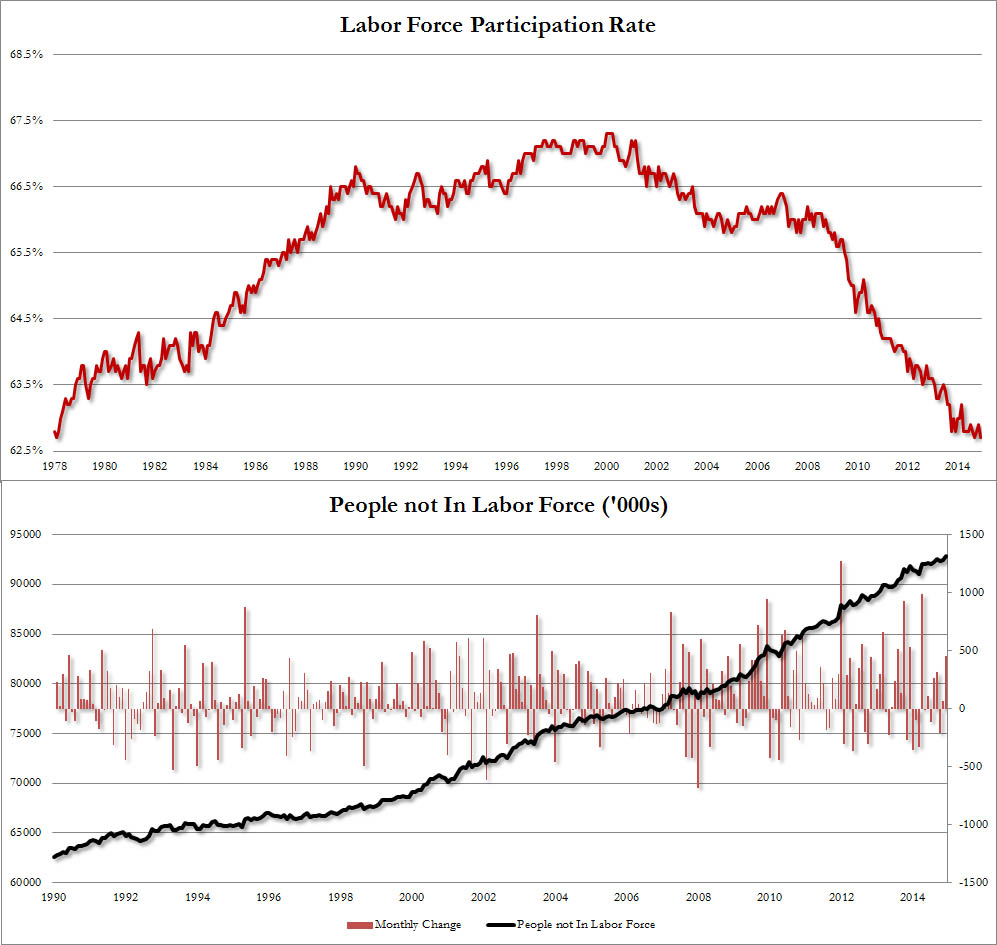
The labor participation rate slid 0.2%, dropping to 62.7%, or the lowest print since December 1977.

LFP

Americans not in the labor forced soared by 451,000 in December, far outpacing the 111,000 jobs added according to the Household Survey, and is the primary reason why the number of uenmployed Americans dropped by 383,000.
Average wages dropped In December,  for all employees on private nonfarm payrolls by 5
cents to $24.57. In December, average hourly earnings of private-sector production and
nonsupervisory employees decreased by 6 cents to $20.68.

One cannot help but notice the discrepancy in the 252000 jobs added according to BLS, versus the 111000 jobs added according to the household survey.

With the lowest labor participation rate since 1977 (the Carter malaise) we are not in a real recovery, the real numbers are much worse.