Why Thorium? 22. China is having a massive Thorium program.

China is having a massive Thorium program. The People’s Republic of China has initiated a research and development project in thorium molten-salt reactor technology. The thorium MSR efforts aims not only to develop the technology but to secure intellectual property rights to its implementation. This may be one of the reasons that the Chinese have not joined the international Gen-IV effort for MSR development, since part of that involves technology exchange. Neither the US nor Russia have joined the MSR Gen-IV effort either.
China is currently the largest emitter of CO2 and air pollutants by far, and according to the Paris accord was allowed to emit six times as much pollutants as the U.S. by 2030, being a “developing nation”. Their air quality is already among the worst in the world so something had to be done if they were to achieve world dominance by 2025 and total rule by 2030. Only Thorium can solve the pollution problem and provide the clean energy needed for the future. Regular Uranium Nuclear reactors require large amounts of water and Molten Salt Thorium reactors require little water to operate.

Geneva, Switzerland, 21 August 2018 – As the world struggles with a record-breaking heatwave, China correctly places its trust in the fuel Thorium and the Thorium Molten Salt Reactor (TMSR) as the backbone of its nation’s plan to become a clean and cheap energy powerhouse.
​​The question is if China will manage to build a homegrown mega export industry, or will others have capacity and will to catch up?

For China, clean energy development and implementation is a test for the state’s ability. Therefore, China is developing the capability to use the “forgotten fuel” thorium, which could begin a new era of nuclear power.​
The first energy system they are building is a solid fuel molten salt reactor that achieves high temperatures to maximize efficiency of combined heat and power generation applications.
However, to fully realize thorium’s energy potential and in this way solve an important mission for China – the security of fuel supply – requires also the thorium itself to be fluid. This is optimized in the Thorium Molten Salt Reactor (TMSR).
The TMSR takes safety to an entirely new level and can be made cheap and small since it operates at atmospheric pressure, one of its many advantages. Thanks to its flexible cooling options it can basically be used anywhere, be it a desert, a town or at sea. In China this is of special interest inland, where freshwater is scarce in large areas, providing a unique way to secure energy independence.

“Everyone in the field is extremely impressed with how China saw the potential, grabbed the opportunity and is now running faster than everyone else developing this futuristic energy source China and the entire world is in a great need of.”
– Andreas Norlin, Thorium Energy World

Picture

China is not telling all they are doing on Nuclear Energy, but this news item is true:

The Shanghai Institute of Applied Physics (SINAP) – part of the Chinese Academy of Sciences (CAS) – has been given approval by the Ministry of Ecology and Environment to commission an experimental thorium-powered molten-salt reactor, construction of which started in Wuwei city, Gansu province, in September 2018.

A cutaway of the TMSR-LF1 reactor (Image: SINAP)

In January 2011, CAS launched a CNY3 billion (USD444 million) R&D programme on liquid fluoride thorium reactors (LFTRs), known there as the thorium-breeding molten-salt reactor (Th-MSR or TMSR), and claimed to have the world’s largest national effort on it, hoping to obtain full intellectual property rights on the technology. This is also known as the fluoride salt-cooled high-temperature reactor (FHR). The TMSR Centre at SINAP at Jiading, Shanghai, is responsible.

Construction of the 2 MWt TMSR-LF1 reactor began in September 2018 and was reportedly completed in August 2021. The prototype was scheduled to be completed in 2024, but work was accelerated.

“According to the relevant provisions of the Nuclear Safety Law of the People’s Republic of China and the Regulations of the People’s Republic of China on the Safety Supervision and Administration of Civilian Nuclear Facilities, our bureau has conducted a technical review of the application documents you submitted, and believes that your 2 MWt liquid fuel thorium-based molten salt experimental reactor commissioning plan (Version V1.3) is acceptable and is hereby approved,” the Ministry of Ecology and Environment told SINAP on 2 August.

It added: “During the commissioning process of your 2 MWt liquid fuel thorium-based molten salt experimental reactor, you should strictly implement this plan to ensure the effectiveness of the implementation of the plan and ensure the safety and quality of debugging. If any major abnormality occurs during the commissioning process, it should be reported to our bureau and the Northwest Nuclear and Radiation Safety Supervision Station in time.”

The TMSR-LF1 will use fuel enriched to under 20% U-235, have a thorium inventory of about 50 kg and conversion ratio of about 0.1. A fertile blanket of lithium-beryllium fluoride (FLiBe) with 99.95% Li-7 will be used, and fuel as UF4.

The project is expected to start on a batch basis with some online refueling and removal of gaseous fission products, but discharging all fuel salt after 5-8 years for reprocessing and separation of fission products and minor actinides for storage. It will proceed to a continuous process of recycling salt, uranium and thorium, with online separation of fission products and minor actinides. The reactor will work up from about 20% thorium fission to about 80%.

If the TMSR-LF1 proves successful, China plans to build a reactor with a capacity of 373 MWt by 2030.

As this type of reactor does not require water for cooling, it will be able to operate in desert regions. The Chinese government has plans to build more across the sparsely populated deserts and plains of western China, complementing wind and solar plants and reducing China’s reliance on coal-fired power stations. The reactor may also be built outside China in Belt and Road Initiative nations.

The liquid fuel design is descended from the 1960s Molten-Salt Reactor Experiment at Oak Ridge National Laboratory in the USA. (Researched and written by World Nuclear News)

Yes, it is true. Their design was given to them free, and now PRC is developing the future energy source including claiming intellectual property rights from a source abandoned in 1969 by U.S.A. because of political infighting, not for economical or national security reasons.
Why Thorium? 21. India is having an ambitious Thorium program, planning to meet 30% of its electricity demand via Thorium based reactors by 2050.

India has an active Thorium program. • India has a flourishing and largely indigenous nuclear power program and did at one time expect to have 20,000 MWe nuclear capacity on line by 2020 and 63,000 MWe by 2032, but being India and subject to Indian bureaucracy and economic limitation the goals tend to get delayed. It aims to supply over 30% of electricity from nuclear power by 2050. • Because India is outside the Nuclear Non-Proliferation Treaty due to its weapons program, it was for 34 years largely excluded from trade in nuclear plant or materials, which has hampered its development of civil nuclear energy until 2009. • Due to these trade bans and lack of indigenous uranium, India has uniquely been developing a nuclear fuel cycle to exploit its reserves of thorium. • Now, foreign technology and fuel are expected to boost India’s nuclear power plans considerably.  All plants will have high indigenous engineering content. • India has a vision of becoming a world leader in nuclear technology due to its expertise in fast reactors and thorium fuel cycle. • India’s Kakrapar-1 reactor is the world’s first reactor which uses thorium rather than depleted uranium to achieve power flattening across the reactor core. India, which has about 25% of the world’s thorium reserves, is developing a 300 MW prototype of a thorium-based Advanced Heavy Water Reactor (AHWR). The prototype was fully operational by 2012, following which five more reactors will be constructed. Considered to be a global leader in thorium-based fuel, India’s new thorium reactor is a fast-breeder reactor and uses a plutonium core rather than an accelerator to produce neutrons. As accelerator-based systems can operate at sub-criticality they could be developed too, but that would require more research. India currently envisages meeting 30% of its electricity demand through thorium-based reactors by 2050.

“[F]ast reactors can help extract up to 70 percent more energy than traditional reactors and are safer than traditional reactors while reducing long lived radioactive waste by several fold,” Yukiya Amano, Director General of International Atomic Energy Agency (IAEA) in Vienna, explained to the Times of India.

Uranium isn’t common in India, but the country has the second largest store of Thorium, so the Prototype Fast Breeder Reactor (PFBR) in Kalpakkam uses rods of that element.

Arun Kumar Bhaduri, Director of the Indira Gandhi Centre for Atomic Research (IGCAR), Kalpakkam, told the Times of India that the technology is safe: “[F]ast breeder reactors are far safer than the current generation of nuclear plants.”

With the PFBR, India is pioneering a kind of nuclear technology that could potentially be the country’s greatest renewable energy source. That’s a big step, especially since nuclear fission remains the only kind of nuclear reaction we’ve managed to sustain, though efforts to make nuclear fusion viable are still in the works.

India used the heavy water, natural Uranium method to produce its Plutonium Nuclear bombs. This is not the cheapest way to produce Nuclear Bombs, but it worked for India as they refused to join the Nuclear proliferation treaty. This technology works slightly better with Thorium rods, as long as a Plutonium sparkplug is provided, but U-233 is not well suited to make nuclear bombs, so the reactors became available. It is very old technology, but it has given India good experience with the Thotium-U-233 breeding, and modern fast breeders is the next step. U.S. should immediately join their development efforts and start very close cooperation developing modern Thorium based reactors.

Why Thorium? 20. Russia has an active Thorium program.

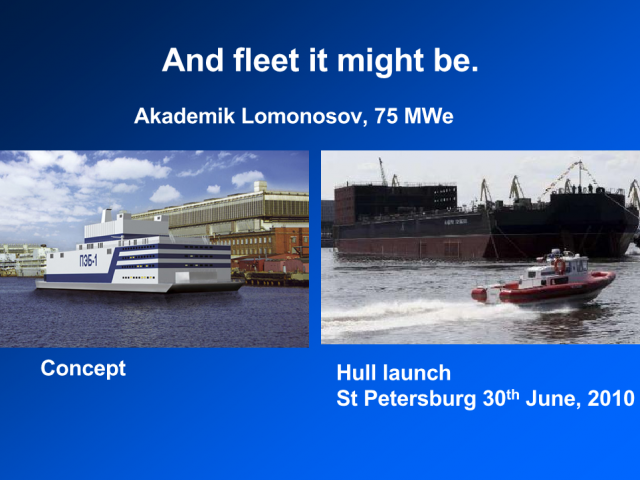
Russia has an active Thorium program.This used to be true, but it was decided that for the Arctisc buildup this barge (below) would be outfitted with regular nuclear power the same type that are in Russia’s nuclear powered ice breakers.

This is a self-contained 7m MW electric or 200 MW heat cogeneration Nuclear Reactor on a barge. Coolant readily available. Hoist it a couple of cables and the town to be serviced will have all the power and heat it needs. This is especially useful in the Arctic. Russia is trying to establish Arctic domination, both commercially and militarily. They have over 30 ice breakers, about half of them nuclear. U.S. has two conventional ice breakers, of which only one is operational.

Now for the good news: Russia is also trying to commercialize hybrid fusion-fission reactors:

Nuclear Engineering International: 29 May 2018

Russia develops a fission-fusion hybrid reactor.
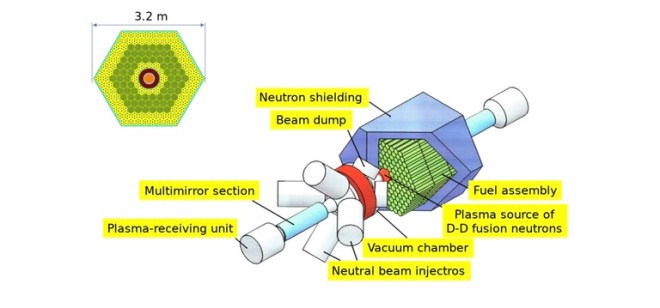
A new fission-fusion hybrid reactor will be assembled at Russia’s Kurchatov Institute by the end of 2018, Peter Khvostenko, scientific adviser of the Kurchatov complex on thermonuclear energy and plasma technologies, announced on 14 May. The physical start-up of the facility is scheduled for 2020.The hybrid reactor combines the principles of thermonuclear and nuclear power – essentially a tokamak fusion reactor and a molten salt fission reactor. Neutrons produced in a small tokamak will be captured in a molten salt blanket located around tokamak. The facility will use Thorium as a fuel, which is cheaper and more abundant than uranium. Moreover, unlike a fusion reactor, a hybrid will not require super high temperatures to generate energy.

  • A new paper describes computer simulations of a hybrid fusion-fission reactor that runs on thorium.
  • Thorium has benefits compared with uranium reaction and has been endorsed by Democratic presidential candidate Andrew Yang.
  • In the reactor, plasma fusion generates neutrons that fuel subsequent fission.

Hybrid reactors reduce the impact of the nuclear fuel cycle on the environment. The concept combines conventional fission processes and fusion reactor principles, comprising a fusion reactor core in combination with a subcritical fission reactor. The results of the fusion reaction, which would normally be absorbed by the cooling system of the reactor, would feed into the fission section, and sustain the fission process. Thorium in a molten salt blanket will enable breeding of uranium-233.

Some of the expected advantages include:

  • Utilization of actinides and transmutation from long-lived radioactive waste;
  • An increase in energy recovered from uranium by a large factor;
  • The inherent  safety of the system, which can be shut down rapidly; and
  • High burnup of fissile materials leaving few by-products.

The hybrid fission-fusion reactor is seen as a near-term commercial application of fusion pending further research on pure fusion power systems.

This is very interesting, and I will follow up when I get more information.

It seems that with the Ukraine war, Russia is preoccupied with other things than to reduce nuclear waste. Ah well.

Why Thorium? 19. Liquid Fluoride Thorium Reactors will lessen the need for an expanded national grid.

Liquid Fluoride Thorium Reactors will lessen the need for an expanded national grid. The National Electric grid is at the breaking point. It needs to be expanded, but neighborhood resistance is great in many areas where they need an expanded grid the most. The grid is also sensitive to terrorism activities.

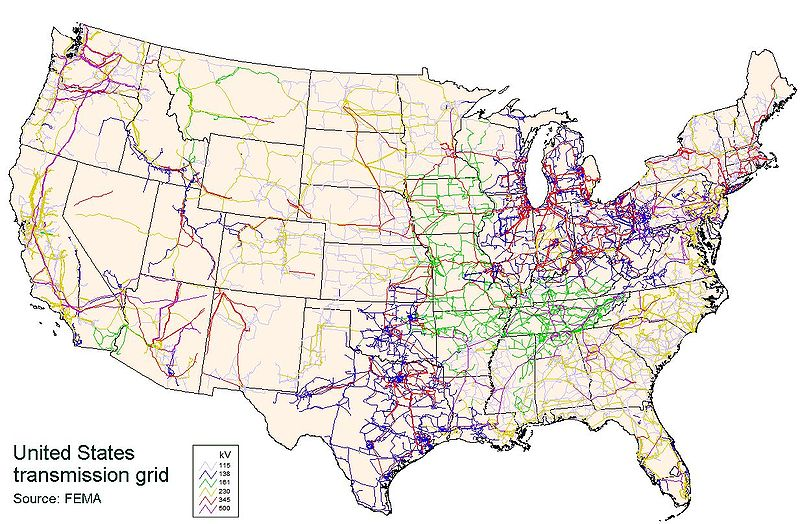
As we can see the national grid is extensive. It is also under severe strain at peak demand. Wind power will only increase the strain since most wind power is generated where few people live and work. A way to lessen the dependency on the national grid is to sprinkle it with many small to medium sized Thorium Nuclear Power generators. They can be placed on barges in rivers and along the coast where the need is greatest, giving the grid maximum flexibility to respond in  case of an emergency. LFTR’s do not depend on water for their cooling, so they can be placed anywhere, even in extreme arid areas. Since LFTR can be placed very close to urban centers, transmission losses are kept low. (The Texas grid is separately controlled from the rest of the grid.)

With the present push to convert energy sources to green energy, Thorium Nuclear energy is greener than both solar and wind energy if one includes the necessary mining to extract the materials needed for both solar and wind power. In addition thw wind blows where few people live or want to live, and the electric need is largest in the winter in the north when the sun is largely absent and the snow covers the solar panels, and the need in the south is largest in the summer when the wind blows less except for storms and hurricanes. This requires long transmission lines, and the grid is divided up in sections. The only way to solve this is to expand the grid through a HVDC (High Voltage Direct Current Network. This will be done through 1 MV cables, preferably using existing railroad rightaways when possible. One proposal is shown below. This would connect the Eastern, Western and the Texas network and significantly lessen transmission losses. (Transmission losses in the U.S. electrical grid is more than 50 Billion dollars yearly)

Transmission losses in a HVDC network are far less. Better yet is to place the energy source near the energy consumer. LFTR Thorium power would solve this problem. As we switch from gasoline powered to electric cars, the need to expand the grid will be more and more urgent, and the resistance to build more transmission lines is already great and growing, especially in already overloaded urban areas.

Why Thorium? 18. Liquid Fluoride Thorium Reactors will work both as Base Load and Load Following power plants.

Liquid Fluoride Thorium Reactors will work both as Base Load and Load Following power plants. LFTR’s operate at a much higher temperature than conventional power plants and operate at up to 45% electricity conversion efficiency, as opposed to 38% or lower for steam generators. In addition, because of the higher operating temperature it is ideal for hydrogen generation. The reactor would use the electricity generation to satisfy the current demand and produce hydrogen during times of low demand. This hydrogen would be temporarily stored and used for electricity production at peak demand. And  hydrogen fuel cells produce only water whenoxidized, no CO2  or polluting fumes are generated. With the objective of reducing the cost of hydrogen production,  solid oxide electrolyser cells (SOECs) are especially well suited.  SOECs operate at high temperatures, typically around 800 °C. At these high temperatures a significant amount of the energy required can be provided as thermal energy (heat), and as such is termed High temperature electrolysis.

Many years ago, I worked in a bakery as a helper, and we had a stone oven, heated at night when the electricity rates were a fraction of day rates, and in the morning when the oven was hottest we baked danishes, followed by buns, ended up with bread and cookies as the day wore on. Stone ovens make really good bread. Stone storage can store a lot of heat. They are used as heat storage in solar concentrators, up to 100 GWh. there may be a great future for heat storage with Thorium Nuclear plants. When demand is low it is kept at full temperature, up to 550 C and the gas, normally run through a generator is heating the storage tank or building, ready to be providing heat for the generators at high demand. This would help to limit the need for large batteries to stabilize electric output and provide fast response to varying load demands.

Why Thorium? 17. No need for evacuation zones, Liquid Fuel Thorium Reactors can be placed near urban areas.

No need for evacuation zones, can be placed near urban areas. Molten Salt Thorium reactors operate at atmospheric pressure and have a very high negative temperature coefficient, so there is no risk for a boil-over. They are easily made earthquake-safe and no pressure vessel is needed. This will greatly simplify the approval process, no need for elaborate evacuation plans have to be developed. Since the Three Mile Island accident there was a thirty year gap in approvals for new nuclear plants. The “not in my backyard ” mentality reigned supreme, and delay and denial was the rule of the years. But the lawyers still got their share, leading to escalating cost for new nuclear power. In the early days of nuclear power France took the approach of building some of their nuclear plants near the Belgian and German border, so they only had to develop half of an  evacuation plan, leaving the other half to their ‘understanding’ neighbors. It also lead to placing the nuclear plants where there was least popular resistance, not where they were needed the most, adding to the strain and efficiency losses on the electric grid. Liquid Fluoride Thorium Reactors have one additional advantage. They do not need access to water, so they can be placed even in desert areas. When a coal fired, or even a natural gas fired plant is decommissioned, it can be replaced in the same place, the electric connections are already there, so there is no need to go through lengthy and costly eminent domain processes ‘to acquire more land, or even expand the electric grid for that location. Thorium power is clean power.

Why Thorium? 16. Liquid Fluoride Thorium Nuclear reactors scale beautifully from small portable generators to full size power plants.

Thorium Nuclear Power generators  scale  beautifully from small portable generators to full size power plants. One of the first applications was as an airborne nuclear reactor.

Granted this was not a Thorium breeder reactor, but it proves nuclear reactors can be made lightweight. Thorium reactors can be made even lighter as long as they are not of the breeder type.

Lawrence Livermore, Los Alamos, and Argonne national laboratories are designing a self-contained nuclear reactor with tamper-resistant features. Called SSTAR (small, sealed, transportable, autonomous reactor), this next-generation reactor will produce 10 to 100 megawatts electric and can be safely transported on ship or by a heavy-haul transport truck.

This type of reactor can be transported to disaster areas, and provide emergency power, during rescue and rebuilding efforts. This particular reactor still uses solid fuel and steam heat exchanger. A LFTR reactor with a supercritical CO2 gas heat exchanger would be even more compact and efficient.

From these compact designs, Thorium power can be scaled up to any size. The LFTR reactor will be placed on barges and left moored in navigable rivers or in ocean harbors. This will typically be a one or two 250 MW LFTR with reprocessing capabilities. Where there is only road access the LFTR’s will be one or up to six 100 MW LFTR with one reprocessing fuel capability servicing the nuclear units one at a time on a rotary basis. These will come as complete units tested and ready for use on a number of trucks. It is to be noted that no water is necessary for cooling. There can also be 5 and 10 MW power units for freight trains and large towboats. They will not have reprocessing capabilities on board, but will be serviced regularily by refueling and reprocessing stations in key locations. Oceangoing ships will be fitted with LFTR reactors with reprocessing capability. When all of this is done the need for diesel fuel for nearly all shipping by train, barge or ship will be nearly eliminated.

Admittedly there are security risks associated with this arrangement. Locomotives and barges can be stolen, ships can be hijacked, when the whole reactor vessel came on a truck it can be stolen. By having minimum fuel at all time, it increases safety, but it also makes it possible for terrorists and common thieves to steal shipments of fuel and fissile by-products. This means that there must still be strict security measurements for maintaining chain of security for U-233 and Protactinium.

Why Thorium? 15. Virtually no spent fuel problem, very little on site storage or transport. U-232 is the preferred radioactive tracer.

 Virtually no spent fuel problem, very little on site storage or transport. I have been following the events at Fukushima Nuclear Power plants disaster with great interest. How ironic that one of the greatest problems was with the spent fuel, not with the inability to shut down the working units. The spent fuel issue is the real Achilles’ heel of the Nuclear Power Industry. The cost of reprocessing and storing spent reactor fuel will burden us for centuries after the reactors themselves have been decommissioned when their useful life is ended. Molten Salt Thorium nuclear power works differently from  conventional Uranium fueled Reactors as  the fissile fuel gets generated in the breeding process itself and nearly all fuel gets consumed as it is generated. When the process shuts down, that is it. Only the radioactivity that is en route so to say will have to be accounted for, not everything generated thus far in the process. The difference is about ten thousand to one in the size of the problem. It is high time to rebuild and expand our Nuclear power generation by switching to Thorium..

The detractors of Thorium like to point out that the Thorium-U233 process generates some U 232 in the presence of free neutrons. U-232 decays with a 69-year half-life through 1.9-year half-life Th-228 to Tl-208, which emits a 2.6 MeV gamma ray upon decay. Gamma rays are easily shielded by clean water, so transportation and storage is not a problem. Rather than being a problem, this is a great asset. The 232U decay chain is the source of the high energy gamma rays that make 232U the preferred tracer isotope. Uranium-232 has a half-life of 69.8 years, and the decay chain terminates at 208Pb (National Nuclear Data Center).

Why Thorium? 14. Molten Salt Nuclear Reactors have a very high negative temperature coefficient leading to a safe and stable control.

Molten Salt Nuclear Reactors have a very high negative temperature coefficient leading to a safe and stable control. This is another beauty of the molten salt design. The temperature coefficient is highly negative, making possible a simple and safe design enabling simple and consistent feedback. What does that mean?  It means that when the temperature of the fissile core rises, the efficiency of the reaction goes down, leading to less heat generated. There is no risk for a thermal runaway. This advantage is also true for Molten Salt Enriched Uranium Reactors. In contrast,  graphite moderated generators can have a positive temperature coefficient which leads to complicated control, necessitating many safety circuits to ensure controlled startup, operation and shutdown. Their worst failure mode is they can go prompt critical, and no containment vessel can contain the explosion that would occur, so they were built without one. There have been several major accidents in graphite moderated reactors, with the Windscale fire and the Chernobyl disaster being the largest and best known..

Why Thorium? 12. Atmospheric pressure operating conditions, no risk for explosions. Much safer and simpler design.

Molten Salt nuclear Reactors operate under Atmospheric pressure  conditions, no risk for explosions. Materials subjected to high radiation tend to get brittle or soften up. Molten Salt Thorium nuclear reactors operate under atmospheric conditions so the choice of materials that can withstand both high temperatures and high radiation is much greater, leading to a superior and less expensive design.  There is no high pressure gas buildup and the separation stage can be greatly simplified, leading to a much safer design. (From Wikipedia:)

The LFTR needs a mechanism to remove the fission products from the fuel. Fission products left in the reactor absorb neutrons and thus reduce neutron economy. This is especially important in the thorium fuel cycle with few spare neutrons and a thermal neutron spectrum, where absorption is strong. The minimum requirement is to recover the valuable fissile material from used fuel.

Removal of fission products is similar to reprocessing of solid fuel elements; by chemical or physical means, the valuable fissile fuel is separated from the waste fission products. Ideally the fertile fuel (thorium or U-238) and other fuel components (e.g. carrier salt or fuel cladding in solid fuels) can also be reused for new fuel. However, for economic reasons they may also end up in the waste.

On site processing is planned to work continuously, cleaning a small fraction of the salt as often as practical and sending it back to the reactor. There is no need to make the fuel salt very clean; the purpose is to keep the concentration of fission products and other impurities (e.g. oxygen) low enough. The concentrations of some of the rare earth elements must be especially kept low, as they have a large absorption cross section. Some other elements with a small cross section like Cs or Zr may accumulate over years of operation before they are removed.

As the fuel of a LFTR is a molten salt mixture, it is attractive to use pyroprocessing, high temperature methods working directly with the hot molten salt. Pyroprocessing does not use radiation sensitive solvents and is not easily disturbed by decay heat. It can be used on highly radioactive fuel directly from the reactor. Having the chemical separation on site, close to the reactor avoids transport delays and risks and keeps the total inventory of the fuel cycle low. Ideally everything except new fuel (thorium) and waste (fission products) stays inside the plant.

One potential advantage of a liquid fuel is that it not only facilitates separating fission-products from the fuel, but also isolating individual fission products from one another, which is lucrative for isotopes that are scarce and in high-demand for various industrial (radiation sources for testing welds via radiography), agricultural (sterilizing produce via irradiation), and medical uses (Molybdenum-99 which decays into Technetium-99m, a valuable radiolabel dye for marking cancerous cells in medical scans).

Mo-99 is used in hospitals to produce the technetium-99m employed in around 80% of nuclear imaging procedures. Produced in research reactors, Mo-99 has a half-life of only 66 hours and cannot be stockpiled, and security of supply is a key concern. Most of the world’s supply currently comes from just four reactors in Belgium, the Netherlands, Russia and South Africa, and recent years have illustrated how unexpected shutdowns at any of those reactors can quickly lead to shortages. Furthermore, most Mo-99 is currently produced from HEU targets, which are seen as a potential nuclear proliferation risk.

With the Mo-99 having a half-life of 66 hours and being continuously separated out from the fertile core in a LFTR, this seems to be the ideal vehicle to cheaply produce ample supplies of this valuable medical resource.

While LFTR reactors can be built today safely and profitably, much work remains to be done to achieve the full eight to ten thousand times reduction in TRU waste and maximize the breeding rate of U-233 for optimal speed of expanding the Thorium program.