Why thorium? 32. Can deplete most of the existing radioactive waste and nuclear weapons stockpiles, and in so doing produce power and U-233 needed for fuel in true LFTR power plants.

The stockpiles from light water reactor keep growing. The temporary storages are all full and spent nuclear fuel is still coming in with no good place to put it. This is an estimate of future stockpiles:
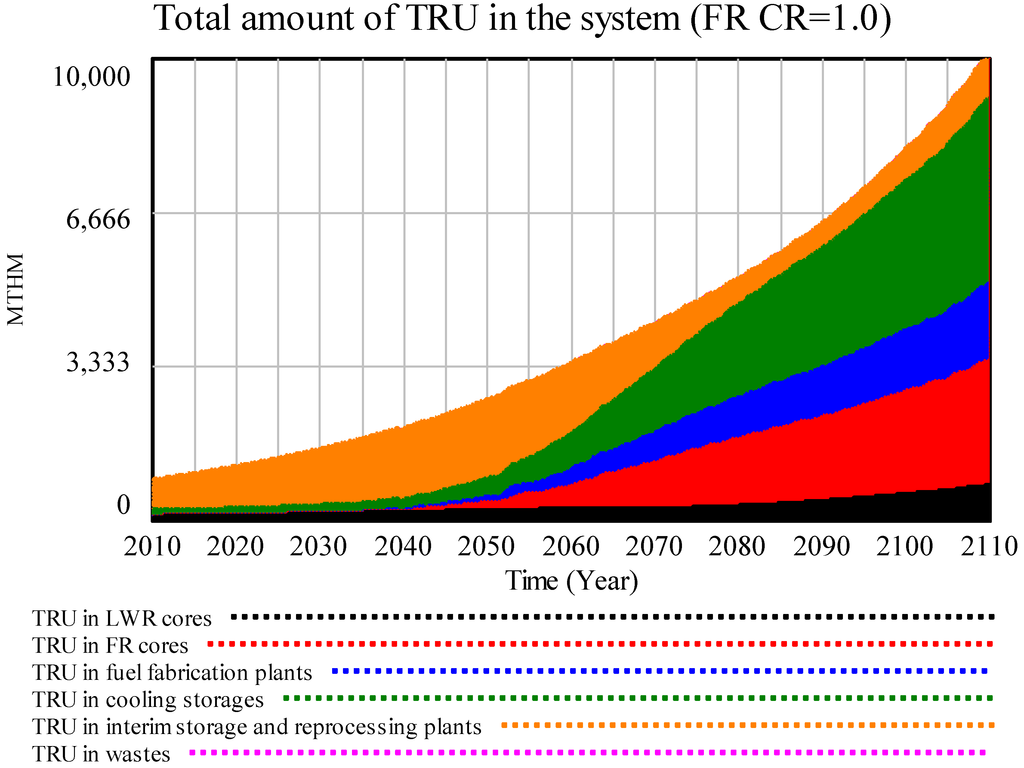
MTHM: Metric Tons Heavy Metals TRU: TRansUranium metals, a large amount of witch is Plutonium 239

The dry storage is usually very neat and catalogued. After all Plutonium 239 is what you make atomic bombs from, so proliferation security is of utmost importance.
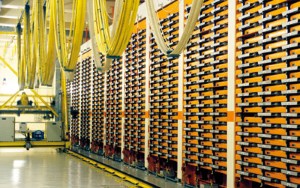
TRU can be reprocessed in a molten salt generator and generate far more energy than was obtained the first time around in the LWR

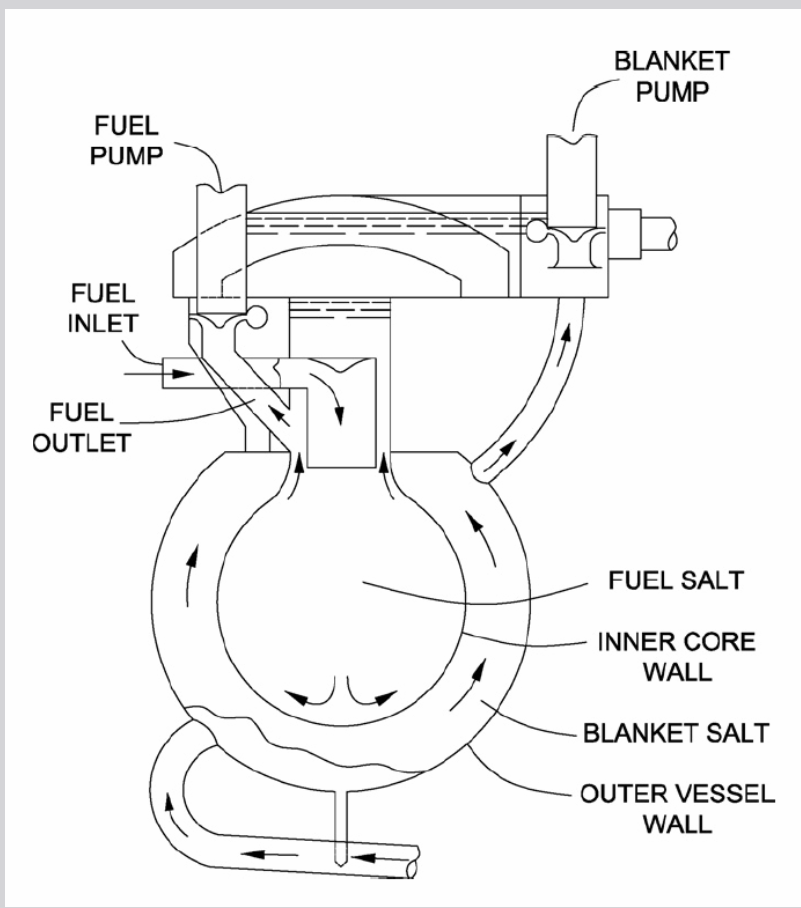
LFTR is a type of Molten Salt Reactor with equipment to convert plentiful thorium into uranium (U233) to use as fuel. It can also use plutonium from LWR (Light Water Reactor) waste. LFTR is not very efficient at using depleted uranium (need a Fast-Spectrum reactor to fission U-238 effectively; in a thermal-spectrum reactor like LFTR or LWR, would convert some U-238 to plutonium which is fissile). The best solution is a two-fuel molten salt reactor
Because a LFTR fissions 99%+ of the fuel (whether thorium, or plutonium from nuclear waste), it consumes all the uranium and transuraniums leaving little long-term radioactive waste. 83% of the waste products are safely stabilized within 10 years. The remaining 17% need to be stored less than 350 years to become completely benign.

The fuel source would be Trans-Uraniums, mostly Plutonium 239 and some Uranium 233. The blanket would contain Thorium, which when converted to Protactinium would be extracted out and in 28 days half of it would be converted to Uranium 233. The temperature in the fissile core will be around 650C and in the blanker somewhat less, its only purpose is to produce U 233 to be used in other nuclear plants.

“LFTR technology can then be used to reprocess and consume the remaining fissile material in spent nuclear fuel stockpiles around the world and to extract and resell many of the other valuable fission byproducts that are currently deemed hazardous waste in their current spent fuel rod form. The U.S. nuclear industry has already allocated $25 billion for storage or reprocessing of spent nuclear fuel and the world currently has over 340,000 tons of spent LWR fuel with enough usable fissile material to start one 100 MWe LFTR per day for 93 years. (A 100 MW LFTR requires 100 kg of fissile material (U-233, U-235, or Pu-239) to start the chain reaction). LFTR can also be used to consume existing U-233 stockpiles at ORNL ($500 million allocated for stockpile destruction) and plutonium from weapons stockpiles.”

FS-MSRs essentially avoid the entire fuel qualification issue in that they are tolerant of any fissile material composition, with their inherent strong negative thermal reactivity feedback providing the control necessary to accommodate a shifting fuel feed stream. Fast Spectrum Molten Salt Reactor Options,

See also: Why Thorium? 20: Russia develops a fission-fusion hybrid reactor.

Some of the pictures are from a slide presentation given by David Archibald in Melbourne Feb 5 2011. He posted it “for the benefit of all” which I have interpreted as waving the copyright of the pictures

http://wattsupwiththat.com/2011/02/12/david-archibald-on-climate-and-energy-security/
Why Thorium? 27. With a Molten Salt Reactor, accidents like Chernobyl are impossible.

With a Molten Salt Reactor, accidents like Chernobyl are impossible. The Three Mile Island accident was bad. The Chernobyl disaster was ten million times worse. Ah yes, I remember it  well.

One morning at work, a fellow co-worker, a Ph.D. Chemist working on an Electron Capture Detector, containing a small amount of Nickel 63, came with a surprising question: You know nuclear science, how come the reactors in Chernobyl don’t have a containment vessel? Well- I answered, it is because they are carbon moderated and their failure mode is that they go prompt critical, and  no containment vessel in the world can hold it in, so they skip it. He turned away in disgust. A few weeks later my wife’s father died, and we went to Denmark to attend the funeral. The day of the return back to the U.S. we heard that there had been a nuclear incident in Sweden, too much radiation had caused two nuclear power stations to close down. The Chernobyl disaster had happened 26 April 1986, and this was the first time anyone outside of Chernobyl has heard about it, two days later. This was still the Soviet Union, and nothing ever did go wrong in it worthy of reporting.

Image result for the chernobyl disaster

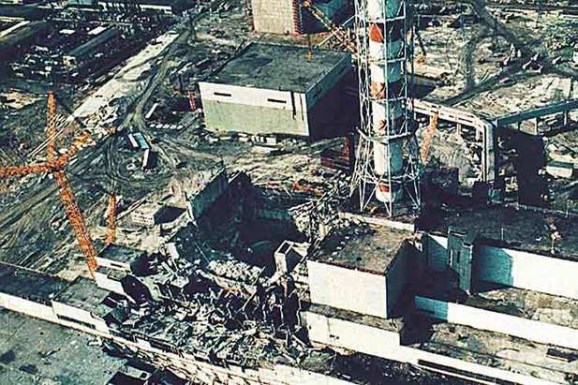
(Photo Courtesy of EBRD)

Notice the gaping hole where the reactor was. The adjacent reactor was not shut down immediately, but continued to operate and deliver power for days. During the invasion of Ukraine in 2022, the still-very-real health risks inherent to lingering around certain parts of the Chernobyl Exclusion Zone just didn’t sink in with Russian soldiers and their commanding officers based in Belarus. Radiation sunk in, though—particularly after Russian troops dug into the zone’s heavily irradiated Red Forest. And today, some soldiers are still falling sick, according to diplomatic sources cited by the UK journal The Independent.

The radiation cloud immediately following the accident continued to spread, and was first noticed in Sweden, and the SLV immediately declared reindeer meat, wild game and inland fish with a 300-bequerel/kilogram (Bq/kg) count or higher to be unsafe for human consumption and therefore unmarketable. 75% of all reindeer meat was deemed unfit for human consumption, and this played havoc with the Sami population.

(But the carbon moderated Uranium reactors are the most efficient in producing Pu-239 the preferred nuclear bomb material.)

As I mentioned before, the failure mode of carbon moderated nuclear power plants is that they can go prompt critical during power downs, so very stringent power down protocols must be followed. There is a loss of power production during the lengthy power down process. Carbon moderated nuclear power plants has a positive temperature coefficient; the warmer it gets the more power it produces, so they must be provided with multiple safety circuits and infallible scram shutdowns. However, power shutdowns are costly, so they try to stretch the shutdown intervals as much as possible. In the case of Chernobyl, the protocols were violated for political reasons, one or more safety circuits were disabled to allow power production for as long as possible and suddenly there was a power surge, the temperature surged and the chain reaction started. The scram rods failed and the rest is history.

This has nothing to do with anything, but Chernobyl means wormwood in Russian. It is mentioned in the Bible, Revelation 8: 10-11 “ And the third angel sounded, and there fell a great star from heaven, burning as it were a lamp, and it fell upon the third part of the rivers, and upon the fountains of waters; And the name of the star is called Wormwood: and the third part of the waters became wormwood; and many men died of the waters, because they were made bitter.

Molten Salt Thorium reactors cannot be used to supply Plutonium 239, only Uranium 233, and so far there is no research on how to make bombs from U 233, and they are far safer than even Light water Uranium reactors. Only gravity is needed to shut them down in case of earthquakes, total power failures, EMP pulses and bombs.

The case for Thorium. 7. Thorium based nuclear power is not suited for making nuclear bombs.

 Thorium based Nuclear Power does not produce much Plutonium-239, which is the preferred material used in nuclear bombs. The higher Plutonium isotopes and other TRansUraniums are about as nasty as they get, need expensive protection against terror attacks, and need to be stored for a very long time.

One anecdote from my youth. The time had come to apply to University, and to my delight I was accepted to Chalmers’ University in Sweden as a Technical Physics major. I felt, maybe I can do my part by becoming a Nuclear Engineer and help solve the energy needs of the future. The Swedes at that time championed the heavy water – natural Uranium program together with the Canadians. Sweden is a non-aligned country, so it was not privy to any atomic secrets, it had to go it alone. They settled on the heavy water moderated natural Uranium process because Sweden had an ambition to produce its own nuclear bomb. Officially this was never talked about, and I was not aware of it at that time. They could have gone with Thorium instead, but a Thorium based nuclear reactor  produces very little Plutonium, and what it produces is nearly all Pplutonium-238, not fissile and as such not suitable for bomb making.

I was excited to learn about all the possibilities and signed up for a couple of nuclear classes. One lab was to design a safety circuit, then run the heavy water research reactor critical and hopefully watch the reactor shut down from the safety circuit before the system safety circuit shutdown. About that time the word came that U.S. will sell partially enriched uranium at bargain basement prices if Sweden agreed to abandon the heavy water project and sign the nuclear non-proliferation treaty, a treaty being formulated by U.N.

Sweden was in awe about U.N, all the problems of the world were to be solved through it, and it had such a capable General Secretary in Dag Hammarskjöld, a Swede. I looked at the light water, partially enriched Uranium nuclear power plants being developed and decided to have no part with it, not due to safety concerns but it was the design that produced the most nuclear waste of any of the available designs. At that time there was still optimism that fusion would be ready by about the year 2010 or so. The cost of maintaining spent fuel in perpetuity was never considered, so light water reactors became the low cost solution.

India on the other hand refused to join the nuclear non-proliferation treaty, kept their heavy water program going and had by 1974 produced enough plutonium for one nuclear bomb, which they promptly detonated. They still use heavy water moderated reactors, but since India is low on Uranium but rich in Thorium they have now converted one heavy water reactor to Thorium with a Plutonium glow plug. It went on-line in 2011.

They are also developing molten salt Thorium reactors, but full production is still a few years off.

There we have it. We could have gone with Thorium from the beginning, but the cold war was on, and the civilian peaceful use of nuclear energy was still all paid for by nuclear weapons research and development. Once all the bombs we could ever wish for were developed the greatest asset of nuclear power became its greatest liability.