If you can, do.
If you can’t do, teach.
If you cant teach, administrate.
If you cant administrate, administrate.
This saying is old, and was circulated both when I was in private industry and when I worked at the University. During my 56 years in the U.S. I have watched the cost of medical care rise from 6% of GNP to over 20% of GNP. Part of it is of course that we are getting older, and people used to die at their first heart attack, and now they can survive multiple heart attacks, just to name one disease.
I got a hint at the real reason seeing this official chart:
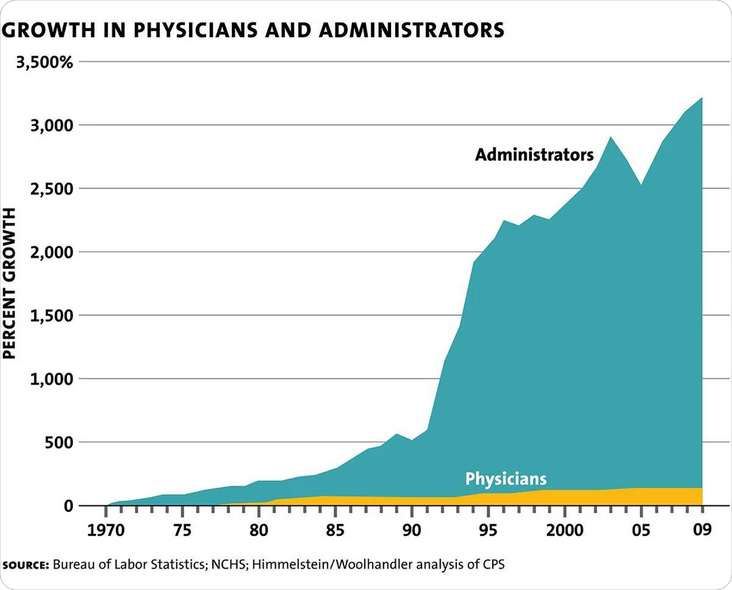
While the number of doctors have slightly more than doubled, the number of administrators have risen thirty-twofold. and that was in 2009. Things are even worse now, since another level of federal bureaucracy have come between the doctors and the patients. It used to be simple, you paid the doctor, and that was it. The problem with this was that many could not afford a doctor, so during the second world war companies offered free health care since there was wage controls and competition for available workers was strong. This got institutionalized, and unions negotiated the best contracts, so pressure for national health care, which was the norm in many parts of the world never materialized.
Obamacare was finally enacted in 2010 and we now have the worst of all possible health care systems. The pharmaceutical establishment operate under their mission statement: “To cure a patient is not a sustainable business model” and so all pharmaceutical research is directed to control diseases, not to find permanent cures. Granted, there are many doctors that want to cure their patients, but they are swamped by incentives to control the diseases instead; the U.S. and New Zealand are the only two countries in the world that allow medical advertisements. The doctors operate in a difficult regulatory environment, there are local and state regulations, overlayed by federal regulations, often in conflict with each other. The hospitals are burdened with a lot of patients that are not willing or able to pay leading to people that are able to pay with horrendous bills, that they have to pay for the rest of their lives. I could go on, but you get the picture.
There has been much ballyhoo about to control the cost of medicine, like limit the cost of insulin to no more than 35 dollars per month. this all makes sense, since a person with type 1 diabetes is totally dependent on insulin for survival.
Yesterday I received a reimbursement for overpaying a drug. They really try to control drug costs!

This is how bureaucracy works. Thanks for the 15 cents back.The stamp alone was 59.3 cents. And the letter included the obligatory “Discriminating is against the law” page. Just to be sure, it was the bureaucracy itself that made the request, not me.
Thanks, bureaucracy!
 Len Bilén's blog, a blog about faith, politics and the environment.