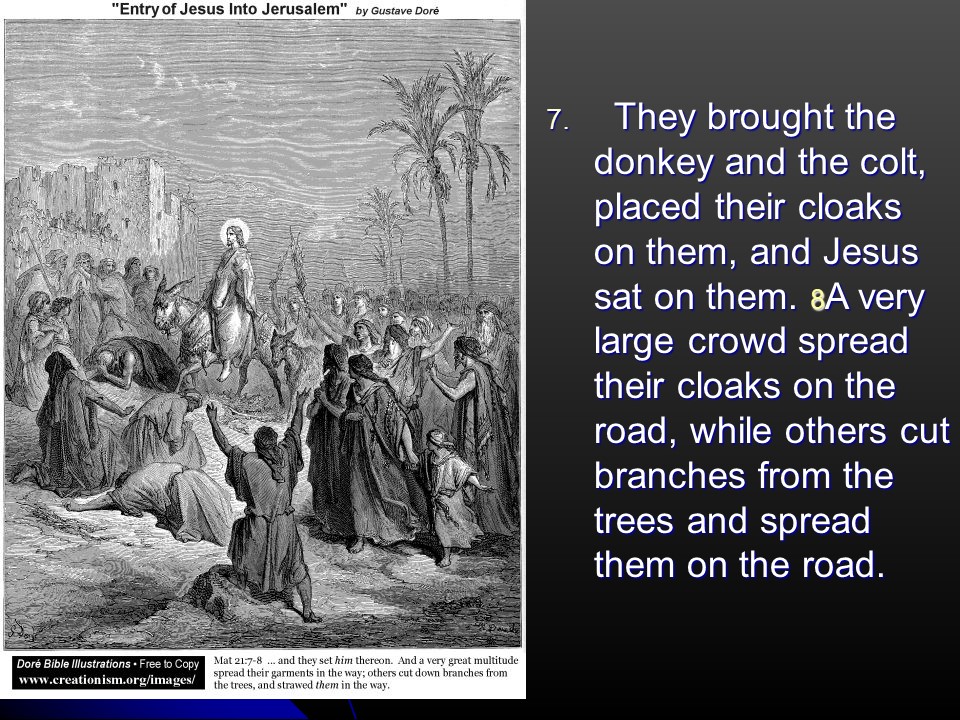
Matthew 21:1-11, the triumphant entry.
Matthew 21
John 21 tells of the eighth miracle of Jesus. This miracle of a great catch of fish happened after Jesus resurrection and was a sign of new beginnings. Jesus reinstated Peter and told him: “Feed my sheep.”
Exodus 12 tells of how God instituted the Passover. The name comes from the action that night, when the angel of death came to kill every firstborn in Egypt, if he saw the blood of the pascal lamb om the doorposts and the lentil of the house, he would pass over that house. The chapter is fantastic, read it and marvel!
In Exodus 13 the feast of unleavened bread is defined and the consecrating of the firstborn to the LORD. The Hebrews have escaped from Egypt, and a proposed route is suggested.
John 20 deals with the resurrection, and Jesus was not there, only his grave clothes, strips of cloth, not the “Turin Shroud.” It was the first day of the week and Jesus showed himself to all the disciples except Thomas. He doubted their testimony, and it is from this we have the expression “Doubting Thomas.” Later, when even he saw Jesus, he bowed down and worshiped him saying “My Lord, and my God”. Jesus also gave the promise they would receive the Holy Spirit.
Exodus 10: Two more plagues, the plague of locusts and the plague of darkness. For these two plagues the LORD hardened Pharaoh’s heart.
In Exodus 11 Moses and Aaron proclaimed the tenth and final plague: The death of the firstborn. Interestingly enough the plagues of Egypt are also in the Quran, four are the same, five are different, and one is missing altogether. Guess which one!
Psalm 11 has the phrase “flee as a bird to the mountain”, which bring back memories of songs we used to sing in choir.
John 19:16b-42. I took the liberty to incorporate all the “seven words of Christ on the cross.” This requires to take passages from the Gospel of Luke, as well as from the Gospel pf Matthew or Mark. It helped me a lot to get the time-order of events as well as the completeness of Christ substitutionary sacrifice on the Cross. It is finished!
In Exodus 9 there are three more plagues, the plague of livestock, the plague of boils and the plague of hail. In the fifth and seventh plague Pharaoh’s heart remained hard, but for thesixth plague the LORD hardened Pharaoh’s heart.
John 19:1-16. The trial of Jesus continued under Pilate. He tried his best to get out of it by placing a crown of thorn on Jesus, let the soldiers mock him and hit him, hoping that would placate the Jews. But they cried Crucify! He tried and tried, but they cried “E\We have no King but Caesar” so Pilate finally gave in and handed Jesus over to be crucified.
In Exodus 7 God promised Moses to give him the words to all he must say, and Aaron was to tell it to Pharaoh. God also said he would harden Pharaoh’s heart and not let the people go. Aaron threw down his rod and it became a snake. The Egyptians duplicated it. The first plague out of ten occurred, turning the water of the Nile to blood.
Exodus 8 is very interesting. It tells of three more plagues of Egypt, the plague of frogs, the plague of gnats and the plague of flies. The Egyptian magicians had no trouble duplicating elements of the plague of frogs, but when it came to the plague of gnats they threw up their hands and said “This is the finger of God”. From then on they could not duplicate any of the plagues.
John 18:28-40 deals with the last 24 hours of Jesus life, from the trial before Annas and the Sanhedron Jesus was paraded before Pilate, seeing a way out, Pilate sent him to Herod, who sent him back to Pilate, Pilate offered to release Jesus or Barabbas and the people demanded that Barabbas be released.
In Exodus 4 God gave Moses his call. At first Moses came up with one objection after another, but God persuaded him with signs that he must go back to Egypt, face Pharaoh and lead his people.
In Exodus 5 Moses and Aaron went to Pharaoh and asked for a 3 day reprieve for his people so they can go and worship God. Like all dictators Pharaoh reacted to this petition by making life even more miserable for the Hebrews; he wanted them to gather their own straw and still make as many bricks as before. The Hebrews blamed Moses for stirring up trouble for them.
And in Exodus 6 the LORD (Jehovah) promised deliverance from Pharaoh and He would give them the land He had promised Abraham. The narrative continues with an interlude where the names of the heads of the clans of Israel are listed. Moses protested and did not want to talk to Pharaoh any more, so Aaron would have to do the speaking.